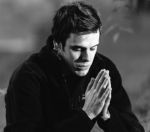
Follow the Way of Love

Bhakti  – intense devotion – leads to prayerful surrender which clears the mind of thoughts and concerns. Then, meditation is made possible.

            Swami Tadatmananda

A recent favourite quote from my teacher, that is helping me a lot on my own spiritual journey. Wikipedia also describes Bhakti in terms of intense devotion, adding words such as faith, love, homage, worship.

The wonderful Wikipedia also tells us that Bhakti is a term common in Indian religions, which may refer to loving devotion towards a personal god, a formless god or an enlightened being such as Buddha. They add:

Bhakti is often a deeply emotional devotion based on relationship between the devotee and the object of devotion.

Then what of one (AKA me) who at least aspires to see all things – all living and non-living things, all of ‘creation’ – as the Divine? How does a ‘loving devotion’ towards God work when one is striving to fully realise that there is only the Divine?

In my heart I know that all there is is the Divine, or God. Or put another way: it’s not so much that the Divine is in everything, or that everything is divine; the sense I have and aspire to realize completely, is that everything is the Divine. One without a second, the teachers say.

(Just a quick disclaimer: my heart may be telling me that there is only the Divine, but the rest of me still has a lot of catching up to do)

So, how does it work? Well writing it down in words seems to make it sound very simple: if everything is the Divine, is God, then it’s simple logic to assume that devotion to the Divine means having loving devotion towards all and everything; for all of existence, for everything that is. For all of creation as some say.
Simple to say, yes. Not so easy to easy to actually attain such a state. Of course the first thing to say is that it isn’t a state to attain. I am a part (not quite the right word) of that creation, that divinity, and as there is only one without a second, then logic again tells us that I am that creation – just like you and everyone and everything else that exists.

As such, it would seem to be an easy matter of me simply loving myself which automatically includes everyone and everything else in the Universe in that love (note to self: make this little paragraph my new mantra).

Here is where that ‘thoughts and concerns’ thing comes in. We all know how our minds like to interfere and get involved with every little thing. The mind tries to convince us of our separation from other people and the rest of life too, while its ally the ego runs wild convincing us of the urgency of status, of possessing things, of competing (also status isn’t it?), acquiring more stuff and worldly knowledge and power.
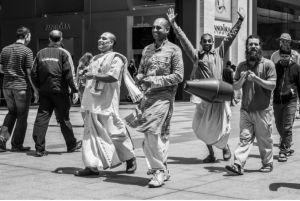
The solution? The means to realize one’s love for all? Prayerful surrender – which our quote tells us is acquired through the practice of Bhakti or loving devotion.

But hold on: Isn’t the realisation of our love the very thing we want to achieve? So, we are to use a practice involving love to realize our love?
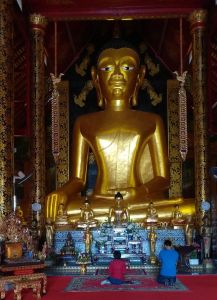
Ah yes: the means is the end. Now that’s a nice little insight don’t you think? But, still, Bhakti or loving devotion isn’t at all easy, even if you’re talking about a personal God or deity or the Divine; how much harder it is (speaking only for me here mind you) to suddenly love everyone and everything, to suddenly recognise everyone and everything as the Divine. Including, mind you, things and people I don’t like or have a distaste for or aversion towards.

So what I try to do is be open and receptive to things, ideas, concepts, other living beings, that resonate within me as representing the Divine. Then I make those things the objects of my devotion which means my prayers are prayed with a mood of love. Good vibes you see. They spread out like (my partner hermit says) ripples in a pond or even waves in the ocean. No need to think of who or what I don’t like; they’ll be affected by those ripples too.
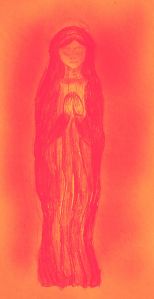
You’ve read my prayer to the Divine Mother – the embodiment of the Divine qualities of love, nurture, compassion. And soon I hope to post my Prayer of praise and gratitude to Trees. In that prayer I express my love, praise, respect for, and gratitude to, trees.

So many people – even the non-spiritual – view trees as symbols of creation in action, strength, resilience, even compassion and shelter. In other words, the Divine.

To surrender my heart to such representatives of the Divine is my continual effort and prayer. I pray to fully surrender to the natural order and smooth running of the universe, or the Divine.

And that surrender will come through my continuing and growing loving devotion.
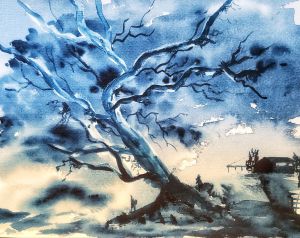
Now, the ‘meditation is made possible’ bit? Well we all know what meditation means don’t we? Pretty much as many meanings as there are people meditating (and many who are not!). In this context I think the meditation that’s made possible is more a kind of contemplation leading to a clear comprehension or understanding.

Contemplation of the entirety of the Universe (which includes you obviously) as one whole, undivided expression of love or the Divine.

Comprehension is understanding, in a final, complete truly ‘knowing’ way, that the things of the world – the status, the possessions, wealth, sensual pleasures – are not and never can be the means to attaining perfect peace and happiness.
Of course, the ‘things of the world’ continue to be important. After all, we are (at least our bodies and minds) things of the world too aren’t we?

But that contemplation of the totality as the Divine will help us to reduce our suffering by helping us to reduce our excessive desires or cravings for those worldly things.

I think I mentioned that Bhakti, loving devotion, can be difficult. It’s true it is often hard to focus on love and devotion, to always have your heart available and open. But, you know, it can actually be a very satisfying and enjoyable feeling, and I can say a really nice experience.

So, I hope some of the ripples (and some of the waves too), some of those good good vibes are making themselves known to you.

Thank you and my love to you
Just Another Day at The Office

Who am I to even contemplate composing a commentary on the Bhagavad Gita (BG) after only seven or eight years of study, some formal with a teacher and some more casual alone?

Well, what I am is nowhere near qualified, nowhere near ready. Actually I don’t feel qualified in any way for such a thing. So much less so was I when I first sat down with my newly gifted BG in a tiny cafe called The Office in Rishikesh, literally hanging over the river Ganges.

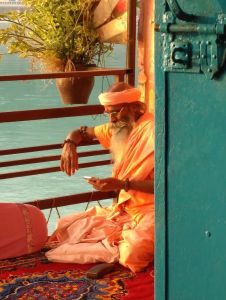
A Saddhu or Holy man and his phone at The Office

With the best fruit salad in the Universe, and fine chai to match, it was the ideal place for contemplation – that is when it wasn’t bursting at the seams and crazy.

But, as I sat there with my new BG I was one of only a couple of customers, so it was a conducive atmosphere for the aforementioned contemplation. Instead I think what happened as I thought about how to proceed to a proper study, was I allowed the sugar from the just ingested fruit salad go to my head.

You see, I decided, as I sipped a post-fruit salad chai, that the perfect study method would be to write a commentary on the whole thing starting with Chapter one, Verse one.

I no longer possess the diary in which this masterpiece was begun. Nor do I recall much, actually nothing, of what I wrote. It’s enough to say however that nothing I wrote could possibly have had any significance or depth or proper perspective.

So, as you might guess, I rambled and waffled for a couple of verses before I snapped out of my ego-driven state of arrogance and hubris. I realised I had absolutely no business taking on such a task. My lack of knowledge, wisdom, experience, all disqualified me from even thinking I had a right to try.

Now, even with the small amount of knowledge I have managed to acquire after all the study, I’m stunned at that arrogance and hubris – even if it was sugar induced. I mean, I’d never even read more than a few verses of the BG before. So, how could I even form a ‘first impression’ or ‘casual opinion’, much less a full blown commentary?

A couple of days ago I read a couple of verses that really resonated with me, as they have before. So, just like that fool sitting in The Office all those years ago, I confidently asserted that I was more than up to the job of making a commentary on those verses for this blog.

But, and here’s the really weird thing: I only just now realised, as I’ve been writing these notes, that the two verses which I will quote for you shortly, address precisely my behaviour on that post fruit salad, sugar shock induced ego trip.
I realised that it’s as if I have indeed written a commentary on those verses. And I have used a personal experience to illustrate the text. Absolutely unintentionally as it happens.

Regardless of what excuse I come up with the error in judgement in thinking I could write a full blown BG commentary all those years ago, the reality is that I failed to act with discrimination, or what I would call discernment.

In the high holy lands wrong thinking can still happen

Somehow I ignored (or totally forgot) the facts: I knew nothing! I’d lost the ability to discern what I could do and what I couldn’t do, what was a sensible action and what was a ridiculous one.

Stop! Memo to Self: Please stop picking on me!

Anyway, moving right along, here are the verses – free from commentary!

‘Thinking about sense objects brings an attachment towards them. Attachment leads to desire and desire leads to frustration, which in turn leads to delusion.
When you are deluded you lose your memory [the knowledge and experiences you could draw on to make proper decisions; sometime even to the extent of compromising your own values] and with the loss of memory the power of discrimination is destroyed; with the destruction of discrimination your self itself is lost’ .
Bhagavad Gita Chapter 2 Verses 62-63 (my version of the BG sometimes combines verses as it has here)

That Which is From the Sea, Shall Return to the Sea

As I sauntered along the shores of the Ganges River in Rishikesh several years ago, I was given a gift.

In the High Holy Lands Where Magic Sometimes Happens

As I ambled, headed upstream in a relaxed kind of mood on that sandy riverbank, I happened to glance down. There, right at my foot I noticed a small shell. Flat with the stereotypical fan shape so many shells have, and a about a centimetre  across. I picked it up.

At that moment I sensed that this little shell was a gift from the river to me. Still, I had to wonder how it got there, a seashell on the sandy banks of a freshwater river with it’s source not too far from where I stood, just a bit higher up in the Himalayas – the highest mountain range on the surface of the planet.

One possibility is that this shell originated in the sea that once existed in the lands above, where the Himalayas now stand. Mind you, I’ve only ever heard of the fossils of sea creatures being found in that region.

Another possibility suggested to me at the time, is that some other traveller having picked up the shell on a beach somewhere other on their travels, kept it with them till they arrived at this sacred place.

Then, perhaps as an offering that traveller – fellow pilgrim?- let that shell go into the waters of Maa Ganga.

Of course it doesen’t matter in the least which – if either – of these scenarios  reflect what actually happened. Somehow this little shell travelled from an ocean somewhere (and somewhen!) to this precise spot on the banks of the Ganga to be discovered, to be gifted to me.

I received that offering, now a gift from the river to me, with a deep and prayerful thank you, and a sense of the sacredness of that moment and of that place.

And, today, the journey made by that little shell, has come to a kind of full circle. This morning I released it to Varuna, to the sea here on the Pacific Coast at the beach over the dunes from the hermitage.

That initial giving and receiving  took place about eight years ago now and I have that little shell with me ever since.

First I wore it around my neck attached to a mala (prayer beads) made of Rudraksha seeds I used for chanting mantra.

After that, it migrated to another mala – this one made of beads of black volcanic rock, perhaps very fitting given the little shell’s possibly ancient origins.

Then, one day about a year or so ago, that little shell developed a crack and then shattered into several little pieces.

Still, I treasured those remains, those fragment I kept with my other ‘holy bits and pieces’. Then, after a while, I began to get the sense that I was going to have to return this little shell to the sea from where it had come.

I knew, though, that it would have to be the right place, a place I was drawn or led to. So, time passed, we travelled to several different hermitages for about a year.

Then, two days ago, we moved here. To a cozy hermitage on the side of a sand dune, just across a bridge from and on the outskirts of a little seaside town on the Pacific Coast of Australia.

It’s one of those spots where the elevation, distance, and whatever else by nature’s arrangement, all combine in just the right way to allow a vast view that takes the eyes to the curve of Earth herself; the horizon isn’t flat here, it’s a sweeping giant curve. Add to this the equally dramatic view offered by the dome of the sky.

The coast is beautiful here. Not that it’s not special in so many places, but there is something here that speaks to me.

At the top of the dune just beside the hermitage there is an extremely convenient bench seat overlooking the beauty of the ocean.

And it just felt right: here is the place that seeks the return of the remains of that little shell, by now reduced to a couple of small fragments.

So, after a time sitting and contemplating at the above-mentioned convenient seat, I walked down the dune to the beach, and then to the water’s edge. In a mood of prayer, with the edge of the incoming waves lapping at my feet.

After first consigning to the water a shell native to this shore, to show the way to my little shell, I thought of the journey that little shell and I had undertaken together. Then I thought of how far and for how long that little shell had travelled so far on its own journey.

Then I returned what was left of that little shell to the sea from which it had come. And I watched it carried by the waves returning from the sands of the land to waters of the endless ocean.

PS See the Lava Rock Mala? Well, it too has changed form in recent times. It is now no longer a full length neck mala; it has evolved to become a compact and convenient pocket Mala for what you might say is ‘everyday use.


Things of beauty are, like all things made of

material stuff, transient.

Beauty, however, is not

Hiccups on the Road to Enlightenment

These last couple of days I’ve been getting a good lesson in enlightenment. Wait, that’s a silly thing to say. What I mean is that these last couple of days I’ve been getting a good lesson in what it means to be not enlightened. That’s a bit better I think.

Not that I’m not receiving lessons all the time; the reality of not being enlightened, is that the entirety of one’s life is really one long ongoing lesson.

Anyway, moving right along.

Not our actual hermitage

We’re about to move to another hermitage, to one more safe-haven by the side of the road (in this case a very small, very quiet road). Obviously it’s a process we’ve been through quite a few times. This time, the concept excited us (well it usually does!) and the arrangements began on a smooth and happy note.

But, just as when any of us make a plan, take some action to fulfil that plan, and proceed from a good start, the path forward doesn’t always remain smooth and hiccup free.

And so it is this time with the hermits’ plan to relocate: one or two quite small hiccups have cropped up that we have had no control over.

‘Quite small’ are the key words here: it’s more my reaction to said hiccups that’s the point of this post.

You see, I’m not enlightened, nor am I the toughest kid on the block, and my skin’s not that thick. As well as that I’m no expert at letting things run off me like water off a duck’s back (guess who is a cliché lover?).

You talkin’ ’bout us?

The hiccups under discussion themselves are trivial and as I say out of our hands. As such, they are not especially interesting to talk about.

Getting back to the water off a duck’s back thing: it’s actually a pretty neat description of what occurs when one in enlightened. Just a thought for now.

Contrary to popular myth, being enlightened isn’t a flash or some sort of mystical thunderbolt from heaven or from some other transcendental wherever, a flash that leads to bliss ongoing, superhuman or magical powers; It doesn’t render the enlightened one an intellectual or any other kind of giant.

And right to the point, being enlightened will not protect the enlightened one from the normal, natural apparently real troubles, ups and downs, pain, illnesses, sorrow and grief, and all the rest of being a physical creature living in a physical world.

What enlightenment does mean – in my interpretation at any rate – is the enlightened one is able to let these perfectly normal problems, hurts, pain, illness, and so on, (Oh the joy of repeating a great cliché) to roll off them like water off a duck’s back.

Of course the enlightened ones still experience the pain, the sadness, grief, the disappointments and so on; it’s just that those ones have attained to the knowledge – been enlightened to -that none of those things can really hurt them.

Sure they are still there, the pains in the body, the sadness or whatever in the mind. But the real us – the true Self that is the consciousness that witnesses all that’s going on in our lives right now – is unaffected.

That true Self, that Consciousness, is constant, it is and has always been existent and unchanging. All those pains in our bodies, those emotions, distress and the rest in our minds, will pass; they aren’t permanent. However that Self, that ‘I’ won’t pass, and it is permanent.

Anyway, back to the current topic. What happened to me was this: the hiccups refered to were minor – less than trivial in the context of the ‘real world’ – yet the disappointment resulting from one, and the annoyance coming from the other, were profound.

An enlightened person might say ‘That was disappointing.’ Or, ‘That was annoying.’ But me? Well I sank into a pit of negative emotions and negative (to put it mildly) thinking. I may as well have declared: ‘I am disappointment embodied.  I am annoyance itself.’

Look dear reader, this was supposed to be a fairly light, quick telling of me reminding myself that the pains, sorrows and other stuff of the world can’t hurt me. That ‘me’ is the Self I talked about earlier, the ‘I’ who is, as I said, the witness to my experience here and now.

So, in conclusion as they say, all there’s left for me to say (in this post at any rate) is that I am most definitely not enlightened. Having said that, I wouldn’t say that I’m completely unenlightened. There was a time (a long stretch of time) when, far from letting things roll off me like water off a duck’s back, they very often overwhelmed and threatened to drown me.

Of course there is a lot more to be said on the subject of enlightenment. Suffice it to say that it is my dream and deep, deep aspiration to one day, one life (if there is indeed another one waiting for me) to get there, to realise enlightenment.

As The Seekers used to sing:

Some day, one day
time’s not so far away.

PS There is no need to worry. I feel a bit better now. I managed to gain a little perspective, a truer perspective. In fact gaining perspective is an important step on the path to enlightenment. The tricky thing about perspective though is hanging onto it once it’s been gained.

Bushland Contemplation

Salute to the Sun

Namaste

In today’s post I’d like to share with you a photo. Actually, I share photos with you in just about every post don’t I? In fact, for me sharing photos (the vast majority of the ones I post on this blog are made by me.) is a really special and important element of my spiritual practice.

As is the actual making of them. My camera is – I think has always been – a tool for contemplation. Essentially, I wander around with my camera ready, my eyes open to see and receive, and with my heart and mind open. These last two are in the ‘much as I can’ category, but really that’s what I try to achieve: a kind of open, receptive, presence.

Then, sometimes, my eyes, mind, and heart all sort of see the same thing at the same time, or something draws my attention, or an insight dawns. Then, I raise my camera to my eye and the picture is made.

Anyway, let’s back to the topic. This isn’t a post about Contemplative Photography. My intention today is to share this photo with you.

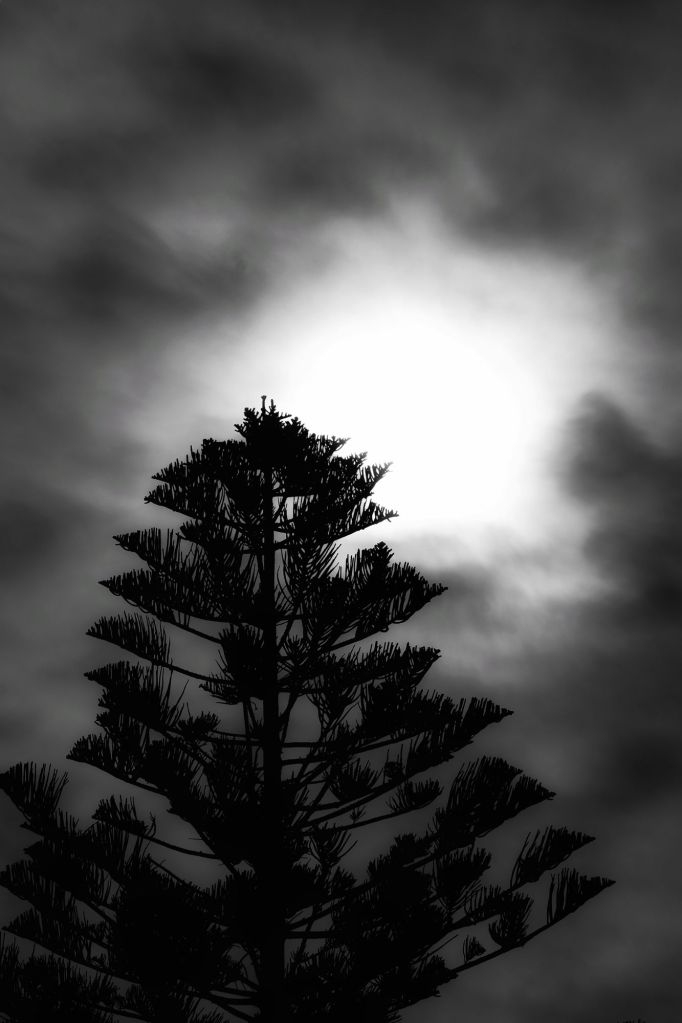
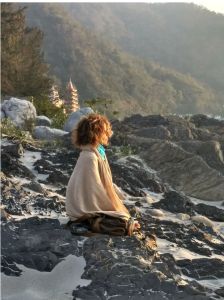
It’s called At a Time of Prayer, and from the moment my senses, mind and heart too, coalesced to cause me to raise my camera to my eye and make the photo, it’s had a unique or special resonance for me.

And not only me: The photo has gone viral here at the hermitage, appearing on phone screens and tablet desktops and lock screens. And it appears very often in my thoughts and prayers, my contemplations and even in conversations.
Perhaps you will allow me to share the little story behind this image as well as a possible explanation for its hermitage wide fame, favour, and love.

About a month ago I was walking along the lake front in the seaside town hosting the hermits at the moment, heading home after a long walk. I was listening to and chanting a favourite mantra (one about removing obstacles).

Absorbed in the music and the vibe of the mantra, I looked up – seemingly at random – and saw, well what you see in the photo. Without thought or hesitation and simply instinctively, I raised my camera to make the picture.

Ah yes, I see what you mean. You are quite right, I can’t exactly say I saw the scene in tones of grey, not technically. Though the camera did actually see and record it in monochrome. Let me explain.

You see, sometimes I switch my camera to only make black and white photographs, with the intention of shifting my way of looking and seeing the world around me. It’s always amazing to me how differently I start seeing things, once I get used to the change. I never get tired of it really. Like magic!

Anyway, once I lowered my camera, I said a prayer to Surya,  the divine in the form of the sun.

Everyday, each morning when I first get up, I go to a window in the hermitage that faces the rising sun. I give thanks and praise for the life given and sustained by the sun; I praise its beauty too and give thanks for its light and warmth. Today, although the cloud is mostly covering the sun, I know it is still there and still shining, giving us all life.

Okay, back to the moment of the making of the picture. It was after my small prayer – my Surya Namaskar –  my salute to the Sun – that the name of the photo came to me: At a Time of Prayer.

That made sense to me: I was already praying before I made the photo, then after it was made, I once more said a prayer. It truly was a time of prayer.

Now, the big question: Why has this particular photo had such an impact here in this haven of the hermits? Why, even now, do I find it a really appealing focus for contemplation?

Despite it being a dramatic photograph of start contrasts between light and dark, it seems to me to exude a kind of serenity. Perhaps it’s precisely the balance of those contrasts that makes for a peaceful easy feeling in what otherwise might not be seen as a quiet and calm image.

And it may be just that serenity arising due to that balance that contributes to the sense I get when looking at the photo: All is well.

All is Well. Why sense that in particular? Perhaps because I was there at the time. Perhaps because I was praying, looked up at just that moment and all my senses led me, along with my camera, to make the picture.

And in a sense, it’s a moment I can relive and remem ber through the photo, especially given the prayerful, contemplative mood in which it was made. At that moment of making it did indeed seem that All’s well.

And now? I know that All is well, all shall be well, and all manner of things shall be well (paraphrasing and with thanks to Julian of Norwich.)

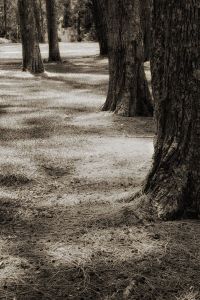
There is too, the power and light of the sun illumining life, which here is represented in the form of the towering Pine Tree.

Yes, I sense that balance again. A kind of harmony also. This time between life itself and that which enables and supports life. It is good to contemplate balance and harmony.

Anyway, a gift given to me, now shared with you.

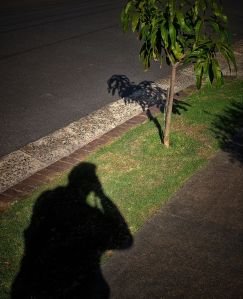
The Hermit Contemplates His Shadow

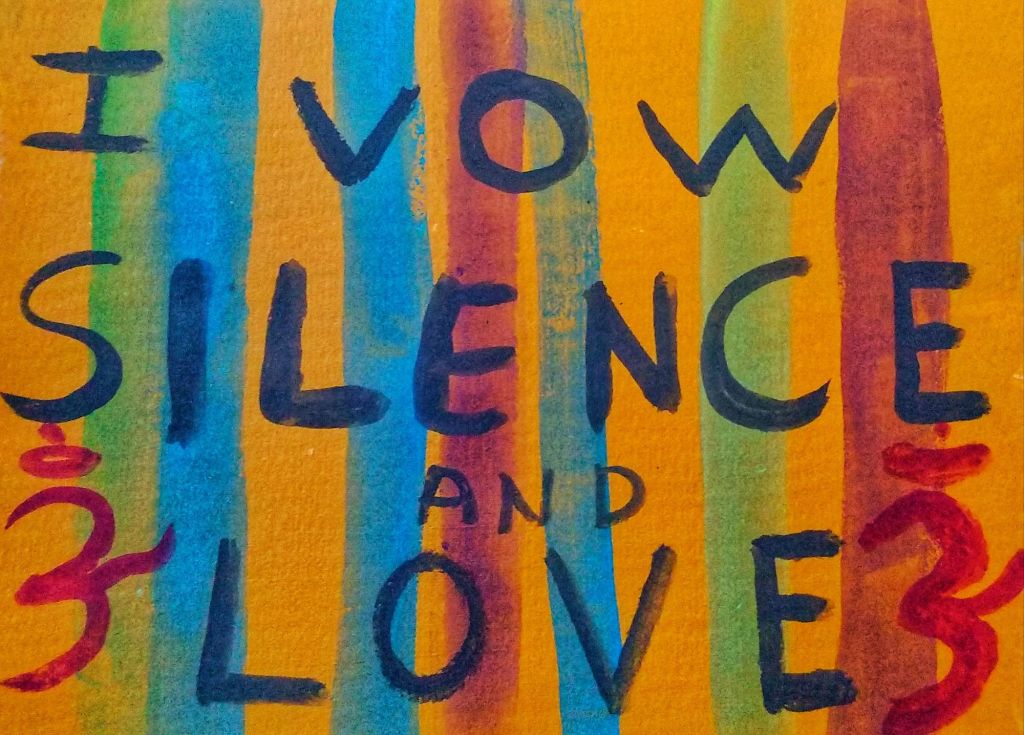
Silence Is!

Everyday I affirm, I pray with longing and with hope, these words:

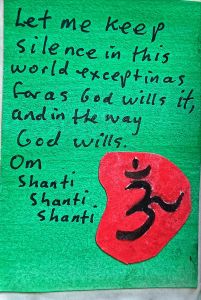
Let me keep silence in this world

Some days, like today for instance, the prayer feels empty, devoid of any hope, or faith on my part, that I will at some point really be able to attain at least a degree of silence.

Yes, I know, prayer is not some kind of magic formula by which one utters the words of the prayer as in some kind of incantation, then in due course that which has been prayed for appears or comes to pass as if by magic.

Prayer, rather, is affirmation in which the one praying places full attention on the words prayed and their meanings. And more importantly on the notion that the Universe is in perfect balance all of the time, and that things – all things  – are manifesting how and where and when and why, and in precisely the manner that they’re supposed to.

Prayer is more a kind of wake-up call, a reminder notification to Self that everything is exactly as it is, and is meant to be that way.

Fine theory. Yet it’s a theory I sometimes know to be much more than a theory.

Other times, this being one of those times, I have a hard time, or I should say my mind can’t accept that silence does indeed exist. My mind is simply not able to grasp that silence is already within me, ready and able to give me peace.

Closed Cafe at the End of Lonely Street: Silence comes in many and varied forms

It is obvious to all of us I think, that silence is not simply the mere absence of words, of speech. Not talking is simply one aspect of silence; it’s like silence is a thing, an entity or state of being that doesn’t only imply an absence but suggests an adding on of a new state of being.

When I pray Let me keep silence, it is true that I am seeking the silence of the mind, the inner silence that can bring calm and quiet to the heart and whole of Self too. But, to be truly upfront as they say, it is the silence or quiet that emerges from time spent not speaking that I long for.

Long for? I use that word quite often and it’s occured to me that, while to long for something is to have a desire for that thing, a longing is actually more than a simple desire. It’s a very strong desire, a kind of desperate wanting or wishing for that thing. You might even call it a compulsion.

Now I think about it, what is the desire or drive that keeps me doing exactly the opposite? Why do i feel the need to be talking (thinking too, but here I’m thinking about talking too much) all the time? It is clearly also a compulsion. That’s the only conclusion I can come to.

So then, why the compulsion to talk all the time?

Well, to once again be frank, upfront, I don’t really care about the reasons for or causes of, this compulsion. Probably stems from deep-seated anxiety, long-standing low self-esteem, old habits, fear. The list of explanations could go on and on, but what would be the point of that?

The real point, for me, is that compulsive talking is no mere bad or inconvenient habit. Personally it can actually cause physical symptoms of the ‘feeling sick’ variety, as well as guilt, shame, even sadness and regret.

And even far worse still is that this compulsion causes at the very least for those around me annoyance and frustration. Incessant talking distracts them from their own thoughts and activities, disturbs their own desire for silence. It’s all very obvious to me.

So, while I am compelled to talk all the time and too much, at the same time I have a strong aversion to that very act of talking too much (and all the time). The talking too much causes suffering to myself and others, while my inability to change also causes suffering. A kind of no-win situation arises, has risen, is always present.

Okay then, what is the solution? Or, more to the point,is there a solution? Well, I didn’t start making these notes with the hope that I would somehow come up with a solution to this dilemma . But, having said that, I’ve been thinking while writing that I do seem hugely attached to the idea that I talk too much, and too often. 

As well, I also seem desperately  attached to the desire to stop talking so much and so often.

While doing all this (possibly excessive) thinking, I was reminded that the Buddha didn’t say that the cause of suffering is desire; what he said was (allow me to paraphrase): the cause of suffering is attachment to  desires.)

You know, another thing I write and think of a lot, is the idea that things work out exactly as they’re meant to. Of course not so easy to actually believe all the time, especially when things aren’t going according our personal wants, desires, and wishes. But it’s another of the prayers if you like, the affirmations which speak of the truth of the balance of the workings of the Universe.

In a way then, despite the lack of intention, I may have nevertheless stumbled upon at the very least a hint of a solution to my dilemma.

We ourselves are merely one more manifestation or result of those workings of the Universe, of that natural order, of those laws of nature that keep it all (including us) in motion.

So, I’m back where I started when I described what I believe prayer to be: an affirmation and a statement of faith in the reality that the Universe is unfolding exactly as it should.

Perhaps if I spent more time (not to forget more heart, more mind, more love) in reminding myself of that reality, and less in toying with my compulsions and aversions and with all my efforts to shift and maneuver the natural order of things to my liking, then I might find that equilibrium , that – what’s the word? – equipoise – in which I may actually realise the balance that I know already and always exists. Maybe then I can finally attain silence.

Deep with the still centre of my being,
may I find peace.

Silently within the silence of the grove,
may I share peace.

Gently & powerfully within the greater circle of humankind,
may I radiate peace.

Just a quick final note: my idea that the universe is working out exactly as it’s supposed to is not mine and it’s not new. I’ve quoted the beautiful poem/prayer Desiderata (the word is from Latin for things desired) before, but there’s a line from it that I’ve borrowed heaps of times:

No doubt the Universe is unfolding as it should


Thank you for allowing me the privilege of sharing all of this, which is really one long prayer, with you.

Me & My Senses

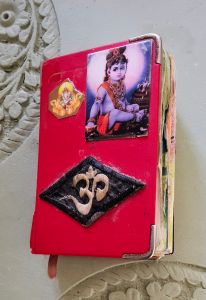
Today, once again, I would like to share with you some thoughts and insights on a quote I have written in the front of my Bhagavad Gita. Yes, I know, I do this quite frequently, but there really is a good reason.

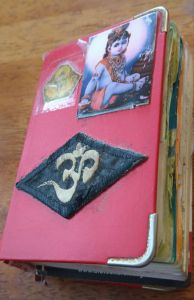
You see, for me, this particular Bhagavad Gita, this little book (and it is a little book: 10 x 7cm but still a little fat too!) is so much more than a collection of bits of paper with words printed on them inside a nice cover.

Well, it is a book, so of course it is that as well. But for me it is more a repository of wisdom. It is actually the first scripture or holy book of any kind that I have spent years studying. And over those years I have devoted who knows how much time, energy, heart and mind to it. As for how many times I’ve read it cover to cover, well I don’t keep count!

This Bhagavad Gita is truly a treasure trove that enriches me and my life every time I open it.

Anyway, enough of the praise and gratitude intro. Allow me to share the verse (in fact it’s a part of a verse) with you:

… restrain your senses and focus your entire mind on me.
               Bhagavad Gita 2:61

Let me try to explain why this verse – and this particular portion of the verse – is like a kind of motto or mission statement for my life. Well, to be honest, It’s one among a whole collection, but this one for me seems to especially significant.

It is through and only through, the senses that we are able to experience the world. In addition to the traditional five senses (sight, smell, hearing, taste, and touch) here we include the mind. This sixth sense includes all the activities of the mind.

When you think about it, the mind is really our major sense organ, in that it is in the mind that imput from our other senses comes together in such a way that allows us to perceive and experience the world around us as a coherent whole.

Then of course, the mind being a sense organ in its own right, does its share of providing us with imput in the form of thoughts and emotions. The problem arises when we let the mind have its way and we hand over control of our senses to our mind (and also we let our other senses free rein to control the mind) completely or at least in ways that  might not be in our best interests.

So, if we are to restrain our senses – all of them – what are we to do? Well, rather than getting into a long rave with a big list of what we should do, why don’t I simply talk about some of the ways in which I try to put into practice, the injunction to restrain the senses.

The Eyes of the Teacher

First, a disclaimer : I’m still in a human body. Meaning that I’ve been struggling with my senses for a long long time. And it means the struggle continues, just as it does with all of us. It’s the effort, though, that is the real key: to restrain the senses we might easily add retrain the senses including the mind.

For so much of my life I was careless about what I put into my body by way of my sense of taste. Food, I was not very controlled when it came to what, when and how I ate. I’ve been vegetarian for about 40 years and vegan for at least the last ten years. But until the last few years (and I still struggle now) that didn’t stop me from going for the tasty stuff – meaning the fatty and sugary things that can (and do) cause great harm, as they did to me.

Now, strictly vegan as I said, I never add sugar (okay one in coffee on very rare occasions), there’s no cooking with oils, and eating as little processed foods as is possible. Simple food too, simply cooked, with just a few spices. Surprisingly (to myself at least) I always have enough taste sensations to satisfy.

As to what I consume via the senses of sight and hearing, there is only so much that one can do unless one lives in a remote desert or mountain cave. Which, of course, some people do for this exact reason – to control and limit what they consume or are exposed to. Still, I don’t watch, listen to, or read news of any kind.

Like many people I watch videos on the Internet. While there is a massive amount of brilliant  content available, it is hard to sift through inappropriate suggested videos, impossible to avoid advertising, and even the news sneaks through quite often. For a while now I’ve been on the brink of deleting online video viewing platforms, but I’m not quite there yet. Soon.

Give up listening to Buddy Holly??? That’ll be the day!

As for music, I’ve gathered a large collection over the years. Lately however I’m finding that I’m not wanting to listen to much of the music I have.  Why? Well, I think as I’ve meditated more, studied, contemplated more, I’m slowly beginning to exert some discipline over my mind making me more sensitive to what my senses pick up.

It seems to me that more and more of the music and songs I’ve loved and listened to my whole life are about dark themes and subjects, about emotions made petty, and sometimes songs or tunes just feel plain and simply nasty.

I’m content with this outcome and curious to see where it leads. As with videos, TV or the news, so much of the music I listened to does’t speak of Truth, at least for me.

With a view to control visual and audio imput, I try to live in as quiet an environment as possible. As we all know, these days this is becoming more and more difficult, perhaps even for those who can retreat to the desert cave! And we have a saying in the hermitage about just this issue: Something’s gotta give! Meaning of course that the time is right for radical thinking and action to be taken in the search for silence.

Which leads me to mind – my mind anyway. Like yours, my mind is a raging torrent of often repetitive thoughts going in all directions (or none) and very often without any kind of rhyme or reason.

But, through the above efforts at discipling the other senses, I do have some control, not much, but… . Through an increasing amount of time and effort spent on meditation and engaging mindfully in all my actions as much as I can, I think I am at least giving myself (my mind that is) some control over the other senses, my thoughts, and all that mental chaos.

Now, what does it mean, ‘focus your entire mind on me’? Well, this is a question that you will find asked and answered  given in numerous books, blogs, and in many other places. But, for me, and to sum it up in the one sentence, it’s about focusing all my senses (including mind) on what is of the good, what is right, what speaks of truth, love, and is for the betterment of all beings.

I mentioned that our quote is only a part of a verse. Here’s the whole thing:

In order to attain steady wisdom {knowledge of the true nature of Self and the world} restrain your senses and focus your entire mind on me.
               Bhagavad Gita 2:61

Self Enquiry is the means to acquire Self Knowledge which leads to real wisdom

It is this wisdom, or at least the efforts we make at acquiring it, that is the way to a happier, freer life. At least that’s my take on it all.
Peace

To Speak or Not to Speak & What Not to Speak About When You Do Speak

Have I mentioned lately that I talk far too much? No? Well then, it’s way past time to once again confess; it’s  time that I finally get it out into the open: the thing is you see, umm, I talk too much. There I’ve said it.

But wait, there is no need for concern: I have a prayer (stuck in my Bhagavad Gita, where else?) that I pray at least a couple of times a day. Well, rather than being a prayer, it’s a kind of affirmation or instruction to myself. Okay, it’s a prayer.


It’s a nice injunction, I think. I don’t recall where I borrowed it from, but I’m grateful that I came across it. It’s important to me; a vital instruction that I feel assists me in my aspiration to be a bit more thoughtful, and a bit less vocal.

Does it work?  Well with the risk of repeating myself, I will say yes. Maybe I’m a bit more thoughtful and perhaps a bit  less vocal. But, on the other hand, I wouldn’t say I was anywhere close to the ‘spending no time’ level.

Now that I’m thinking about it, illusion, fear, and wrong thinking are common themes in many people’s lives, and we might even say that they dominate our culture whether it’s the media, celebrity gossip, or any of the rest of the illusory and speculative talk that goes on all around us.

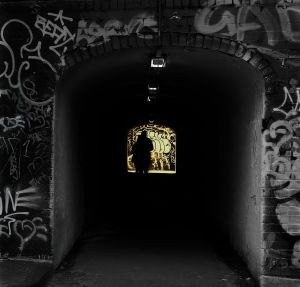
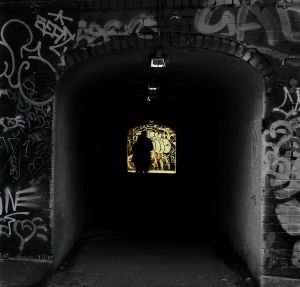
Tunnel to the Light

Anyway, fear is the biggie isn’t it? Fear of not having enough; fear of not being good enough; fear of what might happen or what might not. This list is endless. Fear of illness or ageing; fear of losing friends or fear of not having any! Fear of ‘missing out on the good life’ we imagine everyone else is living.

Then there is what’s called, the fear of the other, most often promoted and replicated by the mass media through their creation of illusions, fake news, exaggerated  or one-sided information (I hesitate to use the terms ‘facts and figures’ but you know what I mean). And then they sell us on ideas that we need to fear some other person, people, thing, time, impending catastrophe that never comes.

I don’t need to go on here: as I said, the list is endless. All that’s left to say about these fears and the illusions we are force-fed and made to believe are real, is that it all boils down to costing us a great deal of time spent and usually wasted, in wrong thinking of one kind or another.

It seems to me the media (news and social), advertising, and governments of all persuasions, are really quite happy for us all to be ‘getting the wrong end of the stick’. I think that’s the expression. Our societies are drowning in, for want of a better word, propaganda.

Buy this, do that, don’t do the other thing. Be afraid of (insert the latest scapegoat, political opponent, boogy man, the Apocalypse. Again it’s an endless list).

Then there are the fears we invent for ourselves, the illusions about ourselves that in our wrong thinking we come to believe are all real and true. One thing you can say about wrong thinking is that it makes for more and more wrong thinking. More illusions about who we are, what we do (or can’t do), what we are like, who likes (or doesn’t like) us. Here I once again risk repeating myself, but yes, it’s a long long list.

So, what can we do? Well, we could use a little reminder like the one we’re talking about here. It’s possible that it can help us correct a little of the wrong thinking that leads to fears and illusions.

Then there is what we might call discernment. Not so much deciding between one thing and another; more like coming to know what is real or illusion, a genuine, rational fear that I need to act on, or some inherited, manipulated, received  or otherwise irrational, baseless, or invented ‘fear’.

We won’t get rid of wrong thinking by trying to push it away. It’s about replacing the wrong thinking with some right thinking. We can try to recognise that wrong stuff as it comes up. We can make an effort to stop allowing ourselves to get away with our own misunderstandings, our own wild imaginations, wishful thinking, and confusions. As my teacher said just the other day, use your mind to control your mind.

One word we haven’t discussed from my little injunction is discussing. We discuss things when we talk or communicate  with others or when we talk to ourselves. Here we are at another issue for discernment: what shall we talk about?

Actually I was about to write that one excellent strategy for not spending time discussing illusions, fears, and wrong thinking is to simply stop talking altogether. That’s all there is to it: Don’t talk!

But obviously that’s a ridiculous notion right? Stop talking? Perhaps for a set time? Or perhaps as a kind of ‘time-out’ strategy? But as a principle for a whole life, it’s not going to appeal to the majority of us. Actually, that feels to me like a bit of wrong thinking creeping in: a life of no, or at least limited talking is very appealing to me. Just difficult.

Still that does seem to be what my treasured injunction suggests I do. Mind you, it’s very specific isn’t it? Spend no time, it says. Discussing what? Illusions, fear, and wrong thinking.

So, how do we manage to follow this suggestion ‘to the letter’ as they say?

Here’s another little prayer I say everyday. This one is from Thomas Merton.


Keep silent ‘except in as far as God wills it’. For God I could say the good of all concerned; Truth; my heart; my goodwill; my love. It’s all God; it’s all the Divine.

I guess it gets back to something I said earlier about thinking before I speak. To this I would now add, feel before I speak: What’s right? What’s wrong? Does this help? Will this hurt someone else for myself.

About right and wrong: In the religious  tradition I was ‘raised in’ it was deemed that at the age of seven or eight a child is suddenly, without any preparation, able to discern right from wrong. Which means they are now responsible for the consequences of their thoughts, words, deeds. In other words, they are now capable of sinning and suffering  the consequences.

I can’t (obviously) speak for you or anyone else, but it’s been a very very long time since I was seven or eight, and I still find it tricky sometimes working out right from wrong. Of course while I know I am now responsible for my thoughts, words and deeds, I also know that we are all flawed; nobody’s perfect, so we’re going to make mistakes. 

So, all I can do – all any of us can do – is appeal to the innermost Self and use my intellect and my heart to try to discern as best I can, what is right and what is wrong.

Only in the innermost places where the real Self dwells can we know reality from illusion; it is only in our ‘heart of hearts’ as they say, combined with our rational thinking mind, what fears are real and what fear is illusion. And it is only then that heart and intellect can determine when our thinking is headed down the wrong (or the right) track.

It’s only then that we will know what and what not to spend our time discussing, either with others or internally within ourselves.  This all sounds like a long, convoluted, tricky process (told you I talk (write) too much!), but it needn’t be.

Like all things it takes practise, and once we begin to know that innermost Self, it will soon become a spontaneous way of living, when we begin to ‘just know’.

Your own inner divinity (which is the real you) wishes for you peace.

Om Shanti, Shanti, Shanti.

One, Without a Second, is All There Is

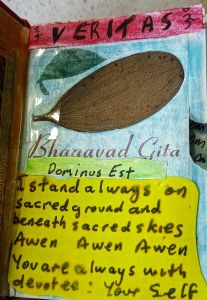
Right at the front of my Bhagavad Gita (the only book aside from the notebook I’m writing this in, that I personally own), I have recorded and inserted sayings and various words , that are important to me. Among those things is a statement I first heard many many years ago, that is common among the First Nations’ peoples of this country:

I [We] stand always on sacred ground and beneath sacred skies.


It is not an affirmation of ownership or possession. It is, instead, an affirmation of belonging to the land, to nature. It is a prayer of thanks, and it is a declaration of the knowledge of unity with the rest of the natural world, that is the hallmark and foundation for Indigenous cultures throughout the world and through time.

I’ve valued – treasured – this sentiment for a very long time – probably from even before I first heard it, which was so long ago as to be lost to memory. Perhaps I always knew it because I’ve somehow always thought this idea was a fundamental truth concerning my existence as a being living on this planet.

Well, now I have heard another statement that for me makes a perfect compliment for this one. The other day, during a lecture, my teacher mentioned that in his student days a fellow student said:

Wherever you are, you are walking through Ishwara

(Ishwara being her preferred name for the divine – for all that is.)

There is a feeling or sense of ‘belonging’, of awe and wonder when we attempt to immerse ourselves in what we term the natural world.

Once again I immediately felt the bell of Truth ringing clearly through this statement. Yes, I thought, everything is divine – including our own selves – so of course it follows that wherever we go, whatever we do, we are always in the divine.

You’ve probably read a number of times me quoting my teacher quoting his teacher:

It’s not that there is only one God, there is only God.
          Swami Dayananda Saraswati

Emphasis very much on only. Meaning of course, that it’s not that God is within us, or that we are within God; we are not surrounded by God; and it’s not that God ‘sits in our hearts’. The reality (for my teacher’s teacher) was that all that is, everywhere, everything, every thought, every word and deed, everything there is, is the divine.

Another way to describe the divine or God, that appeals to me is that Ishwara (also my own preferred name for the Divine) is in reality the natural order of the universe as dictated by the laws of nature. Those laws of nature, the rules that govern how the universe works, are also Ishwara, as are all that is manifest or in existence  as a consequence of the workings of those laws.

In other words, the Divine is the sum total of what some would call the entirety of creation.***

For the hermits a sacred site. Part of a grove we named The Sentinels. A place of experience of unity and oneness of creation

For me this an enormously comforting and reassuring concept. Of course, for me at least, it is also an extremely difficult one to wrap my head around. But here’s a small summary of what I think I’ve grasped so far.

Ishwara – the Divine – is all there is; everything. Also divine is the natural order of the Universe as governed by the laws of nature. These laws are neither good or bad – there is no duality. They are neutral.

You and I, as one more entity among who knows how many others, act as we do and are subject to the laws of nature, just like everything else. We can’t change or influence those laws; we can only live our lives as they unfold.

To quote from Desiderata: No doubt the Universe is unfolding as it should

And, well, then things just work out as they do. While we can’t change the laws of nature, or bend the universe to always suit our liking, it is also true to say that every action we take, every thought we think, every word we utter, even our very presence as a living being in our time and place, do indeed contribute to ‘how things work out’. Another way of saying this is to say, we do our bit, and the universe does its bit and what happens, well, happens.

For me, this is not at all as simple or as straightforward as it sounds. Naturally  we see ourselves as individual selves, as entities on our own. After all, to state the obvious, we live and operate in a material (dualistic) world. So automatically we see ourselves as individuals living in, but always separate from all the other individual entities, as well as being disconnected from the world itself.

It is part of human nature (for the most part) to long for connection; there is so often a drive within us pushing us to create family, enter relationships, feel we belong to a community or communities, and for many but not all, there is the almost instinctive urge to seek connection with the rest of nature.

Many forms, One reality

We often think of these longings as goals to achieve, as something outside of ourselves to attain, to reach for. Consequently, so very often we tend to focus our attention outwards, towards other people, or material things.

But, instead, all these inclinations, desires and longings are simply our Self (note the capital?) endeavoring to open itself to discovering (or rediscovering?) that which already exists: our oneness with, and our non-separation, and non-difference from, The All That Is.

Peace and Love from Paul the Hermit

FOOTNOTE

***Just a few thoughts about naming, or giving labels to the Universe and its laws.  Obviously it’s a personal choice for each of us what we choose to call that creation. Then, on the other hand, we don’t have to call it anything at all. For me personally it is very difficult, even near impossible to not name it. By naming the creation, I don’t think I am attributing the manifestation of the Universe to some distant entity living in some heavenly abode (as my teacher likes to say). Rather I am acknowledging the intelligence  and order, beauty, complexity of all that is and how it all works, as its own reality. At the same time, I am learning to understand that I as my true nature am not separate from the rest of creation, and I feel the need to have a name towards which I am able to focus my thanks and my reverence.

You Can’t Always Get What You Want

‘I wish I could write a blog post.’

So said I to my partner hermit yesterday. You see, for a few days I’d felt the coming on of a blog post: no topic, no clue as to ideas, and no hint of anything, only that it was on its way. Hence the exasperated outburst.

What’s wrong with wishing for something we want? Absolutely nothing. Sort of. Contrary to popular rumours, erroneous teachings, misunderstandings, mistranslations, or just a simple lack of information, Buddha’s Second Noble Truth does not say ‘The cause of suffering is wishes’ or we can say desires.

What he actually taught was that the cause of suffering is clinging. Clinging, being attached to a desire so strongly that failing to fulfil that desire causes us to suffer through annoyance, frustration, sadness and all those other things that impact on our mental or emotional wellbeing.

My teacher uses the word  compulsion. Compulsion to chase after what you want, compulsion to run away from what you don’t want.

Using me as an example: yesterday I wanted so badly to write, and was so frustrated that I couldn’t write just then, that I caused myself suffering. Because I couldn’t have what I wanted immediately, I made myself miserable.

Just as an aside (or perhaps not?), I realise that this little annoyance hardly means anything in the larger context of living and suffering that all of us experience simply by being alive.

But in a way, that’s my point. How many of the things we desperately want or that we desperately don’t want are the ‘little things’? Aren’t they so often the very things that, on a daily basis, cause us the most annoyance, frustration, anger, and even sorrow?

In any case, I had made myself annoyed with myself, frustrated too. However as soon as it was suggested that I needed to just down and type something – anything – if only to get the words flowing, I felt much better. I had the answer!

So, here I am, albeit a day late, and not typing as it happens, but scribbling in my notebook. Actually I don’t know why I don’t type it all up first thing, cutting out the middle step.  I mean, it really does flow better on the screen (via my fingers on the keyboard of course), and it’s also, as an added incentive, a whole lot easier to read than my scratchings.

I suppose I could say that not all old habits that have not quite died just yet, are necessarily ‘bad’ ideas. I happen to like my notebook.

Now, here’s the thing, the paradox if you like. I had felt a post coming on, and because I wished so badly for it to emerge and it wouldn’t, I suffered. And then, I sat to write something (anything as was suggested) and voila: the desperately, compulsively, longed for post obedeintly appears.

Cause and effect? I mean to say, which came first? Did I at some deeper subconscious level already have an idea to write a blog post about how clinging and compulsions and attachments to the things we want – and aversions and compulsions to get away from things we don’t want – cause us suffering?

Did that existing but deeply buried idea then manifest itself as a real world situation to give me the ‘material’ to write from?

Or, perhaps more simply, I got annoyed because I couldn’t write, so I made myself write (took a day to get to it though; remember me saying?), and well, what you see is what you get when one sits to write – words on a page.

Who can say? There are theories that propose effects can and do often precede causes. It’s a tough one to get my head around, and somehow I don’t think there’s any point in trying to.

We know instinctively that everything that exists in the Universe is constantly changing, evolving, devolving, mutating, never still. And we also know that we can affect what happens in our lives and in the world around us through our own actions. Some might disagree with me on that last one; it’s only my opinion.

The tricky bit is that oftentimes we forget that those changes as well as the lack of fulfilment or otherwise of our desires (wishes also), and even the results of our own actions aren’t always to our liking. Well, it’s not that we don’t know it in our minds and through personal experience, but when it comes down to it, we all usually as part of our normal conditioning, suffer when outcomes aren’t to our liking. It’s like we know it but we haven’t realised the truth of it yet.

Sounds like a trivial or flippant, even silly and pointless, thing to say, but it’s demanding to be said anyway: things (as in life and the rest) always work out how they work out.

But if you think about it, it’s true whether we like it or not. Actually, in a sense this is one of the very important, even pivotal points, of my ongoing studies, meditations, and contemplations. To realise fully that I, along with every other living thing, has a place within, no, not just a place within but is actually an indivisible part of, if I may be forgiven a cliché, the grand scheme of things. Not only that, but we in our essential true natures as Consciousness remain untouched and genuinely okay whatever transpires here in the material world.

I do what I do; you do what you do; and regardless of whether we like the outcomes or not, things work out as they do. Sorry to be repeating myself. Just seemed the right thing to say again.

And here’s another tricky bit: it’s not about resigning ourselves to ‘fate’ or ‘destiny; or whatever we might call not having control over our own lives.

Just by way of exploring that last point, and finishing this post, I would like to leave you with a quote. Yes, I know, we are all bombarded by quotes from famous (and not so famous) people, aphorisms of all sorts, and affirmations that claim they will improve our lives.

I truly believe this flood (mixing my metaphors here) of good words, written with good intentions, has numbed us to their actual value and usefulness to us in assisting us to live good lives.

So, here is one such, that I think puts it in a nutshell, in a very simple, straightforward way, an important Truth. It’s called the Serenity Prayer, and rereading it just now, I see clearly that serenity would indeed be the outcome if we are able to take this invocation to heart, and begin to live by it.

God grant me the serenity to accept the things I cannot change,

Courage to change the things I can,

and the wisdom to know the difference

Peace and Love from Paul the Hermit

PS: This version is only one among many. In fact, the Wikipedia entry linked above is a fascinating (though apparently quite flawed) exploration of this prayer and its origins.