Earlier today I took my camera out for a walk. Which is to say, I had an intention that the walk would be more than exercise for the body (very much needed as it is), but also an opportunity for my eyes and heart to open up a little to the tiny part of the world I was to pass through.
I also hoped that my mind would join in so that I would be able to actually recognise what I was seeing and feeling, allowing me to perhaps make images of what I saw and felt.
One final prayer: In doing its job, I hoped my mind would stay focused, and work behind the scenes very quietly.
A few minutes walk from the Hermitage is the shore of a fairly large lake, and when I reached that spot, I sat on a conveniently placed little wall, so I could, well, just sit for a bit.
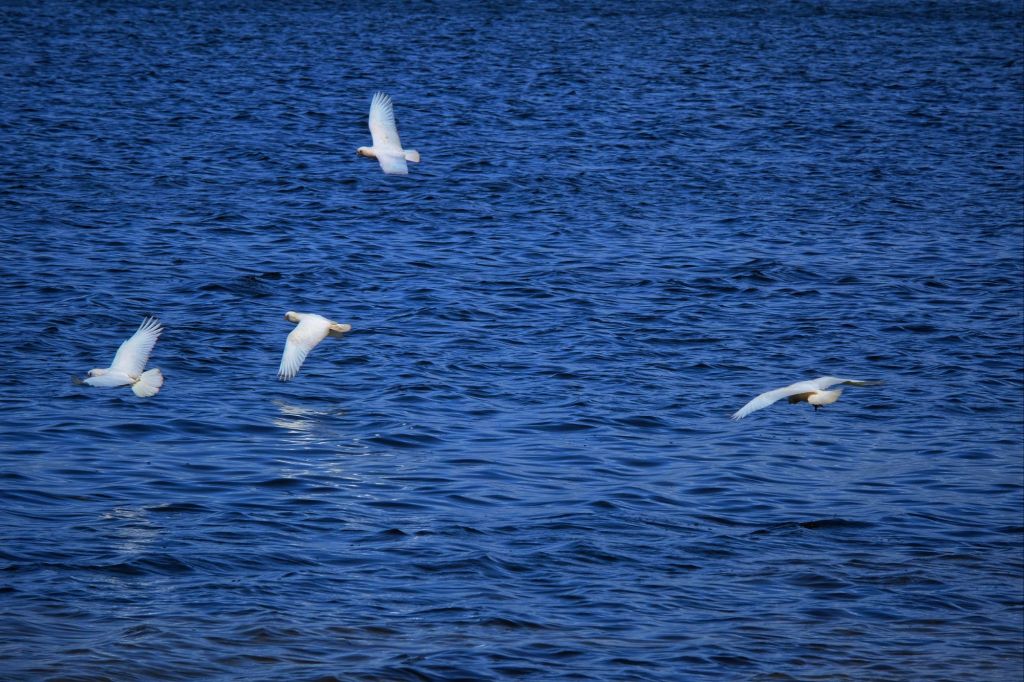
By chance, um. Sorry, let me rephrase that. By the brilliant synchronicity that results from the perfect working out of the natural laws of the Universe, right in front of me, nearer to the water’s edge, a dozen or more Corellas played and foraged. At least to my limited human eyes, that’s what they were doing.
Zoom in and share the fun!!
It’s mesmerizing watching them: tumbling with each other or on their own; picking up and wrestling with twigs and other small things. I was blessed too, to witness several of these creatures taking off, in flight, and landing.
You might have heard me say (or read when I wrote) that ‘I was just not there’. Well, not today; today I was definitely there. In a contemplative reverie in which I felt connected with what I was witnessing through my lens.
‘I had a small sense of being relaxed,’ I commented casually to my community when I arrived back at the Hermitage. And that’s what it felt like: I had relaxed for a time. I can’t say I was aware of the passage of time; it was more an eternal being in the moment if I was to try to label it now. It might have been thirty minutes or ten by the world’s measure; I have no idea really.
I’m only ever going to be a beginner when it comes to paying full attention, to contemplating and being completely immersed in the moment, and not forgetting trying to control the monkey mind. Practise will never make perfect in that department!
Anyway that’s why spiritual practices are called practices: they require the spiritual seeker to be committed to a life of ongoing and continual practise.
Of course encountering those birds at the lake today is definitely a practice I would be happy to practise anytime!
Walking home, returning to the sanctuary of the hermitage, I fell over. Or to be exact, I tripped.
It’s not the first time I’ve tripped in my life, and I’m sure it won’t be the last. Mind you, I’m not supposed to be making speculations about the future; after all, I may never fall over (or trip) again.
Let me share with you how I came to find myself lying on the ground, fully conscious thankfully, with only a few grazes on arms and knees, and a sore spot on the side of my head.
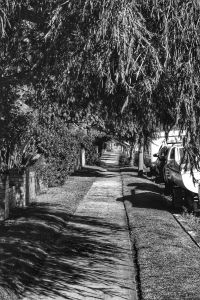
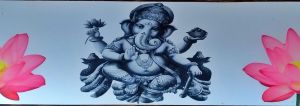
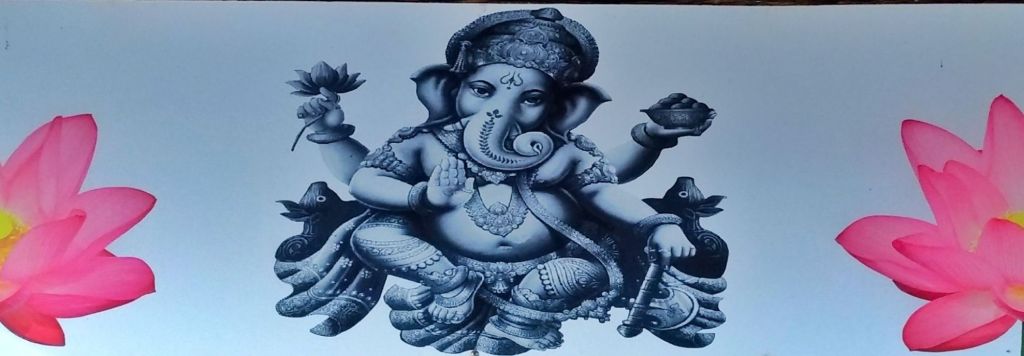
Walking along the sidewalk quite freely, earbuds feeding my ears and my heart my favourite mantra to Ganesha – known as the remover of obstacles and the God of wisdom. (more on the earbud issue later)
At one point I noticed, a few metres ahead, what appeared to be the back of a largish sign board leaning against the base of an electricity pole growing out of the pavement.
Not the actual sidewalk
Without any thought whatsoever, as I came up to that pole, I turned my head to the left to see what the sign read. Next thing I know, is I have the sense of falling. Later I remembered that at the exact moment I turned my head, my foot caught the broken and uneven edge of a slab of the pavement.
I was blessed by two passersby who stopped and helped me back to my feet, and stayed with me as I regained some semblance of my bearings. Thank you to those two good and kind ones.
Now, I don’t like falling over (well, when you think about it, who does?), but in this case I can say through this fall, I have learned a couple of good lessons.
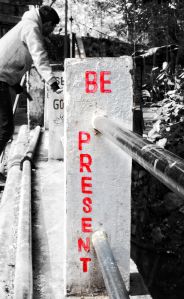
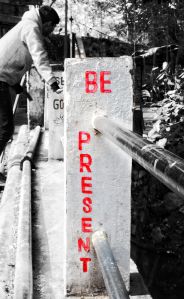
Presence – or lack thereof. Here I am, the hermit monk who is supposedly constantly practising being present, in the moment, here and now; yet I tripped over what I later discovered was a really obvious, clear obstacle on my path.
We all get distracted, you might be thinking. And, yes, it’s true. We can be paying close attention, fully focused, riveted to and in the moment, and, suddenly distraction barges in – in the form of a thought, an external noise, visual imput, and even a broken pavement. You name it, and mind will use any excuse it can to manifest a distraction.
Another lessen – intimately related to presence – is pausing, or not! As I noticed that sign coming up, I could have chosen to pause to look at it once I reached it.
Then, rather than being a distraction, looking at that sign would have simply been another moment in the ongoing flow of the present. In other words, there’d have been no tripping.
The actual earbuds in question
Now, to the earbud issue. To be honest, my earbuds have more or less replaced my regular over the ears headphones. Because I was never comfortable going out and about with those clunky things on my head and earbuds have allowed me to listen to music pretty much whenever and wherever I go. Even to me wearing them, they are barely noticeable. It’s possible that’s the problem right there: unnoticeable.
More than 30 years ago now, I spent every Tuesday evening for a year attending classes at a school of philosophy . To this day I still follow some of the practices I learned there. And, passed to me were so many good lessons, so much good knowledge drawn from many of the world’s spiritual and intellectual traditions. So many of these lessons have stuck with me.
Presence, or rather the benefits and rewards of realizing the present is all there is, was I would say, one of the cornerstones of those teachings.
One illustration about presence concerned driving, and although at the time I haddn’t learned to drive, it resonated with me. Our teacher told us that, when she was driving, she never listened to music or anything else. She told us that she simply put her full attention on the task at hand: driving.
She described how it often happened that when driving she’d reach her destination with little or no memory of the actual act of driving or any landmarks or events on the trip itself. She said it was if she was somehow unconscious, yet still able to drive ‘on autopilot’ was how she put it.
And of course it’s not a phenomenon limited to driving: how much of our routine daily activity runs on autopilot?
Anyway, back to the other day and me grooving to Ganesh in my ears and tripping in a moment of inattention.
I don’t recall being distracted by the mantra in my head, or moving on autopilot. But, thinking back, I was in one of the busiest sections of the little town that hosts our hermitage. I’d been to the supermarket, the parking lot of which is as busy – and crazy – as one you would find in any big city.
Just another sidewalk tripper
So, I realise now, I had already kind of set myself up to fall for any distraction that happened to come along. While I don’t really remember myself as being ‘unconscious’ of my surroundings or of the path itself, clearly I wasn’t completely there, not in the here and now sense if you know what I mean. Just an after thought: who remembers ‘being unconscious? Nobody I think!
Whatever I say now, I wasn’t present; I wasn’t fully in the moment, not paying attention to either what I was doing or what was going on around me.
Since my little trip, I have vowed before my hermit community to not ever walk again in a built up and busy area wearing my earbuds.
Not only do I have a sense of danger lurking when I think of the idea of wearing them in those situations, but I also feel that it’s not exactly being present, in the here and now is it?
Another closed cafe on some other trip
Okay, I am very sure you are waiting with great anticipation to learn what what fateful sign, put in my way by the Universal Traffic Controller to push me into changing direction, actually said:
It was a handwritten advertisement for ‘great coffee’ to be had in a cafe across the road. A closed cafe I might add.
On Main Road – a road that more than lives up to its name – perhaps there are worse fates awaiting the inattentive than merely tripping on the sidewalk.
There, dear friends, right there, in the title are our next two W questions, as well as the answers to both.
The answer is brief, succinct, right to the point, yes indeed. But somehow to me it doesen’t seem very helpful, a bit vague.
Here and now. Let’s look at this tricky little phrase. On the face of it Here and Now has an obvious meaning: if we choose to think on it in the spirit of our ongoing contemplation on my prayer life, it’s very clear. Here and now is a timely reminder to me to pray right where I am, right now, wherever I might be; and whatever the time, day or night.
But it’s not really a very satisfying answer is it? Here and Now? It seems too flippant to me, too bland, even a bit of a ‘catch all’ cliche thrown around without any real insight into its meaning or importance.
Anyway, moving right along …
We are exhorted to pray without ceasing in the Christian Bible with similar exhortations found in so many other texts and scriptures from many faith traditions.
Remember my aspiration to make of my life a prayer? Well, that’s the idea: to pray without ceasing. Which translates to mean that everything I do, say, think, feel (what else?) will be prayer – or I can also say a prayer. Life is a prayer, life is lived as a prayer.
Of course the precise forms my prayer takes are – and will ever be – many and varied. We’ll be looking at some of those forms and types later in the How post of this series. But, for now, allow me to brainstorm on the topic for a bit.
Consider washing the dishes, a task we all find ourselves engaged in to some degree or other. I have a sense that my feelings towards dish washing is actually quite neutral. Don’t get me wrong: if I never had to wash a dish again you would not hear me complain.
At the same time, I have absolutely no hard feelings against washing dishes.I just get on with it, just like most everybody else.
Sticking with dish washing …
Most often dishes need washing as a consequence of preparing, cooking, and eating food, for a meal or meals. Right there is an obvious opportunity for a simple prayer of gratitude.
It might be a simple whispered thank you for the gifts of the nourishment, satisfaction, even pleasure of the meal. Anyway, just a random first thought on the subject.
There are a few other points to be made in our little dish washing thought exercise as it fits into my own prayer life.
Sometimes, while actually dish washing and cleaning up, I might chant mentally, or otherwise pray with words – set prayers. Prayers of praise or gratitude; mainly whatever pops into mind. Go with the flow is the theme here.
Now, that’s one thought. Next: I might decide to be quiet while washing up. That is not speaking and being as silent inside as I can be.
On these occasions I just focus as intently as I can on what I’m doing: washing dishes. I make it an occasion for not doing the dishes just to get them done, or to get them out of the way, or to put an end to an onerous chore.
Rather, it’s more an opportunity to simply wash the dishes, by being with the dishes and the actions required to clean them. Just a little aside: this particular form of mindful (prayerful) dish washing actually results in cleaner dishes. It’s been proven scientifically.
These two approaches to washing dishes – not to mention all the other means and forms of prayer – are not necessarily mutually exclusive, nor are they the only one: a given dish washing event might involve several prayer modes.
Which leads me to the next thought that I had more or less forgotten…
Sometimes I do indeed slip into that old ‘Just get the blank blank things done’ frustration mood. And it doesn’t just happen when faced with the dishes!
It goes without saying that I wouldn’t need an aspiration if I was already acting full time in that prayerful manner. I do practise – sometimes with more determination than others – performing all my actions mindfully (aka prayerfully), though there’s far to go for me in the praying ceaselessly department.
So, to a good question you may be asking: Is there somewhere (or multiple somewheres) that I go to to pray? Some special sacred or holy place?
Well, I know that we are always all of us standing on sacred ground – it is all the Divine. Still, there are places that help me, all of us, feel closer to that divinity, to the sacred, to God, or whatever we call it.
There are places that exude that special vibe, or have a certain atmosphere of calm, quiet, or stillness, that are conducive to prayer.
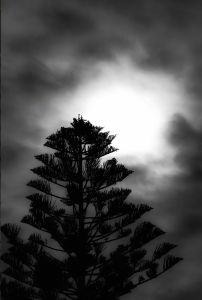
An apparently random glance skyward blessed me with this moment and this place of prayer
Talking about the idea that we are always standing and walking on sacred ground, there are often places I come across that speak to me as places of prayer. It might be a tree, like the one pictured here; it might be a distant view of a lake and the hills beyond.
Such places call to me to stop. Perhaps for a moment, perhaps to sit and linger and pray with words, or with silence.
In the Hermitage, there is temple, a room we have set aside for that purpose, and no other. From the very first day I set this room aside as a temple, I have felt a stillness there, a tranquil vibe.
Among such spontaneous little moments, there are times I simply stop and stare at a flower, or without thought put my hand on a tree. I will whisper a quiet thank you and a blessing to the Divinity I sense there.
Temples, churches, chapels, prayer rooms, mosques, and other types of sacred sites from andy and all spiritual and religious traditions, attract me as well.
These are all places people have spent time in praying, contemplating their lives and their union with the Divine. All that energy, all that love and devotion has caused an atmosphere of holiness, or sacredness to build up over what can be years, centuries, even millennia, in some places I have prayed.
But, really, when all is said and done, anywhere and anywhen can be and is a place for prayer. Here, in this booth, in the cafe at the lakeshore near the Hermitage, I make these notes in a mood of prayer, a prayer of love and devotion.
Being present, mindful, and prayerful in all I do, that’s my aspiration. Here and Now. Anywhere and anywhen; it’s all prayer.
The Hermit Pilgrims have signed a lease for the rent of a house for a year. Not only have we signed a lease, we have, in fact as of yesterday, been residing in the said leased property.
Admittedly, it’s exactly the sort of small house which we had in fact been longing for for some time. It’s got many characteristics that make it for us, the ideal site for a hermitage: we even have a temple room!
The lease is for a year initially, and if, after a year we feel led to move on, then that’s what we shall do. But for now, – as in the present moment that is the ongoing now, the only ‘time’ one can talk about with any meaning or truth – we will be in the one hermitage, the one safehaven by the side of the road, for a longer period than in any other in the last many years.
Anyway, enough of this reflection on the nature of time; the big question on your mind I am sure is why? Well, the first little thing to say is that the pilgrimage goes on; it’s just that we’ve taken a tiny step towards the vow of stability many monks and nuns make as a matter of course. We’ve not really ever taken such a vow before. Mind you, a lease is a binding document, I wonder does that count as a vow?
Of course, as I’ve just laboriously spelled out, there is only the moment, the ongoing now; so who can possibly say about ‘a year’?
Next, let me tell you a bit about a book I’ve read a few times and like very much. It will possibly give you a flavour of the why.
Cave in the Snow by Vicki Mackenzie tells the story of Tenzin Palmo, a Tibetan Buddhist nun and her, I think, twelve years in solitu6de in a nearly all year round snowed in cave in the high Himalayas.
Tenzin Palmo had been living in a rather remote monastery, but felt after some years the need for greater isolation and solitude. The monastery was too busy and noisy, with all sorts of comings and goings.
There was too much entanglement with the greater society in the form of the surrounding villages and town. She wanted some quiet basically
In an interview sometime after she came down from the mountains she was asked if going to a cave was perhaps an escape, an ‘evasion of the trials of an “ordinary” life. Her reply spoke to me when I first read it about 20 (or more?) years ago, and still does today:
‘Not at all. To my mind worldly life is an escape,’ she replied to the interviewer. ‘When you have a problem you can turn on the television, phone a friend, go out for a coffee. In a cave, however, you have no one to turn to but yourself.
You have no choice, she says, when problems come up, and when things get tough, but to go through with them, till you come out the other side.
‘In a cave,’ she said, ‘ you face your own nature in the raw, you have to find a way of working with it and dealing with it.’
My situation is not quite like hers. For example there is more than one person in our community of hermits. Still her story does resonate and speaks very much to my own situation.
Not only is there never going to be any absolute certainty in our material world, there is never – ever – going to be anything in the realm of worldly things that will deliver us perfect peace and lasting happiness.
Easy to repeat, this tidbit of transcendental knowledge, but quite another to get oneself unattached to the idea that, well, maybe, just maybe, the next big thing, might just be different, might indeed be the forever answer to peace and happiness.
And it’s that attachment that I’m tackling at the moment.You see I long for a more pure hermit life, a life with a lot less engagement – and entanglement with – worldly things and situations.
I once wrote in a poem calledSeeking Noble Truths or Just Passing Through that ‘longing is loss’, and it is, if one is attached or clings to the object of desire, or an outcome being exactly as is envisaged. Not being attached means less disappointment, less suffering, if as often happens, life does its thing and the outcome is not what we hoped it would be.
But here’s the thing: the bonds of my attachments in this area are loosening a little, bit by bit. And the paradox isn’t lost on me either: As I ‘settle’ into our (supposedly) longer term hermitage, I will, I hope, come closer to a point of stillness, of equanimity, and of silence. I will inch even closer to that state where attachments will all just fall away.
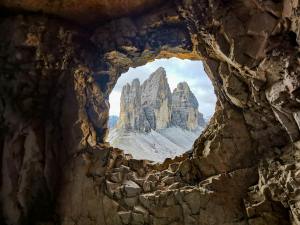
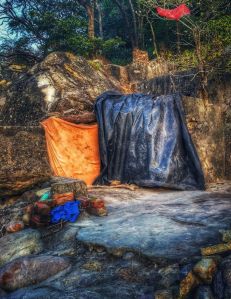
Hermit caves take many and varied forms
Now, in no particular order of priority or preference, I’ll try to convey in words some of the reasons we’re opting to continue our pilgrimage in a more long-term hermitage.
To be honest, as hard as I try to be present, to just live here and now, I just like the vast majority of my fellow human beings, find it extremely difficult to not be pulled ahead to the future (or dragged back to the past for that matter).
No sooner have we moved into a new hermitage, then we feel we have to start shopping around for the next one. Of course, one can’t ignore the practicalities, but for me it goes way beyond being a sensible planner.
And to be perfectly frank (I wonder who this ‘frank’ is anyway?) we’ve tired of it. The looking, the thinking, the talking and emailing to prospective places. It’s actually quite boring, to be stuck on that kind of merry-go-round .
It’s also extremely distracting. It gets in the way of our efforts to calm and quieten our minds for extended and deeper meditation and contemplation. Not to mention the ongoing (seems endless sometimes) discussions of the pros and cons of decisions to be made, as well as the frustrating second guessing I’m famous for.
Portrait of a Hermitage
We all know from experience that there is never going to be any absolute certainty in anything we arrange in our lives. Of course I know very well that even a signed, sealed and delivered legally binding contract or lease, means very little if the parties involved put their minds to it or change plans somewhere along the way.
All things in the material world are relative, and always subject to change; there’s nothing we can do to bend that natural law. Given such a context we still feel okay about entering with a right-hearted intention, this agreement for a year (at least) in the new hermitage.
As the residents of the hermitage are prone to say really quite often: ‘Your will, not mine, be done’.
Then, when life does its thing, I’ll be more able to roll with it. Why? Because I will (hopefully) have better learned that it’s not my will that’s to be done, but the Divine Will, the natural law and order of the Universe.
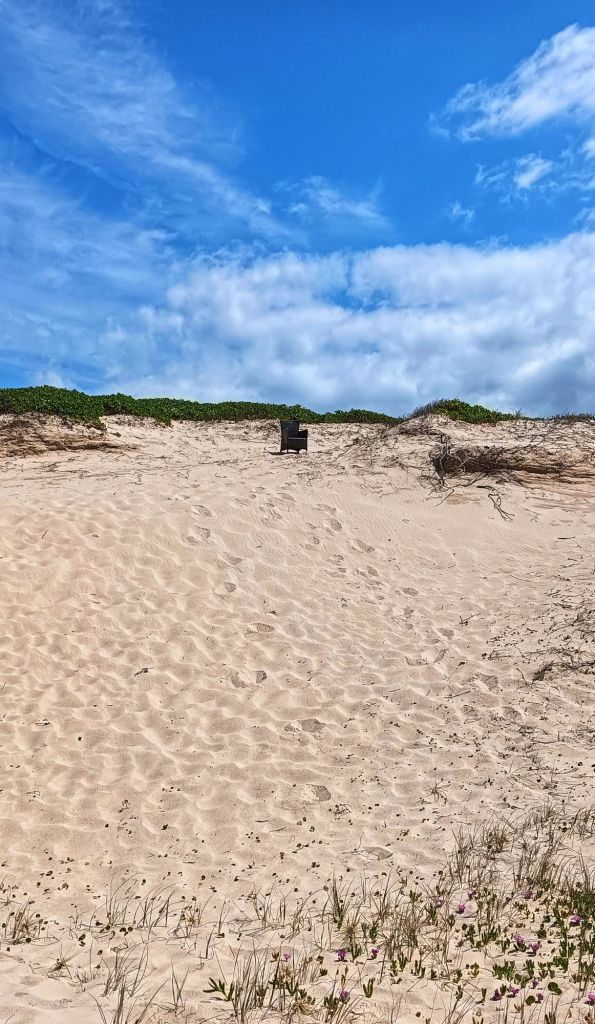
With the current hermitage located not so much on the side of the road, as right on the side of a large sand dune system, you might imagine that I am at and on the beach every day.
While almost every day, I walk the track that follows the crest of the dunes in this particular area, I’ve only actually gone down to the beach itself a handful of times.
So, yesterday as start to my resolve to make amends for this omission, I climbed the dune, ignored the crest track leading left and right, and continued straight on and down the other side of the dune, and onto the beach itself. My intent was to spend an hour or so walking along the tide line.
And so it was.
Judging by such rare experience of the beach itself, I might easily say I am no ‘beachcomber’; no discoverer of coastal treasures, little natural beauties from the sea, or even the occasional oddity one might expect washed up. Until yesterday that is.
Not that I went to ‘comb’ the beach: rather I was there trying to put myself on the receiving end so to speak, to be a receptacle for what I might be blessed with (not to forget the need for exercise and movement).
And so it was.
This sense of grace and blessings, I hope I’ve conveyed in the small poetic effort (as well as its companion photo) that I now share with you.
SPOTTED ON THE SAND DUNE
Strolling (briskly mind you) along the sands, There I was – deep in the liminal zone. Ankle-deep – sometimes – seawater cooling my feet. One way to receive Varuna’s blessings.
Back on dry sands (still in the liminal zone) I pause to examine a spiral shell – an elegant and delicate sea creature. It lives. Reverently, I move it to deeper water.
As I rise from my small task of union, of reunion, I glance – still within the liminal zone – upwards. There, near the crest of the sand dune sits a chair. An armchair I spotted right there on the sand dune.
There it was, facing me – and the sea – in the middle of nowhere. Though this is clearly somewhere for somebody. The perfect perch for taking in Pacific views.
Empty chair, lonely sight overlooking the liminal zone.
‘It’s good practis/ce sitting out here.’ So said my partner hermit as we sat sipping post evening meal tea on our little front porch that happens to face exactly due west.
It was on the tip of my tongue to ask: ‘Do you mean it’s a good thing (practice) to be doing regularly as in Sadhana, a spiritual practice? In other words is it a good habit to cultivate?
‘Or do you mean it’s good as a kind of training – as practise – in improving our ability to sit in quiet and stillness?’
As I say, these questions were on the tip of my tongue, but then: Blog Alert!!. So, in a rare moment of triumph I managed to hold my tongue (metaphorically speaking) and let those questions sift through my mind so that later (it’s now the next day) a post to share with you might emerge.
So, here we are, setting the scene for this post. I know it’s about words, about language. Semantics is what it could be about, given that it’s about words and their meanings.
But, aren’t words simply symbols for the things they describe or represent? And so often semantics involves quibbles over meanings.
So let’s not make this about semantics, no quibbling required here. You see what set off the Blog Alert!!! was that here was the one word, that is actually two distinct words each with their own meanings, that just happen to sound alike.
Still no quibbling though: we don’t need to pick and choose between meanings – actual and/or intended. Two words, two symbols, two meanings (one for each word that is), so we can choose not to choose – remember no quibbling.
We can realise that in the context, both words are equal and correct. Both may be acknowledged as being meaningful to and in the moment, to the situation.
Lately I think I’ve been saying quite a lot about silence quiet – quietude – peace and calm. Stillness also. All are the same thing: all are states in which we might realise the truth of our natures as divine.
Same Sun Another time & place
Anyway, we had just finished our evening meal, and now sat with tea, having just witnessed the last remnants of the sun sink below the horizon (or was it the horizon coming up to meet and finally hide the sun?).
Quietly sitting, relaxing you might say, in post sunset peace and quiet, with only the occasional and softly spoken conversation going on.
Then that comment from my partner hermit, sharing that sitting as we were is good practis/ce.
Certainly for one such as me who has great difficulties in being quiet, being still, and cultivating silence, such occasions of quiet sitting (with tea naturally) is excellent practise, good training in the changing of long-established and conditioned habits and behaviours.
And, as such, it is a most excellent practice to cultivate, a great thing to do (I’d say action to take, but somehow that feels not quite right) to cultivate stillness and silence. I’ve written elsewhere that to cultivate or to rediscover silence is to realise that silence already existent as the divine, as consciousness, as all and everything.
My partner hermit is one of the wise ones, a sage. One spoken word that actually contains two words, two symbols, each with its own meaning, that finally merge into One.
There is a sacred song by Krishna Das that I am especially fond of and find very uplifting. I’d like to share the lyrics of that song with you, as well as what it means to me. It’s called By Your Grace.
Closer than breath, you are the air Sweeter than life itself, you are here I am a wanderer, you are my peace I am a prisoner, you are release
Jai Gurudev…
I am a pilgrim, your road so long I am the singer, you are the song Held in the open sky, so far above I am the lover, you are the love
Jai Gurudev…
I follow your footsteps through the flame All that I ever need is in your name Carry your heart in mine, vast as space All that I am today is by your grace. By your Grace… I live by your grace.
And if you’d like to hear him as he sings the song (I guess you could call it a hymn?) then just go here.
Grace traditionally refers to a gift or blessing from God, or from the Divine, the Universe; whatever we call it. Generally it seems to only have a positive or even happy connotation. It’s as if grace, like love, in Bette Midler‘s The Rose, is only for the lucky and the strong.
But I think it can be looked at another way. Or rather, in a similar way but with a twist.
Krishna Das is onto something when he sings:
All that I am today is by your grace
And
All that I ever need is by your grace
He’s not saying ‘Well that was by your grace, but that other thing wasn’t. He says everything .The good, the bad and the ugly, as they say.
There’s an old expression that I like: By your leave. It means with your permission, with your power and authority you can (do) grant this or that. In this sense Das’s song is a prayer to his guru for the granting of all that has made his life what it is today, as well as giving him all that he needs and will ever need regardless of the nature of the things granted or not.
Life can be a bumpy and bruising ride, always is really. Simple way to put it, go with the flow
To me the song is not so much, or rather not just, about a prayer in order to be granted something; it is a hymn of gratitude. It’s both really. Das is expressing his gratitude to his Guru in the broadest sense of the world: the divine or the universe.
The laws of nature determine how the universe operates, how nature works itself out, which it always does, though of course, it isn’t always to our liking.
But if we are able to look at with an objective outlook, with no notion of good and bad, right and wrong, desired or not desired, then it can be seen as an elegant order that simply works. The Universe has no agenda, it simply is.
This way of looking at grace as being the natural order of the universe requires our surrender. Surrender in the sense of acceptance of the fact the the Universe unfolds exactly as it is supposed to.
This surrender, this acceptance of that natural order is not about being resigned, or fatalistic. It is the way to rid ourselves of irrational and wishful attachments to outcomes. Outcomes and results, that when they don’t work in ‘our favour’ cause us suffering.
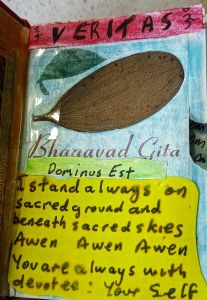
Right at the front of my Bhagavad Gita (the only book aside from the notebook I’m writing this in, that I personally own), I have recorded and inserted sayings and various words , that are important to me. Among those things is a statement I first heard many many years ago, that is common among the First Nations’ peoples of this country:
I [We] stand always on sacred ground and beneath sacred skies.
It is not an affirmation of ownership or possession. It is, instead, an affirmation of belonging to the land, to nature. It is a prayer of thanks, and it is a declaration of the knowledge of unity with the rest of the natural world, that is the hallmark and foundation for Indigenous cultures throughout the world and through time.
I’ve valued – treasured – this sentiment for a very long time – probably from even before I first heard it, which was so long ago as to be lost to memory. Perhaps I always knew it because I’ve somehow always thought this idea was a fundamental truth concerning my existence as a being living on this planet.
Well, now I have heard another statement that for me makes a perfect compliment for this one. The other day, during a lecture, my teacher mentioned that in his student days a fellow student said:
Wherever you are, you are walking through Ishwara
(Ishwara being her preferred name for the divine – for all that is.)
There is a feeling or sense of ‘belonging’, of awe and wonder when we attempt to immerse ourselves in what we term the natural world.
Once again I immediately felt the bell of Truth ringing clearly through this statement. Yes, I thought, everything is divine – including our own selves – so of course it follows that wherever we go, whatever we do, we are always in the divine.
You’ve probably read a number of times me quoting my teacher quoting his teacher:
Emphasis very much on only. Meaning of course, that it’s not that God is within us, or that we are within God; we are not surrounded by God; and it’s not that God ‘sits in our hearts’. The reality (for my teacher’s teacher) was that all that is, everywhere, everything, every thought, every word and deed, everything there is, is the divine.
Another way to describe the divine or God, that appeals to me is that Ishwara (also my own preferred name for the Divine) is in reality the natural order of the universe as dictated by the laws of nature. Those laws of nature, the rules that govern how the universe works, are also Ishwara, as are all that is manifest or in existence as a consequence of the workings of those laws.
In other words, the Divine is the sum total of what some would call the entirety of creation.***
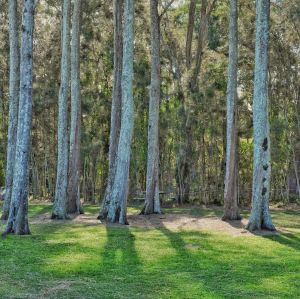
For the hermits a sacred site. Part of a grove we named The Sentinels. A place of experience of unity and oneness of creation
For me this an enormously comforting and reassuring concept. Of course, for me at least, it is also an extremely difficult one to wrap my head around. But here’s a small summary of what I think I’ve grasped so far.
Ishwara – the Divine – is all there is; everything. Also divine is the natural order of the Universe as governed by the laws of nature. These laws are neither good or bad – there is no duality. They are neutral.
You and I, as one more entity among who knows how many others, act as we do and are subject to the laws of nature, just like everything else. We can’t change or influence those laws; we can only live our lives as they unfold.
To quote from Desiderata: No doubt the Universe is unfolding as it should
And, well, then things just work out as they do. While we can’t change the laws of nature, or bend the universe to always suit our liking, it is also true to say that every action we take, every thought we think, every word we utter, even our very presence as a living being in our time and place, do indeed contribute to ‘how things work out’. Another way of saying this is to say, we do our bit, and the universe does its bit and what happens, well, happens.
For me, this is not at all as simple or as straightforward as it sounds. Naturally we see ourselves as individual selves, as entities on our own. After all, to state the obvious, we live and operate in a material (dualistic) world. So automatically we see ourselves as individuals living in, but always separate from all the other individual entities, as well as being disconnected from the world itself.
It is part of human nature (for the most part) to long for connection; there is so often a drive within us pushing us to create family, enter relationships, feel we belong to a community or communities, and for many but not all, there is the almost instinctive urge to seek connection with the rest of nature.
Many forms, One reality
We often think of these longings as goals to achieve, as something outside of ourselves to attain, to reach for. Consequently, so very often we tend to focus our attention outwards, towards other people, or material things.
But, instead, all these inclinations, desires and longings are simply our Self (note the capital?) endeavoring to open itself to discovering (or rediscovering?) that which already exists: our oneness with, and our non-separation, and non-difference from, The All That Is.
Peace and Love from Paul the Hermit
FOOTNOTE
***Just a few thoughts about naming, or giving labels to the Universe and its laws. Obviously it’s a personal choice for each of us what we choose to call that creation. Then, on the other hand, we don’t have to call it anything at all. For me personally it is very difficult, even near impossible to not name it. By naming the creation, I don’t think I am attributing the manifestation of the Universe to some distant entity living in some heavenly abode (as my teacher likes to say). Rather I am acknowledging the intelligence and order, beauty, complexity of all that is and how it all works, as its own reality. At the same time, I am learning to understand that I as my true nature am not separate from the rest of creation, and I feel the need to have a name towards which I am able to focus my thanks and my reverence.
What a beautiful expression, I thought when I first heard this said a couple of weeks ago.
I’m not sure who said it, but that’s not so important. And I thought isn’t quite right either. My reaction was more from the heart than the head; more visceral, more ‘real’ somehow than something concocted by the mind.
Now we’ve dealt with one of the ‘w’ questions writers so love, there is another that’s important to ask at this stage: What does this fantastic sentence actually mean?
Naturally I’d had this question from the beginning as well, but despite it going round in my mind almost like a mantra, I don’t think I’ve quite worked it out yet. Perhaps a part of the reason for this failure is the nature of my reaction when first hearing it that I mentioned above: My reaction was one of the heart, not of the mind, so harder to look at analytically.
Still, the emotions and even the (spiritual) heart itself originate in the mind. So, let me share with you what I’ve come up with so far.
Wear the tender miracles. It seems to be a very straightforward sentence. But is it merely a well-intentioned piece of advice? Is it more a spiritual injunction? Well, as I thought about it, I realised it was in fact both.
Certainly it feels like good advice – though before we can finally decide that, we need to work out the meaning and intent of the words we have. Mind you having said that, I have to say it resonates with me as something one might hear from a spiritual director, or read in a sacred text of some kind.
So, what exactly are tender miracles? Are they soft and gentle, happy happenings that come from some place ‘out of the ordinary’?
You know, in my Contemplative Photography practice and in my earlier Street Photography days, I had a few maxims that I worked by and tried to live by. One of those maxims was: There is no such thing as ordinary. Which is another way of saying that there is nothing that is not extraordinary, and therefore out of the ordinary.
Just now there are several Magpies making beautiful melodies outside the hermitage. I know very well that these vocalizations that for this particular species represent an expression of biological and or evolutionary impulses or drives.
But, is that all there is to it? I don’t think so. As I listen, I smile. And my heart feels something. I sense beauty, and realise that I am receiving a gift; you might even say it’s a miracle.
Biological imperative or tender miracle? Why can’t it be both?
How many times a day do we experience or encounter ‘little things’, that appear ordinary, but are hardly noticed (or not noticed at all?) in our hurried and harried lives? Yet, anyone of those little things may be a tender miracle waiting for you to come along.
I know, the glorious singing of Magpies is a fairly obvious miracle, not so hard to miss – if one looks at that way. But even then, I know we don’t always notice. And what about the smile from a random stranger passing on the street? Or the comforting warmth of the sun? All things easily missed and if we actually do notice, we likely will simply take for granted.
Talking about taking for granted. What about the million little things our loved-ones do for us every single day that we either don’t notice, or just let slide without any real attention? Better stop here: this list really could go on forever.
Now, wear. Of course we all know what wear means; we might wear a coat, a hat, shoes. We all wear clothes. There really is no end to what we humans can and do wear!
Perhaps, though there is a deeper way we can think about wear. When a hat (purely by way of example obviously) comes your way, you at the very least try it on to see how it fits, how it looks, how it feels.
Of course you do need to be paying attention when engaging in these tryings on don’t you? So why not as you live your lives and when miracles might be coming?
Well the first thing to be said is that in our busy, distracted and stressed out lives (sorry to be so repetitious) much of the time we aren’t ‘there and available’ to pay attention. It seems that our minds are rarely in sync with what we’re doing with out bodies, where we are or even when. The mind is more often than not way off in the future or stuck in the past somewhere.
So, if we want to wear the tender miracle, we need to begin to cultivate presence. We need to be paying attention to and in every moment we possibly can. It’s really just about Mindfulness . In this way we make ourselves available to actually notice and recognise when a miracle come to us.
Okay, the miracle has happened, you’ve noticed it, seen it for what it is, what now? Put it on! After all it’s yours. When you put on a new hat you look in the mirror: How does it look? How does it feel?
And as with the hat, if you like what you see, you proceed to go about your normal life, wearing the miracle for all to see. People will notice: after all if you are wearing a new hat and think it suits you, your demeanour, your smile, and your stature, the way you carry yoursef, will say it all.
But really that last bit is about yourself. Don’t forget yourself, share the good vibes with you. See yourself being contented, satisfied, grateful. Wear the miracle lightly.
One word we haven’t really looked at is tender. We all know what tender means, and I’m sure you agree that not a lot of whatever we might call miracles could be described as tender. In any case, most of us know that life doesn’t really work that way.
Much of what we experience in life – both the big stuff and the little stuff – looks and feels more like hellish nightmares than some sort of ‘miracle’. Besides, a grumpy boss, or a sudden illness, are both to grab our attention more readily than singing Magpies.
Life is full of variables . It’s unpredictable in that we can”t know for certain what’s going to happen, when it’s going to happen, and most of the time we won’t ever get to the why something happens either (there’s those ‘w’ words again).
What I’m going to say now is just my theory. I can’t say I’ve realised its truth. And I probably won’t get there anytime soon either.
Every single thing that happens in the Universe – absolutely everything – is a miracle. Why? Because everything that happens expresses – manifests – the laws of nature, the laws of life, the universe, and everything else.
Maybe the most tender, the most beautiful, the truest miracle is the one we are actually there and now, sorry here and now, to experience and acknowledge it for what it is, good, bad, or anything else.
Pay attention; be present in the presence of the miracle.
The first line of this post was going to read something like: I listen to a lot of music. Then just as I put fingers to keys, I thought, no I don’t. More true to say I don’t listen to anywhere as much music as I’d like.
But I do try, and I am blessed that I have quite a large and extremely diverse music collection. All digital these days (which in itself is a great blessing), but once, I had CDs, DVDs, cassettes, as well as quite a nice range of vinyl singles and LPs.
Thank you Wikipedia No glasses?
Anyway. Moving right along. Tonight, as I cooked dinner for the hermit pilgrims, I was listening to a self-titled album called Buddy Holly. I just discovered that it was his debut studio album recorded in 1958. My copy is most likely a rerelease,though unlike most of the rereleases, this one features the original track line up.
I found myself thinking about, fantasizing I could say, about what might have happened had tragedy not called a halt to Buddy’s songs and life. Who can say? Then I mentally shook myself: this kind of daydreaming and speculation is not what one might call being present in the here and now; such thinking is an outright denial of the truth of things as they are. But, remember, I’m still learning: not yet enlightened; just another sentimental human who can’t help himself or control his wayward mind.
A Studied Pose
Some would say that the album contains songs that are typical rock and roll pop songs. And yes, they would be absolutely correct. Why? Because, as you’ve probably worked out in your own life, living on this planet as a human being is a drama in itself ready made for song lyrics, movie scripts, and novel plots. It’s not a new idea!
As such the songs’ lyrics are about love and loss, hope and despair, longing, joy, sadness; you know, the normal everyday ups and downs, ins and outs of life. Not a lot you might think to interest the likes of me. But there is something, that I’m not sure I can name in Holly’s music and lyrics that strikes a chord (sorry pun not intended) for this hermit-pilgrim, aspiring to be a monk, rock and roll fan, who just loves music from wherever and whoever.
Sure, the songs being products of their times can be a little sexist (nothing compared to the twisted misogyny we sometimes hear today though): sometimes naive and simplistic. But, for me there seems to be an innocence, even a kind of purity to the lyrics. Have a look at the lyrics of Mailman Bring Me No More Blues:
Mailman, bring me no more blues Mailman, bring me no more blues One little letter is all I can use
She wrote me only one sad line Told me she’s no longer mine Mr. Mailman, that’ll do for some time
Cried like never before So hard, couldn’t cry no more Shoo, shoo, Mailman, stay away from my door
Mailman, bring me no more blues Mailman, bring me no more blues One blue letter is all I can use
By the way, those two lines in the second verse are about as sexist as any of the album’s lyrics get, not that I am suggesting we minimise in any way whatsover such a sentiment. It’s abhorrent to me.
Anyway, it is pretty clear what this song is all about: it is the pleas of our rejected hero to be left alone; he can’t handle any more bad news or heartbreak.
Actually as I’ve listened to this particular song a few times tonight, I’ve realised that it’s about attachment, about compulsions and aversions. It’s about how this guy believes his wellbeing depends on someone else, that without her he is doomed to suffer.
When we think like that, we are compelled to chase after those things in the world that we think will make us happy, and run away from the things that we think make us suffer. In this song it’s all the mailman’s fault.
Obviously we are all like that; it’s part of human nature isn’t it? You might ask, am I now preaching a dualistic , clinging to your desires type of approach to living. No, but at the same time, it’s a true story isn’t it? This song. None of us want suffering, pain, rejection, and all the rest of it. I guess instead I should be saying now: let go of worldly attachments, give up your notion that things of the world can make you happy.
Now, how about these partial lyrics from Everyday. One of Buddy’s biggest hits:
Everyday, it’s a gettin’ closer, Goin’ faster than a roller coaster, Love like yours will surely come my way, (hey, hey, hey) Everyday, it’s a gettin’ faster, Everyone says go ahead and ask her, Love like yours will surely come my way, (hey, hey, hey)
Everyday seems a little longer, Every way, love’s a little stronger, Come what may, do you ever long for True love from me?
…
…
And the music. Holly has been credited with being the originator of what became the standard set up for rock and roll bands: two guitars, bass, and drums. Mind you, according the album notes I read online, many of the songs on this album also feature many other instruments, classical and contemporary. I think it’s brilliant; something about it makes me think of alchemy
Wake me up for the drum solo
For me it’s that instrumentation, the tunes, the melodies, and sometimes great harmonies (not to mention the occasional lack of harmony) that promote or provoke a kind of mellow, reflective mood. Sometimes though it feels like the music itself goes further and actually creates or induces that mood.
I just love these songs. That’s the essence of what I’m saying. In a strange way, they serve to uplift, despite the sometimes apparant gloom and doom of many of them.
Anyway, let me leave you with a couple of verses from one more song, Valley of Tears, which was actually written and first recorded by Fats Domino.
While most of us have been at some time or another a frequent visitor to or even long term resident in that valley, in this song our hero wants to actually go there forever!
Of course, I don’t think it’s that simple. I think he wants so badly to be relieved of his suffering that the only place he can think of where he can truly belong is where everybody else is suffering like him.
I want you to take me Where I belong Where hearts have been broken With a kiss and a song
The Closed Cafe at the End of Lonely Street
Spend the rest of my days, dear Without any cares Everyone understands me In the Valley of Tears
I guess that’s why I love and respect Buddy Holly along with so many others: he’s telling us, reminding us, that happiness doesn’t come from outside, from out there in the world. And if it does, it’s fleeting, only temporary. He reminds us, or at least he speaks this truth to me, that the only place I can find permanent peace, love, happiness is within.
Peace and love from me to you
PS: A note of thanks
Most of the photos are mine, except for the ones depicting the record single and the LP cover. I am very grateful to Wikipedia for allowing such access to these things.
Also thank you to Wikipedia for the song lyrics. If you ask my personal opinion, I will tell you that Wikipedia is one of the greatest resources for knowledge (or rather informatioun with the potential to become knowledge), that has ever existed in the historyof our species.






















 Notes from the Hermit's Cave