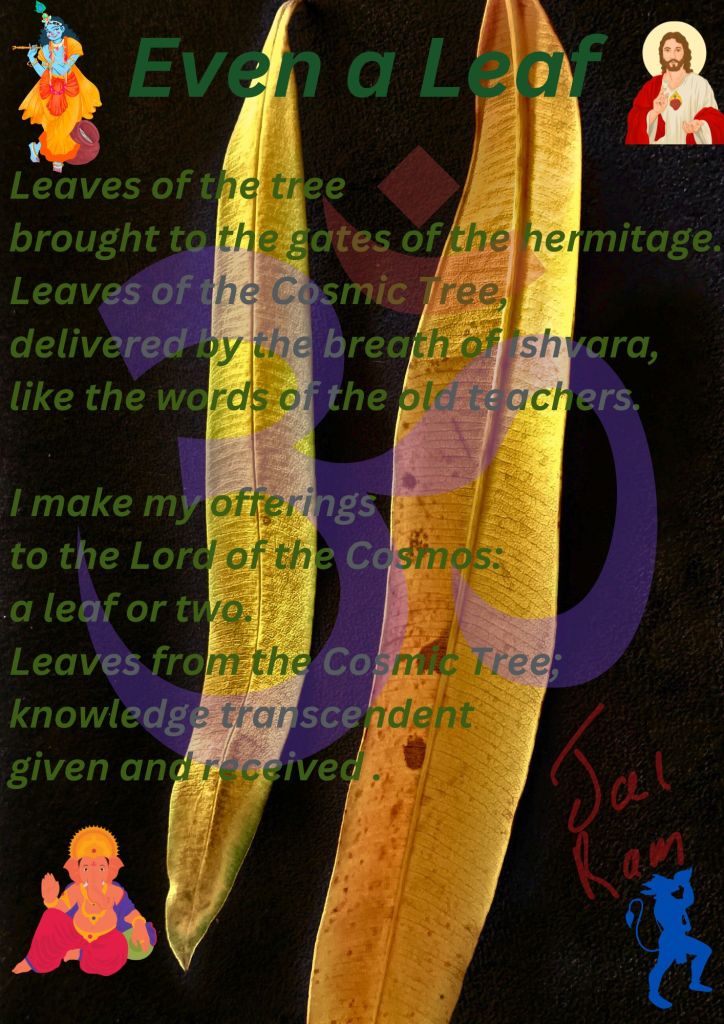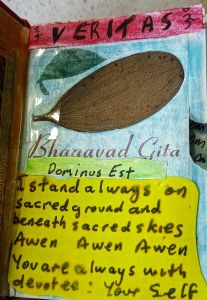
Today, a poem for your reading and contemplative pleasure. The title of the poem comes references a verse from the Bhagavad Gita in which Lord Krishna talks about what are acceptable offerings: He tells Arjuna that God, or the Divine will accept even a leaf as an offering of devotion.
So, when I returned to the Hermitage one day recently to find two leaves on the ground at the front gate, I recalled that verse and decided to make of those leaves, just such an offering.
It wouldn’t be quite correct to say that I never get calls or texts on my phone. What would be correct is to say is that the vast majority are to do with what I might call The Bureaucracy: Reminders of Doctor and dentist appointments, notices from various government bodies, library notices; all that kind of thing.
And there is another emerging category that’s actually a lot more welcome: while my partner hermit and I have always phoned each other, lately we’ve been texting more and more as an extra way to communicate with each other.
Sometimes these texts are about the mundane things we all have to do in the world, but then there’s another dimension in which texting allows us to keep in touch with each other’s feelings, thoughts, doings, and simply as a means of keeping the connection open and strong.
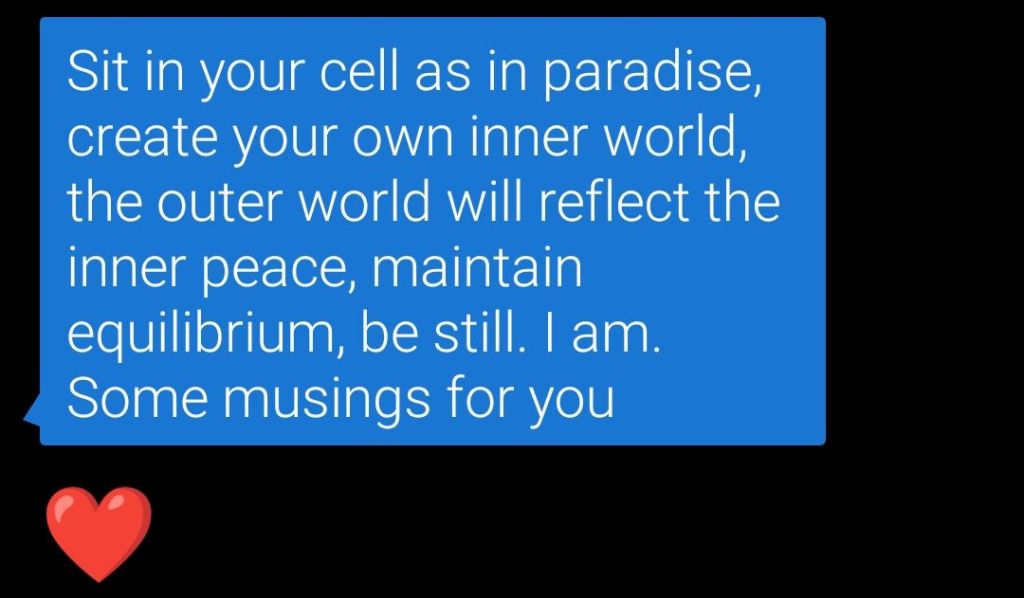
The other day, for example, such a text arrived unannounced in my phone. Like some I get from The Bureaucracy, this one was essentially a little series of reminders. But rather than being about the things of the outside world, these ones, in this text, spoke directly and deeply to the enrichment of the inner life – my inner life.
Powerful messages, all of them, that really go to the heart of one’s (my) efforts to live a life more centred on my spiritual quest and my commitment to living more in sync with Absolute Reality.
On first reading of this text (and on each rereading, of which there have been many), I really felt strongly that I needed to contemplate deeply and prayerfully on the pieces of this whole. And, as well, to share my reflections with you.
Sit in your cell as in Paradise
This little – yet tremendous – injunction references an answer to a question posed to Abba Moses, one of the early Desert Fathers:
Go sit in your cell and your cell will teach you everything.
Essentially Moses’ advice is, remain within the confines of your dwelling place – whatever and wherever form that place takes. This can be a literal geographical location, or even your own body as it moves in the world. We all have a body, we all dwell there.
Sitting in one’s cell is not a simple or passive activity. It is in fact hard work as we wrestle with the mad monkey mind, and attempt to grow spiritually.
So, what about the ‘as in Paradise’ bit? Well, to me this feels very much like thinking of one’s cell as the place to be. What I mean to say is that it’s the only you can possibly be in right now, in the present of the here and now.
It’s not about judgements of is it good or bad, pleasant or unpleasant, painful or not. Just acceptance of where youu’re at right now. Doesn’t mean you’re stuck there and by no means suggests you resign yourself to your circumstances. It simply means you see it like it is, at this moment.
And it’s about understanding that, while you are in that place, it’s where you know you need to be. Your cell – your dwelling place – has within it everything you need to live, grow, learn, and prosper in the spiritual life.
Whatever the ‘place’ you are in is like, we can try to cocoon ourselves, make a space within the space, even if it is just being aware of our bodies sitting in the space. Cocoon myself is an expression I’ve been using lately to describe the act of isolating myself in any way I can from my surroundings. This can apply on the macro scale or the micro as we seek to centre ourselves and find quiet and a peaceful place.
It’s not as if in this cocoon (or whatever it might be) that all will be bliss and light all of a sudden. No, I think the suggestion here is we try to develop an attitude of non-attachment towards the things of the world that trouble us, those things that cause us suffering, precisely because we are attached to them.
That is the purpose of sitting in your cell. That is the everything that your cell will teach you.
You know my friends, I’m a bit weary tonight, and with your permission I will continue with this sharing of my contemplation, my reflections, in my next post.
Reading the other day about the deeper meanings of the word Amen, a memory surfaced.
A memory from the summer of 1971. I was seventeen years old; young yes. I was hitchhiking around Europe, and as for this memory in particular, I was sitting day by day in the Dam Square in Amsterdam.
The memory of which we are speaking involves chanting. One day (or it could have been more), chanting, along with dozens, perhaps hundreds of hippies, freaks, travellers from all over the world, assorted tourists and locals. Chanting Amen. Just like Sidney Poitier sings in Lilies of the Field. Minus all the verses; we chanted the chorus only. Amen. To help get the vibe, just go here.
Anyway, it was a nice memory, a memory of a day (and more) of music in a time of exploration, on the road and trying to be free.
More that that though: experiencing the memory gave me the feeling that that day, in the Square, had included at least a moment of devotion.
Sure, it was likely just one more tune among many sung during those times, but as I think about it now, I sense a distinct vibe of devotion and praise. I recall a sense of a kind of rejoicing in the word itself – Amen.
Anyway, here is the resulting poem. Do look up the chant; and do please join in, add your voice – your own distinct vibration – to the gathered voices.
Amen
DAYS OF AMSTERDAM CHANTING
Once upon a time I hitchhiked to Holland. Another mad attempted escape, trying to leave the madness behind. Amen.
Crashing in the park in the night, beneath a bridge – when it rained, behind the bushes – when it didn’t. Amen.
Squatting in the Square in the day. Sometimes singing days. Dozens of hippies, freaks, travellers, and even a few tourists and locals. Amen.
Many memories of those days remain. Like this one: I was 17, you see, in those days, squatting in the Square – Dam Square. Music in all directions. Truly surround sound. Guitars, bongos, reedy things like flutes and whistles, even a trumpet I can recall. Amen.
Then, a chant erupts, and soon engulfs the gathered. Amen … Amen … Amen, Amen, Amen.
And, now, I’ve joined the chanting, maracas shaking held high, as if in exalted devotion, as I sway to vibration overwhelming. Amen.
This entrancing word, this creative vibration, how long did it linger, permeating the very air I was breathing? Amen.
Memory informs: it was hours. That is to say, it was eternal – or was it a mere moment? Same. Of course, Amen – Om – the vibration of creation was never born, is never changing, always existent. Amen.
Always creating. Always dissolving. Then again creating. Making manifest that which was unmanifest. Amen.
Or, is it a sound and light show? Amen, the word, the vibration, the sound shining a light on what is there already? And what is there already, is all there is. Amen Amen Amen
Another poetic and photographic note to share with you today. In the last month or so I’ve written two poems which are about angels. And both connected in some way with rain, or at least impending rain in one and actual rain in the other.
Initially I thought to just include the most recent of the two, but as I put my fingers on the keyboard it just seems to be emerging that I shall share both with you. And as you know I’m not one to ignore the demands of what types me!
Anyway, I offer them to your for your reading pleasure and perhaps cause for contemplation. Last shall be first in this matter I think. Enjoy please!
Angels, they are everywhere. Perhaps there are more than we know? Personifications of love, of compassion. Of charity too.
ON THE TEARS OF ANGELS
Is it good that angels cry? Anyway, why do they cry at all?
To wash away all the sorrows, to cleanse, to purify, to make new. And to ease the world’s pain.
Then, there are those of us who can’t conceive of ourselves as angels.
For those ones – each and every one – the tears of angels are cathartic; granting catharsis.
A CLOUD ANGEL SEEN
An angel wing seen in a cloud, ephemeral, gossamer. And the angel? She stands concealed within the silver linings of clouds, neighbouring clouds, heralding a soon to be descending deluge.
Frustrated, depressed, annoyed, and even angry at times. All because I know for certain sure that it’s God’s will that I write more – as in more often, more volume, and more quality too. And I’ve vowed to do God’s will in all things to the best of my ability.
No, actually those extremely un-monklike emotional reactions are not because of this knowledge of the will of the Universe or my vow to obey; I have those unhappy emotions because of the other vow I’ve yet to mention: I have vowed to find ways to content myself with how the universe unfolds for my life, and for the world.
I’m not saying that I have promised to resign myself to ‘fate’ or ‘destiny’ or whatever one might call it. No. And it’s a big no because while what happens in the material world is working out according to the laws of nature, it’s equally true that I am in that mix: I have my part to play in the universal scheme of things, just like we all do. It’s a matter of I do my bit, and the Universe (or God) does its bit.
And then it struck me. Blew my mind is more like it. All my frustration, depression, anger, and whatever, over not writing to my own desired level, is really nothing more than a raging against God’s will. Needless to say, this reaction is really quite a distance from obedience!
Another thought on the topic of God’s will – the laws of nature and the natural order of the Universe: By obvious definition those laws and order must (obviously again) apply to all things in what we call the Cosmos or Universe.
All material things, such as bodies, as well as non-material things like minds, emotions and the like. You name it; All there is is bound by the same set of natural laws.
So, speaking for myself alone, not being able to write to my expected or desired for level is only one – and quite a minor one it has to be said – of numerous areas in my life and the world that cause me frustration and all the rest, as I struggle to to be content with the will of the Universe.
Too big a topic, or should I say too many topics to get into here. In any case, shall we set aside that not so little aside for now?
So, where were we? Right: Raging against God’s will; resisting the ways in which the natural laws of the universe are working themselves out. Sounds terrible when you see it writen down like that doesn’t it?
Anyway, it’s clear to me that the Universe , the will of God, is trying to say something to me, which sounds something like this:
‘Look you may very well want to write, you might even be desperate to get those words and ideas out of your head and onto the page, but that’s just not the way things are right now is it?
‘Of course the smooth running of the Universe involves you, and in a big big way too, but you are still just one element in what is really quite a complex, not to mention gigantic, system.’ Nature can put you in your place for sure sometimes.
‘In fact it might be,’ this spokesperson for the Universal order continued, ‘that the Universe is trying to get a none too subtle message across to you? Do you think that desperately clinging to some outcome you want or desire that strongly but can’t seem to get, is causing you pain? Of course it is. Anger, depression, all those sad and negative emotions, they are just not necessary.’
The Universe (in its manifestation as my discursive mind) can be very vocal sometimes, but I think I sort of get it. Essentially what that Universal spokesperson is saying is that the order of the Universe is working out just as it’s supposed to. Actually it can’t do otherwise. I play my part (which according to the spokesperson is bigger than I imagine), and really that’s all there is to it.
In other words, If I’m not writing, then that is precisely what is supposed to be happening (or not happening) right now. And not only that, but because I am an active participant in the way the Universe looks and behaves right now, then it’s also pretty obvious that I already know – deep down somewhere – that it’s really alright. It’s all just as it’s meant to be.
Once again speaking just for myself, I find it quite tricky finding the balance between what part I am to play, and what’s the Universe’s bit, in controlling the direction my life takes or in affecting the conditions that impact me.
Perhaps the best way, indeed it might be the only way, to have a positive impact on my own happiness, peace, contentment, and having a calm mind, is to give up any desires for things that won’t contribute to my spiritual and personal growth or the wellbeing of other beings, while at the same time acting upon without attachment to the outcomes, those desires that seem to me to be for the good of all, including Self.
Being attached – driven by compulsions or aversion – to the outcome of our desires, however, simply leads to more desires even when fulfilled. And when they are not fullfilled, there is suffering due to clinging to those compulsions.
Bottom line? I am seriously attached to my desire to write more (as well as so many other things as I alluded to earlier), that not being able to do that right now is causing a lot of suffering. Enough of that I say! Oh, that balance thing: it’s about discernment isn’t it? Okay I get it, story for another day.
PS I’m so glad I got that all out of my head and onto the page. Thanks for listening friends.
Who am I to even contemplate composing a commentary on the Bhagavad Gita (BG) after only seven or eight years of study, some formal with a teacher and some more casual alone?
Well, what I am is nowhere near qualified, nowhere near ready. Actually I don’t feel qualified in any way for such a thing. So much less so was I when I first sat down with my newly gifted BG in a tiny cafe called The Office in Rishikesh, literally hanging over the river Ganges.
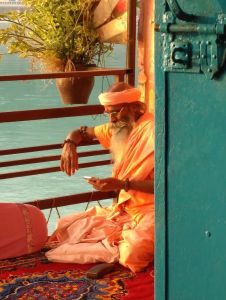
A Saddhu or Holy man and his phone at The Office
With the best fruit salad in the Universe, and fine chai to match, it was the ideal place for contemplation – that is when it wasn’t bursting at the seams and crazy.
But, as I sat there with my new BG I was one of only a couple of customers, so it was a conducive atmosphere for the aforementioned contemplation. Instead I think what happened as I thought about how to proceed to a proper study, was I allowed the sugar from the just ingested fruit salad go to my head.
You see, I decided, as I sipped a post-fruit salad chai, that the perfect study method would be to write a commentary on the whole thing starting with Chapter one, Verse one.
I no longer possess the diary in which this masterpiece was begun. Nor do I recall much, actually nothing, of what I wrote. It’s enough to say however that nothing I wrote could possibly have had any significance or depth or proper perspective.
So, as you might guess, I rambled and waffled for a couple of verses before I snapped out of my ego-driven state of arrogance and hubris. I realised I had absolutely no business taking on such a task. My lack of knowledge, wisdom, experience, all disqualified me from even thinking I had a right to try.
Now, even with the small amount of knowledge I have managed to acquire after all the study, I’m stunned at that arrogance and hubris – even if it was sugar induced. I mean, I’d never even read more than a few verses of the BG before. So, how could I even form a ‘first impression’ or ‘casual opinion’, much less a full blown commentary?
A couple of days ago I read a couple of verses that really resonated with me, as they have before. So, just like that fool sitting in The Office all those years ago, I confidently asserted that I was more than up to the job of making a commentary on those verses for this blog.
But, and here’s the really weird thing: I only just now realised, as I’ve been writing these notes, that the two verses which I will quote for you shortly, address precisely my behaviour on that post fruit salad, sugar shock induced ego trip.
I realised that it’s as if I have indeed written a commentary on those verses. And I have used a personal experience to illustrate the text. Absolutely unintentionally as it happens.
Regardless of what excuse I come up with the error in judgement in thinking I could write a full blown BG commentary all those years ago, the reality is that I failed to act with discrimination, or what I would call discernment.
In the high holy lands wrong thinking can still happen
Somehow I ignored (or totally forgot) the facts: I knew nothing! I’d lost the ability to discern what I could do and what I couldn’t do, what was a sensible action and what was a ridiculous one.
Stop! Memo to Self: Please stop picking on me!
Anyway, moving right along, here are the verses – free from commentary!
‘Thinking about sense objects brings an attachment towards them. Attachment leads to desire and desire leads to frustration, which in turn leads to delusion. When you are deluded you lose your memory [the knowledge and experiences you could draw on to make proper decisions; sometime even to the extent of compromising your own values] and with the loss of memory the power of discrimination is destroyed; with the destruction of discrimination your self itself is lost’ .
Bhagavad Gita Chapter 2 Verses 62-63 (my version of the BG sometimes combines verses as it has here)
Everyday I affirm, I pray with longing and with hope, these words:
Let me keep silence in this world
Some days, like today for instance, the prayer feels empty, devoid of any hope, or faith on my part, that I will at some point really be able to attain at least a degree of silence.
Yes, I know, prayer is not some kind of magic formula by which one utters the words of the prayer as in some kind of incantation, then in due course that which has been prayed for appears or comes to pass as if by magic.
Prayer, rather, is affirmation in which the one praying places full attention on the words prayed and their meanings. And more importantly on the notion that the Universe is in perfect balance all of the time, and that things – all things – are manifesting how and where and when and why, and in precisely the manner that they’re supposed to.
Prayer is more a kind of wake-up call, a reminder notification to Self that everything is exactly as it is, and is meant to be that way.
Fine theory. Yet it’s a theory I sometimes know to be much more than a theory.
Other times, this being one of those times, I have a hard time, or I should say my mind can’t accept that silence does indeed exist. My mind is simply not able to grasp that silence is already within me, ready and able to give me peace.
Closed Cafe at the End of Lonely Street: Silence comes in many and varied forms
It is obvious to all of us I think, that silence is not simply the mere absence of words, of speech. Not talking is simply one aspect of silence; it’s like silence is a thing, an entity or state of being that doesn’t only imply an absence but suggests an adding on of a new state of being.
When I pray Let me keep silence, it is true that I am seeking the silence of the mind, the inner silence that can bring calm and quiet to the heart and whole of Self too. But, to be truly upfront as they say, it is the silence or quiet that emerges from time spent not speaking that I long for.
Long for? I use that word quite often and it’s occured to me that, while to long for something is to have a desire for that thing, a longing is actually more than a simple desire. It’s a very strong desire, a kind of desperate wanting or wishing for that thing. You might even call it a compulsion.
Now I think about it, what is the desire or drive that keeps me doing exactly the opposite? Why do i feel the need to be talking (thinking too, but here I’m thinking about talking too much) all the time? It is clearly also a compulsion. That’s the only conclusion I can come to.
So then, why the compulsion to talk all the time?
Well, to once again be frank, upfront, I don’t really care about the reasons for or causes of, this compulsion. Probably stems from deep-seated anxiety, long-standing low self-esteem, old habits, fear. The list of explanations could go on and on, but what would be the point of that?
The real point, for me, is that compulsive talking is no mere bad or inconvenient habit. Personally it can actually cause physical symptoms of the ‘feeling sick’ variety, as well as guilt, shame, even sadness and regret.
And even far worse still is that this compulsion causes at the very least for those around me annoyance and frustration. Incessant talking distracts them from their own thoughts and activities, disturbs their own desire for silence. It’s all very obvious to me.
So, while I am compelled to talk all the time and too much, at the same time I have a strong aversion to that very act of talking too much (and all the time). The talking too much causes suffering to myself and others, while my inability to change also causes suffering. A kind of no-win situation arises, has risen, is always present.
Okay then, what is the solution? Or, more to the point,is there a solution? Well, I didn’t start making these notes with the hope that I would somehow come up with a solution to this dilemma . But, having said that, I’ve been thinking while writing that I do seem hugely attached to the idea that I talk too much, and too often.
As well, I also seem desperately attached to the desire to stop talking so much and so often.
While doing all this (possibly excessive) thinking, I was reminded that the Buddha didn’t say that the cause of suffering is desire; what he said was (allow me to paraphrase): the cause of suffering is attachment to desires.)
You know, another thing I write and think of a lot, is the idea that things work out exactly as they’re meant to. Of course not so easy to actually believe all the time, especially when things aren’t going according our personal wants, desires, and wishes. But it’s another of the prayers if you like, the affirmations which speak of the truth of the balance of the workings of the Universe.
In a way then, despite the lack of intention, I may have nevertheless stumbled upon at the very least a hint of a solution to my dilemma.
We ourselves are merely one more manifestation or result of those workings of the Universe, of that natural order, of those laws of nature that keep it all (including us) in motion.
So, I’m back where I started when I described what I believe prayer to be: an affirmation and a statement of faith in the reality that the Universe is unfolding exactly as it should.
Perhaps if I spent more time (not to forget more heart, more mind, more love) in reminding myself of that reality, and less in toying with my compulsions and aversions and with all my efforts to shift and maneuver the natural order of things to my liking, then I might find that equilibrium , that – what’s the word? – equipoise – in which I may actually realise the balance that I know already and always exists. Maybe then I can finally attain silence.
Deep with the still centre of my being, may I find peace.
Silently within the silence of the grove, may I share peace.
Gently & powerfully within the greater circle of humankind, may I radiate peace.
Just a quick final note: my idea that the universe is working out exactly as it’s supposed to is not mine and it’s not new. I’ve quoted the beautiful poem/prayer Desiderata (the word is from Latin for things desired) before, but there’s a line from it that I’ve borrowed heaps of times:
No doubt the Universe is unfolding as it should
Thank you for allowing me the privilege of sharing all of this, which is really one long prayer, with you.

Right at the front of my Bhagavad Gita (the only book aside from the notebook I’m writing this in, that I personally own), I have recorded and inserted sayings and various words , that are important to me. Among those things is a statement I first heard many many years ago, that is common among the First Nations’ peoples of this country:
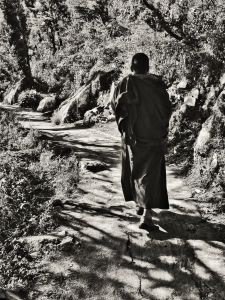
I [We] stand always on sacred ground and beneath sacred skies.
It is not an affirmation of ownership or possession. It is, instead, an affirmation of belonging to the land, to nature. It is a prayer of thanks, and it is a declaration of the knowledge of unity with the rest of the natural world, that is the hallmark and foundation for Indigenous cultures throughout the world and through time.
I’ve valued – treasured – this sentiment for a very long time – probably from even before I first heard it, which was so long ago as to be lost to memory. Perhaps I always knew it because I’ve somehow always thought this idea was a fundamental truth concerning my existence as a being living on this planet.
Well, now I have heard another statement that for me makes a perfect compliment for this one. The other day, during a lecture, my teacher mentioned that in his student days a fellow student said:
Wherever you are, you are walking through Ishwara
(Ishwara being her preferred name for the divine – for all that is.)
There is a feeling or sense of ‘belonging’, of awe and wonder when we attempt to immerse ourselves in what we term the natural world.
Once again I immediately felt the bell of Truth ringing clearly through this statement. Yes, I thought, everything is divine – including our own selves – so of course it follows that wherever we go, whatever we do, we are always in the divine.
You’ve probably read a number of times me quoting my teacher quoting his teacher:
Emphasis very much on only. Meaning of course, that it’s not that God is within us, or that we are within God; we are not surrounded by God; and it’s not that God ‘sits in our hearts’. The reality (for my teacher’s teacher) was that all that is, everywhere, everything, every thought, every word and deed, everything there is, is the divine.
Another way to describe the divine or God, that appeals to me is that Ishwara (also my own preferred name for the Divine) is in reality the natural order of the universe as dictated by the laws of nature. Those laws of nature, the rules that govern how the universe works, are also Ishwara, as are all that is manifest or in existence as a consequence of the workings of those laws.
In other words, the Divine is the sum total of what some would call the entirety of creation.***
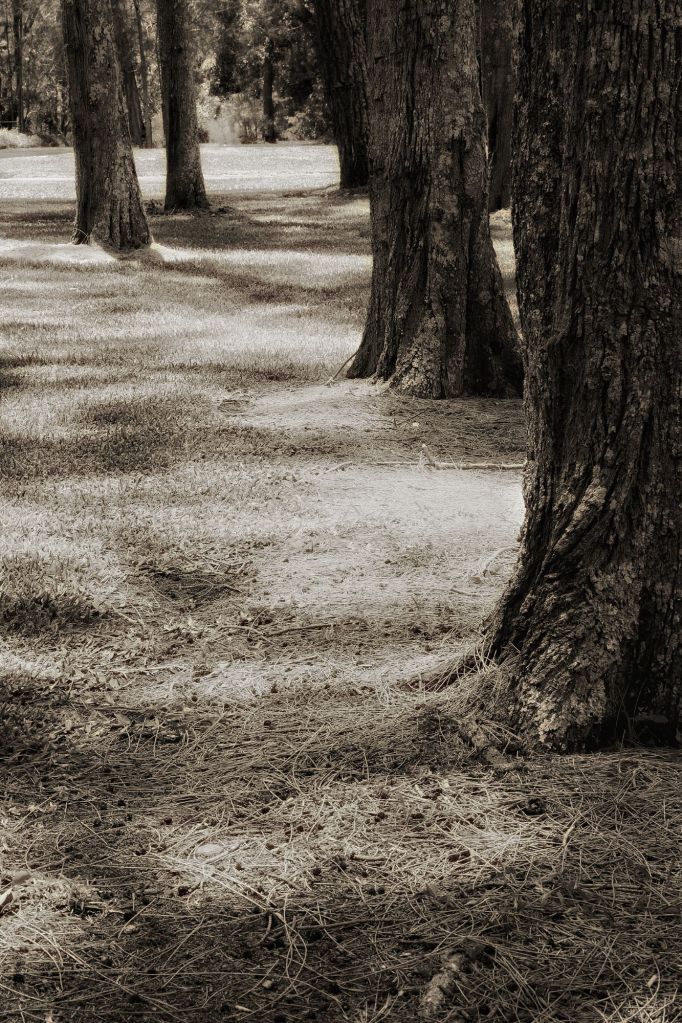
For the hermits a sacred site. Part of a grove we named The Sentinels. A place of experience of unity and oneness of creation
For me this an enormously comforting and reassuring concept. Of course, for me at least, it is also an extremely difficult one to wrap my head around. But here’s a small summary of what I think I’ve grasped so far.
Ishwara – the Divine – is all there is; everything. Also divine is the natural order of the Universe as governed by the laws of nature. These laws are neither good or bad – there is no duality. They are neutral.
You and I, as one more entity among who knows how many others, act as we do and are subject to the laws of nature, just like everything else. We can’t change or influence those laws; we can only live our lives as they unfold.
To quote from Desiderata: No doubt the Universe is unfolding as it should
And, well, then things just work out as they do. While we can’t change the laws of nature, or bend the universe to always suit our liking, it is also true to say that every action we take, every thought we think, every word we utter, even our very presence as a living being in our time and place, do indeed contribute to ‘how things work out’. Another way of saying this is to say, we do our bit, and the universe does its bit and what happens, well, happens.
For me, this is not at all as simple or as straightforward as it sounds. Naturally we see ourselves as individual selves, as entities on our own. After all, to state the obvious, we live and operate in a material (dualistic) world. So automatically we see ourselves as individuals living in, but always separate from all the other individual entities, as well as being disconnected from the world itself.
It is part of human nature (for the most part) to long for connection; there is so often a drive within us pushing us to create family, enter relationships, feel we belong to a community or communities, and for many but not all, there is the almost instinctive urge to seek connection with the rest of nature.
Many forms, One reality
We often think of these longings as goals to achieve, as something outside of ourselves to attain, to reach for. Consequently, so very often we tend to focus our attention outwards, towards other people, or material things.
But, instead, all these inclinations, desires and longings are simply our Self (note the capital?) endeavoring to open itself to discovering (or rediscovering?) that which already exists: our oneness with, and our non-separation, and non-difference from, The All That Is.
Peace and Love from Paul the Hermit
FOOTNOTE
***Just a few thoughts about naming, or giving labels to the Universe and its laws. Obviously it’s a personal choice for each of us what we choose to call that creation. Then, on the other hand, we don’t have to call it anything at all. For me personally it is very difficult, even near impossible to not name it. By naming the creation, I don’t think I am attributing the manifestation of the Universe to some distant entity living in some heavenly abode (as my teacher likes to say). Rather I am acknowledging the intelligence and order, beauty, complexity of all that is and how it all works, as its own reality. At the same time, I am learning to understand that I as my true nature am not separate from the rest of creation, and I feel the need to have a name towards which I am able to focus my thanks and my reverence.
It would be true to say that I’ve been on a spiritual journey all my life. Perhaps there have been other lives too, who can know? Who can work it out? And, anyway, I don’t think it matters at all. This life will do.
That’s an easy generalised statement to make I know. So, being more specific, let’s just say that for as long as I can remember I’ve been interested in and studied ‘spiritual stuff’; and in more recent years I’ve narrowed my focus, so to speak, and now I am on a deliberate and committed journey towards that time when I actually recognise, when I fully realise for myself that I am already one with God. Or the Divine, Dharma, Love, Absolute reality, Truth, Spirit. Many names and no names.
During this long journey, I’ve been blessed to have been exposed to so many sacred texts, scriptures, books, teachers, and so on, from so many different spiritual and religious traditions. And of course, the Christian New Testament ranks high among these treasure troves.
Like many of us, however, long before I actually read the text itself I had heard and was familiar with many of the stories and characters in the Gospels and so on. As well, over the years of childhood (and later too) I came to know several different Gospel verses. One of these in particular has long been a favourite (actually there are a lot of ‘favourites’ but …) and I couldn’t possible tally up all the times I’ve either thought about this verse or quoted it out loud.
For where two or three are gathered together in My name, I am there in the midst of them.”
Gospel of Matthew 18:20
Now, this verse comes in the context of a chapter with some really powerful teachings from Jesus to his disciples, in which he is telling them how things should work when people gather to pray, to praise, celebrate the Divine. Essentially in this and other verses Jesus talks about the characteristics that should be present in a community of disciples.
And everyone else too
Things like harmonious relations between people. He stresses the importance of forgiveness when people think someone has wronged them. There is a great stress placed on the value of consensus when it comes to decision making or disputes between people.
Another biggie is the emphasis on how people should not behave in any way that would cause their fellow disciples to ‘stumble’ or fall. Meaning I think, be a good influence, not a negative one on others.
I have a confession to make: I knew none of this before I read the full chapter along with a few commentaries quite recently. Let me tell you what I thought for many many years the verse meant.
For me, it was simple. It just meant what it says: If I gather with one or more other people in the name of Truth, Dharma, God, the Divine, or whatever else we might choose to call the Absolute Reality that is everything, then we are reminded to recognise that Absolute Reality is present with us and in us.
Which means we have to act accordingly, just as Lord Jesus advises. That is, with love, with an intention to foster consensus and harmony; in ways that build us all up and bring nobody down.
While Jesus was addressing the needs of the newly formed Christian communities, I believe that this verse can refer to any gathering of people of goodwill. And communication between people that has as its intent love, devotion, positive living, peacemaking of any kind. Basically any meeting of people that is infused with good intentions and the desire to pursue right action in the world, or internally within each individual. And when you think of it like this, then it pretty much covers any coming together of people doesn’t it?
I especially like the use of the phrase I am in the verse. Of course, the ‘I AM‘ is a name for God.Essentially there is no need for any other name because ‘God’ encompasses everything and there is no need to ‘label’ that I AM because that would limit what is actually Absolute Reality to some ‘created thing’, which is less real or perhaps absolutely unreal!
Notice I seem to be labelling the I AM as Absolute Reality. That’s the trouble with us limited beings: we have to use words to help us define or describe everything. So be it. Some people will call that Absolute Reality as God. Others will call it the Divine, Truth, Love, Dharma, and a million other names (or by no name as I said earlier).
This verse promising the presence of I AM may have been uttered by the human incarnation we know as Jesus, but for me, those words in truth came from Universal Consciousness, the I AM. Meaning, again for me, Universal Consciousness or Absolute Reality, which really is all there is.