Lakshmi Visits: Timely Reminders

Today I have a story to share. It’s one of those stories in which one little random (as if!) event or occurence leads to another, then another. Like life really – one thing leading to another.

When I think about it, this small sharing is very much like many of the other stories I’ve shared: about my prayer life; about realisations and revelations I encounter along the way.

(note from inner editor: Please try to ignore him going on and on like this. You know what he’s like don’t you? You’d think he might find some shorter way to say something so simple wouldn’t you? Something like, that’s why the blog’s called Notes from the Hermit’s Cave and leave it at that. He really should just get out of the way and let me get on with the writing)

Ignoring that little interruption, I will begin our story. Yesterday morning. I was in the very act of opening my Bhagavad Gita to get to some of my inserted prayers, when without thought I turned towards the back of the little book, landing on the second to last page.

On these facing pages I have a treasured image of Lakshmi and on the facing page I have copied a mantra to her that I particularly like and sometimes chant.
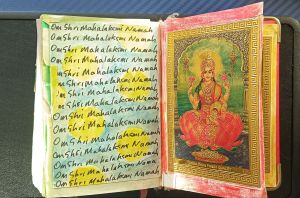
Smiling to myself, I thought that, today (as in yesterday) I would spend a little time with Lakshmi.

For me personally, Lakshmi represents the eventual realisation of my aspiration to complete Self Knowledge, the final realisation of the oneness of all things in one absolute reality. For me that says freedom, liberation, Moksha some call it.
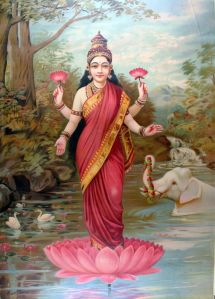
So she – who is one more manifestation of the Divine Feminine and the Divine Mother – represents for me that state of peace, bliss, harmony, as well as a perfect balance in both my internal and external lives.

Sometimes when I feel in need of a little extra courage, some piece of missing knowledge, or perhaps I’m feeling the need to persevere with something or other just a bit longer, I’ll think of Maa Lakshmi, and often recite her mantra.

Really, for me, it’s simply a kind of way to remind myself that the courage, knowledge, perseverance, already exist within me. No need to go looking elsewhere.

I’ve read somewhere that many people appreciate Lakshmi’s  fickleness. You never know what she’ll do, what’s actually going to happen.

Which obviously is a way of saying that thinking of Lakshmi can remind you (or me in this instance) that life is like that: it’s all ups and downs, it’s unpredictable in that it gives us things or situations we don’t want, while also frustratingly not always giving us what we do want.

In other words, Lakshmi reminds me that, whatever happens in my life, regardless of my opinions or wishes on the matter, is happening exactly as things are supposed to be. Of course it’s not really ‘fickleness’ is it? That’s just how we see it sometimes as we seem to impose our own human changeability on the Absolute Reality which is just the way it is, no duality!

Anyway, before that pesky inner editor makes another pop-up appearance, let’s move on wth the story.

So, a ‘little time with Lakshmi’ has turned into a perfect illustration of life working out as it does, and not necessarily according to our little momentary expectations or desires. That planned ‘little time’ has morphed into, so far, a full day and a half.

Back to yesterday morning then: I chanted the Lakshmi mantra, then decided to listen to a recording of the mantra I have so I could contemplate what She means to me.

Right away I discovered that the music file was corrupted, and that sent me on a several hour long quest to find a replacement. Suffice it to say that there are what seemed like an infinite choice of candidates to choose from.

But, even after those few hours, I’d failed to find a version that satisfied all my requirements: it had to be a relaxing, clear chant I could ‘sing along to’; it had to be free of bells, whistles, and other superfluous adornments. Above all, it had to feel right.

As I went forward with this quest, I did in fact come across and listen to several lovely versions of the mantra, that while not quite right for my purposes, I did think might make for good and happy general listening.

These – or the links thereto – I emailed to myself and to my hermit partner. I then put the search aside, thinking that the right mantra will eventually turn up.
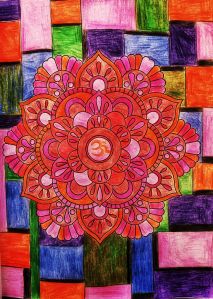
Not too long after this, I heard coming from the direction of my hermit partner, a truly magnetic and beautiful version of the Lakshmi mantra. You can find the mantra here

‘Where did you find that?’ I asked wonderingly.

‘You sent it to me,’ was the incredulous and puzzled reply.

Really? I honestly had no memory of hearing that particular version, and I still have no idea about it. In any case, once it was forwarded back to me, I set about listening to the mantra through my earbuds.

Blown away, would be one way to describe my reaction. Probably more accurate to say that listening to that twenty something minutes of beautiful music blew me not away, but inwards; completely and utterly to inner depths rarely experienced. Another full story all its own if truth be told. Perhaps another time.

The serendipitous turning to Lakshmi in my little Bhagavad Gita was yesterday morning. And the poem was written this morning as we listened to the mantra itself. A listening, I might add, that has only just now ended as other things required attention. Several hours, in other words, of exposure to beauty itself.
Anyway, my dear friends, what I share now is my response to that listening experience. Or to put it more accurately, the poem that follows is my response to my response.

Hearing the Song of the Universe, is the name of the poem. And it is an absolutely suitable and appropriate title I think.

May you also hear that song.

HEARING THE SONG OF THE UNIVERSE

Om Shree Maha Laxmi Namah.
The beauty of the words, the blessings of the melody,
infuse me with a mood prayerful.
Inner resonance has my Self reverberating
with the rhythm.
With the drumbeats accompanying the voices of angels.
Like raindrops dripping from eaves
after the storm has passed.

Words of praise for Maa Laxmi
meld with the hypnotic wind
emerging from the flute.
Wood and wind,
and angelic voices.
Together they sing.
They sing the song of the Universe.

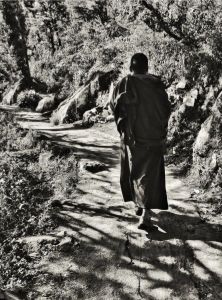
Tears well at the corners
of the eyes of the worshipping monk.
‘Let it all go.’
The encouraging words
of the Beloved enter the heart of the monk.
Yet, the tears do not fall.
No, not yet.
In the meantime, the monk breathes.

A Gift Came to Me in an Email

Even a Leaf

A couple of days ago I recieved a beautiful gift in an email. I often receive wonderful things through the email, and this one, as with so many of the others, has profound meaning for me.

Not only that, but this gift has served as a reminder to me of that significance. I’d like to share with you that gift, as well as some thoughts on its importance and meaning to me.

There are a multitude of sources online where you can learn all the technical stuff, word meanings, history, origin, when it’s used and all the rest. I would like, however, to just ‘think out loud’ in my own words, and follow my own heart’s promptings.

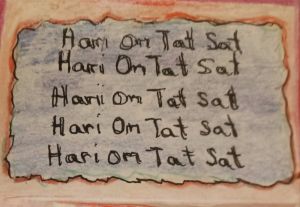
Hari Om Tat Sat, is actually two mantras in one: Hari Om, and Om Tat Sat.

Hari Om represents the totality of what we might call God. Hari refers to the manifested cosmos, as well as the creative impulse in its manifest form. I call that Ishvara, but it doesn’t have a name I’m sure!

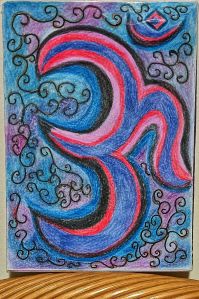
Om, is the unmanifested universal consciousness, the Absolute Reality. Meaning, as I understand it, existence itself. I call it Brahman, or God, but again, names are just labels we humans apply to things to make it all seem so neat and tidy!

They say that Om Tat Sat is the most sacred of mantras (in Hinduism). It’s used at the completion of prayers and rituals as a way of invoking the presence of the divine and ‘bringing it all together’ you might say. Well not so much bringing, more like a reminder that everything is one already.

I really like the chanting of Hari Om Tat Sat. It’s a centering practice I would say, a way to remember the oneness of all. And I say it, as the traditionalists do, as a closing to prayers or other practice; it’s like ‘Amen’ or ‘It is so’ or ‘Let it be so’ or, well it’s endless – and personal and subjective.

As mentioned, Om means Brahman – or God in the unmanifested state; Tat, not only sounds like that but does in fact mean all that is. In other words, Brahman or the Absolute. Sat means Truth, Absolute Truth or, once again Brahman.

For me it is a little prayer of its own actually. And I’ve heard it used as a greeting many times. It’s a means I think of honouring the divine within the one being greeted, while at the same time I have a sense that it is a recognition, or acknowledgement rather, of the oneness, the unity of the greeter and the greeted along with everything else.

This is why I don’t really feel the need to break the mantra down to explain in technical detail all the constituent syllables (even I were qualified to do so, which I most surely am not).

It really is a way to acknowledge the oneness of all, the Absolute, which includes, obviously, me and you. The Truth is absolute, it says, so must we be, absolute.

Hari Om!
Om Tat Sat

New Series Coming Soon: An Introduction

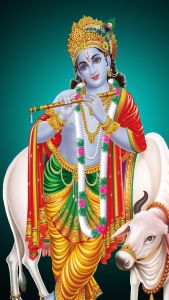
Lord Krishna

Namaste and greetings friends

Not long ago I began studying an Indian scripture called The Uddhava Gita. It’s quite a lovely book actually: it’s poetic, actually it is a poem, or song, and beautifully written. The title means The song of Uddhava and is an account of a conversation between Krishna wearing his God of the Universe hat, and his cousin Uddhava.

The story takes place in their home town of Dwarka in the state of Gujarat (Krishna was also a regular family man with a huge extended family) which is about to explode in a destructive civil war. Soon Krishna is leaving to return to his heavenly abode, and at the opening of our story, he advises Uddhava that he too should leave town ASAP.

I should point out at this juncture that I do not see this Gita as a historical document. It’s a story created as a backdrop against which to place a long conversation in which Krishna, or God, passes some spiritual teaching to Uddhava.

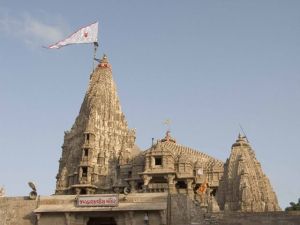
Dwarkadheesh Temple Dwarka India
By Scalebelow – Own work, CC BY-SA 3.0, https://commons.wikimedia.org/w/index.php?curid=5739970

Although the location of the story is a real place and exists today, we don’t learn anything beyond that this is the setting for this little chat.

The purpose was to present these teachings in an entertaining and accessible format. Like so many scriptures around the world, this one is a song, making it easier to learn and pass from one person to another over time in a society that was not yet universally literate.

So, why am I writing about this text? Well, in one section Uddhava is asking his cuz all sorts of questions, that have obviously been on his mind for a while. He knows Krishna is leaving he planet soon and he thinks that this might be his last chance to get some answers.

He asks questions like: What are reality and truth? And, What is a person’s strength. Then there are queries like: Who is a friend? What is home? Many are related to spiritual matters and practice, and all are concerning qualities and attributes a person should possess to live a good life, a honest life. A Dharmic life.

Actually, if I were to condense all of Uddhava’s questions into one big question, it would probably go something like this:

How can I change my lifestyle so I might live a righteous life, a good and honest life in which I can learn the truth and live my whole life according to that truth?

Now, here’s the thing: Uddhava asks a total of 36 questions, some singularly, some are multiple questions containing two or three queries. Krishna then proceeds to answer the questions, all of them in fairly quick succession.

I would like to share a few of those answers with you. I don’t get the sense that the questions are asked or answered in any particular order or pattern, so perhaps those I share will be an idiosyncratic selection, or it may be entirely random. Not that there is such a thing of course, so I guess you will just have to wait and discover for yourself the chosen questions.

Don’t worry! I have no intention of burdening you with the complete set of 36. In addition to saving you that fate, some of the questions and or answers didn’t resonate; others didn’t feel overly relevant to this blog.

I’d like to devote an individual post to each of the questions, bearing in mind some of them are multiples. I learned about all 36 questions and their answers in an hour long class. Needless to say that experience was more than slightly mind-blowing. One or two (or maybe three) at a time will be just fine for all concerned I think.

So, next post, I look forward to sharing with you the first of Uddhava questions along with Krishna’s answer. It will in fact be literally the first one asked; I thought discussing it at the start would sort of set the scene and the tone for us.
After that one there will be further posts. Again don’t worry, I’m planning a fairy short and occasional only series.

Salute to the Sun

Namaste

In today’s post I’d like to share with you a photo. Actually, I share photos with you in just about every post don’t I? In fact, for me sharing photos (the vast majority of the ones I post on this blog are made by me.) is a really special and important element of my spiritual practice.

As is the actual making of them. My camera is – I think has always been – a tool for contemplation. Essentially, I wander around with my camera ready, my eyes open to see and receive, and with my heart and mind open. These last two are in the ‘much as I can’ category, but really that’s what I try to achieve: a kind of open, receptive, presence.

Then, sometimes, my eyes, mind, and heart all sort of see the same thing at the same time, or something draws my attention, or an insight dawns. Then, I raise my camera to my eye and the picture is made.

Anyway, let’s back to the topic. This isn’t a post about Contemplative Photography. My intention today is to share this photo with you.

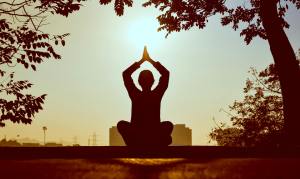
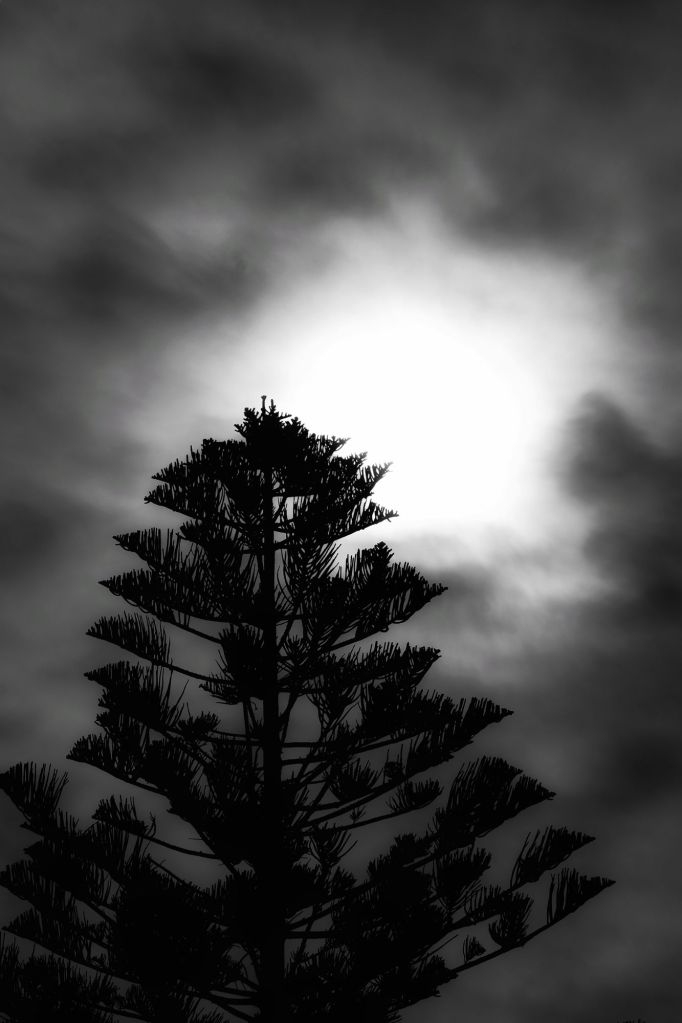
It’s called At a Time of Prayer, and from the moment my senses, mind and heart too, coalesced to cause me to raise my camera to my eye and make the photo, it’s had a unique or special resonance for me.

And not only me: The photo has gone viral here at the hermitage, appearing on phone screens and tablet desktops and lock screens. And it appears very often in my thoughts and prayers, my contemplations and even in conversations.
Perhaps you will allow me to share the little story behind this image as well as a possible explanation for its hermitage wide fame, favour, and love.

About a month ago I was walking along the lake front in the seaside town hosting the hermits at the moment, heading home after a long walk. I was listening to and chanting a favourite mantra (one about removing obstacles).

Absorbed in the music and the vibe of the mantra, I looked up – seemingly at random – and saw, well what you see in the photo. Without thought or hesitation and simply instinctively, I raised my camera to make the picture.

Ah yes, I see what you mean. You are quite right, I can’t exactly say I saw the scene in tones of grey, not technically. Though the camera did actually see and record it in monochrome. Let me explain.

You see, sometimes I switch my camera to only make black and white photographs, with the intention of shifting my way of looking and seeing the world around me. It’s always amazing to me how differently I start seeing things, once I get used to the change. I never get tired of it really. Like magic!

Anyway, once I lowered my camera, I said a prayer to Surya,  the divine in the form of the sun.

Everyday, each morning when I first get up, I go to a window in the hermitage that faces the rising sun. I give thanks and praise for the life given and sustained by the sun; I praise its beauty too and give thanks for its light and warmth. Today, although the cloud is mostly covering the sun, I know it is still there and still shining, giving us all life.

Okay, back to the moment of the making of the picture. It was after my small prayer – my Surya Namaskar –  my salute to the Sun – that the name of the photo came to me: At a Time of Prayer.

That made sense to me: I was already praying before I made the photo, then after it was made, I once more said a prayer. It truly was a time of prayer.

Now, the big question: Why has this particular photo had such an impact here in this haven of the hermits? Why, even now, do I find it a really appealing focus for contemplation?

Despite it being a dramatic photograph of start contrasts between light and dark, it seems to me to exude a kind of serenity. Perhaps it’s precisely the balance of those contrasts that makes for a peaceful easy feeling in what otherwise might not be seen as a quiet and calm image.

And it may be just that serenity arising due to that balance that contributes to the sense I get when looking at the photo: All is well.

All is Well. Why sense that in particular? Perhaps because I was there at the time. Perhaps because I was praying, looked up at just that moment and all my senses led me, along with my camera, to make the picture.

And in a sense, it’s a moment I can relive and remem ber through the photo, especially given the prayerful, contemplative mood in which it was made. At that moment of making it did indeed seem that All’s well.

And now? I know that All is well, all shall be well, and all manner of things shall be well (paraphrasing and with thanks to Julian of Norwich.)

There is too, the power and light of the sun illumining life, which here is represented in the form of the towering Pine Tree.

Yes, I sense that balance again. A kind of harmony also. This time between life itself and that which enables and supports life. It is good to contemplate balance and harmony.

Anyway, a gift given to me, now shared with you.

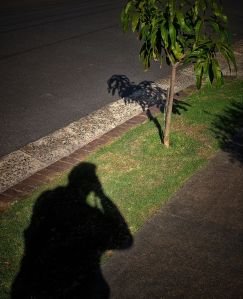
The Hermit Contemplates His Shadow

Sacred Places, Sacred States

Tirtha. There is much varied, detailed and fascinating information about this word on its Wikipedia entry. While I invite you to click the link and head over there to read what is truly a riveting story, for this post I wanted to focus on the word’s actual meaning, especially the metaphoric meanings it has acquired.

Tirtha is a Sanskrit word meaning ford, as in a place one fords or crosses a river, stream or other body of water. Over time, however places of religious pilgrimage began to be called Tirthas. This evolved because so many holy sites were on or near rivers or lakes, or were the water bodies themselves, or were located nearby.

Sacred sites, and places of pilgrimage often inspire in people a sense of leaving the ordinary material existence  of their day to day lives, and entering a kind of other world, the world of the spiritual or non-material. This experience, which we might call spiritual or religious , is something people remember as being very special, even transformational; for them it speaks of a connection, even briefly, with the divine in the form or in the presence of that place or site.

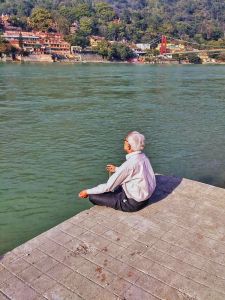
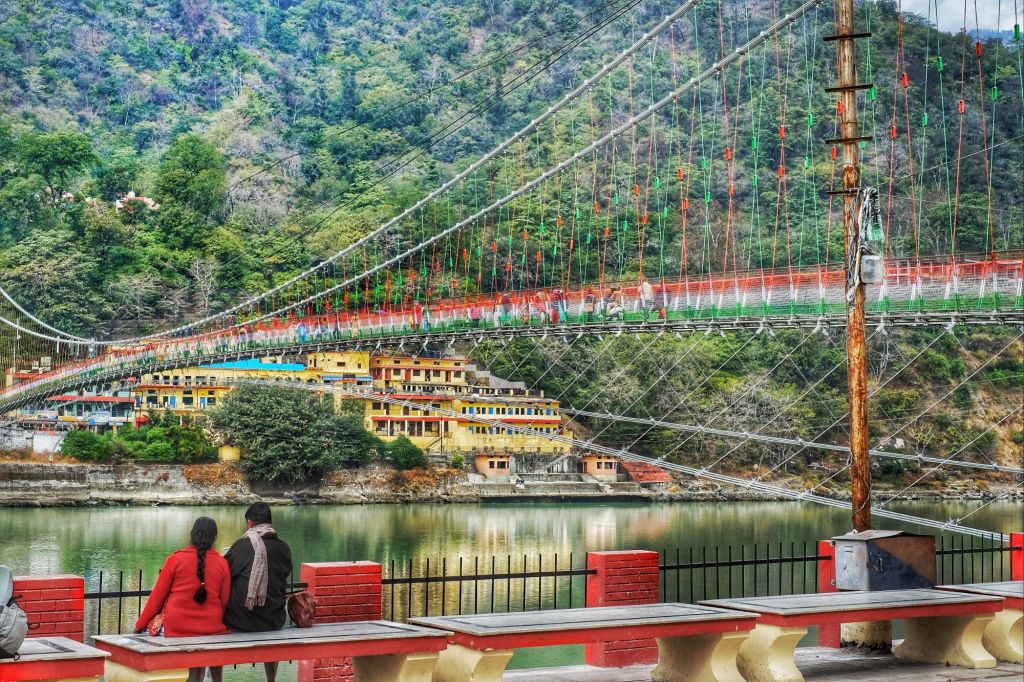
Perfect example of a Tirtha as a literal crossing place that is also an ancient sacred site. Mother Ganga at Rishikesh in India

And after many years – centuries and millennia very often – the energies from sometimes countless pilgrims and their prayers, devotion, love and mere presence, accumulate and begin to permeate the atmosphere in that place as well as the very ground and sacred objects there.

To me this notion is reminiscent of the concept of thin places  as described in Celtic Spirituality (though the concept by the same or other names exists for many cultures around the world. Sorry I’m not providing any links: there are so many!).

Some would say they are places where Heaven and Earth meet. Places where the boundary between the mundane world and that ‘somewhere else’ of the transcendent, is especially thin, and where crossing over, or connecting with that transcendent may be possible, or made easier than at other places.

Of course, as I’ve written in at least one previous post, I feel that we are always standing upon sacred ground; all things are sacred or holy. At the same time, I have, like so many others, experienced what seem to be very real connections to or mergings with something  transcendent, something ‘spiritual’ as we like to call it, at specific sites or location.

A few of these places of my own transcendent experiences  have been churches, temples, and other historically recognised  sacred places. However, I would say that most of my own experiences have been at unexpected places, places where the ‘transcendent’ has been for me alone at that moment.

The Campaspe River after the floods receded

One such place for me happens to be a river called the Campaspe. It was here that the ashes of two fellow hermit pilgrims of the feline persuasion found their rest.

As I stood on the muddy bank of that river, and made my offering, I sensed that feeling I describe above; that feeling of oneness with or connection to the river, to that place. As those two little creatures whom I loved (and love now) and who are made of the same stuff as me, were returning to some kind of essential or foundational state, we were there and connected with them as they continued on their journey.

I knew then for sure the sacredness of that place, the thinness of the boundaries there. While then I didn’t yet know the word, the Campaspe River had for me became a Tirtha.

DEDICATED TO:

Shanti and Lofi. Two beautiful beings and fellow hermits and pilgrims on the journey with us. With us in our hearts and now off carrying on with their own adventures and pilgrimages.

When Love is a Yoga and Lovers are Yogis

There was light at the end of the research tunnel

These last few days I’ve been researching and thinking about an idea for a blog post. But I’ve come to realise that I am grossly underqualified to write about the topic I had in mind. Let me put it another way: I am completely and utterly unqualified in any way whatsoever to go there. In fact, after all the research, I think I’m going to disqualify myself from ever going there in writing.

However, I’m a great believer in the idea that no quest for knowledge is ever a waste of time or effort; there is always something to be learned. During my research I came across a topic I believe I am qualified to discuss, as it forms an integral and vital part of my own personal spiritual practice.

Why I’ve decided to write this post, though, is because I made a discovery that lead to an insight that I know will lead to a great progress in that practice. It’s nothing new, not really, but it was one of those occasions we’ve all experienced of ‘I knew that, but now I really know it.’ For me, it was a realisation of something that till then had been a nice cosy theory and belief.

Bhakti Yoga is that practice. It is really a key foundation, a valuable component of my spiritual life.

Wikipedia opens its entry on Bhakti Yoga (see the link just above) with a description of the practice that mirrors what I think is the traditional understanding of Bhakti Yoga:

Bhakti Yoga (also called Bhakti Marga, literally the path of Bhakti) is a spiritual path or practice within Hinduism focused on loving devotion towards any personal deity.

In the same entry there is a description of the origins and meanings of the two words, Bhakti and Yoga:

The Sanskrit word Bhakti is derived from the root bhaj, which means “divide, share, partake, participate, to belong to”. The word also means ‘attachment, devotion to, fondness for, homage, faith or love, worship, piety to something as a spiritual, religious principle or means of salvation’.

The term Yoga literally means “union, yoke”, and in this context connotes a path or practice for ‘salvation, liberation’. yoga referred to here is the ‘joining together, union’ of one’s Atman (true self) with the concept of Supreme Brahman (true reality).

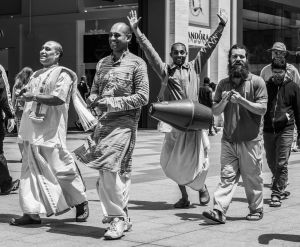
For some, dancing while chanting the names of their God, demonstrates their devotion and celebrates their union with each other and with God

In other words, those called to a religious or spiritual life, practise Bhakti Yoga whenever they pray or otherwise express devotion towards their personal conception of God, or the Divine. This particular definition seems to be saying that such a conception of the Divine, or God, is in the form of a personal deity who is a kind of representative of true reality, which the devotee is aspiring to join with.

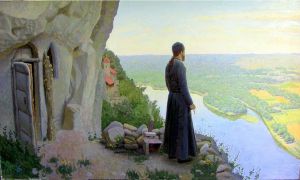
Some Bhakta Yogis are full-time, full-on practitioners. People like contemplative nuns or monks, hermits who retire from the world into seclusion. Anyone basically whose entire life and activities are spent in devotion.

So, when I discovered all this, I became intrigued; I decided to go off on a tangent and explore the word Bhakti itself. Wikipedia has a separate entry for the word on its own:

Bhakti is a term common in Indian religions which means attachment, fondness for, devotion to, trust, homage, worship, piety, faith, or love. In Indian religions, it may refer to loving devotion for a personal God

is often a deeply emotional devotion based on a relationship between a devotee and the object of devotion.

In ancient texts the term simply means participation, devotion and love for any endeavor.

May refer to devotion to a personal god? While I thought this entry doesn’t contradict our first quote above, it does seem to broaden, and deepen, the meaning of Bhakti. Expand might be the better word.

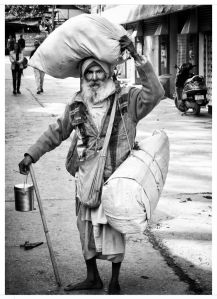
In some traditions a simple life on the road is a way to commit full time to Bhakti or devotion.

It struck me that that object of devotion might be anything. Or even everything. You see? I told you it wasn’t a new idea. It’s just that it’s resonated deeply within me now. It appears that the object of Bhakti Yoga practice doesn’t necessarily have to be a ‘personal god’.

Many many people would say ‘I like animals’ or ‘I think we should save the world’. But, while that may imply a kind of love for or at least a fondness for, I think Bhakti is something more – actually several somethings more!

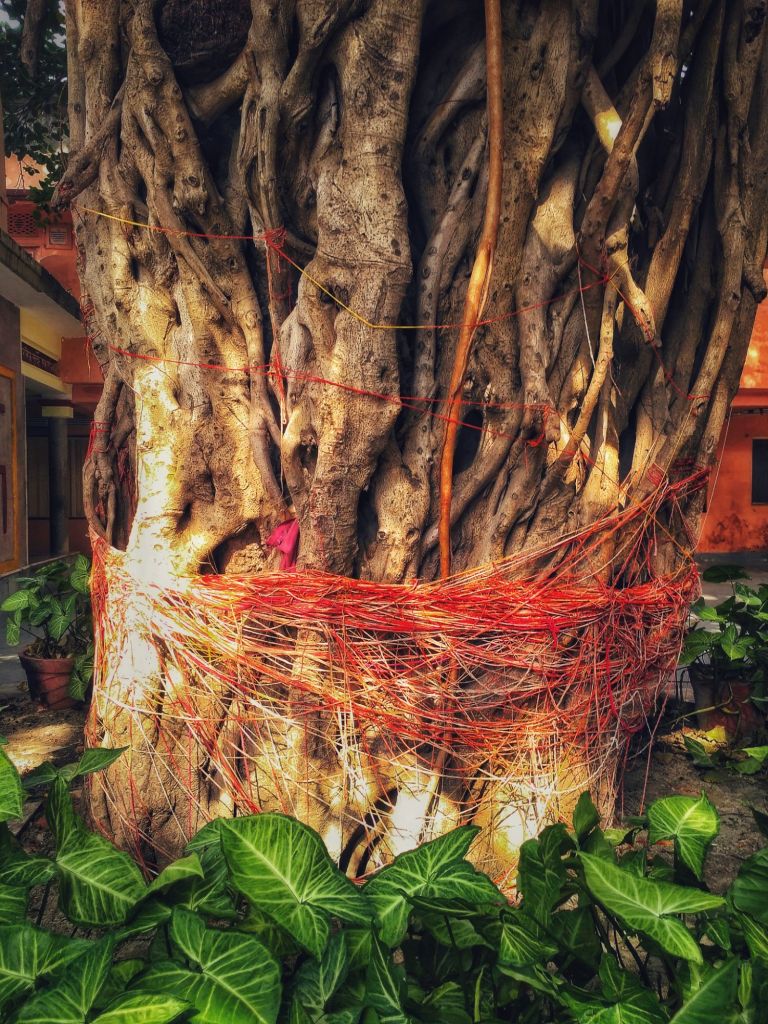
For example, some people have a particular attraction to and love for, the ocean, or it might be a river they view as, if not sacred in a religious sense, then as special to them in some deep, comforting, even therapeutic way. Others have similar relationships with and feelings for trees, or even a particular tree.

Animals as either individuals or as a species or group, can have the same appeal and call to other people. Then there are those who feel strongly in their hearts you could say, that Earth itself is a sacred object, or others have a knowing that the planet is a living entity and worthy of our devotion.

Bhakti begins with love and devotion, which is about caring for, affection towards, loyalty to, emotional engagement with the object of devotion. But even more than that, there is faith in that object of devotion; faith as in trust, confidence that the love is real, that the ‘relationship’ is sound and real.

Homage and worship too are key aspects of Bhakti. The deep inner feeling we have towards a thing, person, or other being, that is beyond what we normally call ‘love’. It’s about seeing and actually realizing ‘in our hearts’ our desire to be merged or united with that thing, person, or other being.

Actually, seeing that word other just now got me thinking. I had to go back and reread our definition of Yoga up there near the beginning. It says Yoga means ‘union, yoke’. It goes on to add: yoga refers to a ‘joining together, union’.

This passage seems to be suggesting that Yoga (in our case Bhakti Yoga) is both an already existing union, and a process of joining together to achieve union. One thing I would say here is that in my practice of Bhakti (and love as a general thing to strive for and be) it’s both.

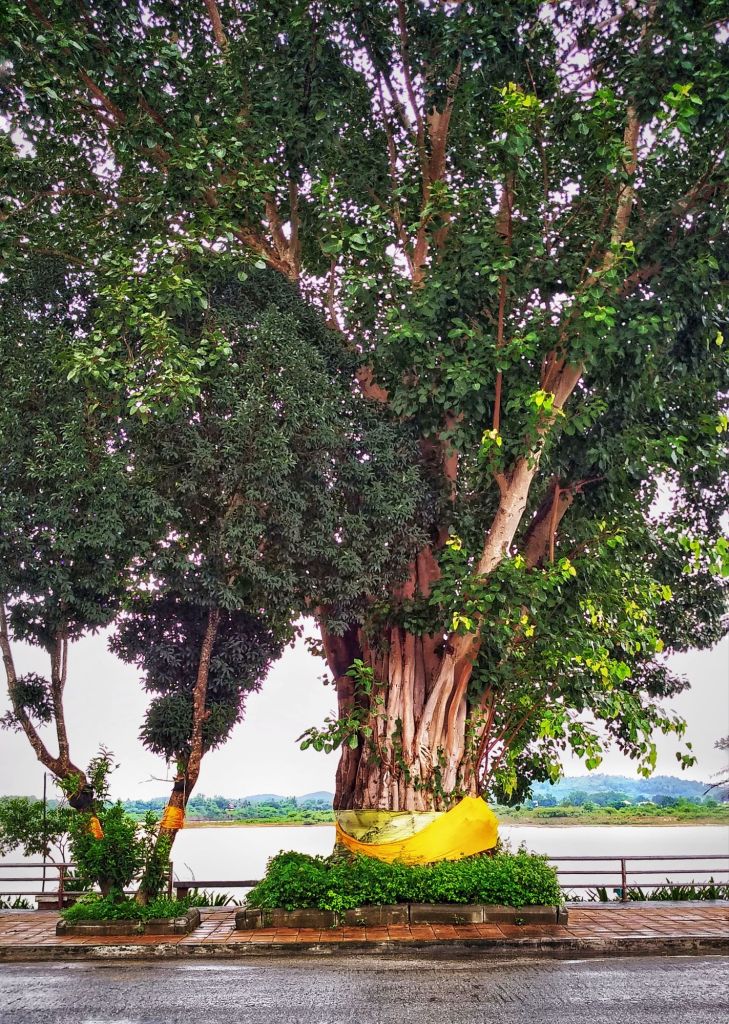
Trees are special beings for many people from a whole variiety of cultures all over the world

But, in the end, it seems to me that the process or practice, the path of Bhakti, serves to awaken us, to assist us to acknowledge, recognise, and realise in that really knowing way, our pre-existent true nature.

That true essential nature can be said to be the reality of our oneness with all things, living and non-living. And their oneness with us too of course. In fact, by putting it that way, I’m saying there is only one, or oneness. What’s that expression? One without a second.

May you be a Bhakta Yogi. Or, perhaps you already are one?

Love and peace from Paul the Hermit

Life has manifested itself as the multitudinous forms that comprise the universe. It is the one Universal Life, Power or Shakti (the laws of the universe or natural laws) that controls, guides and actuates all movements and activities in all beings, creatures and things.

                — Swami Ramdas