A Case of Mixed Feelings & Questions of Identity

Yesterday, after getting back to the Hermitage from a walk around the block, I went to take off my shoes.

Actually, I thought, while I’ve got my shoes on I may as well spray the weeds out the front and out the back in the courtyards of the Hermitage.

Sounds like an innocent and innocuous thing to say and do doesn’t it? Well, in fact it is a far from innocuous euphemism which in reality has me saying: I’ll apply some poison through a spray bottle to the leaves and stems of plants somebody or other has classified weeds, in order to kill them slowly over a few days.

Needless to say, this activity always evokes mixed feelings in me. Like everything else in the material life, this issue has two sides concerning the rightness and wrongness of ‘spraying the weeds’.

On the one hand, I understand that we humans are merely one more species along with so many others. We have to do what we need to do in order to feed, clothe, and shelter ourselves.

Weeds, I know, interfere with humans’ ability to grow food for example. In this context weeds are those plants that threaten to overrun, damage, or reduce supplies of ‘acceptable’ food plant species. Thinking about it now, it strikes me that the decisions about is it a weed or is it not a weed, can be pretty subjective.

On the other hand I personally do not want – nor do I think it right – to kill other living things. Of course, and clearly obvious too, it’s a bit more nuanced than a simple choice between do I? or don’t I?

I eat plants of many varieties, and in many forms, and I understand very well that they are all living beings. And, add to that, how many insects, lizards, snails, small mammals, birds, and other animals are displaced, injured, or killed in the planting, growing, harvesting, packaging, transport, and sale of the fruits, vegetables, nuts and so on that I eat?

Like I said earlier, the human species, like all others, must do what it has to to survive. Obviously, again being human, we have minds capable of discernment and decision making that can help us minimise the harm we cause as we pursue survival.

For me, a major component of that harm minimization takes the form of not eating the flesh of animals, as well as my choice to not utilise items made from animals.

Even with this there is a problem: Who’s to say what life forms are acceptable as food, and which aren’t? Humans have invented the scary idea of the Food Chain. We simply decide who is higher and who is lower on that chain and eat accordingly.

Needless to say, humans have appointed themselves to be the highest species on that ‘food chain’. Meaning of course, anything else is lower and hence okay as food.

Anyway, I digress a bit. Getting away from food questions, to look specifically once again at the ‘weeds’ to be sprayed in the Hermitage garden.
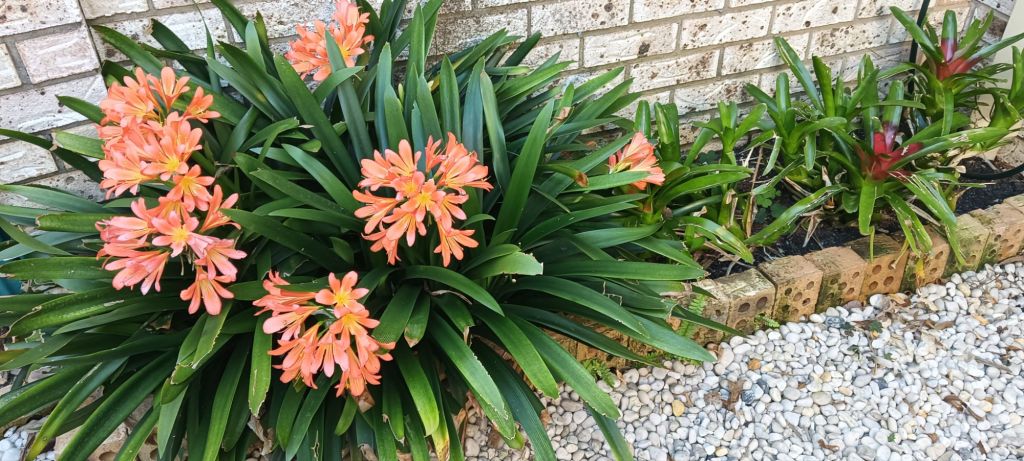
I often ask myself what is it that makes one plant with big orange flowers acceptable as a garden plant? Of course it’s beautiful, ornamental, and a pleasure to have nearby, but what else?
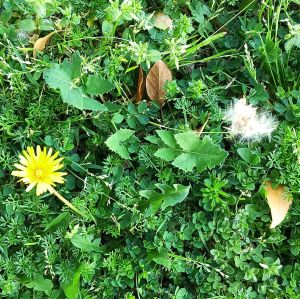
But, what is it that makes another plant, with its delicacy and little flower that are equally beautiful and as pleasing to be around in my view, not acceptable as a garden plant? What makes this one a weed, while that first one we met in the previous paragraph not?

Well, it seems to me that the first answer has to do with necessity dictated by circumstances or conditions beyond one’s control.

As I’ve said, when it comes to growing food, it’s necessary to control plants that threaten that growth. Discernment comes in when we decide how to eliminate that threat with the least harm. One aspect of discernment is actually related to that subjectivity I mentioned before: one person’s weed, is another person’s delicious and nutritious food – and vice versa.
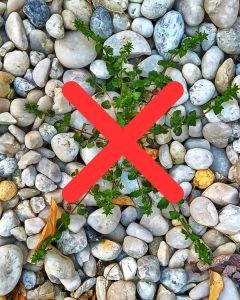
At the Hermitage we don’t grow our own food, so we don’t face that dilemma. Here, at the Hermitage, it is a condition of living here that we control the weeds. And the plants classed as weeds are well known to us due to this condition being a routine clause in most rental contracts.

Besides, it seems that another major factor that makes a plant a weed, is where it grows, how hard it is to keep in bounds and behave.

I guess it’s not only a requirement, that we control the weeds. It’s an issue for our discernment as we try to find ways to share this little patch of the world with the other life forms who also live in this space with us.

It is a wise discernment that tells us to follow the rules of the contract. And our discernment also shows us that, in this human built environment we live in, we can’t allow the space to be taken over by plants that would then provide a safe harbour for insects, rodents, and other creatures that might or would threaten our health and wellbeing and that of our neighbours.
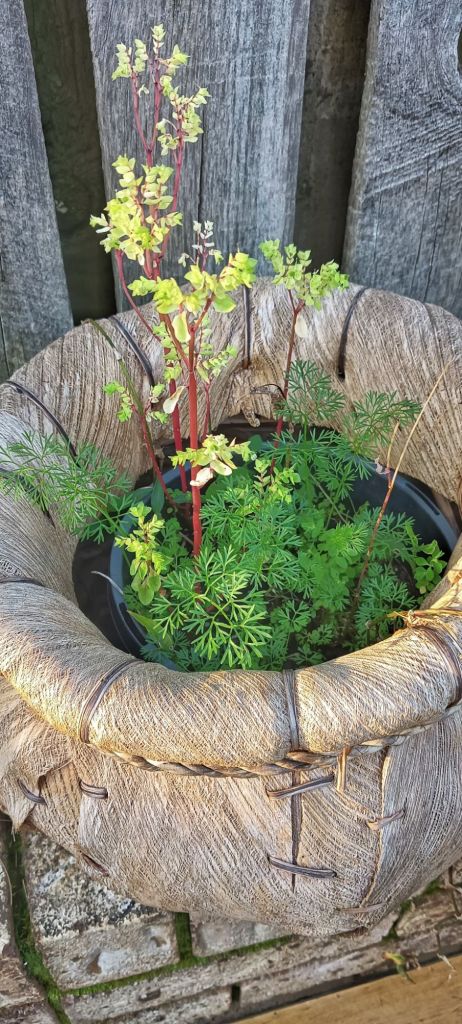
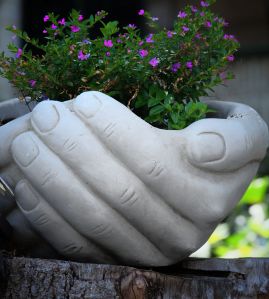
In a pot rescued from a roadside pile of domestic discards, a variety of plants – weeds also rescued over a few months of ‘spraying the weeds’ as a kind of offering to and celebration of life – grow in a group.

It’s a pretty group, I think, of delicate, yet sturdy little lifeforms.

Are they still weeds? Now that I’ve placed them to grow in an ‘approved’ space? Now that they are confined by bounds within which I can control them?

Confined? Controlled? Perhaps for now, but not for long. It’s a comforting thought, realising they all have allies: the sun, the rain – and the wind.

At the same time, we consider all life forms, including humans, to be manifestations of the Divine. All life is one, as I assert so often. Speaking personally, I am sad that any lifeform that is harmed because of my actions and my material needs.

Discernment, compassion, love and mindful action. As we seek to coexist in peace with those beings we share our world and lives with, these things are all required. Empathy too: We are the weeds, the weeds are us.

And the inner editor is insisting I finish by reminding myself  that life, the universe, and all that happens, is unfolding exactly as it’s meant to; all we can do is play our part in that unfolding.

Mindful? Full of What?

Anyone who has tried to meditate for more than a minute, knows very well that the mind right away jumps into overdrive, trying its hardest to keep us nice and distracted; anything but quiet and peace is the mind’s aim. Speaking for myself, all I want to do is get rid of that mind altogether.

But, I know, that would be a mistake. I may not like how my mind behaves sometimes, but I do actually quite like having one, a mind that is. I guess, for me, it’s about realising that my mind is here to stay, and can be either my friend or my foe.

Trouble is, when trying to meditate, I can easily believe it’s my worst enemy. Another mistake, I think, that arises from a not so discerning attitude to the thoughts that flood in seemingly at random.

But, sometimes in that quiet and still space – and even if that quiet and peaceful space hasn’t yet been reached – a thought comes from the mind friend, not the foe. It seems I must learn discernment. Here’s a good example.

Not long into my meditation earlier today, but already bombarded with random thoughts, memories, and other distractions to said peace and quiet, an idea came that just caught my attention. Suddenly, there seemed to be a full-blown idea for what sounded like a great blog post.

I din’t have this notebook with me, and though I had my phone handy, I thought, no, be firm, don’t let interruptions in. Of course, I thought that I’d remember the idea, but sure enough, I didn’t. Now, it’s nowhere to be found. I mean it must be in some tiny neuron in my brain, but it’s hiding pretty well!

Later, after my meditation session, I thought to myself, how come I could make a list of all the less than useful thoughts, memories, ideas and random mental craziness that tried its best to keep me distracted, yet I have no idea what that one wonderful blog post idea was?

I think it might possibly be about attachment; a lesson I’m giving myself in discerning between what thoughts are from my friend mind which ones from my foe mind, the mind running wild with its accomplice, my ego.

It’s a lesson I badly need, I think. Endless thoughts of little or no use to me have stayed, while the one that might have been helpful is gone, seemingly forever.

Yes indeed. Perhaps ny perspective on what ideas ad thoughts are useful to me and what ones aren’t, needs to be contemplated upon.

Actually, it’s not really needing a lot of contemplation: I mean, the one idea I thought would be great is gone. But looking at it the other way around, the fact that the great pile of not so good thoughts staying with me has given us this post I am now writing, and you are reading.

Perspective. It’s all about perspective. And discernment.

The Dharma of Keeping

A curious title for a post, I thought as the words popped into mind. And it’s one that could be hinting at, pointing towards, any number of ideas, topics, or whatever.

In this case, however, it is really quite straightforward: The title refers to a three-line quote I rediscovered when I was transferring notes from a full notebook to a new one the other day.

Actually, ‘three-line’ quote may not be quite correct. In fact, I have no idea if it is a longer quote consisting of three lines, or, three individual one-liners that I happen to have grouped together.

Whatever the case, I don’t know where I found this quote or these quotes. All I can say is that I was surprised to come across them as I performed the normally routine task of transferring notes.

Surprised,  because each of these lines I think, hold a special message for me; a unique piece of advice. You could even call them guidance.

Each individual line and its message is wrapped around  and driven by the verb to keep:

Keep your spirits up
Please help keep the silence.
God’s will be done and keep calm.

As a whole, this quote (these quotes) constitute  a kind of ‘how to live in the world’ mini-guide. Each – and all – of the three lines point to an aspect of what we might call Right Living – guiding us to the means by which we may approach daily life with its ups and downs, its sorrows and joys, good and bad times, mistakes, hurts, confusion, that make up our lives as flawed human beings living the best we can in an imperfect world.

Keep your spirits up

What with all those ups and downs, sorrows, daily crises – in our own lives and in the world around us – how are we to keep  our spirits up?

How do we free ourselves of the pain and suffering caused to us by all these travails?

How do we remain positive and optimistic in the face of what passes for a life ‘in the world’?

All good questions, and there are many many answers out there in that same crazy, mixed-up world that’s giving us all the trouble in the first place.

Speaking only for me, I have nowhere near reached the point where I can say that my spirits are consistently lifted, that I let nothing disturb me.

Why is that? The answer is simple: because I’m a human being. Or perhaps it’s better to say I inhabit a human body which is subject to one thing only: constant change.

I’m learning more and more that the only one I can address such questions to is me. If there are any answers to how to keep my spirits up, I’m realizing slowly that I won’t find them out there in the world or in the things of the world.

So, going within has to be at least my tentative response. It seems that there really is nothing else that will keep my spirits up for more than some fleeting often illusory moments here and there.

Please help keep the silence

What silence? Well may you ask: hardly what you’d call a quiet place to live, this world of ours.

Once again, for me, going within is a good start. Though I’m not the quietest person in the world, especially ‘within’. Too many thoughts, emotions coming and going, all the craziness of an overactive mind and heart.

But it’s a start.

I keep re-centring  when I can. I focus on my breath; recite some favourite prayers; chant mantra (the names of God); I sometimes just sit. All these do help me, will help me, I know. They do, sometimes, every now and again, for little moments, create that little (vast?) space I call silence.

As to playing my part in keeping that broader, silence? Well I’ve mentioned before the invisible community – the heaps of people all over the world who are on the same or similar paths, practising their own unique ways of going within, of cultivating both inner and external quiet, or silence.

All of which tells me, I am not alone. And it says, my little contribution to silence – to being still and quiet – actually counts.

God’s will be done and keep calm

For me, ‘God’s will be done’ is simply another way of saying that the Universe (or life) is unfolding exactly as it does in the only way it can. It just is as it is. And me, being also that life, I play my part.

And that’s all: we play our part; we do our bit, and it all happens as it does.

Acceptance of this truth is also one of those aspiration things I keep near the top of my list. Surrender, I sometimes call it. Surrender, rather than being a ‘giving up’ as we sometimes use the word, is more about going with the flow of the river, or accepting and cooperating with the flow of the natural order of the Universe as we experience it in our lives.

That ‘keep calm’ bit reminds me of that meme that was everywhere a few years ago: ‘Keep calm and carry on’. It, in a real sense, is exactly what I’m trying to do.

Surrendering, or accepting that ‘the universe is unfolding as it should’ (to borrow once again from the astonishing Desiderata) seems to be the clearest most obvious way to that calm our quote speaks about: Calm acceptance, free from the resistance and struggle against the flow of the river of life that lies at the root of much of our suffering.
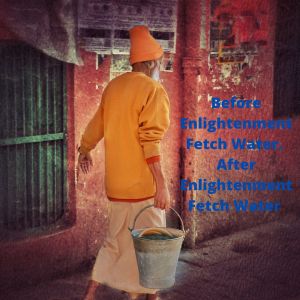
So, the Dharma of Keeping. One small (or perhaps not so small) set of clues about how to live right in the world – and with the world.
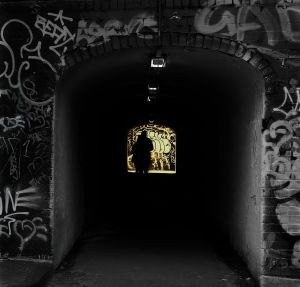

The river of life is calling me to the kitchen. Even hermit monks have dishes to put away. So, keeping calm, I carry on.

Hermitage on the Loch (courtesy: a member of our community

Tripping On the Sidewalk

Walking home, returning to the sanctuary of the hermitage, I fell over. Or to be exact, I tripped.

It’s not the first time I’ve tripped in my life, and I’m sure it won’t be the last. Mind you, I’m not supposed to be making speculations about the future; after all, I may never fall over (or trip) again.

Let me share with you how I came to find myself lying on the ground, fully conscious thankfully, with only a few grazes on arms and knees, and a sore spot on the side of my head.

Walking along the sidewalk quite freely, earbuds feeding my ears and my heart my favourite mantra to Ganesha – known as the remover of obstacles and the God of wisdom. (more on the earbud issue later)

At one point I noticed, a few metres ahead, what appeared to be the back of a largish sign board leaning against the base of an electricity pole growing out of the pavement.

Not the actual sidewalk

Without any thought whatsoever, as I came up to that pole, I turned my head to the left to see what the sign read. Next thing I know, is I have the sense of falling. Later I remembered that at the exact moment I turned my head, my foot caught the broken and uneven edge of a slab of the pavement.

I was blessed by two passersby who stopped and helped me back to my feet, and stayed with me as I regained some semblance  of my bearings. Thank you to those two good and kind ones.

Now, I don’t like falling over (well, when you think about it, who does?), but in this case I can say through this fall, I have learned a couple of good lessons.

Presence – or lack thereof. Here I am, the hermit monk who is supposedly constantly practising being present, in the moment, here and now; yet I tripped over what I later discovered was a really obvious, clear obstacle on my path.

We all get distracted, you might be thinking. And, yes, it’s true. We can be paying close attention, fully focused, riveted to and in the moment, and, suddenly distraction barges in – in the form of a thought, an external noise, visual imput, and even a broken pavement. You name it, and mind will use any excuse it can to manifest a distraction.

Another lessen – intimately related to presence –  is pausing, or not! As I noticed that sign coming up, I could have chosen to pause to look at it once I reached it.

Then, rather than being a distraction, looking at that sign would have simply been another moment in the ongoing flow of the present. In other words, there’d have been no tripping.

The actual earbuds in question

Now, to the earbud issue. To be honest, my earbuds have more or less replaced my regular over the ears headphones. Because I was never comfortable going out and about with those clunky things on my head and earbuds have allowed me to listen to music pretty much whenever and wherever  I go. Even to me wearing them, they are barely noticeable. It’s possible that’s the problem right there: unnoticeable.

More than 30 years ago now, I spent every Tuesday evening for a year attending classes at a school of philosophy . To this day I still follow some of the practices I learned there. And, passed to me were so many good lessons, so much good knowledge drawn from many of the world’s spiritual and intellectual traditions. So many of these lessons have stuck with me.

Presence, or rather the benefits and rewards of realizing  the present is all there is, was I would say, one of the cornerstones of those teachings.

One illustration about presence concerned driving, and although at the time I haddn’t learned to drive, it resonated with me. Our teacher told us that, when she was driving, she never listened to music or anything else. She told us that she simply put her full attention on the task at hand: driving.

She described how it often happened that when driving she’d reach her destination with little or no memory of the actual act of driving or any landmarks or events on the trip itself. She said it was if she was somehow unconscious, yet still able to drive ‘on autopilot’ was how she put it.

And of course it’s not a phenomenon limited to driving: how much of our routine daily activity runs on autopilot?

Anyway, back to the other day and me grooving to Ganesh in my ears and tripping in a moment of inattention.

I don’t recall being distracted by the mantra in my head, or moving on autopilot. But, thinking back, I was in one of the busiest sections of the little town that hosts our hermitage. I’d been to the supermarket, the parking lot of which is as busy – and crazy –  as one you would find in any big city.

Just another sidewalk tripper

So, I realise now, I had already kind of set myself up to fall for any distraction that happened to come along. While I don’t really remember myself as being ‘unconscious’ of my surroundings or of the path itself, clearly I wasn’t completely there, not in the here and now sense if you know what I mean. Just an after thought: who remembers ‘being unconscious? Nobody I think!

Whatever I say now, I wasn’t present; I wasn’t fully in the moment, not paying attention to either what I was doing or what was going on around me.

Since my little trip, I have vowed before my hermit community to not ever walk again in a built up and busy area wearing my earbuds.

Not only do I have a sense of danger lurking when I think of the idea of wearing them in those situations, but I also feel that it’s not exactly being present, in the here and now is it?

Another closed cafe on some other trip

Okay, I am very sure you are waiting with great anticipation to learn what what fateful sign, put in my way by the Universal Traffic Controller to push me into changing direction, actually said:

It was a handwritten advertisement for ‘great coffee’ to be had in a cafe across the road. A closed cafe I might add.

On Main Road –  a road that more than lives up to its name –  perhaps there are worse fates awaiting the inattentive than merely tripping on the sidewalk.

And in Conclusion: According to the Text Message

Welcome to the continuation and conclusion of the topic we were discussing in our last post. We are spending some time reflecting on a text message I received some days ago.

A multi layered text and one full of treasures on leading a purposeful and satisfying spiritual or inner life. If you missed it, please feel free to visit that post here.

In that previous post I included an image of the text in question, and we ended up looking rather deeply and prayerfully at the first sentence in the text:

Go sit in your cell and your cell with teach you everything.

In today’s post I hope to share with you my contemplation and rigorous reflections on the remainder of the text message.

So, let’s carry on with the next little bit of that text message.

Create your own inner world

This little gem speaks directly to the notion that it is your body and mind themselves that are the primary places in which you dwell; they are your cell that you carry around with you (or perhaps it is they that carry you around) always and everywhere.

And in that cell, where you dwell, you are the creator of the world. It needn’t be a fantasy world, as we might think of an inner world we create for ourselves. It need not be made up of wishful thinking, dreams, or endless thinking about the past, future, fears, regrets and all the other stuff we are prone to.

Rather it can be a place where you content yourself with the constant efforts to remain in the present; it can be a place in which your disciplined and focused mind and heart remain on those self enquiry questions which will ultimately lead you to the full realisation of who you really are, what is your true nature.

There’s a paradox here it occurs to me as I type: while everything that exists in the universe is simply a manifestation of Absolute Reality, (and that includes you and me obviously) the only way to actually discover or realise this knowledge is by delving deeply in our own hearts and minds – and sitting in our cells. We won’t find it ‘out there’.

The outer world will reflect the inner peace

So, with all this inner – self – enquiry cause the big shift? Will you see and experience only bliss and happiness? Will the ills of your body suddenly vanish never to return?
Well, yes. And no.

No because as living entities we are able to do our bit in making our lives what they can be; we can do our part in keeping a healthy body and mind; we can play our part in making the world a better place for all living beings.

Ultimately, though, it is the natural order, the natural laws of the universe that controls, directs, and manifests how all of the material world – including us obviously – operates and works itself out.

Yes, because the committed and rigorous discipline necessary to sit in our cells and enquire into our true natures, will over time and step by step help us to change the way we look at all the troubles and events of the world and our own minds and bodies. Our perspective will undergo a big shift (not quite the one mentioned earlier; this one’s for real).

You see, there are three sources from which our suffering come from: other people, nature, and our own bodies and minds. Self-Enquiry will lead us to realise that our true nature is in fact the totality of all there is, the Absolute Reality.

After this realisation of the truth of our natures, the sources of suffering (other people, nature, and our own body and mind) are still going to be there, going about their business as usual. It’s just that we won’t be as affected by them like we were before; we won’t suffer as we once did.

Maintain Equilibrium

Having read this far you might well be thinking that, yes indeed, the realisation of our true natures, the evolving knowledge that we are not simply the mind and body, and that we are in fact the Absolute Reality, just might lead to a life of balance, of equilibrium. Of calm in the face of crises and problems, peace in the wake of strife.

Well, umm yes, that’s all entirely true. But as for me, I can say I’m nowhere near that state yet. And I suspect nor are most people, and most of us will be trying for a few more lifetimes (if there are any more that is) before we make it.
Mind you, equilibrium does seem to come in little bursts, like a kind of reconditioning process. Sometimes I realise that I am indeed acting more calmly, with more equanimity to situations that might once have thrown me completely off balance.

I’ll admit, though it’s an issue that frustrates me (you see? That proves I’m still identifying with and attached to, the idea that I am a body and mind only). I ask myself, how come with all the spiritual practice, the meditation, and all the sitting in my cell, I can still suffer with annoyance and irritation or collapse with existential angst, rant at injustice … You know what I’m talking about.

All I can do, all any of us can do, is persevere with the enquiry into self; Who is it exactly that’s losing it right now?
Of course it’s ‘me’, but is it really? It is the mind and its emotions and the ego. But it isn’t me, and it’s not you.

Be Still

One of the beauties of this wonderful text message, is that the individual injunctions have built – are building – one upon the other in a nicely logical and understandable way.

Now, the advice to be still: Of course we can take it at face value and take it to mean we are to literally sit with our bodies very still in the one place, in the one spot. Not moving.

Well, it seems the Desert Fathers and Mothers  had a saying or a word of advice to fit every situation. I came across a quote from Abba Ammonas, that sits as a kind of caveat, or perhaps a sort of reality check when thinking of sitting still:

A person may remain for a hundred years in his [sic] cell without learning to live in the cell.

Meaning obviously, that thinking we are still doesn’t mean we actually are still. Well, yes it does actually. But it’s only a part of the picture that we name stillness.

For example, right this moment I am making these notes, I’m looking up references online, listening to Bob Marley on my headphones, and every few minutes I’m taking a sip of tea.

Yet I feel quite still. I sense real focus on every one of these particular tasks as I’m performing them. I am feeling pretty calm and even a tad relaxed. Believe it, for me these are big achievements. Actually this very much speaks to a concept called Action in Inaction, and Inaction in Action. If you’re interested, there’s a fascination article here.

In other words, I think I am actually being still. My thoughts are focused as I said. I’m even in the moment well enough to pause everything else to listen to something from Bob in my ear that speaks to me.

I don’t think anyone can tell you how to be still. Not only is it going to be different from every one of us, being still will always vary and fluctuate in quality and degree. You might say it’s one of those ‘it depends’ kind of things.

I am

Ask yourself: Who am I? Usually the answer comes back: I am … followed by a name, designation, label, an identity of some kind.

Nothing wrong with this. In fact it is natural: it’s how members of our species place ourselves – and everyone else – in the order of things; we need to know our position and that of others in order to negotiate our way through and in the world.

So, what happens when I ask myself that big who am I question? Well, I could answer: I am Paul, I am a hermit, I am a writer, I am servant of God, I am tall, I am a friend, I am a …

Stop! These are all things I do or roles I take on and fill by choice or otherwise. They’re not me, though they are ways for me to describe the ‘me’ that exists and acts in the material world.

It seems according to Ramana‘s teachings on Self-Enquiry that the only way we can discover who or what we are is to list instead what we are not.

Neti Neti it’s called: not this, not this. But most of us feel very strongly that we do in fact exist. In other words we are – or referring to myself – I am.

If I’m not to confuse myself with the misidentification , the temporary labels, and other limiting beliefs as I try to answer my own Who am I? question, then the best I can do is metaphorically shrug my shoulders and answer, ‘Well, I am’.

Which means I think we’ve reached the point where we may finally realise that there is actually no answer to our enquiry; we simply are.

There is nothing to ask; nothing to answer. Only pure being, as in existing: the Absolute Reality. There’s nobody to do the asking.

And in the example of this text message the expression I am, speaks as a kind of signature of the text sender. No names, no labels or self-identifiers or anything else. I aim.

Some musings for you

Last, but most definitely not least is this, a final PS if we can call it that. A reminder that I am to contemplate on all the above, that I am to reflect on the words of the text.

And I’m very happy that I’ve spent this time sharing that contemplation, those reflections, with you.

I am. You are. We are
(actually there is only I am, but you know what I mean

Happiness, Freedom & Other Joys VS Anger, Depression & Other Sufferings

Frustrated, depressed, annoyed, and even angry at times. All because I know for certain sure that it’s God’s will that I write more – as in more often, more volume, and more quality too. And I’ve vowed to do God’s will in all things to the best of my ability.

No, actually those extremely un-monklike emotional reactions are not because of this knowledge of the will of the Universe or my vow to obey; I have those unhappy emotions because of the other vow I’ve yet to mention: I have vowed to find ways to content myself with how the universe unfolds for my life, and for the world.

I’m not saying that I have promised to resign myself to ‘fate’ or ‘destiny’ or whatever one might call it. No. And it’s a big no because while what happens in the material world is working out according to the laws of nature, it’s equally true that I am in that mix: I have my part to play in the universal scheme of things, just like we all do. It’s a matter of I do my bit, and the Universe (or God) does its bit.

And then it struck me. Blew my mind is more like it. All my frustration, depression, anger, and whatever, over not writing to my own desired level, is really nothing more than a raging against God’s will. Needless to say, this reaction is really quite a distance from obedience!

Another thought on the topic of God’s will – the laws of nature and the natural order of the Universe: By obvious definition those laws and order must (obviously again) apply to all things in what we call the Cosmos or Universe.

All material things, such as bodies, as well as non-material things like minds, emotions and the like. You name it; All there is is bound by the same set of natural laws.

So, speaking for myself alone, not being able to write to my expected or desired for level is only one – and quite a minor one it has to be said – of numerous areas in my life and the world that cause me frustration and all the rest, as I struggle to to be content with the will of the Universe.

Too big a topic, or should I say too many topics to get into here. In any case, shall we set aside that not so little aside for now?

So, where were we? Right: Raging against God’s will; resisting the ways in which the natural laws of the universe are working themselves out. Sounds terrible when you see it  writen down like that doesn’t it?

Anyway, it’s clear to me that the Universe , the will of God, is trying to say something to me, which sounds something like this:

‘Look you may very well want to write, you might even be desperate to get those words and ideas out of your head and onto the page, but that’s just not the way things are right now is it?

‘Of course the smooth running of the Universe involves you, and in a big big way too, but you are still just one element in what is really quite a complex, not to mention gigantic, system.’ Nature can put you in your place for sure sometimes.

‘In fact it might be,’ this spokesperson for the Universal order continued, ‘that the Universe is trying to get a none too subtle message across to you? Do you think that desperately clinging to some outcome you want or desire that strongly but can’t seem to get, is causing you pain? Of course it is. Anger, depression, all those sad and negative emotions, they are just not necessary.’

The Universe (in its manifestation as my discursive mind) can be very vocal sometimes, but I think I sort of get it.
Essentially what that Universal spokesperson is saying is that the order of the Universe is working out just as it’s supposed to. Actually it can’t do otherwise. I play my part (which according to the spokesperson is bigger than I imagine), and really that’s all there is to it.

In other words, If I’m not writing, then that is precisely what is supposed to be happening (or not happening) right now. And not only that, but because I am an active participant in the way the Universe looks and behaves right now, then it’s also pretty obvious that I already know – deep down somewhere – that it’s really alright. It’s all just as it’s meant to be.

Once again speaking just for myself, I find it quite tricky finding the balance between what part I am to play, and what’s the Universe’s bit, in controlling the direction my life takes or in affecting the conditions that impact me.

Perhaps the best way, indeed it might be the only way, to have a positive impact on my own happiness, peace, contentment, and having a calm mind, is to give up any desires for things that won’t contribute to my spiritual and personal growth or the wellbeing of other beings, while at the same time acting upon without attachment to the outcomes, those desires that seem to me to be for the good of all, including Self. 

Being attached – driven by compulsions or aversion – to the outcome of our desires, however, simply leads to more desires even when fulfilled.  And when they are not fullfilled, there is suffering due to clinging to those compulsions.

Bottom line? I am seriously attached to my desire to write more (as well as so many other things as I alluded to earlier), that not being able to do that right now is causing a lot of suffering. Enough of that I say! Oh, that balance thing: it’s about discernment isn’t it? Okay I get it, story for another day.

PS I’m so glad I got that all out of my head and onto the page. Thanks for listening friends.

Hiccups on the Road to Enlightenment

These last couple of days I’ve been getting a good lesson in enlightenment. Wait, that’s a silly thing to say. What I mean is that these last couple of days I’ve been getting a good lesson in what it means to be not enlightened. That’s a bit better I think.

Not that I’m not receiving lessons all the time; the reality of not being enlightened, is that the entirety of one’s life is really one long ongoing lesson.

Anyway, moving right along.

Not our actual hermitage

We’re about to move to another hermitage, to one more safe-haven by the side of the road (in this case a very small, very quiet road). Obviously it’s a process we’ve been through quite a few times. This time, the concept excited us (well it usually does!) and the arrangements began on a smooth and happy note.

But, just as when any of us make a plan, take some action to fulfil that plan, and proceed from a good start, the path forward doesn’t always remain smooth and hiccup free.

And so it is this time with the hermits’ plan to relocate: one or two quite small hiccups have cropped up that we have had no control over.

‘Quite small’ are the key words here: it’s more my reaction to said hiccups that’s the point of this post.

You see, I’m not enlightened, nor am I the toughest kid on the block, and my skin’s not that thick. As well as that I’m no expert at letting things run off me like water off a duck’s back (guess who is a cliché lover?).

You talkin’ ’bout us?

The hiccups under discussion themselves are trivial and as I say out of our hands. As such, they are not especially interesting to talk about.

Getting back to the water off a duck’s back thing: it’s actually a pretty neat description of what occurs when one in enlightened. Just a thought for now.

Contrary to popular myth, being enlightened isn’t a flash or some sort of mystical thunderbolt from heaven or from some other transcendental wherever, a flash that leads to bliss ongoing, superhuman or magical powers; It doesn’t render the enlightened one an intellectual or any other kind of giant.

And right to the point, being enlightened will not protect the enlightened one from the normal, natural apparently real troubles, ups and downs, pain, illnesses, sorrow and grief, and all the rest of being a physical creature living in a physical world.

What enlightenment does mean – in my interpretation at any rate – is the enlightened one is able to let these perfectly normal problems, hurts, pain, illness, and so on, (Oh the joy of repeating a great cliché) to roll off them like water off a duck’s back.

Of course the enlightened ones still experience the pain, the sadness, grief, the disappointments and so on; it’s just that those ones have attained to the knowledge – been enlightened to -that none of those things can really hurt them.

Sure they are still there, the pains in the body, the sadness or whatever in the mind. But the real us – the true Self that is the consciousness that witnesses all that’s going on in our lives right now – is unaffected.

That true Self, that Consciousness, is constant, it is and has always been existent and unchanging. All those pains in our bodies, those emotions, distress and the rest in our minds, will pass; they aren’t permanent. However that Self, that ‘I’ won’t pass, and it is permanent.

Anyway, back to the current topic. What happened to me was this: the hiccups refered to were minor – less than trivial in the context of the ‘real world’ – yet the disappointment resulting from one, and the annoyance coming from the other, were profound.

An enlightened person might say ‘That was disappointing.’ Or, ‘That was annoying.’ But me? Well I sank into a pit of negative emotions and negative (to put it mildly) thinking. I may as well have declared: ‘I am disappointment embodied.  I am annoyance itself.’

Look dear reader, this was supposed to be a fairly light, quick telling of me reminding myself that the pains, sorrows and other stuff of the world can’t hurt me. That ‘me’ is the Self I talked about earlier, the ‘I’ who is, as I said, the witness to my experience here and now.

So, in conclusion as they say, all there’s left for me to say (in this post at any rate) is that I am most definitely not enlightened. Having said that, I wouldn’t say that I’m completely unenlightened. There was a time (a long stretch of time) when, far from letting things roll off me like water off a duck’s back, they very often overwhelmed and threatened to drown me.

Of course there is a lot more to be said on the subject of enlightenment. Suffice it to say that it is my dream and deep, deep aspiration to one day, one life (if there is indeed another one waiting for me) to get there, to realise enlightenment.

As The Seekers used to sing:

Some day, one day
time’s not so far away.

PS There is no need to worry. I feel a bit better now. I managed to gain a little perspective, a truer perspective. In fact gaining perspective is an important step on the path to enlightenment. The tricky thing about perspective though is hanging onto it once it’s been gained.

Bushland Contemplation

The Time is Always Right for Niceness

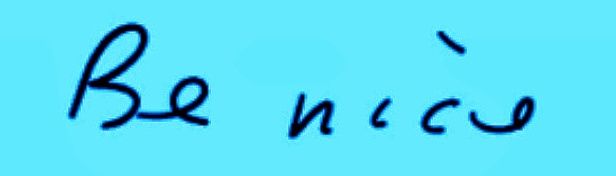
Scrawled in the margin of a page in my notebook are two words: Be nice. Nothing else on the page to suggest a context, source, or inspiration. But, here’s the interesting thing: Just below those two lonely words, and in brackets, I’ve written:

Do nice, Consume nice, Share Nice.

Most likely we’ll never know what prompted me to write that particular series of words. I mean, they’re not exactly new ideas are they? Still, discovering (or is it rediscovering) them today, I thought that, while not original, they do present us with a neat little package of behaviours, attitudes and actions; a perspective or way of looking at things that might just help us (or I should say me) along the road to spiritual growth, for being better, doing better; oops! You get the idea.

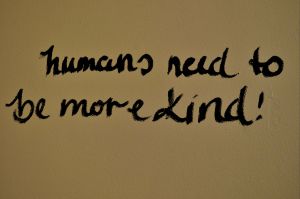
Be nice. All of us long to be nice to others, to family, friends, work colleagues, strangers, the world as a whole. Some of us would even feel better if we could only be nice to ourselves now and again.

Speak softly, go slowly in my interactions with others – loved ones or strangers, it doesn’t matter. While we all wish for others to be nice to us, we are all very aware that life doesn’t always work that way. But at the very least if we can be nice in every situation, then it’s better for everyone.

So, when slighted by another, spoken to with a loud or aggressive voice, or in some other way treated ‘not so nicely’, pause. Breathe. Then with confidence in yourself and what you have to say or do, be nice to that other.

Smile (when you can and it’s appropriate), be calm, assertive, but stay nice.

As to being nice to Self. Well, I’m trying to give up the negative self talk, and the self critical thoughts, as well as not so nice thoughts about other people or situations. Being nice to others is also an act of niceness to ourselves. We feel good when we’re nice to others (and bad when we’re not so nice to others).

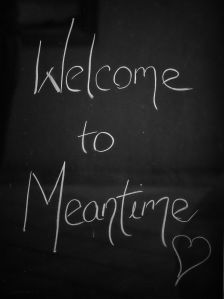
Meantime is so Yesterday. Make it Nicetime today!

Do nice

The verb do suggests doing; taking action. Do nice things for others – and for Self also. Sometimes it’s easy to do nice things for others, sometimes not so easy. Still, as with everything, it is the efforts we make that are the key: remember, nice makes nice.

Anyway, we’re all familiar with the brilliant (genius really) Random Acts of Kindness concept and movement. It’s a truly revolutionary idea that’s rightly spread far and wide and has become an integral aspcet of everyday life for many many people. Really any act of kindness, random or otherwise, is another way to describe doing nice.

And, once again, we shouldn’t forget about ourselves. Doing nice things for ourselves lifts our spirits, changes moods, enriches our lives overall. Don’t forget that doing nice things for others is just one more way we can do something nice for ourselves.

Consume nice. What am I putting into my body? What am I looking at, listening to, reading, buying – what am I consuming? How much of this consumption can I label as nice? How much of it is of benefit to myself or to any or all other beings, or to Earth herself?

And, the flip side of that question: Of all that I consume, how much is doing harm, again to myself, other beings, the planet itself?

Heaps, if you’re anything like me. I am engaged in constant struggle to change my habits of consumption. As I make these efforts, fight these battles with old old habits (I think I talked about this in a recent post?), I remind myself to be kind to myself when I fail to make forward steps – and just as or more often when I take a step (or two, or…)backwards.

Share nice. This one’s easy: reread all of the above. Well, okay, maybe there’s a little more to it than that. Actually, isn’t there an old aphorism that we’re all supposed to have heard in kindergarten? ‘Share nicely‘? I guess back then it was about sharing toys and other playthings with the other kids.

Now we are all grown ups, it means, well much the same really. If you have been blessed with material prosperity, be free with the way you share that good fortune.  Be free and generous with how, and with whom, you share that wealth with.

Equally, no it’s not equally at all; it’s way more important and significant. Share your time; share your skills; share your knowledge; share your experience. The best thing of all to share – the nicest thing – is your love.

Love works well, not only with those close to us, those we call loved ones. Love can be shared in all our interactions with the world, whether it’s family, friends, work colleagues, or with strangers we encounter as we go about our day-to-day lives.

Share nicely of course isn’t only about what you share; it’s also about how we share. Share with a nice attitude. We’re right back where we started, be nice. Approach all with an attitude of love, generosity, and kindness.

So, how does all this nice stuff contribute to our spiritual growth?

The Greatest Hashtag of Them All

Well, I think as we’ve just seen, nice equals love. I feel that having nice – love – as the foundation of our being, doing, consuming and sharing, helps us move forward on the path to the realisation that happiness does not come from outside of ourselves – and certainly not from material things like money, possessions, and the like.

Nice can really only start with me – with you. From within my own Self, which in truth is non-different than your own Self.

There is a beautiful – truly beautiful – expression that has become an empty, flavourless, hollow, meaningless platitude. I’d like to rehabilitate that expression right now.

I want to say with my heart and my love, to all of you:

Have a nice day

and

To Speak or Not to Speak & What Not to Speak About When You Do Speak

Have I mentioned lately that I talk far too much? No? Well then, it’s way past time to once again confess; it’s  time that I finally get it out into the open: the thing is you see, umm, I talk too much. There I’ve said it.

But wait, there is no need for concern: I have a prayer (stuck in my Bhagavad Gita, where else?) that I pray at least a couple of times a day. Well, rather than being a prayer, it’s a kind of affirmation or instruction to myself. Okay, it’s a prayer.


It’s a nice injunction, I think. I don’t recall where I borrowed it from, but I’m grateful that I came across it. It’s important to me; a vital instruction that I feel assists me in my aspiration to be a bit more thoughtful, and a bit less vocal.

Does it work?  Well with the risk of repeating myself, I will say yes. Maybe I’m a bit more thoughtful and perhaps a bit  less vocal. But, on the other hand, I wouldn’t say I was anywhere close to the ‘spending no time’ level.

Now that I’m thinking about it, illusion, fear, and wrong thinking are common themes in many people’s lives, and we might even say that they dominate our culture whether it’s the media, celebrity gossip, or any of the rest of the illusory and speculative talk that goes on all around us.

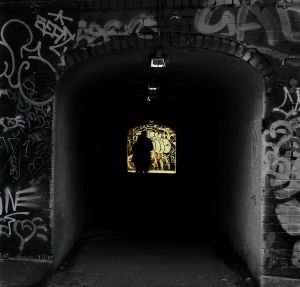
Tunnel to the Light

Anyway, fear is the biggie isn’t it? Fear of not having enough; fear of not being good enough; fear of what might happen or what might not. This list is endless. Fear of illness or ageing; fear of losing friends or fear of not having any! Fear of ‘missing out on the good life’ we imagine everyone else is living.

Then there is what’s called, the fear of the other, most often promoted and replicated by the mass media through their creation of illusions, fake news, exaggerated  or one-sided information (I hesitate to use the terms ‘facts and figures’ but you know what I mean). And then they sell us on ideas that we need to fear some other person, people, thing, time, impending catastrophe that never comes.

I don’t need to go on here: as I said, the list is endless. All that’s left to say about these fears and the illusions we are force-fed and made to believe are real, is that it all boils down to costing us a great deal of time spent and usually wasted, in wrong thinking of one kind or another.

It seems to me the media (news and social), advertising, and governments of all persuasions, are really quite happy for us all to be ‘getting the wrong end of the stick’. I think that’s the expression. Our societies are drowning in, for want of a better word, propaganda.

Buy this, do that, don’t do the other thing. Be afraid of (insert the latest scapegoat, political opponent, boogy man, the Apocalypse. Again it’s an endless list).

Then there are the fears we invent for ourselves, the illusions about ourselves that in our wrong thinking we come to believe are all real and true. One thing you can say about wrong thinking is that it makes for more and more wrong thinking. More illusions about who we are, what we do (or can’t do), what we are like, who likes (or doesn’t like) us. Here I once again risk repeating myself, but yes, it’s a long long list.

So, what can we do? Well, we could use a little reminder like the one we’re talking about here. It’s possible that it can help us correct a little of the wrong thinking that leads to fears and illusions.

Then there is what we might call discernment. Not so much deciding between one thing and another; more like coming to know what is real or illusion, a genuine, rational fear that I need to act on, or some inherited, manipulated, received  or otherwise irrational, baseless, or invented ‘fear’.

We won’t get rid of wrong thinking by trying to push it away. It’s about replacing the wrong thinking with some right thinking. We can try to recognise that wrong stuff as it comes up. We can make an effort to stop allowing ourselves to get away with our own misunderstandings, our own wild imaginations, wishful thinking, and confusions. As my teacher said just the other day, use your mind to control your mind.

One word we haven’t discussed from my little injunction is discussing. We discuss things when we talk or communicate  with others or when we talk to ourselves. Here we are at another issue for discernment: what shall we talk about?

Actually I was about to write that one excellent strategy for not spending time discussing illusions, fears, and wrong thinking is to simply stop talking altogether. That’s all there is to it: Don’t talk!

But obviously that’s a ridiculous notion right? Stop talking? Perhaps for a set time? Or perhaps as a kind of ‘time-out’ strategy? But as a principle for a whole life, it’s not going to appeal to the majority of us. Actually, that feels to me like a bit of wrong thinking creeping in: a life of no, or at least limited talking is very appealing to me. Just difficult.

Still that does seem to be what my treasured injunction suggests I do. Mind you, it’s very specific isn’t it? Spend no time, it says. Discussing what? Illusions, fear, and wrong thinking.

So, how do we manage to follow this suggestion ‘to the letter’ as they say?

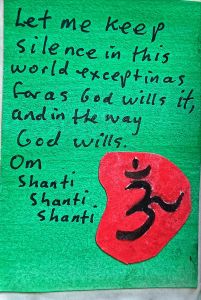
Here’s another little prayer I say everyday. This one is from Thomas Merton.


Keep silent ‘except in as far as God wills it’. For God I could say the good of all concerned; Truth; my heart; my goodwill; my love. It’s all God; it’s all the Divine.

I guess it gets back to something I said earlier about thinking before I speak. To this I would now add, feel before I speak: What’s right? What’s wrong? Does this help? Will this hurt someone else for myself.

About right and wrong: In the religious  tradition I was ‘raised in’ it was deemed that at the age of seven or eight a child is suddenly, without any preparation, able to discern right from wrong. Which means they are now responsible for the consequences of their thoughts, words, deeds. In other words, they are now capable of sinning and suffering  the consequences.

I can’t (obviously) speak for you or anyone else, but it’s been a very very long time since I was seven or eight, and I still find it tricky sometimes working out right from wrong. Of course while I know I am now responsible for my thoughts, words and deeds, I also know that we are all flawed; nobody’s perfect, so we’re going to make mistakes. 

So, all I can do – all any of us can do – is appeal to the innermost Self and use my intellect and my heart to try to discern as best I can, what is right and what is wrong.

Only in the innermost places where the real Self dwells can we know reality from illusion; it is only in our ‘heart of hearts’ as they say, combined with our rational thinking mind, what fears are real and what fear is illusion. And it is only then that heart and intellect can determine when our thinking is headed down the wrong (or the right) track.

It’s only then that we will know what and what not to spend our time discussing, either with others or internally within ourselves.  This all sounds like a long, convoluted, tricky process (told you I talk (write) too much!), but it needn’t be.

Like all things it takes practise, and once we begin to know that innermost Self, it will soon become a spontaneous way of living, when we begin to ‘just know’.

Your own inner divinity (which is the real you) wishes for you peace.

Om Shanti, Shanti, Shanti.

One Way to Look at Life

Yes, it’s true: life is precious.
But gold? Silver?
And what about diamonds?
Something to think about.

Peace & love