Sharing our prayers this morning, the hermits each reciting a prayer to the other so each can pray, and talking about the oneness of life (prompted by one of the shared prayers), the dependence of one species upon another.
As we reflected on that idea – of interdependence – it occured to me that perhaps, there might be a problem in how we as humans, interpret its meaning. We can maybe call it a kind of paradox, but we’ll get to that in a bit.
Our dependence – as humans beings – on so many other species is actually a well known, and I hope increasingly accepted, reality. For food, for shelter, for water, air to breathe. Everything.
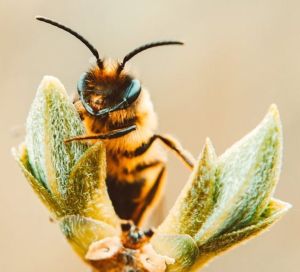
In any case, an aspect of this interdendcence idea that struck me as perhaps missing, that I’ve not really heard before (I haven’t researched this; just winging it thought and contemplation wise) is this; If, say, bees disappeared, or all trees were cut down, would humans survive? Definitely not.
On the other hand, let’s say that in an instant or even over time, all humans on Earth disappeared. What would happen to all the other living beings? All the bugs, the fishes, the animals of all kinds, trees, grasses – all the living beings?
It seems to me that all those other species, all those beings of all kinds, would not only survive, they would most likely thrive.
Actually, now I think about it, I remember during the COVID lockdowns, people in various places around the world were amazed at the return of birds to usually busy polluted cities, and how the air seemed fresher in some places when in ‘normal times’ it was getting hard to breathe. And beaches and rivers looked a bit cleaner than usual.
Fewer people commuting; fewer planes flying; less goods being transported on congested roads; less waste going into rivers and the oceans. Seems life on Earth was doing better when we (humans) were out of the picture, even for a short while.
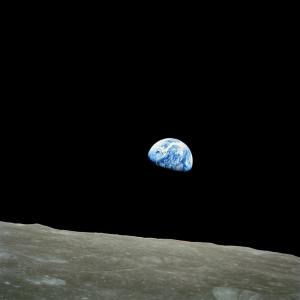
Which is to say, humans may not be necessary for the survival of planet Earth and the other life that lives here. Putting it very simply: We go, they thrive; They go, we go too.
But, my thought train races along its newly discovered track here, what if I’m wrong? What if I’m looking at the whole issue on just a superficial level? What if all I am seeing is the gross material level of the whole question? What if I’m missing the real point of it all?
Well it seems to me that on that purely physical, surface level, my theory (borrowed as it may be perhaps) might be right, the irony true: we go, they thrive; they go, we all go; they stay, we all get to stay.
But who are ‘they‘? Who are ‘we‘? For me it’s clear that we are not all simply and only our physical bodies and our minds living here in the material world; that’s all temporary and comes and goes. No, there has to be more to it than that.
Which is what I end up coming back to so very often: there is only one. No separation; no you and me; them or us. Just one. Without a second. Only Consciousness.
I think the best thing to do, just to be on the safe side is to look after each other – regardless of the particular body we happen to be inhabiting at the moment.
‘Why do you pray?’ I ask myself. It’s not a rhetorical question: I really do want to know; it’s one of those big ‘Who am I?’ kind of questions.
‘I pray because I pray,’ I hear myself answer, sounding as if I am indeed responding to a rhetorical question.
‘So’, one might think (as I well might and sometimes do) ‘you pray without any ulterior motive at all? You don’t pray to get things? You don’t pray for healing for others or yourself? You don’t pray for peace and happiness for the world or yourself? None of these things?’
These are good, valid questions. And the answer is of course I do; of course I pray for healing for others and myself; I do pray for communal and personal peace. And happiness? Well who doesn’t pray in one way or another for happiness?
I do, however draw the line at praying for material things like money and physical objects to possess, that sort of thing. I believe I don’t pray for ‘things’. I think so anyway.
So, what do I mean when I say ‘I pray because I pray’? Well, it’s not so much that it isn’t true, its just that at this moment that praying for praying’s sake isn’t the whole of life activity that I would like it to be. I would say it is a core aspiration that I am working towards.
You see, I want to pray, and to make my whole life a prayer. A prayer of praise and devotion; a prayer of gratitude and loving; and a prayer of service to all living beings.
If that’s the aspiration, then how come I’m still praying for all that other stuff of the world? Healing, peace, happiness, and the rest? How does that work one might ask (as I might and sometimes do ask myself).
Here’s what I’ve figured out so far: I have a strong sense that any prayers or prayerful activities I might make, are like vibrations, or ripples that interact with the vibrations and ripples emanating from countless, infinite even, other beings and from the fabric of the Universe itself.
In other words, not only the ‘created’ Universe, but the consciousness that is the origin and cause of the Universe, which is in reality life and love itself. Prayet is a way, I think, to make manifest an already existent link or union with what the hermits call the ‘Invisible Community’.
For example, if I’m chanting my mantra at any time day or night, I know that there are at least tens of thousands, if not millions of other beings all over the Universe doing exactly the same thing.
What I’m trying to say here is that, until I reach that pure state of making my prayer solely for prayer’s sake, for praise, devotion, gratitude, then it’s okay that I still pray for things that speak of a clinging still to the world (within my own boundaries of course!).
After all, all those creatures in who knows how many worlds and realms, all praying at the same time? There are some very powerful vibrations we’re talking about here.
I’ve been studying and thinking abut Bhakti – the absolute pure love for and devotion to God – for a while now. And, for me, God is all those other living beings and the Universe itself (or better to say, all that exists, which I might add includes me!). So, in that sense praying for healing, for peace, for happiness, well, it’s good for us all.
Today I went on a pilgrimage.Not that I don’t undertake all kinds of little pilgrimages all the time. And even more, it’s not as if my whole life – just like yours and everyone else’s – isn’t one ongoing and continuing pilgrimage.
All true; but this one, today, was embarked upon in what might be called, a classic manner: on foot, to a place of sacred significance, and in a spirit of contemplation of the nature of the journey as well on that which is being pilgrimed too. (I am positive there is no such word!)
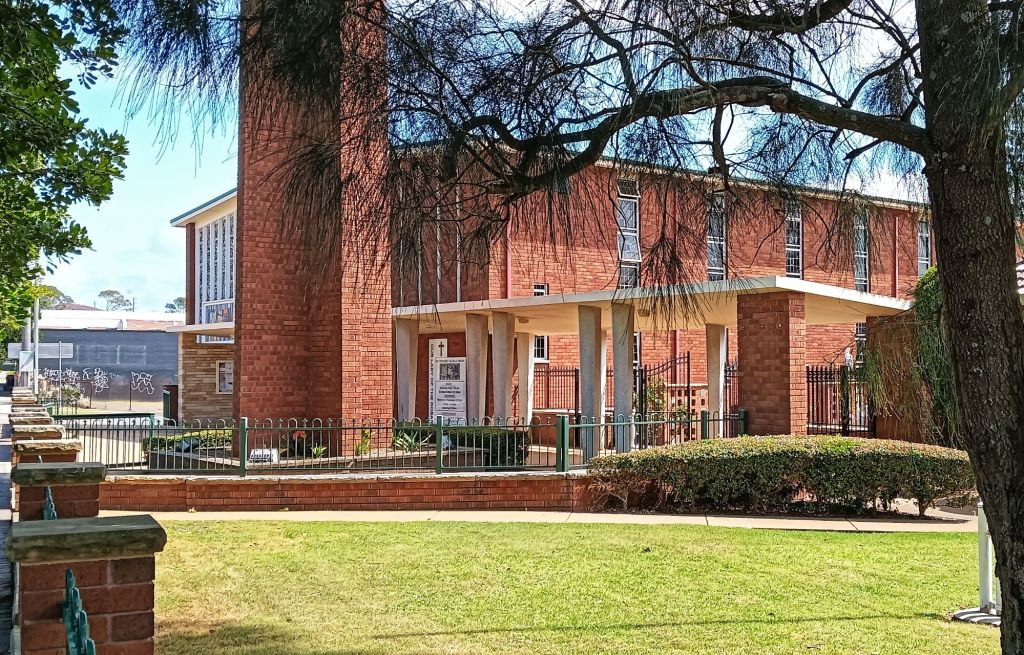
In this case, today’s pilgrimage, that place was a church about two and a half kilometres from the hermitage. It’s a place I have visited several time, but today was the first time I set out as a pilgrim and walked in the way and spirit of the pilgrim.
Our Lady of the Rosary is a Catholic church dedicated to the Mother of Jesus in her role as patron of the Holy Rosary, a Catholic way of prayer that has evolved over time and is a key part of the lives of many Catholic people.
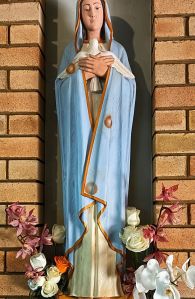
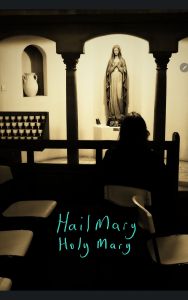
Just to the right, just inside the door there is a plain brick wall in which there is a small niche. The niche holds an almost life-size statue of Mary. She stands, hands folded over her chest on which sits the Dove of Peace.
You can see from the photo that the church itself is a lovely, quiet, serene place full of good vibes and nice peaceful energies. The object, however, of my pilgrimage was not the church in itself, but stood just inside the side door accessed through an equally peaceful, fountain centred garden.
I have come to offer her – this form or manifestation of the Divine Mother – the prayer I wrote to her which I hope you saw when I posted it on this blog recently.
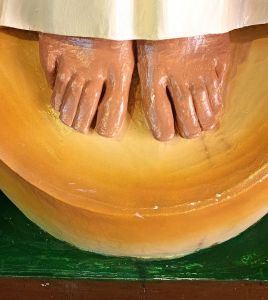
I had decided that my pilgrimage vow would be fulfilled once I had knelt at her feet and offered her the words of my heart in prayer.
My reverence for the Divine Mother is well known, and especially in her form as Mary the Mother of Jesus. Or Our Lady as we called her as good little Catholic children way back in the long ago. And I know I have said often that the entirety of the material and non-material cosmos is a manifestation of the Divine.
So, why then a special trip on foot, that I’m labeling a pilgrimage to a specific site, so I can kneel at the feet of a statue that I know perfectly well is made of stone or plaster and is simply a symbol of one aspect of the Divine?
Actually, the question has answered itself. The pilgrimage and my associated actions worded in that question tell us the why.
It is about acknowledging at a heart level and in my own way, that that symbol, that form, is actually representing a particular aspect of the Divine that I revere.
Besides, I’m not the first person who’s knelt at that spot, at Mary’s feet. I don’t know the age of the church, nor do I know the history of that particular statue, but I think we can say for certain that many hundreds, if not thousands of other people have been there where I was and spoken words from their hearts.
Being honest and true now, what I can say is that, as I said to my partner hermit: ‘I feel like i’ve been on a pilgrimage’.
And I do. I’ve walked – praying and chanting – to a sacred place where I have prayed at the feet of the Divine in the form of a likeness of Mary. I feel blessed that I actually got to offer the prayer I wrote to the Divine Mother.
Somehow I feel a link was established. A heart (mine) opened ever so slightly. I acknowledged the Divine, and I sense that I might just be – ever so slightly again! – topped up with a bit of the Grace that is in reality our true state.
Mary in the Garden (enhanced by a fellow Hermit Pilgrim. Thank you)
So, this is the story of my pilgrimage. I was absolutely exhausted when I arrived back at the hermitage. Most likely that was due to the heat, the traffic, and the noise encountered on the way I trod.
But, now I’ve shared this little tale with you, I’m not tired. Anyway, the Way is not always easy, and we are all very well aware of that aren’t we?
Namaste friends. The Divine in me salutes the Divine in you.
It’s a walk to take,
a pilgrimage to make.
Sometime soon.
Said by me long ago, I don’t know when or where. It was one of those ‘You’re a poet and don’t know it’ moments.
Well, here we are with the third and final part of our contemplations on Flee, Be silent, Pray Always, the answer discovered by our friend Arsenius who was looking for a way to be saved from the the things of the world.
In a very real sense, this third injunction might be seen as the most important of the three. Indeed, again in a very real sense, those first two seem to me to be prerequisites for the third. Certainly, many of us would like to flee to a place and state of silence in order to escape the world and its many and varied causes of our suffering. Such people are simply and completely over the noise, the chaos, war, greed, the complexity of relationships, and all the rest.
Then there are many many others who, rather than looking to escape the world, are wanting to ‘flee’ towards a place and state of silence in order to engage more fully with the world by contemplation, meditation, and most of all, prayer. Such people are working towards making their entire lives a prayer.
And then there are the third group which is made up of those who have some sense of running away from the world while at the same time they feel compelled to move towards a contemplative life that they sense will be the best way they can actually serve the world.
I think I can include myself in this last group. I’ve never coped well with masses of people, being in the workforce, or dealing with the horrors that the world seemed to be overwhelmed with.
At the same time, I’ve always wanted to (and have tried to) combat injustice, racism, violence and the rest. I guess you could sum it up by putting it this way: I was (still am) an oversensitive person who one day had had enough of trying to ‘fight the system’ when it was the system making and changing the rules of the game as it went along.
Better I thought, to turn inwards in order to reach or realise my oneness with all living things. I’ve always been predisposed to praying as well, so it was a natural evolution in many ways. My intention and commitment these last few years has been (and still is of course) to pray continuously and with all my being.
My prayer is for the release from suffering for all living beings and that’s my central focus for prayer. For me, it feels very much that I am a lot more use to others living what I think of as a prayerful contemplative life than being actively engaged with the world out there in the midst of it all so to speak.
Pray Always
Prayer for me is not so much about petitioning some all-powerful being who is seemingly on a whim able to grant or refuse my wishes. For me it is more an affirmation of the reality of my already existent oneness with the entirety of the universe. It’s a way of seeking to actually realise that this oneness is my very Self.
Prayer is about being present, not wishing blindly that things be different than they are. In praying I seek to affirm that the ‘universe is unfolding as it should’, as it says in a famous poem I’ve always loved. (Actually if you don’t know about Desiderata [Things Desired] then please do check it out; you’ll love it).
I think that in this sense, prayer is in fact an act of mindfulness, or rather an act which will help develop a mindfulness practice. It is a way to practise being fully focused and present to whatever is going on, whatever circumstances we find ourselves in.
And if we’re able to be present – even on a temporary or momentary basis – then we will be more calm, more at peace, and more able to achieve some clarity in our lives and with whatever is the intention with our prayer.
I know it might sound like a clumsy attempt at a clever play on words, but we’ve described mindfulness as the practice of being fully present. But we can put it another way. We can define that state of being fully present as being in presence. Like what we might say to a friend who is daydreaming while we are trying to talk to them. We might say something like ‘so and so, your presence would be appreciated’.
In presence of what? I would say everything. When we are absolutely in the present moment (again even momentarily), when we are able to realise our oneness with all things. Essentially the universe is there – or is it here? – with you in that present moment. It’s a moment when we may indeed feel we are in the presence of all that is.
Some may call that presence God, or the Divine, or Universal Consciousness. Others may see it as being in the presence of their own true and authentic Self.
That leads quite nicely to the next aspect of prayer that I want us to look at. Praying to God. I’ve spent so long on mindfulness because I wanted to stress that I don’t think it’s necessary to have a personal name or form for God, or even a notion of an unmanifested, invisible ‘force’ called God, in order to pray.
On the other hand for me, and I know for a lot of people, there are names and forms of the universal consciousness that pervades and permeates the universe, that I personally resonate with and I can reach out to them whenever the feeling or inclination arises. It sounds a bit odd to say, but for me to think that all that is, is all that is, sort of sums it up.
And as a result of that, any prayer I pray is addressed to my own Self which is simply part and parcel of all there is. In other words, it’s a personal choice for any one of us what form or name we choose to pray to. Or if we don’t pray to a name and form at all. All is one.
One thing I’ve mentioned I think a couple of times is the idea of making all our activities into a prayer, but other than the discussion on mindfulness and presence, I’ve not really addressed the how and why.
Why is pretty obvious. Because living and acting mindfully helps us in so many way such as being more peaceful, more relaxed, happier, and so on. The how, now I’m thinking about it is the purpose of this post. And it’s also true to say we’ve been talking about it since this series began.
That is to say, we flee from the aspects of our lives that don’t serve us and which can be changed. This might be a decision to spend 30 minutes every day sitting quietly and undisturbed. And as we’ve mentioned a few times already it could be going all out and moving to a desert cave somewhere.
In both those scenarios we give ourselves the opportunity to be silent and, hopefully also surrounded by silence. How to pray always? There’s an expression I love and try to live by: Follow your Dharma. Here Dharma means your own truth, being authentic to who you are, having the intention to do what’s right in all situations. And of course actually following through with that intention if at all possible. In this way you transform every action into prayer.
Living a life of prayer does seem on the face of it to not involve much use of spoken prayers, as in saying prayers with words. Well, I don’t intend to be humourous here, but a great deal of prayer does it fact involve talking to one’s Self. To the real self, that part of us that’s part of everything else. It can do us good to have these deep conversations.
Then of course there are the many many prayers that already exist to serve people from so many traditions, cultures, to suit all kinds of purposes and intentions.
Many of us will be familiar with a number of prayers learnt when we were children. If you’re anything like me, they still pop up by themselves from time to time.
Actually as I deepen my prayer practice, I’m discovering that I’m remembering all sorts of prayers from many and varied sources. I think as I dig deeper, more and more are coming up to the surface.
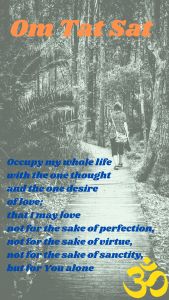
This prayer (by Thomas Merton I think) resonates deeply with me
If these ‘pre-prepared’ prayers say what you want to say and in a way that resonates with you, then you are free to choose those that feel right for you. I guess I mix and match the prayers I use; it’s always dependent on my feelings, thoughts, and intentions at the time.
Like Arsenius, I try to be open and responsive to whatever the ‘answers’ are, even though my ego does sometimes when it doesn’t like the answer, try and control outcomes.
One point about such prayers: I find it tempting oftentimes to simply recite them at what I’ve heard described as lip level. By rote and without emotion, in other words. At those times I try to slow down or pause to reflect on what I’m doing and why to get back in touch with Self.
A major part of my prayer life is chanting mantra. I try to spend more time chanting as time passes. There are a number that I use depending on inclination and need.
I chant anywhere and sometimes a mantra will start chanting itself, surprising me by its arrival
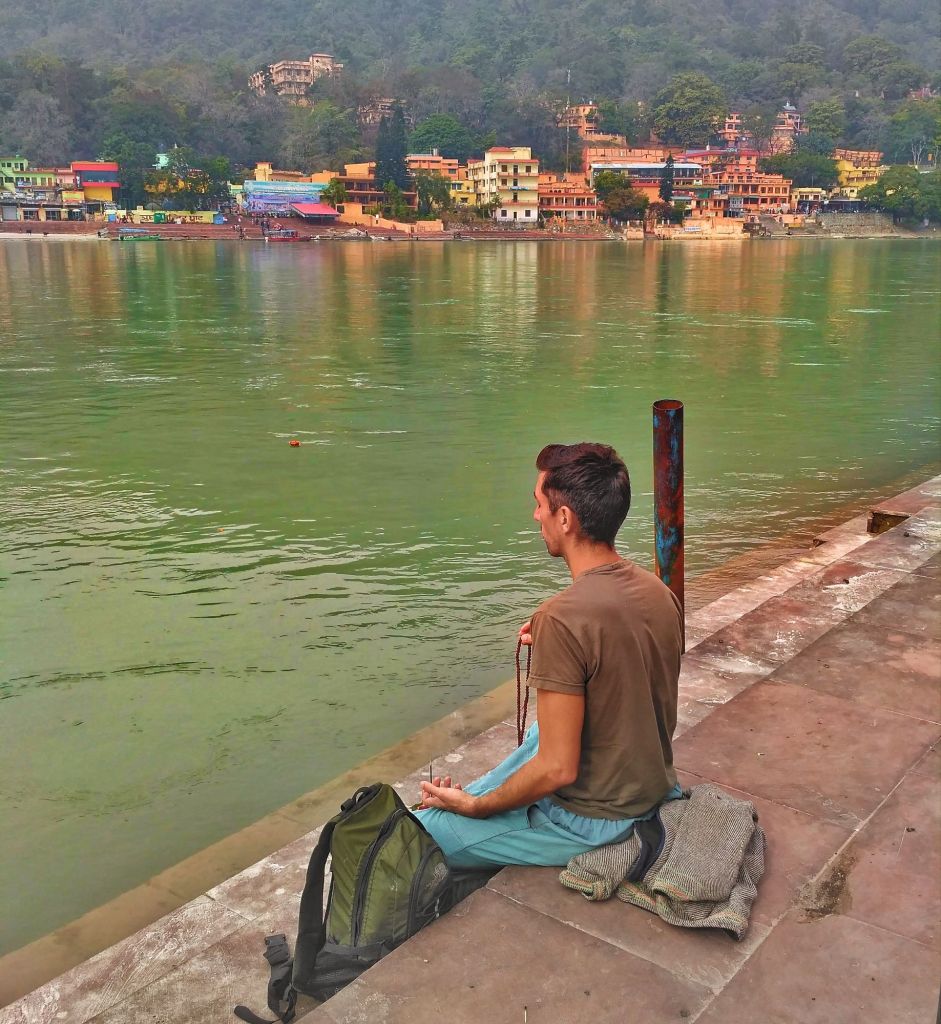
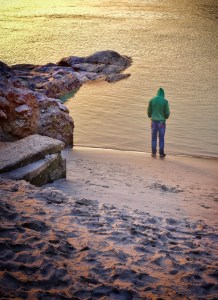
(This photo isn’t me by the way)
Now, probably one of the most important aspects of my own prayer life: I know I’ve mentioned my intentions in praying at all, but one aspect I haven’t mentioned is praying as devotion.
Devotion as in worship, praise, as in gratitude for the beauty in my life, as an expression of love. Knowing with the mind that all is one is fine, but these kinds of prayers help us to cement our awareness of that oneness of all living beings. As I said earlier, I, like you or anyone else, may use particular names and forms to represent this oneness, but, well, it’s all one, so we are non-different from all those names and forms.
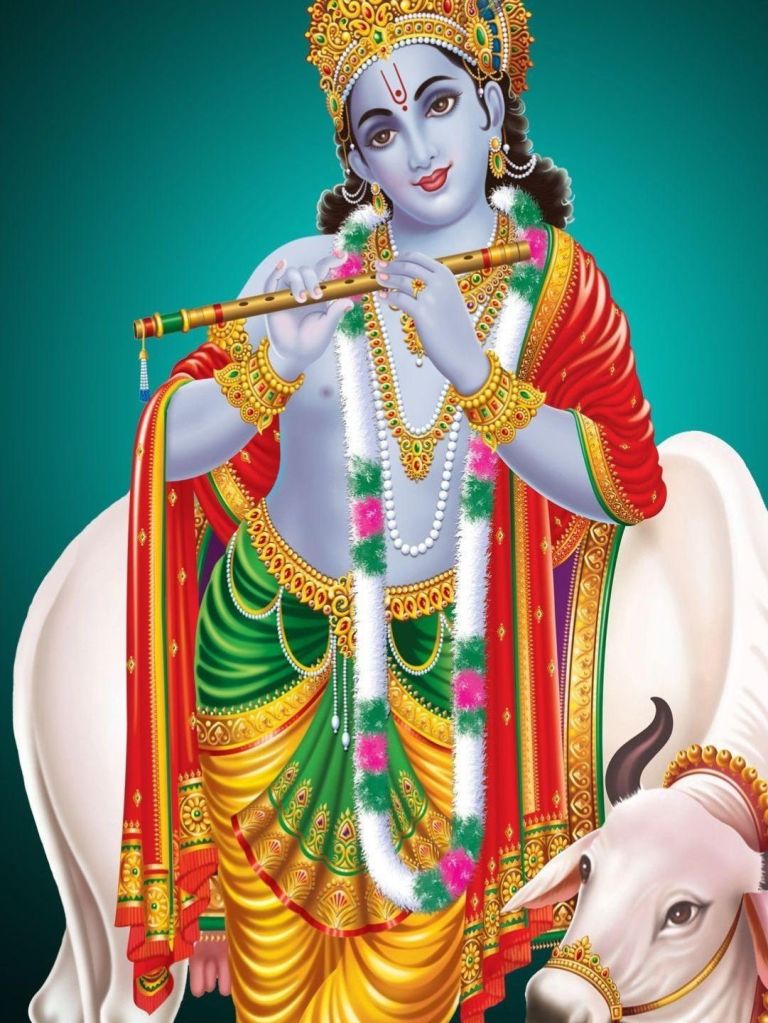
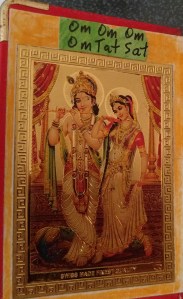
Lord Sri Krishna is among my favourite forms of Universal Consciousness (also known as Brahman)
There are many representations of the Divine, but Krishna and this picture of Him are special to me.
Focusing your devotion on a particular form seems to help make it easier or more real. It’s tricky to pray to and with a thing that has no form and is invisible.
So, my friends I hope what I’ve said here is of some little interest to you and that you have found at least something you can use for your own life.
Thank you for bearing with me as I chose to post a short story before I got onto this post, the next part in our small series. Actually, I hope you enjoyed the story, and if you missed it, then please feel free to have a look. You will find it here.
Anyway, welcome to Part 2 in our little series of contemplations on the answer that Abba Arsenius received to his question: How can I be saved? (from the world with its sorrows and noise and traps of all kinds)
The answer he heard from deep within his own Self – what he called God -was the succinct, to the point, no nonsense:
Flee, Be Silent, and Pray Always.
In Part 1 we realised that fleeing (from the world) doesn’t necessarily mean we have to leave everything and everyone behind and go live in a cave in the desert as he did. For some of course it might mean exactly that or some 21st Century equivalent, but I think for the vast majority of us, fleeing simply involves some modification of our current lifestyle, changes to our habitual ways of thinking and behaviours in order to rid ourselves of attachment to and entanglement in the things, situations, and people in the world that aren’t working for us.
And, now, in this post we will spend some time in contemplating the second injunction given to Arsenius: Be Silent.
Be Silent
I haven’t actually given a lot of thought to this topic since our last post. Nor have I done any online research, or watched YouTubes (I checked for fun and there seems to be hundreds, maybe thousands) about silence.
No, at least in this I have tried to remain silent and simply wait for the post to come together of its own accord in its own time. Perhaps this decision came from that same place Mr A heard from when he had his question.
So, what does it mean to be silent? Well, as I just mentioned, there are seemingly unlimited answers out there just waiting for us to grab on to. The better question would probably be, what does it mean for me to be silent?
First thing to say is that I’ve come to realise (okay, it’s an ongoing process of coming to realise, not there quite yet) that there is absolutely no person, no circumstance, and no place that I can rely on to provide me with silence. So, I’m coming to accept, there is no point in looking anywhere, or to anyone, as the source of silence, at least not in the physical world.
Of course, one key element of achieving silence may be the absence of noise. Maybe. so living where there is less traffic, less focus on materialism and commerce, fewer people, less media imput (news, TV, Internet, and all the rest) might be a place for some to start.
Even if it isn’t possible to to avoid all these things completely, I try to drop or change the things I can which for me sometimes at least, gives me a chance at a little silence.
Having said that, I’m reminded of an aphorism I once read: A hermit living alone, in a cave on a remote mountain, away from any kind of road, no radio, TV, etc, is never going to manage to be in silence if his mind and emotions are always busy with thoughts, memories, desires, fears and other emotions.
On the other hand a person living on a busy city street in the midst of all kinds of chaos and noise, may be living in perfect silence. If they have a still mind, steady emotions, that give them the ability to ‘sail through life’ as the saying goes.
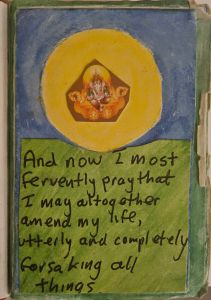
But what about me? Well, this prayer says it all In order to achieve a state in which I can actually be silent, I am attempting to amend my life – utterly and completely. I can be quite self-critical on this, badgering myself with desperate questions how come I can’t just be silent (and quiet in the accepted sense of the word as well). It’s a dilemma which frustrates and disappoints me. But, to be a little fair to myself, I suspect I’m not very different to most other people when it comes to silence. After all, if it was so easy, how come we need thousands of books, articles, YouTubes on how it’s done?
As mentioned, the absence of noise isn’t necessarily a prerequisite to achieving silence. But, I have to say, that for me, it’s pretty important. Being surrounded by the noise of the world, as well as my own hyperactive mind and seesawing emotions, are for me blocks to silence. Though, when I think about it, there are glimpses, even when one of our temporary hermitages is on a busy street, or under an airport flightpath.
As a bottom-line starting point, I don’t watch or read news; I don’t (anymore) randomly scroll the Internet even when ‘looking for something to watch’ on YouTube. And of course I don’t use television. Ever.
I’m not saying that when I do watch a video online that it’s always only spiritual or holy stuff. Nor do I only read books about saints and spiritual matters. Mind you, I would say more and more lately I’ve been tending in that direction. It’s just happening naturally I think.
A reason for that progression is effects of the amount of time I spend meditating, chanting mantra, and ‘just sitting’. Never enough time spent, but I’m getting there.
In all these three activities there is of course always lot of mental noise trying to mess things up. Not to mention the dreaded external noises. But, even then, there are gaps, spaces between breaths, pauses between repetitions of the mantra, and even when just sitting there are (if my mind has mercy on me) little moments free of thoughts, fleeting gifts of silence.
I think most of us have a tendency to focus on the problem of noise and disturbance, both external and internal, and ignore those fleeting little moments of silence.
With the momentary absence of thoughts it’s like when we ‘get lost in a beautiful piece of music’ as my teacher says. We’re still there, we can still hear, it’s just that we – as in our ego in one of its many and varied forms, our mind – is absent. And that means there is silence. Then we are in that legendary blissful state of being one with the music (or whatever the activity we are ‘lost in’).
Because our thinking mind seems to be absent (no thought equals no mind), there is nothing to judge whether there is silence or not. Just as when we are in deep sleep, as opposed to the dreaming state, there is silence, the absence of thought; no ego dialogues; all is silence. That’s why often don’t realise we have achieved that silent state: no mind to record the experience, so when we do resume thinking, we assume we’ve not stopped thinking at all.
Despite these many years of meditating, chanting, and sitting, I seem to still expect something spectacular to occur. Some blissful state, some revelation of enlightenment, or some other magical happening, maybe visions or some genius idea or something. It’s not a rational expectation of course, but …
Yes. It’s still hard to let go of the search for some kind of ‘signal’ buried under all the ‘noise’. Lately, however, I’m slowly coming to realise that looking for signal is really my ego/mind looking outside in the world for some kind of experience of silence. But to belabour the obvious, silence is silence; what’s to experience?
That doesn’t mean that there’s nothing. Nor that it’s some kind of void, just emptiness and ‘nothingness’. Silence is the space in which the seeds or knowledge are able to take root before they can become manifest in our material world.
It’s just that we might not notice untill sometime later when we see or sense a change in our thinking, our behaviour, or how we feel about the people, places, things, and circumstances of our lives.
See you next post when we look at the final of the three injunctions given to our friend Arsenius, Pray Always.
Thank you and may you realise the silence that already is present within you.
We’ve all had this experience I think. I’ll be reading something, and right away I’ll come to a conclusion, become either sure of something or the complete opposite; I can be confused, force myself to ask more questions. I can even have brilliant insights or realizations.
No? Well, maybe it’s really just me then. But, wait there’s more: this is a two part experience. When that second part happens we will come to realise that what we think we read is nothing at all like what the words on the paper (or screen) actually said in a factual sense.
Yes, you’ve probably guessed by now that there’s a story coming. In fact this exact thing happened to me this morning, all the way to the brilliant insight or realisation bit.
In fact it was a brilliant realisation, the only problem was that it was based on only on what I thought I read, not what was actually being said.
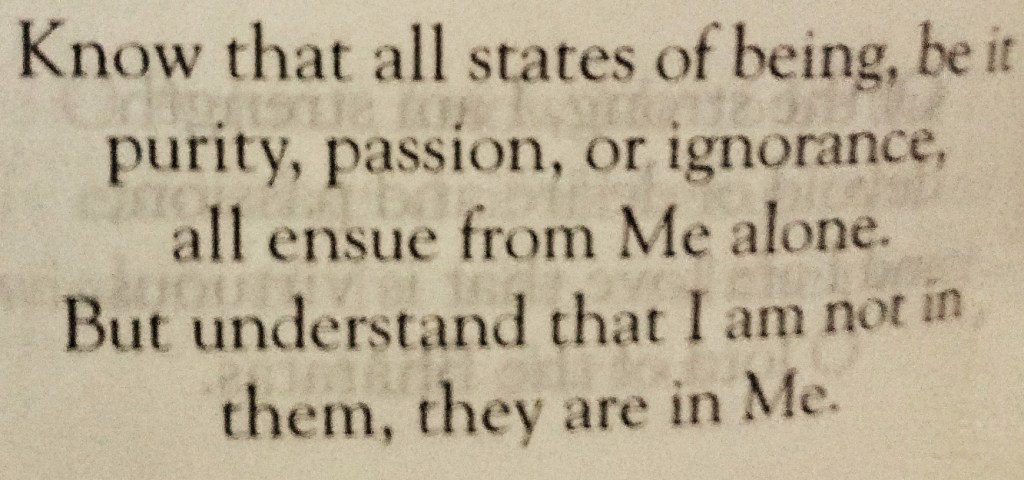
Anyway, I was reading the verse quoted below, from my Bhagavad Gita and a sudden flash of insight hit me.
Despite these five lines saying a particular thing in a clear and precise manner, I somehow misread the first three lines to say:
All beings ensue from Me.
Bhagavad Gita Ch 7:12
Somehow my mind skipped the ‘states of’ bit and made a leap that actually lead to a great realisation: Of course, I thought; God is not in us (as in living beings), it’s we who are in God.
Which to me means that we are all part and parcel of God. I’m not saying, I’m God; I’m not saying you are either. What I am saying is that all creation as one, unified whole, is in God. And if that one unified whole does indeed ensue from God, then it follows that all of creation is God.
As individualized, embodied entities, we (along with all life everywhere) are simply manifestations in the material form of that divine energy, that life, that truth; that which we often call God.
Now, this is an instance of a flash of insight leading to a truth, when the receiver of the insight (that’s me) is engaged with what you might call some other factual reality, that is, the actual words on the page.
At first I thought, that’s weird: how did I misread all those words related to states of being? I mean they are pretty clear right? But then I thought, no, maybe not so weird. In fact, it makes sense.
How can my material mind and intellect possibly be expected to always keep its millions of thoughts, ideas, impulses and the rest, in perfect order each thought or whatever following completely logically from the one before and to the one after? It’s never going to happen is it? Not for any of us (Well maybe I’m overstating my case here, but you know what I mean).
And if mind does indeed operate on what seems on the face of it to be a random basis, then it’s perfectly reasonable to suppose that one might be prompted to some momentous insight by, well by anything really. Even if it’s a conclusion jumped to after the misreading of a text.
In this case though, that jumping to conclusions, even though based a misreading, has turned out to be a genuine realisation that I feel on an intuitive level; my instincts tell me it’s Truth.
Yesterday found me (for a couple of hours anyway) out on the suburban streets close to the hermitage. Camera in hand and trying to cultivate an attitude of Contemplation. Working for the moment my heart, my head, and my mind all came together to help my camera make a photograph.
Well, in terms of contemplative photography, the outing was a bit of a struggle: getting into the Zen Zone isn’t always easy. And come to think of it, it’s not always part of the plan is it?
I don’t mean the little plans and intentions the ego comes up with about how things are going to turn out. I’m talking here about The Plan: what the Divine has in the works for us.
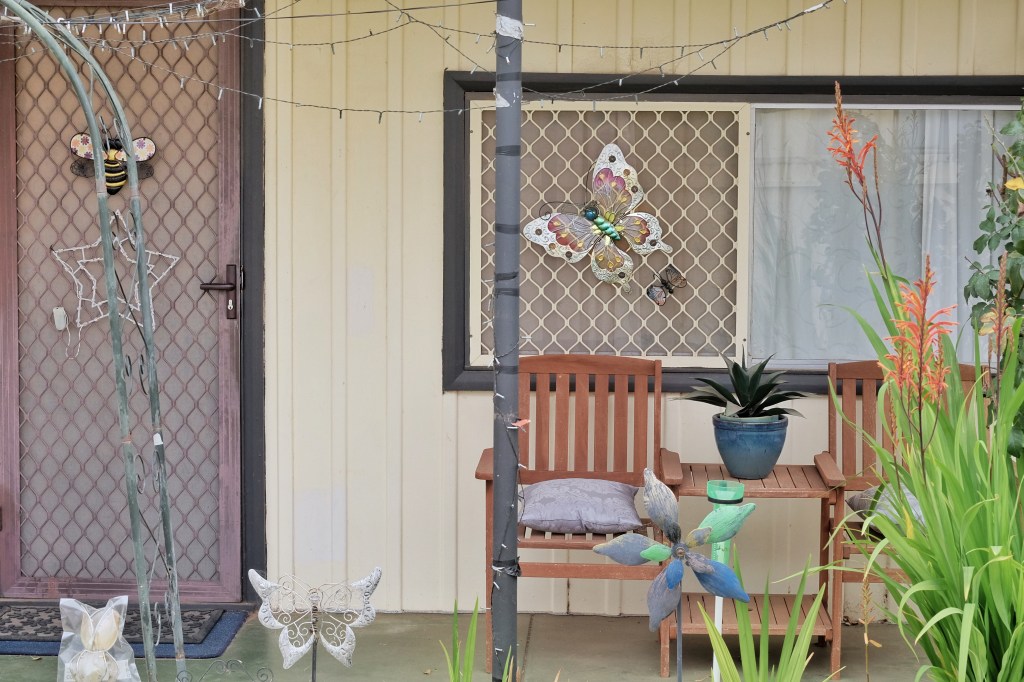
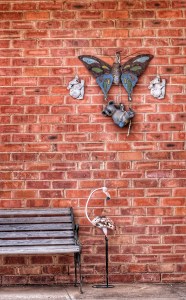
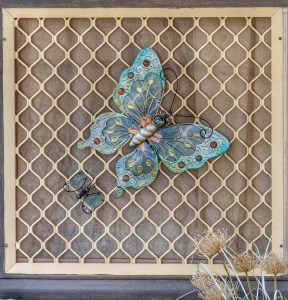
Anyway back to my walk. I kept walking, sometimes making photos. As I said, it wasn’t easy getting in the zone. Suddenly my eyes were drawn to a particular house. As I looked through the viewfinder I noticed a butterfly on the wall. On the window actually.
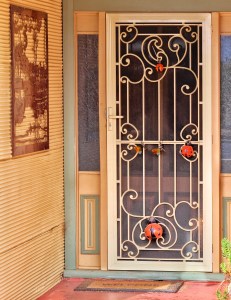
Not a living, flying, being as you can see. More of a kind of garden ornament attached to the front of the house. It struck me as I continued looking, that I’d already seen – and photographed – several ‘butterflies’ so far in that walk.
Four actually. In the space of an hour, and within a couple of streets of home. I’d seen them on walls, windows, and on doors.
Through time and in many places around the world, various cultures have looked at butterflies as symbols of transformation, for change, and renewal.
And, it seems to me, that butterflies can appear to us almost lighter than air. They kind of float on the air currents. They’re also known for their darting way of flying in what might seem to us one random direction then another.
So, butterflies have also been seen as symbolic of the human mind with its tendency to dart all over the place from one thought to another. They are said to remind us that we can in fact control and direct the mind.
In that case then, were these repeated encounters with butterflies – albeit of the ornamental variety – some sort of message for me? Perhaps I was to slow down, stop taking myself so seriously and to make changes? And of course remembering that I’m perfectly able to deal with consequences of any changes I make.
A Window for Two
Well, here’s the funny thing. Literally not until I sat down to draft this blog did it occur to me that I have in the last couple of days made what for me seem monumental changes. Or to be more exact, I have put into motion changes that are yet to reveal what if any transformations they might lead to.
You see, over the last few days I have been systematically deleting all my social media accounts (with the exception of a messenger app to speak to my son). I’ve had most of these accounts for up to 15 years or more. So, while I’m absolutely certain that this act of detachment from some of the things in the world that don’t sit well with my nature, I’m still feeling a bit lost, a little empty.
Okay, the butterflies: what have they to do with any of this? Transformation? Change? Lightness? And the ability to float through changes in life? Yes all of these. And we all know very well that butterflies undergo some pretty tough transformations as they evolve into what they are to become.
Who Invited the Lady Bugs?
Something I read once said that if you see a butterfly you should look at what you’re thinking; ask yourself what’s next for me? What changes are in store? Although all those butterflies of yesterday were ornaments on walls and so on, I have actually at other times been privileged to photograph living and flying ones.
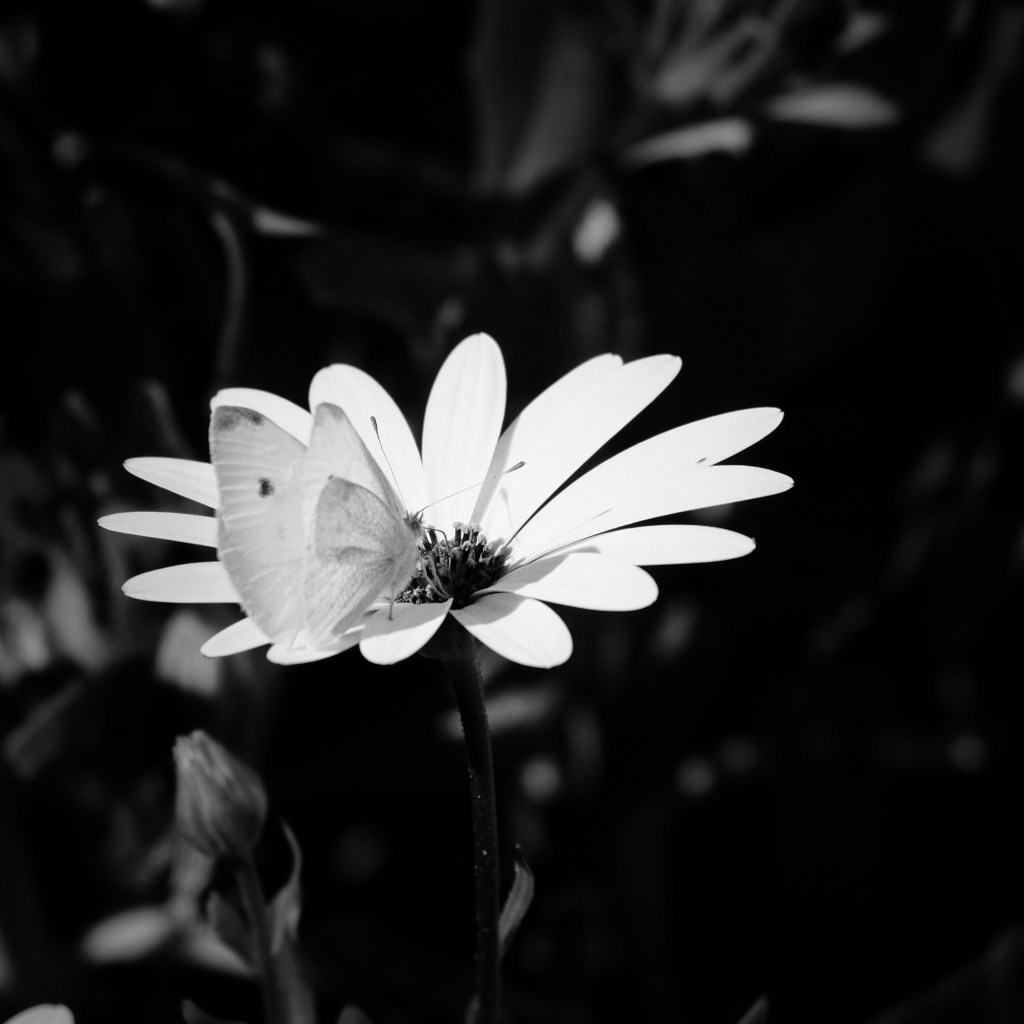
In fact just the day before yesterday I met a small white butterfly flitting from one white flower to flower. In the space of a very short time, this beautiful creature gifted me with a very small moment’s stillness, and it gave me a photograph. Here i share that one with you.
Early Christians associated the butterfly with the soul. So, yes, you could say that my meeting with that particular butterfly was a meeting of souls.
But what of the garden ornament, inanimate butterflies met yesterday?
Have I shared with you my Bhagavad Gita? Well, I know I’ve mentioned a few times that it’s one of, if not the primary resource for study and guidance for me.
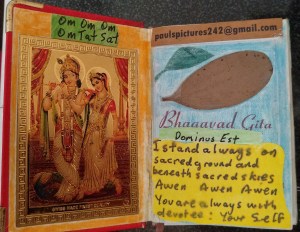
As you’ve probably guessed, this is a quick photo of the inside of the front cover. And, again as you’ve noticed, I like to stick things in my books, especially this little one. (Actually now I mention it, this is the only book in the traditional format as in made of paper, I own). It’s an old practice and for me adds multiple dimensions and depths to what is already a treasure.
Sometime I’d like to go through and describe to you all that I have added, but for today, do you see the little green section with the words Dominus Est printed?
In the religious tradition I was raised in, these two words have a specific meaning and use. However, it’s only recently that I’ve come to think of this little Latin phrase (well technically it’s a sentence, but …) in the sense of the literal meaning of the words themselves: God is.
That’s it. Or the Lord is, or the Master is. If we change the Dominus, we can use this tiny sentence to define our conception of the divine, the holy, in any way that seems right: Truth is, Beauty is, Art is. For me, God is, sits right. As do the others in this list. Same same.
So, God Is. What else could possibly be said that would add to this already very emphatic and simple statement? Nothing at all. It’s stand-alone, complete in itself.
Like asking who or what is God, we can answer: ‘I am this’ or ‘I am not that’. Or we can realise what for me is becoming the only answer: I am.
Why? Well, if we were to add anything at all to these two words, such as God is Truth, or God is Love, or God Resides in …, or God is called … , then we are in fact stating only a little of the truth. Sure, God is truth and love, and goes by many names and is found in many forms, but once we say what something is, we are actually making more of a statement about what it is not.
In the beginning there was the word, and the word was with God, and the word was God.
Mind you, it’s perfectly natural, and for many of us helpful, even necessary, to ascribe to God a name and or form. We are ourselves material beings, living in a material universe; it’s logical that we would choose (or need) to see God in a word, a physical object, or attribute some other kind of materiality to our notions of the divine.
I must say that I am one of those who find it difficult to envisage an invisible, non-physical, and impersonal ‘God’. Of course, our little statement, God is, does indeed say just this doesn’t it? Isness is pretty non-corporeal, certainly not in the least physical. And isn’t even a ‘spirit’ or ‘entity’ of any kind; Isness just is. The moment we label something (including ourselves) we miss that isness, that essence.
You see my picture of Krishna and Radha? This form, or forms, is one of the several that I feel right in having as a kind of focus, or centre of my devotion to and love for the divine; for love, for truth, and for it all.
You might be saying, this guy does believe in a personal God. He just told us. The truth is I don’t believe or not believe that Krishna (or any of the myriad names and forms we’ve invented) is God. God simply is. And my heart tells me that this is enough.
There are a pair of theological ideas known as Cataphatic Theology, and Apophatic Theology. Cataphatic describes or approaches the divine by stating what God is, while Apothatic (you guessed it) describes God by speaking only of what God is not.
My guess is that pretty much everybody, from whatever tradition, would approach the divine (and not only the divine) in one or other of these ways. But for me it was such a relief to realise that there was no need to go there at all. I could stop with the definitions and the descriptions, the what is and what is not. I have the freedom to not have to believe or not beleive. None of it matters. Dominus Est. God is.
Am I there yet? Have I let go of dualities? Hardly. Maybe the odd glimpse, but it’s rare. And it always will be for as long as I live in a physical body. But to paraphrase something Swami Ramdas said:
I’ve set my feet upon the path, so I am already at the goal.
Greetings friends. I welcome you from my new hermitage in desert country.
You know, it’s an old idea, a cliché even, to say that we, all of us, are on a pilgrimage called life, a Hero’s Journey as it’s called by the Mythologists. And, on any such journey there is what those same scholars call a Call to Adventure.
They are the times when we are challenged by life to commit to an action that will stretch us somehow, take us out of our comfort zone, change our life; to make a move; take a risk; embark on a journey either internally or out in the physical world.
So, when I tell you I got a call to come out here to the desert, and that I answered it, why the necessity to add ‘eventually’? What happened to delay that journey? Well, that’s what our Mythologist friends call The Refusal of the Call.
They’re the times when, once we’ve heard the call, and when we’ve felt its rightness, we still say no. Not now. And we come up with all kinds of perfectly reasonable explanations for our refusal.
In my case, I said, hey, it’s fine here; I’m near the beach; I really have no reason to move; there are plenty of ‘other places’ to check out first. The excuses went on and on.
All along though, there was this place, this country, calling. Of course ‘the desert’ isn’t always or for everybody the literal sand covered land, that gets very hot, and is generally thought of as barren and even hostile. It can also be a metaphor for any place – or no place in particular – that is a place of retreat, a quiet place, a place for living apart from the mainstream of human life.
For some people inclined to a life of contemplation and solitude, this place might be a small hut in a forest or a wood, or a camp on a remote beach on an even more remote island. Then there are others who are called to an actual cave high in the mountains, or on the banks of some sacred river somewhere.
And, equally, the desert, the place of retreat, quiet, solitude, and living apart, may well be an apartment or house in a suburb, or even in the centre, of a big city.
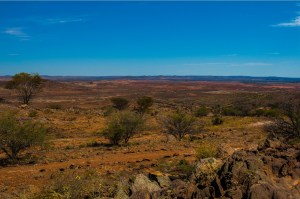
Then there’s me: called to this desert town of Broken Hill, almost but not quite in the centre of the continent of Australia. It is deep in the arid zone: it’s very far out back here in the Outback, 1500 kilometres inland from the east coast to be precise.
Yes, well this is all well and good, but shouldn’t I be answering my own question: why eventually? Well, we’ve covered the excuses, but really isn’t that just plain old procrastination? Yes indeed. If we get back to our Mythologist friends once more, we learn there is a stage in this Hero’s Journey that follows on from the Refusal: The Supernatural Act.
These are the times when things happen that seem to come at us out of the blue, from no rational, logical, or explainable source. Something that we might find hard to beleive at first because it’s way out there; supernatural like it says.
But that supernatural bit doesn’t have to take a spooky form, it might be that the ‘supernatural act’ is an internal insight or realisation triggered by a perfectly natural occurance. That’s what happened for me. What was this non-spooky, natural event that prompted such internal insights and realisations in me and got me moving?
Rain. Yes, rain. It rained almost every day for over six months. I am very very blessed that I wasn’t affected by flooding as so many in nearby area were, and I am thankful for that. But it’s safe to say that rain, mud, no sun, and limited or no access to the outside for days or weeks at a time, soured my romance with the coastal lifestyle.
You could say that through the sound of rain on the roof, I could still hear the call of the desert. In fact it got so loud that, eventually, I could no longer ignore it.
So, eventually, I answered the call, and here I am. Here is a small miner’s cottage and my new hermitage, my new safe haven by the side of the road. The cottage is situated in a mining town that sprung up in the 1880s. So this cottage has been home to miners and their families for generations, including the current owners.
In a sense it’s quite likely that I am the first occupant who hasn’t been or isn’t a miner. Though you might say that my excavations, rather than being in the dark underworld beneath the surface of Mother Earth, are taking place in the equally dark, hidden interior places of Self. A mining of another sort you might say.
Before flying out here, I was thinking about what was actually calling me to the desert (putting aside the rain for a moment). After all, I lived in a small cabin in a park like setting literally five minutes walk to a pristine Pacific Coast beach; I had trees and forest like spaces all round, as well as a small river two minutes walk. And that’s not even thinking about the abundance of wildlife.
And it occured to me that it is the stillness of the desert that was calling to me. This town of Broken Hill is a mid size town (actually a small city with about 15000 people), with the usual shops, cars, people, and the rest.
Yet there is a stillness. No longer can I hear the constant sound of seawaves crashing. No longer can I sense the never stopping coming in and going out of sea tides. And out here, it seems like even the people are moving quite a bit slower too. I’ve yet to see a single person rushing about. And they seem to smile a lot as well.
The street I live on is extremely quiet, and even on the so-called ‘busy streets’ there isn’t the mad acceleration and braking we’d see everywhere on the coast. Of course there is the odd driver who thinks every car is a racecar, but where don’t you get that?
But, actually it’s more than this. There is, beyond the actual literal quietness, a silence that seems to exist as an entity or state of being in its own right.
A stillness that is a solid thing, just as on the coast there was (is I suppose) a constant frenetic atmosphere that seemed to overlay everything. People rushing – on foot or in cars – even when there seems to be no reason for hurry (though of course you can never tell can you?). And not so many smiles either.
Contemplative people, those seeking solitude, and peace and quiet in which to pray, to live slowily, and to explore the divine, have been drawn or called to deserts (in all its forms) for thousands of years or longer. And I am fortunate enough to have finally (eventually) heeded the call myself.
Here, away from the incessant acceleration and braking (I do like this expresion), and in that stillness that envelops this land, perhaps I can dig a little deeper, uncover a bit of quiet, and discover a piece of solitude.
Out here, in the Outback, life can be harsh for all living beings, often dangerous in its aridity and isolation. It’s a long way from major cities, food and supply chains are extended to extreme limits, and the human hold on the land is precarious at best.
Yet, the paradox exists: out here far from the fertile coasts, the soft sandy beaches, the major urban centres where the mainstream of (human) life goes on, there is a quiet, a peace, a stillness that seems to pervade the very air one breathes.
A wise person wrote something short and sweet that sums all this up for me:
Welcome friend to another post. It’s good you are here.
Like so many other people I like documentaries on, well, all kinds of topics. I sort of go through phases and a while back I was on an historical/archaeological kick. And if it involved adventurous journeying, then so much the better.
Anyway, one I watched has stuck with me. In this show, an Indiana Jones type went in search of an ancient religious artifact. After a sombre pilgrimage across a stunning but arid landscape, a number of adventures and fascinating tours of interesting historic sites, he was forced to conclude that nobody could know for sure that this particular artifact actually existed.
This was especially the case given the fact that several hundred individual churches across a vast area claimed to possess said artifact, according to our intrepid guide. Then there was a doco I’d seen a few days prior that suggested this artifact was in fact hidden in Southern France.
Or perhaps it was destroyed in 800BC as some other ‘experts’ suggest. In any case, our fearless explorer came to the conclusion that, at the end of the day, whether the artifact still exists (or ever did exist) isn’t the point. He told us that what mattered was that people believed it existed, and that its power existed through that belief and was a force for good in people’s lives.
Actually I think even this misses the real point: I don’t think we are necessarily meant to have a belief one way or the other when it comes to the historical accuracy of myth. Myths tell us stories about truth, about our place in the Universe, and how to behave and live a good life. The facts or lack of them aren’t important.
Every culture throughout human history has had its myths: about creation, about their pasts, their gods, their futures, and how to conduct one’s life so that society can continue to function. Some will say that we in the so-called West are lacking our own myths and stories.
Well, I also believe that our myths are in many respects largely forgotten, or perhaps are only held by this group or that within our societies.
I think we all have our own myths, whether they are ones received from our society either consciously or unconsciously learned, or from our own personal life experience. Then of course there are the so called ‘modern mythmakers’: the media, politicians, and marketeers, all advertising their own ‘truths’. But that’s not what I’m talking about today.
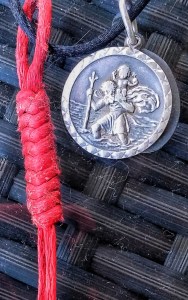
So, moving right along. Hands up if you’ve ever owned or been given a St Christopher medal? Ah, just as I thought. Huge numbers of people out there have at one time or another had a St Christopher around their neck, or hanging from their car’s rear vision mirror, or perhaps tucked securely in their bags. And really one doesn’t have to be ‘religious’ to admit to ownership of such an artifact.
He’s an interesting character this Christopher. He is a saint of the Roman Catholic Church and here we start already to get into the myths and legends around our friend Chris. It’s widely known that he was stripped of sainthood and declared to have never existed after the reforms of the late 60s in the Catholic Church. Myth number one.
He is still a saint, and all that happened was the church found itself with an overly crowded calender of saints’ days and decided that some could be cut off because they weren’t necessarily of ‘universal importance’, and besides, he may not have actually ever existed.
Poor old Christopher was thus unceremoniously dumped. No saint’s day, but he did keep his sainthood. As for the minor question of his existence, the church said that wasn’t their decision to make.
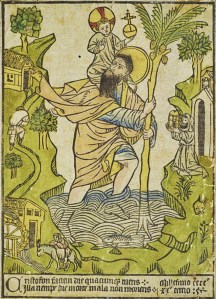
Not much is known about the possibly historical figure of Christopher. First up (myth number two) his name wasn’t Christopher: he was a seven foot five inch (may or may not be a myth) called Reprobus. He was a Canaanite who while working for the king suddenly decided to go off on a spiritual quest to find an even greater king.
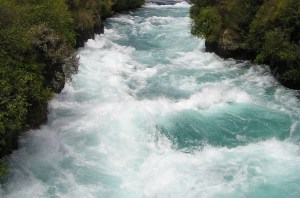
Like all good heroes, Reprobus has all kinds of adventures, until one day he meets a wise old hermit who tells him that if he wants to serve the greatest king of all then he has to help people cross a treacherous river where many drowned trying to get across.
So, Reprobus started to carry people safely across the raging river. One day he lifted a small child onto his broad shoulders and carried him safely to the other side. Reprobus told the child that he’d never carried such a heavy weight before, and so they had both been in grave danger.
The child then told Reprobus that he had not only carried the weight of the world on his shoulders, but also the one who made the world. In other words our friend was informed that he was indeed serving the greatest King of all.
And that’s how good old Reprobus got the nameChristopher: the name means Christ bearer. Later, Christopher is martyred for his faith and the rest, as they say, is history. Because of his splendid lifesaving deeds serving people crossing the river, our hero over time became the patron saint of travellers. And his fame spread beyond the confines of the Catholic Church and all sorts of people have looked to him for protection for themselves or loved ones when travelling.
I have a confession to make: I love and always have loved (venerated isn’t too strong a word) St Christopher.
Mind you, I’d always had some issues around the lack of evidence for his having ever existed. Not to mention the small detail of a miraculous appearance of the Christ as a child who was as heavy as the whole planet.
Anyway, while I was never quite convinced that St Christopher was a real historical figure anyway, I agree with what our friend the Indiana Jones look-a-like says: it doesn’t matter.
And for me there is still a truth at the heart of all this: Our pal St Christopher is me. He is you; he is each of us. We all have the strength to carry the soul of Self, the heart of ourselves, across the raging rivers, through the wild storms, and across the sometimes very rocky ground that make up each of our lives here on Earth.
Do I wear a St Christopher medal? I most certainly do. Belief or non-belief in his historical existence is beside the point for me. It’s the myth I resonate with, the symbolism.
My medal shows a big, strong guy wading through knee high water carrying a small child on his shoulder. Both of them are me. Both of them are you.














 Notes from the Hermit's Cave