What? It’s the Next Question

I’m rewriting this post after initially making it another two for one thing. One of those two questions had been: ‘What is prayer?’. As in what form can and does prayer take, my prayer that is.

Then I realised that all the thoughts, all the contemplations and reflections I came up with in answer, belonged more correctly in the How question which will be coming in due course.

Which means, that in this post we will be looking at just the one question, which also is only about my own personal prayer life.

What do I pray for?

As it happens, I have already spent a little time on this question in the Why do I pray? post back in November. I think it would be a good start to begin this post with a quote from that one:

  ‘So,’ you might ask, ‘you pray without any ulterior motive at all? You don’t pray to get things? You don’t pray for healing for others or yourself? You don’t pray for peace and happiness for the world or for yourself? None of these things?’
  These are good, valid questions. And the short answer is yes, of course I do. I do pray for healing for others and myself; I do pray for communal and personal peace. As for happiness, well who doesn’t pray in one way or another for a just a little happiness now and again?
  However, I do draw the line at praying for material things, like money and material objects to possess, none of those kind of things. I believe I don’t pray for such things. I think so anyway.
Now, I don’t know about you, but it seems to me that those two last little sentences are broadcasting a very clear message: Obviously there is some uncertainty in my thoughts about what I actually in fact do pray for.

Somewhere, sometime, recently I wrote to the effect of that there is nothing to pray for, and that there is nobody to do the praying. This, of course is not a notion we can really get to grips with while living in a material body in a material Universe.

It’s nore for those dwelling in some transcendental realm where everything that exists has ceased to exist, and all that remains is pure consciousness.

So, obviously while we continue our existence as embodied beings, living in a material universe, there is much to pray for and there are many of us who do pray. Speaking only for myself personally, I know I could pray more, better, and deeper. As I’ve mentioned many times, my aspiration is to make my entire life – physical, mental, spiritual, – a prayer.

Okay, that’s all very good and fine, but I still haven’t answered the question: What do I pray for?
Well, as I mention in the quoted passages above, I pray for healing and peace for other people, the world, and for myself. I pray for happiness, health, and freedom from suffering for all beings.

But it’s not that I’m directing my prayer to some being up there in some heavenly realm who sits arbitrarily dispensing favours or denying them, and who acts according to the quality and quantity of prayers sent their way.

No, it’s more about, as I talk about in Who do I pray to? the post before this one, directing my attention, thoughts, actions and everything else, to the symbols that represent for me the natural flow of the laws and order of the Universe. Why?

Seeking alignment, I think that’s the best answer. By praying I am seeking to align myself, to put myself in sync with those natural laws, with the flow of that natural order.

Referring to the quote above, the peace and healing I pray for are like affirmations of my desire for that alignment, and that the entirety of Self itself be in alignment. That Self I speak of is of course all that exists in the Universe.

It’s similar when talking about praying for material ‘things’ while remembering too, that healing and peace are also in fact ‘things’ of the material world. Perhaps the best way to put it is to say that it is not the ‘things’ themselves that I pray for. With the risk of sounding like i’m repeating myself, it is correct alignment with all material existence that I am praying for.

Actually, it is more than that now I think about it. My prayer – and my life – is actually about my seeking to properly and fully realise that (to quote the glorious Desiderata:

No doubt the universe is unfolding as it should

We suffer when we label that unfoldig or a person, a thing or event or whatever as good or bad, desirable or undesirable; when we think there is a them and there is a me or an us always separated; when we are compelled to gather possessions and yet still think we never have enough. These are the dualities of material nature.

My prayer is to realise, not just know in my mind, but realise in my heart, that there are no dualities. There is only … Ummm. Well, perhaps that’s it: There is. Only. Nothing else. Only. Is.

May all beings come to know their Isness.
Who? Just One of Many Questions

In November last year I published a post on this blog that sought to answer the question, Why do I pray?
In that post I said that this question is one of the big ‘Who am I’, Self-Enquiry questions.

I also claimed in that post that it was (is) a core aspiration of mine that I make prayer a ‘whole of life activity’. To quote me from that post:

You see, I want to pray, and make my whole life a prayer. A prayer of praise and devotion; a prayer of gratitude and loving; and a prayer of service to all beings .

Anyway, moving along to today’s post.

That question, why do I pray, is one I ask myself quite often. It’s not a one time enquiry you can tick off and move on from. The contemplation of why pray is an ongoing and evolving thing.

A couple of days ago, as I once again reflected on this particular question, it occured to me that perhaps it wasn’t the only one I needed to be asking myself if I am to think about my prayer life in any depth. Actually, the same could be said for pretty much anything one is trying to find answers to.

Indeed, many writers – particularly story tellers and journalists – will be aware of the series of questions often used to get to the truth of something:

Who? What? When? Where? Why? and How?

Commonly refered to as the ‘The Five W Questions’ (although there is that H in the mix leading to some calling them the WH Questions), these questions asked correctly and thoughtfully, will help to ensure a comprehensive and complete answer to any enquiry.

The next thought popping in suggested that it might be a great idea to apply the W Questions (including the H) to me and my prayer life.

At first I thought it seemed like a neat challenge, a kind of intellectual exercise that would be interesting. Then, though, after thinking about it some more, I realised that contrary to being just some mental challenge, asking myself these questions in relation to my prayer life, might actually be essential.

Especially if I am to some day reach fulfillment of my aspiration to make of my whole life a prayer. It’s the only way, I reasoned, that I would be able to get complete picture of the state of my prayer life.

Of course I have to wonder if it is indeed possible to ever get a ‘complete picture’ of a phenomenon such as an individual’s prayer life. Still, let’s just plunge in, see where it goes, what happens, how it works.

Who

There are actually two ‘who’ questions that I’d like to try to answer, both essential to our enquiry:

Who is it that’s praying? And Who do I pray to?

The answer to the first question is obvious: it’s me doing the praying. But, which me exactly? Not the me who is the true Self, the Absolute Reality. The reason why will become clear as we go along.

No, the me doing the praying is what we might call the body mind complex, the me that lives in the material world as a material being. The impulse to pray, what to pray, who to pray to and all the rest arises in the mind.

Mind you, I along with so many others I’m sure, like to say that I pray with and from my heart, my spiritual heart. But then I do also know that emotions originate as thoughts in the mind. Of course that does not lessen the significance of such emotions and the prayers, love, or devotion that follows.

Now, who do I pray to? I know it’s going to sound a bit odd, flippant and even silly, but as I think about it, I realise that I do in fact pray to everyone and to everything.

Which is to say, my prayers are directed to that invisible ‘something’ that pervades and permeates – and actually is  – everything that exists. You could say that I pray to existence itself. There is nothing or nobody else.

Of course it’s not exactly an easy thing to get a handle on praying to ‘everything and everybody’. I mean, where does one direct their attention? Who or what does one address or speak to? The answer is a lot more straightforward than you might think at first.

Because my prayers are to that amorphous ‘everything and everybody’ it’s quite easy to select one or more resonating and meaningful somethings or somebodys as the objects of my prayer.

There are many spiritual or religious traditions in the world, all with their preferred names and forms of the Divine (or Existence as I named it earlier). Each of these manifestations of the Divine has its own characteristics, their own place in the Universe. They each play their own roles in the cosmic order.

As such there are more or less an infinite number of choices for me to have as foci for my prayer life. I will try to share with you a few of my personal pantheon.

Om: The Essence of Brahman, Absolute Reality

The Existence I’ve mentioned a couple of times is named by some Brahman, the Ultimate Reality, the everything and everybody that I was talking about.

So, I might sometimes pray to Brahman. Mainly it’s an aspirational prayer as I seek to realise fully my already existent oneness with the Ultimate Reality.

Then there is Ishvara, which is probably closer to what most would recognise as God – a personal supreme being, Or, in some traditions Ishvara simply refers to the one or more deities that an individual chooses as objects of her or his devotion.

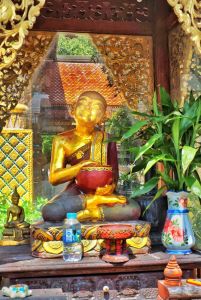
Centre of Attention on the Hermitage temple alter

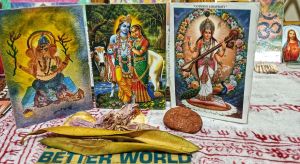
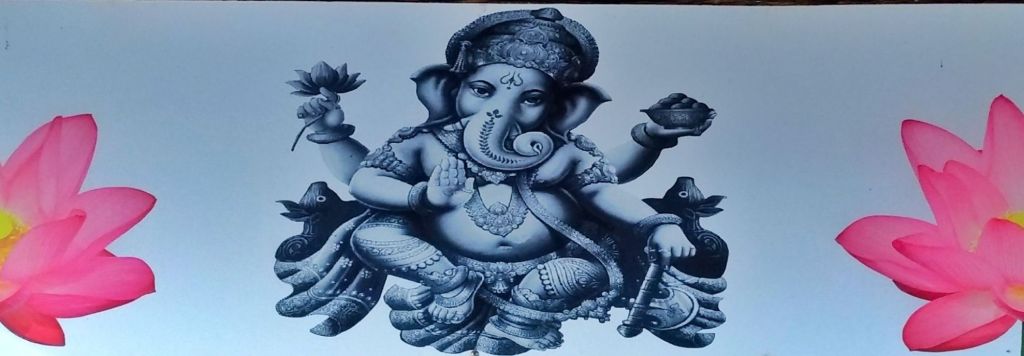
Also included in my personal pantheon, are the Divine Mother, Kirishna, Ganesha, Lord Jesus, The Buddha, Sarasvati, as well as other teachers and saints from many traditions who pop in and out of my prayers, seemingly at random.

My prayers are of praise and/or gratitude to the teacher, deity or saint who seems to me at that moment to be most linked to my current circumstances and thoughts.

All of this I call prayer. To God. Or Brahman or Ishvara. Or very often, simply My Lord,

Divine Mother

When You Say It All in a Text Message

It wouldn’t be quite correct to say that I never get calls or texts on my phone. What would be correct is to say is that the vast majority are to do with what I might call The Bureaucracy: Reminders of Doctor and dentist appointments, notices from various government bodies, library notices; all that kind of thing.

And there is another emerging category that’s actually a lot more welcome: while my partner hermit and I have always phoned each other, lately we’ve been texting more and more as an extra way to communicate with each other.

Sometimes these texts are about the mundane things we all have to do in the world, but then there’s another dimension in which texting allows us to keep in touch with each other’s feelings, thoughts, doings, and simply as a means of keeping the connection open and strong.

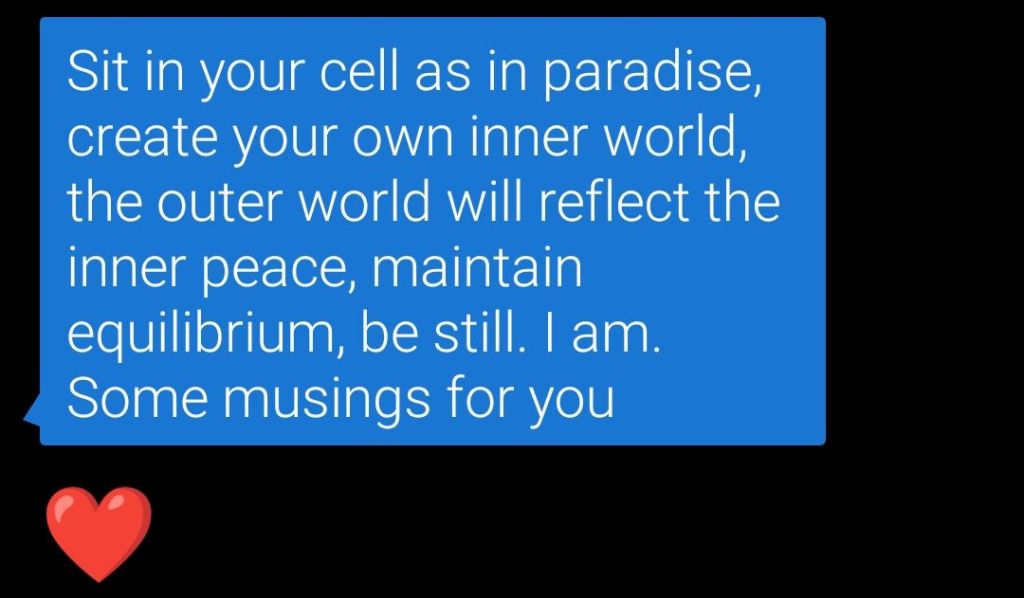
The other day, for example, such a text arrived unannounced in my phone. Like some I get from The Bureaucracy, this one was essentially a little series of reminders. But rather than being about the things of the outside world, these ones, in this text, spoke directly and deeply to the enrichment of the inner life – my inner life.

Powerful messages, all of them, that really go to the heart of one’s (my) efforts to live a life more centred on my spiritual quest and my commitment to living more in sync with Absolute Reality.

On first reading of this text (and on each rereading, of which there have been many), I really felt strongly that I needed to contemplate deeply and prayerfully on the pieces of this whole. And, as well, to share my reflections with you.

Sit in your cell as in Paradise

This little – yet tremendous – injunction references an answer to a question posed to Abba Moses, one of the early Desert Fathers:

Go sit in your cell and your cell will teach you everything.

Essentially Moses’ advice is, remain within the confines of your dwelling place – whatever and wherever form that place takes. This can be a literal geographical location, or even your own body as it moves in the world. We all have a body, we all dwell there.

Sitting in one’s cell is not a simple or passive activity. It is in fact hard work as we wrestle with the mad monkey mind, and attempt to grow spiritually.

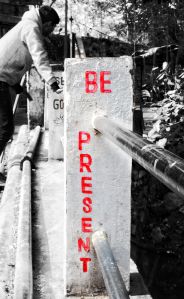
So, what about the ‘as in Paradise’ bit? Well, to me this feels very much like thinking of one’s cell as the place to be. What I mean to say is that it’s the only you can possibly be in right now, in the present of the here and now.

It’s not about judgements of is it good or bad, pleasant or unpleasant, painful or not. Just acceptance of where youu’re at right now. Doesn’t mean you’re stuck there and by no means suggests you resign yourself to your circumstances. It simply means you see it like it is, at this moment.

And it’s about understanding that, while you are in that place, it’s where you know you need to be. Your cell – your dwelling place – has within it everything you need to live, grow, learn, and prosper in the spiritual life.

Whatever the ‘place’ you are in is like, we can try to cocoon ourselves, make a space within the space, even if it is just being aware of our bodies sitting in the space. Cocoon myself is an expression I’ve been using lately to describe the act of isolating myself in any way I can from my surroundings. This can apply on the macro scale or the micro as we seek to centre ourselves and find quiet and a peaceful place.

It’s not as if in this cocoon (or whatever it might be)  that  all will be bliss and light all of a sudden. No, I think the suggestion here is we try to develop an attitude of non-attachment towards the things of the world that trouble us, those things that cause us suffering, precisely because we are attached to them.

That is the purpose of sitting in your cell. That is the everything that your cell will teach you.

You know my friends, I’m a bit weary tonight, and with your permission I will continue with this sharing of my contemplation, my reflections, in my next post.

Thank you for staying with me.

Peace and love

Paul the Hermit

Less Desires, Less Entanglements Equals More Freedom

Along with many other spiritual seekers across many world cultures and over time as well, I have a more or less daily practice of opening a spiritual book, scripture, or other text ‘at random’ (as if there is such a thing) to receive a message, a lesson, or a little bit of guidance for the day.

In my case, that text has for ages now been the Bhagavad Gita. And over I think the last two or three years, one verse in particular has come up time and again, sometimes on two or three days in a row.

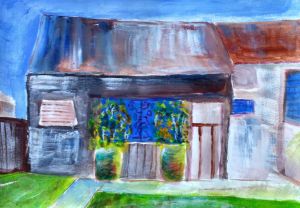
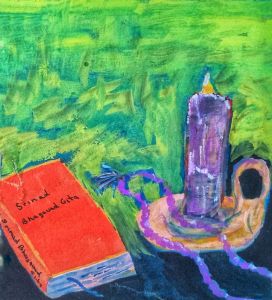
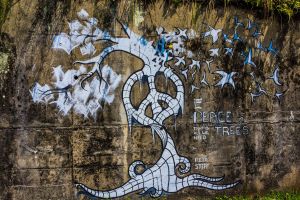
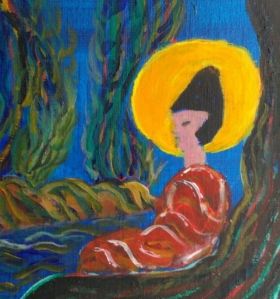
Much thanks to the Hermit Pilgrim who created this beautiful painting

So frequently has this occured that not only have I neglected to examine the verse in any depth, I actually began to ignore it when it came up and went right away to pick another one at random.

Well, this morning, I opened my Gita and there was that verse again – for the second day in a row. However, today, for some reason, I realised that this verse has been calling out to me. Or put it more sensibly: the Divine has been calling on me to take some notice of this verse and its meaning.

So, first of all, allow me to share with you the verse in question.

The Lord of Sri said:

It is said there is an eternal Banyan tree with its roots growing upwards and branches downwards, whose leaves are the Vedic hymns. One who knows this tree knows the Vedas

         Bhagavad Gita 15:01

For me at least, this verse has always appeared quite complicated, complex really, and full of symbolism. Of course, being from an ancient religious text, it’s likely to be all those things isn’t it?

Still, despite reading the verse many times and studying and hearing a few commentaries on it, for some reason it has remained for me rather daunting. At least I can say that I was convinced of the notion that this verse confused me, entangling me in convoluted and sometimes upside down thinking.

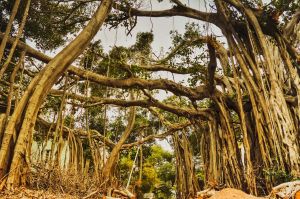
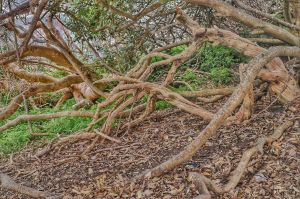
Like the Banyan tree itself I guess. Considered especially sacred among all other sacred trees in India, the Banyan is well known for its way of growing willy nilly, every which way, until the whole thing becomes a complete and dense tangle.

And it is this tangle that is at the heart of the metaphor used to illustrate the lesson in this chapter of the Bhagavad Gita: The tree is Samsara, the illusion that is the material universe in which all of us living beings are entangled. It’s as if we’ve walked into that tangle of branches and roots believing that’s where we will achieve our desires.

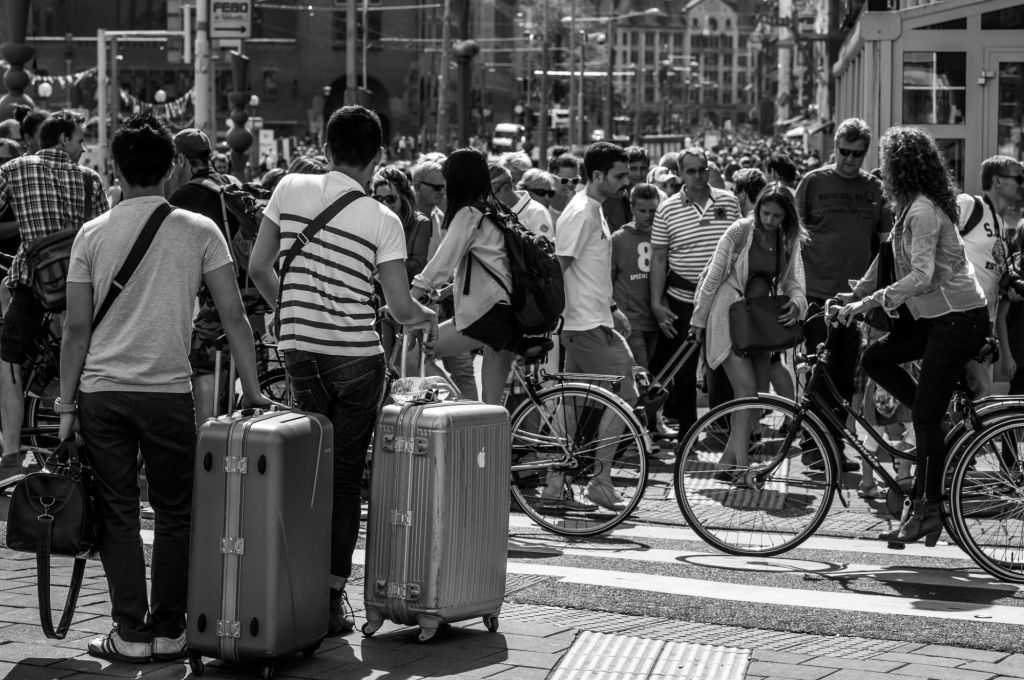
A major city in the middle of tourist season is another neat metaphor for this tangle we’re talking about. We look for worldly pleasures there, but find chaos, confusion, and often unhappiness

We are so attached that we identify completely with that physical world (convinced we are merely physical beings ourselves) and are convinced that this is where we can fulfill all our needs.

As the verse says, the leaves of the tree are the Vedas, and one who knows the tree, knows the Vedas. The Vedas are the sacred Hindu scriptures which in this context can be said to represent knowledge. But not knowledge of a mundane ‘ordinary’ kind.

The knowledge to realise (because we already possess this knowledge, we just aren’t aware of it yet) is that we are not the body, so we have no need to be bound to the tree of Samsara with its suffering and its endless entanglements. It is Self Knowledge.

This Self Knowledge leads us to develop what a following verse calls ‘the weapon of detachment’ with which we can chop down this very strong tree of attachments and illusions

A little note: I don’t like this weapon and chopping metaphor at all. I simply pass it on to you as written.

As we begin and progress with this process of truly realizing we aren’t the body, and therefore have no need to identify with or be attached to worldly objects and desires, then slowly the tangle binding us begins to clear, to fall away bit by bit.

I din’t think we need to actually get to that point of cutting down the whole tree before we begin to see results. to reap the benefits if you want to put it that way.

Each and every small thing, desire, compulsion or aversion we no longer feel ourselves bound to, frees us just that much more.

As with any tangle we get ourselves caught up in, once we loosen that first thread (to switch metaphors), the task of unravelling becomes easier.

It’s true – and I think I’ve mentioned it previously – some of my attachments and compulsions are loosening. Some (small ones I admit) have fallen away completely.

As you read in my little note, I’m not comfortable with the whole cutting down trees with weapons metaphor. Perhaps the loosening of threads, the unravelling of tangles and knots sits better with us.

Perhaps my – our? – efforts at detaching from the desires and aversions, from the compulsions for worldly things and objects, and for sense pleasures, can be achieved by a more gentle untying we could call it. A kinder, gentler, calmer, friendlier, means to realizing we are already free.

Are the Hermit Pilgrims Settling Down?

Stand by for an announcement:

The Hermit Pilgrims have signed a lease for the rent of a house for a year. Not only have we signed a lease, we have, in fact as of yesterday, been residing in the said leased property.

Admittedly, it’s exactly the sort of small house which we had in fact been longing for for some time. It’s got many characteristics that make it for us, the ideal site for a hermitage: we even have a temple room!

The lease is for a year initially, and if,  after a year we feel led to move on, then that’s what we shall do. But for now, – as in the present moment that is the ongoing now, the only ‘time’ one can talk about with any meaning or truth – we will be in the one hermitage, the one safehaven by the side of the road, for a longer period than in any other in the last many years.

Anyway, enough of this reflection on the nature of time; the big question on your mind I am sure is why? Well, the first little thing to say is that the pilgrimage goes on; it’s just that we’ve taken a tiny step towards the vow of stability many monks and nuns make as a matter of course. We’ve not really ever taken such a vow before. Mind you, a lease is a binding document, I wonder does that count as a vow?

Of course, as I’ve just laboriously spelled out, there is only the moment, the ongoing now; so who can possibly say about ‘a year’?

Next, let me tell you a bit about a book I’ve read a few times and like very much. It will possibly give you a flavour of the why.

Cave in the Snow  by Vicki Mackenzie tells the story of Tenzin Palmo, a Tibetan Buddhist nun and her, I think, twelve years in solitu6de in a nearly all year round snowed in cave in the high Himalayas.

Tenzin Palmo had been living in a rather remote monastery, but felt after some years the need for greater isolation and solitude. The monastery was too busy and noisy, with all sorts of comings and goings.

There was too much entanglement with the greater society in the form of the surrounding villages and town. She wanted some quiet basically

In an interview sometime after she came down from the mountains she was asked if going to a cave was perhaps an escape, an ‘evasion of the trials of an “ordinary” life. Her reply spoke to me when I first read it about 20 (or more?) years ago, and still does today:

‘Not at all. To my mind worldly life is an escape,’ she replied to the interviewer. ‘When you have a problem you can turn on the television, phone a friend, go out for a coffee. In a cave, however, you have no one to turn to but yourself.

You have no choice, she says, when problems come up, and when things get tough, but to go through with them, till you come out the other side.

‘In a cave,’ she said, ‘ you face your own nature in the raw, you have to find a way of working with it and dealing with it.’

My situation is not quite like hers. For example there is more than one person in our community of hermits. Still her story does resonate and speaks very much to my own situation.

Not only is there never going to be any absolute certainty in our material world, there is never – ever – going to be anything in the realm of worldly things that will deliver us perfect peace and lasting happiness.
Easy to repeat, this tidbit of transcendental knowledge, but quite another to get oneself unattached to the idea that, well, maybe, just maybe, the next big thing, might just be different, might indeed be the forever answer to peace and happiness.

And it’s that attachment that I’m tackling at the moment.You see I long for a more pure hermit life, a life with a lot less engagement – and entanglement with – worldly things and situations.

I once wrote in a poem called Seeking Noble Truths or Just Passing Through that ‘longing is loss’, and it is, if one is attached or clings to the object of desire, or an outcome being exactly as is envisaged. Not being attached means less disappointment, less suffering, if as often happens, life does its thing and the outcome is not what we hoped it would be.

But here’s the thing: the bonds of my attachments in this area are loosening a little, bit by bit. And the paradox isn’t lost on me either: As I ‘settle’ into our (supposedly) longer term hermitage, I will, I hope, come closer to a point of stillness, of equanimity, and of silence. I will inch even closer to that state where attachments will all just fall away.

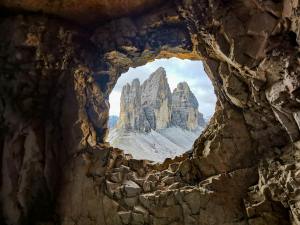
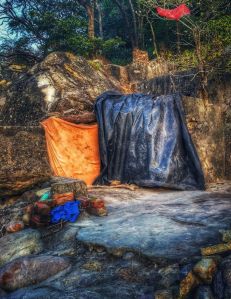
Hermit caves take many and varied forms

Now, in no particular order of priority or preference, I’ll try to convey in words some of the reasons we’re opting to continue our pilgrimage in a more long-term hermitage.

To be honest, as hard as I try to be present, to just live here and now, I just like the vast majority of my fellow human beings, find it extremely difficult to not be pulled ahead to the future (or dragged back to the past for that matter).

No sooner have we moved into a new hermitage, then we feel we have to start shopping around for the next one. Of course, one can’t ignore the practicalities, but for me it goes way beyond being a sensible planner.

And to be perfectly frank (I wonder who this ‘frank’ is anyway?) we’ve tired of it. The looking, the thinking, the talking and emailing to prospective places. It’s actually quite boring, to be stuck on that kind of merry-go-round .

It’s also extremely distracting. It gets in the way of our efforts to calm and quieten our minds for extended and deeper meditation and contemplation. Not to mention the ongoing (seems endless sometimes) discussions of the pros and cons of decisions to be made, as well as the frustrating second guessing I’m famous for.

Portrait of a Hermitage

We all know from experience that there is never going to be any absolute certainty in anything we arrange in our lives. Of course I know very well that even a signed, sealed and delivered legally binding contract or lease, means very little if the parties involved put their minds to it or change plans somewhere along the way.

All things in the material world are relative, and always subject to change; there’s nothing we can do to bend that natural law. Given such a context we still feel okay about entering with a right-hearted intention, this agreement for a year (at least) in the new hermitage.

As the residents of the hermitage are prone to say really quite often: ‘Your will, not mine, be done’.

Then, when life does its thing, I’ll be more able to roll with it. Why? Because I will (hopefully) have better learned that it’s not my will that’s to be done, but the Divine Will, the natural law and order of the Universe.

So, If it be your will…

The Q&A in the Scripture Part 4

A sooner rather than later return to our supposedly occasional series on the Q&A between Uddhava and his cousin Krishna on the eve of their departure from their soon to be engulfed in the nightmare of war hometown.

So, why sooner? After all it’s not been that long since our last installment. Well, I was just reading through my notes and the questions and answers we’re looking at today just sort of jumped out at me, asking to be contemplated. So, here we are then.

It’s another two-part question, but unlike with previous questions, we can look at these two in the one post. The reason being that the answers to both questions are, if not quite the same, are very closely related, as are the questions, come to think of it.

Okay, to the questions. Uddhava has already worked through quite a list, but now he gets to, what seem to me to be a couple of biggies:

What are reality and truth?

You see? I did say they were big questions. When you ask what’s reality and what’s truth, then you are really reaching for, well, I guess, what’s real and what’s true. No dilly-dallying, just right to the heart of things.

But, why these questions? Well, look at it from Uddhava’s perspective: his whole world, the only home he’s ever known, is about to be devastated by war. His world is completely turned upside down as he prepares to leave for an uncertain future perhaps never to return.

Like any of us, he’s probably on the verge of despairing, wondering to himself, ‘Is this really happening? I can’t tell what’s real anymore.’

Well, Krishna’s answers are short and succinct, and to the point. A lofty point, but then it would be wouldn’t it, coming from God?

Anyway, his answers:

Reality is seeing all the same.

and

Truth is the true speech uttered by the wise.

Reality does sound very dull if we take Krishna’s answer at face value. But he’s not talking about what we see with our physical eyes; he’s meaning seeing as in understanding, true realisation, as in ‘Ah yes. I get it now.’

But, ‘all the same’?

Obviously all the various beings in the Universe have their own unique names and forms and attributes; clearly they are not tall the same.

No, what Krishna is getting at here is that all beings in the Universe, all living and non-living things, are manifestations of the Divine. At that level all beings are one as the Universal Consciousness that pervades and underpins all that is in existence. Actually it’s not exactly right to say pervades and underpins: rather, consciousness is all there is, and that all is the Divine.

In other words, all beings are one and the same divinity. All the rest, all that we are and see and experience in the physical world are just those names and forms.

I’ve been told that there can’t be any exceptions to this reality, because there is only the one reality. Reality is non-dual in other words. One without a second as I like to say sometimes. One not followed by two and so on. Seems to me to be a simple way to describe this mind boggling (more like mind exploding) concept of nonduality.

Now, to the answer to Uddhava’s second question. Who are these ‘wise’ who utter ‘true speech’. And what is true speech anyway?

Well, the wise are those who have fully realised for themselves the answer to the what is reality question we just discussed. As you might guess, that’s a very small group of enlightened people.

Having said that, the answers to both questions mutually support the other. They each reinforce and promote realisation or understanding of the other.

Ritam (the Sanskrit word Krishna uses for Truth in his answer) is ‘expressive of the whole truth’, one dictionary tells me. It adds that it’s also a state of consciousness, though it’s probably more accurate to say that the ‘whole truth’ is a state of awareness, a state of being.

True Speech, is not just about what comes out of our mouths when we speak. Of course it can and does include what is spoken, written, thought and so on, but also encompasses our lives as a whole. It’s a state of being as mentioned above, and true speech includes all how we are in the world.

In other words all our thoughts, words, and actions.
True speech has to, obviously, be true. Sounds redundant  to say so, but because it’s not only about what is actually ‘spoken’ in words, it makes sense to mention it.

True Speech has to be pleasant. I think this isn’t to say that all that is true (in the world of matter) is necessarily nice; I think it means that in our attitudes, actions, speech itself, and thoughts towards other beings and ourselves too, we should be guided by courtesy, consideration, compassion, generosity and kindness. Love thy neighbours and thyself, in other words.
Last but certainly not least, True Speech is beneficial. In other words, your actual spoken words, as well as your thoughts and deeds in your life as a whole, should be intended to be beneficial for all concerned (which once again and significantly means you as well), or at least with the intent of causing no harm.

True Speech, the Truth, or Honesty, in our thoughts, word and deeds, come with these, what we can call three criteria. Just because you hate a new freind’s new hairstyle and you feel an obligation ‘to be honest’ doessn’t mean that if you hate it you are                           required to tell them it’s ugly and add for good measure it doesn’t suit them. That ‘letting it all hang out’ version of so-called ‘honesty’ is nothing of the sort, and doesn’t meet the criteria for being True Speech.

I mean to say that while it might be true in your opinion, and you deliver the bad news in a nice, pleasant and charming manner, still does not make up for the fact that, far from being beneficial to anyone, your supposed honesty is in reality hurtful, even cruel.

So, the reality – as in there is only one – is that I, and you, along with all other beings, are one consciousness . Our bodies, minds, our individual lives and ways of being in the world, may all be very different, and transient, but consciousness is one, whole, indivisible, indestructible , and never changing.

And, if we as individual entities inhabiting physical bodies, would like to act out our lives as expressive of that absolute reality that is our true nature, then our every thought, word, and deed, needs to be an expression of our acknowledgement of that oneness, that unity of one.

In other words, the only reality is that we are in fact that self same True Speech we’ve been talking about. To become wise (borrowing Krishna’s word here), all we have to do is be true. We need to fully realise that we are in fact Truth, and that Truth is all there is.

That’s it really. That’s the Reality.

Another Poetic Offering: Birds in the Bushes

‘I like writing reverent things,’ I said to my partner Hermit. I’d just shown her a poem I had written about a walk earlier in the day on the track on the crest of the sand dune near the hermitage.

Yes, it’s true I thought later. I do write around themes of solemn respect, deep praise, of love, of appreciation of beauty, of devotional things. About my devotion to all that is Divine – which of course is eveything that is!

The walk began as a bit of a struggle, a bit challenging, though the challenge was eased somewhat by some winged friends. I know I’ve been writing a bit about angels lately, but this time the winged ones were birds. Mind you, angels can and do take many forms. Perhaps those birds were angels after all!

Anyway, as I recorded the original version while still ‘slogging’ through the sand on the track, I did so without intention. But, what emerged is, in my heart, a song of praise for those winged friends.

BIRDS IN THE BUSHES

Lumbering and stumbling, sometimes shambling
through deep and shifting drifts of sand
along coastal track
on the crest of dune.
Slow going on the track. Plodding.

But there are birds in the bushes
alongside the track.
Birds in the bushes twitter their encouragement.
Is it twitter? Is it tweeter?
Is it twirp? Twirping?
Are they twirping? Are they trilling?

In any case, there is encouragement in their serenade.
So, I continue on.
Plodding still
but a little lighter.

Poetics & Photographs: Shared Note

Namaste and greetings

Another poetic and photographic note to share with you today. In the last month or so I’ve written two poems which are about angels. And both connected in some way with rain, or at least impending rain in one and actual rain in the other.

Initially I thought to just include the most recent of the two, but as I put my fingers on the keyboard it just seems to be emerging that I shall share both with you. And as you know I’m not one to ignore the demands of what types me!

Anyway, I offer them to your for your reading pleasure and perhaps cause for contemplation. Last shall be first in this matter I think. Enjoy please!

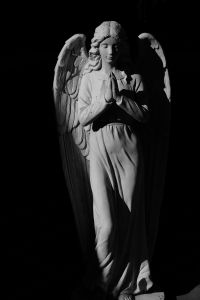
Angels, they are everywhere.
Perhaps there are more than we know?
Personifications of love, of compassion.
Of charity too.

ON THE TEARS OF ANGELS

Is it good that angels cry?
Anyway, why do they cry at all?

To wash away all the sorrows,
to cleanse, to purify, to make new.
And to ease the world’s pain.

Then, there are those of us
who can’t conceive of ourselves
as angels.

For those ones – each and every one – the tears of angels
are cathartic; granting catharsis.

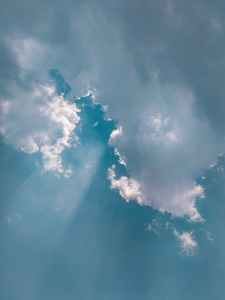
A CLOUD ANGEL SEEN

An angel wing
seen in a cloud, ephemeral, gossamer.
And the angel?
She stands concealed within the silver linings of clouds, neighbouring clouds,
heralding a soon to be descending deluge.

When One Word is Actually Two & Becomes One Again

‘It’s good practis/ce sitting out here.’ So said my partner hermit as we sat sipping post evening meal tea on our little front porch that happens to face exactly due west.

It was on the tip of my tongue to ask: ‘Do you mean it’s a good thing (practice) to be doing regularly as in Sadhana,  a spiritual practice? In other words is it a good habit to cultivate?

‘Or do you mean it’s good as a kind of training – as practise – in improving our ability to sit in quiet and stillness?’

As I say, these questions were on the tip of my tongue, but then: Blog Alert!!. So, in a rare moment of triumph I managed to hold my tongue (metaphorically speaking) and let those questions sift through my mind so that later (it’s now the next day) a post to share with you might emerge.

So, here we are, setting the scene for this post. I know it’s about words, about language. Semantics is what it could be about, given that it’s about words and their meanings.

But, aren’t words simply symbols for the things they describe or represent? And so often semantics involves quibbles over meanings.

So let’s not make this about semantics, no quibbling required here. You see what set off the Blog Alert!!! was that here was the one word, that is actually two distinct words each with their own meanings, that just happen to sound alike.

Still no quibbling though: we don’t need to pick and choose between meanings – actual and/or intended. Two words, two symbols, two meanings (one for each word that is), so we can choose not to choose – remember no quibbling.

We can realise that in the context, both words are equal and correct. Both may be acknowledged as being meaningful to and in the moment, to the situation.

Lately I think I’ve been saying quite a lot about silence quiet – quietude – peace and calm. Stillness also. All are the same thing: all are states in which we might realise the truth of our natures as divine.

Same Sun Another time & place

Anyway, we had just finished our evening meal, and now sat with tea, having just witnessed the last remnants of the sun sink below the horizon (or was it the horizon coming up to meet and finally hide the sun?).

Quietly sitting, relaxing you might say, in post sunset peace and quiet, with only the occasional and softly spoken conversation going on.

Then that comment from my partner hermit, sharing that sitting as we were is good practis/ce.

Certainly for one such as me who has great difficulties in being quiet, being still, and cultivating silence, such occasions of quiet sitting (with tea naturally) is excellent practise, good training in the changing of long-established and conditioned habits and behaviours.

And, as such, it is a most excellent practice to cultivate, a great thing to do (I’d say action to take, but somehow that feels not quite right) to cultivate stillness and silence. I’ve written elsewhere that to cultivate or to rediscover silence is to realise that silence already existent as the divine, as consciousness, as all and everything.

My partner hermit is one of the wise ones, a sage. One spoken word that actually contains two words, two symbols, each with its own meaning, that finally merge into One.

No quibbling.

On a Pilgrim’s Way

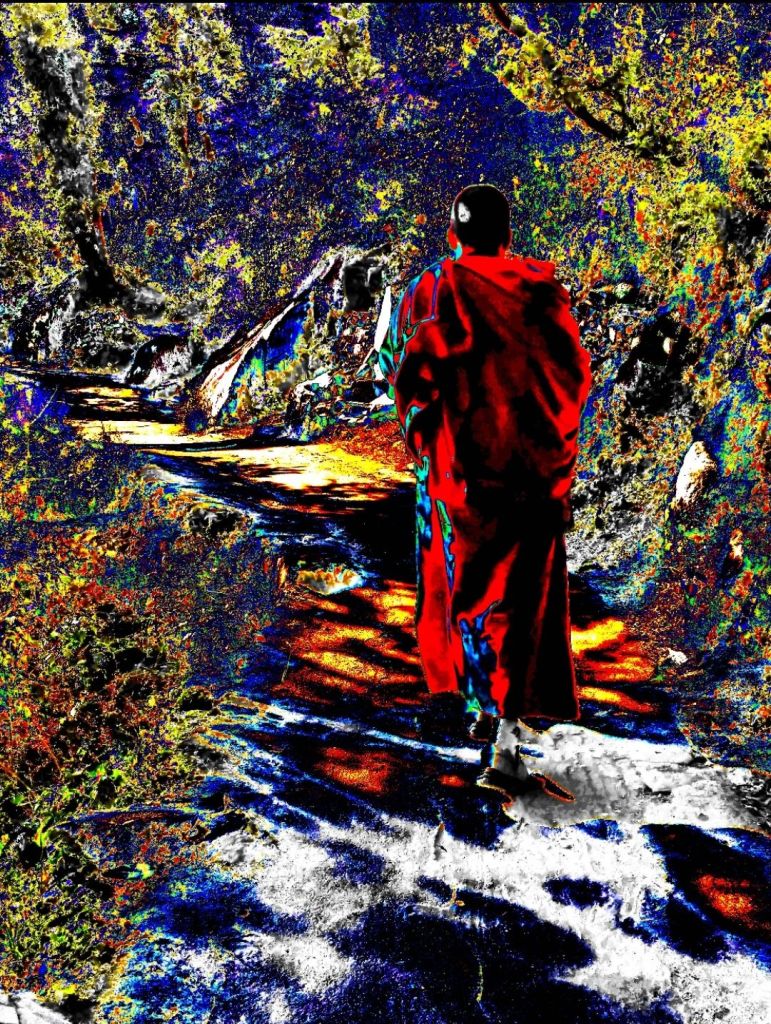
Today I went on a pilgrimage.Not that I don’t undertake all kinds of little pilgrimages all the time. And even more, it’s not as if my whole life – just like yours and everyone else’s – isn’t one ongoing and continuing pilgrimage.

All true; but this one, today, was embarked upon in what might be called, a classic manner: on foot, to a place of sacred significance, and in a spirit of contemplation of the nature of the journey as well on that which is being pilgrimed too. (I am positive there is no such word!)

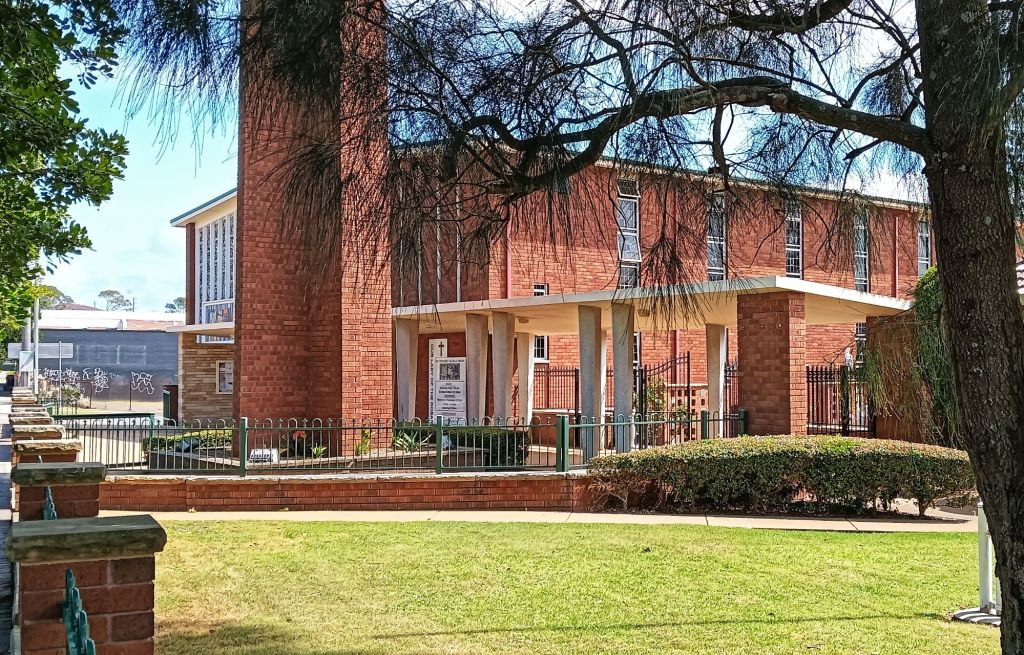
In this case, today’s pilgrimage, that place was a church about two and a half kilometres from the  hermitage. It’s a place I have visited several time, but today was the first time I set out as a pilgrim and walked in the way and spirit of the pilgrim.

Our Lady of the Rosary is a Catholic church dedicated to the Mother of Jesus in her role as patron of the Holy Rosary, a Catholic way of prayer that has evolved over time and is a key part of the lives of many Catholic people.

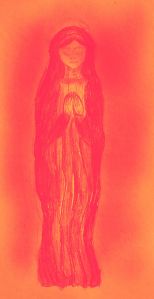
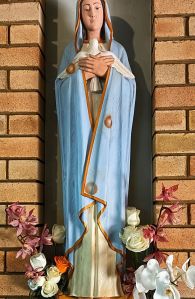
Just to the right, just inside the door there is a plain brick wall in which there is a small niche. The niche holds an almost life-size statue of Mary. She stands, hands folded over her chest on which sits the Dove of Peace.

You can see from the photo that the church itself is a lovely, quiet, serene place full of good vibes and nice peaceful energies. The object, however, of my pilgrimage was not the church in itself, but stood just inside the side door accessed through an equally peaceful, fountain centred garden.

I have come to offer her – this form or manifestation of the Divine Mother – the prayer I wrote to her which I hope you saw when I posted it on this blog recently.

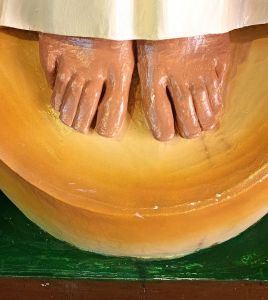
I had decided that my pilgrimage vow would be fulfilled once I had knelt at her feet and offered her the words of my heart in prayer.

My reverence for the Divine Mother is well known, and especially in her form as Mary the Mother of Jesus. Or Our Lady as we called her as good little Catholic children way back in the long ago. And I know I have said often that the entirety of the material and non-material cosmos is a manifestation of the Divine.

So, why then a special trip on foot, that I’m labeling a pilgrimage to a specific site, so I can kneel at the feet of a statue that I know perfectly well is made of stone or plaster and is simply a symbol of one aspect of the Divine?

Actually, the question has answered itself. The pilgrimage and my associated actions worded in that question tell us the why.

It is about acknowledging at a heart level and in my own way, that that symbol, that form, is actually representing a particular aspect of the Divine that I revere.

Besides, I’m not the first person who’s knelt at that spot, at Mary’s feet. I don’t know the age of the church, nor do I know the history of that particular statue, but I think we can say for certain that many hundreds, if not thousands of other people have been there where I was and spoken words from their hearts.

Being honest and true now, what I can say is that, as I said to my partner hermit: ‘I feel like i’ve been on a pilgrimage’.

And I do. I’ve walked – praying and chanting – to a sacred place where I have prayed at the feet of the Divine in the form of a likeness of Mary. I feel blessed that I actually got to offer the prayer I wrote to the Divine Mother.

Somehow I feel a link was established. A heart (mine) opened ever so slightly. I acknowledged the Divine, and I sense that I might just be – ever so slightly again! – topped up with a bit of the Grace that is in reality our true state.

Mary in the Garden (enhanced by a fellow Hermit Pilgrim. 
Thank you)

So, this is the story of my pilgrimage. I was absolutely exhausted when I arrived back at the hermitage. Most likely that was due to the heat, the traffic, and the noise encountered on the way I trod.

But, now I’ve shared this little tale with you, I’m not tired. Anyway, the Way is not always easy, and we are all very well aware of that aren’t we?

Namaste friends. The Divine in me salutes the Divine in you.

It’s a walk to take,

a pilgrimage to make.

Sometime soon.

Said by me long ago, I don’t know when or where. It was one of those ‘You’re a poet and don’t know it’ moments.

Peace!