Story of a Misadventure & An Apology

Today I’d like to share with you a short cautionary tale. It’s a true story, relating events that took place very recently.

There was a blogger, a serious student on the spiritual path; a monk whose mission in publishing his blog was – is – to share that path with others, to share the lessons he’s learned/learning. He sees it as one important aspect of his ‘doing God’s work’, reaching out to others of like heart and like mind.

Anyway, this blogger, he suddenly felt an intuition: he thought, I’ll set up an account on (insert here very popular platform) social media. That’s how to promote my blog he thought, and attract more readers.

So, dutifully, he set up an account and began posting. One or two poems, a couple of photos with commentary, that sort of thing. The plan was, post whatever seemed might be enlightening, whenever the feeling was there.

The blogger felt that this was a sort of ‘next step’. He thought that bringing more readers to his blog would help him with his quest to love more, and to share love.

But. Something wasn’t quite right. Sure, he, the blogger was excited by this new venture, this expansion of his service to the Divine and to the world. But he felt – literally and physically – a bit sick. A kind of nervousness gnawed at his guts; he just felt yuck.

‘I can’t do this,’ he thought to himself. ‘It’s not right’

So, there and then he resolved to delete the account, to close that chapter forever, and bring his focus back more fully to his blog. That’s where, he realised, was where God’s work could be done, as well as where his own passions lay.

But, the resolve, didn’t last long. He just had to act immediately. So, again right there and then, he deleted the account.

Instantly, a wave of relief swept over our blogger friend. He felt free, back on track. He now felt less burdened by a burden he’s made for himself, a burden that there really was no need to be carrying.

Okay, I confess: the blogger of whom we speak is in fact me. I know, you guessed that already, but it’s a disturbing saga and I guess I had some need to distance myself a little, at least to start with.

So, why the big relief? Why did it feel so right at the outset, but – almost immediately – felt so wrong to the extent of putting me ‘out of sorts’ physically and mentally?

Funny. That ‘out of sorts’ expression. That’s exactly the root of the issue right there I think. Years ago I withdrew from all social media – though I am on a photo sharing platform that is simply for that purpose and only that purpose, sharing photos.

You see, I thought (and still think) that social media generally had become a ground for conflict, and the celebration of conflict; it was a ground for corruption, gossip and sensation, for all the worst of the news (I know, the best too). Anyway, you know wht I mean: I’m not alone in giving it all up.

And, yet, here I was, feeling led to reopen that particular social media account. An example, I think, of an ego-driven desire for gain disguising itself as a genuine heart or soul intuition or calling.

I choose not to criticise or comdemn any social media platform. They are what they are. All I can say is that it’s not for me, not my ‘sort of thing’, not my cup of tea as it were. No wonder I was feeling out of sorts!

In my selfish, ego-driven compulsion to ‘increase traffic’ (what a horrible expression), I forgot entirely – as we so often do when blinded by desire – that this blog is seen and read by exactly those who are meant to see and read it – you!

So, I apologise to you for that sudden blindness, and for ignoring the absolute reality that it’s all working out just as it’s supposed to.

Thank you for making that so.

Peace and love
Paul the hermit

Self Enquiry: Listen to Your Self

This last little while I’ve been going through some serious contemplation, some deep questioning, on how to be ‘more of a monk’. Things like how to pray more deeply, and often; how to have a more focused and concentrated devotional practice; how to be a nicer person. Things like that.

Actually, that’s not exactly right is it? These are questions, enquiries, that for a number of years (is all my life too big a stretch?) habe occupied me. I’ve consistently been making enquiries, addressing questions, to Self – as well as to God or the Divine.

Still, like all things in life, self-enquiry goes through more intense, then less intense phases or periods. Let’s just say that lately I’ve been immersed – sometimes to the point of distraction – in one of those more intense periods.

(note from internal editor: Do I have to remind you once again to get on with the story you are here to tell?)

Okay then; let me see. Oh yes, right. Last night I was looking forward to beginning a new book. I’d read the introduction and thought that it was going to be just my cup of tea as it were, that it was something I would enjoy and learn from.

Anyway, as I opened the book on my tablet, I was suddenly stopped by a sort of wordless warning. The sense I had was that this book would indeed be a little piece of the answers I’ve been seeking.

Not so much in the contents I felt, it was more about approaching the book with more openness, less skepticism, more generosity of spirit and mental attitude. And the idea seemed to also include taking these qualities with me later as I thought about what I had read (or was about to read I should say).

You see, being more open, less skeptical, and more generous, come under the umbrella of being nicer. Still given the subject I was about to read about, I was a bit surprised by this ‘warning’.

As it turned out, I finished the entire book, so enthralled was I by the contents. The only things that tested my resolve to ‘be nicer’ was a number of occasions when the author’s worldview and interpretation of events, stretched my patience.

But, I managed. I didn’t become inpatient or outraged or irritable . When threatened by such responses I simply reminded myself that I was reading about another person, and I didn’t have to have an opinion one way or the other about what they believed or how they lived. Not only do I not have to have an opinion, I’m not sure I really have the right to an opinion about someone else’s life at all.

Besides, haven’t I just got through describing how I am myself deeply engaged in a process of self-enquiry? And wouldn’t such a process involve exposing myself to ideas, worldviews, kinds of information, new to me or not in alignment with my own beliefs? Surely bursts of impatience, indignance, judgement, and the like, would close me off in my search for answers?

Anyway, as I said I was so enthralled by the book – my reading informed by a little more generosity, a little less judgement, a renewed attempt at openness – that I finished the book in that one sitting.

Mind you it was only one hundred and something pages long. Still, for me, it was pretty good going.

PS Speed reading wasn’t – isn’t, nor ever will be – a part of my ongoing self-enquiry into the depths of my monkhood. Perhaps I need to add something like ‘Transcend the ego’ to my list.

Note to Self: Have a Little Faith Will Ya?

As a hermit, I am a pilgrim, dependent on a pure faith that I am exactly where God would have me be. I am here, and it is now.

I forget in which of his books I read this, but it’s a prayer written by Thomas Merton shortly after he’d finally moved into his hermitage full time. The ‘I am here, and it is now’ I added, though of course it’s also borrowed.

It’s a prayer, an affirmation, I recite at least once a day. And, like Merton, I aspire to that ‘pure faith’. Faith is a strange thing: it may grow and develop and then it does indeed support me in my intentions and living, not to mention the comfort it provides..

But, all of a sudden it can just flow away, leaving me adrift, bereft, and not sure of anything.

I am a pilgrim, it’s true. But as Bhajan (a bhajan is a sacred song, a hymn) singer Krishna Das sings:

I am a pilgrim/the road’s so long.

And sometimes it seems a lot longer than this particular pilgrim would like. Still, as they say, how long’s a piece of string? And it’s rougher than I’d like as well. but again how rough is rough? Layers of meaning in that word longer.

Yes, I am a  hermit, and my mind’s not the same, as Jackson VanHorn sings. Same as what? Whose mind is mine different from? Is my mind somehow not that same as it once was? True though: my mind is hardly ever the same.Here’s the whole chorus as it spoke to me:

Yes I am a hermit
My mind is not the same
Yes I am a hermit and ecstacy’s
my game.

For this hermit, ecstacy is not a stage experienced all that often. Mind you, there are fleeting moments, but like the pilgrim road, there are long distances to be trod between one of those moments and the next.

And as for Tim Moore claiming he’s

‘… sittin’ peacefully on Hermit Rock’?

Well, yes the rock – the hermitage – has much potential for peacefulness; a peace expereienced quite often actually. It’s a sacred space

But, as in any way of living, any way of being, peace comes and peace goes. And when it goes, it can seem like it never existed, and that ‘sittin’ peacefully’ is, and always will be a fantasy never to be realised or made real.

It’s about equinimity 

That’s something else I heard today. Well, there’s not a lot of equinimity in this hermit pilgrim today. Seems, then, that there needs to be some shifting of perspective; some peace needs to be restored

My Lord Ishvara

Deep withn the still centre of my being

May I find peace.

Silently withing the quiet of the grove

May I share peace.

Gently and powerfully in the wider circle of humankind

May I radiate peace.

Om Tat Sat

Om Shanti Shanti Shanti

Afterword:

A few hours have passed since I made these notes; I have regained a little balance, but still thought it was important to publish this post.

Thank you for your patience

Love and peace

Paul the hermit

A Gift Came to Me in an Email

Even a Leaf

A couple of days ago I recieved a beautiful gift in an email. I often receive wonderful things through the email, and this one, as with so many of the others, has profound meaning for me.

Not only that, but this gift has served as a reminder to me of that significance. I’d like to share with you that gift, as well as some thoughts on its importance and meaning to me.

There are a multitude of sources online where you can learn all the technical stuff, word meanings, history, origin, when it’s used and all the rest. I would like, however, to just ‘think out loud’ in my own words, and follow my own heart’s promptings.

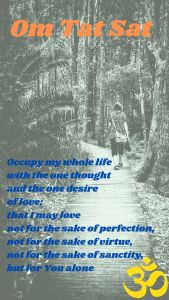
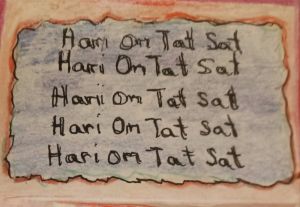
Hari Om Tat Sat, is actually two mantras in one: Hari Om, and Om Tat Sat.

Hari Om represents the totality of what we might call God. Hari refers to the manifested cosmos, as well as the creative impulse in its manifest form. I call that Ishvara, but it doesn’t have a name I’m sure!

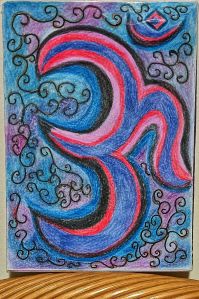
Om, is the unmanifested universal consciousness, the Absolute Reality. Meaning, as I understand it, existence itself. I call it Brahman, or God, but again, names are just labels we humans apply to things to make it all seem so neat and tidy!

They say that Om Tat Sat is the most sacred of mantras (in Hinduism). It’s used at the completion of prayers and rituals as a way of invoking the presence of the divine and ‘bringing it all together’ you might say. Well not so much bringing, more like a reminder that everything is one already.

I really like the chanting of Hari Om Tat Sat. It’s a centering practice I would say, a way to remember the oneness of all. And I say it, as the traditionalists do, as a closing to prayers or other practice; it’s like ‘Amen’ or ‘It is so’ or ‘Let it be so’ or, well it’s endless – and personal and subjective.

As mentioned, Om means Brahman – or God in the unmanifested state; Tat, not only sounds like that but does in fact mean all that is. In other words, Brahman or the Absolute. Sat means Truth, Absolute Truth or, once again Brahman.

For me it is a little prayer of its own actually. And I’ve heard it used as a greeting many times. It’s a means I think of honouring the divine within the one being greeted, while at the same time I have a sense that it is a recognition, or acknowledgement rather, of the oneness, the unity of the greeter and the greeted along with everything else.

This is why I don’t really feel the need to break the mantra down to explain in technical detail all the constituent syllables (even I were qualified to do so, which I most surely am not).

It really is a way to acknowledge the oneness of all, the Absolute, which includes, obviously, me and you. The Truth is absolute, it says, so must we be, absolute.

Hari Om!
Om Tat Sat

A Lesson in Humility

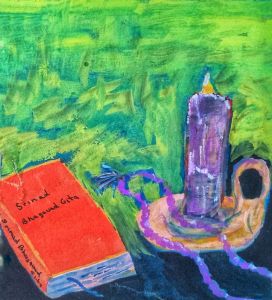
Opening my Bhagavad Gita this morning for my daily reading, I noticed that I was about to begin a new chapter. I always like when that happens, but this post isn’t about that; it’s inspired by a small scrap of paper glued on the facing page.

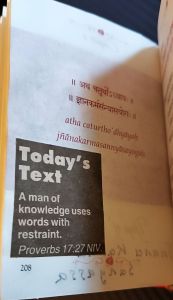
In years long gone, a less minimalist me would collect bits and pieces cut from newspapers, magazines or wherever (no Internet in those days). This particular strip of paper was cut from a newspaper (makes me shudder a bit to think how I would devour newspapers every day if I could. Shudder in horror) and has the title Today’s Text. It was a daily quote, usually a verse, from the Bible, and I’d often cut out those that appealed to me. As this one obviously did.

No longer collecting such bits and pieces, this one somehow survived the now ancient culling of excess material stuff, and has ended up in my Bhagavad Gita. Don’t ask me how or when.

Anyway, before I get off track, or too far down the track, here’s the quote we’re talking about

A man of knowledge uses words with restraint.
    Proverbs 17:37

I paused when I read this. As you probably are already guessing, I just had to write it down and added some notes of my own before getting on with my Bhagavad Gita reading.

What comes next is essentially what those full of first thought notes said, plus a little context setting to begin with.

In addition to the Bhagavad Gita, I am also reading, bit by bit, another sacred text. A couple of times (including today) I’ve been frustrated at having to plough through a page and a half (for example) of a description of a concept or idea that I’ve thought could have been said in no more than a couple of sentences.

Is he, the author, a person of knowledge? He most certainly is. He has wisdom too. He was a respected teacher and scholar. Some, many, say he was a saint.

So, perhaps it’s me demonstrating my own lack of knowledge here. Perhaps it is me, also lacking in wisdom, who is using words without restraint. Just because my opinion proposed using fewer words, does not mean by any means that they are better words.

Perhaps it’s me in error: passing judgement on an author I consider knowledgeable and wise, and who is certainly more than intimate with the topics he’s commenting on.

So, allow me to put another perhaps into this mix: Perhaps if such a person takes one and a half pages to describe an idea, then it might just mean that I am in need of more knowledge than I think I have. Surely I am missing something.

At the very least I am being prompted to reread the sections in question, that I was so hasty to dismiss as too wordy. Perhaps (what is it with this word today? Have to nominate it word of the day – perhaps) there is something for me to actually learn before letting my mind run away with critical thoughts based on quick and ill-informed judgements.

To Sleep or To Not Sleep?

One of the stories I’ve been telling myself for pretty much as long as I can remember, is that my life has been impacted, influenced, directed, controlled, by depression and fatigue. As with all stories, there are elements of fact, fiction, fantasy, real life experience, truth, and the not so true in this one.

Anyway, with the fatigue factor in mind, I’ve recently made an intention (I call it a sankalpa) to lie down for an hour or two every day whether I ‘felt like’ it or not. The idea was that a daily break would be like a catch up, a preemptive measure if you like. Even if I didn’t sleep, it’d be an opportunity to just be still, listen to nice music, relax for a while, a quiet time.

Today, just after breakfast, and getting deeply into my spiritual practice, I suddenly experienced an epiphany. Or to be a little less grandiose about it, I had a little insight which has lead to me to make these notes.

Despite that feeling of exhaustion, and despite the previously mentioned intention to rest more, I resisted going to lie down, thinking I can lie down later in the day.

Why? Surely a person who thinks their life has been ruled by depression and fatigue, would welcome any pretext to lie down, to sleep, to shut the world out for a while.

And, then comes the insight: All of a sudden I realised why I was resisting taking rest: Well, the fact was that I didn’t want to sleep because, well, I’d be asleep. I’d not be able to continue my practice, read, write, to ‘live now’. Putting it another way, I simply wanted to keep on keeping on doing exactly what I was doing.

But wait, I hear you asking: how can you fully live now when you’re so tired?

Excellent question; the exact question in fact that I asked myself. The answer I got from Self was interesting: fatigue as a symptom and outcome of depression is one thing; fatigue resulting from living a full life with enthusiasm (sort of sometimes) is quite a different thing.

Actually, now I think about it, there’s another little insight making its way to the surface of this over-active, over-full mind: The very fact that I thought I had living to do now is a very clear signal that, for at least the moment, depression is not dragging me around, or down, or anywhere else.

Just that concept of wanting to be awake to live this moment? Well, isn’t that a joyful thing? But what about being so tired? Should I go and lie down now anyway?

Ummm… Actually I don’t know; I can’t say really. So, I think I will just keep on doing what I was doing when I began these notes.

Which was chanting the names of God.

Hare Krishna Hare Krishna Krishna Krishna Hare Hare
Hare Rama Hare Rama Rama Rama Hare Hare.

Now that should wake me up for a bit.

PS It’s a bit later in the day, and I’m typing up the notes as a post for the blog. I did in fact carry on chanting for a while, I’ve had lunch, and I think after I post this, I might go for a walk around the neighbourhood. And no, I haven’t had to lie down yet.

Maybe later!

The Hermits (and the Lion) Sleep Tonight

The Lion Sleeps Tonight. That’s the song name I always think of. Sometimes you might hear it called Wimoweh. While it’s the song’s Zulu title, it’s actually not a real word: it references a mishearing (and subsequent recording by a group in the early ’50s) of Uyimube (the original chorus) which is Zulu for you are a lion.

In any case, I feel like I’ve known the song all my life. I suppose I have: it was a smash hit when I was seven or eight years old. It’s been one of those songs that have stuck, become a constant presence, to be hummed occasionally, to be sung even less frequently, heard rarely, but loved and familiar.

Anyway, recently (in March I think) my affection for the song surfaced. I was thinking about something my partner hermit had said about creativity and suddenly the melody to The Lion Sleeps Tonight came into mind.

That melody, and my memory of the lyrics then became integral to the poem I wrote to express some of my thoughts about my partner hermit’s statement. It helped me say what I had to say.

I hope you like it – the song – Listen to the Tokens doing their version from 1961; check out the lyrics too. It’s a happy song, a reassuring song of safety and love.

With that I humbly offer my poem. Enjoy

THE HERMITS SLEEP TONIGHT

A creative way to start the day.
A prayerful way, a prayerful way.

In Samsara’s jungle there is a village, a suburban village.
A prayerful way, a prayerful way.

Near the village – no, in the village
the hermits sleep tonight.
A prayerful way, a prayerful way.

The walled enclosure,
their very own paradise,
like a castle keep,
keeps them safe.
A peaceful way, a peaceful way.

Hush my sisters; hush my brothers.
No need to fear the jungle.
A prayerful way, a prayerful way.

Day breaks; Surya rises.
A prayerful way, a prayerful way.

Sleeping hermits gather, to break the fast.
A prayerful way, a prayerful way.

Fast broken, sacred tea imbibed.
A prayerful way, a prayerful way

The hermits begin, begin their day of prayer.

A creative way to start the day.
A prayerful way, a prayerful way.

A Story of a Door

The walk from the Hermitage to the coffee shop at the Village Green takes around five minutes or so. This morning, noticing a pause in the rain, we thought we might take the opportunity to get some fresh air and a walk, at the end of which there would be coffee. So, we stepped bravely forward, with the faith that the gods of the rain were indeed taking a break.

‘Look over there, ‘ said my partner hermit as we passed through the centre of the village. ‘There’s a door that can only be opened from the inside.’

‘I’ve never noticed that before,’ I replied, looking across the street to a wall into which was set a door with no visible handles or lock. The only things that suggested that it was in fact a door were the hinges on one side, as well as its size and shape.

Now don’t ask me how many times I’d passed that spot. Most likely dozens of times, on both sides of the road. Still, now that I had been shown it, I was intrigued. Mentally I was captured: I thought, what a wonderful thing: the one or ones on the other side of the door have complete control over who or what is allowed to enter.

With such a door, one that only opens from your side, you could easily choose to rarely – or even never – open it. Ah, peace at last went my thoughts.

But, right away, those thoughts were dismissed, sent packing: too simplistic, too extreme, to heavy a response. Though, you know, I do feel strongly that such a response to the world – shutting it all out completely – is perfectly understandable, completely reasonable, and oftentimes even an absolute necessity .

Still, I had that feeling towards my reactive thoughts of ‘too extreme’ (inner editor’s note: he has no idea what he’s saying does he? If you ask me, right this minute he will be thinking his initial reaction was spot on and he’d love to have a door like that. Anyway, we’ll let him have it his way).

Some further, more careful thought is required here I think. For a start, here’s a question: If I were to keep the door shut all the time, how would I ever be able to allow my own light, my own love, my own Self, out into the world?

Maybe there’s a way to keep the door open sometimes, then at other times choose to keep it closed to bar access to unwanted intruders in the form of people, thoughts, events, emotions and so on.

After all, it is my door (in this little fantasy at least), the door to the inside, where resides the ‘real’ me, the Self within, beyond and above, the physical form that I so tenaciously cling to as as being the real me. Talk about attachment!

Perhaps slightly exagerated, but this is close to how I see my actual door working as distinct from the story I’m telling in this post.

Where was I? Oh yes. With that door that opens only from the inside, I might come – eventually – to realise that there is nothing to disturb me – unless I open the door and let whoever or whatever that is unwanted, through the door.

I am my own gatekeeper, and without my consent my gate (door) cannot be opened and entered.

And, getting back to the choices I am able to make to sometimes open the door to allow some light and love to flow out from me, out the door and into the world. The more I’m able to discern when, and for how long, to open the door as a way to control what comes in, to what can reach me, the more resources of said love and light I shall be able to build up.

Which, in turn, will lead to more and more opportunities I’ll have to open the door in order to share some of that good.

I can envisage a state reached where my door could quite possibly be left to stand ajar all the time.

You see, the more love and light pouring out, the less that disturbs me can get in. Love and light is transforming, isn’t it?

Yes. Now I’ve noticed – recognised – the door that can only be opened from the inside: It’s me! Now, where did I leave my door keys?

What Will Please You Lord? A Prayer Contemplated

Namaste my friends

In my last post I reflected upon the meaning for me personally of a Bhagavad Gita verse that had particularly struck me as I carried on with my renewed inspiration to read the text from the beginning.

Today, I didn’t even get to the place where my reading left off yesterday. Before reading I like to pray some or all the prayers I have pasted in the front (and the back now). As I was deep into this practice, one prayer in particular stopped me, just as with that verse yesterday.

This one seemed to speak to me, asking ‘What do I mean to you?’ So, I made a mental note (always a risky proposition with me), and carried on with my prayers, determined to take time later to think about that prayer, and try to answer its question. So, here I am, later in the day, making these notes.

The prayer itself I am fairly sure comes from Thomas Merton, monk, mystic, and writer. Not completely sure, but I know that whoever composed it was one clearly inclined towards living the life of the mystic.

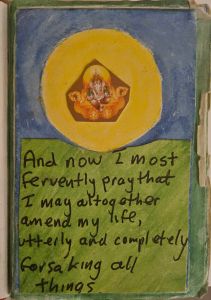
What will please you Lord?
Let me grow in wisdom,
become purified,
and do your will.

For whoever composed this prayer, it is an expression of a genuine longing. I can say that for me it is a deep plea, expresses my own longing. Each time I recite it, in fact, I can say that, although this is the first time I’ve addressed the big what does it mean question, I do sense the longing and grasp the meanings of the various words and ideas in the prayer. Actually, now I think about it, I do say this prayer or parts thereof in one form or another very often.

What will please you Lord?

When I begin to pray these words, what I feel I am actually doing is asking the Universe, the Divine, Self, God – the I AM – how can I live my life so that it is attuned to the natural order and flow of the Universe.

I am asking, what do I need to do to let go of attachments to worldly things which arise from material desires? How do I find the grace to accept when things aren’t going completely my way?

In other words, I’m asking how can i live a good, truthful, happy life in harmony with all other beings and with the Universe.

Let me grow in wisdom

Another of my prayer pages. This one devoted to Maa Saraswati, goddess of, among other things, wisdom

A good place to start, a great first step. But, again I have to ask myself, what does growing in wisdom mean to me?

To me wisdom is not merely knowledge. Though, having said that wisdom needs to rest on a firm foundation of knowledge, otherwise what’s there to be ‘wise’ about?

I’m not talking about worldly knowledge here, though obviously it takes some degree of knowledge for any of us to live in the world. Also it’s relevant to the next part of our prayer; we’ll see that soon.

I’m referring instead to a special kind of knowledge that will (I pray) lead me somewhere closer to acquiring some degree of wisdom – one day.

Self-knowledge is what I’m getting at. And I go about my attempt to obtain self-knowledge in a couple of different ways. I study, sacred texts like the Bhagavad Gita, as well as the words of those wiser than me (which is rather a large selection of people I can tell you) both living and historical.

I meditate (not nearly enough!) as a way to enquire into my own ‘real’ or true nature: who am I? what am I? Just digging deep within to reach some realisation of the answers to those questions.

When I have answered those questions, I will understand that I have reached a true level of self-knowledge. I sense that, at least being on the path to that realisation, I would never be able to develop any level of wisdom.

Mind you, I do feel that all humans are born with some degree of wisdom potential ‘built in’ so to say. As for me, I don’t feel especially wise just yet.

Become purified

For me, becoming purified goes hand in hand with the cultivation of wisdom. In fact I would say that in the very efforts to become purified, it might be possible for me to develop some wisdom as a result of those efforts.

So, here we go again: What does it mean? To become purified? For me it means living a Dharmic life. By Dharmic I mean a life steered and driven by Truth, Right Living, Right Speech, Right Conduct , Right … The Buddha taught The Noble Eightfold Path. That is in my opinion the very best, topmost, pinnacle of self directed means to living a Dharmic or purified life.

The Eightfold Path is not a set of dogmas, rules, or anything like a list of commandments or instructions . The eight steps are merely signposts, a roadmap, pointers for me to follow in order to purify my life, live a Dharmic life. No behaviours are prescribed: it’s entirely my choice what forms my behaviour, actions, and the rest take.

Obviously the path to becoming purified is a life-long one, though some would say that many lifetimes are required. Personally, I can’t even hint that I might be anywhere near close; some days I feel further away than ever.

But, as I work towards ‘growing in wisdom, with the help of my becoming purified path, I pray that some day I might actually learn what I call proper discernment.

This discernment is the ability to act in the world and to react to the joys and sorrows that are inevitable, with compassion, love, and wisdom. To face those inevitabilities with calm and equanimity. Acting with proper discernment will mean that I am living in Truth.

… and do your will

As I reread the words I’ve just written, I realise that, by the time I reach the state described in that last paragraph, I will have succeeded in ‘doing your will.
I will have aligned my self perfectly with the order of the Universe. I will know my place as a tiny fragment of that very order.

If I’m honest however, I have to say that I think it’s going to be a very very long time before such a state come to pass. So, what to do in the meantime?

Well, along with my attempts to live Dharmically, and to cultivate wisdom, I have committed myself to a life of devotion. Devotion, prayer, contemplation.

Devotion to what? To whom?

To the Universe, Divinity, God; all that is represented by all those names we humans have put on the Absolute Reality, that is all there is.

Everything. And everybody, is what I’m saying. There really is no separation except a kind of superficial one we allow ourselves to imagine by applying so many names and forms to the material objects, things and so on, that appear to us as separate one from another, whereas there is in fact only one, without a second.

That’s where the contemplation comes in. It’s a going within, inward to what we imagine is a kind of ‘space’ where all merges into one, the one that is all there is.

I think that’s what ‘pleases the Lord’. While I am indescribably, gravely, deficient at all the steps described above, one course I know to be right for me is to continue to engage with those steps, and to devote myself and my life to the Divine, to the Truth.

That’s what pleases me. I pray that it pleases the Lord.

Friend Or Foe?

Your enemies will now question your capabilities. Is there anything more painful and shameful than that?

Bhagavad Gita 2:36

Thanks to inspiration from my partner hermit, I’ve once again begun reading Bhagavad Gita from the beginning. The quoted verse came up this morning as I continued through chapter 2.

Setting the scene, the Bhagavad Gita is a conversation between Krishna (God) and Arjuna, a famous warrior who’s leading the army of the ‘good guys’. The context is actually a metaphor for the battle that goes on constantly between what some call the Higher Self (represented by Krishna of course), and our lower selves, our ego, mind, and the rest of the worldly us (represented by the very worldly Arjuna).

Knowing that, sometimes a verse will jump out at me as being in some direct way related to me. This verse, this morning seemed spookily all knowing about my mood of just slightly earlier.

Before we move on, I should point out that Arjuna has just realised that if the battle goes ahead, he’s going to have to kill many relatives and friends, teachers, and others he respects. And he’s just decided he’s not going to do it and sits down depressed and dejected on his chariot.

Now while I personally applaud this decision (he even says it might be better if he went off into the forest and lived the life of a wandering monk rather than be in this battle), I have to remind myself that it’s not for real, it’s a metaphor for the battle between our two selves.

Krishna says to Arjuna that you’re going to look really bad if you don’t fight the fight to uphold the Truth as you know it. Lesson number one when studying the Gita: don’t sweat the context!

Anyway, to our current story.

I’d just finished my breakfast cup of tea, and I knew it was time to ‘get on with the day’ as the saying goes. Today, though, Tamas** was strong. Which left me feeling, I don’t really want to get on with the day.

Instead I felt I wanted to not get on with anything; I wanted to lie down and sleep, and not think about anything, or do anything else either!

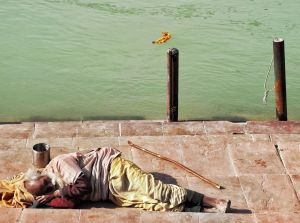
This picture is called Lunchtime Sleeper but it’s how I felt after breakfast this morning!

Mind you, not in the ’empty your mind of random thoughts, relax the body, realise the Divine’ kind of mood. No, more like ‘lay down, block out everything, blank the mind, sleep.’ Blank as it blot out!

Then, the famous second thought kicks in: No, I said to myself. I will not allow Tamas to take control. So, I got up, brushed my teeth, washed my face, and got ready to begin my practice.

I guess you could say that Tamas finds it easy to take control when one’s mind is in enemy mode as I like to call it (somewhere else in the Gita, Krishna says the mind can be our friend or our enemy).

My mind in particular doesn’t usually need a lot of help to disparage me, put me down. Getting me to question my own capabilities is one of its favourite activities – sometimes.

And it’s exactly right, perhaps I should be questioning myself: If I allow Tamas (mind and ego etc) to have free rein, the pain and the shame is all I feel. Well, perhaps not all, and not always, but still, it’s not a good thing.

So, what’s going on now? I’ve been reading Bhagavad Gita, and now I’m making these notes. Tamas is on the run and my mind is being ever so friendly.

**Tamas is that aspect of our (human) nature that has us leaning towards lethargy, laziness, that ‘I can’t be bothered’ feeling, and excess sleep, and all the other slothful stuff. Blotting out, as I termed it earlier.