New Series Coming Soon: An Introduction

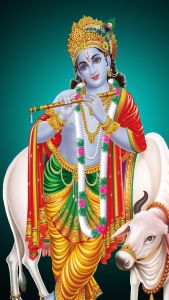
Lord Krishna

Namaste and greetings friends

Not long ago I began studying an Indian scripture called The Uddhava Gita. It’s quite a lovely book actually: it’s poetic, actually it is a poem, or song, and beautifully written. The title means The song of Uddhava and is an account of a conversation between Krishna wearing his God of the Universe hat, and his cousin Uddhava.

The story takes place in their home town of Dwarka in the state of Gujarat (Krishna was also a regular family man with a huge extended family) which is about to explode in a destructive civil war. Soon Krishna is leaving to return to his heavenly abode, and at the opening of our story, he advises Uddhava that he too should leave town ASAP.

I should point out at this juncture that I do not see this Gita as a historical document. It’s a story created as a backdrop against which to place a long conversation in which Krishna, or God, passes some spiritual teaching to Uddhava.
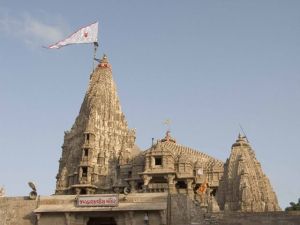
Dwarkadheesh Temple Dwarka India
By Scalebelow – Own work, CC BY-SA 3.0, https://commons.wikimedia.org/w/index.php?curid=5739970

Although the location of the story is a real place and exists today, we don’t learn anything beyond that this is the setting for this little chat.

The purpose was to present these teachings in an entertaining and accessible format. Like so many scriptures around the world, this one is a song, making it easier to learn and pass from one person to another over time in a society that was not yet universally literate.

So, why am I writing about this text? Well, in one section Uddhava is asking his cuz all sorts of questions, that have obviously been on his mind for a while. He knows Krishna is leaving he planet soon and he thinks that this might be his last chance to get some answers.

He asks questions like: What are reality and truth? And, What is a person’s strength. Then there are queries like: Who is a friend? What is home? Many are related to spiritual matters and practice, and all are concerning qualities and attributes a person should possess to live a good life, a honest life. A Dharmic life.

Actually, if I were to condense all of Uddhava’s questions into one big question, it would probably go something like this:

How can I change my lifestyle so I might live a righteous life, a good and honest life in which I can learn the truth and live my whole life according to that truth?

Now, here’s the thing: Uddhava asks a total of 36 questions, some singularly, some are multiple questions containing two or three queries. Krishna then proceeds to answer the questions, all of them in fairly quick succession.

I would like to share a few of those answers with you. I don’t get the sense that the questions are asked or answered in any particular order or pattern, so perhaps those I share will be an idiosyncratic selection, or it may be entirely random. Not that there is such a thing of course, so I guess you will just have to wait and discover for yourself the chosen questions.

Don’t worry! I have no intention of burdening you with the complete set of 36. In addition to saving you that fate, some of the questions and or answers didn’t resonate; others didn’t feel overly relevant to this blog.
I’d like to devote an individual post to each of the questions, bearing in mind some of them are multiples. I learned about all 36 questions and their answers in an hour long class. Needless to say that experience was more than slightly mind-blowing. One or two (or maybe three) at a time will be just fine for all concerned I think.

So, next post, I look forward to sharing with you the first of Uddhava questions along with Krishna’s answer. It will in fact be literally the first one asked; I thought discussing it at the start would sort of set the scene and the tone for us.
After that one there will be further posts. Again don’t worry, I’m planning a fairy short and occasional only series.

You Can’t Always Get What You Want

‘I wish I could write a blog post.’

So said I to my partner hermit yesterday. You see, for a few days I’d felt the coming on of a blog post: no topic, no clue as to ideas, and no hint of anything, only that it was on its way. Hence the exasperated outburst.

What’s wrong with wishing for something we want? Absolutely nothing. Sort of. Contrary to popular rumours, erroneous teachings, misunderstandings, mistranslations, or just a simple lack of information, Buddha’s Second Noble Truth does not say ‘The cause of suffering is wishes’ or we can say desires.

What he actually taught was that the cause of suffering is clinging. Clinging, being attached to a desire so strongly that failing to fulfil that desire causes us to suffer through annoyance, frustration, sadness and all those other things that impact on our mental or emotional wellbeing.

My teacher uses the word  compulsion. Compulsion to chase after what you want, compulsion to run away from what you don’t want.

Using me as an example: yesterday I wanted so badly to write, and was so frustrated that I couldn’t write just then, that I caused myself suffering. Because I couldn’t have what I wanted immediately, I made myself miserable.

Just as an aside (or perhaps not?), I realise that this little annoyance hardly means anything in the larger context of living and suffering that all of us experience simply by being alive.

But in a way, that’s my point. How many of the things we desperately want or that we desperately don’t want are the ‘little things’? Aren’t they so often the very things that, on a daily basis, cause us the most annoyance, frustration, anger, and even sorrow?

In any case, I had made myself annoyed with myself, frustrated too. However as soon as it was suggested that I needed to just down and type something – anything – if only to get the words flowing, I felt much better. I had the answer!

So, here I am, albeit a day late, and not typing as it happens, but scribbling in my notebook. Actually I don’t know why I don’t type it all up first thing, cutting out the middle step.  I mean, it really does flow better on the screen (via my fingers on the keyboard of course), and it’s also, as an added incentive, a whole lot easier to read than my scratchings.

I suppose I could say that not all old habits that have not quite died just yet, are necessarily ‘bad’ ideas. I happen to like my notebook.

Now, here’s the thing, the paradox if you like. I had felt a post coming on, and because I wished so badly for it to emerge and it wouldn’t, I suffered. And then, I sat to write something (anything as was suggested) and voila: the desperately, compulsively, longed for post obedeintly appears.

Cause and effect? I mean to say, which came first? Did I at some deeper subconscious level already have an idea to write a blog post about how clinging and compulsions and attachments to the things we want – and aversions and compulsions to get away from things we don’t want – cause us suffering?

Did that existing but deeply buried idea then manifest itself as a real world situation to give me the ‘material’ to write from?

Or, perhaps more simply, I got annoyed because I couldn’t write, so I made myself write (took a day to get to it though; remember me saying?), and well, what you see is what you get when one sits to write – words on a page.

Who can say? There are theories that propose effects can and do often precede causes. It’s a tough one to get my head around, and somehow I don’t think there’s any point in trying to.

We know instinctively that everything that exists in the Universe is constantly changing, evolving, devolving, mutating, never still. And we also know that we can affect what happens in our lives and in the world around us through our own actions. Some might disagree with me on that last one; it’s only my opinion.

The tricky bit is that oftentimes we forget that those changes as well as the lack of fulfilment or otherwise of our desires (wishes also), and even the results of our own actions aren’t always to our liking. Well, it’s not that we don’t know it in our minds and through personal experience, but when it comes down to it, we all usually as part of our normal conditioning, suffer when outcomes aren’t to our liking. It’s like we know it but we haven’t realised the truth of it yet.

Sounds like a trivial or flippant, even silly and pointless, thing to say, but it’s demanding to be said anyway: things (as in life and the rest) always work out how they work out.

But if you think about it, it’s true whether we like it or not. Actually, in a sense this is one of the very important, even pivotal points, of my ongoing studies, meditations, and contemplations. To realise fully that I, along with every other living thing, has a place within, no, not just a place within but is actually an indivisible part of, if I may be forgiven a cliché, the grand scheme of things. Not only that, but we in our essential true natures as Consciousness remain untouched and genuinely okay whatever transpires here in the material world.

I do what I do; you do what you do; and regardless of whether we like the outcomes or not, things work out as they do. Sorry to be repeating myself. Just seemed the right thing to say again.

And here’s another tricky bit: it’s not about resigning ourselves to ‘fate’ or ‘destiny; or whatever we might call not having control over our own lives.

Just by way of exploring that last point, and finishing this post, I would like to leave you with a quote. Yes, I know, we are all bombarded by quotes from famous (and not so famous) people, aphorisms of all sorts, and affirmations that claim they will improve our lives.

I truly believe this flood (mixing my metaphors here) of good words, written with good intentions, has numbed us to their actual value and usefulness to us in assisting us to live good lives.

So, here is one such, that I think puts it in a nutshell, in a very simple, straightforward way, an important Truth. It’s called the Serenity Prayer, and rereading it just now, I see clearly that serenity would indeed be the outcome if we are able to take this invocation to heart, and begin to live by it.

God grant me the serenity to accept the things I cannot change,

Courage to change the things I can,

and the wisdom to know the difference

Peace and Love from Paul the Hermit

PS: This version is only one among many. In fact, the Wikipedia entry linked above is a fascinating (though apparently quite flawed) exploration of this prayer and its origins.

Wear the Tender Miracles: When a Magpie Sings

Wear the Tender Miracles

What a beautiful expression, I thought when I first heard this said a couple of weeks ago.

I’m not sure who said it, but that’s not so important. And  I thought isn’t quite right either. My reaction was more from the heart than the head; more visceral, more ‘real’ somehow than something concocted by the mind.

Now we’ve dealt with one of the ‘w’ questions writers so love, there is another that’s important to ask at this stage: What does this fantastic sentence actually mean?

Naturally I’d had this question from the beginning as well, but despite it going round in my mind almost like a mantra, I don’t think I’ve quite worked it out yet. Perhaps a part of the reason for this failure is the nature of my reaction when first hearing it that I mentioned above: My reaction was one of the heart, not of the mind, so harder to look at analytically.

Still, the emotions and even the (spiritual) heart itself originate in the mind. So, let me share with you what I’ve come up with so far.

Wear the tender miracles. It seems to be a very straightforward sentence. But is it merely a well-intentioned piece of advice? Is it more a spiritual injunction? Well, as I thought about it, I realised it was in fact both.

Certainly it feels like good advice – though before we can finally decide that, we need to work out the meaning and intent of the words we have. Mind you having said that, I have to say it resonates with me as something one might hear from a spiritual director, or read in a sacred text of some kind.

So, what exactly are tender miracles? Are they soft and gentle, happy happenings that come from some place ‘out of the ordinary’?

You know, in my Contemplative Photography practice and in my earlier Street Photography days, I had a few maxims that I worked by and tried to live by. One of those maxims was: There is no such thing as ordinary. Which is another way of saying that there is nothing that is not extraordinary, and therefore out of the ordinary.

Photo by data9090 on Freeimages.com

Just now there are several Magpies making beautiful melodies outside the hermitage. I know very well that these vocalizations that for this particular species represent an expression of biological and or evolutionary impulses or drives.

But, is that all there is to it? I don’t think so. As I listen, I smile. And my heart feels something. I sense beauty, and realise that I am receiving a gift; you might even say it’s a miracle.

Biological imperative or tender miracle? Why can’t it be both?

How many times a day do we experience or encounter ‘little things’, that appear ordinary, but are hardly noticed (or not noticed at all?) in our hurried and harried lives? Yet, anyone of those little things may be a tender miracle waiting for you to come along.

I know, the glorious singing of Magpies is a fairly obvious miracle, not so hard to miss – if one looks at that way. But even then, I know we don’t always notice. And what about the smile from a random stranger passing on the street? Or the comforting warmth of the sun? All things easily missed and if we actually do notice, we likely will simply take for granted.

Talking about taking for granted. What about the million little things our loved-ones do for us every single day that we either don’t notice, or just let slide without any real attention? Better stop here: this list really could go on forever.

Now, wear. Of course we all know what wear means; we might wear a coat, a hat, shoes. We all wear clothes. There really is no end to what we humans can and do wear!

Perhaps, though there is a deeper way we can think about wear. When a hat (purely by way of example obviously) comes your way, you at the very least try it on to see how it fits, how it looks, how it feels.

Of course you do need to be paying attention when engaging in these tryings on don’t you? So why not as you live your lives and when miracles might be coming?

Well the first thing to be said is that in our busy, distracted and stressed out lives (sorry to be so repetitious) much of the time we aren’t ‘there and available’ to pay attention. It seems that our minds are rarely in sync with what we’re doing with out bodies, where we are or even when. The mind is more often than not way off in the future or stuck in the past somewhere.

So, if we want to wear the tender miracle, we need to begin to cultivate presence. We need to be paying attention to and in every moment we possibly can. It’s really just about Mindfulness . In this way we make ourselves available to actually notice and recognise when a miracle come to us.

Okay, the miracle has happened, you’ve noticed it, seen it for what it is, what now? Put it on! After all it’s yours. When you put on a new hat you look in the mirror: How does it look? How does it feel?

And as with the hat, if you like what you see, you proceed to go about your normal life, wearing the miracle for all to see. People will notice: after all if you are wearing a new hat and think it suits you, your demeanour, your smile, and your stature, the way you carry yoursef, will say it all.

But really that last bit is about yourself. Don’t forget yourself, share the good vibes with you. See yourself being contented, satisfied, grateful.  Wear the miracle lightly.

One word we haven’t really looked at is tender. We all know what tender means, and I’m sure you agree that not a lot of whatever we might call miracles could be described as tender. In any case, most of us know that life doesn’t really work that way.

Much of what we experience in life – both the big stuff and the little stuff – looks and feels more like hellish nightmares than some sort of ‘miracle’. Besides, a grumpy boss, or a sudden illness, are both to grab our attention more readily than singing Magpies.
Life is full of variables . It’s unpredictable in that we can”t know for certain what’s going to happen, when it’s going to happen, and most of the time we won’t ever get to the why something happens either (there’s those ‘w’ words again).

What I’m going to say now is just my theory. I can’t say I’ve realised its truth. And I probably won’t get there anytime soon either.

Every single thing that happens in the Universe – absolutely everything – is a miracle. Why? Because everything that happens expresses – manifests – the laws of nature, the laws of life, the universe, and everything else.

Maybe the most tender, the most beautiful, the truest miracle is the one we are actually there and now, sorry here and now, to experience and acknowledge it for what it is, good, bad, or anything else.

Pay attention; be present in the presence of the miracle.

love from me to you.

Illusion, fear and wrong thinking? A good question

Greetings to you, visitors to the cave

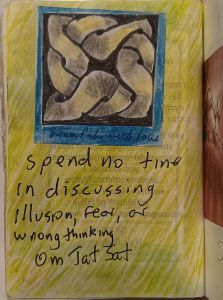
Let me begin this post by asking you a question. No. I’ll start again: I’m going to begin this post by asking me a question. It’s a question prompted by prayers I recite every day, not only during my morning practice, but at random times during the day. Here goes with the question:

How much time do I spend discussing illusion, fear, and wrong thinking?

Well the short answer is, a lot! Despite all my efforts, prayers, meditation, discipline, and the rest, I spend way too much time pondering all kinds of illusions, indulging in an ever revolving range of fears, and thinking about all sorts of ridiculous, irrelevant, and unwanted stuff.

Oh, before I go on, I should mention that there are actually two prayers I’m referring to:

This prayer, which you might call an affirmation comes, I think, from the teachings of the ancient Indian Rishi Adi Shankara. I’ve not been able to track down the exact source. Getting a little ahead of ourselves here, but a perfect example of wrong thinking would be to berate myself for not being more careful with sources.

So, what does it mean to spend time discussing illusion, fear, and wrong thinking? Well, I know I said I was asking myself this question, but I think it would not be out of order to say that we are all prone to spending time on these things.
Discussing is obvious: talking about, thinking about, angsting over, worrying over. Illusion? Anything that isn’t real, stuff that’s ‘make believe’ as the expression goes. Anything that we are imagining for good or bad.

Our illusions are often about worst-case scenarios, or at the other end of the spectrum, they can be about some fantasy, an idealized perfect outcome to a situation. There is a lot written about how we are so very much trapped in illusion; it’s not the place here for that discussion.

Fears: pretty obvious what fears are. I don’t know about you, but I can get to thinking of stuff to be fearful of anytime, anywhere, even things I know I can face without fear. Like a couple of days ago I was walking across a rail and walking bridge near our current hermitage. A long time ago I had huge paralysing fears of high bridges, especially over water as this one is.

But for a long time now I’ve felt I have mastered this fear and then suddenly on this occasion I looked down to the river below and shocked myself with ‘What am I doing?’ type thinking and fear returned. Mind you, it passed quite quickly as I reminded myself I’d walked over this bridge (and many others) a lot of times without a second thought.

And then there are fears about the future, fears of consequences of past actions, fears of not making the right choices now, fears for health, loved ones, the world. Anything goes when it comes to fear doesn’t it?

Ah, now we get to the biggie: wrong thinking. Again I think it’s safe to say that we all spend far too much time in the company of wrong thoughts. And again, they can be about anything, and can pop up to take over our mind without warning.

Consider how often we think about things that are either none of our business, or they are things we can’t do anything about. We obsess over what we see on the news,  or what celeb is doing what and with whom. Think about how interested we often are in what other people are doing, thinking, saying.

Then there’s blindly following fashion, thinking so much about things we don’t have (and how everyone except us has those things already) that we give into advertising, and end up buying lots of stuff we don’t need, maybe can’t afford, and might not ever use. And don’t forget about the one we all fall for: gossiping about others whether they are famous, our family or friends, or simply our neighbours.

A huge case of wrong thinking are the harsh judgements we make on ourselves; and the amount of time we spend thinking about our faults and failings. And don’t forget the other end of the ego spectrum: it’s also wrong thinking to be constantly telling ourselves how great we are.

There are endless examples of wrong thinking. We need to bear in mind Buddha’s central teachings: there is a middle path that can be taken in all things. Well, this maxim applies to thinking as well. Remember that our mind can be our enemy or our friend.

Even enlightened ones such as sages, rishis, saints and the like, fall victim to illusion, fears, and wrong thinking. Of course as they are enlightened, they perhaps are less affected, less inclined to fall to the depths, as the rest of us might.

Of course, there are ways we can put ourselves on the path to that enlightenment. But in truth, it is a subject that is dealt with very adequately by all great scriptures of the world, not to mention the visionaries who have delved deeply into psychology, philosophy, and the human condition.

And this leads me to the second prayer:

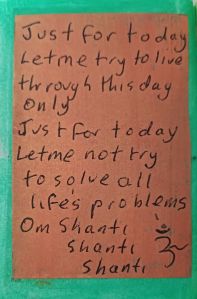
This one comes from a song by George Harrison, titled Just for Today. I actually did a post on this song a couple of years ago that you can find here. As well, if you do check out the lyrics of this masterpiece, you will see that my prayer is a rather generous paraphrase. I don’t think George would mind; I hope you don’t either.

Just for Today (the song and, a little less articulately, this, my paraphrased prayer) is a prayer for presence, a plea to be in this place, and in this time. In other words, an affirmation that I (or you) may remember that there is only here, and only now.

But, and it’s a big big but, we need to make of our entire lives a prayer.

Of course that means using the words, but it also requires a whole lot more. Discipline, self-control, deliberate actions (saying prayers is obviously also an action), meditation, silence, contemplation, and to put it simply: good behaviour in all that we do and think.

Now, this prayer inspired by George is a good place to finish. Or rather, it’s a good place to remind ourselves we can’t solve all life’s problems at once.

Being present, being here and now, really says we have no other choice but to live through this day only. Or perhaps we can paraphrase once more and say we have to actually realise what is already true: we can only live through this one, ever-evolving and moving moment.

So, how do we get to that point of spending less time discussing illusion, fears, and wrong thinking? By coming to realise that being in this moment, and in this place, we are already perfectly fine. All we can and need to do is remember that one simple fact. But don’t worry, all you need to do is remember it just for today.

peace and love

Lessons Never Too Late for the Learning

This morning I completed the penultimate lesson in a course of classes on the Bhagavad Gita. The classes were held once a week for I think 3 or 4 years and finished a few months ago. As it happens the entire course was recorded giving me and so many others the opportunity to study it online.

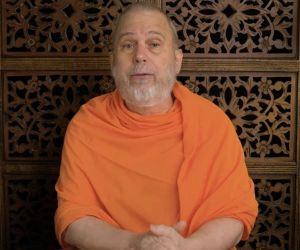
Anyway, at the start of the lesson today Swamiji ( Swami Tadatmananda, resident teacher at the Arsha Bodha Centre) reminded us that the course will soon be over. I thought (and it was by no means the first time I’ve had this thought): what an achievement; finishing this long and complicated course; fancy me sticking with it till the end.

Second thought, following a nano-second behind: What an odd idea, to think how great I am simply for finishing my study. Especially when it is not in the slightest way true. I’ll be studying the Bhagavad Gita (and I hope many other teachings) for the rest of my life. This period of study has been simply an introduction, a foretaste of what is to come.

Swami Tadatmananda

Having said all that, I have to say that this time of digging deep into the Gita has been a terrific ride. I’d been studying it by myself for a few years, but that’s nothing compared to having a qualified teacher guide me through such an in depth study and contemplation of this great teaching.

While I do know a few of the 800 verses by heart, I understand that this is not ‘ordinary’ knowledge. As the disclaimer goes: it is very much a pointer to the knowledge; the key is to not to confuse the pointer with the very much transcendental knowledge that is to be gained from what the pointer points to.

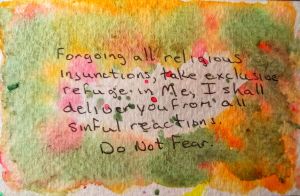
Probably my favourite verse written
on a little card that I treasure

My partner hermit has been responding to some of my photos when I post them with little Haiku-like writings. Yesterday (or was it the day before?) I said to her:

‘You’ve done 71 so far.’ I was thinking to praise the achievement.

She replied (with much wisdom as always):

‘I don’t count them. One or seventy one, it’s all the same.’ I’m paraphrasing here.

Looks as if I might be only just at the beginning of my lessons.

Peace

Silence, Solitude: Where can I find it?

Remain in your cell, and your cell will teach you everything

This piece of advice from one of the early Christian desert hermits to a follower has been going round in my head for ages. And I mean a couple of years at least. I’d read it in several books at the time, and I’ve seen it in a few since.

Of course, most of the writers of those books interpreted this advice at face value, literally advising the student, hermit, monk, or other contemplative person to stay in their physical cell (hut, cave monastery cell, suburban bedroom, wherever is their permanent dwelling) and listen, meditate, study, and contemplate. The advice is, stay in that space in silence and seclusion. Quite possibly forever.

‘But it could be the cell of your Self,’ my partner hermit said to me one time. And yes, I thought, that’s exactly right. I liked the symbolism. The actual literal, physical space and its geographical location isn’t necessarily the important factor. What’s important is that you, the real you is actually fully present wherever you are, right here, right now.

Think about what it really means to be present – to be here now: It means that you can say, ‘This is the only space and the only moment that exists. Right here and right now.’

Living life is an ever-flowing movement or process, and at the same time (excuse the unintended pun) is always occuring in the present. And in that ongoing moment you – your Self -is always there.

Of course along for the ride is your little s self with its ego, chattering and never quiet mind reminding you of the distractions, stresses, anxieties, worries about things to do or not do, memories of the past, and fears for the future. It goes on and on.

But, still, that space within where you can meditate, pray, contemplate quietly, that’s your Self, your ‘cell’.

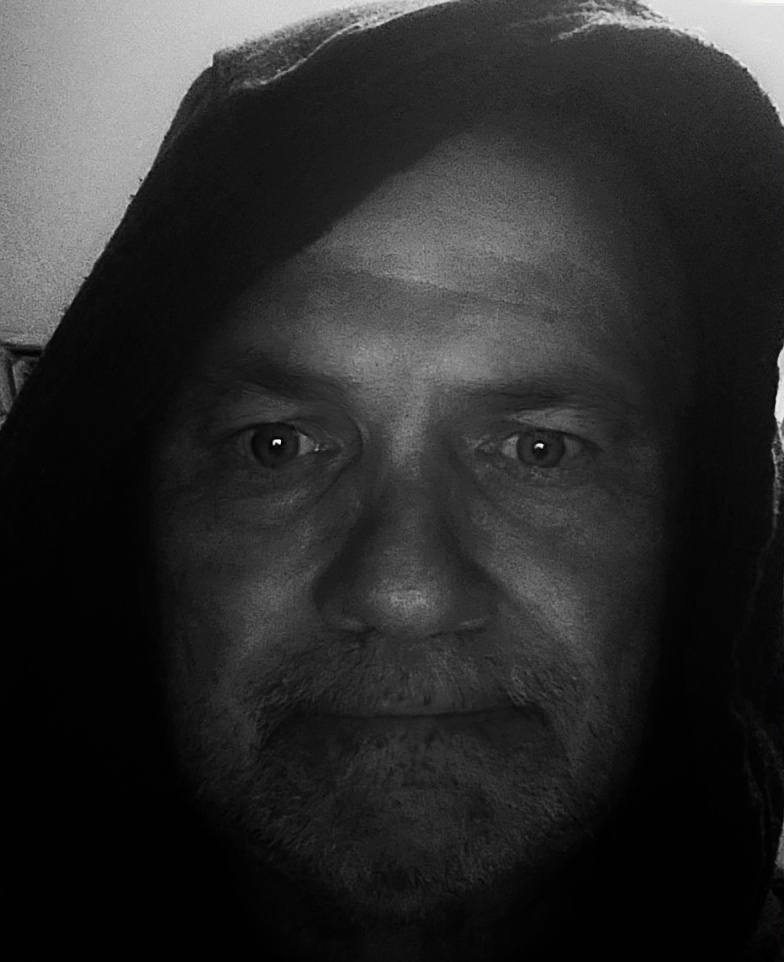
I’ve always liked and worn hoodies. I guess a lot of people do. For some it’s about fashion; others wear them for warmth in cold weather or to keep the sun off when it’s hot; some people even use them to hide.

Then there are others such as nuns, monks, priests and others too, for whom a hood is a part of the robe they wear as a member of their particular group.

In those cases, a hood is called a cowl and most often it’s a largish loose hood sewn onto the robe or habit. Just like a regular hoodie.

I read somewhere (I forget where) that some groups nickname these cowls ‘cells’. In other words, the wearer carries their cell with them wherever they go.

Of course they don’t always actually wear the hood on their heads, but whenever they wish or need to retreat to their cells, all they have to do is simply pull their hood up and over their head and all of a sudden they are in their own private and solitary world; they are in their cell.

As I said earlier, I like the symbolism. But more than that: I find wearing a hood on my head or simply in standby mode, comforting.

I’m not overly good with crowds, or in close proximity to other people on a bus or train or whatever. I like knowing that just by pulling my hood on, I’m able to create my own space apart from my surroundings. In that space I can feel safe and kind of apart.

Even at home I wear a hood when I’m meditating or praying. It’s just one more opportunity to retreat into my cell, into Self

Peace from the Hermit to you

When Trees Speak

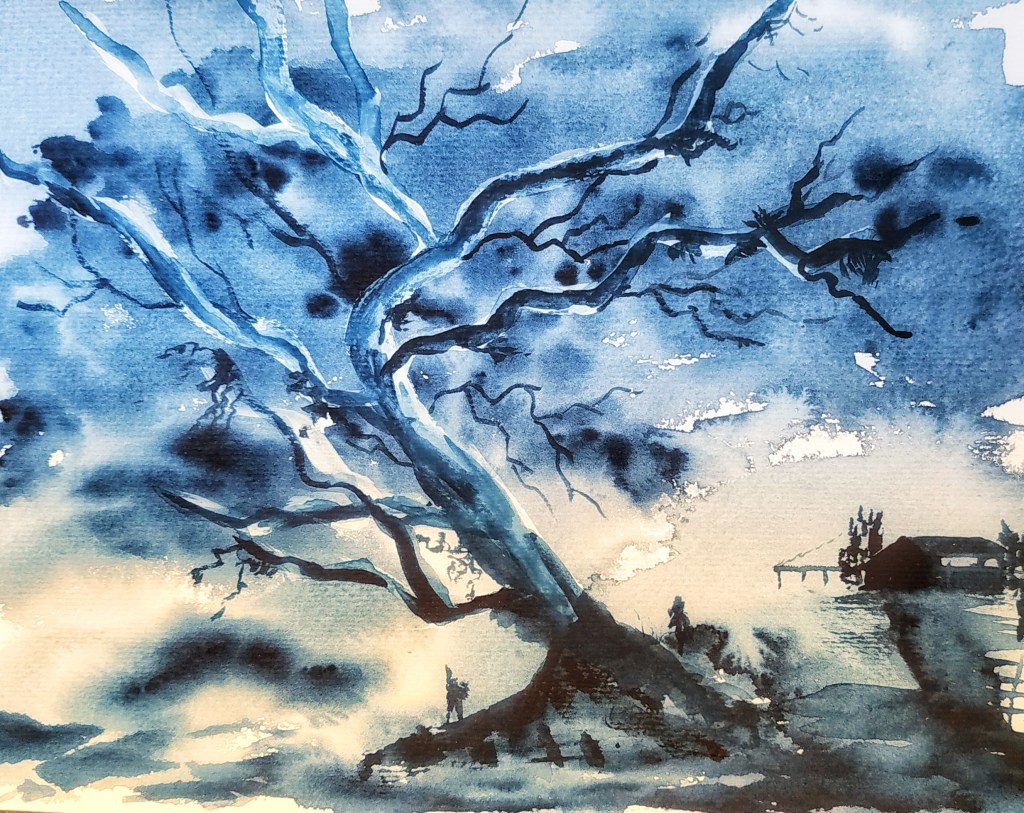
Watercolour by Pauline (with digital enhancement by the Hermit)

Vibing on the mystic trees,
their upside is downside, their downside is upside
selves telling me:
You’ve got to cut through the attachments.
Then, not a new, but old made new again, insight
confirms, clarifies, brings details to,
shines a light on the specifics:
Stop desiring what you already have.

Tell Me: What is God? Dominus Est

Welcome dear reader

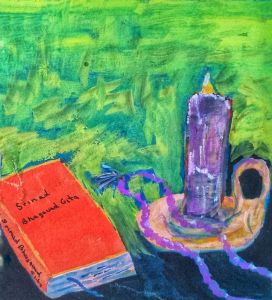
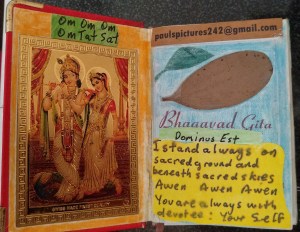
Have I shared with you my Bhagavad Gita? Well, I know I’ve mentioned a few times that it’s one of, if not the primary resource for study and guidance for me.

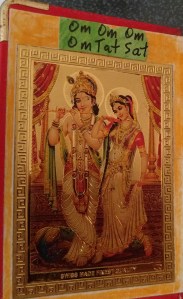
As you’ve probably guessed, this is a quick photo of the inside of the front cover. And, again as you’ve noticed, I like to stick things in my books, especially this little one. (Actually now I mention it, this is the only book in the traditional format as in made of paper, I own). It’s an old practice and for me adds multiple dimensions and depths to what is already a treasure.

Sometime I’d like to go through and describe to you all that I have added, but for today, do you see the little green section with the words Dominus Est printed?

In the religious tradition I was raised in, these two words have a specific meaning and use. However, it’s only recently that I’ve come to think of this little Latin phrase (well technically it’s a sentence, but …) in the sense of the literal meaning of the words themselves: God is.

That’s it. Or the Lord is, or the Master is. If we change the Dominus, we can use this tiny sentence to define our conception of the divine, the holy, in any way that seems right: Truth is, Beauty is, Art is. For me, God is, sits right. As do the others in this list. Same same.

So, God Is. What else could possibly be said that would add to this already very emphatic and simple statement? Nothing at all. It’s stand-alone, complete in itself.

Like asking who or what is God, we can answer: ‘I am this’ or ‘I am not that’. Or we can realise what for me is becoming the only answer:
I am.

Why? Well, if we were to add anything at all to these two words, such as God is Truth, or God is Love, or God Resides in …, or God is called … , then we are in fact stating only a little of the truth. Sure, God is truth and love, and goes by many names and is found in many forms, but once we say what something is, we are actually making more of a statement about what it is not.

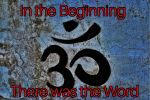
In the beginning there was the word, and the word was with God, and the word was God.

Mind you, it’s perfectly natural, and for many of us helpful, even necessary, to ascribe to God a name and or form. We are ourselves material beings, living in a material universe; it’s logical that we would choose (or need) to see God in a word, a physical object, or attribute some other kind of materiality to our notions of the divine.

I must say that I am one of those who find it difficult to envisage an invisible, non-physical, and impersonal ‘God’. Of course, our little statement, God is, does indeed say just this doesn’t it? Isness is pretty non-corporeal, certainly not in the least physical. And isn’t even a ‘spirit’ or ‘entity’ of any kind; Isness just is. The moment we label something (including ourselves) we miss that isness, that essence.

You see my picture of Krishna and Radha? This form, or forms, is one of the several that I feel right in having as a kind of focus, or centre of my devotion to and love for the divine; for love, for truth, and for it all.

You might be saying, this guy does believe in a personal God. He just told us. The truth is I don’t believe or not believe that Krishna (or any of the myriad names and forms we’ve invented) is God. God simply is. And my heart tells me that this is enough.

There are a pair of theological ideas known as Cataphatic Theology, and Apophatic Theology. Cataphatic describes or approaches the divine by stating what God is, while Apothatic (you guessed it) describes God by speaking only of what God is not.

My guess is that pretty much everybody, from whatever tradition, would approach the divine (and not only the divine) in one or other of these ways. But for me it was such a relief to realise that there was no need to go there at all. I could stop with the definitions and the descriptions, the what is and what is not. I have the freedom to not have to believe or not beleive. None of it matters. Dominus Est. God is.

Am I there yet? Have I let go of dualities? Hardly. Maybe the odd glimpse, but it’s rare. And it always will be for as long as I live in a physical body. But to paraphrase something Swami Ramdas said:

I’ve set my feet upon the path, so I am already at the goal.

Peace and love from me to you

Am I Here & Now or There & Then?

One week today and I will be there. In other words, this time next week at this time I will have arrived in the desert city of Broken Hill. Almost in the heart of the continent and right in the middle of the Outback. In fact they call that whole area The Big Red after the colour of its tens of thousands of square kilometres of desert sands.

Back to Country

It’s about 1500 kilometres from the Pacific Coast where I am right now. I’d like to write about the ‘call’ to the desert, which I am finally answering, but maybe I’ll get to that in another post.

Right now I only want to say how excited I am to be going. A bit anxious too (I’ve been there before, but still …), and plain and simple looking forward to getting there.

Acturally, to be perfectly clear about it: I can’t wait to be there. But, you see, herein lies the problem: I am so keen to get there that I’m feeling as if I am no longer here. I am not present; I am not living in the moment and in the place I’m in (which I love by the way, the place I mean).

I don’t mean to say that I am some sort of Buddha who is usually fully present in each moment; or who is serene and calm when he knows change is coming. Any reader of this blog will tell you that presence isn’t necessarily my greatest strength.


But, I must say that lately I have improved (slightly) my living in the moment, being here and now, way of living. It’s just that I’ve been longing for this particular change (and all that I anticipate will come with it) so much that I just can’t help myself.

Did I mention already that this is a problem for me? Well, yes, I did, and it is. I prefer very much to be where I am and when I am and fully in the flow of the ongoing present.

Of course there is nothing wrong with wanting something to happen. The problem arises when one is so anxious for whatever it is to happen, that what’s happening here and now ceases to be where one is at—in other words: the trouble is that I stop being in the present.

Buddha taught what are called The Four Noble Truths. (which pretty much form the core of Buddhist teachings) The second of these Truths says that attachment is the cause of suffering. Suffering here means anxiety, worry, regret, fear; all those kinds of things. Whenever we say something like, ‘I can’t wait to…’, then it is a sure sign we are attached to that want or desire.

If I’m in it, will I win it?

By the way, the First Noble Truth is: Life is suffering. Suffering, The Buddha taught, is simply the price of being alive. We get hungry, we are conscious of pain (in all its guises), we grieve; we grow old; we get sick; and we die.

But, right now, I want to talk more about Noble Truths three and four. Number three says that suffering can be overcome. Nice clean, clear, and not to mention, succinct little statement. Of course, it’s easy for him to say isn’t it? He is Buddha after all.

Perfectly reasonable reaction from us suffering humans. But there is hope and we will find that in Noble Truth number four which gives us the how to overcome suffering. There are quite a few ways to put this Truth into words, but the one I like best says:

The way to overcome suffering is to sit.

What? Sit? Yes, sit. Be still; stop moving. Of course if we relate this Truth to my little dilemma for wanting to so badly to be somewhere else that I’m not able to be where I am now, we can expand this Truth to something like this:

Focus your full attention on what you are doing now, and where you are now as well. As much as you can, be open to change, but be less attached to the nature or timing of that change. After all, you can make all the plans you like, but who knows what’s really going to happen—you won’t know that till it actually happens.

So, that’s what I am trying to do. Instead of saying stuff like ‘I wish I could go sooner’, or ‘it’s only x days till I go’ (yes I know, that’s what I said way up there at the top of the post), I am going to ask myself, ‘What am I doing now?’, and I plan to look around me, and engage more with the reality of this moment. And try hard to realise the ongoingness of that everlasting moment.

As Ram Dass said,

Be Here Now.

Hey, that’s a great mantra isn’t it? Chanting it whenever I start getting out of the here and now mode, might just put me back there again. I mean here—and now. You know what I mean!

Love and blessings from me to you

Paul

Homage to The Cockroach Man. With thanks and affection

Notes from the Hermit’s Cave is what this blog is called. I promised to publish musings or notes of all sorts: your regular text blog; photos or other pictures; poems; and other assorted bit and pieces.

Well, I’ve rediscovered a poem that I think would be great to share with you.

Looking through some posts saved from old blogs no longer active, I came across theaforementioned poem. It’s about a guy I met in a cafe in India back in 2006. This person kept me and a crowd of other travellers spellbound for a couple of hours one monsoon afternoon. Not to mention the many conversations focused on him that followed in the next few days and the several pages in my Journal recounting the whole experience.

Anyway, as soon as I saw this poem again, I thought I just have to post it here. That trip was a big step for me in my own healing and spiritual journey. And meeting this guy has played a part in all that.

So, please join me in making this small offering of thanks to that guy, whose actual name I never learned, and who forever will be known to several very fortunate travellers as the Cockroach Man

THE COCKROACH MAN

This is what he said.
He’d lived many years in India,
and, in that time he’d done many things.
Even, he said, for a while he’d trained with a yogi, his guru.
This is what he said.

Yogic training is not easy, he said,
In fact, he said, one aspect made him sick
for a year.
This is what he said.

His Guru put beings in his head.
Beings like parasites he said.
Yes, yogic training, it made him sick.
This is what he said.

Parasites implanted in the head? A part of yogic training?
No. I don’t think so.
Actually, inserted was the word he used.
‘inserted beings in my head.’
This is what he said.

All gone now, save one, he said.
Only one remains—it’s like a cockroach.
And it’s still in him making him sick.
This is what he said.

At night, he said, there is sometimes relief.
The cockroach leaves and floats just below the ceiling.
Well, its astral body leaves his head and floats above his bed.
This is what he said

‘You’re a healer. You understand,’
is what he says as he turns to me.
Umm, no. Actually I don’t.
But this is not what I said.

Where is he now, the Cockroach Man?
‘It’s winter soon. I’m gonna give blankets
to the villagers.’
This is what he said.

He’s known suffering, he said.
And you could tell he was tired
from fighting the cockroach.
‘I’ll feed the poor.’
This is what he said.