Unknown's avatar

About Notes from the Hermit's Cave

I am a hermit and monk living a contemplative and reclusive life within a small hermit community. I spend a lot of my time and energy in prayer, chanting, writing, in contemplative photography practice, and studying.

To Speak or Not to Speak & What Not to Speak About When You Do Speak

Have I mentioned lately that I talk far too much? No? Well then, it’s way past time to once again confess; it’s  time that I finally get it out into the open: the thing is you see, umm, I talk too much. There I’ve said it.

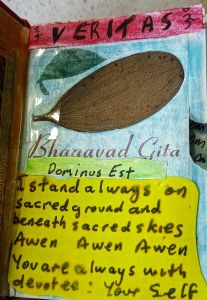
But wait, there is no need for concern: I have a prayer (stuck in my Bhagavad Gita, where else?) that I pray at least a couple of times a day. Well, rather than being a prayer, it’s a kind of affirmation or instruction to myself. Okay, it’s a prayer.


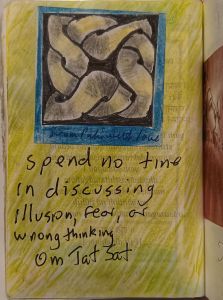
It’s a nice injunction, I think. I don’t recall where I borrowed it from, but I’m grateful that I came across it. It’s important to me; a vital instruction that I feel assists me in my aspiration to be a bit more thoughtful, and a bit less vocal.

Does it work?  Well with the risk of repeating myself, I will say yes. Maybe I’m a bit more thoughtful and perhaps a bit  less vocal. But, on the other hand, I wouldn’t say I was anywhere close to the ‘spending no time’ level.

Now that I’m thinking about it, illusion, fear, and wrong thinking are common themes in many people’s lives, and we might even say that they dominate our culture whether it’s the media, celebrity gossip, or any of the rest of the illusory and speculative talk that goes on all around us.

Tunnel to the Light

Anyway, fear is the biggie isn’t it? Fear of not having enough; fear of not being good enough; fear of what might happen or what might not. This list is endless. Fear of illness or ageing; fear of losing friends or fear of not having any! Fear of ‘missing out on the good life’ we imagine everyone else is living.

Then there is what’s called, the fear of the other, most often promoted and replicated by the mass media through their creation of illusions, fake news, exaggerated  or one-sided information (I hesitate to use the terms ‘facts and figures’ but you know what I mean). And then they sell us on ideas that we need to fear some other person, people, thing, time, impending catastrophe that never comes.

I don’t need to go on here: as I said, the list is endless. All that’s left to say about these fears and the illusions we are force-fed and made to believe are real, is that it all boils down to costing us a great deal of time spent and usually wasted, in wrong thinking of one kind or another.

It seems to me the media (news and social), advertising, and governments of all persuasions, are really quite happy for us all to be ‘getting the wrong end of the stick’. I think that’s the expression. Our societies are drowning in, for want of a better word, propaganda.

Buy this, do that, don’t do the other thing. Be afraid of (insert the latest scapegoat, political opponent, boogy man, the Apocalypse. Again it’s an endless list).

Then there are the fears we invent for ourselves, the illusions about ourselves that in our wrong thinking we come to believe are all real and true. One thing you can say about wrong thinking is that it makes for more and more wrong thinking. More illusions about who we are, what we do (or can’t do), what we are like, who likes (or doesn’t like) us. Here I once again risk repeating myself, but yes, it’s a long long list.

So, what can we do? Well, we could use a little reminder like the one we’re talking about here. It’s possible that it can help us correct a little of the wrong thinking that leads to fears and illusions.
Then there is what we might call discernment. Not so much deciding between one thing and another; more like coming to know what is real or illusion, a genuine, rational fear that I need to act on, or some inherited, manipulated, received  or otherwise irrational, baseless, or invented ‘fear’.

We won’t get rid of wrong thinking by trying to push it away. It’s about replacing the wrong thinking with some right thinking. We can try to recognise that wrong stuff as it comes up. We can make an effort to stop allowing ourselves to get away with our own misunderstandings, our own wild imaginations, wishful thinking, and confusions. As my teacher said just the other day, use your mind to control your mind.

One word we haven’t discussed from my little injunction is discussing. We discuss things when we talk or communicate  with others or when we talk to ourselves. Here we are at another issue for discernment: what shall we talk about?

Actually I was about to write that one excellent strategy for not spending time discussing illusions, fears, and wrong thinking is to simply stop talking altogether. That’s all there is to it: Don’t talk!

But obviously that’s a ridiculous notion right? Stop talking? Perhaps for a set time? Or perhaps as a kind of ‘time-out’ strategy? But as a principle for a whole life, it’s not going to appeal to the majority of us. Actually, that feels to me like a bit of wrong thinking creeping in: a life of no, or at least limited talking is very appealing to me. Just difficult.

Still that does seem to be what my treasured injunction suggests I do. Mind you, it’s very specific isn’t it? Spend no time, it says. Discussing what? Illusions, fear, and wrong thinking.

So, how do we manage to follow this suggestion ‘to the letter’ as they say?

Here’s another little prayer I say everyday. This one is from Thomas Merton.
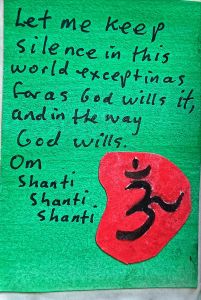

Keep silent ‘except in as far as God wills it’. For God I could say the good of all concerned; Truth; my heart; my goodwill; my love. It’s all God; it’s all the Divine.

I guess it gets back to something I said earlier about thinking before I speak. To this I would now add, feel before I speak: What’s right? What’s wrong? Does this help? Will this hurt someone else for myself.

About right and wrong: In the religious  tradition I was ‘raised in’ it was deemed that at the age of seven or eight a child is suddenly, without any preparation, able to discern right from wrong. Which means they are now responsible for the consequences of their thoughts, words, deeds. In other words, they are now capable of sinning and suffering  the consequences.

I can’t (obviously) speak for you or anyone else, but it’s been a very very long time since I was seven or eight, and I still find it tricky sometimes working out right from wrong. Of course while I know I am now responsible for my thoughts, words and deeds, I also know that we are all flawed; nobody’s perfect, so we’re going to make mistakes. 

So, all I can do – all any of us can do – is appeal to the innermost Self and use my intellect and my heart to try to discern as best I can, what is right and what is wrong.

Only in the innermost places where the real Self dwells can we know reality from illusion; it is only in our ‘heart of hearts’ as they say, combined with our rational thinking mind, what fears are real and what fear is illusion. And it is only then that heart and intellect can determine when our thinking is headed down the wrong (or the right) track.

It’s only then that we will know what and what not to spend our time discussing, either with others or internally within ourselves.  This all sounds like a long, convoluted, tricky process (told you I talk (write) too much!), but it needn’t be.

Like all things it takes practise, and once we begin to know that innermost Self, it will soon become a spontaneous way of living, when we begin to ‘just know’.

Your own inner divinity (which is the real you) wishes for you peace.

Om Shanti, Shanti, Shanti.
One, Without a Second, is All There Is

Right at the front of my Bhagavad Gita (the only book aside from the notebook I’m writing this in, that I personally own), I have recorded and inserted sayings and various words , that are important to me. Among those things is a statement I first heard many many years ago, that is common among the First Nations’ peoples of this country:

I [We] stand always on sacred ground and beneath sacred skies.


It is not an affirmation of ownership or possession. It is, instead, an affirmation of belonging to the land, to nature. It is a prayer of thanks, and it is a declaration of the knowledge of unity with the rest of the natural world, that is the hallmark and foundation for Indigenous cultures throughout the world and through time.

I’ve valued – treasured – this sentiment for a very long time – probably from even before I first heard it, which was so long ago as to be lost to memory. Perhaps I always knew it because I’ve somehow always thought this idea was a fundamental truth concerning my existence as a being living on this planet.

Well, now I have heard another statement that for me makes a perfect compliment for this one. The other day, during a lecture, my teacher mentioned that in his student days a fellow student said:

Wherever you are, you are walking through Ishwara

(Ishwara being her preferred name for the divine – for all that is.)

There is a feeling or sense of ‘belonging’, of awe and wonder when we attempt to immerse ourselves in what we term the natural world.

Once again I immediately felt the bell of Truth ringing clearly through this statement. Yes, I thought, everything is divine – including our own selves – so of course it follows that wherever we go, whatever we do, we are always in the divine.

You’ve probably read a number of times me quoting my teacher quoting his teacher:

It’s not that there is only one God, there is only God.
          Swami Dayananda Saraswati

Emphasis very much on only. Meaning of course, that it’s not that God is within us, or that we are within God; we are not surrounded by God; and it’s not that God ‘sits in our hearts’. The reality (for my teacher’s teacher) was that all that is, everywhere, everything, every thought, every word and deed, everything there is, is the divine.

Another way to describe the divine or God, that appeals to me is that Ishwara (also my own preferred name for the Divine) is in reality the natural order of the universe as dictated by the laws of nature. Those laws of nature, the rules that govern how the universe works, are also Ishwara, as are all that is manifest or in existence  as a consequence of the workings of those laws.

In other words, the Divine is the sum total of what some would call the entirety of creation.***

For the hermits a sacred site. Part of a grove we named The Sentinels. A place of experience of unity and oneness of creation

For me this an enormously comforting and reassuring concept. Of course, for me at least, it is also an extremely difficult one to wrap my head around. But here’s a small summary of what I think I’ve grasped so far.

Ishwara – the Divine – is all there is; everything. Also divine is the natural order of the Universe as governed by the laws of nature. These laws are neither good or bad – there is no duality. They are neutral.

You and I, as one more entity among who knows how many others, act as we do and are subject to the laws of nature, just like everything else. We can’t change or influence those laws; we can only live our lives as they unfold.

To quote from Desiderata: No doubt the Universe is unfolding as it should

And, well, then things just work out as they do. While we can’t change the laws of nature, or bend the universe to always suit our liking, it is also true to say that every action we take, every thought we think, every word we utter, even our very presence as a living being in our time and place, do indeed contribute to ‘how things work out’. Another way of saying this is to say, we do our bit, and the universe does its bit and what happens, well, happens.

For me, this is not at all as simple or as straightforward as it sounds. Naturally  we see ourselves as individual selves, as entities on our own. After all, to state the obvious, we live and operate in a material (dualistic) world. So automatically we see ourselves as individuals living in, but always separate from all the other individual entities, as well as being disconnected from the world itself.

It is part of human nature (for the most part) to long for connection; there is so often a drive within us pushing us to create family, enter relationships, feel we belong to a community or communities, and for many but not all, there is the almost instinctive urge to seek connection with the rest of nature.

Many forms, One reality

We often think of these longings as goals to achieve, as something outside of ourselves to attain, to reach for. Consequently, so very often we tend to focus our attention outwards, towards other people, or material things.

But, instead, all these inclinations, desires and longings are simply our Self (note the capital?) endeavoring to open itself to discovering (or rediscovering?) that which already exists: our oneness with, and our non-separation, and non-difference from, The All That Is.

Peace and Love from Paul the Hermit

FOOTNOTE

***Just a few thoughts about naming, or giving labels to the Universe and its laws.  Obviously it’s a personal choice for each of us what we choose to call that creation. Then, on the other hand, we don’t have to call it anything at all. For me personally it is very difficult, even near impossible to not name it. By naming the creation, I don’t think I am attributing the manifestation of the Universe to some distant entity living in some heavenly abode (as my teacher likes to say). Rather I am acknowledging the intelligence  and order, beauty, complexity of all that is and how it all works, as its own reality. At the same time, I am learning to understand that I as my true nature am not separate from the rest of creation, and I feel the need to have a name towards which I am able to focus my thanks and my reverence.

You Can’t Always Get What You Want

‘I wish I could write a blog post.’

So said I to my partner hermit yesterday. You see, for a few days I’d felt the coming on of a blog post: no topic, no clue as to ideas, and no hint of anything, only that it was on its way. Hence the exasperated outburst.

What’s wrong with wishing for something we want? Absolutely nothing. Sort of. Contrary to popular rumours, erroneous teachings, misunderstandings, mistranslations, or just a simple lack of information, Buddha’s Second Noble Truth does not say ‘The cause of suffering is wishes’ or we can say desires.

What he actually taught was that the cause of suffering is clinging. Clinging, being attached to a desire so strongly that failing to fulfil that desire causes us to suffer through annoyance, frustration, sadness and all those other things that impact on our mental or emotional wellbeing.

My teacher uses the word  compulsion. Compulsion to chase after what you want, compulsion to run away from what you don’t want.

Using me as an example: yesterday I wanted so badly to write, and was so frustrated that I couldn’t write just then, that I caused myself suffering. Because I couldn’t have what I wanted immediately, I made myself miserable.

Just as an aside (or perhaps not?), I realise that this little annoyance hardly means anything in the larger context of living and suffering that all of us experience simply by being alive.

But in a way, that’s my point. How many of the things we desperately want or that we desperately don’t want are the ‘little things’? Aren’t they so often the very things that, on a daily basis, cause us the most annoyance, frustration, anger, and even sorrow?

In any case, I had made myself annoyed with myself, frustrated too. However as soon as it was suggested that I needed to just down and type something – anything – if only to get the words flowing, I felt much better. I had the answer!

So, here I am, albeit a day late, and not typing as it happens, but scribbling in my notebook. Actually I don’t know why I don’t type it all up first thing, cutting out the middle step.  I mean, it really does flow better on the screen (via my fingers on the keyboard of course), and it’s also, as an added incentive, a whole lot easier to read than my scratchings.

I suppose I could say that not all old habits that have not quite died just yet, are necessarily ‘bad’ ideas. I happen to like my notebook.

Now, here’s the thing, the paradox if you like. I had felt a post coming on, and because I wished so badly for it to emerge and it wouldn’t, I suffered. And then, I sat to write something (anything as was suggested) and voila: the desperately, compulsively, longed for post obedeintly appears.

Cause and effect? I mean to say, which came first? Did I at some deeper subconscious level already have an idea to write a blog post about how clinging and compulsions and attachments to the things we want – and aversions and compulsions to get away from things we don’t want – cause us suffering?

Did that existing but deeply buried idea then manifest itself as a real world situation to give me the ‘material’ to write from?

Or, perhaps more simply, I got annoyed because I couldn’t write, so I made myself write (took a day to get to it though; remember me saying?), and well, what you see is what you get when one sits to write – words on a page.

Who can say? There are theories that propose effects can and do often precede causes. It’s a tough one to get my head around, and somehow I don’t think there’s any point in trying to.

We know instinctively that everything that exists in the Universe is constantly changing, evolving, devolving, mutating, never still. And we also know that we can affect what happens in our lives and in the world around us through our own actions. Some might disagree with me on that last one; it’s only my opinion.

The tricky bit is that oftentimes we forget that those changes as well as the lack of fulfilment or otherwise of our desires (wishes also), and even the results of our own actions aren’t always to our liking. Well, it’s not that we don’t know it in our minds and through personal experience, but when it comes down to it, we all usually as part of our normal conditioning, suffer when outcomes aren’t to our liking. It’s like we know it but we haven’t realised the truth of it yet.

Sounds like a trivial or flippant, even silly and pointless, thing to say, but it’s demanding to be said anyway: things (as in life and the rest) always work out how they work out.

But if you think about it, it’s true whether we like it or not. Actually, in a sense this is one of the very important, even pivotal points, of my ongoing studies, meditations, and contemplations. To realise fully that I, along with every other living thing, has a place within, no, not just a place within but is actually an indivisible part of, if I may be forgiven a cliché, the grand scheme of things. Not only that, but we in our essential true natures as Consciousness remain untouched and genuinely okay whatever transpires here in the material world.

I do what I do; you do what you do; and regardless of whether we like the outcomes or not, things work out as they do. Sorry to be repeating myself. Just seemed the right thing to say again.

And here’s another tricky bit: it’s not about resigning ourselves to ‘fate’ or ‘destiny; or whatever we might call not having control over our own lives.

Just by way of exploring that last point, and finishing this post, I would like to leave you with a quote. Yes, I know, we are all bombarded by quotes from famous (and not so famous) people, aphorisms of all sorts, and affirmations that claim they will improve our lives.

I truly believe this flood (mixing my metaphors here) of good words, written with good intentions, has numbed us to their actual value and usefulness to us in assisting us to live good lives.

So, here is one such, that I think puts it in a nutshell, in a very simple, straightforward way, an important Truth. It’s called the Serenity Prayer, and rereading it just now, I see clearly that serenity would indeed be the outcome if we are able to take this invocation to heart, and begin to live by it.

God grant me the serenity to accept the things I cannot change,

Courage to change the things I can,

and the wisdom to know the difference

Peace and Love from Paul the Hermit

PS: This version is only one among many. In fact, the Wikipedia entry linked above is a fascinating (though apparently quite flawed) exploration of this prayer and its origins.

Wear the Tender Miracles: When a Magpie Sings

Wear the Tender Miracles

What a beautiful expression, I thought when I first heard this said a couple of weeks ago.

I’m not sure who said it, but that’s not so important. And  I thought isn’t quite right either. My reaction was more from the heart than the head; more visceral, more ‘real’ somehow than something concocted by the mind.

Now we’ve dealt with one of the ‘w’ questions writers so love, there is another that’s important to ask at this stage: What does this fantastic sentence actually mean?

Naturally I’d had this question from the beginning as well, but despite it going round in my mind almost like a mantra, I don’t think I’ve quite worked it out yet. Perhaps a part of the reason for this failure is the nature of my reaction when first hearing it that I mentioned above: My reaction was one of the heart, not of the mind, so harder to look at analytically.

Still, the emotions and even the (spiritual) heart itself originate in the mind. So, let me share with you what I’ve come up with so far.

Wear the tender miracles. It seems to be a very straightforward sentence. But is it merely a well-intentioned piece of advice? Is it more a spiritual injunction? Well, as I thought about it, I realised it was in fact both.

Certainly it feels like good advice – though before we can finally decide that, we need to work out the meaning and intent of the words we have. Mind you having said that, I have to say it resonates with me as something one might hear from a spiritual director, or read in a sacred text of some kind.

So, what exactly are tender miracles? Are they soft and gentle, happy happenings that come from some place ‘out of the ordinary’?

You know, in my Contemplative Photography practice and in my earlier Street Photography days, I had a few maxims that I worked by and tried to live by. One of those maxims was: There is no such thing as ordinary. Which is another way of saying that there is nothing that is not extraordinary, and therefore out of the ordinary.

Photo by data9090 on Freeimages.com

Just now there are several Magpies making beautiful melodies outside the hermitage. I know very well that these vocalizations that for this particular species represent an expression of biological and or evolutionary impulses or drives.

But, is that all there is to it? I don’t think so. As I listen, I smile. And my heart feels something. I sense beauty, and realise that I am receiving a gift; you might even say it’s a miracle.

Biological imperative or tender miracle? Why can’t it be both?

How many times a day do we experience or encounter ‘little things’, that appear ordinary, but are hardly noticed (or not noticed at all?) in our hurried and harried lives? Yet, anyone of those little things may be a tender miracle waiting for you to come along.

I know, the glorious singing of Magpies is a fairly obvious miracle, not so hard to miss – if one looks at that way. But even then, I know we don’t always notice. And what about the smile from a random stranger passing on the street? Or the comforting warmth of the sun? All things easily missed and if we actually do notice, we likely will simply take for granted.

Talking about taking for granted. What about the million little things our loved-ones do for us every single day that we either don’t notice, or just let slide without any real attention? Better stop here: this list really could go on forever.

Now, wear. Of course we all know what wear means; we might wear a coat, a hat, shoes. We all wear clothes. There really is no end to what we humans can and do wear!

Perhaps, though there is a deeper way we can think about wear. When a hat (purely by way of example obviously) comes your way, you at the very least try it on to see how it fits, how it looks, how it feels.

Of course you do need to be paying attention when engaging in these tryings on don’t you? So why not as you live your lives and when miracles might be coming?

Well the first thing to be said is that in our busy, distracted and stressed out lives (sorry to be so repetitious) much of the time we aren’t ‘there and available’ to pay attention. It seems that our minds are rarely in sync with what we’re doing with out bodies, where we are or even when. The mind is more often than not way off in the future or stuck in the past somewhere.

So, if we want to wear the tender miracle, we need to begin to cultivate presence. We need to be paying attention to and in every moment we possibly can. It’s really just about Mindfulness . In this way we make ourselves available to actually notice and recognise when a miracle come to us.

Okay, the miracle has happened, you’ve noticed it, seen it for what it is, what now? Put it on! After all it’s yours. When you put on a new hat you look in the mirror: How does it look? How does it feel?

And as with the hat, if you like what you see, you proceed to go about your normal life, wearing the miracle for all to see. People will notice: after all if you are wearing a new hat and think it suits you, your demeanour, your smile, and your stature, the way you carry yoursef, will say it all.

But really that last bit is about yourself. Don’t forget yourself, share the good vibes with you. See yourself being contented, satisfied, grateful.  Wear the miracle lightly.

One word we haven’t really looked at is tender. We all know what tender means, and I’m sure you agree that not a lot of whatever we might call miracles could be described as tender. In any case, most of us know that life doesn’t really work that way.

Much of what we experience in life – both the big stuff and the little stuff – looks and feels more like hellish nightmares than some sort of ‘miracle’. Besides, a grumpy boss, or a sudden illness, are both to grab our attention more readily than singing Magpies.

Life is full of variables . It’s unpredictable in that we can”t know for certain what’s going to happen, when it’s going to happen, and most of the time we won’t ever get to the why something happens either (there’s those ‘w’ words again).

What I’m going to say now is just my theory. I can’t say I’ve realised its truth. And I probably won’t get there anytime soon either.

Every single thing that happens in the Universe – absolutely everything – is a miracle. Why? Because everything that happens expresses – manifests – the laws of nature, the laws of life, the universe, and everything else.

Maybe the most tender, the most beautiful, the truest miracle is the one we are actually there and now, sorry here and now, to experience and acknowledge it for what it is, good, bad, or anything else.

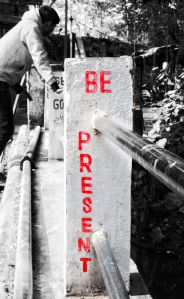
Pay attention; be present in the presence of the miracle.

love from me to you.

The Alchemy of Rain: A Poem & a Picture (or two)

THE ALCHEMY OF RAIN


Surya’s life-giving energies shine upon
scattered and drifting, yet converging, patches dotting the clear blue sky.
Silver linings, so they say,
granted to those scattered grey clouds.

Those clouds, those grey scattered and converging clouds,
bless.
Bless the domain of Varuna,
God of the skies
with the potential for change.
All forms change.

Clouds, silver-lined or no,
are Varuna,
for he is also God of the skies.
And now, with clouds’ convergence,
the expectancy ends:
the change begins.

The Sun, still present, yet his light blotted out
by those very clouds – joins Varuna
In the form of the cloud. Alchemy.

From the convergence of energy and matter
water droplets emerge;
Varuna has remanifested,
and falls to wet Earth below.

To cleanse the dust from all things
living and non-living.
From the feathers of the winged-ones;
From the fur of the four-legged;
To quench the thirst of the Tree People.
And to moisten the throats of us, the Two Legged.

Thank you my friends.

May your day be blessed by both Surya and Varuna, in the correct measure and balance that is for the benifit of all beings.

When Love is a Yoga and Lovers are Yogis

There was light at the end of the research tunnel

These last few days I’ve been researching and thinking about an idea for a blog post. But I’ve come to realise that I am grossly underqualified to write about the topic I had in mind. Let me put it another way: I am completely and utterly unqualified in any way whatsoever to go there. In fact, after all the research, I think I’m going to disqualify myself from ever going there in writing.

However, I’m a great believer in the idea that no quest for knowledge is ever a waste of time or effort; there is always something to be learned. During my research I came across a topic I believe I am qualified to discuss, as it forms an integral and vital part of my own personal spiritual practice.

Why I’ve decided to write this post, though, is because I made a discovery that lead to an insight that I know will lead to a great progress in that practice. It’s nothing new, not really, but it was one of those occasions we’ve all experienced of ‘I knew that, but now I really know it.’ For me, it was a realisation of something that till then had been a nice cosy theory and belief.

Bhakti Yoga is that practice. It is really a key foundation, a valuable component of my spiritual life.

Wikipedia opens its entry on Bhakti Yoga (see the link just above) with a description of the practice that mirrors what I think is the traditional understanding of Bhakti Yoga:

Bhakti Yoga (also called Bhakti Marga, literally the path of Bhakti) is a spiritual path or practice within Hinduism focused on loving devotion towards any personal deity.

In the same entry there is a description of the origins and meanings of the two words, Bhakti and Yoga:

The Sanskrit word Bhakti is derived from the root bhaj, which means “divide, share, partake, participate, to belong to”. The word also means ‘attachment, devotion to, fondness for, homage, faith or love, worship, piety to something as a spiritual, religious principle or means of salvation’.

The term Yoga literally means “union, yoke”, and in this context connotes a path or practice for ‘salvation, liberation’. yoga referred to here is the ‘joining together, union’ of one’s Atman (true self) with the concept of Supreme Brahman (true reality).

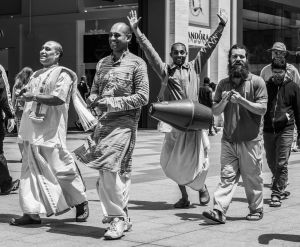
For some, dancing while chanting the names of their God, demonstrates their devotion and celebrates their union with each other and with God

In other words, those called to a religious or spiritual life, practise Bhakti Yoga whenever they pray or otherwise express devotion towards their personal conception of God, or the Divine. This particular definition seems to be saying that such a conception of the Divine, or God, is in the form of a personal deity who is a kind of representative of true reality, which the devotee is aspiring to join with.

Some Bhakta Yogis are full-time, full-on practitioners. People like contemplative nuns or monks, hermits who retire from the world into seclusion. Anyone basically whose entire life and activities are spent in devotion.

So, when I discovered all this, I became intrigued; I decided to go off on a tangent and explore the word Bhakti itself. Wikipedia has a separate entry for the word on its own:

Bhakti is a term common in Indian religions which means attachment, fondness for, devotion to, trust, homage, worship, piety, faith, or love. In Indian religions, it may refer to loving devotion for a personal God

is often a deeply emotional devotion based on a relationship between a devotee and the object of devotion.

In ancient texts the term simply means participation, devotion and love for any endeavor.

May refer to devotion to a personal god? While I thought this entry doesn’t contradict our first quote above, it does seem to broaden, and deepen, the meaning of Bhakti. Expand might be the better word.
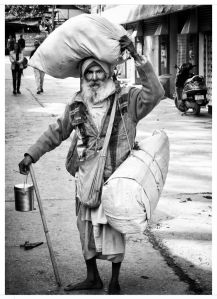
In some traditions a simple life on the road is a way to commit full time to Bhakti or devotion.

It struck me that that object of devotion might be anything. Or even everything. You see? I told you it wasn’t a new idea. It’s just that it’s resonated deeply within me now. It appears that the object of Bhakti Yoga practice doesn’t necessarily have to be a ‘personal god’.

Many many people would say ‘I like animals’ or ‘I think we should save the world’. But, while that may imply a kind of love for or at least a fondness for, I think Bhakti is something more – actually several somethings more!

For example, some people have a particular attraction to and love for, the ocean, or it might be a river they view as, if not sacred in a religious sense, then as special to them in some deep, comforting, even therapeutic way. Others have similar relationships with and feelings for trees, or even a particular tree.

Animals as either individuals or as a species or group, can have the same appeal and call to other people. Then there are those who feel strongly in their hearts you could say, that Earth itself is a sacred object, or others have a knowing that the planet is a living entity and worthy of our devotion.

Bhakti begins with love and devotion, which is about caring for, affection towards, loyalty to, emotional engagement with the object of devotion. But even more than that, there is faith in that object of devotion; faith as in trust, confidence that the love is real, that the ‘relationship’ is sound and real.

Homage and worship too are key aspects of Bhakti. The deep inner feeling we have towards a thing, person, or other being, that is beyond what we normally call ‘love’. It’s about seeing and actually realizing ‘in our hearts’ our desire to be merged or united with that thing, person, or other being.


Actually, seeing that word other just now got me thinking. I had to go back and reread our definition of Yoga up there near the beginning. It says Yoga means ‘union, yoke’. It goes on to add: yoga refers to a ‘joining together, union’.

This passage seems to be suggesting that Yoga (in our case Bhakti Yoga) is both an already existing union, and a process of joining together to achieve union. One thing I would say here is that in my practice of Bhakti (and love as a general thing to strive for and be) it’s both.

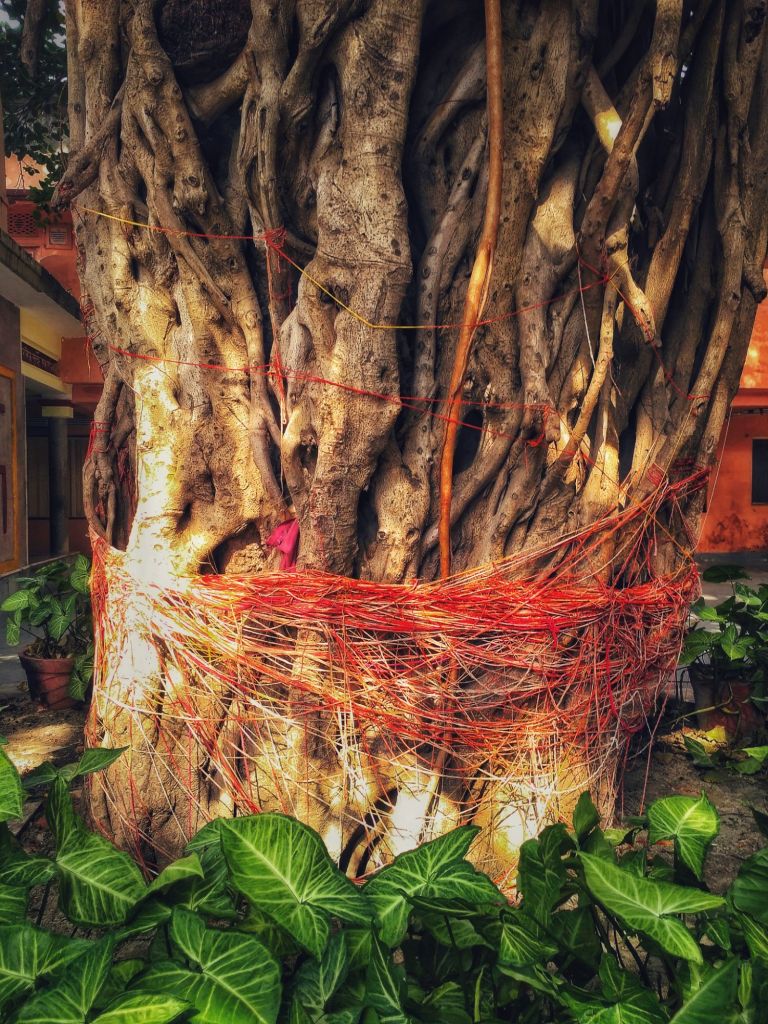
Trees are special beings for many people from a whole variiety of cultures all over the world

But, in the end, it seems to me that the process or practice, the path of Bhakti, serves to awaken us, to assist us to acknowledge, recognise, and realise in that really knowing way, our pre-existent true nature.

That true essential nature can be said to be the reality of our oneness with all things, living and non-living. And their oneness with us too of course. In fact, by putting it that way, I’m saying there is only one, or oneness. What’s that expression? One without a second.

May you be a Bhakta Yogi. Or, perhaps you already are one?

Love and peace from Paul the Hermit

Life has manifested itself as the multitudinous forms that comprise the universe. It is the one Universal Life, Power or Shakti (the laws of the universe or natural laws) that controls, guides and actuates all movements and activities in all beings, creatures and things.

                — Swami Ramdas

A Music Star, Some Songs, and the Human Condition

The first line of this post was going to read something like: I listen to a lot of music. Then just as I put fingers to keys, I thought, no I don’t. More true to say I don’t listen to anywhere as much music as I’d like.

But I do try, and I am blessed that I have quite a large and extremely diverse music collection. All digital these days (which in itself is a great blessing), but once, I had CDs, DVDs, cassettes, as well as quite a nice range of vinyl singles and LPs.

Thank you Wikipedia No glasses?

Anyway. Moving right along. Tonight, as I cooked dinner for the hermit pilgrims, I was listening to a self-titled album called Buddy Holly. I just discovered that it was his debut studio album recorded in 1958. My copy is most likely a rerelease,though unlike most of the rereleases, this one features the original track line up.

I found myself thinking about, fantasizing I could say, about what might have happened had tragedy not called a halt to Buddy’s songs and life. Who can say? Then I mentally shook myself: this kind of daydreaming and speculation is not what one might call being present in the here and now; such thinking is an outright denial of the truth of things as they are. But, remember, I’m still learning: not yet enlightened; just another sentimental human who can’t help himself or control his wayward mind.

A Studied Pose

Some would say that the album contains songs that are typical rock and roll pop songs. And yes, they would be absolutely correct. Why? Because, as you’ve probably worked out in your own life, living on this planet as a human being is a drama in itself ready made for song lyrics, movie scripts, and novel plots. It’s not a new idea!

As such the songs’ lyrics are about love and loss, hope and despair, longing, joy, sadness; you know, the normal everyday ups and downs, ins and outs of life. Not a lot you might think to interest the likes of me. But there is something, that I’m not sure I can name in Holly’s music and lyrics that strikes a chord (sorry pun not intended) for this hermit-pilgrim, aspiring to be a monk, rock and roll fan, who just loves music from wherever and whoever.

Sure, the songs being products of their times can be a little sexist (nothing compared to the twisted misogyny we sometimes hear today though): sometimes naive and simplistic. But, for me there seems to be an innocence, even a kind of purity to the lyrics. Have a look at the lyrics of Mailman Bring Me No More Blues:

Mailman, bring me no more blues
One little letter is all I can use

She wrote me only one sad line
Told me she’s no longer mine
Mr. Mailman, that’ll do for some time

Cried like never before
So hard, couldn’t cry no more
Shoo, shoo, Mailman, stay away from my door

Mailman, bring me no more blues
One blue letter is all I can use

By the way, those two lines in the second verse are about as sexist as any of the album’s lyrics get, not that I am suggesting we minimise in any way whatsover such a sentiment. It’s abhorrent to me.

Anyway, it is pretty clear what this song is all about: it is the pleas of our rejected hero to be left alone; he can’t handle any more bad news or heartbreak.

Actually as I’ve listened to this particular song a few times tonight, I’ve realised that it’s about attachment, about compulsions and aversions. It’s about how this guy believes his wellbeing depends on someone else, that without her he is doomed to suffer.

When we think like that, we are compelled to chase after those things in the world that we think will make us happy, and run away from the things that we think make us suffer. In this song it’s all the mailman’s fault.

Obviously we are all like that; it’s part of human nature isn’t it? You might ask, am I now preaching a dualistic , clinging to your desires type of approach to living. No, but at the same time, it’s a true story isn’t it? This song. None of us want suffering, pain, rejection, and all the rest of it. I guess instead I should be saying now: let go of worldly attachments, give up your notion that things of the world can make you happy.

Now, how about these partial lyrics from Everyday. One of Buddy’s biggest hits:

Everyday, it’s a gettin’ closer,
Goin’ faster than a roller coaster,
Love like yours will surely come my way, (hey, hey, hey)
Everyday, it’s a gettin’ faster,
Everyone says go ahead and ask her,
Love like yours will surely come my way, (hey, hey, hey)

Everyday seems a little longer,
Every way, love’s a little stronger,
Come what may, do you ever long for
True love from me?

And the music. Holly has been credited with being the originator of what became the standard set up for rock and roll bands: two guitars, bass, and drums. Mind you, according the album notes I read online, many of the songs on this album also feature many other instruments, classical and contemporary. I think it’s brilliant; something about it makes me think of alchemy

Wake me up for the drum solo

For me it’s that instrumentation, the tunes, the melodies, and sometimes great harmonies (not to mention the occasional lack of harmony) that promote or provoke a kind of mellow, reflective mood. Sometimes though it feels like the music itself goes further and actually creates or induces that mood.

I just love these songs. That’s the essence of what I’m saying. In a strange way, they serve to uplift, despite the sometimes apparant gloom and doom of many of them.

Anyway, let me leave you with a couple of verses from one more song, Valley of Tears, which was actually written and first recorded by Fats Domino.

While most of us have been at some time or another a frequent visitor to or even long term resident in that valley, in this song our hero wants to actually go there forever!

Of course, I don’t think it’s that simple. I think he wants so badly to be relieved of his suffering that the only place he can think of where he can truly belong is where everybody else is suffering like him.

I want you to take me
Where I belong
Where hearts have been broken
With a kiss and a song

The Closed Cafe at the End of Lonely Street

Spend the rest of my days, dear
Without any cares
Everyone understands me
In the Valley of Tears

I guess that’s why I love and respect Buddy Holly along with so many others: he’s telling us, reminding us, that happiness doesn’t come from outside, from out there in the world. And if it does, it’s fleeting, only temporary. He reminds us, or at least he speaks this truth to me, that the only place I can find permanent peace, love, happiness is within.

Peace and love from me to you

PS: A note of thanks

Most of the photos are mine, except for the ones depicting the record single and the LP cover. I am very grateful to Wikipedia for allowing such access to these things.

Also thank you to Wikipedia for the song lyrics. If you ask my personal opinion, I will tell you that Wikipedia is one of the greatest resources for knowledge (or rather informatioun with the potential to become knowledge), that has ever existed in the history of our species.

A TRIBUTE TO THAT WHICH IS SEEN

An affinity with trees;
crowns moved by the breeze.
    The Sentinels stand firm.

Sentinel Rising
Neighbours
In the Grove of the Sentinels

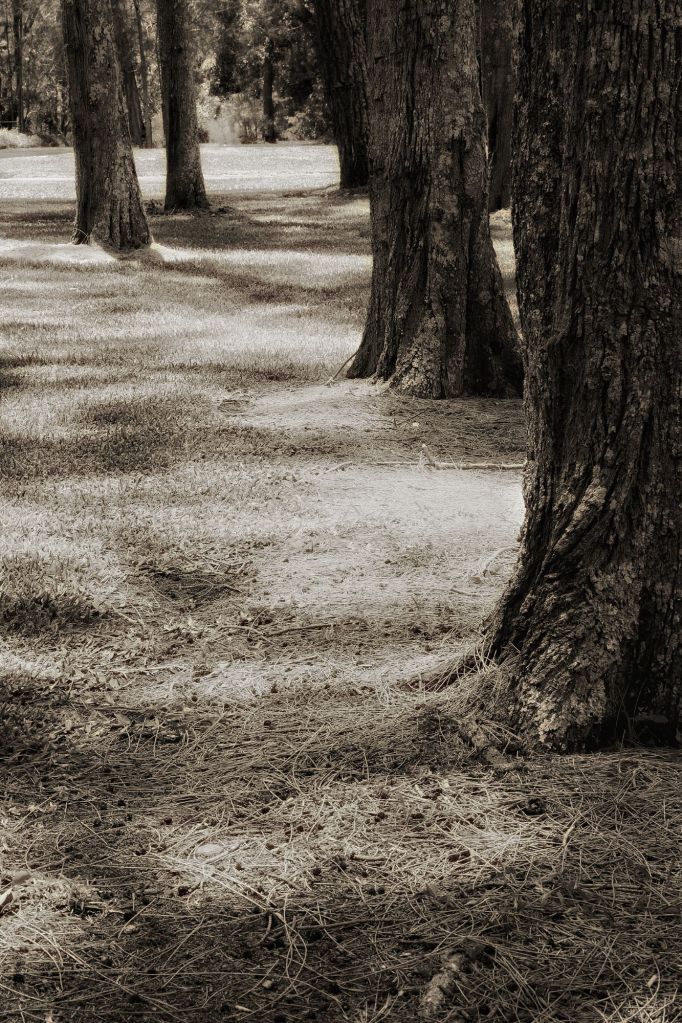
A Grove of trees we came to know well as The Sentinels, a creek, a field of grass, and nature in abundance.

Our cottage was small, but richer than all.

We do indeed stand always upon sacred ground.

Peace and love

Paul

A small remembrance and a prayer of gratitude for some old and sadly missed friends.

Sentinel Magic

Be Here Now: There’s No There and Then

Earlier today I thought I might write a post to let you know what’s going on at the Hermitage at the moment. That’s it. One thought, no follow up.  One more idea that might or might not work out.

And then just now my partner hermit and I were talking about how we’re not feeling present where we are and how frustrating  that is.


Then I made a joke about how I’d had the thought about updating you on where we’re at right now and how useless that idea is because we aren’t actually here and it’s not actually now. We have already moved in our minds to our next temporary hermitage.

Let me explain.

You see, we move around a lot. Every few months, sometimes even more often. It’s just the way we are, pilgrims and nomads. Still hermits mind you, but the pilgrimage takes us wherever and whenever it wants.

Anyway, we are scheduled to move in about a month. It happens that our next safe haven is in a familiar town that we actually like quite a lot. So, naturally, we’ve been thinking and talking about all the great things about that place. But worse, all that forward thinking, fantasizing, speculating, has lessened our hold on the present, on the here and now.

Like I said, it’s as if we aren’t here anymore and that’s a pity. You’d think that someone who writes and thinks so much about presence would be a little more skilled at actually being present. At least sometimes. But, no. It often feels like the more I think about it, the less it happens. Being in the present, in the here and now I mean.

I know that my last post was about story and its central place in pretty much all our communication with each other and the world. With that in mind, there is a story I’d like to tell you now that I’ve heard a couple of times from a favourite teacher of mine.

It’s a story about presence, yes, but it’s also about having an attachment to some kind of anticipated and (in one’s own mind) fixed outcome. It’s really about how we can never really know anything at all about the future for absolute certain, and how that attachment to the outcome can easily obscure from us other possibilities, other outcomes that are available here and now.

Imagine you work in a city office and have just finished work for the day. You head out onto the street in a casual way because you know for sure the bus isn’t due for another 15 minutes and the stop is just across the road.

So, there you are, just about to cross the road, eyes on the ticket home (aka the busstop), and a car pulls up right in front of you. It’s a friend of yours you haven’t seen for a while (this part of the story is my little embellishment, added for extra clarity and detail you might say).

‘Hop in,’ your friend smiles and opens the passenger door to let you in. ‘I’ll drive you home. It’ll give us a chance to catch up.’

You are in a little world of your own after a long tiring day. You’re, already planning what to watch on TV, and thinking about dinner. So, after the hellos and the how are yous, you politely tell your friend that you’re okay, the bus is due in five minutes (time flies!) and you checked and you know it’s coming on time.

Your friend drives off with a shrug and a wave, and you get ready to cross the road .Just as you are about to step out onto the road the light changes leaving you stuck on the spot. Then you see the bus – your bus – pull into the stop. No worries, the light will change again in a few seconds. But it doesn’t. It’s a busy time of day and the traffic keeps on flowing.

Then, as you stand watching, the bus pulls away and your eyes follow it down the road, round the corner, and out of sight. Now, you also know that the next bus isn’t due for an hour and a half. And that is for sure going to ruin dinner and you won’t be watching much TV tonight either. An exhausting end to an exhausting day.

In your attachment to the idea of the bus arriving on time, and on your thinking about the evening ahead, you refused the other option that just by way of serendipity had presented itself.

Now, like all of us who miss opportunities because we’re busy thinking about the future (and of course it could just as easily be the past), you are asking yourself why was I so sure the bus was coming on time? How could I possibly know? Timetables can be wrong can’t they? You’re already regretting saying no to your friend. You were only being polite anyway.

While you sit annoyed and frustrated at the bus stop, you start to think a little differently. It might have been nice to catch up, after so long. Not only that [my friend’s] car would have been way more comfortable than a crowded bus. Not only that I would be almost home by now.

So, what about me? What will I miss because I’m not here while I’m still here? What won’t I see or experience because I’m attached to the next place? Well, unlike our bus timetable know-it-all, I don’t want to find out.

Time now to recentre. Time to practise what I preach. Time to return to where I already am, here and now. Mindfulness in even the smallest activity. When I remember that is; after all, it isn’t called practise for nothing: it’s a practice that never ends.

Time to remind myself that I can’t ever know for certain what’s going to happen from one moment to the next, much less at any moment between now and a planned event in a month. Nothing wrong with planning, with preparing. The trick is to not be so attached to that plan that you are compelled to either ignore the present or fixate on that possible future.

So then, it’s time to open my eyes, ears, mind and heart to what’s around me, where I am and what is happening. Same disclaimer as above mind you! It’s the effort we make that really matters after all.

The real bonus, though, of being as fully in the moment as you can be, is that being there (sorry I mean here) is the only place you can actually be, which means you are fully in the presence of all there is. There’s nothing else. Not in that (this?) moment anyway.

peace and love

Paul the Hermit

Let Me Tell You a Story: It’s a Good One!


Has anyone seen Walk the Line? It’s a great movie that tells the story (or a version thereof) of the life of Johnny Cash. Yes, I know: not everyone is into country music. This movie, however, is an intriguing insight into the life and work of a  gifted but troubled artist. He was a prolific and inspired singer and songwriter.

There is a scene in the movie in which Johnny is about ten or so. He’s talking to his brother who is maybe 14. The brother is studying the Christian scriptures (he wants to be a preacher when he grows up, but dies soon after in an horrific accident) and Johnny says, ‘Why you studying so hard?’ His brother looks up from his reading and says,

‘You can’t help nobody if you don’t tell ´em the right stories.’

Yes, I thought when I heard that, you have to tell them the right stories. But, what are the right stories? It’s a good question but, fortunately, there is a simple answer: they are all the right stories. That is if they are told from and with the heart, and if they are created and shared with the intention of conveying Truth, promoting harmony, and doing or causing to be done, what’s right.

The ‘them’ of poor brother Cash’s reply are those who get to hear/see/feel the stories we tell. And we all tell stories don’t we? I mean I’m telling you a story right now. As a (cringe) blogger, that’s what I do.

But we all share stories of all kinds. Sometimes they are stories of our lives, sometimes they are from memories passed down the generations. Other times they might be something we ‘make up’ to help someone to understand a point or idea. Pretty much all of us, most of the time communicate in one kind of story or another.

Of course there’s the other kind of stories; the ones meant to spread rumour or gossip, to hurt someone, to mislead. We all know how that works, and it’s not today’s topic anyway, so let’s just leave it there.

Those we share stories with may be those we intend to share with, and they might be others who at the time are distant from us both in time and space. Just as the stories we tell each other might be decades or even centuries old, so might our stories keep on reverberating through time and space.

A true story written on a wall somewhere

It’s also true that the stories that ‘help’ people come in all shapes and forms and are about an unlimited variety of subjects and topics. Then there’s the matter of timing. How often have you ‘just by chance’ read something inspirational when you were needing some guidance or advice?

Or what about those times when you are feeling a bit low or under the weather and you come across a story that makes you smile or otherwise lifts your spirits? I’ve often been in need of a good cry only to come across a sad movie or story or a moving tale of one kind or another. (Just last night I read a wonderful phrase I’d never seen before: Transformational Weeping. Probably a story or two there do you think?)

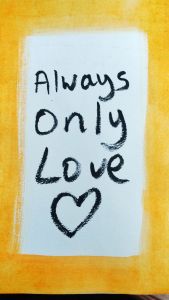
A story I tell myself literally every day. One that’s a prayer and an affirmation

So, let’s keep telling stories. They are all the right ones for us to tell – if they come from the heart and told with the intention of serving Truth. Someone once wrote:

If there is a way to improve the world, it is by telling a good story.

Okay then.

Once upon a time on a dark but not so stormy night …

PS I saw the movie in Dharamsala India. On a postcard home I wrote a little rhyme about some writing work I was doing on some of the town’s environmental issues for a local magazine:

He walked the line
did Johnny Cash.
But here in Dalai Lama Land
my words will help reduce trash.

I did say stories come in all shapes and forms didn’t I?