It was way back in the earlier days of this blog, sometime in 2022, that I wrote a post about our community’s liking for snacking on plain toast by choice. It’s our more or less regular late evening, before bed, bite to eat. Perhaps accompanied by black tea, as I described in that post.
As I also point out in that post, I do actually enjoy plain toast. It’s not that I no longer like jam or other yummy spreads; I like them too well truth be told, but sometimes, well, plain is good.
As the day winds down to become night, and we settle to our evening snack, I will sometimes make a joke about simple food, or monks with simple tastes, whatever. Anyway, a few nights ago I made a remark, a joke, that has had a profound impact on me.
‘I’ll just say a prayer for my two slices of dry toast.’
Of course I am just like so many other religious or spiritually inclined people, and say a prayer before I receive any and all food or drink. It’s a long time habit, and a blessing I like to perform. Just a thank you is all it is really.
This comment, this joke, as soon as it was out of my mouth, I realised, of course I will. Don’t I always?
It’s true that our community lives simply, as simply as we can. And that includes what we eat and drink. It’s also true that this is not some sort of ethical stance consciously taken; nor is it a kind of overlaid act of solidarity with those who have no choices due to poverty or other circumstances.
It’s purely and simple because we like simple. It really does suit our natures and temperaments and for us it is the obvious way to live.
It is no renunciation: we welcome simple. This obviously is not to say that we are unaware that our very natures and temperaments naturally steer us away from choices that are unethical or are out of sync with compassion (call it solidarity) for other beings.
The reason I’m ranting on about this off-hand comment thrown out as a so-called joke is, well just that: It was off-hand, and my misguided intention in making this ‘joke’ was insensitive and careless; it was lacking compassion for all the other living beings sharing life and consciousness with me.
And for that flippancy and carelessness, I ask forgiveness from the invisible community that is in fact all of us struggling to live in a material world.
My sense is that in saying ‘all of us’ I might instead say, all of us who are in truth One; We who are that one Self that seeks forgiveness.
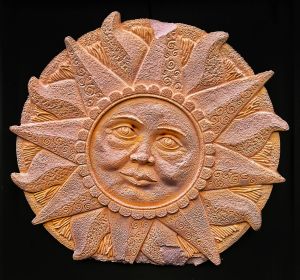
Varuna and Surya. the Hindu deities of sky and all Earth’s waters (Varuna), and our sun (Surya). These names resonate for me. I like how such great natural phenomena fundamental to our existence on this planet, can be ‘personalised’ in this way.
I find that having acquired symbolic or representational names for sky, water, and sun, has allowed me to somehow relate to the inherent giving and preserving of the energies that power all life that water, sky, and sun provide in a prayerful, thankful way. Kind of makes it personal.
Let me put aside for a moment the obvious scientific reality that tells us we can’t live long without water, can’t live at all without the gases in our atmosphere, and if the sun goes dark for whatever length of time it is, then all life ceases to exist.
How many times have I stood in awe watching a sunset?
Or watched as big waves rolled in with a surfer hoping for a ride?
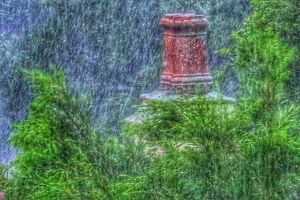
How many times have I welcomed the sound of rain on a roof and the sight of it nourishing trees or other life
And how many times have I sat on or walked along a riverbank feeling uplifted and a little more grounded?
Many, many times is the short answer. Varuna and Surya are constant presences in our lives. And I am grateful for the life-giving and life-sustaining natures of their existence.
Sharing with you today, a little poetic expression of one of those times when sky, water, and sun, gave me just a little more than those fundamental material energies.
ONCE AGAIN VARUNA AND SURYA
Once again, Varuna and Surya are coming to make rescue. They arrive on – as in fact they are – the currents and eddies of the river of life. In this way, the natural order remains in motion.
Shared with love
from Paul the hermit
Flow river go, past the shady tree. Flow river flow, flow to the sea. Flow river flow, flow to the sea.
Thanks to Roger McGuinn for one of the classic flowing on a river songs.
Earlier today I took my camera out for a walk. Which is to say, I had an intention that the walk would be more than exercise for the body (very much needed as it is), but also an opportunity for my eyes and heart to open up a little to the tiny part of the world I was to pass through.
I also hoped that my mind would join in so that I would be able to actually recognise what I was seeing and feeling, allowing me to perhaps make images of what I saw and felt.
One final prayer: In doing its job, I hoped my mind would stay focused, and work behind the scenes very quietly.
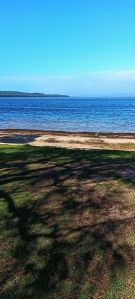
A few minutes walk from the Hermitage is the shore of a fairly large lake, and when I reached that spot, I sat on a conveniently placed little wall, so I could, well, just sit for a bit.
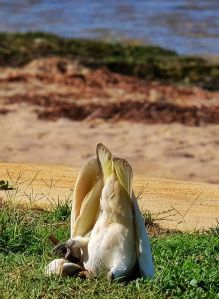
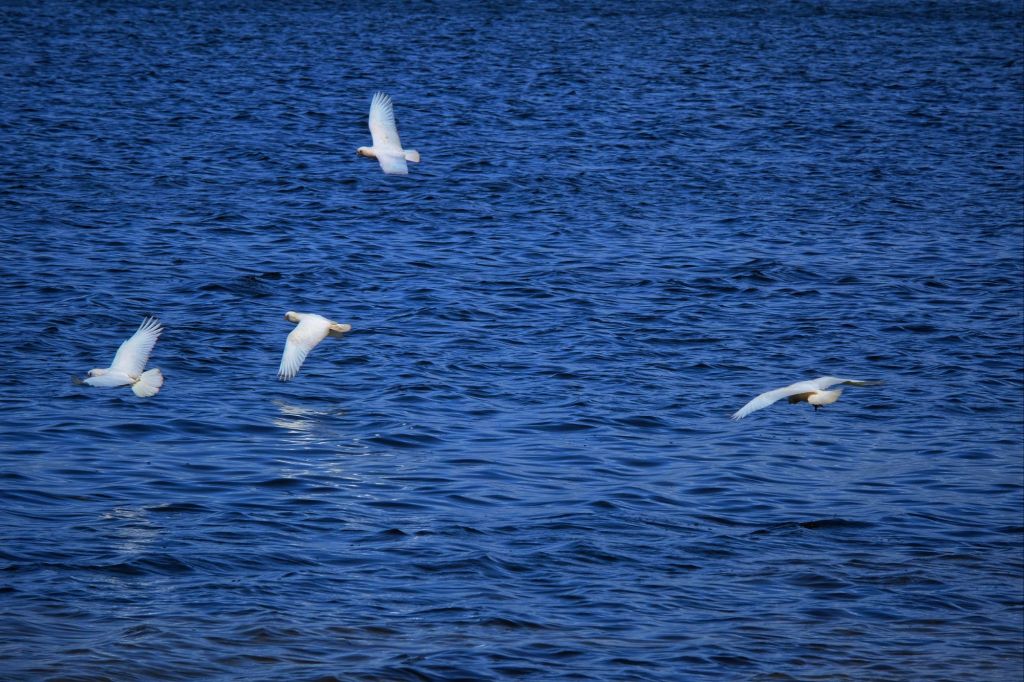
By chance, um. Sorry, let me rephrase that. By the brilliant synchronicity that results from the perfect working out of the natural laws of the Universe, right in front of me, nearer to the water’s edge, a dozen or more Corellas played and foraged. At least to my limited human eyes, that’s what they were doing.
Zoom in and share the fun!!
It’s mesmerizing watching them: tumbling with each other or on their own; picking up and wrestling with twigs and other small things. I was blessed too, to witness several of these creatures taking off, in flight, and landing.
You might have heard me say (or read when I wrote) that ‘I was just not there’. Well, not today; today I was definitely there. In a contemplative reverie in which I felt connected with what I was witnessing through my lens.
‘I had a small sense of being relaxed,’ I commented casually to my community when I arrived back at the Hermitage. And that’s what it felt like: I had relaxed for a time. I can’t say I was aware of the passage of time; it was more an eternal being in the moment if I was to try to label it now. It might have been thirty minutes or ten by the world’s measure; I have no idea really.
I’m only ever going to be a beginner when it comes to paying full attention, to contemplating and being completely immersed in the moment, and not forgetting trying to control the monkey mind. Practise will never make perfect in that department!
Anyway that’s why spiritual practices are called practices: they require the spiritual seeker to be committed to a life of ongoing and continual practise.
Of course encountering those birds at the lake today is definitely a practice I would be happy to practise anytime!
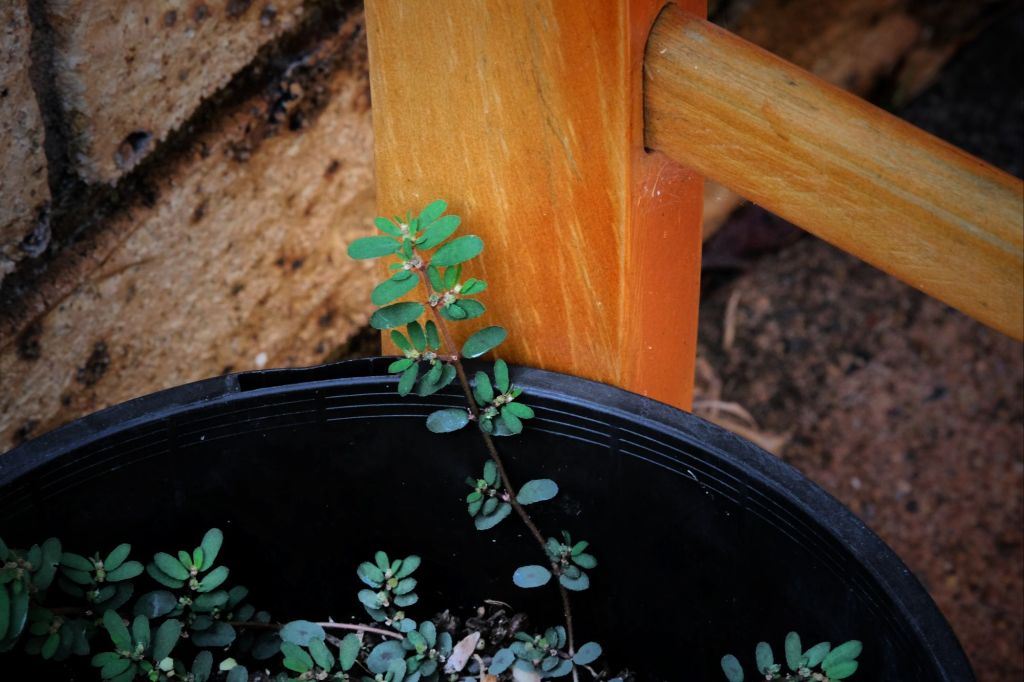
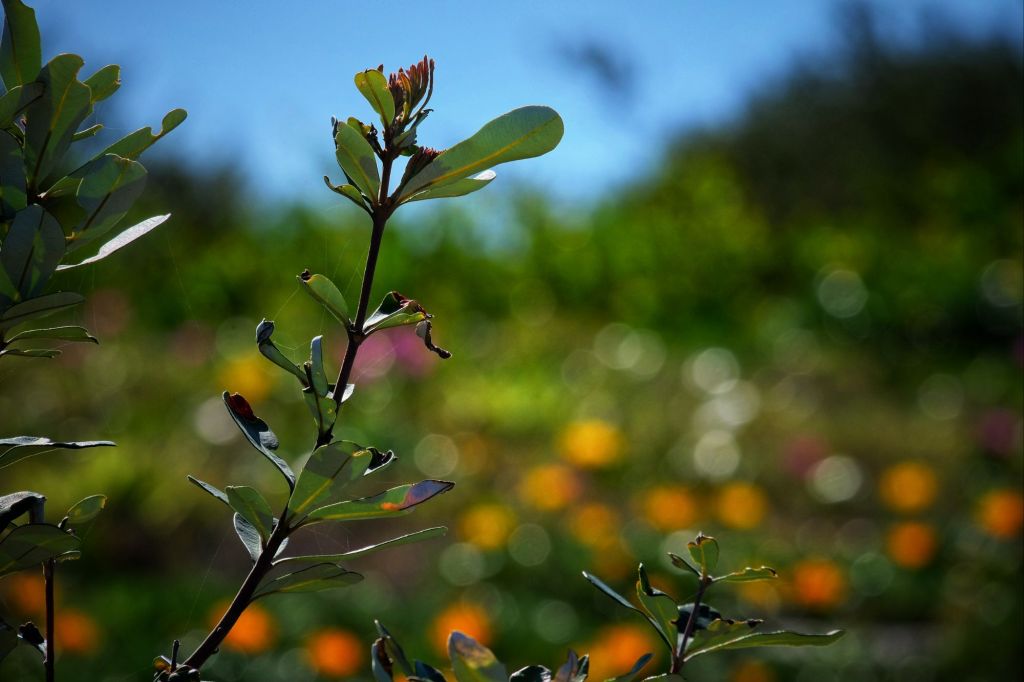
Reaching for freedom is what I called this photograph that I made today. But, is it really? I mean is the plant actually in reality ‘reaching for freedom’?
Well, thus far, science can only tell us something like: This plant is programmed by its DNA to grow upwards towards the light.
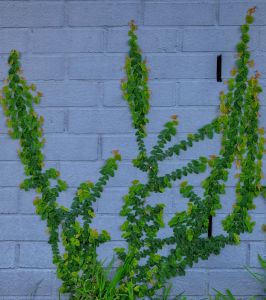
Another climbing plant, in another place. Kind of looks like a painting, but it’s real
True, of course, but, here in this scene, that one shoot in the centre does appear to be reaching for the chair leg – perhaps for support? It’s quite common for me to see plants using all kinds of supports to do their upward growing (think Ivy on a wall). I think that in a few weeks, that tiny shoot might just be half way up that chair leg – or maybe higher!
So, as I came across this little scene, I questioned. No, questioned isn’t the right word. When I saw this reaching happening only a day after placing that plant pot in that spot, I made a declarative statement: I said, ‘There is an intelligence at work here.’
Am I saying that this little plant has a brain that is continually figuring out strategies for the plant’s growth and other behaviours?
Am I saying that there is a ‘god’ up there in some heavenly domain who is in charge of getting plants down here on Earth to grow in the right direction?
No, to both questions. I don’t and can’t accept either of these supposed ‘possibilities’.
But, are there some kind of universal laws that regulate and control how the Universe flows, behaves, evolves and the rest? More likely I think.
Again I am not suggesting there is some kind of controlling ‘entity’ separate from the material universe, or a supercomputer somewhere that’s running the whole thing. More a kind of energy or essence that’s built into all material things, and that is an element of the very existence of things.
A regulatory principle, I guess you could call it. But not some imposed or externally dictated regulations, laws, or controls. I think it’s more natural than that: existence is its own regulator and controller. Or so it seems to me in my good moments – such as when I witnessed this unfolding and evolving life drama.
Along with many other spiritual seekers across many world cultures and over time as well, I have a more or less daily practice of opening a spiritual book, scripture, or other text ‘at random’ (as if there is such a thing) to receive a message, a lesson, or a little bit of guidance for the day.
In my case, that text has for ages now been the Bhagavad Gita. And over I think the last two or three years, one verse in particular has come up time and again, sometimes on two or three days in a row.
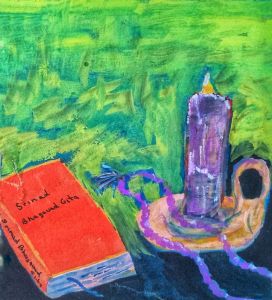
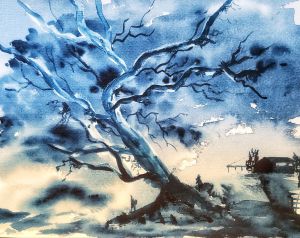
Much thanks to the Hermit Pilgrim who created this beautiful painting
So frequently has this occured that not only have I neglected to examine the verse in any depth, I actually began to ignore it when it came up and went right away to pick another one at random.
Well, this morning, I opened my Gita and there was that verse again – for the second day in a row. However, today, for some reason, I realised that this verse has been calling out to me. Or put it more sensibly: the Divine has been calling on me to take some notice of this verse and its meaning.
So, first of all, allow me to share with you the verse in question.
The Lord of Sri said:
It is said there is an eternal Banyan tree with its roots growing upwards and branches downwards, whose leaves are the Vedic hymns. One who knows this tree knows the Vedas
For me at least, this verse has always appeared quite complicated, complex really, and full of symbolism. Of course, being from an ancient religious text, it’s likely to be all those things isn’t it?
Still, despite reading the verse many times and studying and hearing a few commentaries on it, for some reason it has remained for me rather daunting. At least I can say that I was convinced of the notion that this verse confused me, entangling me in convoluted and sometimes upside down thinking.
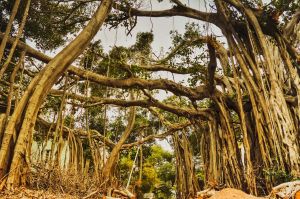
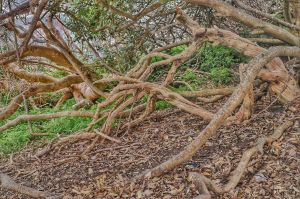
Like the Banyan tree itself I guess. Considered especially sacred among all other sacred trees in India, the Banyan is well known for its way of growing willy nilly, every which way, until the whole thing becomes a complete and dense tangle.
And it is this tangle that is at the heart of the metaphor used to illustrate the lesson in this chapter of the Bhagavad Gita: The tree is Samsara, the illusion that is the material universe in which all of us living beings are entangled. It’s as if we’ve walked into that tangle of branches and roots believing that’s where we will achieve our desires.
A major city in the middle of tourist season is another neat metaphor for this tangle we’re talking about. We look for worldly pleasures there, but find chaos, confusion, and often unhappiness
We are so attached that we identify completely with that physical world (convinced we are merely physical beings ourselves) and are convinced that this is where we can fulfill all our needs.
As the verse says, the leaves of the tree are the Vedas, and one who knows the tree, knows the Vedas. The Vedas are the sacred Hindu scriptures which in this context can be said to represent knowledge. But not knowledge of a mundane ‘ordinary’ kind.
The knowledge to realise (because we already possess this knowledge, we just aren’t aware of it yet) is that we are not the body, so we have no need to be bound to the tree of Samsara with its suffering and its endless entanglements. It is Self Knowledge.
This Self Knowledge leads us to develop what a following verse calls ‘the weapon of detachment’ with which we can chop down this very strong tree of attachments and illusions
A little note: I don’t like this weapon and chopping metaphor at all. I simply pass it on to you as written.
As we begin and progress with this process of truly realizing we aren’t the body, and therefore have no need to identify with or be attached to worldly objects and desires, then slowly the tangle binding us begins to clear, to fall away bit by bit.
I din’t think we need to actually get to that point of cutting down the whole tree before we begin to see results. to reap the benefits if you want to put it that way.
Each and every small thing, desire, compulsion or aversion we no longer feel ourselves bound to, frees us just that much more.
As with any tangle we get ourselves caught up in, once we loosen that first thread (to switch metaphors), the task of unravelling becomes easier.
It’s true – and I think I’ve mentioned it previously – some of my attachments and compulsions are loosening. Some (small ones I admit) have fallen away completely.
As you read in my little note, I’m not comfortable with the whole cutting down trees with weapons metaphor. Perhaps the loosening of threads, the unravelling of tangles and knots sits better with us.
Perhaps my – our? – efforts at detaching from the desires and aversions, from the compulsions for worldly things and objects, and for sense pleasures, can be achieved by a more gentle untying we could call it. A kinder, gentler, calmer, friendlier, means to realizing we are already free.
Japa, or the chanting of the names of God or the Divine, is a central spiritual practice for me. In fact, as time goes by, it becomes even more important for me as I try to spend more time chanting than not!
With Japa in mind I climbed yesterday to the crest of the sand dune on which our current hermitage is situated, to spend a while with the sea and the dunefield flowers, the birds, and as I planned to be doing some chanting, also with those unseen aspects of the Divine that I would be addressing with my words.
As seems to be happening quite often these days when I immerse myself in the beauty that is to be found all around me, all that is to be seen and experienced ‘up there’ as it’s come to be called, a poem wrote itself about yesterday’s particular excursion and experience.
I share it with you now in the hope you will enjoy reading it; thank you for reading it!
Perched upon the crest of a sand dune, I chant the names of the Lord Hare Krishna Hare Krishna Hare Rama Hare Rama
I am still; the Lord’s names vibrate in my mind. But Varuna’s energy washes saltwater back and forth in the middle distance. Sea waves manifest from depths unknown. Sea waves dissolve on the shore in the middle distance.
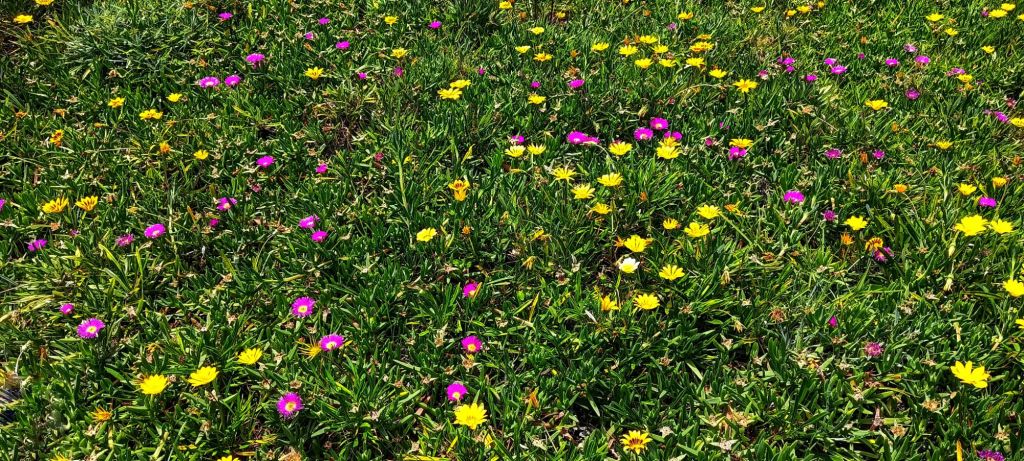
Now, in the near distance, near to me where I rest and chant on sacred ground, flowers with yellow heads, purple heads, wave in the wind as if ecstatically dancing to a holy Kirtan gifted them by the wind.
These myriad jewels in the dunefield join me in my japa. Or is it that I merge with their sacred dances?
It’s neither, and yet it’s both: The beautiful blooms are me, and I am them. We are the One, Chanting and dancing the names of the One.
Welcome to another installment in our occasional series (see links to all previous installments at the end of this post) looking at some of the answers given by Krishna to his cousin Uddhava during a kind of Q&A session that takes place as both are about to leave their hometown which is on the brink of war. Krishna’s returning to Heaven, while Uddhava is heading for parts – and a future – unknown.
Hence all the questions around living a good true life, all driven by the knowledge that Krishna isn’t going to be around anymore to give Uddhava life advice.
And the question we’re discussing today is certainly a big one. In fact, though it is a single part of a three part question, I felt inclined to give it our full attention. To me it is that significant. In fact, thinking about it now, I could even add here that of all the questions and answers, this one could stand alone as the question, the answer.
To the question then, as asked by Uddhava to Krishna:
What is Charity?
Well, although I thought I knew what the word charity meant, and what charity is, I did end up looking it up, just to get a clearer and deeper picture.
Yes, a charity is an organization set up to give aid to those in need. And, as I also knew, charity is the voluntary giving of help – often in the form of money or other material goods – to those in need.
All just as I’d thought. But, then, I came across another entry that filled out the picture for me a little more. In addition to the above, this listing told me that the ‘true meaning‘ of charity is generosity and helpfulness.
Again, it specifies that this generosity, this helpfullness, is usually extended to the ‘suffering and needy’. Still it suggests that charity may be at least a little more universal an attitude toward functioning in the world, a world shared with so many other living beings.
(note from me: This latter definition comes from the Merriam-Webster Dictionary. I’ve used this dictionary a great deal, and for very many years. It’s been my favourite go to, as they say.
PRESS THE PAUSE BUTTON PLEASE
Right, yes, I hear you loud and clear. Here I am going on as if this is a semantics blog. Sorry about that. Perhaps we should get back on track and allow Krishna to give the answer Uddhava and the rest of us have been waiting for:
Charity is the renunciation of aggression.
Perhaps you can see why I was at first a bit taken by surprise, and I puzzled over it for a while. Then after seeing that Merriam-Webster definition, I knew I’d found a clue: generosity and helpfullness.
Then it came to me: Ahimsa!! No, this is not some obscure exclamation reserved for Eureka! moments. Rather Ahimsa is a foundational principle underpinning many of the great religious traditions of India.
For me, Ahimsa is basically doing no harm, the practice of non-violence towards all living beings, through one’s thoughts, words (speech), attitudes, actions.
However because life is complicated (ie: there are no easy answers), various schools of thought over time have developed a kind of modification in which they say that Ahimsa is choosing to tackle the complexities of our lives in the world in such a way that we do as little harm as possible.
But how, one might ask, can we expand those dictionary definitions to include Ahimsa? Well, as far as I’ve been able to think about it so far, I’d say that Krishna’s answer itself is the root that we can graft those definitions onto
Which is to say, renouncing aggression is that root, that foundation on which to base the cultivation of charity and a charitable attitude and manner in our relationship with ourselves, with all other beings, and with the planet (and the rest of the Universe too of course).
(By the way, thank you to my Partner Hermit for that word: charitable. Not that I didn’t already know the word, obviously, it’s just that at the time I just could not find it anywhere in my slow-moving brain!)
That open, generous, helpful, compassionate, patient, kind, thoughtful (oh let me count the applicable words!), that charitable demeanour and behaviours with which we engage with the world (and with ourselves) are the result of removing aggression from our thoughts, words, and deeds.
Actually, thinking about cause and effect, and effect and cause, for a second: the way towards that state of charity is the same. In other words the means and the end don’t only justify each other, they are each other. One thing.
Don’t be ready for fight or flight each time you communicate with your boss, or your spouse, or your child, or your parent. Or with anyone else in any situation you find yourself in.
Listen to and observe with patience, care, compassion, and your full attention, the needs of others. Don’t assume you know best. And include yourself in this paying attention.
Look before you leap. Stop, listen, think, pause, before jumping into any situation that needs understanding, calm, quiet and time to alleviate any possible confusions, or misunderstandings.
If you make a mistake (or is it when?), don’t be so hard (aggression?) on yourself. Be just as open, friendly, forgiving, patient and the rest, with you as you would like to be with everyone else.
As to ‘generosity and helpfullness to the needy and suffering’? Well, all living beings suffer simply in the act of living itself. We are all well aware of this. The degree and forms of this suffering (and the needs that cause the suffering) will always vary, but even so, they are inevitable.
There’s a small mantra or prayer, I often use to end other prayers or reading, that I’ve always liked a lot:
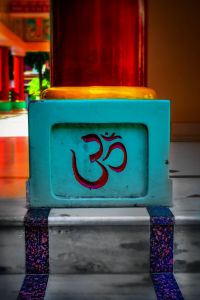
Om Shanti, Shanti, Shanti
I have always thought that this was simply a prayer to the Divine that included the repetition of the word for peace three times.
Of course it is that, but recently I heard that it’s structured in this way with the three repetitions to make of it a deeper or more universal prayer:
Shanti: Peace within myself Shanti: Peace to all living beings Shanti: Peace to the world itself
I may have the words slightly off, but the essence is there. Anyway, for me this really does sound like Charity.
If you’ve missed earlier posts in this series please click on the links below
With the current hermitage located not so much on the side of the road, as right on the side of a large sand dune system, you might imagine that I am at and on the beach every day.
While almost every day, I walk the track that follows the crest of the dunes in this particular area, I’ve only actually gone down to the beach itself a handful of times.
So, yesterday as start to my resolve to make amends for this omission, I climbed the dune, ignored the crest track leading left and right, and continued straight on and down the other side of the dune, and onto the beach itself. My intent was to spend an hour or so walking along the tide line.
And so it was.
Judging by such rare experience of the beach itself, I might easily say I am no ‘beachcomber’; no discoverer of coastal treasures, little natural beauties from the sea, or even the occasional oddity one might expect washed up. Until yesterday that is.
Not that I went to ‘comb’ the beach: rather I was there trying to put myself on the receiving end so to speak, to be a receptacle for what I might be blessed with (not to forget the need for exercise and movement).
And so it was.
This sense of grace and blessings, I hope I’ve conveyed in the small poetic effort (as well as its companion photo) that I now share with you.
SPOTTED ON THE SAND DUNE
Strolling (briskly mind you) along the sands, There I was – deep in the liminal zone. Ankle-deep – sometimes – seawater cooling my feet. One way to receive Varuna’s blessings.
Back on dry sands (still in the liminal zone) I pause to examine a spiral shell – an elegant and delicate sea creature. It lives. Reverently, I move it to deeper water.
As I rise from my small task of union, of reunion, I glance – still within the liminal zone – upwards. There, near the crest of the sand dune sits a chair. An armchair I spotted right there on the sand dune.
There it was, facing me – and the sea – in the middle of nowhere. Though this is clearly somewhere for somebody. The perfect perch for taking in Pacific views.
Empty chair, lonely sight overlooking the liminal zone.
A poem for your reading pleasure. Written on site today in response to an experience while out walking on the dunes next to the hermitage.
I’m including a photo I made a few weeks ago of the exact place where the poem was written,
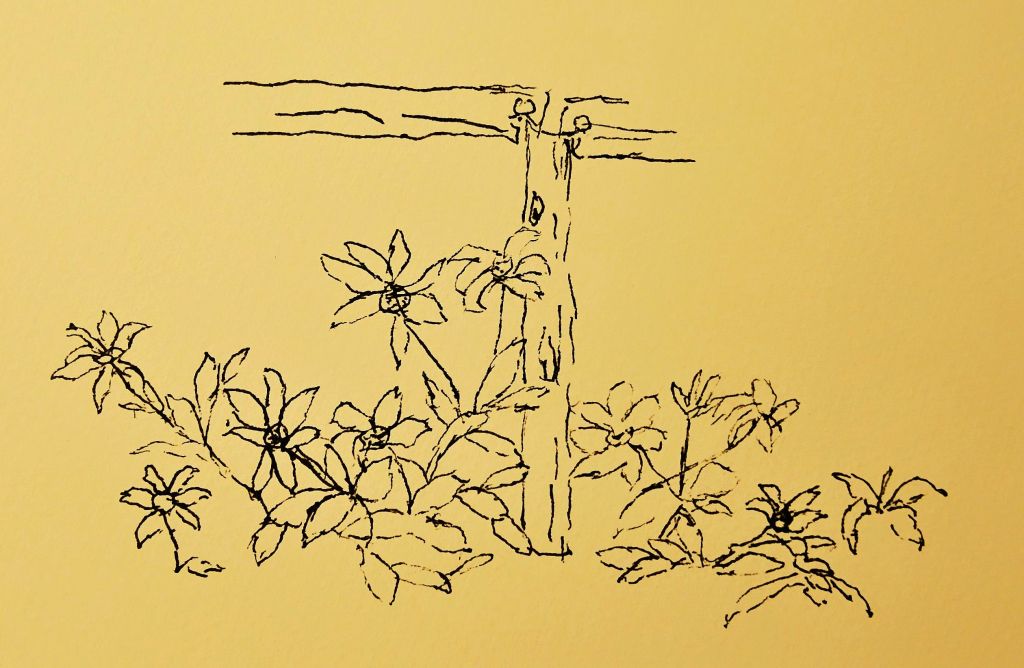
And many loving thanks to my partner hermit for the sketch made in the same area today (synchronistically it was made unknown to me and vica versa)
Please enjoy.
Love from Paul the Hermit
BRIGHT LIGHTS IN THE DUNEFIELDS
Today. On the Ocean Track. Daily hiking across the top of the dunefields. Not so sure-footed, I trudge heavy-footed.
As I pass by, there are bright lights in the dunefields. I pause in my passing as my eyes are drawn (or is it my heart?) to the bright lights in the dunefields.
I feast my senses upon the bright lights in the dunefields. They bless me, these bright lights. They sing to me; they speak to me.
In my silence, I hear them. But I hear not voices. I see them. But I see not colours, shapes or forms.
What I see, I see. I see me, I see you. They see me, the bright lights in the dunefields.
They see you; can you see them? These bright lights in the dunefields.
A recent favourite quote from my teacher, that is helping me a lot on my own spiritual journey. Wikipedia also describes Bhakti in terms of intense devotion, adding words such as faith, love, homage, worship.
The wonderful Wikipedia also tells us that Bhakti is a term common in Indian religions, which may refer to loving devotion towards a personal god, a formless god or an enlightened being such as Buddha. They add:
Bhakti is often a deeply emotional devotion based on relationship between the devotee and the object of devotion.
Then what of one (AKA me) who at least aspires to see all things – all living and non-living things, all of ‘creation’ – as the Divine? How does a ‘loving devotion’ towards God work when one is striving to fully realise that there is only the Divine?
In my heart I know that all there is is the Divine, or God. Or put another way: it’s not so much that the Divine is in everything, or that everything is divine; the sense I have and aspire to realize completely, is that everything is the Divine. One without a second, the teachers say.
(Just a quick disclaimer: my heart may be telling me that there is only the Divine, but the rest of me still has a lot of catching up to do)
So, how does it work? Well writing it down in words seems to make it sound very simple: if everything is the Divine, is God, then it’s simple logic to assume that devotion to the Divine means having loving devotion towards all and everything; for all of existence, for everything that is. For all of creation as some say.
Simple to say, yes. Not so easy to easy to actually attain such a state. Of course the first thing to say is that it isn’t a state to attain. I am a part (not quite the right word) of that creation, that divinity, and as there is only one without a second, then logic again tells us that I am that creation – just like you and everyone and everything else that exists.
As such, it would seem to be an easy matter of me simply loving myself which automatically includes everyone and everything else in the Universe in that love (note to self: make this little paragraph my new mantra).
Here is where that ‘thoughts and concerns’ thing comes in. We all know how our minds like to interfere and get involved with every little thing. The mind tries to convince us of our separation from other people and the rest of life too, while its ally the ego runs wild convincing us of the urgency of status, of possessing things, of competing (also status isn’t it?), acquiring more stuff and worldly knowledge and power.
The solution? The means to realize one’s love for all? Prayerful surrender – which our quote tells us is acquired through the practice of Bhakti or loving devotion.
But hold on: Isn’t the realisation of our love the very thing we want to achieve? So, we are to use a practice involving love to realize our love?
Ah yes: the means is the end. Now that’s a nice little insight don’t you think? But, still, Bhakti or loving devotion isn’t at all easy, even if you’re talking about a personal God or deity or the Divine; how much harder it is (speaking only for me here mind you) to suddenly love everyone and everything, to suddenly recognise everyone and everything as the Divine. Including, mind you, things and people I don’t like or have a distaste for or aversion towards.
So what I try to do is be open and receptive to things, ideas, concepts, other living beings, that resonate within me as representing the Divine. Then I make those things the objects of my devotion which means my prayers are prayed with a mood of love. Good vibes you see. They spread out like (my partner hermit says) ripples in a pond or even waves in the ocean. No need to think of who or what I don’t like; they’ll be affected by those ripples too.
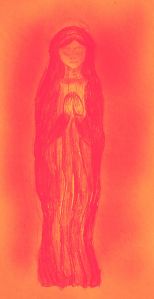
You’ve read my prayer to the Divine Mother – the embodiment of the Divine qualities of love, nurture, compassion. And soon I hope to post my Prayer of praise and gratitude to Trees. In that prayer I express my love, praise, respect for, and gratitude to, trees.
So many people – even the non-spiritual – view trees as symbols of creation in action, strength, resilience, even compassion and shelter. In other words, the Divine.
To surrender my heart to such representatives of the Divine is my continual effort and prayer. I pray to fully surrender to the natural order and smooth running of the universe, or the Divine.
And that surrender will come through my continuing and growing loving devotion.
Now, the ‘meditation is made possible’ bit? Well we all know what meditation means don’t we? Pretty much as many meanings as there are people meditating (and many who are not!). In this context I think the meditation that’s made possible is more a kind of contemplation leading to a clear comprehension or understanding.
Contemplation of the entirety of the Universe (which includes you obviously) as one whole, undivided expression of love or the Divine.
Comprehension is understanding, in a final, complete truly ‘knowing’ way, that the things of the world – the status, the possessions, wealth, sensual pleasures – are not and never can be the means to attaining perfect peace and happiness. Of course, the ‘things of the world’ continue to be important. After all, we are (at least our bodies and minds) things of the world too aren’t we?
But that contemplation of the totality as the Divine will help us to reduce our suffering by helping us to reduce our excessive desires or cravings for those worldly things.
I think I mentioned that Bhakti, loving devotion, can be difficult. It’s true it is often hard to focus on love and devotion, to always have your heart available and open. But, you know, it can actually be a very satisfying and enjoyable feeling, and I can say a really nice experience.
So, I hope some of the ripples (and some of the waves too), some of those good good vibes are making themselves known to you.



























 Notes from the Hermit's Cave