Just let go cries the winged messenger perched in the fence-corner tree. Let go. Just surrender. Surrender to what? The river of life, its flow, its vibe
Lord here I am, I cry in reply. Two beings, one Self.
Our post today is closely related to our last one. In fact, so close is the relationship, we can call them sibling posts, even twins.
Anyway to begin, I’d like to share one verse from a song I’ve loved and not loved for years. The song’s called You’re Just a Country Boy by Alison Krauss:
Never could afford a store bought ring with a sparklin’ diamond stone. All you can afford is a loving heart, the only thing you own.
It’s easy to start disliking this song right from reading the title: ‘Just‘? As in only? As in ‘Is that all you are?’. And ‘country boy’? What’s wrong with people – of whatever age or gender – who come from rural areas?
But, there is some to love as well: The lyrics are clever (cleverer than I’d thought, as you will see soon); the singer has a lovely and skilled voice that I like a lot; and there is a generally relaxed, easy listening kind of vibe to the whole tune.
Still, there is more to dislike: The song is addressed to said country boy, perhaps as well meant advice from a friend who is trying to let the country boy down easy as they say. ‘Get real my friend,’ she seems to be saying. ‘You have nothing that anyone wants. You’re poor, you’re from the country, and no way will anyone ever want you.’
The lyrics are like an affirmation or confirmation of what we know already: the world turns on material objects and money, and you aren’t anyone or going anywhere if you don’t have that stuff.
But, then on the other hand, there is much more to love. And this verse kind of sums it up. For the first time today, rereading the lyrics as I ate my lunch, I finally got it: it’s IRONY!
‘What?’ the lyrics seem to say. ‘You mean to say that the only thing you own is a loving heart? What use is that for goodness sake? Nobody wants that. Everyone wants money, jewels, and other material things’.
Well, I think I’d actually gotten it already; it’s just (there’s that troublesome little word again) that today is the first time the word itself came to mind. How ironic to come to the realisation of the irony of this song after all this time?
I like the use of the word afford. Clearly our country boy is broke, has no money, little material worth, and being a ‘country boy’ he obviously has limited prospects.
The irony is, of course, obvious: if one has a loving heart (or an awakened heart as we reflected on in our last post), what else do they need to be able to afford?
Our friend has most likely earned his loving heart over and over again anyway as he’s lived his life with its inevitable trials, tribulations, joys and sorrows. Riches galore right there. Afford? Of what value are material riches when one already possesses the most valuable asset to which a human being can aspire – a loving heart?
Just thought I’d look up the lyrics to another song I also quote from quite often. It’s also about that ‘all I have’ idea. The song is Words by the Bee Gees. These two lines I like:
It’s only words and words are all I have to take away your heart
Or, as I might reinterpret it: ‘I know these are only words, but they’re all I’ve got to try to speak to your heart from my heart’.
If I’m to dig deep, be honest, and all that, I would have to say that this idea has been a major guiding force in and for my life in one way or another – whether I’ve been conscious of it or not. As has been aspiring to a loving heart, though that aspiration has at times been bogged down in the mire of the mess of life.
Words are good and sacred, and I’ve always seemed to have a lot of them (it’s not the words that are at fault, it’s the one who uses or abuses them). Really, as I think about it now, all I want is to continue using them – words – to express what’s in this (aspirational) loving heart.
All I can afford is a loving heart.
PS Now I’ve actually truly and really seen the irony in the lyrics, maybe I don’t have to dislike this song quite so much
There would be some – including me – who would say that all human beings, and not just monks, need to learn to awaken their hearts, to cultivate attitudes and a life of love, compassion, empathy, and kindness.
Who would disagree with such a suggestion?
Well, I’ve already said that I am one of the ‘some’ who would welcome such an evolution in human consciousness. But, at the same time, I don’t want to make pronouncements, form judgements, hold opinions, on what anybody should do, or be like. Only me. I am only responsible for my own behaviours, attitudes, ideas, thoughts, speech, and the rest of how to live my life. I just can’t – as in I’m not entitled – to tell anyone else what to do, what to think, what to say and so on.
Actually I’d even speculate that Merton is in fact talking about just the one monk: himself; he’s not preaching a prescription for the behaviour of others.
I’ve read so much Merton that it’s impossible now for me to remember exactly where I read this statement of his, but I do know that when I first saw it and made a note, the concept resonated deeply for me as a great aspiration for my own life as a monk, and as a trying to be decent human being.
In other words, this monk – me, myself, and I – has a task to carry on with: to cultivate an awakened heart. And being a ‘great study’ it’s bound to be at least a lifetime’s project.
It’s an effort though, awakening one’s heart. It’s even a bit of a mystery at times what the phrase actually means in real terms.
Love, obviously, tops the list for any aspirant on the awakened heart path. And, yes, I do feel, express, and act out love – so deeply sometimes to the point of being overwhelmed or ‘flooded’; sometimes speechless (that’s the good bit), sometimes full of words.
But then there are times (oftentimes is the word) when that love is clouded or shrouded completely by angers and irritations, by regrets of what should be or shouldn’t be, could be or cant’t be, what isn’t.
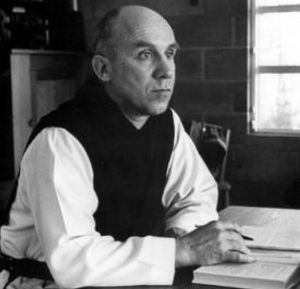
The great study of the monk is to have an awakened heart Thomas Merton
All attachments to what is not as I think it should be. All barriers to love. All ways and means of keeping the heart asleep – or at best semi-awake, and still sleepy: slow to respond, slow to act, and with ongoing blockages to seeing how things actually are.
The quest to acquire an awakened heart and the outpourings of love, kindness, gentleness, generosity, that such a state would allow, is probably at the root, the foundation, of my life as a hermit monk, of my life as a pilgrim journeying through and to Self.
Living quietly and simply; developing a contemplative way of being in the world while definitely being not of the world; cultivating silence, peace and calm; all are activities and attitudes directed at cultivating an awakened heart.
All that generosity, patience, love, kindness, empathy, and all the rest are definitely all characteristics of an awakened heart. Here’s my dilemma (only one among many that riddle my crazy monkey mind): they are also precisely the elements that need to be practised in order for one to acquire an awakened heart. What’s the expression? Catch 22?
Of course, it just occurs to me now, everything that is, is exactly as it’s meant to be, happening just as it ‘should’. So, in other words, all these words of reflection are simply a commentary on what has been and gone already, that which is in the past, and is no longer existing.
All that matters – all that exists – now is that at this moment, in its ongoingness, I am as loving, as kind, as patient, and as generous (not to forget compassionate, empathetic) as I’m able. To others obviously, as well as to myself.
All that wonderful list of characteristics of an awakened heart all exist right now within me. Perhaps I need to wake up my mind a bit more so I might see that reality. Then I might actually realise that I already have an awakened heart and that I simply got forgetful somewhere along the way.
There’s this funny little thing I do; it’s an odd little habit. On the face of it, at first glance, it’s not really anything to bother about. Just another little quirk that could easily be dismissed to add to my long list of such quirks.
Don’t laugh. I’ve had this habit for I have no idea how long, and I’ve been wanting for ages now to stop and think about it: why I do it? Can I stop it? You know the thing. Well, I’ve taken steps to try to change it, but still, I think it’s time to look at it properly.
You see, I am prone to holding my breath. Just to illustrate: as I held my pen poised about to write that last sentence: I held my breath. What directly prompted this renewed resolve to finaly get down to facing the facts, is that just a little earlier I’d made a cup of tea, and when I went to put it down on the table? Yes, I held my breath.
I’m likely to hold my breath (for a short moment) at any old time: Bend down to pick up a dropped pen? Hold the breath. Raise a forkful of food to my mouth? Hold my breath. Do one or any of my regular physical exercises? I have to really watch myself, otherwise I’d not breathe at all doing them.
All the time, and at any time, as I said. Why? Well, that’s the question isn’t it? I can kind of understand it as a pause, a way to summon up focus and physical energy before doing a task requiring much physical (or mental?) effort.
But that’s just a guess really. As you probably could imagine, I’ve never discussed breath holding issues with anyone else. Well, present company excepted.
Anyway, my guess doesn’t really tally with the lightweight activities, like my pen poising before a new sentence, or my breath suspending before taking a bite of food. Something else is at play here.
So, what is air? What is it good for exactly? Well, umm, it’s a gaseous combination of a whole heap of ‘stuff’, the key one for us here is oxygen. And, more or less obviously we mammals and other beings too, need oxygen to breathe – to keep breathing. In other words it’s the ideal means of staying alive.
I guess that’s why some traditions call air, not only an element, but a sacred element. Life giving, life sustaining – some call it the Life Force, or Prana. Of course these two terms encompass other elements and concepts, but air is pretty much a fundamental component of the whole eqaution.
Next question: If I know it to be the life force, that which keeps me alive, why would I choose to suspend breathing? No, after pausing here (and holding my breath briefly), I’ve concluded that I very much doubt that I’m trying through this little habit to curtail the flow of the Life Force, or Prana through my body.
So, specifically, what does air do in the body? Well, it fills the lungs, which then somehow get the oxygen into the bloodstream (the heart’s job?), which in turn carries that oxygen to the brain, other organs, and to the muscles. I hope you will forgive my over-reliance on such complex technical jargon.
Once again, I can’t see how holding my breath as I poise my pen, is intended to deprive my arm muscles – and my brain – of the fuel needed to help the pen do its work of putting words on paper.
Anxiety? Well, finally we might be getting somewhere at last. When we get a fright, or fear something, or watch scary stuff in a movie, we will often ‘hold our breath in suspense’.
Maybe that’s where the breath holding habit began for me. Not watching movies, but perhaps when confronted with anxiety making situations. Of course picking up a pen is hardly a cause for anxiety, though eating might be?
Well, maybe those ‘little things’ are where the habit became a habit, but now I’m starting to think this breath holding might be a habit without a cause.
At least no consistent cause or causes. Anyway, there’s no point to dredging the past to try to find out the why of the thing. What’s important and the only thing we can impact on is now; best to pay attention to here and now;
So, I suppose the conclusion is simple: Sometimes a quirky little habit is just that, a quirky little habit.
PS A habit to be done away with mind you. Time for some little reconditioning of myself. I’d prefer not to hold my breath while writing notes, while eating, or while doing my exercises – or when doing anything else for that matter. The brain, the digestion, the muscles – this entire being – needs oxygen, and it’s my job to make sure that it flows freely and easily to everywhere it’s needed.
In my last post, I spent some time contemplating a question:
If I’m actually praying a prayer, how could it even occur to me that I might in fact not be praying, but instead simply be reading the words of the prayer? (substitute here ‘reciting the words of the prayer in rote fashion’)
Well, for today’s post I have a poetic offering which I composed several days ago. It’s actually words of my own built around – embracing even – an already existing prayer: the Mahā-mantra, which is better known as the Hare Krishna mantra.
While making notes for that post, my mind at one point drifted to that poem. So, after finally publishing the post, I reread the poem a few times.
It struck me that, rather than creating a simple poem, I had instead composed another and distinct prayer of my own, which incorporates the Mantra. That was a revelation to me.
It’s a poem, no a prayer, of gratitude. And of praise also. It has a structure and a cadence that has me sensing that it is a prayer to be prayed, and not simply a poem to be read as words on a page – or screen.
It is with that gratitude and with love that I humbly offer these words – this prayer – to you.
TAKE THE LORD’S NAMES
‘Going to chant for a while’. Hare Krishna A refrain often heard Hare Krishna Here in this place Krishna Krishna In this hermitage Hare Hare In this place of abode of hermits Hare Rama In this paradise for hermits Hare Rama In this place of refuge Rama Rama In this safe haven Hare Hare Where we servants serve Hare Krishna
‘I’ll carry on with my Gita then,’ I said to my partner hermit after we’d been discussing something for a while.
‘I’m enjoying reading my prayers this morning. So I’ll read a few more then read a few verses’ (of the Bhagavad Gita).
‘Reading’ my prayers? Is that what I’m doing? Surely a prayer – prayers – are for praying? Anyway, not simply for ‘reading’.
Of course in this particular instance, the forms the prayers are taking – on the most superficial, worldly, material level – are as words written by human hand (mine) on paper pages in a little book.
But, right now, the big question, the existential question really, is have I been merely reading those prayers? Or have I been praying those prayers?
Then there’s another, equally existential, concern that arises: How to know the difference. Reading? Or praying?
I feel like saying that the first thought that comes to mind – the first answer to reach the tip of my pen on this page – is this: Actually, the answer has come in the form of a rhetorical question:
If a prayer is prayed, how would it ever even occur to me query if it is in fact a prayer, and not just words on a page to be read?
Yes, first thought best thought here I think. When a prayer is prayed, even if its form is words written on a page, there is a movement beyond those words on the page. In fact, there is a transcendence of all that is of the material world that takes place.
A prayer is what it’s always been: a prayer. The forms prayers take are, I think, literally endless, uncountable, and can never be submitted to categorisation by us humans.
Prayer is for praying, that’s the lesson for me. Just pray.
You know, for all my prayers; for all my mental discipline – efforts at mental discipline – for all my meditations, chanting, and other practices, I still just talk way too much for my liking, and often it feels like it’s only talking for the sake of talking.
I still just open my mouth and let come out any old thing that keeps the noise going. Oh, it’s worse than that: sometimes when I talk it’s rambling and waffling that I cleverly (or not so cleverly) disguise as intelligent, rational, and based logically on knowledge that I either have or haven’t got. Either way, I somehow seem to think I’m offering words of well thought out wisdom.
Whereas, as I said, the noise I make is so often rambling, contradictory , ill-informed, thoughtless waffle.
Enough! Blimey, that’s enough. Talk about opening a post on a calm, relaxed, optimistic, and compassionate note.
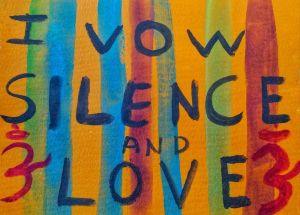
Here’s the thing: I want to devote my entire life to devotion and prayer. And that requires at least some silence. Yet, instead, I merely talk about the joys of silence, about the joys of full-on devotion to the divine, and as well I occupy so much time and energy to just voicing random thoughts that come and go, go and come, without rhyme, without reason.
Okay, here’s the second thing: I long with my deepest longing to be silent – to not simply stop talking, though that would be an excellent beginning. No, I want to be quiet; I want my vocal chords to have a break and let my true voice speak through my life, through this blog, my photographs and in whatever way I am lead.
So, what to do? Well, here’s the third thing, thing number three: all I need to do in order to both stop talking so much and be silent is to just sit. Sit and do nothing. There is no thing that I can do that will magically turn me into an oasis of silence and peaceful calm.
Sometime in the dim distant path I read someone paraphrasing The fouth Noble Truth in two words, Just sit. Buddha did indeed know what he was talking about. And I do get the irony: when I talk, I need to say something that helps, not just make noise and try to avoid silence.
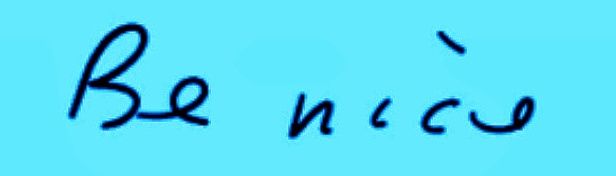
Scrawled in the margin of a page in my notebook are two words: Be nice. Nothing else on the page to suggest a context, source, or inspiration. But, here’s the interesting thing: Just below those two lonely words, and in brackets, I’ve written:
Do nice, Consume nice, Share Nice.
Most likely we’ll never know what prompted me to write that particular series of words. I mean, they’re not exactly new ideas are they? Still, discovering (or is it rediscovering) them today, I thought that, while not original, they do present us with a neat little package of behaviours, attitudes and actions; a perspective or way of looking at things that might just help us (or I should say me) along the road to spiritual growth, for being better, doing better; oops! You get the idea.
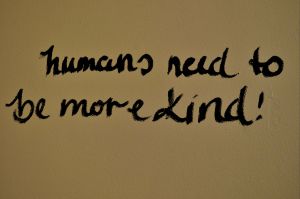
Be nice. All of us long to be nice to others, to family, friends, work colleagues, strangers, the world as a whole. Some of us would even feel better if we could only be nice to ourselves now and again.
Speak softly, go slowly in my interactions with others – loved ones or strangers, it doesn’t matter. While we all wish for others to be nice to us, we are all very aware that life doesn’t always work that way. But at the very least if we can be nice in every situation, then it’s better for everyone.
So, when slighted by another, spoken to with a loud or aggressive voice, or in some other way treated ‘not so nicely’, pause. Breathe. Then with confidence in yourself and what you have to say or do, be nice to that other.
Smile (when you can and it’s appropriate), be calm, assertive, but stay nice.
As to being nice to Self. Well, I’m trying to give up the negative self talk, and the self critical thoughts, as well as not so nice thoughts about other people or situations. Being nice to others is also an act of niceness to ourselves. We feel good when we’re nice to others (and bad when we’re not so nice to others).
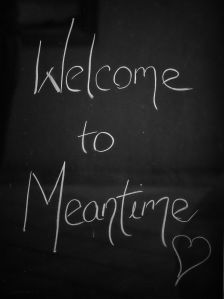
Meantime is so Yesterday. Make it Nicetime today!
Do nice
The verb do suggests doing; taking action. Do nice things for others – and for Self also. Sometimes it’s easy to do nice things for others, sometimes not so easy. Still, as with everything, it is the efforts we make that are the key: remember, nice makes nice.
Anyway, we’re all familiar with the brilliant (genius really) Random Acts of Kindness concept and movement. It’s a truly revolutionary idea that’s rightly spread far and wide and has become an integral aspcet of everyday life for many many people. Really any act of kindness, random or otherwise, is another way to describe doing nice.
And, once again, we shouldn’t forget about ourselves. Doing nice things for ourselves lifts our spirits, changes moods, enriches our lives overall. Don’t forget that doing nice things for others is just one more way we can do something nice for ourselves.
Consume nice. What am I putting into my body? What am I looking at, listening to, reading, buying – what am I consuming? How much of this consumption can I label as nice? How much of it is of benefit to myself or to any or all other beings, or to Earth herself?
And, the flip side of that question: Of all that I consume, how much is doing harm, again to myself, other beings, the planet itself?
Heaps, if you’re anything like me. I am engaged in constant struggle to change my habits of consumption. As I make these efforts, fight these battles with old old habits (I think I talked about this in a recent post?), I remind myself to be kind to myself when I fail to make forward steps – and just as or more often when I take a step (or two, or…)backwards.
Share nice. This one’s easy: reread all of the above. Well, okay, maybe there’s a little more to it than that. Actually, isn’t there an old aphorism that we’re all supposed to have heard in kindergarten? ‘Share nicely‘? I guess back then it was about sharing toys and other playthings with the other kids.
Now we are all grown ups, it means, well much the same really. If you have been blessed with material prosperity, be free with the way you share that good fortune. Be free and generous with how, and with whom, you share that wealth with.
Equally, no it’s not equally at all; it’s way more important and significant. Share your time; share your skills; share your knowledge; share your experience. The best thing of all to share – the nicest thing – is your love.
Love works well, not only with those close to us, those we call loved ones. Love can be shared in all our interactions with the world, whether it’s family, friends, work colleagues, or with strangers we encounter as we go about our day-to-day lives.
Share nicely of course isn’t only about what you share; it’s also about how we share. Share with a nice attitude. We’re right back where we started, be nice. Approach all with an attitude of love, generosity, and kindness.
So, how does all this nice stuff contribute to our spiritual growth?
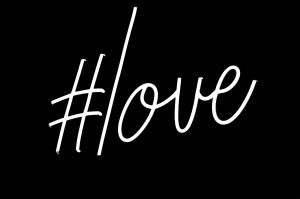
The Greatest Hashtag of Them All
Well, I think as we’ve just seen, nice equals love. I feel that having nice – love – as the foundation of our being, doing, consuming and sharing, helps us move forward on the path to the realisation that happiness does not come from outside of ourselves – and certainly not from material things like money, possessions, and the like.
Nice can really only start with me – with you. From within my own Self, which in truth is non-different than your own Self.
There is a beautiful – truly beautiful – expression that has become an empty, flavourless, hollow, meaningless platitude. I’d like to rehabilitate that expression right now.
I want to say with my heart and my love, to all of you:
Today, once again, I would like to share with you some thoughts and insights on a quote I have written in the front of my Bhagavad Gita. Yes, I know, I do this quite frequently, but there really is a good reason.
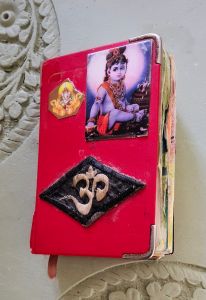
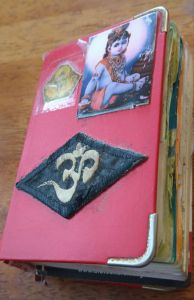
You see, for me, this particular Bhagavad Gita, this little book (and it is a little book: 10 x 7cm but still a little fat too!) is so much more than a collection of bits of paper with words printed on them inside a nice cover.
Well, it is a book, so of course it is that as well. But for me it is more a repository of wisdom. It is actually the first scripture or holy book of any kind that I have spent years studying. And over those years I have devoted who knows how much time, energy, heart and mind to it. As for how many times I’ve read it cover to cover, well I don’t keep count!
This Bhagavad Gita is truly a treasure trove that enriches me and my life every time I open it.
Anyway, enough of the praise and gratitude intro. Allow me to share the verse (in fact it’s a part of a verse) with you:
… restrain your senses and focus your entire mind on me. Bhagavad Gita 2:61
Let me try to explain why this verse – and this particular portion of the verse – is like a kind of motto or mission statement for my life. Well, to be honest, It’s one among a whole collection, but this one for me seems to especially significant.
It is through and only through, the senses that we are able to experience the world. In addition to the traditional five senses (sight, smell, hearing, taste, and touch) here we include the mind. This sixth sense includes all the activities of the mind.
When you think about it, the mind is really our major sense organ, in that it is in the mind that imput from our other senses comes together in such a way that allows us to perceive and experience the world around us as a coherent whole.
Then of course, the mind being a sense organ in its own right, does its share of providing us with imput in the form of thoughts and emotions. The problem arises when we let the mind have its way and we hand over control of our senses to our mind (and also we let our other senses free rein to control the mind) completely or at least in ways that might not be in our best interests.
So, if we are to restrain our senses – all of them – what are we to do? Well, rather than getting into a long rave with a big list of what we should do, why don’t I simply talk about some of the ways in which I try to put into practice, the injunction to restrain the senses.
The Eyes of the Teacher
First, a disclaimer : I’m still in a human body. Meaning that I’ve been struggling with my senses for a long long time. And it means the struggle continues, just as it does with all of us. It’s the effort, though, that is the real key: to restrain the senses we might easily add retrain the senses including the mind.
For so much of my life I was careless about what I put into my body by way of my sense of taste. Food, I was not very controlled when it came to what, when and how I ate. I’ve been vegetarian for about 40 years and vegan for at least the last ten years. But until the last few years (and I still struggle now) that didn’t stop me from going for the tasty stuff – meaning the fatty and sugary things that can (and do) cause great harm, as they did to me.
Now, strictly vegan as I said, I never add sugar (okay one in coffee on very rare occasions), there’s no cooking with oils, and eating as little processed foods as is possible. Simple food too, simply cooked, with just a few spices. Surprisingly (to myself at least) I always have enough taste sensations to satisfy.
As to what I consume via the senses of sight and hearing, there is only so much that one can do unless one lives in a remote desert or mountain cave. Which, of course, some people do for this exact reason – to control and limit what they consume or are exposed to. Still, I don’t watch, listen to, or read news of any kind.
Like many people I watch videos on the Internet. While there is a massive amount of brilliant content available, it is hard to sift through inappropriate suggested videos, impossible to avoid advertising, and even the news sneaks through quite often. For a while now I’ve been on the brink of deleting online video viewing platforms, but I’m not quite there yet. Soon.
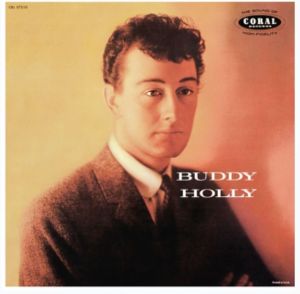
Give up listening to Buddy Holly??? That’ll be the day!
As for music, I’ve gathered a large collection over the years. Lately however I’m finding that I’m not wanting to listen to much of the music I have. Why? Well, I think as I’ve meditated more, studied, contemplated more, I’m slowly beginning to exert some discipline over my mind making me more sensitive to what my senses pick up.
It seems to me that more and more of the music and songs I’ve loved and listened to my whole life are about dark themes and subjects, about emotions made petty, and sometimes songs or tunes just feel plain and simply nasty.
I’m content with this outcome and curious to see where it leads. As with videos, TV or the news, so much of the music I listened to does’t speak of Truth, at least for me.
With a view to control visual and audio imput, I try to live in as quiet an environment as possible. As we all know, these days this is becoming more and more difficult, perhaps even for those who can retreat to the desert cave! And we have a saying in the hermitage about just this issue: Something’s gotta give! Meaning of course that the time is right for radical thinking and action to be taken in the search for silence.
Which leads me to mind – my mind anyway. Like yours, my mind is a raging torrent of often repetitive thoughts going in all directions (or none) and very often without any kind of rhyme or reason.
But, through the above efforts at discipling the other senses, I do have some control, not much, but… . Through an increasing amount of time and effort spent on meditation and engaging mindfully in all my actions as much as I can, I think I am at least giving myself (my mind that is) some control over the other senses, my thoughts, and all that mental chaos.
Now, what does it mean, ‘focus your entire mind on me’? Well, this is a question that you will find asked and answered given in numerous books, blogs, and in many other places. But, for me, and to sum it up in the one sentence, it’s about focusing all my senses (including mind) on what is of the good, what is right, what speaks of truth, love, and is for the betterment of all beings.
I mentioned that our quote is only a part of a verse. Here’s the whole thing:
In order to attain steady wisdom {knowledge of the true nature of Self and the world} restrain your senses and focus your entire mind on me. Bhagavad Gita 2:61
Self Enquiry is the means to acquire Self Knowledge which leads to real wisdom
It is this wisdom, or at least the efforts we make at acquiring it, that is the way to a happier, freer life. At least that’s my take on it all. Peace
These last few days I’ve been researching and thinking about an idea for a blog post. But I’ve come to realise that I am grossly underqualified to write about the topic I had in mind. Let me put it another way: I am completely and utterly unqualified in any way whatsoever to go there. In fact, after all the research, I think I’m going to disqualify myself from ever going there in writing.
However, I’m a great believer in the idea that no quest for knowledge is ever a waste of time or effort; there is always something to be learned. During my research I came across a topic I believe I am qualified to discuss, as it forms an integral and vital part of my own personal spiritual practice.
Why I’ve decided to write this post, though, is because I made a discovery that lead to an insight that I know will lead to a great progress in that practice. It’s nothing new, not really, but it was one of those occasions we’ve all experienced of ‘I knew that, but now I really know it.’ For me, it was a realisation of something that till then had been a nice cosy theory and belief.
Bhakti Yoga is that practice. It is really a key foundation, a valuable component of my spiritual life.
Wikipedia opens its entry on Bhakti Yoga (see the link just above) with a description of the practice that mirrors what I think is the traditional understanding of Bhakti Yoga:
Bhakti Yoga (also called Bhakti Marga, literally the path of Bhakti) is a spiritual path or practice within Hinduism focused on loving devotion towards any personal deity.
In the same entry there is a description of the origins and meanings of the two words, Bhakti and Yoga:
The Sanskrit word Bhakti is derived from the root bhaj, which means “divide, share, partake, participate, to belong to”. The word also means ‘attachment, devotion to, fondness for, homage, faith or love, worship, piety to something as a spiritual, religious principle or means of salvation’.
The term Yoga literally means “union, yoke”, and in this context connotes a path or practice for ‘salvation, liberation’. yoga referred to here is the ‘joining together, union’ of one’s Atman (true self) with the concept of Supreme Brahman (true reality).
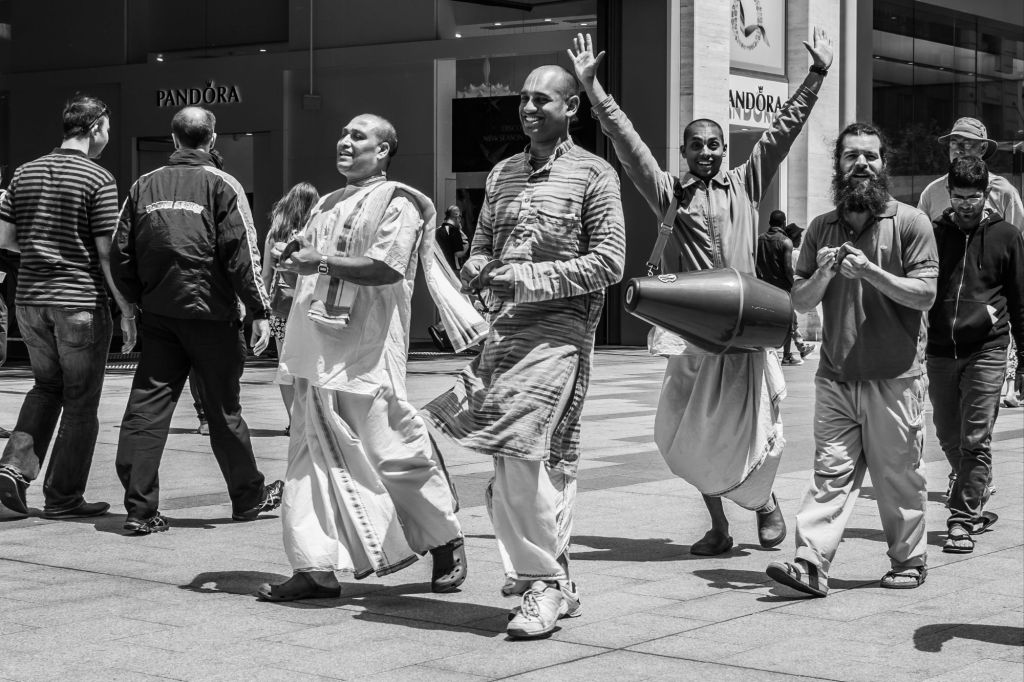
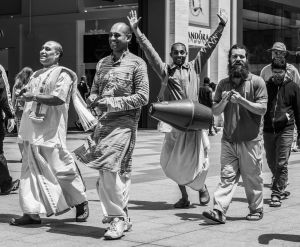
For some, dancing while chanting the names of their God, demonstrates their devotion and celebrates their union with each other and with God
In other words, those called to a religious or spiritual life, practise Bhakti Yoga whenever they pray or otherwise express devotion towards their personal conception of God, or the Divine. This particular definition seems to be saying that such a conception of the Divine, or God, is in the form of a personal deity who is a kind of representative of true reality, which the devotee is aspiring to join with.
Some Bhakta Yogis are full-time, full-on practitioners. People like contemplative nuns or monks, hermits who retire from the world into seclusion. Anyone basically whose entire life and activities are spent in devotion.
So, when I discovered all this, I became intrigued; I decided to go off on a tangent and explore the word Bhakti itself. Wikipedia has a separate entry for the word on its own:
Bhakti is a term common in Indian religions which means attachment, fondness for, devotion to, trust, homage, worship, piety, faith, or love. In Indian religions, it may refer to loving devotion for a personal God
…
is often a deeply emotional devotion based on a relationship between a devotee and the object of devotion.
…
In ancient texts the term simply means participation, devotion and love for any endeavor.
May refer to devotion to a personal god? While I thought this entry doesn’t contradict our first quote above, it does seem to broaden, and deepen, the meaning of Bhakti. Expand might be the better word.
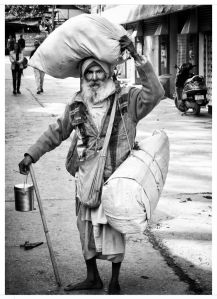
In some traditions a simple life on the road is a way to commit full time to Bhakti or devotion.
It struck me that that object of devotion might be anything. Or even everything. You see? I told you it wasn’t a new idea. It’s just that it’s resonated deeply within me now. It appears that the object of Bhakti Yoga practice doesn’t necessarily have to be a ‘personal god’.
Many many people would say ‘I like animals’ or ‘I think we should save the world’. But, while that may imply a kind of love for or at least a fondness for, I think Bhakti is something more – actually several somethings more!
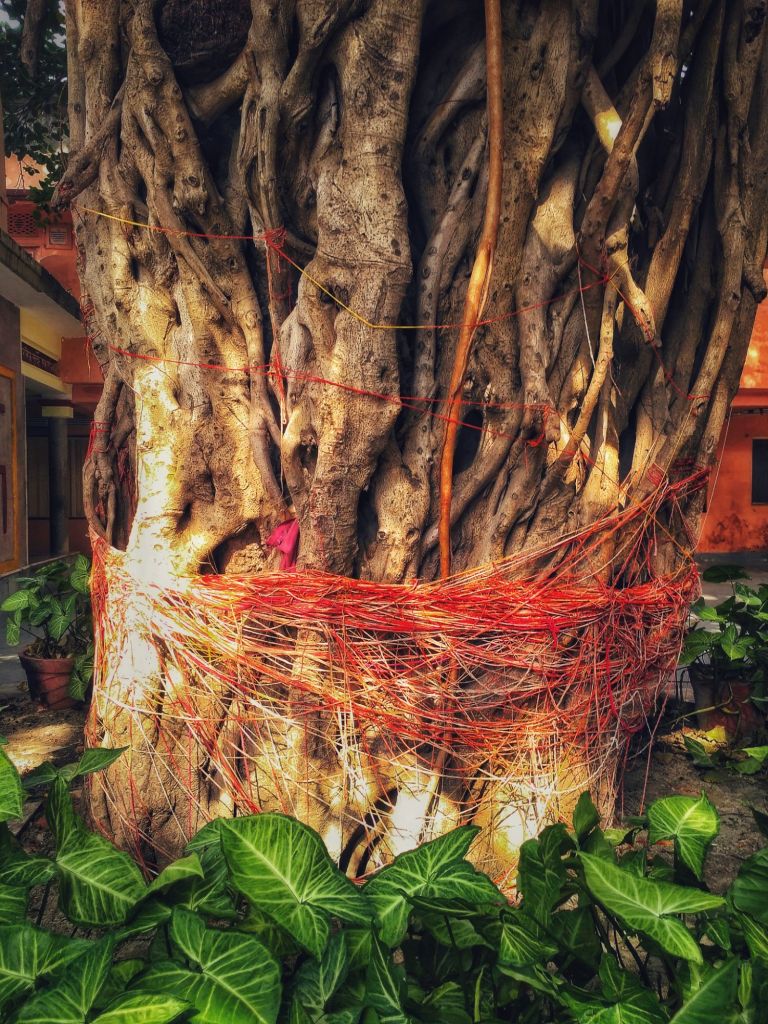
For example, some people have a particular attraction to and love for, the ocean, or it might be a river they view as, if not sacred in a religious sense, then as special to them in some deep, comforting, even therapeutic way. Others have similar relationships with and feelings for trees, or even a particular tree.
Animals as either individuals or as a species or group, can have the same appeal and call to other people. Then there are those who feel strongly in their hearts you could say, that Earth itself is a sacred object, or others have a knowing that the planet is a living entity and worthy of our devotion.
Bhakti begins with love and devotion, which is about caring for, affection towards, loyalty to, emotional engagement with the object of devotion. But even more than that, there is faith in that object of devotion; faith as in trust, confidence that the love is real, that the ‘relationship’ is sound and real.
Homage and worship too are key aspects of Bhakti. The deep inner feeling we have towards a thing, person, or other being, that is beyond what we normally call ‘love’. It’s about seeing and actually realizing ‘in our hearts’ our desire to be merged or united with that thing, person, or other being.
Actually, seeing that word other just now got me thinking. I had to go back and reread our definition of Yoga up there near the beginning. It says Yoga means ‘union, yoke’. It goes on to add: yoga refers to a ‘joining together, union’.
This passage seems to be suggesting that Yoga (in our case Bhakti Yoga) is both an already existing union, and a process of joining together to achieve union. One thing I would say here is that in my practice of Bhakti (and love as a general thing to strive for and be) it’s both.
Trees are special beings for many people from a whole variiety of cultures all over the world
But, in the end, it seems to me that the process or practice, the path of Bhakti, serves to awaken us, to assist us to acknowledge, recognise, and realise in that really knowing way, our pre-existent true nature.
That true essential nature can be said to be the reality of our oneness with all things, living and non-living. And their oneness with us too of course. In fact, by putting it that way, I’m saying there is only one, or oneness. What’s that expression? One without a second.
May you be a Bhakta Yogi. Or, perhaps you already are one?
Love and peace from Paul the Hermit
Life has manifested itself as the multitudinous forms that comprise the universe. It is the one Universal Life, Power or Shakti (the laws of the universe or natural laws) that controls, guides and actuates all movements and activities in all beings, creatures and things.



























 Notes from the Hermit's Cave