All I Can Afford is a Loving Heart

Our post today is closely related to our last one. In fact, so close is the relationship, we can call them sibling posts, even twins.

Anyway to begin, I’d like to share one verse from a song I’ve loved and not loved for years. The song’s called You’re Just a Country Boy by Alison Krauss:
Never could afford a store bought ring
with a sparklin’ diamond stone.
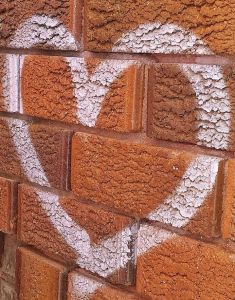
All you can afford is a loving heart,
the only thing you own.

It’s easy to start disliking this song right from reading the title: ‘Just‘? As in only? As in ‘Is that all you are?’. And ‘country boy’? What’s wrong with people – of whatever age or gender – who come from rural areas?

But, there is some to love as well: The lyrics are clever (cleverer than I’d thought, as you will see soon); the singer has a lovely and skilled voice that I like a lot; and there is a generally relaxed, easy listening kind of vibe to the whole tune.

Still, there is more to dislike: The song is addressed to said country boy, perhaps as well meant advice from a friend who is trying to let the country boy down easy as they say. ‘Get real my friend,’ she seems to be saying. ‘You have nothing that anyone wants. You’re poor, you’re from the country, and no way will anyone ever want you.’

The lyrics are like an affirmation or confirmation of what we know already: the world turns on material objects and money, and you aren’t anyone or going anywhere if you don’t have that stuff.

But, then on the other hand, there is much more to love. And this verse kind of sums it up. For the first time today, rereading the lyrics as I ate my lunch, I finally got it: it’s IRONY!
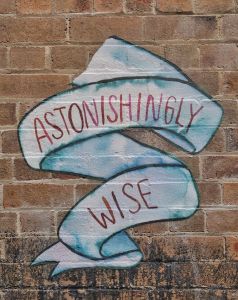
‘What?’ the lyrics seem to say. ‘You mean to say that the only thing you own is a loving heart? What use is that for goodness sake? Nobody wants that. Everyone wants money, jewels, and other material things’.

Well, I think I’d actually gotten it already; it’s just (there’s that troublesome little word again) that today is the first time the word itself came to mind. How ironic to come to the realisation of the irony of this song after all this time?

I like the use of the word afford. Clearly our country boy is broke, has no money, little material worth, and being a ‘country boy’ he obviously has limited prospects.

The irony is, of course, obvious: if one has a loving heart (or an awakened heart as we reflected on in our last post), what else do they need to be able to afford?

Our friend has most likely earned his loving heart over and over again anyway as he’s lived his life with its inevitable trials, tribulations, joys and sorrows. Riches galore right there. Afford? Of what value are material riches when one already possesses the most valuable asset to which a human being can aspire – a loving heart?

Just thought I’d look up the lyrics to another song I also quote from quite often. It’s also about that ‘all I have’ idea. The song is Words by the Bee Gees. These two lines I like:

It’s only words and words are all I have
to take away your heart

Or, as I might reinterpret it: ‘I know these are only words, but they’re all I’ve got to try to speak to your heart from my heart’.

If I’m to dig deep, be honest, and all that, I would have to say that this idea has been a major guiding force in and for my life in one way or another – whether I’ve been conscious of it or not. As has been aspiring to a loving heart, though that aspiration has at times been bogged down in the mire of the mess of life.

Words are good and sacred, and I’ve always seemed to have a lot of them (it’s not the words that are at fault, it’s the one who uses or abuses them). Really, as I think about it now, all I want is to continue using them – words – to express what’s in this (aspirational) loving heart.

All I can afford is a loving heart.
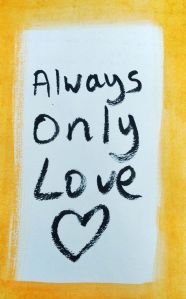
PS Now I’ve actually truly and really seen the irony in the lyrics, maybe I don’t have to dislike this song quite so much
How Shall I Live?

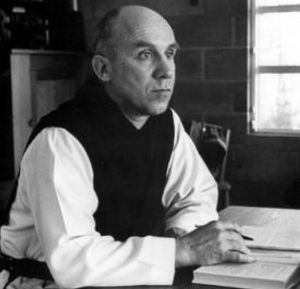
Thomas Merton in his hermitage (Courtesy Wikipedia)

The great study of the monk is to have an awakened heart

      Thomas Merton


There would be some – including me – who would say that all human beings, and not just monks, need to learn to awaken their hearts, to cultivate attitudes and a life of love, compassion, empathy, and kindness.

Who would disagree with such a suggestion?

Well, I’ve already said that I am one of the ‘some’ who would welcome such an evolution in human consciousness. But, at the same time, I don’t want to make pronouncements, form judgements, hold opinions, on what anybody should do, or be like. Only me. I am only responsible for my own behaviours, attitudes, ideas, thoughts, speech, and the rest of how to live my life. I just can’t – as in I’m not entitled – to tell anyone else what to do, what to think, what to say and so on.

Actually I’d even speculate that Merton is in fact talking about just the one monk: himself; he’s not preaching a prescription for the behaviour  of others.

I’ve read so much Merton that it’s impossible now for me to remember exactly where I read this statement of his, but I do know that when I first saw it and made a note, the concept resonated deeply for me as a great aspiration for my own life as a monk, and as a trying to be decent human being.
In other words, this monk – me, myself, and I – has a task to carry on with: to cultivate an awakened heart. And being a ‘great study’ it’s bound to be at least a lifetime’s project.

It’s an effort though, awakening one’s heart. It’s even a bit of a mystery at times what the phrase actually means in real terms.

Love, obviously, tops the list for any aspirant on the awakened heart path. And, yes, I do feel, express, and act out love – so deeply sometimes to the point of being overwhelmed or ‘flooded’; sometimes speechless (that’s the good bit), sometimes full of words.

But then there are times (oftentimes is the word) when that love is clouded or shrouded completely by angers and irritations, by regrets of what should be or shouldn’t be, could be or cant’t be, what isn’t.

The great study of the monk is to have an awakened heart
          Thomas Merton

All attachments to what is not as I think it should be. All barriers to love. All ways and means of keeping the heart asleep – or at best semi-awake, and still sleepy: slow to respond, slow to act, and with ongoing blockages to seeing how things actually are.

The quest to acquire an awakened heart and the outpourings of love, kindness, gentleness, generosity, that such a state would allow, is probably at the root, the foundation, of my life as a hermit monk, of my life as a pilgrim journeying through and to Self.

Living quietly and simply; developing a contemplative way of being in the world while definitely being not of the world; cultivating silence, peace and calm; all are activities and attitudes directed at cultivating an awakened heart.

All that generosity, patience, love, kindness, empathy, and all the rest are definitely all characteristics of an awakened heart. Here’s my dilemma  (only one among many that riddle my crazy monkey mind): they are also precisely the elements that need to be practised in order for one to acquire an awakened heart. What’s the expression? Catch 22?

Of course, it just occurs to me now, everything that is, is exactly as it’s meant to be, happening just as it ‘should’. So, in other words, all these words of reflection are simply a commentary on what has been and gone already, that which is in the past, and is no longer existing.

All that matters – all that exists – now is that at this moment, in its ongoingness, I am as loving, as kind, as patient, and as generous (not to forget compassionate, empathetic) as I’m able. To others obviously, as well as to myself.

All that wonderful list of characteristics of an awakened heart all exist right now within me. Perhaps I need to wake up my mind a bit more so I might see that reality. Then I might actually realise that I already have an awakened heart and that I simply got forgetful somewhere along the way.

with love
Paul the Hermit

Flee, Be Silent, Pray Always: A Revisit

Courtesy Wikipedia

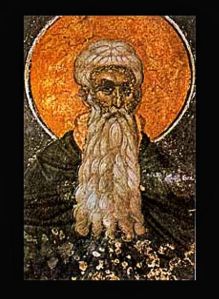
Recently I came across the story of Abba Arsenius – one of the early Christian desert fathers. I’d originally written about him a year ago in what became a short series of posts.

Coming across him and his story again prompted me to revisit those posts – the first of which you can read here – and I reread them again, though as if for the first time. Anyway, here’s a short recap before we move on.

Arsenius was a high ranking official for the Roman Empire, working for many years as a tutor to the sons of the Emperor.

Over time he grew tired of the glamour lifestyle, the politics, corruption and court intrigues, and looked for a way to free himself from the whole material trap he was in.

So he prayed, ceaselessly, the story goes. He prayed for salvation, for freedom.

And, in time the answer, according to the story came in just a few words:

Flee, be silent, and pray always.

And he did. Flee I mean. He headed for the Egyptian deserts which is where he found that silence, and the space, peace, and calm to fulfil  his desire to be praying constantly. And, with some comings and goings, ups and downs, he stayed for the rest of his life.

Now, while Arsenius and his story are fascinating (in fact now I’ve rediscovered him, I’m going to look around  for a biography or something  so I can learn more), what I want to think about here is something I wrote in the first of those previous posts, and how it ties in with our decision (almost a year ago now) to stay in this one place for the present.

For these Hermit Pilgrims ‘fleeing from the world’  has meant a nomadic lifestyle, few possessions and material needs, a hermit life where our engagement or entanglement with the world is kept to a minimum, and in which we feel less of a pressure to conform, to ‘be shaped’ by the world around us.

The notion of staying in this one place – as fully now and in the present as we can be – is actually  paradoxically a fleeing of its own kind. The world of Samsara, the material world ‘out there’ continues to become less and less appealing to these Hermit Pilgrims.

Alongside this growing detachment to the world (as well as the loss of desire to move about in the world geographically speaking), is the deepening realisation that the real and true pilgrimage is within, through and to our own mind and heart.

Complimenting all this, is the growing contentment we are experiencing in this actual place, this hermitage of ours that we are creating on a daily basis. More and more it feels to be the exact place in which that inner pilgrimage is to continue.

Does this mean we have given up on that ‘nomadic lifestyle’? No, not at all. Or, more accurately, we are not niether giving up or not giving up. The present is all there is and we don’t – can’t – know anything beyond that. As the saying goes, What can we say about tomorrow?

We are here, and it is now.

with love
Paul the Hermit

Moment of Catharsis?

One morning recently I was reciting my prayers when I began to notice the welling of tears in the corners of my eyes. Soon the wellings became a slow stream down each cheek. And, before long, I was more or less sobbing. For a little while.

Where did the tears come from? Why was I crying? Well, to be honest, it’s a mystery.

No mystery, you might be thinking: Sounds like your tears were brought on for some reason by reading the prayers.

I’m not so sure. I used the words ‘reciting my prayers’ deliberately: Not only was I not paying attention to, or even seeing the words on the paper, I was not engaged in the least in the words themselves and their meaning.

Rather than ‘praying’ I was reciting from memory, rote fashion, as if chanting my times tables in primary school. Merely mouthing the words; my mind was blank, as in not there, distant, off doing what my mind does, without awareness from me, when I’m trying to pay attention.

So, was this some sort of moment of catharsis? Possibly, or so it seems to me.

Sometimes – often spontaneously, other times with some forewarning – there is a release: a shedding of tears, as in my story above; a heavy inner or outer sigh of relief; sometimes simply a sense of something let go, something gone, or at least on the way to being gone.

When such moments of catharsis take place, often what causes them, the catalyst, appears obvious. On the other hand – as in my recent sobbing session – that catalyst is a mystery, unrelated in any obvious way to anything happening at that moment, or at least to anything taking place on the surface of that moment.

Equally the cause for the tears, sighs, relief, and so on – the object of any potential catharsis – may also be a mystery. I had no idea at the time, nor do I know now, what caused my tears.

The prayer being recited at the time was about silence. But, as I’ve already mentioned, no way was I actually praying, what with my total lack of attention, obliviousness to the words, my mental blankness. My unconsciousness come to think of it. Nothing to suggest a catalyst or catharsis.

In any case, when such miraculous happenings occur, one thing I try (I hope) to remind myself to not do: Do not ask why. Let catharsis – or whatever process is underway – be as it is.

And to put aside my habitual tendency to analyse and categorise; resist the temptation to want to know and label everything that happens to me. Let the catharsis – if that’s what it is – carry on as it does and not dismiss it as: ‘Oh that’s just me getting emotional.’ Or ‘I must be a bit overtired today.’

To – wildly and freely – paraphrase a few words from an iconic movie character:

Catharsis is as catharsis does.

Taking it Slowly, Taking it Mindfully

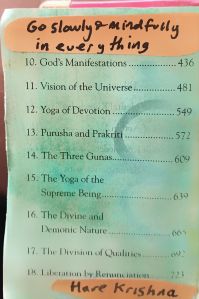
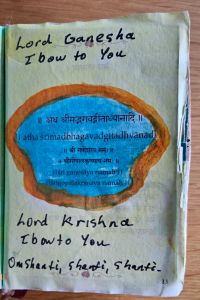
A small irony revealed itself to me just now as I prayed my way through the prayers inserted in the front of my Bhagavad Gita.

I’d completed one prayer and turned the page to the next. Then, without a pause or thought, I quickly turned the page again. I stopped, thought better of it, and turned back to attend to the prayer I’d skipped over.

Now, here’s the irony: The prayer on the first side of that carelessly and mindlessly leafed past page read simply:

Go slowly and mindfully in everything.

Well, that’s not the ironey itself. But, given that this was the page I had simply passed over without a thought, with no pause, the words written there obviously were a lesson for me.

A message to contemplate, to actually stop and pause with, mull over, meditate on, and perhaps make resolutions over. Advice to me to stop, to slow down.

Couldn’t be clearer really.

There’s no telling why I skimmed past that page, that prayer, without a pause. Could be a simple case of absent-mindedness, or a rush to see what was on the next page; a grass is greener type of thing.

Why I was rushing through the pages isn’t the point. What is to the point is here I am, doing morning prayers, praying some, then skipping others. The other point is that in this instance, for some reason I stopped, went back, and prayed the skipped prayers.

So, moving to the resolution.

It’s extraordinary to me when that kind of thing happens. (It does happen quite a lot, but unfortunately I only notice it occasionally) We will have an intuition, or receive a message from ourself that helps to us get back on track when we mess up.

In any case, it’s obvious that I’ve found what I might call the prayer of the day, the mission statement, so to speak, informing whatever activities I undertake today.

Slow and mindful in everything I do, say, and think. For now, for the present, that will the guide on the path of today that I will follow. Keeping in mind the adage that practise makes perfect, for when I falter.

Oh, another irony wrapped up with this one. The prayer on the facing page was also skipped, and in itself sheds another light on the message from that first one. That second prayer actually puts forward one, important, way in which I can actually set about achieving  that first one:

In other words: place more focus on, pay more attention to, the Divine in whatever form, and by whatever name, I encounter it today.

Works both ways I think: Making the effort to go slowly, to be mindful, puts us in the present moment. And, the present moment is the only place we’re going to be able to become aware of the Divine.

Then, as we become aware of the presence of the Divine, we are right where we need to be, when we need to be there in order to actually slow down and be more mindful.

PS These notes were made a few hours ago. Since then, I have on the whole practised being slow and mindful. Not perfectly, mind you, but then as I say, practise makes perfect. Even now as I type this – very attentively – my mind wanders, so there is a way to go for me. The day is not over yet!

It’s All There Is

This is my second attempt to start this post. In the first try I just couldn’t see or feel my voice, myself. Right away, as I began making notes, I launched into and quickly became bogged down, in a wordy, overly complex rational discussion.

It seemed more suited to some kind of academic essay (not that I am remotely qualified to write such essays) than a note from the heart of a hermit contemplating from deep within his cell.

So, here I am beginning again. This time I hope I’ll find a little more of me in what I write, perhaps discern something a little more authentically heartfelt.

This post emerged from my desire to share with you a little about a small item that helps me as I chant my mantra. My mind seems to switch into strong wandering mode when I try to settle into Japa or chanting mantra mode.

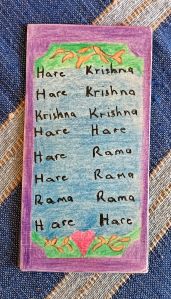
So, I have a small card, made from a cereal box and measuring about 15×7.5 centimetres, decorated with lovely colour pencil designs, with the mantra written in pen. Oh, it’s covered in plastic for protection and longevity, and was given to me as a gift.

Having it in hand or close by when chanting allows me to focus on the words if my mind wanders. I read them slowly, mindfully and I find it puts my chanting back on track – until the next wandering thoughts announce their presence!

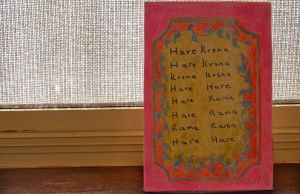
Actually we have a couple of similar cards scattered around the Hermitage. One lives on the window ledge above the kitchen sink, and always acts as a timely reminder to make even the washing of dishes an opportunity for prayer.

The View from the Kitchen Sink

Having my card acts as more than a prompter to me to remember and focus; it acts as a kind of tool for contemplation: when looking at the mantra written there, I often sense the meaning of the words, the importance and place of them. I don’t call this mind wandering, this is contemplation and I welcome it.

While on this level, my card can be viewed as a mere ‘prompt’, there are some who would – and do – say that the card, and the very words written on it, are in fact, much more than being simply physical stuff.
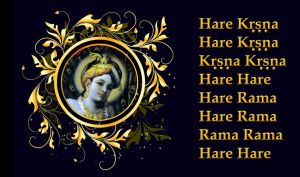
They would say that the card, and especially the words are literally, factually, and in truth the Divine (in this case in the form of Krishna). Just as some traditions maintain that ordinary bread is transformed through ritual, into the actual body and blood of their God who was once made human.

Not mine. I’ve had this as a file for ages, and love it. I think it was originally the size of a visiting card

For much of my life I dismissed such notions as mere fantasy, the products of literal interpretations accepted as dogma through blind faith. I’ve even in the past used the word nonsense to describe and dismiss such superstitions.

Nowadays though (and here comes the but, the however, the on the other hand) I’ve come to a slightly different view of the idea. Is my little card literally a piece of cereal box, decorated with nice coloured pencil work, with words written on it? Obviously it is. Of course it is a material thing existing in a material world.

Is the statue of a deity or saint in a church or temple a lump of stone, wood, metal, or other physical material? Again, it’s obviously a material thing with a material existence . Just as communion bread and wine are baked in a bakery, and brewed in a winery.

So, is my card, along with these other examples, merely a stand in, a symbol, a represention of the Divine?

No, I don’t think so.

Over recent times, my instinct, my heart, senses that, in truth, there is only God, only the Divine, only the Absolute Reality, what we can call existence, or being, itself. It seems to me that this Absolute Reality is everything, is everywhere; there can be nothing else.

One without a second, I’ve heard it described. It’s why, I think, we can look at a flower, a tree, the ocean, a person, or some other material object and be able to in awe remark ‘this is divine’. Or how when we hear birds singing in a nearby tree (or on a neighbour’s roof as I can now as I type this) we may have a sense that we have actually had an encounter with the Divine.

Lately I’ve become bored, uninterested, even irritated, with dogma (my own or that of others) and my constant striving for rational and logical answers. My heart tells me – it feels – that the Divine is all there is.

You, me, all that is visible, and all that is invisible, is all there is, one unity. No, not even a unity: that implies the union of one thing with another.

One without a second. Yes, that says it all for me. Those four words, now I think about it, really do encapsulate all there is.

Including my own heartfelt aspiration to fully realise this Truth in the heart and soul of Self.

A Prayer to Share: for the Divine Mother

Namaste and Welcome

Today I would like to share with you a prayer (it’s a poem too, but …) I’ve written in praise of the Divine Mother. It’s actually the second prayer I’ve written to and for her. I shared that first one, called simply, A Prayer to the Divine Mother on the blog previously and you can find it here.

That post will also give you some background to my reverence for the Divine Mother – what she means to me; where my initial devotion comes from; my heart sense that this universal creative energy drives and sustains all creation; and finally how Divine Mother may be worshipped in many and varied (and even no) forms.

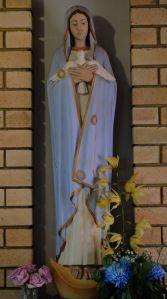
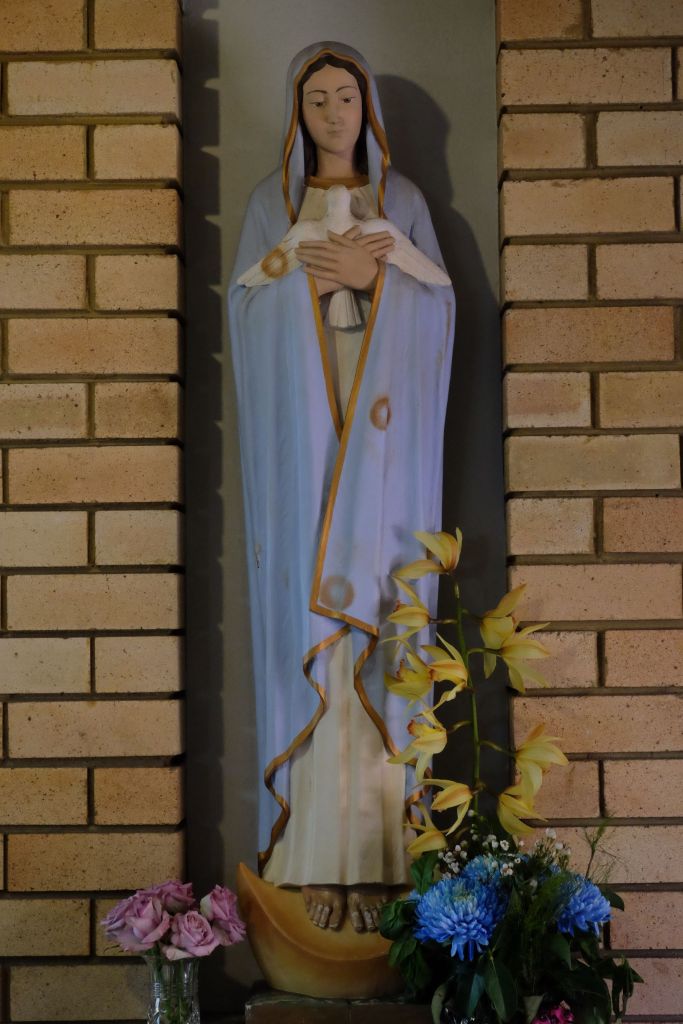
The prayer I share with you today – Jai Shree Maa –  emerged as I knelt chanting those exact word at the alter of a holy place dedicated to the Divine Mother as revered by many in her form as Our Lady of the Rosary.

It is a temple in that name I sometimes go pilgrimming to for quietness, meditation, and devotion.

Please accept my prayer. Thank you

JAI SHREE MAA

In this temple to the Divine Mother
upon my knees and praying.
Jai Shree Maa

I chant with sacred love in my heart,
sacred words upon my lips.
Jai Shree Maa

Divine Mother, with these words,
Jai Shree Maa
I invoke your holy presence;
I speak from my heart to yours.

With love and wishes for peace

Paul the Hermit

Let It Be

I’m not complaining, nor am I bemoaning my lot, when I say that for much of the time I feel totally and absolutely exhausted.

Well, there might be the odd time when I might feel ‘just a bit tired’, but generally speaking, I’d say that exhaustion is closer to what I mean.

But, then, this morning, as I pottered around in the kitchen, making tea, putting dishes away while I waited for water to boil, I had, what I can only describe as a sudden awakening of a sense that this – the perception of permanent and total exhaustion – might not be completely true.

I sensed, in a kind of wordless insight, that – at least in this instance – it wasn’t exhaustion I felt overwhelmed by. Perhaps, there are at least fleeting moments when I am actually relaxed and I’ve simply mistaken that feeling for fatigue, not having had enough experience of being relaxed to know the difference.

The same slow movements: mindfulness and relaxed, or tiredness?

The same slow and considered speech (and thought): again, slow and mindful, or fatigue?

Even the overwhelming sadness and melancholy that often goes hand in hand with exhaustion might be something else: perhaps it is in reality a slowing down (though it often feels far from slow, more like a racing) of the mind, combined with a state of intense inner contemplation, mistaken for sadness or whatever.

After all, the meditation I practise, the ‘just sitting’ times of quiet restful contemplation, the study of texts meant to be ‘road maps’ to inner peace, calm, and liberation, all are claimed to produce, just that mindfulness, contentment, and inner peace that I am describing.

So, how to know? How can I discern the difference? Am I absolutely and totally exhausted, consumed by melancholy and the horror thoughts that go with it?

Or am I relaxed and calm, having slowed both body and mind, and in a state of inner enquiry (contemplation) that’s ridding my mind of the horror thoughts and the sadnesses?

Thinking about it now, when I ask myself these questions, it seems to me that I am questioning what I’m experiencing as opposed to states of being as such.

And experiences are never permanent, they are always in flux, changing. New ones come, old ones go. Then more and more come and go. That is, I guess, what being alive does.

Next I’m thinking, if I truly were in a relaxed, calm state of non-suffering, wouldn’t I actually know it, and therefore have no need to ask?

Mmm; maybe. Still another thought just occured to me. Perhaps what happened, as I pottered in he kitchen was a kind a surprise reaction, or rather a reaction to a surprise. My mind – heart, soul, whatever – was so shocked by that feeling of being relaxed, content, happy even, that it simply had to pose the question out of disbelief.

Meaning, as I ramble on in my usual overly wordy way, that what happened was I noticed a change in my state of being; for that moment I was not exhausted, sad, suffering. Perhaps – for that moment – I had entered a state of relaxation and freedom from suffering.

Let it be, I say. Stop the words; give up the analysis. Let the experiences come and go. It might be that, if I can allow those changes in states of being to be just as they are, then they’ll have a chance to develop, to evolve, perhaps even to make the changes permanent!

Scribbling let it be just now, put in my mind the Beatles song of that name, especially one small snippet of the lyric, a chorus really. Even a mantra (now there’s a thought):

Let it be, let it be, let it be.
Whisper words of wisdom, let it be.

With love and peace

Who is whispering the words of wisdom? And when and where?

When I find myself in times of trouble,

Mother Mary comes to me

Speaking words of wisdom, let it be

And in my hour of darkness she is standing right in front of me
Speaking words of wisdom, let it be.

Mary. The Divine Mother

Jai Maa

Paul the Hermit

PS I was 16 when Let It Be was released by the Beatles. I loved it at first hearing (didn’t everyone?) and I love it now. It meant a lot then, even more now. Thank you very much for the music.

Flowing With the River of Life: A Work in Progress

O Lord, I take refuge in You.
You are my sole guide, my master.
Show me the right path and
I shall follow it.

This is a prayer I like very much. It appeared one day in a previous incarnation of this notebook, then migrated to my prayer book. Its origins are lost in the mists of forgetfullness.

In any case, I like it – a lot. In a big picture kind of way it encapsulates much about the way I aspire to live my life; what I aspire to devote my life and energies to.

The prayer is addressed to the ‘Lord’ – to the Divine; to the Absolute Reality of (to borrow a favourite phrase) Life, the Universe, and Everything. Some will call this God, some think of it as the creator. For me it is simply Lord: all that is existence.

And it is there that I aspire to take refuge. I seek shelter in the knowledge of the rightness and order of the universe. Not an easy task when I think about the state of life ‘on the ground’ on our home planet; how the horrors can be almost impossible to grasp, to understand, and to keep from despairing over.

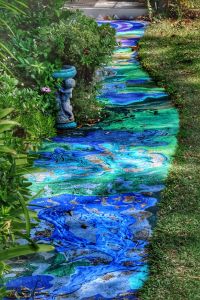
But a contented state of refuge, of safety, security, and even happiness, may be found, I sense, by a cooperation with what we might call the flow of the river of life.

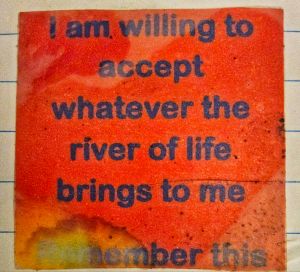
And if I am to discover for myself that refuge, then there really is only one choice: to accept that flow of the river of life as my only guide to how to live, what to do, how to be.

Not surprisingly I struggle with the idea of cooperating with and accepting the often crazy and random nature of that flow of my life as my ‘sole guide’; how much harder is it to accept that very river as my master?

Again, if I ever want to be happy, if I ever hope to be free from suffering and attachments to those things that cause me to suffer, then I must accept and cooperate with the reality: the river of life is the master whether I like it or not. I may as well accept it.

Which absolutely and I hope obviously, does not mean I’m a fatalist, or that I am resigned to just let the currents toss me about willy nilly. No, not at all.

My deep sense (yet another site for other struggles) that the solution to suffering does indeed lie in an acceptance of the reality of the flow of life as it’s happening moment to moment.

By not resisting life and what it presents to me, I aspire to arrive at a state of acceptance where I might contentedly and freely ask what is my role here? What is the universe asking me to do?

If I can listen, and actually hear with the ear of my heart, then I might be able to discern the path, which if followed, will free me from suffering .

Then I shall be going with the flow, following the path of least resistence, and I’ll be contributing to my own smooth (well, smoother at least) ride through life.

We are Many, Yet We are One

To ‘check the weather’ is to actively seek knowledge – news – of the world; it’s asking, what’s going on out there? Kind of an attachment, and in most cases, most of the time, I don’t seek out news of the world, but in certain circumstances it does sometimes seem necessary.

So, because it’s been raining heavily, and there have has been some minor flooding not too far from us, I checked the Bureau of Meteorology earlier this morning – I have an app on my phone.

Along with the air temperature, the measured and predicted rainfall, and other weather related details, there is list of ‘Current Severe Weather Warnings’.

There were three listed: big surf (we’re a couple of kilometres from the coast), big winds, and a third which leapt out and grabbed me, or putting it more accurately, it reached out and grabbed my heart.

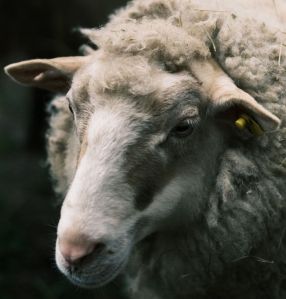
A ‘Sheep Graziers’ Warning’ it’s called. It’s purpose is to warn farmers, that due to cold temperatures, heavy rain, and high winds, there is a risk of ‘losses to lambs and sheep exposed to these conditions.’

In other words, lambs and sheep might die if left out in the weather.

That casual check of the weather has now exposed me to some of that information of the world, the news, that I usually avoid. And that news has impacted my heart, my soul.

The risk of ‘loss’ to those sheep – and lambs – is to me as devastating as it would be when any other being is at risk of suffering or death. And, obviously, I’m absolutely aware at the same level that many creatures of many and varied species – including my own – are at this moment exposed to the very same risks.

One of the thoughts that occur to me is this: The very reason for these warnings is so that farmers can take the appropriate action to protect and safeguard the creatures in their care.

Another thought: the sheep have no choice. Like the rest of us living beings they are subject to the conditions that play out in the material world. Of course we can add a little perspective to this: I am making these notes in a warm, dry and safe hermitage.

(Then, as I began to type up those notes just now, there was a very short but powerful thunder and lightning storm accompanied by very heavy hail. Once again I am warm, dry and safe.)

All beings are prisoners in a sense, to their material bodies, and, as I said, subject to suffering due to the material world. What we, as individual beings, or individual species, can do to reduce our suffering is going to always vary from individual to individual, from species to species.

I suppose what I’m getting at is that all of us – all beings – need help of one sort or another at some point, to release us or protect us from suffering.

I must admit that very often feel helpless when it comes to what I’m able to do to relieve the suffering of the world – my own, the suffering of those close to me, and that of all beings.

You know, I don’t not watch the news so I can avoid being upset or sad or angry which are often my reactions when seeing or reading news of the world. While I don’t enjoy those emotions when they come, it’s more the emotion they lead to that really bothers me: more and more feelings of helplessness.

And helplessness for me causes paralysis: whatever little I might otherwise be able to do, I cannot. For example, since checking that weather report I haven’t been able to settle to my prayers, my meditation, my chanting, and study; I am not, right now able to do any of the things I would normally do as my way of contributing to the welfare of other beings. Paralysis.

So, here I am making notes that will become a post to share with you. A story of checking the weather; of empathy with other beings; my feelings of inadequacy at not being able to relieve their suffering – as well as my own for that matter.

But, I will pray. I promise. Prayer is healing, prayer banishes helplessness.

Those sheep – as well as all other beings – and I are not separate; I am them and they are me. We are the One.