In my last post I reflected upon the meaning for me personally of a Bhagavad Gita verse that had particularly struck me as I carried on with my renewed inspiration to read the text from the beginning.
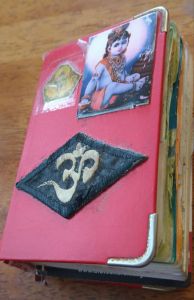
Today, I didn’t even get to the place where my reading left off yesterday. Before reading I like to pray some or all the prayers I have pasted in the front (and the back now). As I was deep into this practice, one prayer in particular stopped me, just as with that verse yesterday.
This one seemed to speak to me, asking ‘What do I mean to you?’ So, I made a mental note (always a risky proposition with me), and carried on with my prayers, determined to take time later to think about that prayer, and try to answer its question. So, here I am, later in the day, making these notes.
The prayer itself I am fairly sure comes from Thomas Merton, monk, mystic, and writer. Not completely sure, but I know that whoever composed it was one clearly inclined towards living the life of the mystic.
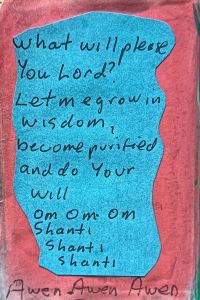
What will please you Lord? Let me grow in wisdom, become purified, and do your will.
For whoever composed this prayer, it is an expression of a genuine longing. I can say that for me it is a deep plea, expresses my own longing. Each time I recite it, in fact, I can say that, although this is the first time I’ve addressed the big what does it mean question, I do sense the longing and grasp the meanings of the various words and ideas in the prayer. Actually, now I think about it, I do say this prayer or parts thereof in one form or another very often.
What will please you Lord?
When I begin to pray these words, what I feel I am actually doing is asking the Universe, the Divine, Self, God – the I AM – how can I live my life so that it is attuned to the natural order and flow of the Universe.
I am asking, what do I need to do to let go of attachments to worldly things which arise from material desires? How do I find the grace to accept when things aren’t going completely my way?
In other words, I’m asking how can i live a good, truthful, happy life in harmony with all other beings and with the Universe.
Let me grow in wisdom
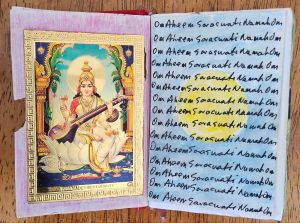
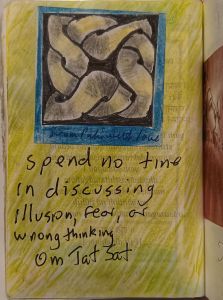
Another of my prayer pages. This one devoted to Maa Saraswati, goddess of, among other things, wisdom
A good place to start, a great first step. But, again I have to ask myself, what does growing in wisdom mean to me?
To me wisdom is not merely knowledge. Though, having said that wisdom needs to rest on a firm foundation of knowledge, otherwise what’s there to be ‘wise’ about?
I’m not talking about worldly knowledge here, though obviously it takes some degree of knowledge for any of us to live in the world. Also it’s relevant to the next part of our prayer; we’ll see that soon.
I’m referring instead to a special kind of knowledge that will (I pray) lead me somewhere closer to acquiring some degree of wisdom – one day.
Self-knowledge is what I’m getting at. And I go about my attempt to obtain self-knowledge in a couple of different ways. I study, sacred texts like the Bhagavad Gita, as well as the words of those wiser than me (which is rather a large selection of people I can tell you) both living and historical.
I meditate (not nearly enough!) as a way to enquire into my own ‘real’ or true nature: who am I? what am I? Just digging deep within to reach some realisation of the answers to those questions.
When I have answered those questions, I will understand that I have reached a true level of self-knowledge. I sense that, at least being on the path to that realisation, I would never be able to develop any level of wisdom.
Mind you, I do feel that all humans are born with some degree of wisdom potential ‘built in’ so to say. As for me, I don’t feel especially wise just yet.
Become purified
For me, becoming purified goes hand in hand with the cultivation of wisdom. In fact I would say that in the very efforts to become purified, it might be possible for me to develop some wisdom as a result of those efforts.
So, here we go again: What does it mean? To become purified? For me it means living a Dharmic life. By Dharmic I mean a life steered and driven by Truth, Right Living, Right Speech, Right Conduct , Right … The Buddha taught The Noble Eightfold Path. That is in my opinion the very best, topmost, pinnacle of self directed means to living a Dharmic or purified life.
The Eightfold Path is not a set of dogmas, rules, or anything like a list of commandments or instructions . The eight steps are merely signposts, a roadmap, pointers for me to follow in order to purify my life, live a Dharmic life. No behaviours are prescribed: it’s entirely my choice what forms my behaviour, actions, and the rest take.
Obviously the path to becoming purified is a life-long one, though some would say that many lifetimes are required. Personally, I can’t even hint that I might be anywhere near close; some days I feel further away than ever.
But, as I work towards ‘growing in wisdom, with the help of my becoming purified path, I pray that some day I might actually learn what I call proper discernment.
This discernment is the ability to act in the world and to react to the joys and sorrows that are inevitable, with compassion, love, and wisdom. To face those inevitabilities with calm and equanimity. Acting with proper discernment will mean that I am living in Truth.
… and do your will
As I reread the words I’ve just written, I realise that, by the time I reach the state described in that last paragraph, I will have succeeded in ‘doing your will. I will have aligned my self perfectly with the order of the Universe. I will know my place as a tiny fragment of that very order.
If I’m honest however, I have to say that I think it’s going to be a very very long time before such a state come to pass. So, what to do in the meantime?
Well, along with my attempts to live Dharmically, and to cultivate wisdom, I have committed myself to a life of devotion. Devotion, prayer, contemplation.
Devotion to what? To whom?
To the Universe, Divinity, God; all that is represented by all those names we humans have put on the Absolute Reality, that is all there is.
Everything. And everybody, is what I’m saying. There really is no separation except a kind of superficial one we allow ourselves to imagine by applying so many names and forms to the material objects, things and so on, that appear to us as separate one from another, whereas there is in fact only one, without a second.
That’s where the contemplation comes in. It’s a going within, inward to what we imagine is a kind of ‘space’ where all merges into one, the one that is all there is.
I think that’s what ‘pleases the Lord’. While I am indescribably, gravely, deficient at all the steps described above, one course I know to be right for me is to continue to engage with those steps, and to devote myself and my life to the Divine, to the Truth.
That’s what pleases me. I pray that it pleases the Lord.
This morning I announced here in the Hermitage to anyone within range, that today, I would be making lentils. No, I thought, I can’t ‘make’ lentils; my job is to cook them so they might become Dhal. Jokingly to myself I stated by way of correction in my best mentally affirmative voice ‘It’s Dhal day today.’
Dhal is an important staple for us here at the hermitage. Please don’t imagine I’m exaggerating when I say that we eat it everyday. Actually, come to think of it, it might be just an ever so slight exaggeration.
Very very occasionally we choose some other evening meal, always vegan. But to tell the truth, we all like Dhal so much that we hardly ever feel the need for a change.
Anyway, as I say, it’s one of my relished responsibilities to once a week, or thereabouts, play my part in producing the Dhal that sustains the community for the next week.
Just a little aside: Lest you think Dhal is all we eat, I should mention we eat lots of fruits and vegetables, rice and breads, beans and various other things that come to us one way or another.
Please, the inner editor is begging me, can we just get on with today’s topic? Actually, the topic is the Dhal making that has taken place today. So, really, we are still kind of on track.
Right then. Not long after my announcements to the community and to myself, I got to it, to the task at hand. First, I pour red lentils into a largish saucepan.
Not my picture. Just to give you an idea of what I saw that prompted my feelings
I watched as the lentils streamed from the packet to form a little mountain, first at the bottom of the saucepan, growing to full saucepan scale. Funny thing to say but I was kind of mesmerized by this mountain building. I was struck by the thought – more like a feeling – this is wonderful, this is important.
I mean to say that I felt a little awestruck by the abundance. In a sort of gratitude induced reverie, I scooped a handful of said lentil mountain, letting lentils stream back to Lentil Mountain in the saucepan.
Then it’s rinsing time. You see, you need to rinse the lentils to get rid of excess starch, bits of dirt, little stones, or twigs. This is a vital step in the process according to the Dhal Grand Master who taught me this life-sustaining art.
In any case, it’s at this stage that you’re allowed to get your hands right into the mix. Run water, swish the lentils around, drain off now starchy, twiggy, stony water. And repeat five, six, or more times determined by the clarity of the water after each rinse.
I like that bit too actually: kind of pleasant sensation as lentils swirl through fingers and you get experience something of the lentils themselves. Nice feeling.
Next step, fill a giantish sized saucepan (I call it the big pot) with the rinsed lentils, add water (very exacting amounts too, but don’t ask me for precise details), bring to the boil occasionally scooping off any remaining bits and pieces as you watch the alchemy happen.
Then, once boiling, it’s time to stir in various spices. Once again, exact amounts are called for, but, well it’s kind of a trade secret. By which I mean, I couldn’t tell you measurements; one just knows. Could be a cook thing. Or maybe it’s a monk thing?
Enough cooking (sometimes the inner editor doesn’t know when to leave the writer alone).
Okay then.
Gratitude. And wonder. Both experienced today – and not for the first time.
Wonder at & gratitude to Surya (the Sun) which gives and sustains all life, including lentils
Wonder at the aforementioned alchemy that transforms dried, red lentils, a few spices, and water, into a delicious, substantial, healthy and nourishing, food that satisfies and sustains.
Gratitude that I am able to take a small part in this alchemy. Gratitude for the beings who sustain us – me, our community, you, all of us on Earth. Gratitude for the grace I have been granted that actually allows me access to such wonders and abundance.
It’s a lot to be grateful for. All I can add is that it is my deep gratitude that will keep me ‘making lentils’ always.
You know, for all my prayers; for all my mental discipline – efforts at mental discipline – for all my meditations, chanting, and other practices, I still just talk way too much for my liking, and often it feels like it’s only talking for the sake of talking.
I still just open my mouth and let come out any old thing that keeps the noise going. Oh, it’s worse than that: sometimes when I talk it’s rambling and waffling that I cleverly (or not so cleverly) disguise as intelligent, rational, and based logically on knowledge that I either have or haven’t got. Either way, I somehow seem to think I’m offering words of well thought out wisdom.
Whereas, as I said, the noise I make is so often rambling, contradictory , ill-informed, thoughtless waffle.
Enough! Blimey, that’s enough. Talk about opening a post on a calm, relaxed, optimistic, and compassionate note.
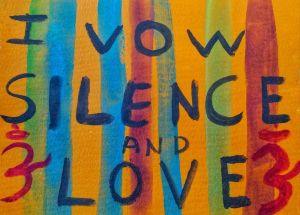
Here’s the thing: I want to devote my entire life to devotion and prayer. And that requires at least some silence. Yet, instead, I merely talk about the joys of silence, about the joys of full-on devotion to the divine, and as well I occupy so much time and energy to just voicing random thoughts that come and go, go and come, without rhyme, without reason.
Okay, here’s the second thing: I long with my deepest longing to be silent – to not simply stop talking, though that would be an excellent beginning. No, I want to be quiet; I want my vocal chords to have a break and let my true voice speak through my life, through this blog, my photographs and in whatever way I am lead.
So, what to do? Well, here’s the third thing, thing number three: all I need to do in order to both stop talking so much and be silent is to just sit. Sit and do nothing. There is no thing that I can do that will magically turn me into an oasis of silence and peaceful calm.
Sometime in the dim distant path I read someone paraphrasing The fouth Noble Truth in two words, Just sit. Buddha did indeed know what he was talking about. And I do get the irony: when I talk, I need to say something that helps, not just make noise and try to avoid silence.
There, dear friends, right there, in the title are our next two W questions, as well as the answers to both.
The answer is brief, succinct, right to the point, yes indeed. But somehow to me it doesen’t seem very helpful, a bit vague.
Here and now. Let’s look at this tricky little phrase. On the face of it Here and Now has an obvious meaning: if we choose to think on it in the spirit of our ongoing contemplation on my prayer life, it’s very clear. Here and now is a timely reminder to me to pray right where I am, right now, wherever I might be; and whatever the time, day or night.
But it’s not really a very satisfying answer is it? Here and Now? It seems too flippant to me, too bland, even a bit of a ‘catch all’ cliche thrown around without any real insight into its meaning or importance.
Anyway, moving right along …
We are exhorted to pray without ceasing in the Christian Bible with similar exhortations found in so many other texts and scriptures from many faith traditions.
Remember my aspiration to make of my life a prayer? Well, that’s the idea: to pray without ceasing. Which translates to mean that everything I do, say, think, feel (what else?) will be prayer – or I can also say a prayer. Life is a prayer, life is lived as a prayer.
Of course the precise forms my prayer takes are – and will ever be – many and varied. We’ll be looking at some of those forms and types later in the How post of this series. But, for now, allow me to brainstorm on the topic for a bit.
Consider washing the dishes, a task we all find ourselves engaged in to some degree or other. I have a sense that my feelings towards dish washing is actually quite neutral. Don’t get me wrong: if I never had to wash a dish again you would not hear me complain.
At the same time, I have absolutely no hard feelings against washing dishes.I just get on with it, just like most everybody else.
Sticking with dish washing …
Most often dishes need washing as a consequence of preparing, cooking, and eating food, for a meal or meals. Right there is an obvious opportunity for a simple prayer of gratitude.
It might be a simple whispered thank you for the gifts of the nourishment, satisfaction, even pleasure of the meal. Anyway, just a random first thought on the subject.
There are a few other points to be made in our little dish washing thought exercise as it fits into my own prayer life.
Sometimes, while actually dish washing and cleaning up, I might chant mentally, or otherwise pray with words – set prayers. Prayers of praise or gratitude; mainly whatever pops into mind. Go with the flow is the theme here.
Now, that’s one thought. Next: I might decide to be quiet while washing up. That is not speaking and being as silent inside as I can be.
On these occasions I just focus as intently as I can on what I’m doing: washing dishes. I make it an occasion for not doing the dishes just to get them done, or to get them out of the way, or to put an end to an onerous chore.
Rather, it’s more an opportunity to simply wash the dishes, by being with the dishes and the actions required to clean them. Just a little aside: this particular form of mindful (prayerful) dish washing actually results in cleaner dishes. It’s been proven scientifically.
These two approaches to washing dishes – not to mention all the other means and forms of prayer – are not necessarily mutually exclusive, nor are they the only one: a given dish washing event might involve several prayer modes.
Which leads me to the next thought that I had more or less forgotten…
Sometimes I do indeed slip into that old ‘Just get the blank blank things done’ frustration mood. And it doesn’t just happen when faced with the dishes!
It goes without saying that I wouldn’t need an aspiration if I was already acting full time in that prayerful manner. I do practise – sometimes with more determination than others – performing all my actions mindfully (aka prayerfully), though there’s far to go for me in the praying ceaselessly department.
So, to a good question you may be asking: Is there somewhere (or multiple somewheres) that I go to to pray? Some special sacred or holy place?
Well, I know that we are always all of us standing on sacred ground – it is all the Divine. Still, there are places that help me, all of us, feel closer to that divinity, to the sacred, to God, or whatever we call it.
There are places that exude that special vibe, or have a certain atmosphere of calm, quiet, or stillness, that are conducive to prayer.
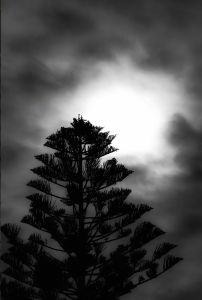
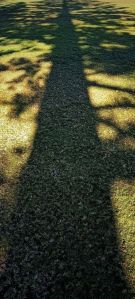
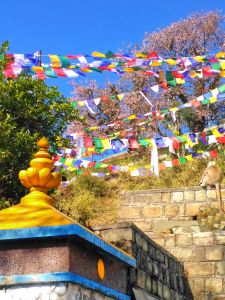
An apparently random glance skyward blessed me with this moment and this place of prayer
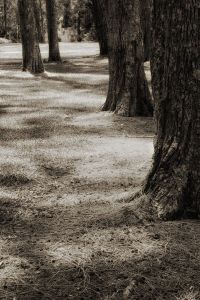
Talking about the idea that we are always standing and walking on sacred ground, there are often places I come across that speak to me as places of prayer. It might be a tree, like the one pictured here; it might be a distant view of a lake and the hills beyond.
Such places call to me to stop. Perhaps for a moment, perhaps to sit and linger and pray with words, or with silence.
In the Hermitage, there is temple, a room we have set aside for that purpose, and no other. From the very first day I set this room aside as a temple, I have felt a stillness there, a tranquil vibe.
Among such spontaneous little moments, there are times I simply stop and stare at a flower, or without thought put my hand on a tree. I will whisper a quiet thank you and a blessing to the Divinity I sense there.
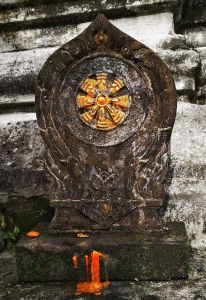
Temples, churches, chapels, prayer rooms, mosques, and other types of sacred sites from andy and all spiritual and religious traditions, attract me as well.
These are all places people have spent time in praying, contemplating their lives and their union with the Divine. All that energy, all that love and devotion has caused an atmosphere of holiness, or sacredness to build up over what can be years, centuries, even millennia, in some places I have prayed.
But, really, when all is said and done, anywhere and anywhen can be and is a place for prayer. Here, in this booth, in the cafe at the lakeshore near the Hermitage, I make these notes in a mood of prayer, a prayer of love and devotion.
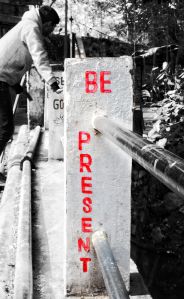
Being present, mindful, and prayerful in all I do, that’s my aspiration. Here and Now. Anywhere and anywhen; it’s all prayer.
Has anyone seen Walk the Line? It’s a great movie that tells the story (or a version thereof) of the life of Johnny Cash. Yes, I know: not everyone is into country music. This movie, however, is an intriguing insight into the life and work of a gifted but troubled artist. He was a prolific and inspired singer and songwriter.
There is a scene in the movie in which Johnny is about ten or so. He’s talking to his brother who is maybe 14. The brother is studying the Christian scriptures (he wants to be a preacher when he grows up, but dies soon after in an horrific accident) and Johnny says, ‘Why you studying so hard?’ His brother looks up from his reading and says,
‘You can’t help nobody if you don’t tell ´em the right stories.’
Yes, I thought when I heard that, you have to tell them the right stories. But, what are the right stories? It’s a good question but, fortunately, there is a simple answer: they are all the right stories. That is if they are told from and with the heart, and if they are created and shared with the intention of conveying Truth, promoting harmony, and doing or causing to be done, what’s right.
The ‘them’ of poor brother Cash’s reply are those who get to hear/see/feel the stories we tell. And we all tell stories don’t we? I mean I’m telling you a story right now. As a (cringe) blogger, that’s what I do.
But we all share stories of all kinds. Sometimes they are stories of our lives, sometimes they are from memories passed down the generations. Other times they might be something we ‘make up’ to help someone to understand a point or idea. Pretty much all of us, most of the time communicate in one kind of story or another.
Of course there’s the other kind of stories; the ones meant to spread rumour or gossip, to hurt someone, to mislead. We all know how that works, and it’s not today’s topic anyway, so let’s just leave it there.
Those we share stories with may be those we intend to share with, and they might be others who at the time are distant from us both in time and space. Just as the stories we tell each other might be decades or even centuries old, so might our stories keep on reverberating through time and space.
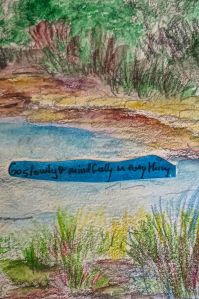
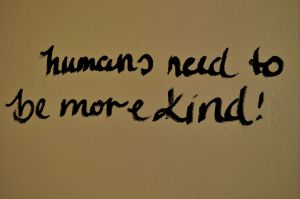
A true story written on a wall somewhere
It’s also true that the stories that ‘help’ people come in all shapes and forms and are about an unlimited variety of subjects and topics. Then there’s the matter of timing. How often have you ‘just by chance’ read something inspirational when you were needing some guidance or advice?
Or what about those times when you are feeling a bit low or under the weather and you come across a story that makes you smile or otherwise lifts your spirits? I’ve often been in need of a good cry only to come across a sad movie or story or a moving tale of one kind or another. (Just last night I read a wonderful phrase I’d never seen before: Transformational Weeping. Probably a story or two there do you think?)
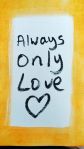
A story I tell myself literally every day. One that’s a prayer and an affirmation
So, let’s keep telling stories. They are all the right ones for us to tell – if they come from the heart and told with the intention of serving Truth. Someone once wrote:
If there is a way to improve the world, it is by telling a good story.
Okay then.
Once upon a time on a dark but not so stormy night …
PS I saw the movie in Dharamsala India. On a postcard home I wrote a little rhyme about some writing work I was doing on some of the town’s environmental issues for a local magazine:
He walked the line did Johnny Cash. But here in Dalai Lama Land my words will help reduce trash.
I did say stories come in all shapes and forms didn’t I?
Remember that old Bee Gees‘ song Words? It’s about one person offering all they have to another. Well, the one doing the offering must have been a writer because, while the song’s a love story, it’s words that are the big thing on offer here:
It’s only words, and words are all I have To take your heart away
Well, as this is a blog, words are the way it hopes to reach your heart. Actually, the posts also include photos and sometimes other art, but the main vehicle used here is words.
So, with that in mind I have a couple of words to offer you today. Well, one word and its opposite. Have a look at this sentence from Thomas Merton:
If Irish monks affirmed his Celtic spirit in their mastery of cataphatic contemplation of the wonders of divinity in nature, Buddhist monks evoked his Zen mind and drew him into the apophatic path of formless ’emptiness’…
As sentences go (though this is obviously only part of a sentence) this has to rank pretty close to the top for length and denseness.
Kataphatic. What a word! Of course I had to look it up; I’d never heard the word before (this post is a rewrite from notes written a while ago that I never got around to posting.), and even though the sentence seems to suggest the meaning, I was still curious.
Looking at Wikipedia – where they spell it with a ‘C’ like Merton, as well as with a ‘K’- I learned that cataphatic is an adjective that describes an approach to theology that uses ‘positive terminology to describe or refer to the divine (God, Truth, Dharma, Spirit. You know what I mean: the divine).
Apophatic, as you probably figured out already, is when one uses ‘negative terminology to indicate what it is believed the divine is not’. A process of negation or we could say you get to what the divine is by a process of elimination.
Pretty simple concept really, but with a couple of big words to label it, and a lot of words to define it. No, don’t worry, I won’t bore you with the meaning and origin of the words and all the rest. Mainly because I don’t know and I’m not especially interested anyway in all that technical stuff.
I simply resonated with the word, and the concept. Cataphatic made me think of Dick Van Dyke and Julie Andrews singing Supercalifragilisticexpialidocious in Mary Poppins. But let’s not go there: this is a serious blog after all. Except to say there’s more to that word than you might imagine.
Putting aside the aesthetic appeal of the word for a minute, let’s contemplate a while on cataphatic, and it’s opposite, apothatic.
To begin thinking about these two words, it’s necessary to acknowledge the existence of the divine. We can call it God, if we like. Or Dharma, Truth, Spirit, Love, Beauty.
As the quote suggests, a cataphatic approach, ideology, theology, or whatever we call it, ascribes names and forms to the divine, as well as describing where and in what the divine may reside.
Whereas apothatic, again as the quote suggests, does not ascribe names and forms to the divine. Instead it seeks to discover what or who god is or isn’t by a process of negation as described already.
For a long time I labelled myself as a Humanist. I had decided that this physical body is all there is; the physical or material universe is all there is, and that there is no ‘god’ separate from us or who has special powers to affect our lives. No God at all in fact.
In the Grove of the Sentinals
But, all that while, I just knew that there was something else, something more than just the physical. And over time, I came to the knowledge that there is indeed more than the simply phsical universe (including we humans).
I’ve thought about it a lot over the years and I came to the conclusion not that many years ago, that I had simply been afraid to name or define that something more. It would have meant admitting to myself that something more really did exist.
That is to say, I was scared of taking the cataphatic approach – and I’d never even heard the word.
Well brothers and sisters, I saw the light. The truth was revealed to me. And what is that truth? Well, to put it simply, I wasn’t scared anymore. Not of names and forms, and not of what I couldn’t see.
Now I could take both the Catophatic and the Apothatic approach: that the something else I had actually always known just was, really is, and can have a name and form, or not. The divine is not an omniscient being or any kind of being at all; As I’m very fond of saying, the divine (or truth, God, Dharma) simply is. And it’s all there is.
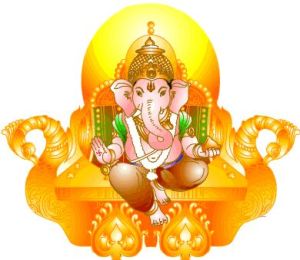
Some of you might know that I am really quite fond of the Indian deity, Ganesha . Do I believe that a man with the head of an elephant actually exists or ever existed?. Of course not. Do I actually think that he resides in the lovely painted icon that sits by my bed? Well, obviously not.
But do I believe that there is a spark or aspect or attribute in all life, in you and me, in nature, in (scary word time) creation, that we can tap into to help us overcome obstacles? Or that we can access when we begin new ventures of whatever kind, or when we need strength to face challenges? Yes, I do. Very definitely.
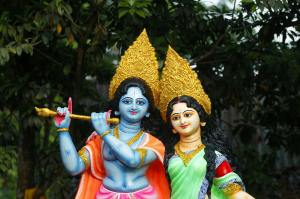
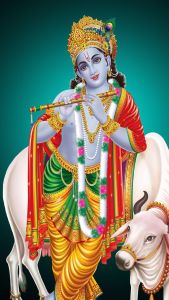
And do I believe in a blue boy called Krishna who lived in India 5000 years ago and spent his time playing in the fields with the village cows and his friends, entertaining them with his flute? Again, of course not. Does he live in the other beautiful icon by my bed? The answer is obvious: no.
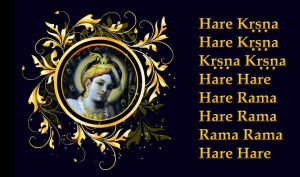
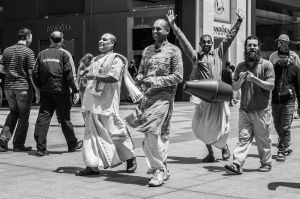
But do I chant the Hare Krishna mantra in an effort to come closer to the divine that is… well, that just is? Yes, again, very definitely.
Words. It’s all only words. Only words? Only??
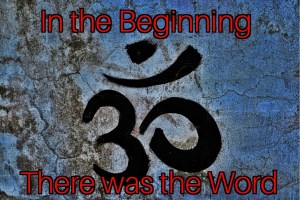
In the beginning was the word, and the word was with God and the word was God. (from the opening of the Gospel of John)
Not too long ago, I completed what I’m now calling my first formal (structured) study of the entire Bhagavad Gita. Of course this wasn’t my first exposure to that text: I’d been reading it on my own for a few years before I came upon a teacher to act as guide.
Anyway, since that bitter-sweet day of completion, I’ve been looking at ‘random’ verses on a more or less daily basis as a way to keep in touch and to act as a reminder of what I’ve learned.
Just opening my Bhagavad Gita at random, just to see what the universe wants me to think about.
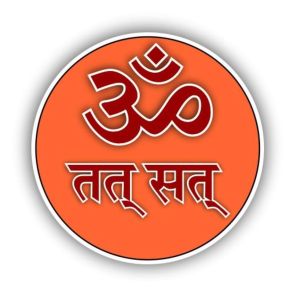
Today, I happened to open it up at what are a series of my favourite verses. (I know I’ve got a lot of favourites; it’s that kind of book). In these particular verses, Krishna describes the meaning and significance of the mantras Om Tat Sat.
In a nutshell, these three syllables, these mantras, are a way of describing the Absolute Reality of the Universe, or God, Consciousness, the Truth, the laws of nature and the universe. Whatever names we might use to encompass all existence.
Krishna details when and why to use the mantras (it’s one mantra made of three, for the technically minded). Again in a nutshell, it’s a mantra to use whenever we perform our duties, basically any actions, with a devotional mood.
By the way, that, and the inclusion of my favourite image of Krishna, doesn’t necessarily imply that our actions have to have a ‘religious’ intent or flavour: Any action we undertake, for whatever purpose as long as it is motivated by Truth, Love and right thinking, qualifies as being devotional.
While you can see the actual verses yourself via the Om Tat Sat link above, I would like to share with you my very liberal paraphrasing of Krishna’s teaching on the mantra. Also, I am adding a few observations of my own that I hope serve to clarify this great teaching. Oh, please forgive any repetitions, if they occur.
The syllables Om Tat Sat are the symbolic representation of the Supreme Absolute Truth; what I choose to describe simply as all that is. It is called by any number of names or none. It’s existence itself.
It’s an ancient practice, this chanting of these three syllables as a mantra. It is recited when one is engaged in any action in a mood of devotional service. Meaning any act that is imbued with a prayerful attitude and feeling, and with a mood or attitude of devotion to and recognition of, Truth in all things.
And it includes any and every action we undertake, from washing the dishes, to sitting in meditation or silent contemplation. And everything in between.
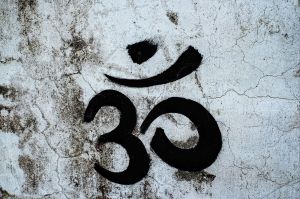
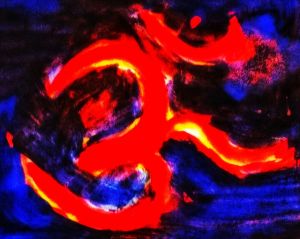
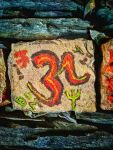
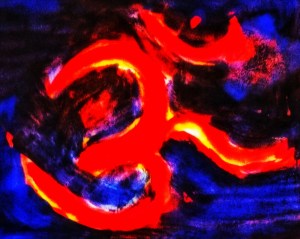
Om
Om is sometimes called the primordial sound, the creative principle, the word from which all creation sprung. I’ve also heard it defined as being the Big Bang, from which the universe emerged.
Om is considered the sacred sound and word by many cultures around our world. Consider the opening of John’s Gospel in the Christian New Testament :
Om is to be chanted when beginning and performing any and all actions motivated and driven by Truth. Chanting Om assists us to actually realise or understand with our heart and not just our mind, the presence of the divine or the universal consciousness in all that we do.
Tat
Tat is chanted by those wishing to be freed from attachment to material things, which includes the desire or compulsion to enjoy the fruits or rewards of our actions.
In the beginning was the word, and the word was with God, and the word was God
John 1:1 New Testament
Attachment is when we depend for our well-being or happiness (physical, mental, or spiritual) upon another thing (money, job, status, etc), person, or desired outcome. Attachment (and clinging, extreme longing, compulsivity), Buddha told us, is the cause of suffering: when things are going well with the things or people we are attached to we are elated; when things aren’t going so well, we are miserable and we suffer.
Sat
The syllable Sat indicates both reality and goodness. In other words, Sat is used to represent that Absolute Truth or Universal Consciousness that we’ve been discussing.
Sat follows very nicely on from Tat as it helps to strengthen our Dharmic (motivated by what’s right and true) actions, so that they actually become Sat – Truth.
So, chanting Om Tat Sat when performing any or all our activities in the world (as well as within) will help us to come to realise or understand that there is only the one Absolute Reality, the one consciousness that is not only universal in nature, but is actually the universe itself.
Oh one more quick note: Often you hear the chant with an extra word up front: Hari Om Tat Sat. Hari is a way to address that which removes darkness, that aids in the shining of the light of knowledge.
It’s a word that represents that Absolute Reality that we’ve talked about here. It can also refer to King or Lord, or otherwise influential entity. I find it rounds out the chant, and I like it!
Please feel free to explore Om Tat Sat for yourself. You will find a lot of great recordings of the chant on YouTube, and the wikipedia link at the beginning of this post is very Illuminating as well.
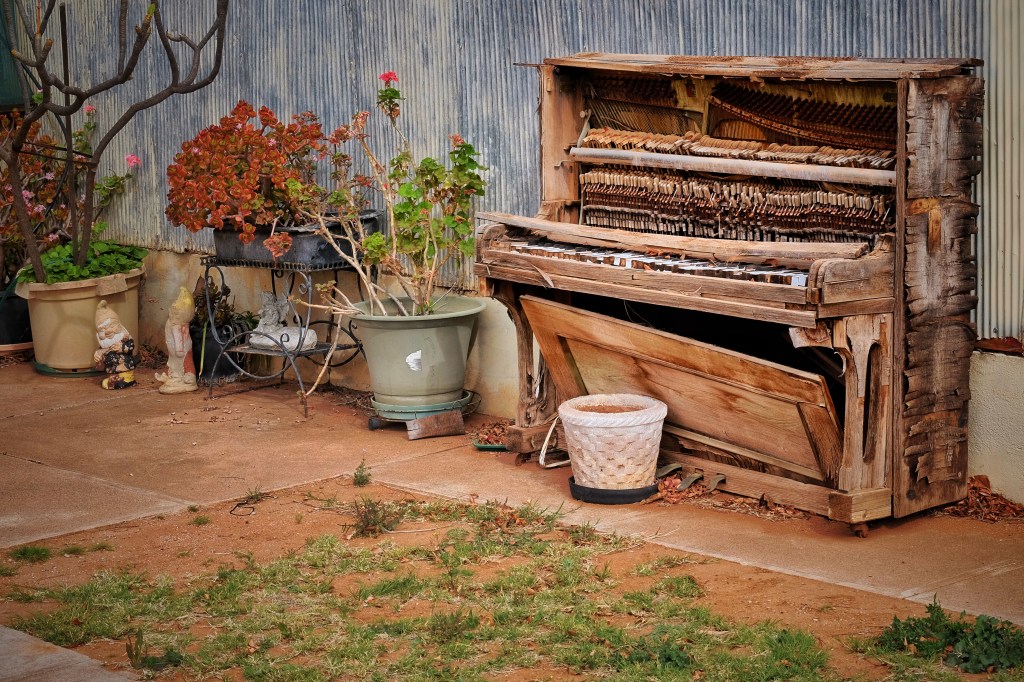
When thinking about a name for this photo I was really tempted to somehow reference the song American Pie by Don McLean. The phrase from the lyrics ‘the day the music died’, kept coming to mind – even as I made the photo of the scene.
And there was that brilliant MASH scene coming to mind. In the scene there is concert pianist who has lost the use of his right hand in battle. One of the doctors attempts to encourage him to not allow the music to die, to find other ways than actually playing piano to share the music.
Both connections seemed obvious: a very old dead piano decaying, returning to old forms of itself. But then it struck me: it was the instrument that had died and was changing forms. All material things change, die, becoming something else.
The music on the other hand, hasn’t died. It not only survived that plane crash and the transition of those three singers, it has thrived. Their music lives on. Music can’t die. Why?
Because music is life. Vibrations, harmony, and sound itself, are the foundations, the roots of ‘life the universe and everything’ (to borrow an old expression). As such, music is not a tangible, physical thing and it needs an instrument to make it manifest in the world; music merely passes through the instrument and emerges into being.
I liked that MASH episode. The doctor (stuffy Major Winchester) says to his patient, the wounded pianist, that as a skilled surgeon he has hands that ‘can make a scalpel sing’. But really, what he’s wanted all his life to is to experience music the way the pianist has.
He says he can play the notes, but he doesn’t have the gift that would allow the music (as in Chopin, Brahms and the rest) to flow through him. He tells his patient, who is depressed and unwilling or unable to consider that the music may not have died:
The gift does not live in your hands. The true gift is in your head, and in your heart, and in your soul.
Major Charles Winchester
Hearing that line again reminded me of Om. There are a number of religious traditions that consider OM (sometimes spelt as AUM) to be the primordial sound, the very source of creation. The word itself, when written is considered sacred.
Then there is the verse from the Christian Bible that makes the exact same assertion:
In the beginning was the word and the word was with God and the word was God.JOHN 1:1-3
Well, music needs an instrument – whether in the form of a voice, body, mind, or in an object made of wood, strings, brass, or something else – in order to manifest into the material world and to be experienced by us.
Just think: the piano in my photo in the front garden of a house in a mining town has most likely allowed many generations to experience music. Accompanied them in celebrations and greivings; helped so many through good times and bad times; witnessed people laugh, cry, and even dance;
Of course, Major Winchester’s gifts as a surgeon are that he is a instrument for the vibration, the music of the universe, to make itself manifest in another way.
And what he is essentially saying to our wounded pianist is: ‘Look you can shut it off forever (his words) or you can continue making your gifts – your Self – available as an instrument that allows that music to come into the world for everyone to share’.
Well dear friends, I have pledged to carry on using my gifts and be available in just that way that allows the music to come through me in whatever form and shape it takes.
By gifts I mean those things that have been granted to every living being: the ability to create harmony; the ability to make and spread good vibrations; and the capacity to appreciate and celebrate beauty.
And when you think of it there is no way to put a limit on the number of ways that the music that is Life might be channelled through each and every one of us
A good place to pick up some good vibes, get into harmony with yourself and appreciate beauty, all at the same time
In my own ways I try to make harmony in and around myself as much as I’m able. I am always attempting to cultivate behaviours and attitudes that help to create and spread good vibes. And I constantly seek to appreciate beauty, even when the world seems to be only ugliness.
Of course, as I say I am only the instrument. The music -the beauty, good vibes, and harmony – exist with or without me. But music in whatever shape and form it takes needs an instrument if it is to come into our material world and be there for all of us to share.
So, this is my prayer: that at least every once in a while, every now and then, I can actually be that instrument .
PS Just a little postscript. When passing that particular garden (the piano garden I call it now) I was drawn to this:
Eagle-eyed Garden Guardian
Just as I photographed this lovely creature, I heard my partner’s voice:
‘Did you see the piano?’
Now being in what you’ve heard me call the Zen Zone I was fully focused on and absorbed in, our winged friend. Coming back from wherever I’d been, I did in fact notice the piano.
You see, you just never never know where the music is going to come from. I might not have seen the piano with my own eagle eye but lucky for me music had a ready and willing instrument standing by to remind me of which way to look.














 Notes from the Hermit's Cave