Reaching for Freedom?

Reaching for Freedom

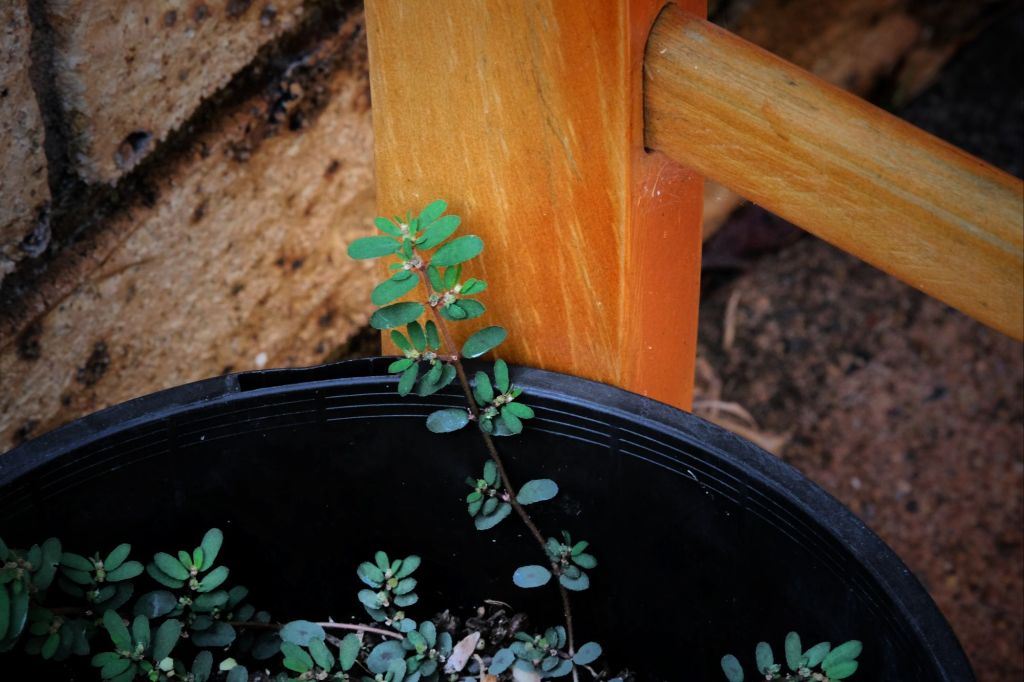
Reaching for freedom is what I called this photograph that I made today. But, is it really? I  mean is the plant actually in reality ‘reaching for freedom’?

Well, thus far, science can only tell us something like: This plant is programmed by its DNA to grow upwards towards the light.

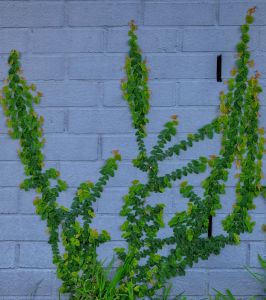
Another climbing plant, in another place. Kind of looks like a painting, but it’s real

True, of course, but, here in this scene, that one shoot in the centre does appear to be reaching for the chair leg – perhaps for support? It’s quite common for me to see plants using all kinds of supports to do their upward growing (think Ivy on a wall). I think that in a few weeks, that tiny shoot might just be half way up that chair leg – or maybe higher!

So, as I came across this little scene, I questioned. No, questioned isn’t the right word. When I saw this reaching happening only a day after placing that plant pot in that spot, I made a declarative  statement: I said, ‘There is an intelligence at work here.’

Am I saying that this little plant has a brain that is continually figuring out strategies for the plant’s growth and other behaviours?

Am I saying that there is a ‘god’ up there in some heavenly domain who is in charge of getting plants down here on Earth to grow in the right direction?

No, to both questions. I don’t and can’t accept either of these supposed ‘possibilities’.

But, are there some kind of universal laws that regulate and control how the Universe flows, behaves, evolves and the rest? More likely I think.

Again I am not suggesting there is some kind of controlling ‘entity’ separate from the material universe, or a supercomputer somewhere that’s running the whole thing. More a kind of energy or essence that’s built into all material things, and that is an element of the very existence  of things.

A regulatory principle, I guess you could call it. But not some imposed or externally dictated regulations, laws, or controls. I think it’s more natural than that: existence is its own regulator and controller. Or so it seems to me in my good moments – such as when I witnessed this unfolding and evolving life drama.

Tripping On the Sidewalk

Walking home, returning to the sanctuary of the hermitage, I fell over. Or to be exact, I tripped.

It’s not the first time I’ve tripped in my life, and I’m sure it won’t be the last. Mind you, I’m not supposed to be making speculations about the future; after all, I may never fall over (or trip) again.

Let me share with you how I came to find myself lying on the ground, fully conscious thankfully, with only a few grazes on arms and knees, and a sore spot on the side of my head.

Walking along the sidewalk quite freely, earbuds feeding my ears and my heart my favourite mantra to Ganesha – known as the remover of obstacles and the God of wisdom. (more on the earbud issue later)

At one point I noticed, a few metres ahead, what appeared to be the back of a largish sign board leaning against the base of an electricity pole growing out of the pavement.

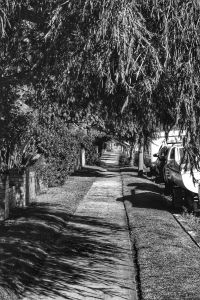
Not the actual sidewalk

Without any thought whatsoever, as I came up to that pole, I turned my head to the left to see what the sign read. Next thing I know, is I have the sense of falling. Later I remembered that at the exact moment I turned my head, my foot caught the broken and uneven edge of a slab of the pavement.

I was blessed by two passersby who stopped and helped me back to my feet, and stayed with me as I regained some semblance  of my bearings. Thank you to those two good and kind ones.

Now, I don’t like falling over (well, when you think about it, who does?), but in this case I can say through this fall, I have learned a couple of good lessons.

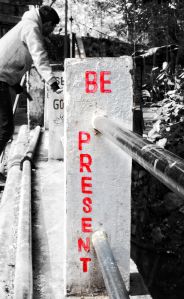
Presence – or lack thereof. Here I am, the hermit monk who is supposedly constantly practising being present, in the moment, here and now; yet I tripped over what I later discovered was a really obvious, clear obstacle on my path.

We all get distracted, you might be thinking. And, yes, it’s true. We can be paying close attention, fully focused, riveted to and in the moment, and, suddenly distraction barges in – in the form of a thought, an external noise, visual imput, and even a broken pavement. You name it, and mind will use any excuse it can to manifest a distraction.

Another lessen – intimately related to presence –  is pausing, or not! As I noticed that sign coming up, I could have chosen to pause to look at it once I reached it.

Then, rather than being a distraction, looking at that sign would have simply been another moment in the ongoing flow of the present. In other words, there’d have been no tripping.

The actual earbuds in question

Now, to the earbud issue. To be honest, my earbuds have more or less replaced my regular over the ears headphones. Because I was never comfortable going out and about with those clunky things on my head and earbuds have allowed me to listen to music pretty much whenever and wherever  I go. Even to me wearing them, they are barely noticeable. It’s possible that’s the problem right there: unnoticeable.

More than 30 years ago now, I spent every Tuesday evening for a year attending classes at a school of philosophy . To this day I still follow some of the practices I learned there. And, passed to me were so many good lessons, so much good knowledge drawn from many of the world’s spiritual and intellectual traditions. So many of these lessons have stuck with me.

Presence, or rather the benefits and rewards of realizing  the present is all there is, was I would say, one of the cornerstones of those teachings.

One illustration about presence concerned driving, and although at the time I haddn’t learned to drive, it resonated with me. Our teacher told us that, when she was driving, she never listened to music or anything else. She told us that she simply put her full attention on the task at hand: driving.

She described how it often happened that when driving she’d reach her destination with little or no memory of the actual act of driving or any landmarks or events on the trip itself. She said it was if she was somehow unconscious, yet still able to drive ‘on autopilot’ was how she put it.

And of course it’s not a phenomenon limited to driving: how much of our routine daily activity runs on autopilot?

Anyway, back to the other day and me grooving to Ganesh in my ears and tripping in a moment of inattention.

I don’t recall being distracted by the mantra in my head, or moving on autopilot. But, thinking back, I was in one of the busiest sections of the little town that hosts our hermitage. I’d been to the supermarket, the parking lot of which is as busy – and crazy –  as one you would find in any big city.

Just another sidewalk tripper

So, I realise now, I had already kind of set myself up to fall for any distraction that happened to come along. While I don’t really remember myself as being ‘unconscious’ of my surroundings or of the path itself, clearly I wasn’t completely there, not in the here and now sense if you know what I mean. Just an after thought: who remembers ‘being unconscious? Nobody I think!

Whatever I say now, I wasn’t present; I wasn’t fully in the moment, not paying attention to either what I was doing or what was going on around me.

Since my little trip, I have vowed before my hermit community to not ever walk again in a built up and busy area wearing my earbuds.

Not only do I have a sense of danger lurking when I think of the idea of wearing them in those situations, but I also feel that it’s not exactly being present, in the here and now is it?

Another closed cafe on some other trip

Okay, I am very sure you are waiting with great anticipation to learn what what fateful sign, put in my way by the Universal Traffic Controller to push me into changing direction, actually said:

It was a handwritten advertisement for ‘great coffee’ to be had in a cafe across the road. A closed cafe I might add.

On Main Road –  a road that more than lives up to its name –  perhaps there are worse fates awaiting the inattentive than merely tripping on the sidewalk.

Where? & When? Here & Now


There, dear friends, right there, in the title are our next two W questions, as well as the answers to both.

The answer is brief, succinct, right to the point, yes indeed. But somehow to me it doesen’t seem very helpful, a bit vague.

Here and now. Let’s look at this tricky little phrase. On the face of it Here and Now has an obvious meaning: if we choose to think on it in the spirit of our ongoing contemplation on my prayer life, it’s very clear. Here and now is a timely reminder to me to pray right where I am, right now, wherever I might be; and whatever the time, day or night.

But it’s not really a very satisfying answer is it? Here and Now? It seems too flippant to me, too bland, even a bit of a ‘catch all’ cliche thrown around without any real insight into its meaning or importance.

Anyway, moving right along …

We are exhorted to pray without ceasing in the Christian Bible with similar exhortations found in so many other texts and scriptures from many faith traditions.

Remember my aspiration to make of my life a prayer? Well, that’s the idea: to pray without ceasing. Which translates to mean that everything I do, say, think, feel (what else?) will be prayer – or I can also say a prayer. Life is a prayer, life is lived as a prayer.

Of course the precise forms my prayer takes are – and will ever be – many and varied. We’ll be looking at some of those forms and types later in the How post of this series. But, for now, allow me to brainstorm on the topic for a bit.

Consider washing the dishes, a task we all find ourselves engaged in to some degree or other. I have a sense that my feelings towards dish washing is actually quite neutral. Don’t get me wrong: if I never had to wash a dish again you would not hear me complain.

At the same time, I have absolutely no hard feelings against washing dishes.I just get on with it, just like most everybody else.

Sticking with dish washing …

Most often dishes need washing as a consequence of preparing, cooking, and eating food, for a meal or meals. Right there is an obvious opportunity for a simple prayer of gratitude.

It might be a simple whispered thank you for the gifts of the nourishment, satisfaction, even pleasure of the meal. Anyway, just a random first thought on the subject.

There are a few other points to be made in our little dish washing thought exercise as it fits into my own prayer life.

Sometimes, while actually dish washing and cleaning up, I might chant mentally, or otherwise pray with words – set prayers. Prayers of praise or gratitude; mainly whatever pops into mind. Go with the flow is the theme here.

Now, that’s one thought. Next: I might decide to be quiet while washing up. That is not speaking and being as silent inside as I can be.

On these occasions I just focus as intently as I can on what I’m doing: washing dishes. I make it an occasion for not doing the dishes just to get them done, or to get them out of the way, or to put an end to an onerous chore.

Rather, it’s more an opportunity to simply wash the dishes, by being with the dishes and the actions required to clean them. Just a little aside: this particular form of mindful (prayerful) dish washing actually results in cleaner dishes. It’s been proven scientifically.

These two approaches to washing dishes – not to mention all the other means and forms of prayer – are not necessarily mutually exclusive, nor are they the only one: a given dish washing event might involve several prayer modes.

Which leads me to the next thought that I had more or less forgotten…

Sometimes I do indeed slip into that old ‘Just get the blank blank things done’ frustration mood. And it doesn’t just happen when faced with the dishes!

It goes without saying that I wouldn’t need an aspiration if I was already acting full time in that prayerful manner. I do practise – sometimes with more determination than others – performing all my actions mindfully (aka prayerfully), though there’s far to go for me in the praying ceaselessly department.

So, to a good question you may be asking: Is there somewhere (or multiple somewheres) that I go to to pray? Some special sacred or holy place?

Well, I know that we are always all of us standing on sacred ground – it is all the Divine. Still, there are places that help me, all of us, feel closer to that divinity, to the sacred, to God, or whatever we call it.

There are places that exude that special vibe, or have a certain  atmosphere of calm, quiet, or stillness, that are conducive to prayer.

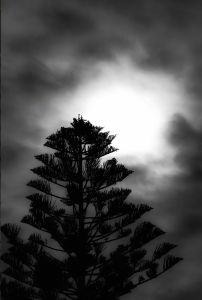
An apparently random glance skyward blessed me with this moment and this place of prayer

Talking about the idea that we are always standing and walking on sacred ground,  there are often places I come across that speak to me as places of prayer. It might be a tree, like the one pictured here; it might be a  distant view of a lake and the hills beyond.

Such places call to me to stop. Perhaps for a moment, perhaps to sit and linger and pray with words, or with silence.

In the Hermitage, there is  temple, a room we have set aside for that purpose, and no other. From the very first day I set this room aside as a temple, I have felt a stillness there, a tranquil vibe.

Among such spontaneous  little moments, there are times I simply stop and stare at a flower, or without thought put my hand on a tree. I will whisper a quiet thank you and a blessing to the Divinity I sense there.

Temples, churches, chapels, prayer rooms, mosques, and other types of sacred sites from andy and all spiritual and religious traditions, attract me as well.

These are all places people have spent time in praying, contemplating their lives and their union with the Divine. All that energy, all that love and devotion has caused an atmosphere of holiness, or sacredness to build up over what can be years, centuries, even millennia, in some places I have prayed.

But, really, when all is said and done, anywhere and anywhen can be and is a place for prayer. Here, in this booth, in the cafe at the lakeshore near the Hermitage, I make these notes in a mood of prayer, a prayer of love and devotion.

Being present, mindful, and prayerful in all I do, that’s my aspiration. Here and Now. Anywhere and anywhen; it’s all prayer.

Well, that’s my prayer anyway.

When You Say It All in a Text Message

It wouldn’t be quite correct to say that I never get calls or texts on my phone. What would be correct is to say is that the vast majority are to do with what I might call The Bureaucracy: Reminders of Doctor and dentist appointments, notices from various government bodies, library notices; all that kind of thing.

And there is another emerging category that’s actually a lot more welcome: while my partner hermit and I have always phoned each other, lately we’ve been texting more and more as an extra way to communicate with each other.

Sometimes these texts are about the mundane things we all have to do in the world, but then there’s another dimension in which texting allows us to keep in touch with each other’s feelings, thoughts, doings, and simply as a means of keeping the connection open and strong.

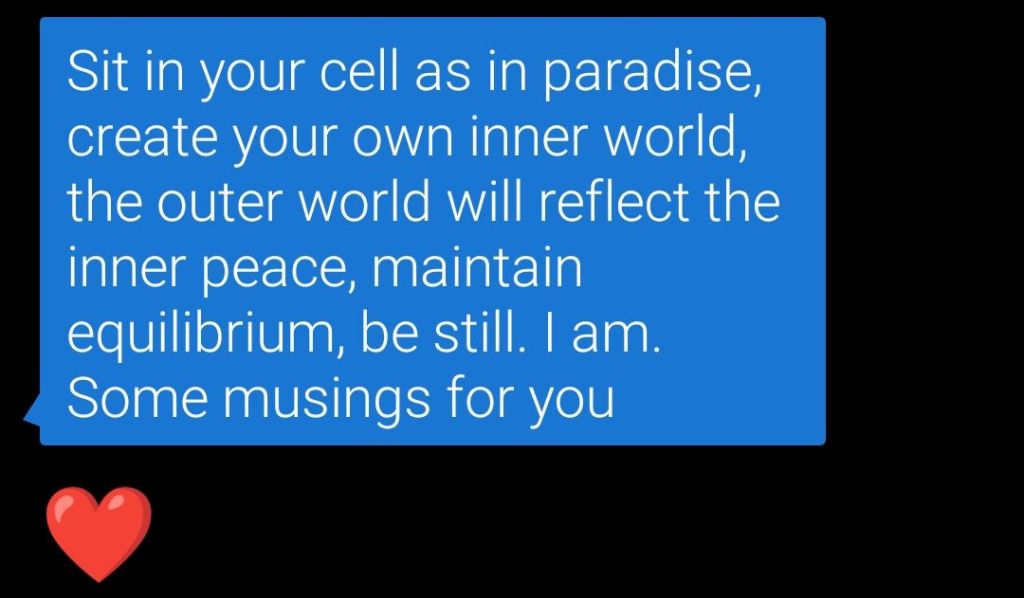
The other day, for example, such a text arrived unannounced in my phone. Like some I get from The Bureaucracy, this one was essentially a little series of reminders. But rather than being about the things of the outside world, these ones, in this text, spoke directly and deeply to the enrichment of the inner life – my inner life.

Powerful messages, all of them, that really go to the heart of one’s (my) efforts to live a life more centred on my spiritual quest and my commitment to living more in sync with Absolute Reality.

On first reading of this text (and on each rereading, of which there have been many), I really felt strongly that I needed to contemplate deeply and prayerfully on the pieces of this whole. And, as well, to share my reflections with you.

Sit in your cell as in Paradise

This little – yet tremendous – injunction references an answer to a question posed to Abba Moses, one of the early Desert Fathers:

Go sit in your cell and your cell will teach you everything.

Essentially Moses’ advice is, remain within the confines of your dwelling place – whatever and wherever form that place takes. This can be a literal geographical location, or even your own body as it moves in the world. We all have a body, we all dwell there.

Sitting in one’s cell is not a simple or passive activity. It is in fact hard work as we wrestle with the mad monkey mind, and attempt to grow spiritually.

So, what about the ‘as in Paradise’ bit? Well, to me this feels very much like thinking of one’s cell as the place to be. What I mean to say is that it’s the only you can possibly be in right now, in the present of the here and now.

It’s not about judgements of is it good or bad, pleasant or unpleasant, painful or not. Just acceptance of where youu’re at right now. Doesn’t mean you’re stuck there and by no means suggests you resign yourself to your circumstances. It simply means you see it like it is, at this moment.

And it’s about understanding that, while you are in that place, it’s where you know you need to be. Your cell – your dwelling place – has within it everything you need to live, grow, learn, and prosper in the spiritual life.

Whatever the ‘place’ you are in is like, we can try to cocoon ourselves, make a space within the space, even if it is just being aware of our bodies sitting in the space. Cocoon myself is an expression I’ve been using lately to describe the act of isolating myself in any way I can from my surroundings. This can apply on the macro scale or the micro as we seek to centre ourselves and find quiet and a peaceful place.

It’s not as if in this cocoon (or whatever it might be)  that  all will be bliss and light all of a sudden. No, I think the suggestion here is we try to develop an attitude of non-attachment towards the things of the world that trouble us, those things that cause us suffering, precisely because we are attached to them.

That is the purpose of sitting in your cell. That is the everything that your cell will teach you.

You know my friends, I’m a bit weary tonight, and with your permission I will continue with this sharing of my contemplation, my reflections, in my next post.

Thank you for staying with me.

Peace and love

Paul the Hermit

Less Desires, Less Entanglements Equals More Freedom

Along with many other spiritual seekers across many world cultures and over time as well, I have a more or less daily practice of opening a spiritual book, scripture, or other text ‘at random’ (as if there is such a thing) to receive a message, a lesson, or a little bit of guidance for the day.

In my case, that text has for ages now been the Bhagavad Gita. And over I think the last two or three years, one verse in particular has come up time and again, sometimes on two or three days in a row.

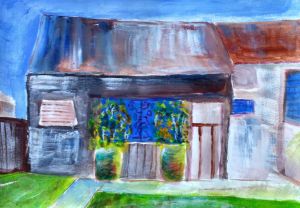
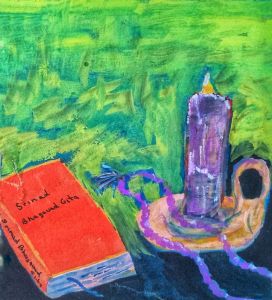
Much thanks to the Hermit Pilgrim who created this beautiful painting

So frequently has this occured that not only have I neglected to examine the verse in any depth, I actually began to ignore it when it came up and went right away to pick another one at random.

Well, this morning, I opened my Gita and there was that verse again – for the second day in a row. However, today, for some reason, I realised that this verse has been calling out to me. Or put it more sensibly: the Divine has been calling on me to take some notice of this verse and its meaning.

So, first of all, allow me to share with you the verse in question.

The Lord of Sri said:

It is said there is an eternal Banyan tree with its roots growing upwards and branches downwards, whose leaves are the Vedic hymns. One who knows this tree knows the Vedas

         Bhagavad Gita 15:01

For me at least, this verse has always appeared quite complicated, complex really, and full of symbolism. Of course, being from an ancient religious text, it’s likely to be all those things isn’t it?

Still, despite reading the verse many times and studying and hearing a few commentaries on it, for some reason it has remained for me rather daunting. At least I can say that I was convinced of the notion that this verse confused me, entangling me in convoluted and sometimes upside down thinking.

Like the Banyan tree itself I guess. Considered especially sacred among all other sacred trees in India, the Banyan is well known for its way of growing willy nilly, every which way, until the whole thing becomes a complete and dense tangle.

And it is this tangle that is at the heart of the metaphor used to illustrate the lesson in this chapter of the Bhagavad Gita: The tree is Samsara, the illusion that is the material universe in which all of us living beings are entangled. It’s as if we’ve walked into that tangle of branches and roots believing that’s where we will achieve our desires.

A major city in the middle of tourist season is another neat metaphor for this tangle we’re talking about. We look for worldly pleasures there, but find chaos, confusion, and often unhappiness

We are so attached that we identify completely with that physical world (convinced we are merely physical beings ourselves) and are convinced that this is where we can fulfill all our needs.

As the verse says, the leaves of the tree are the Vedas, and one who knows the tree, knows the Vedas. The Vedas are the sacred Hindu scriptures which in this context can be said to represent knowledge. But not knowledge of a mundane ‘ordinary’ kind.

The knowledge to realise (because we already possess this knowledge, we just aren’t aware of it yet) is that we are not the body, so we have no need to be bound to the tree of Samsara with its suffering and its endless entanglements. It is Self Knowledge.

This Self Knowledge leads us to develop what a following verse calls ‘the weapon of detachment’ with which we can chop down this very strong tree of attachments and illusions

A little note: I don’t like this weapon and chopping metaphor at all. I simply pass it on to you as written.

As we begin and progress with this process of truly realizing we aren’t the body, and therefore have no need to identify with or be attached to worldly objects and desires, then slowly the tangle binding us begins to clear, to fall away bit by bit.

I din’t think we need to actually get to that point of cutting down the whole tree before we begin to see results. to reap the benefits if you want to put it that way.

Each and every small thing, desire, compulsion or aversion we no longer feel ourselves bound to, frees us just that much more.

As with any tangle we get ourselves caught up in, once we loosen that first thread (to switch metaphors), the task of unravelling becomes easier.

It’s true – and I think I’ve mentioned it previously – some of my attachments and compulsions are loosening. Some (small ones I admit) have fallen away completely.

As you read in my little note, I’m not comfortable with the whole cutting down trees with weapons metaphor. Perhaps the loosening of threads, the unravelling of tangles and knots sits better with us.

Perhaps my – our? – efforts at detaching from the desires and aversions, from the compulsions for worldly things and objects, and for sense pleasures, can be achieved by a more gentle untying we could call it. A kinder, gentler, calmer, friendlier, means to realizing we are already free.

Why do I Pray?

‘Why do you pray?’ I ask myself. It’s not a rhetorical question: I really do want to know; it’s one of those big ‘Who am I?’ kind of questions.

‘I pray because I pray,’ I hear myself answer, sounding as if I am indeed responding to a rhetorical question.

‘So’, one might think (as I well might and sometimes do) ‘you pray without any ulterior motive at all? You don’t pray to get things? You don’t pray for healing for others or yourself? You don’t pray for peace and happiness for the world or yourself? None of these things?’

These are good, valid questions. And the answer is of course I do; of course I pray for healing for others and myself; I do pray for communal and personal peace. And happiness? Well who doesn’t pray in one way or another for happiness?

I do, however draw the line at praying for material things like money and physical objects to possess, that sort of thing. I believe  I don’t pray for ‘things’. I think so anyway.

So, what do I mean when I say ‘I pray because I pray’? Well, it’s not so much that it isn’t true, its just that at this moment that praying for praying’s sake isn’t the whole of life activity that I would like it to be. I would say it is a core aspiration that I am working towards.

You see, I want to pray, and to make my whole life a prayer. A prayer of praise and devotion; a prayer of gratitude and loving; and a prayer of service to all living beings.

If that’s the aspiration, then how come I’m still praying for all that other stuff of the world? Healing, peace, happiness, and the rest? How does that work one might ask (as I might and sometimes do ask myself).

Here’s what I’ve figured out so far: I have a strong sense that any prayers or prayerful activities I might make, are like vibrations, or ripples that interact with the vibrations and ripples emanating from countless, infinite even, other beings and from the fabric of the Universe itself.

In other words, not only the ‘created’ Universe, but the consciousness that is the origin and cause of the Universe, which is in reality life and love itself. Prayet is a way, I think, to make manifest an already existent link or union with what the hermits call the ‘Invisible Community’.

For example, if I’m chanting my mantra at any time day or night, I know that there are at least tens of thousands, if not millions of other beings all over the Universe doing exactly the same thing.

What I’m trying to say here is that, until I reach that pure state of making my prayer solely for prayer’s sake, for praise, devotion, gratitude, then it’s okay that I still pray for things that speak of a clinging still to the world (within my own boundaries of course!).

After all, all those creatures in who knows how many worlds and realms, all praying at the same time? There are some very powerful vibrations we’re talking about here.

I’ve been studying and thinking abut Bhakti  – the absolute pure love for and devotion to God – for a while now. And, for me, God is all those other living beings and the Universe itself (or better to say, all that exists, which I might add includes me!). So, in that sense praying for healing, for peace, for happiness, well, it’s good for us all.

The Q&A in the Scripture Part 4

A sooner rather than later return to our supposedly occasional series on the Q&A between Uddhava and his cousin Krishna on the eve of their departure from their soon to be engulfed in the nightmare of war hometown.

So, why sooner? After all it’s not been that long since our last installment. Well, I was just reading through my notes and the questions and answers we’re looking at today just sort of jumped out at me, asking to be contemplated. So, here we are then.

It’s another two-part question, but unlike with previous questions, we can look at these two in the one post. The reason being that the answers to both questions are, if not quite the same, are very closely related, as are the questions, come to think of it.

Okay, to the questions. Uddhava has already worked through quite a list, but now he gets to, what seem to me to be a couple of biggies:

What are reality and truth?

You see? I did say they were big questions. When you ask what’s reality and what’s truth, then you are really reaching for, well, I guess, what’s real and what’s true. No dilly-dallying, just right to the heart of things.

But, why these questions? Well, look at it from Uddhava’s perspective: his whole world, the only home he’s ever known, is about to be devastated by war. His world is completely turned upside down as he prepares to leave for an uncertain future perhaps never to return.

Like any of us, he’s probably on the verge of despairing, wondering to himself, ‘Is this really happening? I can’t tell what’s real anymore.’

Well, Krishna’s answers are short and succinct, and to the point. A lofty point, but then it would be wouldn’t it, coming from God?

Anyway, his answers:

Reality is seeing all the same.

and

Truth is the true speech uttered by the wise.

Reality does sound very dull if we take Krishna’s answer at face value. But he’s not talking about what we see with our physical eyes; he’s meaning seeing as in understanding, true realisation, as in ‘Ah yes. I get it now.’

But, ‘all the same’?

Obviously all the various beings in the Universe have their own unique names and forms and attributes; clearly they are not tall the same.

No, what Krishna is getting at here is that all beings in the Universe, all living and non-living things, are manifestations of the Divine. At that level all beings are one as the Universal Consciousness that pervades and underpins all that is in existence. Actually it’s not exactly right to say pervades and underpins: rather, consciousness is all there is, and that all is the Divine.

In other words, all beings are one and the same divinity. All the rest, all that we are and see and experience in the physical world are just those names and forms.

I’ve been told that there can’t be any exceptions to this reality, because there is only the one reality. Reality is non-dual in other words. One without a second as I like to say sometimes. One not followed by two and so on. Seems to me to be a simple way to describe this mind boggling (more like mind exploding) concept of nonduality.

Now, to the answer to Uddhava’s second question. Who are these ‘wise’ who utter ‘true speech’. And what is true speech anyway?

Well, the wise are those who have fully realised for themselves the answer to the what is reality question we just discussed. As you might guess, that’s a very small group of enlightened people.

Having said that, the answers to both questions mutually support the other. They each reinforce and promote realisation or understanding of the other.

Ritam (the Sanskrit word Krishna uses for Truth in his answer) is ‘expressive of the whole truth’, one dictionary tells me. It adds that it’s also a state of consciousness, though it’s probably more accurate to say that the ‘whole truth’ is a state of awareness, a state of being.

True Speech, is not just about what comes out of our mouths when we speak. Of course it can and does include what is spoken, written, thought and so on, but also encompasses our lives as a whole. It’s a state of being as mentioned above, and true speech includes all how we are in the world.

In other words all our thoughts, words, and actions.
True speech has to, obviously, be true. Sounds redundant  to say so, but because it’s not only about what is actually ‘spoken’ in words, it makes sense to mention it.

True Speech has to be pleasant. I think this isn’t to say that all that is true (in the world of matter) is necessarily nice; I think it means that in our attitudes, actions, speech itself, and thoughts towards other beings and ourselves too, we should be guided by courtesy, consideration, compassion, generosity and kindness. Love thy neighbours and thyself, in other words.

Last but certainly not least, True Speech is beneficial. In other words, your actual spoken words, as well as your thoughts and deeds in your life as a whole, should be intended to be beneficial for all concerned (which once again and significantly means you as well), or at least with the intent of causing no harm.

True Speech, the Truth, or Honesty, in our thoughts, word and deeds, come with these, what we can call three criteria. Just because you hate a new freind’s new hairstyle and you feel an obligation ‘to be honest’ doessn’t mean that if you hate it you are                           required to tell them it’s ugly and add for good measure it doesn’t suit them. That ‘letting it all hang out’ version of so-called ‘honesty’ is nothing of the sort, and doesn’t meet the criteria for being True Speech.

I mean to say that while it might be true in your opinion, and you deliver the bad news in a nice, pleasant and charming manner, still does not make up for the fact that, far from being beneficial to anyone, your supposed honesty is in reality hurtful, even cruel.

So, the reality – as in there is only one – is that I, and you, along with all other beings, are one consciousness . Our bodies, minds, our individual lives and ways of being in the world, may all be very different, and transient, but consciousness is one, whole, indivisible, indestructible , and never changing.

And, if we as individual entities inhabiting physical bodies, would like to act out our lives as expressive of that absolute reality that is our true nature, then our every thought, word, and deed, needs to be an expression of our acknowledgement of that oneness, that unity of one.

In other words, the only reality is that we are in fact that self same True Speech we’ve been talking about. To become wise (borrowing Krishna’s word here), all we have to do is be true. We need to fully realise that we are in fact Truth, and that Truth is all there is.

That’s it really. That’s the Reality.

The Q&A in the Scripture: Part 2

Namaste

And welcome to Part 2 of The Q&A in the Scripture series in which we are looking at the answers given by Krishna to a list of questions asked by his cousin Uddhava in a scripture called the Uddhava Gita.

Remember the scene? Uddhava has asked Krishna a pile of questions about how to live a good life, how to live in the world with discernment.

These questions have become urgent because the cousins are about to leave their hometown which is on the brink of war. Both will be going their separate ways and both know they won’t be seeing each other for a while – perhaps never again.

Anyway, moving right along: In our last installment, we had Uddhava asking the first of his questions; this one happens to have two parts:

What is quietude and what is self-control?

We discovered that quietude is not the state in which one finds peace, silence, our true selves, or the Divine, but is itself that consciousness, that pervades and permeates all that is, silence, peace. In other words, quietude is  the Divine itself.

In the present post, we move to the second of Uddhava’s two-part question: what is self-control? Krishna’s answer is excellently short and sweet:

Dama  (self-control) is restraint of the senses.

Krishna in his response, makes it clear that restraining the (one’s own) senses includes mind as a kind of sixth sense in addition to the five physical senses. In the context you could almost say that it’s his mind that Uddhava is in most need of restraining. Maybe that’s the message for all of us?

Well, we are all well aware of the ways in which we have tried to control our senses; Uddhava knows too. But look at the situation these two cousins find themselves in:

It’s fine for Krishna: he’s returning home to Heaven, or wherever. But, Uddhava, who is also about to leave, is facing more uncertain prospects. He’s experiencing great turmoil, and fear over his and his familiy’s safety as the threat of war closes in. Most likely he’s also grieving over having to go into exile from his ancestral home.

Of course he’d be fearful for the future: where will he go? What will he do? How will he protect and provide for his family? Like I said, an onslaught of mental and emotional anguish.

Still, it does seem that Uddhava is maintaining quite a steady presence of mind. He’s thinking about the future; he is clear about the sort of stuff he needs to find out from his cousin (remember Krishna is God) in order to put and keep his life on the right track despite the challenges facing him now and in the future.

Then there’s the fact that this self-control thing is only one question on a list of 36. Clearly Uddhava is looking for a lot of advice.

Restrain the senses – all six of them – Krishna says. But how? What does it mean, ‘restrain the senses’? I think I alluded to the notion that we all have some ideas, some clues, about how we as individuals might restrain them, but let’s personalise this: What does it mean for me to restrain my senses?

Actually, now I’ve made that suggestion, I feel overwhelmed: Where would I start? Surely I need to do a whole series of posts, just on this one topic alone?

Oh wait, I can start right there. Exaggeration, hyperbole, over-dramatising, catastrophizing, all perfect examples of emotional reactions leaping from an unrestrained senses central: my mind.

Let’s put aside that mental stuff for a little while, and just say that all those emotional responses could do with a bit more restraining training. Just looking at the physical senses to begin with, I can easily say that they also, at least some of them sometimes, need various degrees of working on.

First, my sense of taste: it goes into overdrive sometimes, and then I eat too much. Not so much as in the past, but the restraint has a way to go still.

My sense of sight is pretty good, well restrained for the most part. But there are times when I lapse into old habits and spend too much time looking at a screen and scrolling in a mindless kind of way. Getting there though!

As for my sense of hearing: You might remember a post from a while ago when I talked about letting go of much of my music collection, some of which I’ve listened to my whole life.  I’m doing this because so much of what used to be ‘my favourite’ songs or artists, no longer serve my spiritual growth, nor does much of it reflect the view of life and the world that I’m trying to cultivate.

Well, I’ve made a good start, but occasionally I slip and find myself humming old tunes, or listening to an album that I really ‘should have’ deleted already. Restrained? Sort of, and I’m still encouraged.

Enough! Let’s get straight to the biggie: my mind. If I’m honest, I have to say that my mind, while not exactly in full agreement with my efforts at restraint, is starting to get into sync with me and my aspirations for a more controlled mind.

But still, those previously mentioned emotional reactions like exaggeration, over-dramatising and the rest, are still there. Falling into line, it’s true, still … .

Then there is the (more than) occasional first port of call reactions to pieces of news of various kinds: I’m prone to ask, just as I imagine Uddhava might have: Why don’t ‘they’ control themselves? Why can’t he or she or such and such country or politician show a little restraint?

Yes, I know, we’re all guilty of this one to some degree or other.

My quickness to anger is not quite, but almost, might soon be, won’t be long before it is, a thing of the past.

Then, there’s my tendency to ruminate: rehash endlessly real and imagined events and other stuff from the past – as well as the always imagined possibilities (as well as the impossibilities) for the future.

Again, I know I’m not alone in this emotional roller coaster ride, and I do know that I am nowhere near as much of a ruminator as I was; I have made great strides, significant inroads, and I am encouraged that the end of rumination is getting closer!

And now, here is the one thing I tend to think of one of my biggest, most tiresome and tedious, most annoying conditioned emotional responses: I talk too much. Not as much as I used to, but still too much for my comfort, and for the peace of mind of those around me. More restraint is called for.

Restraint has played its part in reducing my talking. But in a sense the major ally has been the ongoing quest I’m engaged in to discover my true nature, as consciousness, which is really my oneness with all that is.

And here our second question and answer leads us right back to the first: quietude.

I wrote in that post:

Quietude, calmness, peace of mind, are not where  you will find God, consciousness, or whatever we call it.  Quietude and the rest are God. They are consciousness.

Or putting it the other way round: cultivate silence, calm, peace of mind, and your senses will no longer need to be restrained. Your whole Self, including body and mind, will then be resting in Quietude, in your true nature.

That’s why I think these two questions are asked and answered together: Each leads to the other: by restraining our senses we are more easily able to achieve a state of calm, quiet, some level of peace of mind – in other words, Quietude.

Bright Lights on the Dunefields

Namaste and Welcome friends.

A poem for your reading pleasure. Written on site today in response to an experience while out walking on the dunes next to the hermitage.

I’m including a photo I made a few weeks ago of the exact place where the poem was written,

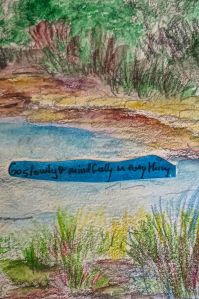
And many loving thanks to my partner hermit for the sketch made in the same area today (synchronistically it was made unknown to me and vica versa)

Please enjoy.

Love from Paul the Hermit

BRIGHT LIGHTS IN THE DUNEFIELDS


Today. On the Ocean Track.
Daily hiking across the top of the dunefields.
Not so sure-footed,
I trudge heavy-footed.

As I pass by, there are bright lights in the dunefields.
I pause in my passing as my eyes are drawn
(or is it my heart?)
to the bright lights in the dunefields.

I feast my senses upon
the bright lights in the dunefields.
They bless me, these bright lights.
They sing to me; they speak to me.

In my silence, I hear them.
But I hear not voices.
I see them.
But I see not colours, shapes or forms.

What I see, I see.
I see me, I see you.
They see me,
the bright lights in the dunefields.

They see you; can you see them?
These bright lights in the dunefields.

We are all bright lights in the dunefields.

Details in the Dunefields

Reflections on a Word

Henry David Thoreau

Did you know that Thoreau, when he was staying at Waldon Pond would sometimes sit on the front steps of his cabin right after sunrise.

Often he would look up and discover that it was already  midday or even late afternoon; he’d spent those several hours in a reverie.

Being in a reverie is most often described as being a pleasant experience, just like a nice day-dream. It is also universally (at least in the context of my short Google searches) described as being ‘lost in thought’, as well as being a place of fantasy, a place in which fanciful and impractical ideas are born.

In other words, a reverie while being pleasant, does not seem to be looked upon as a useful, productive, or worthwhile experience.

I’ve been thinking about the word, reverie, and the state to which it refers for a couple of days now. In fact since I read the anecdote opening post in a truly wonderful and illuminating book called Thoreau’s Quest: Mysticism in the Life and Writings of Henry David Thoreau, by Paul and Anna Hourihan.

The outcome of this contemplation and the above-mentioned little bits of Googling, is that I don’t agree at all with the dictionaries when they tell us that reveries are almost useless and have little or no benefits.

Even the Hourihans dismiss the value of reveries when compared to the practice of formal meditation. Listen to what they say:

There is a difference between the two. Meditation means effort, concentration of the total mind. What Thoreau has experienced is reverie – passive, beautiful and enchanting, but not true meditation.

My reaction to this dismissal? Well, I say, what’s wrong with an experience that is passive (there might be a book in the idea that reveries might not be all that passive after all) beautiful and enchanting?

And on the other side? Why is it  seen as virtuous to be always making efforts and concentrating the total mind all the time? Speaking for me and I suspect several billion other people, I get tired, always trying, making effort, always concentrating and the rest.

I’m not saying at all that I’m not in favour of meditation. Indeed, I spend hours each day (in theory that is) in some kind of effortful, concentrated meditation. But, really, isn’t it nice now and again to just give up the effort, lose concentration, just for a bit? Just rest.

Of course when one’s mind wanders in reverie, fanciful ideas and thoughts will arise. Mind you it’s equally likely that some of those thoughts and ideas won’t be fanciful, but be helpful. And you know, I doubt there’s a meditator in the universe who would not report exactly the same thoughts and fancies come up despite all their meditatory efforts and concentration That’s just how our minds work.

The notion of being ‘lost in thought’ is interesting to look at too. I don’t think it’s quite the right way to refer to what happens in reveries. At least not completely.

Was Thoreau really lost in thought when he would suddenly realise that several hours had passed without him being aware?

Perhaps it’s more likely that at least a proportion of those hours were spent in a thought free state, just as in deep sleep when our mind is absent.And we all know how restful and satisfying deep, dreamless sleep can be. Maybe that’s why reveries are described as ‘pleasant’ experiences.

My teacher talks about how sometimes when we’re listening to a favourite piece of music, we can become ‘lost in the music’. We all know how that feels. He then asks us to consider, what is it exactly that ‘gets lost’?

Well, just as with deep sleep or when in a state of Samadhi or deep meditation, it is the mind that disappears – along with its self-idenifying ego sense. In other words, whoever we think we are goes missing or absent for a while.

When I’ve experienced that state when listening to music, I would describe it as losing track of time, or rather not being aware of time at all. Thoughts come and go but don’t often stay long, ‘just floating by like clouds’ as someone recently described it to me. And afterwards when I return to ‘normal’ I sometimes have a sense that for a time I and the music were one, no separation or judgements, non-different.

And so it is when ‘lost’ in a reverie: the ego disappears; thoughts come and go. What’s left is the space between thoughts – a bit like the silence that exists between notes in a musical composition.

Some say that it is this silence, this space when mind and ego are absent, is where the divine is to be found. It is said, by some, that it is in this space, this silence, one may experience God, or Absolute Reality.

So, no ego; no monkey mind jumping about; no ‘I’ to interfere with the state of silence, stillness, and peace. And quiet!
And if one removes the letter ‘I’ from the word reverie? We are left with revere. Perhaps those who tell us that the silence is God, those who say that the absence of thoughts, ego and so on, allows us to detect the Divine, are onto something. That silence, and the process by which it is realised, are to be revered.

Being ‘lost’ (the dictionary’s word not mine) in a reverie might just be the most useful and the most productive (not the world’s definition, but more in the sense of the actions that make for the betterment of Self) thing we can do when the mood, the moment, and the inclination strike.