A Case of Mixed Feelings & Questions of Identity

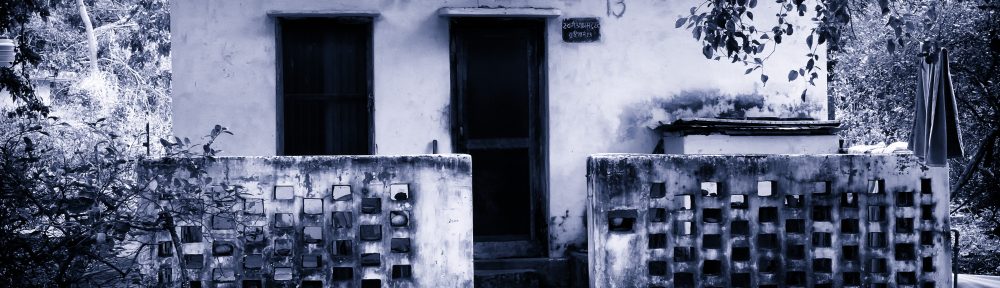
Yesterday, after getting back to the Hermitage from a walk around the block, I went to take off my shoes.

Actually, I thought, while I’ve got my shoes on I may as well spray the weeds out the front and out the back in the courtyards of the Hermitage.

Sounds like an innocent and innocuous thing to say and do doesn’t it? Well, in fact it is a far from innocuous euphemism which in reality has me saying: I’ll apply some poison through a spray bottle to the leaves and stems of plants somebody or other has classified weeds, in order to kill them slowly over a few days.

Needless to say, this activity always evokes mixed feelings in me. Like everything else in the material life, this issue has two sides concerning the rightness and wrongness of ‘spraying the weeds’.

On the one hand, I understand that we humans are merely one more species along with so many others. We have to do what we need to do in order to feed, clothe, and shelter ourselves.

Weeds, I know, interfere with humans’ ability to grow food for example. In this context weeds are those plants that threaten to overrun, damage, or reduce supplies of ‘acceptable’ food plant species. Thinking about it now, it strikes me that the decisions about is it a weed or is it not a weed, can be pretty subjective.

On the other hand I personally do not want – nor do I think it right – to kill other living things. Of course, and clearly obvious too, it’s a bit more nuanced than a simple choice between do I? or don’t I?

I eat plants of many varieties, and in many forms, and I understand very well that they are all living beings. And, add to that, how many insects, lizards, snails, small mammals, birds, and other animals are displaced, injured, or killed in the planting, growing, harvesting, packaging, transport, and sale of the fruits, vegetables, nuts and so on that I eat?

Like I said earlier, the human species, like all others, must do what it has to to survive. Obviously, again being human, we have minds capable of discernment and decision making that can help us minimise the harm we cause as we pursue survival.
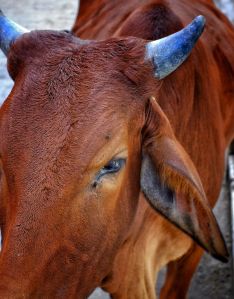
For me, a major component of that harm minimization takes the form of not eating the flesh of animals, as well as my choice to not utilise items made from animals.

Even with this there is a problem: Who’s to say what life forms are acceptable as food, and which aren’t? Humans have invented the scary idea of the Food Chain. We simply decide who is higher and who is lower on that chain and eat accordingly.

Needless to say, humans have appointed themselves to be the highest species on that ‘food chain’. Meaning of course, anything else is lower and hence okay as food.

Anyway, I digress a bit. Getting away from food questions, to look specifically once again at the ‘weeds’ to be sprayed in the Hermitage garden.
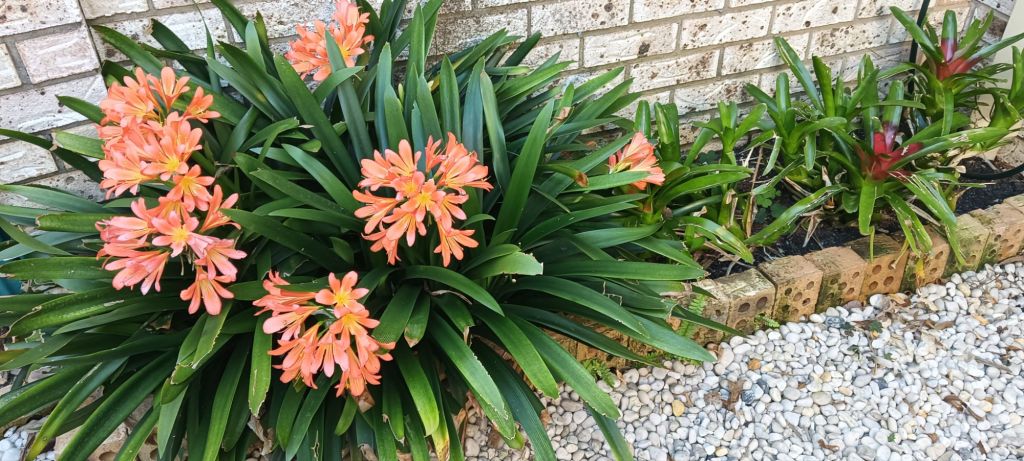
I often ask myself what is it that makes one plant with big orange flowers acceptable as a garden plant? Of course it’s beautiful, ornamental, and a pleasure to have nearby, but what else?
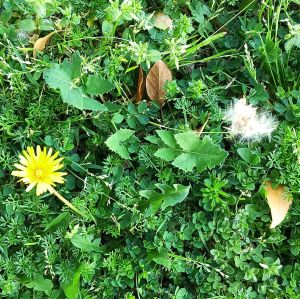
But, what is it that makes another plant, with its delicacy and little flower that are equally beautiful and as pleasing to be around in my view, not acceptable as a garden plant? What makes this one a weed, while that first one we met in the previous paragraph not?

Well, it seems to me that the first answer has to do with necessity dictated by circumstances or conditions beyond one’s control.

As I’ve said, when it comes to growing food, it’s necessary to control plants that threaten that growth. Discernment comes in when we decide how to eliminate that threat with the least harm. One aspect of discernment is actually related to that subjectivity I mentioned before: one person’s weed, is another person’s delicious and nutritious food – and vice versa.
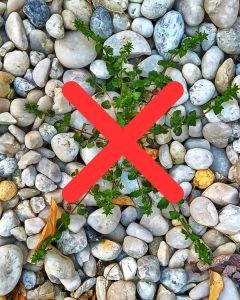
At the Hermitage we don’t grow our own food, so we don’t face that dilemma. Here, at the Hermitage, it is a condition of living here that we control the weeds. And the plants classed as weeds are well known to us due to this condition being a routine clause in most rental contracts.

Besides, it seems that another major factor that makes a plant a weed, is where it grows, how hard it is to keep in bounds and behave.

I guess it’s not only a requirement, that we control the weeds. It’s an issue for our discernment as we try to find ways to share this little patch of the world with the other life forms who also live in this space with us.

It is a wise discernment that tells us to follow the rules of the contract. And our discernment also shows us that, in this human built environment we live in, we can’t allow the space to be taken over by plants that would then provide a safe harbour for insects, rodents, and other creatures that might or would threaten our health and wellbeing and that of our neighbours.
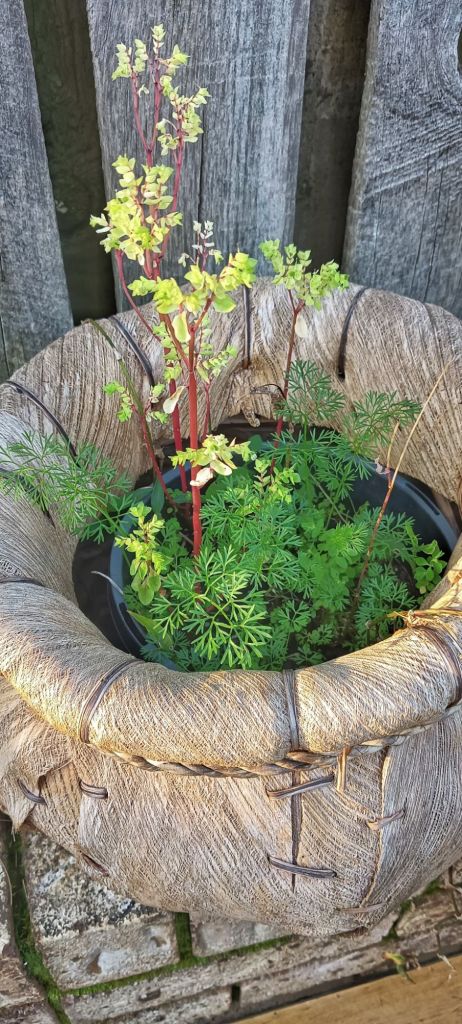
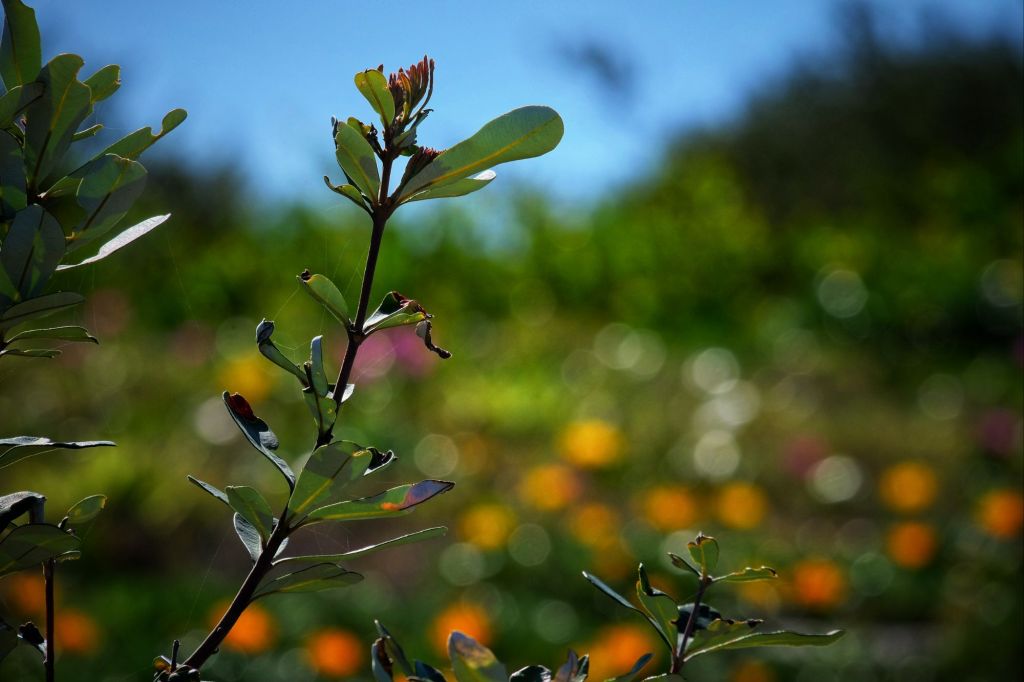
In a pot rescued from a roadside pile of domestic discards, a variety of plants – weeds also rescued over a few months of ‘spraying the weeds’ as a kind of offering to and celebration of life – grow in a group.

It’s a pretty group, I think, of delicate, yet sturdy little lifeforms.

Are they still weeds? Now that I’ve placed them to grow in an ‘approved’ space? Now that they are confined by bounds within which I can control them?

Confined? Controlled? Perhaps for now, but not for long. It’s a comforting thought, realising they all have allies: the sun, the rain – and the wind.

At the same time, we consider all life forms, including humans, to be manifestations of the Divine. All life is one, as I assert so often. Speaking personally, I am sad that any lifeform that is harmed because of my actions and my material needs.

Discernment, compassion, love and mindful action. As we seek to coexist in peace with those beings we share our world and lives with, these things are all required. Empathy too: We are the weeds, the weeds are us.

And the inner editor is insisting I finish by reminding myself  that life, the universe, and all that happens, is unfolding exactly as it’s meant to; all we can do is play our part in that unfolding.
We All Get to Stay

Sharing our prayers this morning, the hermits each reciting a prayer to the other so each can pray, and talking about the oneness of life (prompted by one of the shared prayers), the dependence of one species upon another.

As we reflected on that idea – of interdependence – it occured to me that perhaps, there might be a problem in how we as humans, interpret its meaning. We can maybe call it a kind of paradox, but we’ll get to that in a bit.
Our dependence – as humans beings – on so many other species is actually a well known, and I hope increasingly accepted, reality. For food, for shelter, for water, air to breathe. Everything.
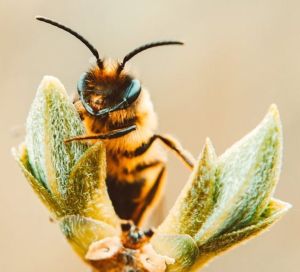
In any case, an aspect of this interdendcence idea that struck me as perhaps missing, that I’ve not really heard before (I haven’t researched this; just winging it thought and contemplation wise) is this; If, say, bees disappeared, or all trees were cut down, would humans survive? Definitely not.

On the other hand, let’s say that in an instant or even over time, all humans on Earth disappeared. What would happen to all the other living beings? All the bugs, the fishes, the animals of all kinds, trees, grasses – all the living beings?

It seems to me that all those other species, all those beings of all kinds, would not only survive, they would most likely thrive.

Actually, now I think about it, I remember during the COVID lockdowns, people in various places around the world were amazed at the return of birds to usually busy polluted cities, and how the air seemed fresher in some places when in ‘normal times’ it was getting hard to breathe. And beaches and rivers looked a bit cleaner than usual.

Fewer people commuting; fewer planes flying; less goods being transported on congested roads; less waste going into rivers and the oceans. Seems life on Earth was doing better when we (humans) were out of the picture, even for a short while.

Which is to say, humans may not be necessary for the survival of planet Earth and the other life that lives here. Putting it very simply: We go, they thrive; They go, we go too.

But, my thought train races along its newly discovered track here, what if I’m wrong? What if I’m looking at the whole issue on just a superficial level? What if all I am seeing is the gross material level of the whole question? What if I’m missing the real point of it all?

Well it seems to me that on that purely physical, surface level, my theory (borrowed as it may be perhaps) might be right, the irony true: we go, they thrive; they go, we all go; they stay, we all get to stay.

But who are ‘they‘? Who are ‘we‘? For me it’s clear that we are not all simply and only our physical bodies and our minds living here in the material world; that’s all temporary and comes and goes. No, there has to be more to it than that.

Which is what I end up coming back to so very often: there is only one. No separation; no you and me; them or us. Just one. Without a second. Only Consciousness.

I think the best thing to do, just to be on the safe side is to look after each other – regardless of the particular body we happen to be inhabiting at the moment.

That way, we all get to stay, and we’ll all thrive

Poetics & Photographs: Shared Note

Namaste and greetings

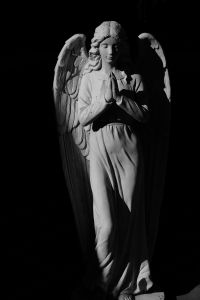
Another poetic and photographic note to share with you today. In the last month or so I’ve written two poems which are about angels. And both connected in some way with rain, or at least impending rain in one and actual rain in the other.

Initially I thought to just include the most recent of the two, but as I put my fingers on the keyboard it just seems to be emerging that I shall share both with you. And as you know I’m not one to ignore the demands of what types me!

Anyway, I offer them to your for your reading pleasure and perhaps cause for contemplation. Last shall be first in this matter I think. Enjoy please!

Angels, they are everywhere.
Perhaps there are more than we know?
Personifications of love, of compassion.
Of charity too.

ON THE TEARS OF ANGELS

Is it good that angels cry?
Anyway, why do they cry at all?

To wash away all the sorrows,
to cleanse, to purify, to make new.
And to ease the world’s pain.

Then, there are those of us
who can’t conceive of ourselves
as angels.

For those ones – each and every one – the tears of angels
are cathartic; granting catharsis.

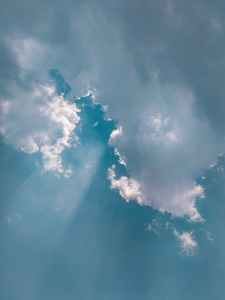
A CLOUD ANGEL SEEN

An angel wing
seen in a cloud, ephemeral, gossamer.
And the angel?
She stands concealed within the silver linings of clouds, neighbouring clouds,
heralding a soon to be descending deluge.

Spotted on a Sand dune: A Poetic Sharing

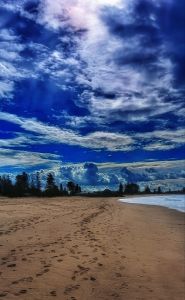
With the current hermitage located not so much on the side of the road, as right on the side of a large sand dune system, you might imagine that I am at and on the beach every day.

While almost every day, I walk the track that follows the crest of the dunes in this particular area, I’ve only actually gone down to the beach itself a handful of times.

So, yesterday as start to my resolve to make amends for this omission, I climbed the dune, ignored the crest track leading left and right, and continued straight on and down the other side of the dune, and onto the beach itself. My intent was to spend an hour or so walking along the tide line.

And so it was.

Judging by such rare experience of the beach itself, I might easily say I am no ‘beachcomber’; no discoverer of coastal treasures, little natural beauties from the sea, or even the occasional oddity one might expect washed up. Until yesterday that is.

Not that I went to ‘comb’ the beach: rather I was there trying to put myself on the receiving end so to speak, to be a receptacle for what I might be blessed with (not to forget the need for exercise and movement).

And so it was.

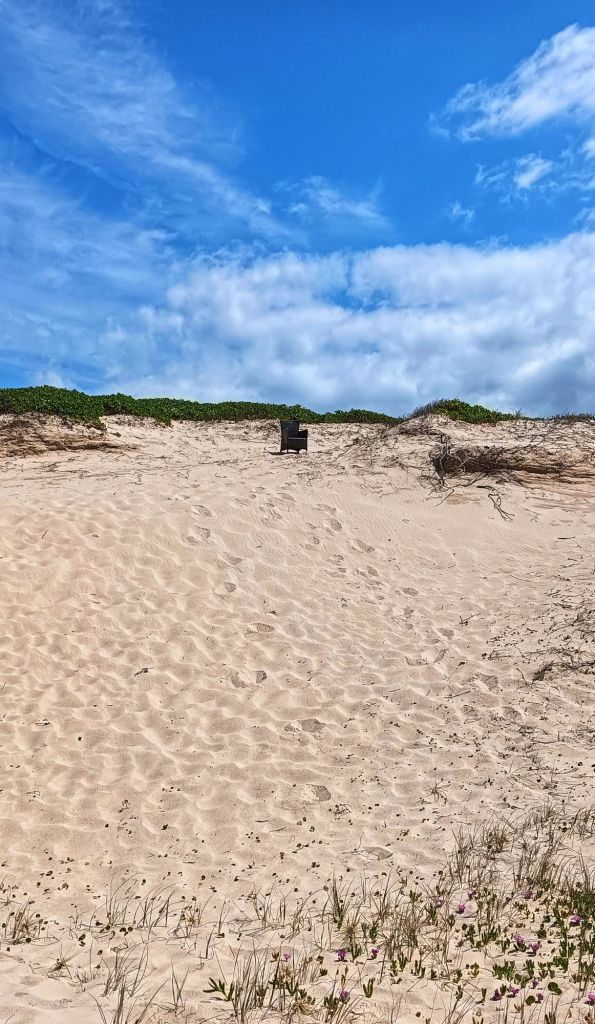
This sense of grace and blessings, I hope I’ve conveyed in the small poetic effort (as well as its companion photo) that I now share with you.

SPOTTED ON THE SAND DUNE

Strolling (briskly mind you) along the sands,
There I was – deep in the liminal zone.
Ankle-deep – sometimes – seawater cooling my feet.
One way to receive Varuna’s blessings.

Back on dry sands (still in the liminal zone) I pause
to examine a spiral shell – an elegant and delicate sea creature.
It lives. Reverently, I move it to deeper water.

As I rise from my small task of union, of reunion,
I glance – still within the liminal zone – upwards.
There, near the crest of the sand dune sits a chair.
An armchair I spotted right there on the sand dune.

There it was, facing me – and the sea – in the middle of nowhere.
Though this is clearly somewhere for somebody.
The perfect perch for taking in
Pacific views.

Empty chair, lonely sight
overlooking the liminal zone.

Bright Lights on the Dunefields

Namaste and Welcome friends.

A poem for your reading pleasure. Written on site today in response to an experience while out walking on the dunes next to the hermitage.

I’m including a photo I made a few weeks ago of the exact place where the poem was written,

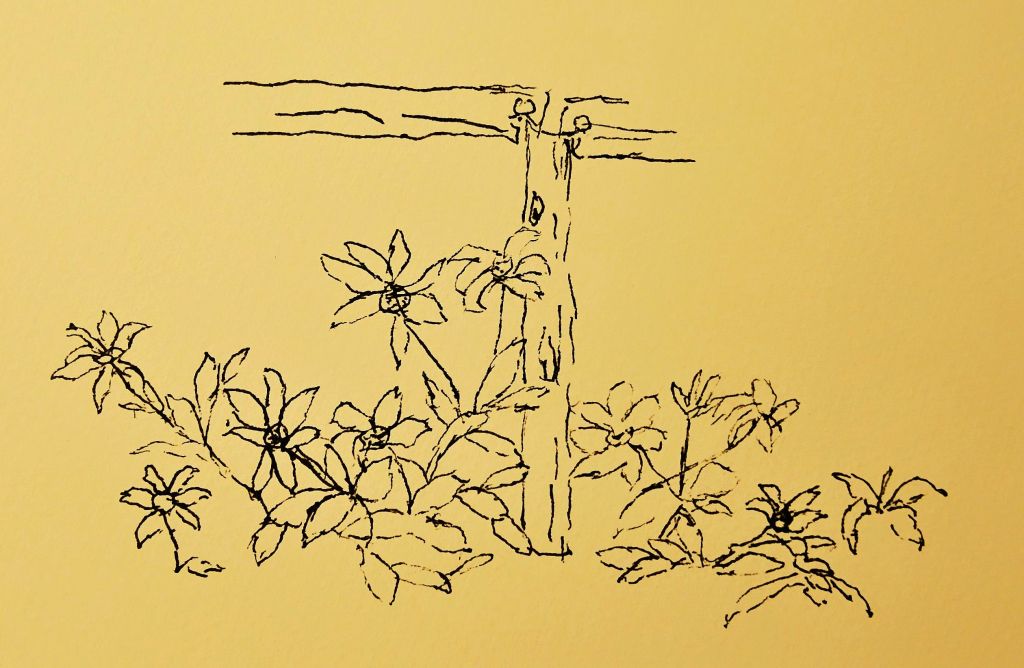
And many loving thanks to my partner hermit for the sketch made in the same area today (synchronistically it was made unknown to me and vica versa)

Please enjoy.

Love from Paul the Hermit

BRIGHT LIGHTS IN THE DUNEFIELDS


Today. On the Ocean Track.
Daily hiking across the top of the dunefields.
Not so sure-footed,
I trudge heavy-footed.

As I pass by, there are bright lights in the dunefields.
I pause in my passing as my eyes are drawn
(or is it my heart?)
to the bright lights in the dunefields.

I feast my senses upon
the bright lights in the dunefields.
They bless me, these bright lights.
They sing to me; they speak to me.

In my silence, I hear them.
But I hear not voices.
I see them.
But I see not colours, shapes or forms.

What I see, I see.
I see me, I see you.
They see me,
the bright lights in the dunefields.

They see you; can you see them?
These bright lights in the dunefields.

We are all bright lights in the dunefields.

Details in the Dunefields

When Love is a Yoga and Lovers are Yogis

There was light at the end of the research tunnel

These last few days I’ve been researching and thinking about an idea for a blog post. But I’ve come to realise that I am grossly underqualified to write about the topic I had in mind. Let me put it another way: I am completely and utterly unqualified in any way whatsoever to go there. In fact, after all the research, I think I’m going to disqualify myself from ever going there in writing.

However, I’m a great believer in the idea that no quest for knowledge is ever a waste of time or effort; there is always something to be learned. During my research I came across a topic I believe I am qualified to discuss, as it forms an integral and vital part of my own personal spiritual practice.
Why I’ve decided to write this post, though, is because I made a discovery that lead to an insight that I know will lead to a great progress in that practice. It’s nothing new, not really, but it was one of those occasions we’ve all experienced of ‘I knew that, but now I really know it.’ For me, it was a realisation of something that till then had been a nice cosy theory and belief.

Bhakti Yoga is that practice. It is really a key foundation, a valuable component of my spiritual life.

Wikipedia opens its entry on Bhakti Yoga (see the link just above) with a description of the practice that mirrors what I think is the traditional understanding of Bhakti Yoga:

Bhakti Yoga (also called Bhakti Marga, literally the path of Bhakti) is a spiritual path or practice within Hinduism focused on loving devotion towards any personal deity.

In the same entry there is a description of the origins and meanings of the two words, Bhakti and Yoga:

The Sanskrit word Bhakti is derived from the root bhaj, which means “divide, share, partake, participate, to belong to”. The word also means ‘attachment, devotion to, fondness for, homage, faith or love, worship, piety to something as a spiritual, religious principle or means of salvation’.

The term Yoga literally means “union, yoke”, and in this context connotes a path or practice for ‘salvation, liberation’. yoga referred to here is the ‘joining together, union’ of one’s Atman (true self) with the concept of Supreme Brahman (true reality).

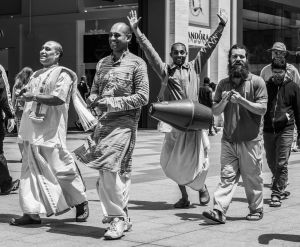
For some, dancing while chanting the names of their God, demonstrates their devotion and celebrates their union with each other and with God

In other words, those called to a religious or spiritual life, practise Bhakti Yoga whenever they pray or otherwise express devotion towards their personal conception of God, or the Divine. This particular definition seems to be saying that such a conception of the Divine, or God, is in the form of a personal deity who is a kind of representative of true reality, which the devotee is aspiring to join with.

Some Bhakta Yogis are full-time, full-on practitioners. People like contemplative nuns or monks, hermits who retire from the world into seclusion. Anyone basically whose entire life and activities are spent in devotion.

So, when I discovered all this, I became intrigued; I decided to go off on a tangent and explore the word Bhakti itself. Wikipedia has a separate entry for the word on its own:

Bhakti is a term common in Indian religions which means attachment, fondness for, devotion to, trust, homage, worship, piety, faith, or love. In Indian religions, it may refer to loving devotion for a personal God

is often a deeply emotional devotion based on a relationship between a devotee and the object of devotion.

In ancient texts the term simply means participation, devotion and love for any endeavor.

May refer to devotion to a personal god? While I thought this entry doesn’t contradict our first quote above, it does seem to broaden, and deepen, the meaning of Bhakti. Expand might be the better word.

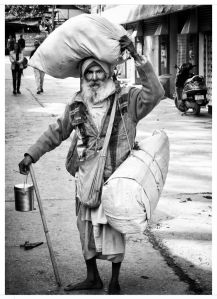
In some traditions a simple life on the road is a way to commit full time to Bhakti or devotion.

It struck me that that object of devotion might be anything. Or even everything. You see? I told you it wasn’t a new idea. It’s just that it’s resonated deeply within me now. It appears that the object of Bhakti Yoga practice doesn’t necessarily have to be a ‘personal god’.

Many many people would say ‘I like animals’ or ‘I think we should save the world’. But, while that may imply a kind of love for or at least a fondness for, I think Bhakti is something more – actually several somethings more!

For example, some people have a particular attraction to and love for, the ocean, or it might be a river they view as, if not sacred in a religious sense, then as special to them in some deep, comforting, even therapeutic way. Others have similar relationships with and feelings for trees, or even a particular tree.

Animals as either individuals or as a species or group, can have the same appeal and call to other people. Then there are those who feel strongly in their hearts you could say, that Earth itself is a sacred object, or others have a knowing that the planet is a living entity and worthy of our devotion.

Bhakti begins with love and devotion, which is about caring for, affection towards, loyalty to, emotional engagement with the object of devotion. But even more than that, there is faith in that object of devotion; faith as in trust, confidence that the love is real, that the ‘relationship’ is sound and real.

Homage and worship too are key aspects of Bhakti. The deep inner feeling we have towards a thing, person, or other being, that is beyond what we normally call ‘love’. It’s about seeing and actually realizing ‘in our hearts’ our desire to be merged or united with that thing, person, or other being.

Actually, seeing that word other just now got me thinking. I had to go back and reread our definition of Yoga up there near the beginning. It says Yoga means ‘union, yoke’. It goes on to add: yoga refers to a ‘joining together, union’.

This passage seems to be suggesting that Yoga (in our case Bhakti Yoga) is both an already existing union, and a process of joining together to achieve union. One thing I would say here is that in my practice of Bhakti (and love as a general thing to strive for and be) it’s both.

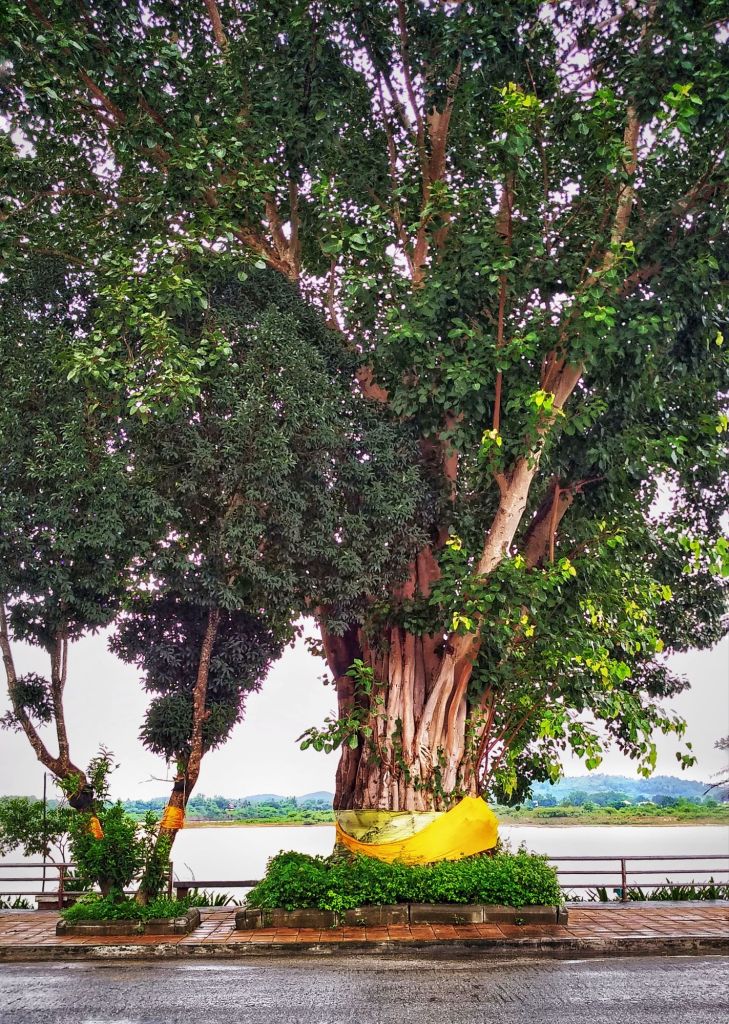
Trees are special beings for many people from a whole variiety of cultures all over the world

But, in the end, it seems to me that the process or practice, the path of Bhakti, serves to awaken us, to assist us to acknowledge, recognise, and realise in that really knowing way, our pre-existent true nature.

That true essential nature can be said to be the reality of our oneness with all things, living and non-living. And their oneness with us too of course. In fact, by putting it that way, I’m saying there is only one, or oneness. What’s that expression? One without a second.

May you be a Bhakta Yogi. Or, perhaps you already are one?

Love and peace from Paul the Hermit

Life has manifested itself as the multitudinous forms that comprise the universe. It is the one Universal Life, Power or Shakti (the laws of the universe or natural laws) that controls, guides and actuates all movements and activities in all beings, creatures and things.

                — Swami Ramdas

A TRIBUTE TO THAT WHICH IS SEEN

An affinity with trees;
crowns moved by the breeze.
    The Sentinels stand firm.

Sentinel Rising
Neighbours
In the Grove of the Sentinels

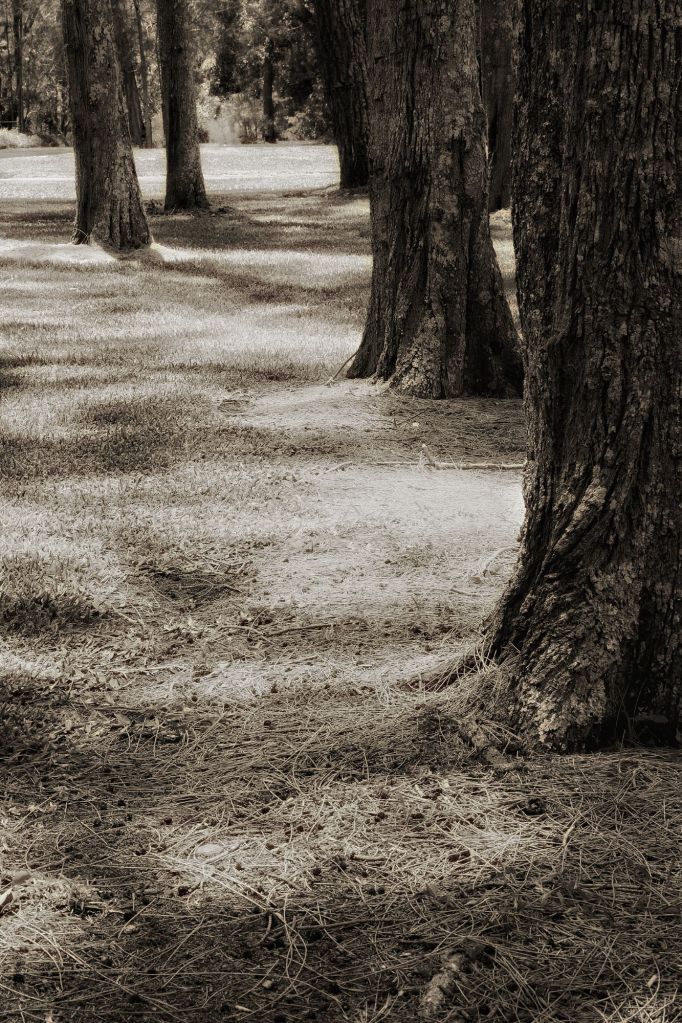
A Grove of trees we came to know well as The Sentinels, a creek, a field of grass, and nature in abundance.

Our cottage was small, but richer than all.

We do indeed stand always upon sacred ground.

Peace and love

Paul

A small remembrance and a prayer of gratitude for some old and sadly missed friends.

Sentinel Magic

Let Me Tell You a Story: It’s a Good One!


Has anyone seen Walk the Line? It’s a great movie that tells the story (or a version thereof) of the life of Johnny Cash. Yes, I know: not everyone is into country music. This movie, however, is an intriguing insight into the life and work of a  gifted but troubled artist. He was a prolific and inspired singer and songwriter.

There is a scene in the movie in which Johnny is about ten or so. He’s talking to his brother who is maybe 14. The brother is studying the Christian scriptures (he wants to be a preacher when he grows up, but dies soon after in an horrific accident) and Johnny says, ‘Why you studying so hard?’ His brother looks up from his reading and says,

‘You can’t help nobody if you don’t tell ´em the right stories.’

Yes, I thought when I heard that, you have to tell them the right stories. But, what are the right stories? It’s a good question but, fortunately, there is a simple answer: they are all the right stories. That is if they are told from and with the heart, and if they are created and shared with the intention of conveying Truth, promoting harmony, and doing or causing to be done, what’s right.

The ‘them’ of poor brother Cash’s reply are those who get to hear/see/feel the stories we tell. And we all tell stories don’t we? I mean I’m telling you a story right now. As a (cringe) blogger, that’s what I do.

But we all share stories of all kinds. Sometimes they are stories of our lives, sometimes they are from memories passed down the generations. Other times they might be something we ‘make up’ to help someone to understand a point or idea. Pretty much all of us, most of the time communicate in one kind of story or another.

Of course there’s the other kind of stories; the ones meant to spread rumour or gossip, to hurt someone, to mislead. We all know how that works, and it’s not today’s topic anyway, so let’s just leave it there.

Those we share stories with may be those we intend to share with, and they might be others who at the time are distant from us both in time and space. Just as the stories we tell each other might be decades or even centuries old, so might our stories keep on reverberating through time and space.

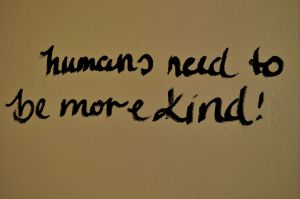
A true story written on a wall somewhere

It’s also true that the stories that ‘help’ people come in all shapes and forms and are about an unlimited variety of subjects and topics. Then there’s the matter of timing. How often have you ‘just by chance’ read something inspirational when you were needing some guidance or advice?

Or what about those times when you are feeling a bit low or under the weather and you come across a story that makes you smile or otherwise lifts your spirits? I’ve often been in need of a good cry only to come across a sad movie or story or a moving tale of one kind or another. (Just last night I read a wonderful phrase I’d never seen before: Transformational Weeping. Probably a story or two there do you think?)

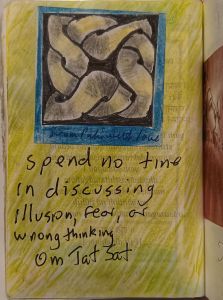
A story I tell myself literally every day. One that’s a prayer and an affirmation

So, let’s keep telling stories. They are all the right ones for us to tell – if they come from the heart and told with the intention of serving Truth. Someone once wrote:

If there is a way to improve the world, it is by telling a good story.

Okay then.

Once upon a time on a dark but not so stormy night …

PS I saw the movie in Dharamsala India. On a postcard home I wrote a little rhyme about some writing work I was doing on some of the town’s environmental issues for a local magazine:

He walked the line
did Johnny Cash.
But here in Dalai Lama Land
my words will help reduce trash.

I did say stories come in all shapes and forms didn’t I?

My Visit to the Beach, and a Poem Shared

Greetings friends

One of the key elements of the current temporary hermitage, the current safe-haven by the side of the road, is that it is literally two minutes walk from a very uncrowded and quiet coastal beach.

It is a place of golden sands (I know that’s a cliche but in this case I have the evidence!), gentle wave action, and the promise of a possible serenity of a kind I’ve not been close to for a long while.

While I don’t visit this little slice of Pacific coast every day, I get to walk and or sit there several days a week. And when I do, I find that it’s always uplifting and relaxing. A reminder too, of my oneness with all nature. All of us are actually nature, along with every other living thing on our planet (and of course elsewhere too).

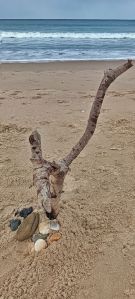
Today, for the second time I built a little ‘shrine’ on the sand.  Walking away from my little temporary temple, a poetic voice entered my mind and wrote itself a few lines. Too engrossed in the moment, I neglected to record it on my phone, so when I got back to the hermitage I wrote it as remembered.

And now, I would like to share it with you. I am grateful that I am actually able to share it, so thank you.

WE STAND ON SACRED GROUND

I planted the branch,
the branch of a fallen tree person.
On the beach,
in the sand of the beach.

And I built a shrine
around that branch.
A pop-up shrine.
Shells, stones, and a piece of coal.

A shrine to Varuna.
A shrine to Surya, to Saraswati.
A shrine to all the gods
of Earth, Sky, Water.
A shrine to the gods of all beings.

A shrine on the beach
is subject to tidal flow.
And soon, this simple shrine,
pop-up and temporary in nature,
will be engulfed.

Lord Varuna will make his claim.
What has emerged, must always return.

with love and in peace


A Story of Words and a Journey of Discovery

Remember that old Bee Gees‘ song Words?  It’s about one person offering all they have to another. Well, the one doing the offering must have been a writer because, while the song’s a love story, it’s words that are the big thing on offer here:

It’s only words, and words are all I have
To take your heart away

Well, as this is a blog, words are the way it hopes to reach your heart. Actually, the posts also include photos and sometimes other art, but the main vehicle used here is words.

So, with that in mind I have a couple of words to offer you today. Well, one word and its opposite. Have a look at this sentence from Thomas Merton:

If Irish monks affirmed his Celtic spirit in their mastery of cataphatic contemplation of the wonders of divinity in nature, Buddhist monks evoked his Zen mind and drew him into the apophatic path of formless ’emptiness’…

A quote from the Introduction to When the trees say nothing: nature writings of Thomas Merton

As sentences go (though this is obviously only part of a sentence) this has to rank pretty close to the top for length and denseness.

Kataphatic. What a word! Of course I had to look it up; I’d never heard the word before (this post is a rewrite from notes written a while ago that I never got around to posting.), and even though the sentence seems to  suggest the meaning, I was still curious.

Looking at Wikipedia – where they spell it with a ‘C’ like Merton, as well as with a ‘K’- I learned that cataphatic is an adjective that describes an approach to theology that uses ‘positive terminology to describe or refer to the divine (God, Truth, Dharma, Spirit. You know what I mean: the divine).

Apophatic, as you probably figured out already, is when one uses ‘negative terminology to indicate what it is believed the divine is not’. A process of negation or we could say you get to what the divine is by a process of elimination.

Pretty simple concept really, but with a couple of big words to label it, and a lot of  words to define it. No, don’t worry, I won’t bore you with the meaning and origin of the words and all the rest. Mainly because I don’t know and I’m not especially interested anyway in all that technical stuff.

I simply resonated with the word, and the concept. Cataphatic made me think of Dick Van Dyke and Julie Andrews singing Supercalifragilisticexpialidocious in Mary Poppins. But let’s not go there: this is a serious blog after all. Except to say there’s more to that word than you might imagine.

Putting aside the aesthetic appeal of the word for a minute, let’s contemplate a while on cataphatic, and it’s opposite, apothatic.

To begin thinking about these two words, it’s necessary to acknowledge the existence of the divine. We can call it God, if we like. Or Dharma, Truth, Spirit, Love, Beauty.

As the quote suggests, a cataphatic approach, ideology, theology, or whatever we call it, ascribes names and forms to the divine, as well as describing where and in what the divine may reside.

Whereas apothatic, again as the quote suggests, does not ascribe names and forms to the divine. Instead it seeks to discover what or who god is or isn’t by a process of negation as described already. 

For a long time I labelled myself as a Humanist. I had decided that this physical body is all there is; the physical or material universe is all there is, and that there is no ‘god’ separate from us or who has special powers to affect our lives. No God at all in fact.

In the Grove of the Sentinals

But, all that while, I just knew that there was something else, something more than just the physical.  And over time, I came to the knowledge that there is indeed more than the simply phsical universe (including we humans).

I’ve thought about it a lot over the years and I came to the conclusion not that many years ago, that I had simply been afraid to name or define that something more. It would have meant admitting to myself that something more really did exist.

That is to say, I was scared of taking the cataphatic approach – and I’d never even heard the word.

Well brothers and sisters, I saw the light. The truth was revealed to me. And what is that truth? Well, to put it simply, I wasn’t scared anymore. Not of names and forms, and not of what I couldn’t see.

Now I could take both the Catophatic and the Apothatic approach: that the something else I had actually always known just was, really is, and can have a name and form, or not. The divine is not an omniscient being or any kind of being at all; As I’m very fond of saying, the divine (or truth, God, Dharma) simply is.  And it’s all there is.

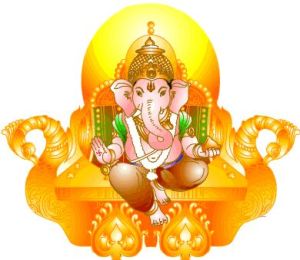
Some of you might know that I am really quite fond of the Indian deity, Ganesha . Do I believe that a man with the head of an elephant actually exists or ever existed?. Of course not. Do I actually think that he resides in the lovely painted icon that sits by my bed? Well, obviously not.

But do I believe that there is a spark or aspect or attribute in all life, in you and me, in nature, in (scary word time) creation, that we can tap into to help us overcome obstacles? Or that we can access when we begin new ventures of whatever kind, or when we need strength to face challenges? Yes, I do. Very definitely.

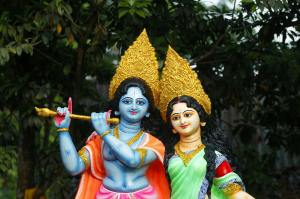
And do I believe in a blue boy called Krishna who lived in India 5000 years ago and spent his time playing in the fields with the village cows and his friends, entertaining them with his flute? Again, of course not. Does he live in the other beautiful icon by my bed? The answer is obvious: no.

But do I chant the Hare Krishna mantra in an effort to come closer to the divine that is… well, that just is? Yes, again, very definitely.

Words. It’s all only words. Only words? Only??

In the beginning was the word, and the word was  with God and the word was God. (from the opening of the Gospel of John)

It’s all I have (for now).

Peace and Love from me to you