Everything & Everywhere

Namaste friends

In the High Holy Lands Where Magic Sometimes Happens

For the last while (long while really. Actually many years), I have dreamed a few times a month, sometimes more, that I am in, about to arrive in, or just about to leave Rishikesh in India.
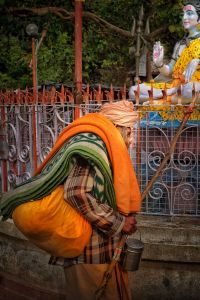
Rishikesh is a small town straddling the Ganges River, and nestled in the foothills of the Himalayas. For millennia it has been considered a sacred place. Its history replete with stories of divine beings, ancient sages and saints, not to mention its status as a major pilgrimage destination for at least a thousand years and the town becoming ever more popular in recent years for pilgrims and ordinary pleasure seeking tourists from around the world.
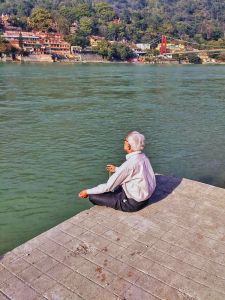
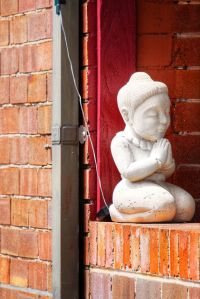
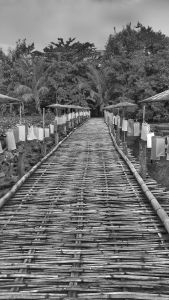
This isn’t me but it could be

I last visited Rishikesh in 2016-17 (having previously spent time there in 2006) when my partner hermit and I stayed for several months. I associate that stay with the strengthening and deepening of my spiritual practice as well as the gaining of a kind of clarity in terms of my outlook on the world particularly on the spiritual path that had been calling to me – as it does still.

Putting aside health issues that hinder our mobility, I think it’s fair to say that my attachment to Rishikesh and my longing to return have more or less faded away almost completely over recent years.

Rishikesh has always been a busy, crowded place with the associated traffic, noise, pollution, and inflated prices. Rampant commercialism has long threatened the town’s ‘spiritual ‘ or ‘sacred’ vibe. These days it is the fourth most visited place in India for overseas travellers  so it’s likely to be more busy, choked with traffic, noisy, more commercial and material focused than ever, with the associated degradation of its appeal for some.
But, even if I were also  able to put all this aside, I think the core of the letting go of my longing for Rishikesh has more to do with the turning inward that has accompanied our eventual recognition of our calling to the hermit life with its quiet, secluded, contemplative lifestyle (or the aspiration for that life).

So, why the dreams? Why so often? Well, as I’ve mentioned, Rishikesh has played a significant role in my life. And despite the dropping away of those longings and attachment, I’m not saying going there again is totally out of the realm of possibility, but it no longer has that ‘I’m home’ kind of feeling. No longer has that magnetic attraction for me.

Now, here’s the missing information about these dreams I’ve neglected to mention thus far: Not one of the dreams has been set in the ‘real’ Rishikesh; never have they been ‘geographically correct’ for wont of better description.

Sometimes the dream town is nothing more than a small clump of houses sitting on a hill or in a field with a dirt track passing by.

Other times it is a sizeable town with temples, streets, cafes and shops masquerading as an Indian town. Sometimes it’s simply a story taking place inside a shop or restaurant that, in the dream, I know is in Rishikesh though not in the terrestrial town. There have been dreams in which the town is more like a city with highrise buildings, multi-lane roadways, and all the rest.

The most recent dream had me in a bus headed for another bus connection to Rishikesh. Worried about missing the connection, I was told that the Rishikesh bus wasn’t due ‘for weeks’.

Many and varied settings all standing in for the ‘real’ Rishikesh. But I don’t think I need Carl Jung to tell me the meaning of these dreams. All of them are my internal sacred or significant ‘Rishikesh’. It’s as if the actual geographic location in India called Rishikesh is the illusion and these dreams are the reality for me. All emanating from the cave in my heart

My inner or true Self, you might say, telling me that my being concerned with my specific geographical location is missing the point. A message for me that I am always in Rishikesh, that I am always in sacred space and with saints and sages, and that the Divine is everything and everywhere.

Om Tat Sat
Do Good, Be Good: A How to Guide

Lately it’s been a bit hard to remember I’m actually a hermit. A lengthy hospital stay, doctors’ visits, sessions with physio and other therapists, moving to a new hermitage. There seems to be no end to the people and activities pulling me back out there into the world.

Sometimes I would like to just stop, do nothing and simply be.

But even a hermit isn’t exempt from performing actions  in the world. Of course the point of living in seclusion as a hermit is to minimise contact and interaction with the world of people and things of the world; to renouncing objects and pleasures of the senses and ridding oneself of desires for these material experiences.

Even so, no matter the degree to which one renounces action, it is simply not possible to cease all activity in this world.

Recently I came across a kind of list of the three types of categories or activities one must never renounce regardless  of the level of withdrawal from the world.

In fact, looking at it from another perspective, this little list could be described as a guide on the types of activities to undertake for not only hermits but all of us wanting to live a life of ‘being good and doing  good’. And as a means to make every single thing we do serve the Truth.

Actually, that brings us to the top most (for me at least) of the three categories of activity that are never to be renounced, which is the embracing of actions that contribute to my quest to understand my true nature, to fully realise the divinity within myself that is in fact the divinity that pervades and permeates all there is.

My intention is that all my activities are informed by loving devotion  to this divinity and a deep yearning to be of service to that divinity. Don’t relate to Divinity? That’s okay: substitute God, the Universe, Love, Beauty, Truth …

Which now leads me to the next category: I aspire to consider the welfare of all other living beings as I perform any action in this world. Being mindful at all times to ensure my actions, including my speech and thought, causes as little harm as possible; how can I be good?

Of course the other side of this mindfulness is to continually be asking myself, what can I actually do to contribute in a positive way to the welfare of all living beings; how can I do good?

The final of the three equal, mutually dependant, and intimately interconnected  categories of activities require once again a continual mindfulness to my own welfare, on all levels.

Sounds obvious: we all want be happy, to enjoy life and be healthy. But, speaking only for myself here, there are any number of activities I have engaged in (some I still do) in order to get some pleasure, to be happy, whatever, that might work for a while, but as with all worldly things, it never lasts. As the saying goes, that which at first tastes like nectar can end up being poison.

Like the relationship I share with Youtube. With no television in the Hermitage Youtube is the go to space for things to watch; an unlimited source for study, inspiration, and sometimes simply for entertainment.

But last night, and by no means for the first time, I realized I was spending far more time ‘looking’ (AKA scrolling) for something of interest to watch then actually watching anything.

Now, watching videos for study, inspiration, and even entertainment, may contribute to my welfare, but scrolling certainly does not. Time consuming, mind deadening, it leads to irritability, depression and exposure to content I want nothing to do with. Time for (another) break.

A life worth striving towards.

Do good, be good?

Keep doing it and it will become normal

(eventually).

Listen: It’s Already Silent

‘I must be back in the blog writing mode, I’m really hanging out for a new topic.’ I blurted out to my partner hermit just now.

Actually, it was desperate. What I actually said was ‘I’m really desperate‘ for a new topic. I quickly modified it to anxious then again to keen, in an attempt to keep the sound of attachment out of my voice. Finally, in these notes, it’s morphed into ‘hanging out’ which is obviously no better at all.

Her reply needs no disclaimer, no modification: ‘The answer comes from the silence,’ she said quietly.

I’ve actually had a relatively quiet – even silent – day: resting in recovery, laying on my bed, sometimes sleeping, sometimes simply following my breath.

Mind wandering, of course, that’s what minds do after all. But overall at least a semblance of silence seemed to be the order of the day.

Even then, after all that silence, quiet, rest and mostly a not overly busy mind, the best I can come up with is ‘I’m desperate’?

As in, I’m really hanging out; really anxious; really keen. As in, I”m not really listening – not at all silent. In fact, so full of desire, clinging and attachment for a new blog topic was I, that actually noticing one come out of the ‘silence’ would likely take a miracle.

All day – hours – I lie still. As I said, only sometimes sleeping, the rest of those several hours watching my breath, attempting just to be in silence and in the stillness.

So is it me? Am I missing something? An answer has come (here I am making notes for a new blog post), but what’s this ‘silence’ business from where answers apparently come all about?

Clearly, silence does not always seem to require an absolute, complete, and total absence of noise, voice, words, thoughts, if it is indeed the source of ‘answers’.

Maybe silence itself produced an apparent state of attachment to a new blog idea as a kind of ruse or trick to have my Self fool myself into seeing the foolishness of attachment as well as showing me how silence really works – in the real world.

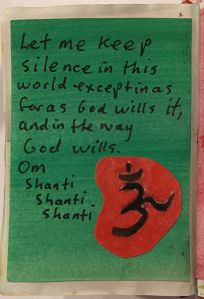
Silence is not some sort of rarified mystical state that we have to enter through rigorous spiritual practices. It is actually a condition that emerges from everyday moments, ‘random’ thoughts, or comments made seemingly without thought or any apparent significance or meaning. Actually silence lives everywhere, is in everything and is all the time.

Listen and you’re there

Moment of Catharsis?

One morning recently I was reciting my prayers when I began to notice the welling of tears in the corners of my eyes. Soon the wellings became a slow stream down each cheek. And, before long, I was more or less sobbing. For a little while.

Where did the tears come from? Why was I crying? Well, to be honest, it’s a mystery.

No mystery, you might be thinking: Sounds like your tears were brought on for some reason by reading the prayers.

I’m not so sure. I used the words ‘reciting my prayers’ deliberately: Not only was I not paying attention to, or even seeing the words on the paper, I was not engaged in the least in the words themselves and their meaning.

Rather than ‘praying’ I was reciting from memory, rote fashion, as if chanting my times tables in primary school. Merely mouthing the words; my mind was blank, as in not there, distant, off doing what my mind does, without awareness from me, when I’m trying to pay attention.

So, was this some sort of moment of catharsis? Possibly, or so it seems to me.

Sometimes – often spontaneously, other times with some forewarning – there is a release: a shedding of tears, as in my story above; a heavy inner or outer sigh of relief; sometimes simply a sense of something let go, something gone, or at least on the way to being gone.

When such moments of catharsis take place, often what causes them, the catalyst, appears obvious. On the other hand – as in my recent sobbing session – that catalyst is a mystery, unrelated in any obvious way to anything happening at that moment, or at least to anything taking place on the surface of that moment.

Equally the cause for the tears, sighs, relief, and so on – the object of any potential catharsis – may also be a mystery. I had no idea at the time, nor do I know now, what caused my tears.

The prayer being recited at the time was about silence. But, as I’ve already mentioned, no way was I actually praying, what with my total lack of attention, obliviousness to the words, my mental blankness. My unconsciousness come to think of it. Nothing to suggest a catalyst or catharsis.

In any case, when such miraculous happenings occur, one thing I try (I hope) to remind myself to not do: Do not ask why. Let catharsis – or whatever process is underway – be as it is.

And to put aside my habitual tendency to analyse and categorise; resist the temptation to want to know and label everything that happens to me. Let the catharsis – if that’s what it is – carry on as it does and not dismiss it as: ‘Oh that’s just me getting emotional.’ Or ‘I must be a bit overtired today.’

To – wildly and freely – paraphrase a few words from an iconic movie character:

Catharsis is as catharsis does.

Taking it Slowly, Taking it Mindfully

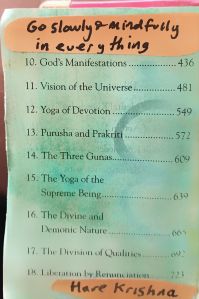
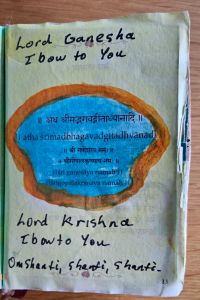
A small irony revealed itself to me just now as I prayed my way through the prayers inserted in the front of my Bhagavad Gita.

I’d completed one prayer and turned the page to the next. Then, without a pause or thought, I quickly turned the page again. I stopped, thought better of it, and turned back to attend to the prayer I’d skipped over.

Now, here’s the irony: The prayer on the first side of that carelessly and mindlessly leafed past page read simply:

Go slowly and mindfully in everything.

Well, that’s not the ironey itself. But, given that this was the page I had simply passed over without a thought, with no pause, the words written there obviously were a lesson for me.

A message to contemplate, to actually stop and pause with, mull over, meditate on, and perhaps make resolutions over. Advice to me to stop, to slow down.

Couldn’t be clearer really.

There’s no telling why I skimmed past that page, that prayer, without a pause. Could be a simple case of absent-mindedness, or a rush to see what was on the next page; a grass is greener type of thing.

Why I was rushing through the pages isn’t the point. What is to the point is here I am, doing morning prayers, praying some, then skipping others. The other point is that in this instance, for some reason I stopped, went back, and prayed the skipped prayers.

So, moving to the resolution.

It’s extraordinary to me when that kind of thing happens. (It does happen quite a lot, but unfortunately I only notice it occasionally) We will have an intuition, or receive a message from ourself that helps to us get back on track when we mess up.

In any case, it’s obvious that I’ve found what I might call the prayer of the day, the mission statement, so to speak, informing whatever activities I undertake today.

Slow and mindful in everything I do, say, and think. For now, for the present, that will the guide on the path of today that I will follow. Keeping in mind the adage that practise makes perfect, for when I falter.

Oh, another irony wrapped up with this one. The prayer on the facing page was also skipped, and in itself sheds another light on the message from that first one. That second prayer actually puts forward one, important, way in which I can actually set about achieving  that first one:

In other words: place more focus on, pay more attention to, the Divine in whatever form, and by whatever name, I encounter it today.

Works both ways I think: Making the effort to go slowly, to be mindful, puts us in the present moment. And, the present moment is the only place we’re going to be able to become aware of the Divine.

Then, as we become aware of the presence of the Divine, we are right where we need to be, when we need to be there in order to actually slow down and be more mindful.

PS These notes were made a few hours ago. Since then, I have on the whole practised being slow and mindful. Not perfectly, mind you, but then as I say, practise makes perfect. Even now as I type this – very attentively – my mind wanders, so there is a way to go for me. The day is not over yet!