Follow the Way of Love

Bhakti  – intense devotion – leads to prayerful surrender which clears the mind of thoughts and concerns. Then, meditation is made possible.

            Swami Tadatmananda

A recent favourite quote from my teacher, that is helping me a lot on my own spiritual journey. Wikipedia also describes Bhakti in terms of intense devotion, adding words such as faith, love, homage, worship.

The wonderful Wikipedia also tells us that Bhakti is a term common in Indian religions, which may refer to loving devotion towards a personal god, a formless god or an enlightened being such as Buddha. They add:

Bhakti is often a deeply emotional devotion based on relationship between the devotee and the object of devotion.

Then what of one (AKA me) who at least aspires to see all things – all living and non-living things, all of ‘creation’ – as the Divine? How does a ‘loving devotion’ towards God work when one is striving to fully realise that there is only the Divine?

In my heart I know that all there is is the Divine, or God. Or put another way: it’s not so much that the Divine is in everything, or that everything is divine; the sense I have and aspire to realize completely, is that everything is the Divine. One without a second, the teachers say.

(Just a quick disclaimer: my heart may be telling me that there is only the Divine, but the rest of me still has a lot of catching up to do)

So, how does it work? Well writing it down in words seems to make it sound very simple: if everything is the Divine, is God, then it’s simple logic to assume that devotion to the Divine means having loving devotion towards all and everything; for all of existence, for everything that is. For all of creation as some say.
Simple to say, yes. Not so easy to easy to actually attain such a state. Of course the first thing to say is that it isn’t a state to attain. I am a part (not quite the right word) of that creation, that divinity, and as there is only one without a second, then logic again tells us that I am that creation – just like you and everyone and everything else that exists.

As such, it would seem to be an easy matter of me simply loving myself which automatically includes everyone and everything else in the Universe in that love (note to self: make this little paragraph my new mantra).

Here is where that ‘thoughts and concerns’ thing comes in. We all know how our minds like to interfere and get involved with every little thing. The mind tries to convince us of our separation from other people and the rest of life too, while its ally the ego runs wild convincing us of the urgency of status, of possessing things, of competing (also status isn’t it?), acquiring more stuff and worldly knowledge and power.
The solution? The means to realize one’s love for all? Prayerful surrender – which our quote tells us is acquired through the practice of Bhakti or loving devotion.

But hold on: Isn’t the realisation of our love the very thing we want to achieve? So, we are to use a practice involving love to realize our love?
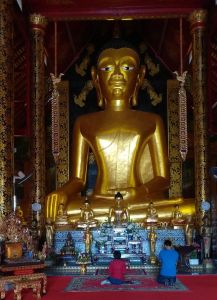
Ah yes: the means is the end. Now that’s a nice little insight don’t you think? But, still, Bhakti or loving devotion isn’t at all easy, even if you’re talking about a personal God or deity or the Divine; how much harder it is (speaking only for me here mind you) to suddenly love everyone and everything, to suddenly recognise everyone and everything as the Divine. Including, mind you, things and people I don’t like or have a distaste for or aversion towards.

So what I try to do is be open and receptive to things, ideas, concepts, other living beings, that resonate within me as representing the Divine. Then I make those things the objects of my devotion which means my prayers are prayed with a mood of love. Good vibes you see. They spread out like (my partner hermit says) ripples in a pond or even waves in the ocean. No need to think of who or what I don’t like; they’ll be affected by those ripples too.
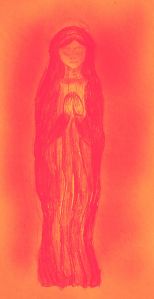
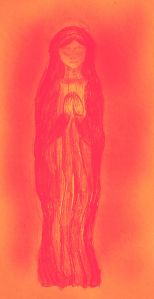
You’ve read my prayer to the Divine Mother – the embodiment of the Divine qualities of love, nurture, compassion. And soon I hope to post my Prayer of praise and gratitude to Trees. In that prayer I express my love, praise, respect for, and gratitude to, trees.

So many people – even the non-spiritual – view trees as symbols of creation in action, strength, resilience, even compassion and shelter. In other words, the Divine.

To surrender my heart to such representatives of the Divine is my continual effort and prayer. I pray to fully surrender to the natural order and smooth running of the universe, or the Divine.

And that surrender will come through my continuing and growing loving devotion.
Now, the ‘meditation is made possible’ bit? Well we all know what meditation means don’t we? Pretty much as many meanings as there are people meditating (and many who are not!). In this context I think the meditation that’s made possible is more a kind of contemplation leading to a clear comprehension or understanding.

Contemplation of the entirety of the Universe (which includes you obviously) as one whole, undivided expression of love or the Divine.

Comprehension is understanding, in a final, complete truly ‘knowing’ way, that the things of the world – the status, the possessions, wealth, sensual pleasures – are not and never can be the means to attaining perfect peace and happiness.
Of course, the ‘things of the world’ continue to be important. After all, we are (at least our bodies and minds) things of the world too aren’t we?

But that contemplation of the totality as the Divine will help us to reduce our suffering by helping us to reduce our excessive desires or cravings for those worldly things.

I think I mentioned that Bhakti, loving devotion, can be difficult. It’s true it is often hard to focus on love and devotion, to always have your heart available and open. But, you know, it can actually be a very satisfying and enjoyable feeling, and I can say a really nice experience.

So, I hope some of the ripples (and some of the waves too), some of those good good vibes are making themselves known to you.

Thank you and my love to you
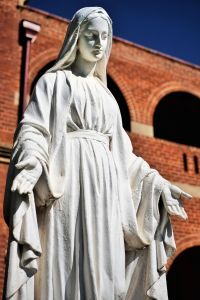
A Prayer to the Divine Mother

Growing up Catholic, attending Catholic schools from age six to fifteen, going to Confession most weeks, going to mass once a week, oftentimes more, I was deeply immersed in a particular cultural environment of Catholicism. Over time I was (we all were) inculcated with, among other things, a deep love and a reverence for Mary, the mother of Jesus.

I say deep love. No, I’m not being quite precise enough to let it slide. Sure we were taught to love her, but in a kind of limited way. We should love her because she is the mother of Jesus. Not that being the mother of Jesus was what you would label a ‘limited’ role of course. But other than that we were taught to view Mary as an intercessor for us, a conduit if you like between us and our wants, and her son Jesus. So love yes, but a kind of conditional love.

Mind you I was always very fond of Our Lady as we called her. Through a serious dedication (for a time) to The Rosary, and the numerous Hail Marys imposed as penances in Confession, I grew close to her.

And, even as I moved on and out of that Catholic sub-culture and began to explore other ideas and ways of being,  I still maintained that fairly deep reverence for Mary, a reverence that has pretty much stayed with me all my life. I only realised today that it wasn’t until quite recently that I stopped calling her Our Lady.

But, in truth, my concept of her evolved beyond her being the mother of Jesus. Indeed, I came to a point when I realised it wasn’t at all relevant if Mary herself was an actual historical figure or not (this was much much later though).

For me Mary had come to represent or symbolise the female aspect of the Divine. Still, in the early days, very dualistic of course, but a huge step from the ‘second place’ she occupied in the earlier days when we weren’t even allowed to worship her as Divine. Worship was reserved for God – who was emphatically and indisputably male, sitting in heaven, entry to which was held tightly in the hands of more males in a male controlled and dominated institution. Which, it does have to be said merely reflected the world it operated in.

Anyway, let’s jump ahead half a life time of, (shall we say for our purposes here?) living, to put ourselves into the present day. Well, recent times anyway.

To put a very long story into one sentence (again for our purposes here today) I will simply say that I moved away from Christianity and especially the denomination of my childhood. Okay, we need another sentence: In more recent times, through a whole lot of circuitous meanderings, I have come to realise that there is only God.

That is to say, all there is is God, only God, nothing else. ‘Not one God, only God.’ as my teacher’s teacher used to say.

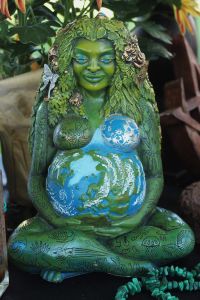
Earth Mother (Courtesy of Amber Avalona, CC0, via Wikimedia Commons)

Nowadays I still love and revere Mary. As symbol. A symbol of the creative energies responsible for bringing the Universe into existence, and which is engaged in the ongoingness of its maintainance through the laws of nature. She is one manifestation among so many of this divine creativity. In a very real sense for me, she is the Divine Mother.

So, a prayer written by me to and for the Great Mother who manifests in whatever form – or no form – in which any of us may choose to worship and love her.

Just Another Day at The Office

Who am I to even contemplate composing a commentary on the Bhagavad Gita (BG) after only seven or eight years of study, some formal with a teacher and some more casual alone?

Well, what I am is nowhere near qualified, nowhere near ready. Actually I don’t feel qualified in any way for such a thing. So much less so was I when I first sat down with my newly gifted BG in a tiny cafe called The Office in Rishikesh, literally hanging over the river Ganges.

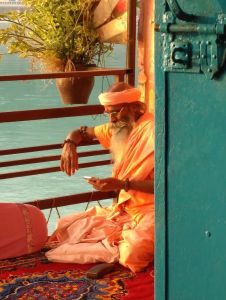
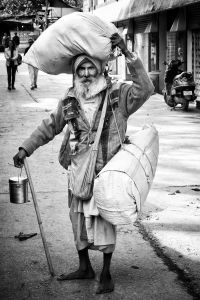
A Saddhu or Holy man and his phone at The Office

With the best fruit salad in the Universe, and fine chai to match, it was the ideal place for contemplation – that is when it wasn’t bursting at the seams and crazy.

But, as I sat there with my new BG I was one of only a couple of customers, so it was a conducive atmosphere for the aforementioned contemplation. Instead I think what happened as I thought about how to proceed to a proper study, was I allowed the sugar from the just ingested fruit salad go to my head.

You see, I decided, as I sipped a post-fruit salad chai, that the perfect study method would be to write a commentary on the whole thing starting with Chapter one, Verse one.

I no longer possess the diary in which this masterpiece was begun. Nor do I recall much, actually nothing, of what I wrote. It’s enough to say however that nothing I wrote could possibly have had any significance or depth or proper perspective.

So, as you might guess, I rambled and waffled for a couple of verses before I snapped out of my ego-driven state of arrogance and hubris. I realised I had absolutely no business taking on such a task. My lack of knowledge, wisdom, experience, all disqualified me from even thinking I had a right to try.

Now, even with the small amount of knowledge I have managed to acquire after all the study, I’m stunned at that arrogance and hubris – even if it was sugar induced. I mean, I’d never even read more than a few verses of the BG before. So, how could I even form a ‘first impression’ or ‘casual opinion’, much less a full blown commentary?

A couple of days ago I read a couple of verses that really resonated with me, as they have before. So, just like that fool sitting in The Office all those years ago, I confidently asserted that I was more than up to the job of making a commentary on those verses for this blog.

But, and here’s the really weird thing: I only just now realised, as I’ve been writing these notes, that the two verses which I will quote for you shortly, address precisely my behaviour on that post fruit salad, sugar shock induced ego trip.

I realised that it’s as if I have indeed written a commentary on those verses. And I have used a personal experience to illustrate the text. Absolutely unintentionally as it happens.

Regardless of what excuse I come up with the error in judgement in thinking I could write a full blown BG commentary all those years ago, the reality is that I failed to act with discrimination, or what I would call discernment.

In the high holy lands wrong thinking can still happen

Somehow I ignored (or totally forgot) the facts: I knew nothing! I’d lost the ability to discern what I could do and what I couldn’t do, what was a sensible action and what was a ridiculous one.

Stop! Memo to Self: Please stop picking on me!

Anyway, moving right along, here are the verses – free from commentary!

‘Thinking about sense objects brings an attachment towards them. Attachment leads to desire and desire leads to frustration, which in turn leads to delusion.
When you are deluded you lose your memory [the knowledge and experiences you could draw on to make proper decisions; sometime even to the extent of compromising your own values] and with the loss of memory the power of discrimination is destroyed; with the destruction of discrimination your self itself is lost’ .

Bhagavad Gita Chapter 2 Verses 62-63 (my version of the BG sometimes combines verses as it has here)

To Speak or Not to Speak & What Not to Speak About When You Do Speak

Have I mentioned lately that I talk far too much? No? Well then, it’s way past time to once again confess; it’s  time that I finally get it out into the open: the thing is you see, umm, I talk too much. There I’ve said it.

But wait, there is no need for concern: I have a prayer (stuck in my Bhagavad Gita, where else?) that I pray at least a couple of times a day. Well, rather than being a prayer, it’s a kind of affirmation or instruction to myself. Okay, it’s a prayer.


It’s a nice injunction, I think. I don’t recall where I borrowed it from, but I’m grateful that I came across it. It’s important to me; a vital instruction that I feel assists me in my aspiration to be a bit more thoughtful, and a bit less vocal.

Does it work?  Well with the risk of repeating myself, I will say yes. Maybe I’m a bit more thoughtful and perhaps a bit  less vocal. But, on the other hand, I wouldn’t say I was anywhere close to the ‘spending no time’ level.

Now that I’m thinking about it, illusion, fear, and wrong thinking are common themes in many people’s lives, and we might even say that they dominate our culture whether it’s the media, celebrity gossip, or any of the rest of the illusory and speculative talk that goes on all around us.

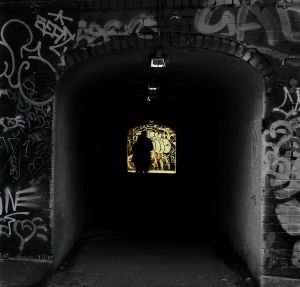
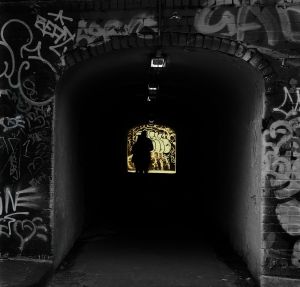
Tunnel to the Light

Anyway, fear is the biggie isn’t it? Fear of not having enough; fear of not being good enough; fear of what might happen or what might not. This list is endless. Fear of illness or ageing; fear of losing friends or fear of not having any! Fear of ‘missing out on the good life’ we imagine everyone else is living.

Then there is what’s called, the fear of the other, most often promoted and replicated by the mass media through their creation of illusions, fake news, exaggerated  or one-sided information (I hesitate to use the terms ‘facts and figures’ but you know what I mean). And then they sell us on ideas that we need to fear some other person, people, thing, time, impending catastrophe that never comes.

I don’t need to go on here: as I said, the list is endless. All that’s left to say about these fears and the illusions we are force-fed and made to believe are real, is that it all boils down to costing us a great deal of time spent and usually wasted, in wrong thinking of one kind or another.

It seems to me the media (news and social), advertising, and governments of all persuasions, are really quite happy for us all to be ‘getting the wrong end of the stick’. I think that’s the expression. Our societies are drowning in, for want of a better word, propaganda.

Buy this, do that, don’t do the other thing. Be afraid of (insert the latest scapegoat, political opponent, boogy man, the Apocalypse. Again it’s an endless list).

Then there are the fears we invent for ourselves, the illusions about ourselves that in our wrong thinking we come to believe are all real and true. One thing you can say about wrong thinking is that it makes for more and more wrong thinking. More illusions about who we are, what we do (or can’t do), what we are like, who likes (or doesn’t like) us. Here I once again risk repeating myself, but yes, it’s a long long list.

So, what can we do? Well, we could use a little reminder like the one we’re talking about here. It’s possible that it can help us correct a little of the wrong thinking that leads to fears and illusions.

Then there is what we might call discernment. Not so much deciding between one thing and another; more like coming to know what is real or illusion, a genuine, rational fear that I need to act on, or some inherited, manipulated, received  or otherwise irrational, baseless, or invented ‘fear’.

We won’t get rid of wrong thinking by trying to push it away. It’s about replacing the wrong thinking with some right thinking. We can try to recognise that wrong stuff as it comes up. We can make an effort to stop allowing ourselves to get away with our own misunderstandings, our own wild imaginations, wishful thinking, and confusions. As my teacher said just the other day, use your mind to control your mind.

One word we haven’t discussed from my little injunction is discussing. We discuss things when we talk or communicate  with others or when we talk to ourselves. Here we are at another issue for discernment: what shall we talk about?

Actually I was about to write that one excellent strategy for not spending time discussing illusions, fears, and wrong thinking is to simply stop talking altogether. That’s all there is to it: Don’t talk!

But obviously that’s a ridiculous notion right? Stop talking? Perhaps for a set time? Or perhaps as a kind of ‘time-out’ strategy? But as a principle for a whole life, it’s not going to appeal to the majority of us. Actually, that feels to me like a bit of wrong thinking creeping in: a life of no, or at least limited talking is very appealing to me. Just difficult.

Still that does seem to be what my treasured injunction suggests I do. Mind you, it’s very specific isn’t it? Spend no time, it says. Discussing what? Illusions, fear, and wrong thinking.

So, how do we manage to follow this suggestion ‘to the letter’ as they say?

Here’s another little prayer I say everyday. This one is from Thomas Merton.


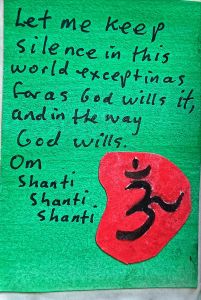
Keep silent ‘except in as far as God wills it’. For God I could say the good of all concerned; Truth; my heart; my goodwill; my love. It’s all God; it’s all the Divine.

I guess it gets back to something I said earlier about thinking before I speak. To this I would now add, feel before I speak: What’s right? What’s wrong? Does this help? Will this hurt someone else for myself.

About right and wrong: In the religious  tradition I was ‘raised in’ it was deemed that at the age of seven or eight a child is suddenly, without any preparation, able to discern right from wrong. Which means they are now responsible for the consequences of their thoughts, words, deeds. In other words, they are now capable of sinning and suffering  the consequences.

I can’t (obviously) speak for you or anyone else, but it’s been a very very long time since I was seven or eight, and I still find it tricky sometimes working out right from wrong. Of course while I know I am now responsible for my thoughts, words and deeds, I also know that we are all flawed; nobody’s perfect, so we’re going to make mistakes. 

So, all I can do – all any of us can do – is appeal to the innermost Self and use my intellect and my heart to try to discern as best I can, what is right and what is wrong.

Only in the innermost places where the real Self dwells can we know reality from illusion; it is only in our ‘heart of hearts’ as they say, combined with our rational thinking mind, what fears are real and what fear is illusion. And it is only then that heart and intellect can determine when our thinking is headed down the wrong (or the right) track.

It’s only then that we will know what and what not to spend our time discussing, either with others or internally within ourselves.  This all sounds like a long, convoluted, tricky process (told you I talk (write) too much!), but it needn’t be.

Like all things it takes practise, and once we begin to know that innermost Self, it will soon become a spontaneous way of living, when we begin to ‘just know’.

Your own inner divinity (which is the real you) wishes for you peace.

Om Shanti, Shanti, Shanti.

The Alchemy of Rain: A Poem & a Picture (or two)

THE ALCHEMY OF RAIN


Surya’s life-giving energies shine upon
scattered and drifting, yet converging, patches dotting the clear blue sky.
Silver linings, so they say,
granted to those scattered grey clouds.

Those clouds, those grey scattered and converging clouds,
bless.
Bless the domain of Varuna,
God of the skies
with the potential for change.
All forms change.

Clouds, silver-lined or no,
are Varuna,
for he is also God of the skies.
And now, with clouds’ convergence,
the expectancy ends:
the change begins.

The Sun, still present, yet his light blotted out
by those very clouds – joins Varuna
In the form of the cloud. Alchemy.

From the convergence of energy and matter
water droplets emerge;
Varuna has remanifested,
and falls to wet Earth below.

To cleanse the dust from all things
living and non-living.
From the feathers of the winged-ones;
From the fur of the four-legged;
To quench the thirst of the Tree People.
And to moisten the throats of us, the Two Legged.

Thank you my friends.

May your day be blessed by both Surya and Varuna, in the correct measure and balance that is for the benifit of all beings.

When Love is a Yoga and Lovers are Yogis

There was light at the end of the research tunnel

These last few days I’ve been researching and thinking about an idea for a blog post. But I’ve come to realise that I am grossly underqualified to write about the topic I had in mind. Let me put it another way: I am completely and utterly unqualified in any way whatsoever to go there. In fact, after all the research, I think I’m going to disqualify myself from ever going there in writing.

However, I’m a great believer in the idea that no quest for knowledge is ever a waste of time or effort; there is always something to be learned. During my research I came across a topic I believe I am qualified to discuss, as it forms an integral and vital part of my own personal spiritual practice.

Why I’ve decided to write this post, though, is because I made a discovery that lead to an insight that I know will lead to a great progress in that practice. It’s nothing new, not really, but it was one of those occasions we’ve all experienced of ‘I knew that, but now I really know it.’ For me, it was a realisation of something that till then had been a nice cosy theory and belief.

Bhakti Yoga is that practice. It is really a key foundation, a valuable component of my spiritual life.

Wikipedia opens its entry on Bhakti Yoga (see the link just above) with a description of the practice that mirrors what I think is the traditional understanding of Bhakti Yoga:

Bhakti Yoga (also called Bhakti Marga, literally the path of Bhakti) is a spiritual path or practice within Hinduism focused on loving devotion towards any personal deity.

In the same entry there is a description of the origins and meanings of the two words, Bhakti and Yoga:

The Sanskrit word Bhakti is derived from the root bhaj, which means “divide, share, partake, participate, to belong to”. The word also means ‘attachment, devotion to, fondness for, homage, faith or love, worship, piety to something as a spiritual, religious principle or means of salvation’.

The term Yoga literally means “union, yoke”, and in this context connotes a path or practice for ‘salvation, liberation’. yoga referred to here is the ‘joining together, union’ of one’s Atman (true self) with the concept of Supreme Brahman (true reality).

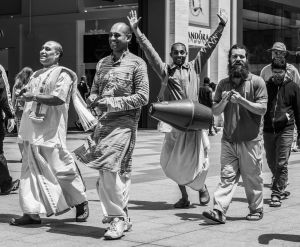
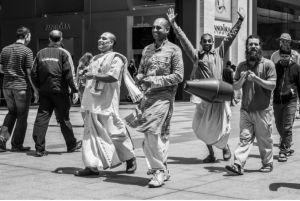
For some, dancing while chanting the names of their God, demonstrates their devotion and celebrates their union with each other and with God

In other words, those called to a religious or spiritual life, practise Bhakti Yoga whenever they pray or otherwise express devotion towards their personal conception of God, or the Divine. This particular definition seems to be saying that such a conception of the Divine, or God, is in the form of a personal deity who is a kind of representative of true reality, which the devotee is aspiring to join with.

Some Bhakta Yogis are full-time, full-on practitioners. People like contemplative nuns or monks, hermits who retire from the world into seclusion. Anyone basically whose entire life and activities are spent in devotion.

So, when I discovered all this, I became intrigued; I decided to go off on a tangent and explore the word Bhakti itself. Wikipedia has a separate entry for the word on its own:

Bhakti is a term common in Indian religions which means attachment, fondness for, devotion to, trust, homage, worship, piety, faith, or love. In Indian religions, it may refer to loving devotion for a personal God

is often a deeply emotional devotion based on a relationship between a devotee and the object of devotion.

In ancient texts the term simply means participation, devotion and love for any endeavor.

May refer to devotion to a personal god? While I thought this entry doesn’t contradict our first quote above, it does seem to broaden, and deepen, the meaning of Bhakti. Expand might be the better word.

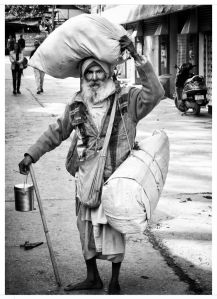
In some traditions a simple life on the road is a way to commit full time to Bhakti or devotion.

It struck me that that object of devotion might be anything. Or even everything. You see? I told you it wasn’t a new idea. It’s just that it’s resonated deeply within me now. It appears that the object of Bhakti Yoga practice doesn’t necessarily have to be a ‘personal god’.

Many many people would say ‘I like animals’ or ‘I think we should save the world’. But, while that may imply a kind of love for or at least a fondness for, I think Bhakti is something more – actually several somethings more!

For example, some people have a particular attraction to and love for, the ocean, or it might be a river they view as, if not sacred in a religious sense, then as special to them in some deep, comforting, even therapeutic way. Others have similar relationships with and feelings for trees, or even a particular tree.

Animals as either individuals or as a species or group, can have the same appeal and call to other people. Then there are those who feel strongly in their hearts you could say, that Earth itself is a sacred object, or others have a knowing that the planet is a living entity and worthy of our devotion.

Bhakti begins with love and devotion, which is about caring for, affection towards, loyalty to, emotional engagement with the object of devotion. But even more than that, there is faith in that object of devotion; faith as in trust, confidence that the love is real, that the ‘relationship’ is sound and real.

Homage and worship too are key aspects of Bhakti. The deep inner feeling we have towards a thing, person, or other being, that is beyond what we normally call ‘love’. It’s about seeing and actually realizing ‘in our hearts’ our desire to be merged or united with that thing, person, or other being.

Actually, seeing that word other just now got me thinking. I had to go back and reread our definition of Yoga up there near the beginning. It says Yoga means ‘union, yoke’. It goes on to add: yoga refers to a ‘joining together, union’.

This passage seems to be suggesting that Yoga (in our case Bhakti Yoga) is both an already existing union, and a process of joining together to achieve union. One thing I would say here is that in my practice of Bhakti (and love as a general thing to strive for and be) it’s both.

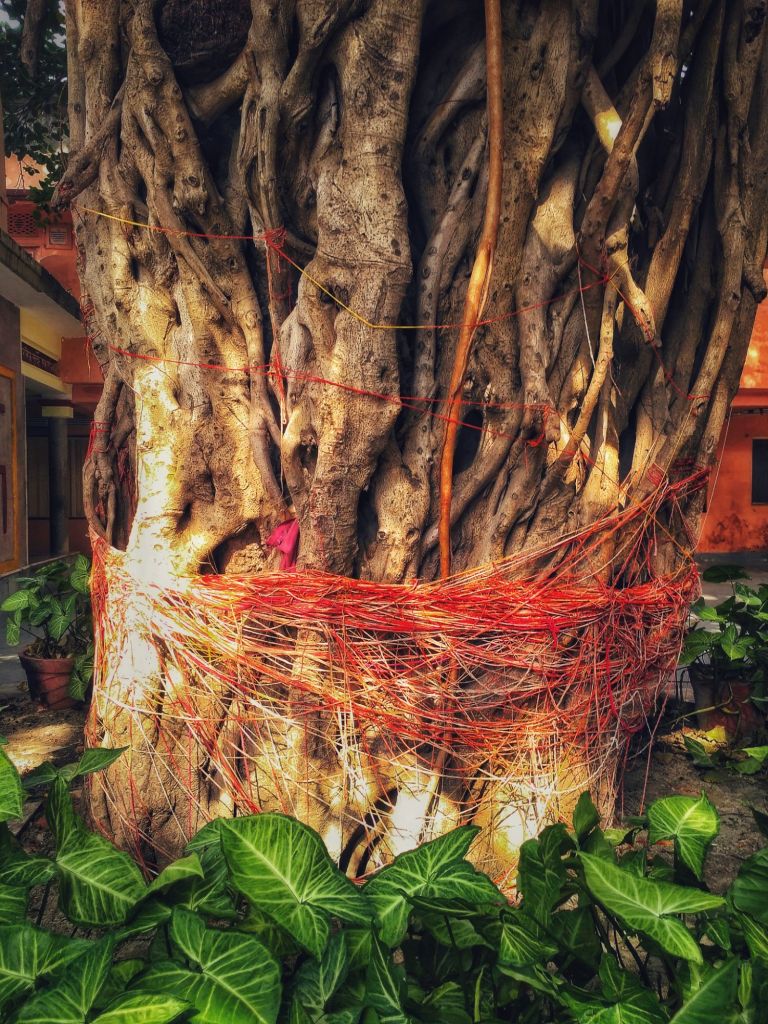
Trees are special beings for many people from a whole variiety of cultures all over the world

But, in the end, it seems to me that the process or practice, the path of Bhakti, serves to awaken us, to assist us to acknowledge, recognise, and realise in that really knowing way, our pre-existent true nature.

That true essential nature can be said to be the reality of our oneness with all things, living and non-living. And their oneness with us too of course. In fact, by putting it that way, I’m saying there is only one, or oneness. What’s that expression? One without a second.

May you be a Bhakta Yogi. Or, perhaps you already are one?

Love and peace from Paul the Hermit

Life has manifested itself as the multitudinous forms that comprise the universe. It is the one Universal Life, Power or Shakti (the laws of the universe or natural laws) that controls, guides and actuates all movements and activities in all beings, creatures and things.

                — Swami Ramdas

A TRIBUTE TO THAT WHICH IS SEEN

An affinity with trees;
crowns moved by the breeze.
    The Sentinels stand firm.

Sentinel Rising
Neighbours
In the Grove of the Sentinels

A Grove of trees we came to know well as The Sentinels, a creek, a field of grass, and nature in abundance.

Our cottage was small, but richer than all.

We do indeed stand always upon sacred ground.

Peace and love

Paul

A small remembrance and a prayer of gratitude for some old and sadly missed friends.

Sentinel Magic

A Story of Words and a Journey of Discovery

Remember that old Bee Gees‘ song Words?  It’s about one person offering all they have to another. Well, the one doing the offering must have been a writer because, while the song’s a love story, it’s words that are the big thing on offer here:

It’s only words, and words are all I have
To take your heart away

Well, as this is a blog, words are the way it hopes to reach your heart. Actually, the posts also include photos and sometimes other art, but the main vehicle used here is words.

So, with that in mind I have a couple of words to offer you today. Well, one word and its opposite. Have a look at this sentence from Thomas Merton:

If Irish monks affirmed his Celtic spirit in their mastery of cataphatic contemplation of the wonders of divinity in nature, Buddhist monks evoked his Zen mind and drew him into the apophatic path of formless ’emptiness’…

A quote from the Introduction to When the trees say nothing: nature writings of Thomas Merton

As sentences go (though this is obviously only part of a sentence) this has to rank pretty close to the top for length and denseness.

Kataphatic. What a word! Of course I had to look it up; I’d never heard the word before (this post is a rewrite from notes written a while ago that I never got around to posting.), and even though the sentence seems to  suggest the meaning, I was still curious.

Looking at Wikipedia – where they spell it with a ‘C’ like Merton, as well as with a ‘K’- I learned that cataphatic is an adjective that describes an approach to theology that uses ‘positive terminology to describe or refer to the divine (God, Truth, Dharma, Spirit. You know what I mean: the divine).

Apophatic, as you probably figured out already, is when one uses ‘negative terminology to indicate what it is believed the divine is not’. A process of negation or we could say you get to what the divine is by a process of elimination.

Pretty simple concept really, but with a couple of big words to label it, and a lot of  words to define it. No, don’t worry, I won’t bore you with the meaning and origin of the words and all the rest. Mainly because I don’t know and I’m not especially interested anyway in all that technical stuff.

I simply resonated with the word, and the concept. Cataphatic made me think of Dick Van Dyke and Julie Andrews singing Supercalifragilisticexpialidocious in Mary Poppins. But let’s not go there: this is a serious blog after all. Except to say there’s more to that word than you might imagine.

Putting aside the aesthetic appeal of the word for a minute, let’s contemplate a while on cataphatic, and it’s opposite, apothatic.

To begin thinking about these two words, it’s necessary to acknowledge the existence of the divine. We can call it God, if we like. Or Dharma, Truth, Spirit, Love, Beauty.

As the quote suggests, a cataphatic approach, ideology, theology, or whatever we call it, ascribes names and forms to the divine, as well as describing where and in what the divine may reside.

Whereas apothatic, again as the quote suggests, does not ascribe names and forms to the divine. Instead it seeks to discover what or who god is or isn’t by a process of negation as described already. 

For a long time I labelled myself as a Humanist. I had decided that this physical body is all there is; the physical or material universe is all there is, and that there is no ‘god’ separate from us or who has special powers to affect our lives. No God at all in fact.

In the Grove of the Sentinals

But, all that while, I just knew that there was something else, something more than just the physical.  And over time, I came to the knowledge that there is indeed more than the simply phsical universe (including we humans).

I’ve thought about it a lot over the years and I came to the conclusion not that many years ago, that I had simply been afraid to name or define that something more. It would have meant admitting to myself that something more really did exist.

That is to say, I was scared of taking the cataphatic approach – and I’d never even heard the word.

Well brothers and sisters, I saw the light. The truth was revealed to me. And what is that truth? Well, to put it simply, I wasn’t scared anymore. Not of names and forms, and not of what I couldn’t see.

Now I could take both the Catophatic and the Apothatic approach: that the something else I had actually always known just was, really is, and can have a name and form, or not. The divine is not an omniscient being or any kind of being at all; As I’m very fond of saying, the divine (or truth, God, Dharma) simply is.  And it’s all there is.

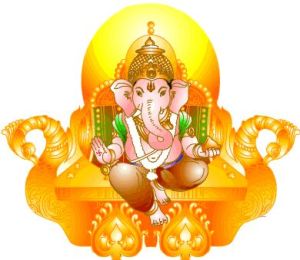
Some of you might know that I am really quite fond of the Indian deity, Ganesha . Do I believe that a man with the head of an elephant actually exists or ever existed?. Of course not. Do I actually think that he resides in the lovely painted icon that sits by my bed? Well, obviously not.

But do I believe that there is a spark or aspect or attribute in all life, in you and me, in nature, in (scary word time) creation, that we can tap into to help us overcome obstacles? Or that we can access when we begin new ventures of whatever kind, or when we need strength to face challenges? Yes, I do. Very definitely.

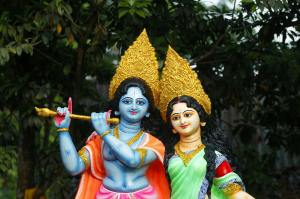
And do I believe in a blue boy called Krishna who lived in India 5000 years ago and spent his time playing in the fields with the village cows and his friends, entertaining them with his flute? Again, of course not. Does he live in the other beautiful icon by my bed? The answer is obvious: no.

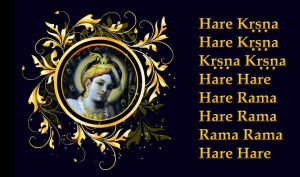
But do I chant the Hare Krishna mantra in an effort to come closer to the divine that is… well, that just is? Yes, again, very definitely.

Words. It’s all only words. Only words? Only??

In the beginning was the word, and the word was  with God and the word was God. (from the opening of the Gospel of John)

It’s all I have (for now).

Peace and Love from me to you

Flee, Be Silent, and Pray Always

A few days ago I began a new work to study and contemplate in my not quite daily Lectio Divina practice. It’s actually a spiritual classic that, although I’ve read it before, I felt the need to explore a little more, dig a little deeper, rather than simply reading through it as I did the first time.

It is The Way of the Heart: The Spirituality of the Desert Fathers and Mothers by Henri Nouwen. It is essentially a sort of guide book for those of us who are looking to live more spiritually oriented lives. And I agree with the author when he suggests that the Desert fathers and mothers are the ultimate examples for us to today, even though they lived several hundred years ago.

I haven’t gotten very far in the book; like I say it’s going to be a slower, more reflective process this time (I’m amazed how little I remember as I reread now). A small story the author tells us by way of describing how he’s structured the book, is actually where I’ve left off, so that I can share it with you before I go on with the text and forget!

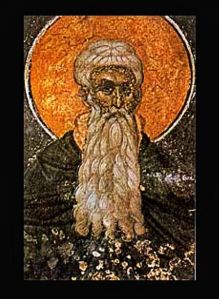
Abba Arsenius (courtesy Wikipedia)

It concerns Abba Arsenius who was a high ranking Roman official working in the household of the Emperor. Clearly he was looking for a more meaningful, more spiritually oriented lifestyle away from the dogma running people’s lives, politics, the decadence and the rest, because he constantly prayed to God, seeking a way out that would lead him ‘to salvation’. He was wanting badly to be free.

Well, he heard an answer, from deep within his soul:

Flee, be silent and pray always.

So, that’s what he did, fleeing first obviously. I don’t know the rest of his story. I mean I could look him up, but for our purposes here today, all we need to know is that he took off secretly to Egypt and went to live alone in the desert.

Nouwen believes:

“The words flee, be silent and pray summarize the spirituality of the desert. They indicate the three ways of preventing the world from shaping us in its image and are thus the three ways to life in the Spirit.”

Flee. It’s quite a strong word isn’t it? On the face of it, it simply means run away or escape. But it seems to suggest something more urgent, as if the one doing the fleeing needs to get away as quickly as possible; sticking around could be (or actually is) dangerous.

And that, as I said, is where I stopped to think. Sorry, I mean contemplate. I was so struck by the concept: in its essence, it is exactly the life I am attempting to live. Anyway, since reading it I’ve been thinking a lot about the three imperatives given to Arsenius in that very succinct answer he received to his question.

In fact, looking the word up just now I see that some slang terms for flee are: bolt, scram, schedaddle, or get the heck of out Dodge (or in the case of Arsenius, Rome). Let’s just say, to flee means to run away as quickly as you can, to escape imminent danger of some kind, real or metaphorical.

I read once of a woman who had the debilitating Chronic Fatigue Syndrome. In an attempt to recover and heal, she moved to a remote cottage in a tiny town ‘in the middle of nowhere’. Why such a drastic move? Surely if she is ill she should stay near to doctors and other resources?

Well, for her being in a city was the problem. Noise, crowds, pollution, pressure to conform and consume, interaction on so many levels all the time with other people, trying to meet daily needs in a complex, crowded and hectic environment was precisely what was making her ill.

Not to mention the effects on mental health that living in such conditions has on a lot of people, and I think we can all relate to some degree to this idea. We’ve all felt sometimes (or even very often) how we would like to just get away from it all.

For me it was about the gross materialism, the lack of ethical and moral thinking in the running of businesses, governments, and the rest; I longed also for a deeper connection with what one might call the sacred; more time and space for contemplation and just a simpler, slower, less rushed, less complex life.

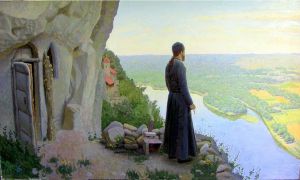
Now, I hear you saying: ‘not everyone can or should just give up everything and take off to live in a cave’. (or desert, wherever). And you are right, of course. In fact, we can say the cave is a metaphor for all sorts of spaces one might feel drawn to when fleeing and seeking separation from the world.  Actually, we’ll be talking more about this later when we get to the be silent bit.           
For these Hermit Pilgrims ‘fleeing from the world’  has meant a nomadic lifestyle, few possessions and material needs, a hermit life where our engagement or entanglement with the world is kept to a minimum, and in which we feel less of a pressure to conform, to ‘be shaped’ by the world around us’).

The reality is of course, at the end of the day for most of us and for most of our lives we have to make money to feed and clothe ourselves and our families. And for that we need to work. And in order to work we need a house to live in, and to have a house to live in we (perhaps) have to get a mortgage, and to get a mortgage … . Well I guess you get the point.

But, for a moment ask yourself: What would it look like for me to ‘flee’? For each person it’s going to take on its own unique meaning. I suppose the easiest way to put it is to say that fleeing for all of us essentially means laying aside those things (or people, places, behaviours) that we look at as ‘dangerous’ , ‘bad for us’, or from which we constantly feel the need to escape. Sometimes they’re little things, sometimes more serious.

It might be that we’ve taken on too many social media ‘obligations’ that are swallowing up any precious spare moments we have, that we’d like to be free of. Or it could be our compulsion for bringing our work home that we are desperate to give up (the bringing work home, though of course it might be the job too), so we can actually make some more free moments.

Perhaps it’s our drive to ‘know what’s going on’ by watching the news every night that’s doing our head in. These are some of the so-called minor things that we know are shaping who we are, and often against our own wishes too. Now I think about it, maybe none of it’s ‘minor’ after all.

Oh dear, I’ve done it again: word count is very nearly 1000. Too many words is another thing people try to flee from: we’re flooded, overwhelmed by words. And as much as I personally love words, I get the point and I will leave our contemplation on what was actually a message of very few words, till the next post.

Thank you for being here. Peace and love

Paul the Hermit

Illusion, fear and wrong thinking? A good question

Greetings to you, visitors to the cave

Let me begin this post by asking you a question. No. I’ll start again: I’m going to begin this post by asking me a question. It’s a question prompted by prayers I recite every day, not only during my morning practice, but at random times during the day. Here goes with the question:

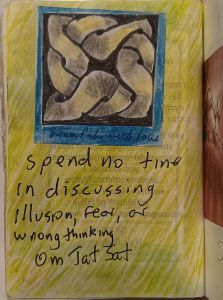
How much time do I spend discussing illusion, fear, and wrong thinking?

Well the short answer is, a lot! Despite all my efforts, prayers, meditation, discipline, and the rest, I spend way too much time pondering all kinds of illusions, indulging in an ever revolving range of fears, and thinking about all sorts of ridiculous, irrelevant, and unwanted stuff.

Oh, before I go on, I should mention that there are actually two prayers I’m referring to:

This prayer, which you might call an affirmation comes, I think, from the teachings of the ancient Indian Rishi Adi Shankara. I’ve not been able to track down the exact source. Getting a little ahead of ourselves here, but a perfect example of wrong thinking would be to berate myself for not being more careful with sources.

So, what does it mean to spend time discussing illusion, fear, and wrong thinking? Well, I know I said I was asking myself this question, but I think it would not be out of order to say that we are all prone to spending time on these things.

Discussing is obvious: talking about, thinking about, angsting over, worrying over. Illusion? Anything that isn’t real, stuff that’s ‘make believe’ as the expression goes. Anything that we are imagining for good or bad.

Our illusions are often about worst-case scenarios, or at the other end of the spectrum, they can be about some fantasy, an idealized perfect outcome to a situation. There is a lot written about how we are so very much trapped in illusion; it’s not the place here for that discussion.

Fears: pretty obvious what fears are. I don’t know about you, but I can get to thinking of stuff to be fearful of anytime, anywhere, even things I know I can face without fear. Like a couple of days ago I was walking across a rail and walking bridge near our current hermitage. A long time ago I had huge paralysing fears of high bridges, especially over water as this one is.

But for a long time now I’ve felt I have mastered this fear and then suddenly on this occasion I looked down to the river below and shocked myself with ‘What am I doing?’ type thinking and fear returned. Mind you, it passed quite quickly as I reminded myself I’d walked over this bridge (and many others) a lot of times without a second thought.

And then there are fears about the future, fears of consequences of past actions, fears of not making the right choices now, fears for health, loved ones, the world. Anything goes when it comes to fear doesn’t it?

Ah, now we get to the biggie: wrong thinking. Again I think it’s safe to say that we all spend far too much time in the company of wrong thoughts. And again, they can be about anything, and can pop up to take over our mind without warning.

Consider how often we think about things that are either none of our business, or they are things we can’t do anything about. We obsess over what we see on the news,  or what celeb is doing what and with whom. Think about how interested we often are in what other people are doing, thinking, saying.

Then there’s blindly following fashion, thinking so much about things we don’t have (and how everyone except us has those things already) that we give into advertising, and end up buying lots of stuff we don’t need, maybe can’t afford, and might not ever use. And don’t forget about the one we all fall for: gossiping about others whether they are famous, our family or friends, or simply our neighbours.

A huge case of wrong thinking are the harsh judgements we make on ourselves; and the amount of time we spend thinking about our faults and failings. And don’t forget the other end of the ego spectrum: it’s also wrong thinking to be constantly telling ourselves how great we are.

There are endless examples of wrong thinking. We need to bear in mind Buddha’s central teachings: there is a middle path that can be taken in all things. Well, this maxim applies to thinking as well. Remember that our mind can be our enemy or our friend.

Even enlightened ones such as sages, rishis, saints and the like, fall victim to illusion, fears, and wrong thinking. Of course as they are enlightened, they perhaps are less affected, less inclined to fall to the depths, as the rest of us might.

Of course, there are ways we can put ourselves on the path to that enlightenment. But in truth, it is a subject that is dealt with very adequately by all great scriptures of the world, not to mention the visionaries who have delved deeply into psychology, philosophy, and the human condition.

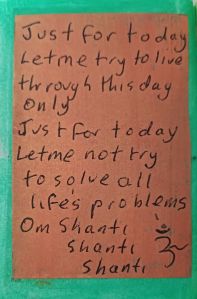
And this leads me to the second prayer:

This one comes from a song by George Harrison, titled Just for Today. I actually did a post on this song a couple of years ago that you can find here. As well, if you do check out the lyrics of this masterpiece, you will see that my prayer is a rather generous paraphrase. I don’t think George would mind; I hope you don’t either.

Just for Today (the song and, a little less articulately, this, my paraphrased prayer) is a prayer for presence, a plea to be in this place, and in this time. In other words, an affirmation that I (or you) may remember that there is only here, and only now.

But, and it’s a big big but, we need to make of our entire lives a prayer.

Of course that means using the words, but it also requires a whole lot more. Discipline, self-control, deliberate actions (saying prayers is obviously also an action), meditation, silence, contemplation, and to put it simply: good behaviour in all that we do and think.

Now, this prayer inspired by George is a good place to finish. Or rather, it’s a good place to remind ourselves we can’t solve all life’s problems at once.

Being present, being here and now, really says we have no other choice but to live through this day only. Or perhaps we can paraphrase once more and say we have to actually realise what is already true: we can only live through this one, ever-evolving and moving moment.

So, how do we get to that point of spending less time discussing illusion, fears, and wrong thinking? By coming to realise that being in this moment, and in this place, we are already perfectly fine. All we can and need to do is remember that one simple fact. But don’t worry, all you need to do is remember it just for today.

peace and love