How Shall I Live?

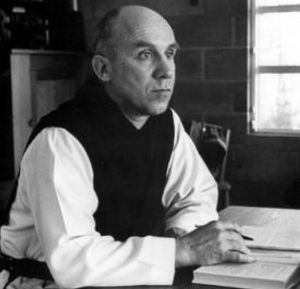
Thomas Merton in his hermitage (Courtesy Wikipedia)

The great study of the monk is to have an awakened heart

      Thomas Merton


There would be some – including me – who would say that all human beings, and not just monks, need to learn to awaken their hearts, to cultivate attitudes and a life of love, compassion, empathy, and kindness.

Who would disagree with such a suggestion?

Well, I’ve already said that I am one of the ‘some’ who would welcome such an evolution in human consciousness. But, at the same time, I don’t want to make pronouncements, form judgements, hold opinions, on what anybody should do, or be like. Only me. I am only responsible for my own behaviours, attitudes, ideas, thoughts, speech, and the rest of how to live my life. I just can’t – as in I’m not entitled – to tell anyone else what to do, what to think, what to say and so on.

Actually I’d even speculate that Merton is in fact talking about just the one monk: himself; he’s not preaching a prescription for the behaviour  of others.

I’ve read so much Merton that it’s impossible now for me to remember exactly where I read this statement of his, but I do know that when I first saw it and made a note, the concept resonated deeply for me as a great aspiration for my own life as a monk, and as a trying to be decent human being.

In other words, this monk – me, myself, and I – has a task to carry on with: to cultivate an awakened heart. And being a ‘great study’ it’s bound to be at least a lifetime’s project.

It’s an effort though, awakening one’s heart. It’s even a bit of a mystery at times what the phrase actually means in real terms.

Love, obviously, tops the list for any aspirant on the awakened heart path. And, yes, I do feel, express, and act out love – so deeply sometimes to the point of being overwhelmed or ‘flooded’; sometimes speechless (that’s the good bit), sometimes full of words.

But then there are times (oftentimes is the word) when that love is clouded or shrouded completely by angers and irritations, by regrets of what should be or shouldn’t be, could be or cant’t be, what isn’t.

The great study of the monk is to have an awakened heart
          Thomas Merton

All attachments to what is not as I think it should be. All barriers to love. All ways and means of keeping the heart asleep – or at best semi-awake, and still sleepy: slow to respond, slow to act, and with ongoing blockages to seeing how things actually are.
The quest to acquire an awakened heart and the outpourings of love, kindness, gentleness, generosity, that such a state would allow, is probably at the root, the foundation, of my life as a hermit monk, of my life as a pilgrim journeying through and to Self.

Living quietly and simply; developing a contemplative way of being in the world while definitely being not of the world; cultivating silence, peace and calm; all are activities and attitudes directed at cultivating an awakened heart.

All that generosity, patience, love, kindness, empathy, and all the rest are definitely all characteristics of an awakened heart. Here’s my dilemma  (only one among many that riddle my crazy monkey mind): they are also precisely the elements that need to be practised in order for one to acquire an awakened heart. What’s the expression? Catch 22?

Of course, it just occurs to me now, everything that is, is exactly as it’s meant to be, happening just as it ‘should’. So, in other words, all these words of reflection are simply a commentary on what has been and gone already, that which is in the past, and is no longer existing.

All that matters – all that exists – now is that at this moment, in its ongoingness, I am as loving, as kind, as patient, and as generous (not to forget compassionate, empathetic) as I’m able. To others obviously, as well as to myself.

All that wonderful list of characteristics of an awakened heart all exist right now within me. Perhaps I need to wake up my mind a bit more so I might see that reality. Then I might actually realise that I already have an awakened heart and that I simply got forgetful somewhere along the way.

with love
Paul the Hermit

You’re the Voice, Try and Understand It

One of the things I like about one of our local coffee shops is that they play a nice wide selection of music. Mostly popular songs from pretty much every decade back to the ’60s. I think they have one of those looping playlists you hear sometimes in shops and cafés.

It must be quite a long list because you don’t necessarily hear the same songs repeated at every visit. Which is a nice thing too.

Anyway, yesterday the chorus of a song I heard played got stuck in my head. The song, You’re the Voice, was a hit around the world in 1986 when it was released by Australian singer John Farnham.

It’s essentially a protest song reminding us that we all have a voice, and encouraging us to use our voices to stand up against corruption and war. One of the co-writers Chris Thompson missed out on going to an anti-nuclear protest because he slept late. He felt so badly about sleeping in that he wrote the lyrics reminding us about taking personal responsibility and making our voices heard.

Okay, back to the chorus getting stuck in my head.

You’re the voice, try and understand it
Make a noise and make it clear Oh woah.
We’re not gonna sit in silence
We’re not gonna live in fear Oh woah

You see? It’s very catchy, and an excellent piece of advice too. And, for a hermit monk, it’s actually advice I could and do aspire to live by. Just not quite in the sense the song intends perhaps.

This morning, when my partner hermit suggested we just sit in silence for a while, I spontaneously started singing the chorus, though a slightly modified version:

We’re just gonna sit in silence
We’re not gonna live with fear.

Then, as I sat in said silence, I got to thinking about the words of the chorus.  Nobody wants to live in fear, yet it is an aspect of the human condition and something so many people live with constantly all over the world. All through human history as well.

The message of the song reminds us all that we have a voice which we can use to help create a state of affairs in which we don’t have to live in quite so much fear, fear that’s coming at us from so many sources.

For me, this is a vital, fundamental, and absolutely essential principle. Without those who do stand up, those who do use their voices to try to right wrongs, then, well I can’t think of what that might mean.

Yet, for me, I’ve chosen silence. Not only chosen I must admit: temperament, my own nature, health, all are factors that have made silence the best course for me to take. Silence as in seclusion from the world, minimizing outside imput, and reducing as much as possible the attachment to the world and its things and fears.

And this way of living ironically allows me to use my voice in my own ways to address the Truth as I see it; to help effect change and contribute to the healing so sorely needed.

Being ‘out there’ and engaged with worldly things and activities and interacting with people constantly causes me so much anxiety that it threatens my health and ability to act in the world.

There is also the personal choice aspect, common to so many who live a contemplative life. Silence – when I can actually achieve such a state – gives me the energy and clarity to write; it gives me the mental, emotional and spiritual ‘space’ and energy to pray, to contemplate, and to foster the ‘good vibrations’ I feel are also necessary to turn the world towards peace, healing, and truth, as well as to assist in maintaining the wellbeing of all life.

The world, and all of life, needs both those who can’t or won’t be silent (I’m definitely not suggesting the world needs more noise). We all need people who can and do raise their voices against war, poverty, corruption, and all the ills that plague us.

And it needs those who are able to ‘just sit in silence’. The work to be done is the same; the outcomes perused are the same; and in essence the means themselves aren’t all that different either. Silence as mentioned can include the use of our voices in ‘quiet’ ways, in ways that don’t have to relate so directly the affairs of the world.

It really is a symbiosis: Those of us living secluded and contemplative lives with our prayers, our witness, our creative endeavours, support those active and vocal ones out there trying to heal the world.

And at the same time those out there in the world support the secluded and contemplative ones. Their efforts and hard work, and simply knowing they are there, are encouraging and nurturing for the secluded and contemplative ones.

We are One after all.
Yet our voices are all unique, each and every one.
That’s what I understand to be true.

I’m ‘Giving Up’ … To Amend My Life

Renunciation. It’s a popular topic here at the Hermitage. Perhaps popular isn’t the right word; let’s say it’s a subject of conversation, thought, and contemplation on a quite frequent basis. As it is, I think, for most people attempting to live a spiritually focused life. For today, however, I really want to focus on some of my own thoughts around renunciation.

For those of us oriented towards the quest to live a spiritual, prayerful, and dharmic or truthful life, renunciation tends to mean the giving up of things, activities, and behaviours (including thoughts, attitudes, and the like). The theory is the very act of renunciation itself predisposes one to more authentic and close identification with their own true natures. It places them nearer to realisation of the Divine, of God, Absolute Reality.

And of course when harmful things, situations and attitudes are released, one has less to distract from the spiritual quest and life,  Of course, most acts of renunciation don’t result in a one off quick fix: I heard in one of our hermitage conversations a few days ago the perfect quote to help make this point:

You just have to keep renewing the renunciation.

In other words, it’s a full-time, life-long job!

But, in the attempt at renouncing, we can potentially find some help towards a clearer focus on the spiritual side of life as well as more sensitivity towards what is good and what is not good for us.

A person free from both hatred & desire is always renounced. Indifferent to dualities, he is free from all bondage and easily attains liberation

Bhagavad Gita Ch 5:V 3

Which is where every one of us knows exactly what it means to try to give up what’s bad for us. It ‘ain’t easy is it? Still, we’re here to talk about me, not you or anyone else. So …

There are a few things that in perusing  the monkish life, that I didn’t have to renounce; some things like eating flesh, drinking and smoking, going out to clubs, pubs and the rest, are things I’ve either never engaged in, or haven’t done for a very long time.

Which brings me to a good point to mention here. Any renunciation whatsover has to be a personal decision taken only after serious reflection and thought. And it must be made without outside coercion or pressures. While others may think they know what’s good (or bad) for you, in truth, it’s only you who really knows.

Anyway, as I was saying, or about to say, renouncing things hasn’t always a piece of cake for me. Actually, I love cakes of many and varied kinds and have had to renounce all of them. But that was more for my body’s health than for my spirit, though obviously the two go hand in hand.

Then, just a couple of days ago in a momentous event which in fact was the trigger for all this reflection on renunciation, I vowed to give up a particular breakfast cereal I’m really very fond of.

This renunciation – not the first attempt I might add – being prompted by the fact that I tend to experience quite strong indigestion, huge bloating, and general feeling yuck, when I’ve indulged in this cereal for any length of time.

There is nothing trivial about attempting to renounce foods and so on that harm our health; as I said, it’s a lifetime’s effort. And equally daunting are the non-physical things like attitudes and behaviours.

Any renunciation whatsover has to be a personal decision taken only after serious reflection and thought.

Here is an example, or group of examples, which along with the above-mentioned cereal saga, played a serious role in bringing about this post. They are behaviours and attitudes which very emphatically interfere with my quest for a Dharmic, prayerful, and spiritually focused life,

What I absolutely hate, despise, detest, am revolted by … Oops sorry; I forgot my monkish manners there for a minute. Let me try to rephrase.

I have a strong aversion to gossip, to judgemental thoughts and comments. I am averse to it on a couple of levels. Firstly, I do not like, for one second, the idea of not minding my own business, of commenting on what other beings do or say, or don’t do or don’t say, or how they behave.

Surely, my thinking goes, I have enough of my own business to mind, why do I need to mind the world’s business?

That’s the key one I think. But I really dislike the feelings such behaviour and attitudes invoke in me: anger, frustration, guilt, inappropriate thoughts, words and conversations. There is even a physical component sometimes when I make myself sick in some way through the stress of such things.

There is another point too, just as key if not more so. I’m routinely disgusted by the notion that these criticisms, judgements, not minding my own business, really do impact on what I call the vibes of life for all of us. Call it vibes, energies, whatever, but I sense that our own behaviour has a ripple effect beyond our immediate relationships and environments to the wider world beyond.

So, by now it’s pretty clear that I am in need of some serious renunciation of my judgemental, critical thought and words, as well as the anger, disgust and the like, I feel and express towards those I deem worthy of my judgement. Okay, not just others: all we’ve been saying here applies equally to myself.

Perhaps it’s to do with family, school, or societal conditioning? And like any full-on conditioning it can tend to preoccupy, even possess, one’s life.

These are all old stories. They come from a past that doesn’t exist. For real, it’s gone right? Actually, when you think about it, there really is no such thing as the past.

Long ago, decades really, I was big into affirmations. I had a whole collection in a little folder that I kept in my pocket of on my desk or wherever was handy.

There are a few I remember even now thirty or more years later, and there are one or two that come to mind that might be helpful that I can resurrect to share here.

I release and let go of all that is unlike love. There is plenty of time and space for everything I want to do.

You let go of all that’s unlike love, what’s left? Love. Love is all. All is love. And this affirmation has an added bonus: no regrets, it’s never too late, there is time –  and space – aplenty.

And the second one. I think it’s just as good:

I am at peace with my own feelings. I am safe where I am. I create my own security. I love and approve of myself.

This one I’ve rewritten as a prayer; I might share that one sometime. The helpfulness  here is easy to get: I’m safe; it’s okay to have my own feelings.

There’s no outside threat – nothing to attack, nothing to defend – and, finally, I have no need to be entangled with all that unwanted stuff, that – as I’ve already said a couple of times – is none of my business.

For my community, the invisible and the visible, with love

Realisation of Reality; It started With a Joke

‘I like looking at you,’ says the hermit.

‘You must be sick in the head,’ replies, as quick as  you like, his partner hermit of 40 odd years. (Obviously an old and oft shared joke).

‘Of course I’m sick in the head,’ bursts out of the hermit in response. ‘It’s like saying the sun comes up every morning. It’s a given, a simple fact of life.’

Problem is, it’s not true is it? the sun I mean; it doessn’t come up does it? Doesn’t go down either for that matter. I mean it looks like it rises up every morning, and it looks  like it goes down every night. But it doesn’t. In reality it’s us here on planet Earth who are doing the turning.

At ‘sunrise’, our home planet in its continual revolving has us looking at a stationary star (our Sun, Sol, Surya) that is, rather than going up, just sits there as we revolve downwards leaving it behind, Same story at night with the sunset, just the other way round.

Our experience when looking at this scene is that the sun is going down behind the hills. But in reality it’s the hills and river and the viewer going up as Earth rovolves. Hard to get one’s head around.

To explain what we see, what we experience – or rather what our ancestors saw and sought to explain – the simplest, most obvious thing to do is tell it like we see it. Sounds obvious enough, but as we’ve just seen, the story we inherited and which was only recently (in historical terms that is) shown to be incorrect, of the rising and the setting of the sun was based on an illusion,

As to the hermit and his story – the long-held believed to be true story – well, if we’ve been able to establish that stories we tell ourselves are often based on illusions, then perhaps the hermit can look for another story concerning the state of his head health, that is based a little more on facts, not so much on illusion.

Or to put it in other words: It’s quite possible that if the truth of the matter is that the sun never goes up and never  goes down, then just maybe the hermit is not actually sick in the head.

Except perhaps when it comes to old jokes shared between beloved partner hermits.

A Short Rant About (and Addressed To) Mind

Lately I’ve been dwelling on thoughts and other mind stuff. A lot, and in both senses: mind stuff won’t leave me alone; and the nature of that mind stuff has had me thinking about it all, as well.

Of course, it’s the way mind works – especially as one makes the effort to calm the mind, still the thoughts and move beyond them to that little place of stillness and silence. It seems the more one practises, the more mind works hard on keeping one thinking, distracted, absorbed in memories and fantasies; anything but still and quiet.

And, in recent times, I’ve come to understand how and why the Desert Fathers and the Desert Mothers spoke of these mind activities as ‘demons’ who came to tempt, torment, distract and disturb.

The memories, thoughts, fantasies, fears plaguing me lately have been like that – extreme, upsetting, disturbing. All making me long for the good old days of simple day to day ‘distractions’.

So, here’s a weird thing: Yesterday, when once again sitting for meditation, I realised that yes indeed, those good old days had returned. Thoughts and memories had taken on a lighter tone – even running a Star Trek episode in my mind. Mind you, there are some that might say that this is very deep meditation material.

Still all the ‘what ifs’, the ‘should haves’, and the rest, but not so heavy, not so frightening or depressing. I was more or less welcoming the light relief.

Then it occured to me with a shock: I had fallen for a sneaky mind trick. Welcoming the relief as I just said, I wasn’t being so firm in my efforts to still these kindler and gentler, not so threatening thoughts as I had when the ‘demons’ had come calling.

So, mind with its wiley ways figured I was an easier target for distraction. No need now for extreme measures.

Well, dear mind of mine, I have woken up to your sneaky little strategy. I’d like to have you as my friend – as you most certainly are a great deal of the time – but if you want to play the old demon game, then I am going to have to try just that much harder to ignore you.

Actually, no. No trying. Despite your determined efforts dear mind, and your ever-changing strategies to keep me off balance, I will simply be here. Being still. Not disturbed.

Mostly.

Mindful? Full of What?

Anyone who has tried to meditate for more than a minute, knows very well that the mind right away jumps into overdrive, trying its hardest to keep us nice and distracted; anything but quiet and peace is the mind’s aim. Speaking for myself, all I want to do is get rid of that mind altogether.

But, I know, that would be a mistake. I may not like how my mind behaves sometimes, but I do actually quite like having one, a mind that is. I guess, for me, it’s about realising that my mind is here to stay, and can be either my friend or my foe.

Trouble is, when trying to meditate, I can easily believe it’s my worst enemy. Another mistake, I think, that arises from a not so discerning attitude to the thoughts that flood in seemingly at random.

But, sometimes in that quiet and still space – and even if that quiet and peaceful space hasn’t yet been reached – a thought comes from the mind friend, not the foe. It seems I must learn discernment. Here’s a good example.

Not long into my meditation earlier today, but already bombarded with random thoughts, memories, and other distractions to said peace and quiet, an idea came that just caught my attention. Suddenly, there seemed to be a full-blown idea for what sounded like a great blog post.

I din’t have this notebook with me, and though I had my phone handy, I thought, no, be firm, don’t let interruptions in. Of course, I thought that I’d remember the idea, but sure enough, I didn’t. Now, it’s nowhere to be found. I mean it must be in some tiny neuron in my brain, but it’s hiding pretty well!

Later, after my meditation session, I thought to myself, how come I could make a list of all the less than useful thoughts, memories, ideas and random mental craziness that tried its best to keep me distracted, yet I have no idea what that one wonderful blog post idea was?

I think it might possibly be about attachment; a lesson I’m giving myself in discerning between what thoughts are from my friend mind which ones from my foe mind, the mind running wild with its accomplice, my ego.

It’s a lesson I badly need, I think. Endless thoughts of little or no use to me have stayed, while the one that might have been helpful is gone, seemingly forever.

Yes indeed. Perhaps ny perspective on what ideas ad thoughts are useful to me and what ones aren’t, needs to be contemplated upon.

Actually, it’s not really needing a lot of contemplation: I mean, the one idea I thought would be great is gone. But looking at it the other way around, the fact that the great pile of not so good thoughts staying with me has given us this post I am now writing, and you are reading.

Perspective. It’s all about perspective. And discernment.

The Time is Always Right for Niceness

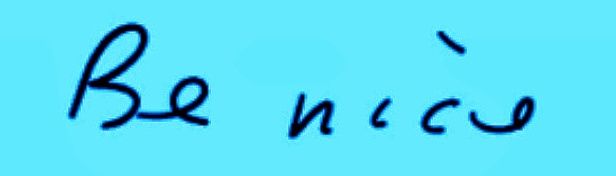
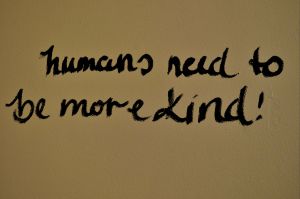
Scrawled in the margin of a page in my notebook are two words: Be nice. Nothing else on the page to suggest a context, source, or inspiration. But, here’s the interesting thing: Just below those two lonely words, and in brackets, I’ve written:

Do nice, Consume nice, Share Nice.

Most likely we’ll never know what prompted me to write that particular series of words. I mean, they’re not exactly new ideas are they? Still, discovering (or is it rediscovering) them today, I thought that, while not original, they do present us with a neat little package of behaviours, attitudes and actions; a perspective or way of looking at things that might just help us (or I should say me) along the road to spiritual growth, for being better, doing better; oops! You get the idea.

Be nice. All of us long to be nice to others, to family, friends, work colleagues, strangers, the world as a whole. Some of us would even feel better if we could only be nice to ourselves now and again.

Speak softly, go slowly in my interactions with others – loved ones or strangers, it doesn’t matter. While we all wish for others to be nice to us, we are all very aware that life doesn’t always work that way. But at the very least if we can be nice in every situation, then it’s better for everyone.

So, when slighted by another, spoken to with a loud or aggressive voice, or in some other way treated ‘not so nicely’, pause. Breathe. Then with confidence in yourself and what you have to say or do, be nice to that other.

Smile (when you can and it’s appropriate), be calm, assertive, but stay nice.

As to being nice to Self. Well, I’m trying to give up the negative self talk, and the self critical thoughts, as well as not so nice thoughts about other people or situations. Being nice to others is also an act of niceness to ourselves. We feel good when we’re nice to others (and bad when we’re not so nice to others).

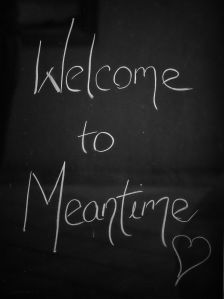
Meantime is so Yesterday. Make it Nicetime today!

Do nice

The verb do suggests doing; taking action. Do nice things for others – and for Self also. Sometimes it’s easy to do nice things for others, sometimes not so easy. Still, as with everything, it is the efforts we make that are the key: remember, nice makes nice.

Anyway, we’re all familiar with the brilliant (genius really) Random Acts of Kindness concept and movement. It’s a truly revolutionary idea that’s rightly spread far and wide and has become an integral aspcet of everyday life for many many people. Really any act of kindness, random or otherwise, is another way to describe doing nice.

And, once again, we shouldn’t forget about ourselves. Doing nice things for ourselves lifts our spirits, changes moods, enriches our lives overall. Don’t forget that doing nice things for others is just one more way we can do something nice for ourselves.

Consume nice. What am I putting into my body? What am I looking at, listening to, reading, buying – what am I consuming? How much of this consumption can I label as nice? How much of it is of benefit to myself or to any or all other beings, or to Earth herself?

And, the flip side of that question: Of all that I consume, how much is doing harm, again to myself, other beings, the planet itself?

Heaps, if you’re anything like me. I am engaged in constant struggle to change my habits of consumption. As I make these efforts, fight these battles with old old habits (I think I talked about this in a recent post?), I remind myself to be kind to myself when I fail to make forward steps – and just as or more often when I take a step (or two, or…)backwards.

Share nice. This one’s easy: reread all of the above. Well, okay, maybe there’s a little more to it than that. Actually, isn’t there an old aphorism that we’re all supposed to have heard in kindergarten? ‘Share nicely‘? I guess back then it was about sharing toys and other playthings with the other kids.

Now we are all grown ups, it means, well much the same really. If you have been blessed with material prosperity, be free with the way you share that good fortune.  Be free and generous with how, and with whom, you share that wealth with.

Equally, no it’s not equally at all; it’s way more important and significant. Share your time; share your skills; share your knowledge; share your experience. The best thing of all to share – the nicest thing – is your love.

Love works well, not only with those close to us, those we call loved ones. Love can be shared in all our interactions with the world, whether it’s family, friends, work colleagues, or with strangers we encounter as we go about our day-to-day lives.

Share nicely of course isn’t only about what you share; it’s also about how we share. Share with a nice attitude. We’re right back where we started, be nice. Approach all with an attitude of love, generosity, and kindness.

So, how does all this nice stuff contribute to our spiritual growth?

The Greatest Hashtag of Them All

Well, I think as we’ve just seen, nice equals love. I feel that having nice – love – as the foundation of our being, doing, consuming and sharing, helps us move forward on the path to the realisation that happiness does not come from outside of ourselves – and certainly not from material things like money, possessions, and the like.

Nice can really only start with me – with you. From within my own Self, which in truth is non-different than your own Self.

There is a beautiful – truly beautiful – expression that has become an empty, flavourless, hollow, meaningless platitude. I’d like to rehabilitate that expression right now.

I want to say with my heart and my love, to all of you:

Have a nice day

and

To Speak or Not to Speak & What Not to Speak About When You Do Speak

Have I mentioned lately that I talk far too much? No? Well then, it’s way past time to once again confess; it’s  time that I finally get it out into the open: the thing is you see, umm, I talk too much. There I’ve said it.

But wait, there is no need for concern: I have a prayer (stuck in my Bhagavad Gita, where else?) that I pray at least a couple of times a day. Well, rather than being a prayer, it’s a kind of affirmation or instruction to myself. Okay, it’s a prayer.


It’s a nice injunction, I think. I don’t recall where I borrowed it from, but I’m grateful that I came across it. It’s important to me; a vital instruction that I feel assists me in my aspiration to be a bit more thoughtful, and a bit less vocal.

Does it work?  Well with the risk of repeating myself, I will say yes. Maybe I’m a bit more thoughtful and perhaps a bit  less vocal. But, on the other hand, I wouldn’t say I was anywhere close to the ‘spending no time’ level.

Now that I’m thinking about it, illusion, fear, and wrong thinking are common themes in many people’s lives, and we might even say that they dominate our culture whether it’s the media, celebrity gossip, or any of the rest of the illusory and speculative talk that goes on all around us.

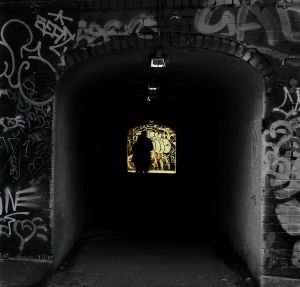
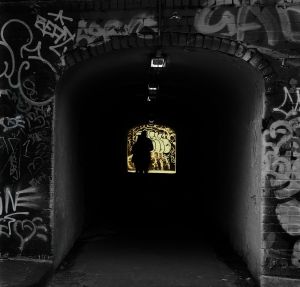
Tunnel to the Light

Anyway, fear is the biggie isn’t it? Fear of not having enough; fear of not being good enough; fear of what might happen or what might not. This list is endless. Fear of illness or ageing; fear of losing friends or fear of not having any! Fear of ‘missing out on the good life’ we imagine everyone else is living.

Then there is what’s called, the fear of the other, most often promoted and replicated by the mass media through their creation of illusions, fake news, exaggerated  or one-sided information (I hesitate to use the terms ‘facts and figures’ but you know what I mean). And then they sell us on ideas that we need to fear some other person, people, thing, time, impending catastrophe that never comes.

I don’t need to go on here: as I said, the list is endless. All that’s left to say about these fears and the illusions we are force-fed and made to believe are real, is that it all boils down to costing us a great deal of time spent and usually wasted, in wrong thinking of one kind or another.

It seems to me the media (news and social), advertising, and governments of all persuasions, are really quite happy for us all to be ‘getting the wrong end of the stick’. I think that’s the expression. Our societies are drowning in, for want of a better word, propaganda.

Buy this, do that, don’t do the other thing. Be afraid of (insert the latest scapegoat, political opponent, boogy man, the Apocalypse. Again it’s an endless list).

Then there are the fears we invent for ourselves, the illusions about ourselves that in our wrong thinking we come to believe are all real and true. One thing you can say about wrong thinking is that it makes for more and more wrong thinking. More illusions about who we are, what we do (or can’t do), what we are like, who likes (or doesn’t like) us. Here I once again risk repeating myself, but yes, it’s a long long list.

So, what can we do? Well, we could use a little reminder like the one we’re talking about here. It’s possible that it can help us correct a little of the wrong thinking that leads to fears and illusions.

Then there is what we might call discernment. Not so much deciding between one thing and another; more like coming to know what is real or illusion, a genuine, rational fear that I need to act on, or some inherited, manipulated, received  or otherwise irrational, baseless, or invented ‘fear’.

We won’t get rid of wrong thinking by trying to push it away. It’s about replacing the wrong thinking with some right thinking. We can try to recognise that wrong stuff as it comes up. We can make an effort to stop allowing ourselves to get away with our own misunderstandings, our own wild imaginations, wishful thinking, and confusions. As my teacher said just the other day, use your mind to control your mind.

One word we haven’t discussed from my little injunction is discussing. We discuss things when we talk or communicate  with others or when we talk to ourselves. Here we are at another issue for discernment: what shall we talk about?

Actually I was about to write that one excellent strategy for not spending time discussing illusions, fears, and wrong thinking is to simply stop talking altogether. That’s all there is to it: Don’t talk!

But obviously that’s a ridiculous notion right? Stop talking? Perhaps for a set time? Or perhaps as a kind of ‘time-out’ strategy? But as a principle for a whole life, it’s not going to appeal to the majority of us. Actually, that feels to me like a bit of wrong thinking creeping in: a life of no, or at least limited talking is very appealing to me. Just difficult.

Still that does seem to be what my treasured injunction suggests I do. Mind you, it’s very specific isn’t it? Spend no time, it says. Discussing what? Illusions, fear, and wrong thinking.

So, how do we manage to follow this suggestion ‘to the letter’ as they say?

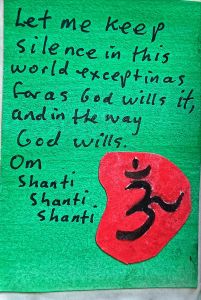
Here’s another little prayer I say everyday. This one is from Thomas Merton.


Keep silent ‘except in as far as God wills it’. For God I could say the good of all concerned; Truth; my heart; my goodwill; my love. It’s all God; it’s all the Divine.

I guess it gets back to something I said earlier about thinking before I speak. To this I would now add, feel before I speak: What’s right? What’s wrong? Does this help? Will this hurt someone else for myself.

About right and wrong: In the religious  tradition I was ‘raised in’ it was deemed that at the age of seven or eight a child is suddenly, without any preparation, able to discern right from wrong. Which means they are now responsible for the consequences of their thoughts, words, deeds. In other words, they are now capable of sinning and suffering  the consequences.

I can’t (obviously) speak for you or anyone else, but it’s been a very very long time since I was seven or eight, and I still find it tricky sometimes working out right from wrong. Of course while I know I am now responsible for my thoughts, words and deeds, I also know that we are all flawed; nobody’s perfect, so we’re going to make mistakes. 

So, all I can do – all any of us can do – is appeal to the innermost Self and use my intellect and my heart to try to discern as best I can, what is right and what is wrong.

Only in the innermost places where the real Self dwells can we know reality from illusion; it is only in our ‘heart of hearts’ as they say, combined with our rational thinking mind, what fears are real and what fear is illusion. And it is only then that heart and intellect can determine when our thinking is headed down the wrong (or the right) track.

It’s only then that we will know what and what not to spend our time discussing, either with others or internally within ourselves.  This all sounds like a long, convoluted, tricky process (told you I talk (write) too much!), but it needn’t be.

Like all things it takes practise, and once we begin to know that innermost Self, it will soon become a spontaneous way of living, when we begin to ‘just know’.

Your own inner divinity (which is the real you) wishes for you peace.

Om Shanti, Shanti, Shanti.

A Story of Words and a Journey of Discovery

Remember that old Bee Gees‘ song Words?  It’s about one person offering all they have to another. Well, the one doing the offering must have been a writer because, while the song’s a love story, it’s words that are the big thing on offer here:

It’s only words, and words are all I have
To take your heart away

Well, as this is a blog, words are the way it hopes to reach your heart. Actually, the posts also include photos and sometimes other art, but the main vehicle used here is words.

So, with that in mind I have a couple of words to offer you today. Well, one word and its opposite. Have a look at this sentence from Thomas Merton:

If Irish monks affirmed his Celtic spirit in their mastery of cataphatic contemplation of the wonders of divinity in nature, Buddhist monks evoked his Zen mind and drew him into the apophatic path of formless ’emptiness’…

A quote from the Introduction to When the trees say nothing: nature writings of Thomas Merton

As sentences go (though this is obviously only part of a sentence) this has to rank pretty close to the top for length and denseness.

Kataphatic. What a word! Of course I had to look it up; I’d never heard the word before (this post is a rewrite from notes written a while ago that I never got around to posting.), and even though the sentence seems to  suggest the meaning, I was still curious.

Looking at Wikipedia – where they spell it with a ‘C’ like Merton, as well as with a ‘K’- I learned that cataphatic is an adjective that describes an approach to theology that uses ‘positive terminology to describe or refer to the divine (God, Truth, Dharma, Spirit. You know what I mean: the divine).

Apophatic, as you probably figured out already, is when one uses ‘negative terminology to indicate what it is believed the divine is not’. A process of negation or we could say you get to what the divine is by a process of elimination.

Pretty simple concept really, but with a couple of big words to label it, and a lot of  words to define it. No, don’t worry, I won’t bore you with the meaning and origin of the words and all the rest. Mainly because I don’t know and I’m not especially interested anyway in all that technical stuff.

I simply resonated with the word, and the concept. Cataphatic made me think of Dick Van Dyke and Julie Andrews singing Supercalifragilisticexpialidocious in Mary Poppins. But let’s not go there: this is a serious blog after all. Except to say there’s more to that word than you might imagine.

Putting aside the aesthetic appeal of the word for a minute, let’s contemplate a while on cataphatic, and it’s opposite, apothatic.

To begin thinking about these two words, it’s necessary to acknowledge the existence of the divine. We can call it God, if we like. Or Dharma, Truth, Spirit, Love, Beauty.

As the quote suggests, a cataphatic approach, ideology, theology, or whatever we call it, ascribes names and forms to the divine, as well as describing where and in what the divine may reside.

Whereas apothatic, again as the quote suggests, does not ascribe names and forms to the divine. Instead it seeks to discover what or who god is or isn’t by a process of negation as described already. 

For a long time I labelled myself as a Humanist. I had decided that this physical body is all there is; the physical or material universe is all there is, and that there is no ‘god’ separate from us or who has special powers to affect our lives. No God at all in fact.

In the Grove of the Sentinals

But, all that while, I just knew that there was something else, something more than just the physical.  And over time, I came to the knowledge that there is indeed more than the simply phsical universe (including we humans).

I’ve thought about it a lot over the years and I came to the conclusion not that many years ago, that I had simply been afraid to name or define that something more. It would have meant admitting to myself that something more really did exist.

That is to say, I was scared of taking the cataphatic approach – and I’d never even heard the word.

Well brothers and sisters, I saw the light. The truth was revealed to me. And what is that truth? Well, to put it simply, I wasn’t scared anymore. Not of names and forms, and not of what I couldn’t see.

Now I could take both the Catophatic and the Apothatic approach: that the something else I had actually always known just was, really is, and can have a name and form, or not. The divine is not an omniscient being or any kind of being at all; As I’m very fond of saying, the divine (or truth, God, Dharma) simply is.  And it’s all there is.

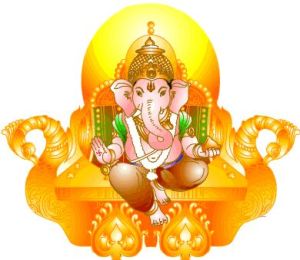
Some of you might know that I am really quite fond of the Indian deity, Ganesha . Do I believe that a man with the head of an elephant actually exists or ever existed?. Of course not. Do I actually think that he resides in the lovely painted icon that sits by my bed? Well, obviously not.

But do I believe that there is a spark or aspect or attribute in all life, in you and me, in nature, in (scary word time) creation, that we can tap into to help us overcome obstacles? Or that we can access when we begin new ventures of whatever kind, or when we need strength to face challenges? Yes, I do. Very definitely.

And do I believe in a blue boy called Krishna who lived in India 5000 years ago and spent his time playing in the fields with the village cows and his friends, entertaining them with his flute? Again, of course not. Does he live in the other beautiful icon by my bed? The answer is obvious: no.

But do I chant the Hare Krishna mantra in an effort to come closer to the divine that is… well, that just is? Yes, again, very definitely.

Words. It’s all only words. Only words? Only??

In the beginning was the word, and the word was  with God and the word was God. (from the opening of the Gospel of John)

It’s all I have (for now).

Peace and Love from me to you

Flee, Be Silent, and Pray Always

A few days ago I began a new work to study and contemplate in my not quite daily Lectio Divina practice. It’s actually a spiritual classic that, although I’ve read it before, I felt the need to explore a little more, dig a little deeper, rather than simply reading through it as I did the first time.

It is The Way of the Heart: The Spirituality of the Desert Fathers and Mothers by Henri Nouwen. It is essentially a sort of guide book for those of us who are looking to live more spiritually oriented lives. And I agree with the author when he suggests that the Desert fathers and mothers are the ultimate examples for us to today, even though they lived several hundred years ago.

I haven’t gotten very far in the book; like I say it’s going to be a slower, more reflective process this time (I’m amazed how little I remember as I reread now). A small story the author tells us by way of describing how he’s structured the book, is actually where I’ve left off, so that I can share it with you before I go on with the text and forget!

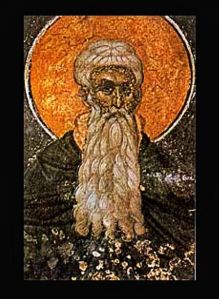
Abba Arsenius (courtesy Wikipedia)

It concerns Abba Arsenius who was a high ranking Roman official working in the household of the Emperor. Clearly he was looking for a more meaningful, more spiritually oriented lifestyle away from the dogma running people’s lives, politics, the decadence and the rest, because he constantly prayed to God, seeking a way out that would lead him ‘to salvation’. He was wanting badly to be free.

Well, he heard an answer, from deep within his soul:

Flee, be silent and pray always.

So, that’s what he did, fleeing first obviously. I don’t know the rest of his story. I mean I could look him up, but for our purposes here today, all we need to know is that he took off secretly to Egypt and went to live alone in the desert.

Nouwen believes:

“The words flee, be silent and pray summarize the spirituality of the desert. They indicate the three ways of preventing the world from shaping us in its image and are thus the three ways to life in the Spirit.”

Flee. It’s quite a strong word isn’t it? On the face of it, it simply means run away or escape. But it seems to suggest something more urgent, as if the one doing the fleeing needs to get away as quickly as possible; sticking around could be (or actually is) dangerous.

And that, as I said, is where I stopped to think. Sorry, I mean contemplate. I was so struck by the concept: in its essence, it is exactly the life I am attempting to live. Anyway, since reading it I’ve been thinking a lot about the three imperatives given to Arsenius in that very succinct answer he received to his question.

In fact, looking the word up just now I see that some slang terms for flee are: bolt, scram, schedaddle, or get the heck of out Dodge (or in the case of Arsenius, Rome). Let’s just say, to flee means to run away as quickly as you can, to escape imminent danger of some kind, real or metaphorical.

I read once of a woman who had the debilitating Chronic Fatigue Syndrome. In an attempt to recover and heal, she moved to a remote cottage in a tiny town ‘in the middle of nowhere’. Why such a drastic move? Surely if she is ill she should stay near to doctors and other resources?

Well, for her being in a city was the problem. Noise, crowds, pollution, pressure to conform and consume, interaction on so many levels all the time with other people, trying to meet daily needs in a complex, crowded and hectic environment was precisely what was making her ill.

Not to mention the effects on mental health that living in such conditions has on a lot of people, and I think we can all relate to some degree to this idea. We’ve all felt sometimes (or even very often) how we would like to just get away from it all.

For me it was about the gross materialism, the lack of ethical and moral thinking in the running of businesses, governments, and the rest; I longed also for a deeper connection with what one might call the sacred; more time and space for contemplation and just a simpler, slower, less rushed, less complex life.

Now, I hear you saying: ‘not everyone can or should just give up everything and take off to live in a cave’. (or desert, wherever). And you are right, of course. In fact, we can say the cave is a metaphor for all sorts of spaces one might feel drawn to when fleeing and seeking separation from the world.  Actually, we’ll be talking more about this later when we get to the be silent bit.           

For these Hermit Pilgrims ‘fleeing from the world’  has meant a nomadic lifestyle, few possessions and material needs, a hermit life where our engagement or entanglement with the world is kept to a minimum, and in which we feel less of a pressure to conform, to ‘be shaped’ by the world around us’).

The reality is of course, at the end of the day for most of us and for most of our lives we have to make money to feed and clothe ourselves and our families. And for that we need to work. And in order to work we need a house to live in, and to have a house to live in we (perhaps) have to get a mortgage, and to get a mortgage … . Well I guess you get the point.

But, for a moment ask yourself: What would it look like for me to ‘flee’? For each person it’s going to take on its own unique meaning. I suppose the easiest way to put it is to say that fleeing for all of us essentially means laying aside those things (or people, places, behaviours) that we look at as ‘dangerous’ , ‘bad for us’, or from which we constantly feel the need to escape. Sometimes they’re little things, sometimes more serious.

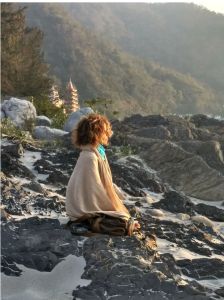
It might be that we’ve taken on too many social media ‘obligations’ that are swallowing up any precious spare moments we have, that we’d like to be free of. Or it could be our compulsion for bringing our work home that we are desperate to give up (the bringing work home, though of course it might be the job too), so we can actually make some more free moments.

Perhaps it’s our drive to ‘know what’s going on’ by watching the news every night that’s doing our head in. These are some of the so-called minor things that we know are shaping who we are, and often against our own wishes too. Now I think about it, maybe none of it’s ‘minor’ after all.

Oh dear, I’ve done it again: word count is very nearly 1000. Too many words is another thing people try to flee from: we’re flooded, overwhelmed by words. And as much as I personally love words, I get the point and I will leave our contemplation on what was actually a message of very few words, till the next post.

Thank you for being here. Peace and love

Paul the Hermit