Japa in the Dunes

Japa, or the chanting of the names of God or the Divine, is a central spiritual practice for me. In fact, as time goes by, it becomes even more important for me as I try to spend more time chanting than not!

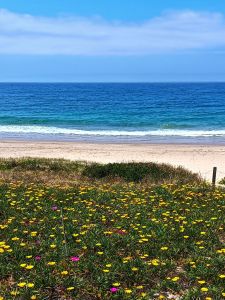
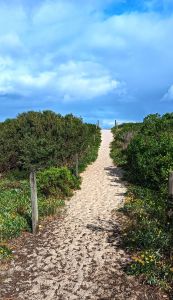
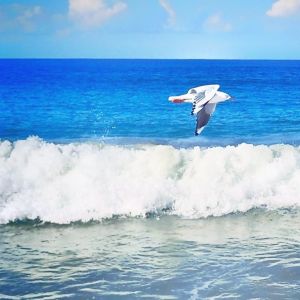
With Japa in mind I climbed yesterday to the crest of the sand dune on which our current hermitage is situated, to spend a while with the sea and the dunefield flowers, the birds, and as I planned to be doing some chanting, also with those unseen aspects of the Divine that I would be addressing with my words.

As seems to be happening quite often these days when I immerse myself in the beauty that is to be found all around me, all that is to be seen and experienced ‘up there’ as it’s come to be called, a poem wrote itself about yesterday’s particular excursion and experience.

I share it with you now in the hope you will enjoy reading it; thank you for reading it!

SAND DUNE KIRTAN

Perched upon the crest of a sand dune,
I chant the names of the Lord
Hare Krishna Hare Krishna
Hare Rama Hare Rama

I am still; the Lord’s names vibrate in my mind.
But Varuna’s energy washes saltwater back and forth
in the middle distance.
Sea waves manifest from depths unknown.
Sea waves dissolve on the shore
in the middle distance.

Now, in the near distance,
near to me where I rest and chant on sacred ground,
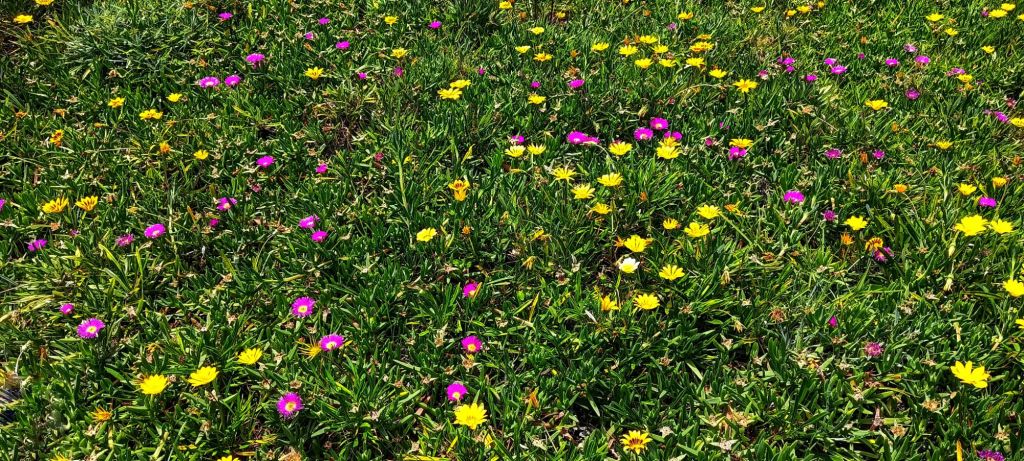
flowers with yellow heads, purple heads, wave in the wind
as if ecstatically dancing to a holy Kirtan
gifted them by the wind.

These myriad jewels in the dunefield join me in my japa.
Or is it that I merge with their sacred dances?

It’s neither, and yet it’s both:
The beautiful blooms are me,
and I am them.
We are the One,
Chanting and dancing
the names of the One.

Spotted on a Sand dune: A Poetic Sharing

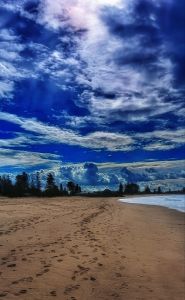
With the current hermitage located not so much on the side of the road, as right on the side of a large sand dune system, you might imagine that I am at and on the beach every day.

While almost every day, I walk the track that follows the crest of the dunes in this particular area, I’ve only actually gone down to the beach itself a handful of times.

So, yesterday as start to my resolve to make amends for this omission, I climbed the dune, ignored the crest track leading left and right, and continued straight on and down the other side of the dune, and onto the beach itself. My intent was to spend an hour or so walking along the tide line.

And so it was.

Judging by such rare experience of the beach itself, I might easily say I am no ‘beachcomber’; no discoverer of coastal treasures, little natural beauties from the sea, or even the occasional oddity one might expect washed up. Until yesterday that is.

Not that I went to ‘comb’ the beach: rather I was there trying to put myself on the receiving end so to speak, to be a receptacle for what I might be blessed with (not to forget the need for exercise and movement).

And so it was.

This sense of grace and blessings, I hope I’ve conveyed in the small poetic effort (as well as its companion photo) that I now share with you.

SPOTTED ON THE SAND DUNE

Strolling (briskly mind you) along the sands,
There I was – deep in the liminal zone.
Ankle-deep – sometimes – seawater cooling my feet.
One way to receive Varuna’s blessings.

Back on dry sands (still in the liminal zone) I pause
to examine a spiral shell – an elegant and delicate sea creature.
It lives. Reverently, I move it to deeper water.

As I rise from my small task of union, of reunion,
I glance – still within the liminal zone – upwards.
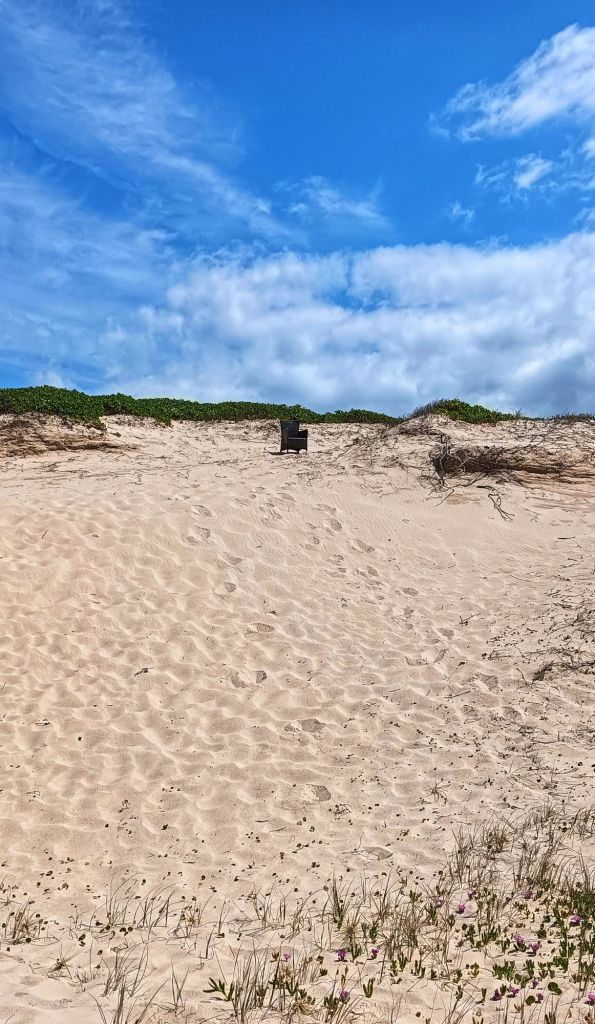
There, near the crest of the sand dune sits a chair.
An armchair I spotted right there on the sand dune.

There it was, facing me – and the sea – in the middle of nowhere.
Though this is clearly somewhere for somebody.
The perfect perch for taking in
Pacific views.

Empty chair, lonely sight
overlooking the liminal zone.

Sacred Places, Sacred States

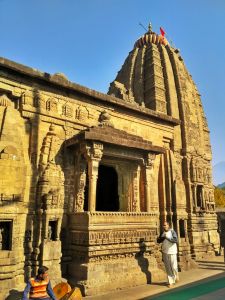
Tirtha. There is much varied, detailed and fascinating information about this word on its Wikipedia entry. While I invite you to click the link and head over there to read what is truly a riveting story, for this post I wanted to focus on the word’s actual meaning, especially the metaphoric meanings it has acquired.

Tirtha is a Sanskrit word meaning ford, as in a place one fords or crosses a river, stream or other body of water. Over time, however places of religious pilgrimage began to be called Tirthas. This evolved because so many holy sites were on or near rivers or lakes, or were the water bodies themselves, or were located nearby.

Sacred sites, and places of pilgrimage often inspire in people a sense of leaving the ordinary material existence  of their day to day lives, and entering a kind of other world, the world of the spiritual or non-material. This experience, which we might call spiritual or religious , is something people remember as being very special, even transformational; for them it speaks of a connection, even briefly, with the divine in the form or in the presence of that place or site.

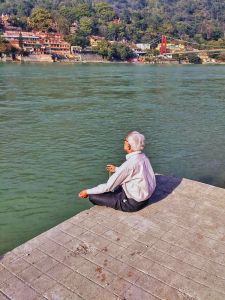
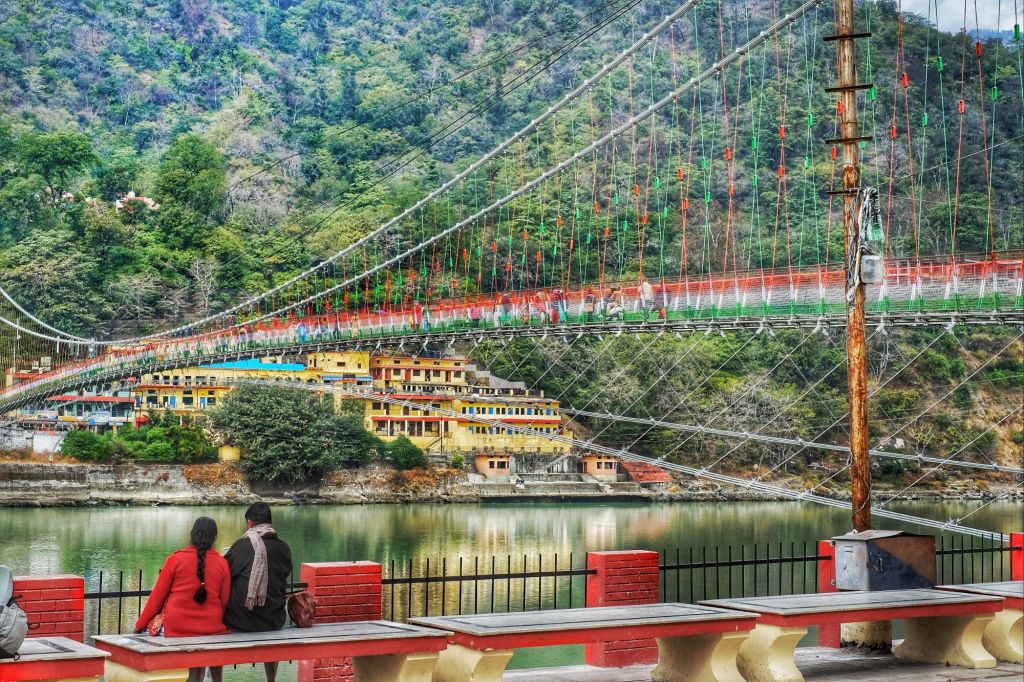
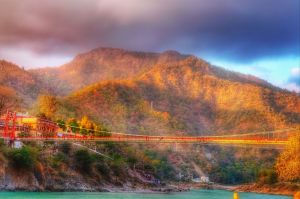
Perfect example of a Tirtha as a literal crossing place that is also an ancient sacred site. Mother Ganga at Rishikesh in India

And after many years – centuries and millennia very often – the energies from sometimes countless pilgrims and their prayers, devotion, love and mere presence, accumulate and begin to permeate the atmosphere in that place as well as the very ground and sacred objects there.

To me this notion is reminiscent of the concept of thin places  as described in Celtic Spirituality (though the concept by the same or other names exists for many cultures around the world. Sorry I’m not providing any links: there are so many!).

Some would say they are places where Heaven and Earth meet. Places where the boundary between the mundane world and that ‘somewhere else’ of the transcendent, is especially thin, and where crossing over, or connecting with that transcendent may be possible, or made easier than at other places.

Of course, as I’ve written in at least one previous post, I feel that we are always standing upon sacred ground; all things are sacred or holy. At the same time, I have, like so many others, experienced what seem to be very real connections to or mergings with something  transcendent, something ‘spiritual’ as we like to call it, at specific sites or location.

A few of these places of my own transcendent experiences  have been churches, temples, and other historically recognised  sacred places. However, I would say that most of my own experiences have been at unexpected places, places where the ‘transcendent’ has been for me alone at that moment.

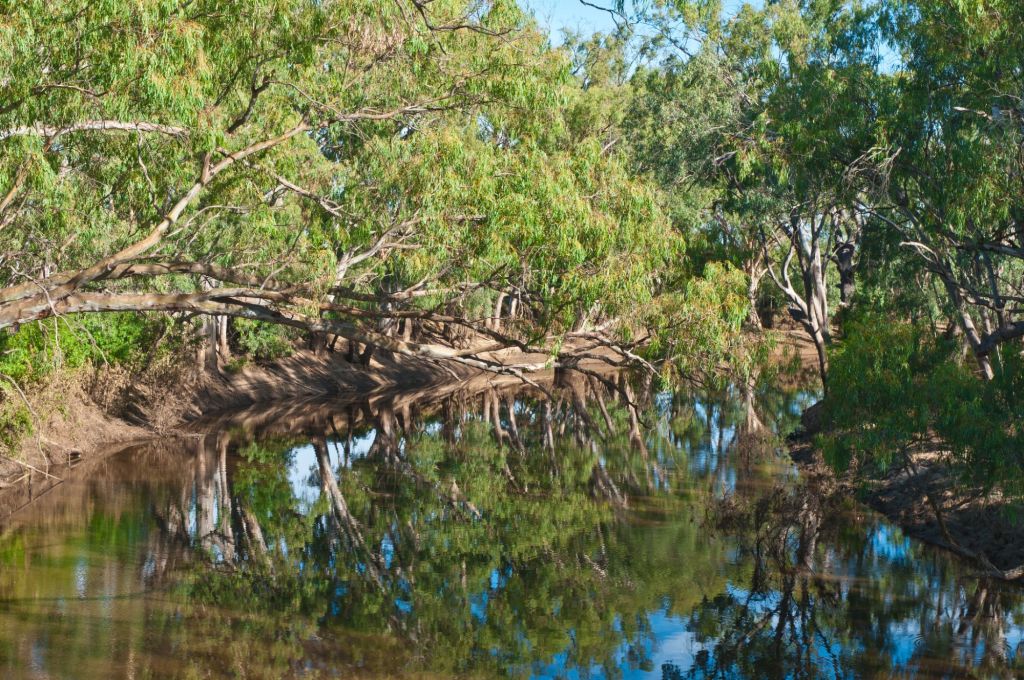
The Campaspe River after the floods receded

One such place for me happens to be a river called the Campaspe. It was here that the ashes of two fellow hermit pilgrims of the feline persuasion found their rest.

As I stood on the muddy bank of that river, and made my offering, I sensed that feeling I describe above; that feeling of oneness with or connection to the river, to that place. As those two little creatures whom I loved (and love now) and who are made of the same stuff as me, were returning to some kind of essential or foundational state, we were there and connected with them as they continued on their journey.

I knew then for sure the sacredness of that place, the thinness of the boundaries there. While then I didn’t yet know the word, the Campaspe River had for me became a Tirtha.

DEDICATED TO:

Shanti and Lofi. Two beautiful beings and fellow hermits and pilgrims on the journey with us. With us in our hearts and now off carrying on with their own adventures and pilgrimages.

One, Without a Second, is All There Is

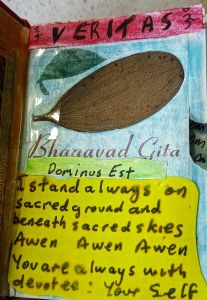
Right at the front of my Bhagavad Gita (the only book aside from the notebook I’m writing this in, that I personally own), I have recorded and inserted sayings and various words , that are important to me. Among those things is a statement I first heard many many years ago, that is common among the First Nations’ peoples of this country:

I [We] stand always on sacred ground and beneath sacred skies.


It is not an affirmation of ownership or possession. It is, instead, an affirmation of belonging to the land, to nature. It is a prayer of thanks, and it is a declaration of the knowledge of unity with the rest of the natural world, that is the hallmark and foundation for Indigenous cultures throughout the world and through time.

I’ve valued – treasured – this sentiment for a very long time – probably from even before I first heard it, which was so long ago as to be lost to memory. Perhaps I always knew it because I’ve somehow always thought this idea was a fundamental truth concerning my existence as a being living on this planet.

Well, now I have heard another statement that for me makes a perfect compliment for this one. The other day, during a lecture, my teacher mentioned that in his student days a fellow student said:

Wherever you are, you are walking through Ishwara

(Ishwara being her preferred name for the divine – for all that is.)

There is a feeling or sense of ‘belonging’, of awe and wonder when we attempt to immerse ourselves in what we term the natural world.

Once again I immediately felt the bell of Truth ringing clearly through this statement. Yes, I thought, everything is divine – including our own selves – so of course it follows that wherever we go, whatever we do, we are always in the divine.

You’ve probably read a number of times me quoting my teacher quoting his teacher:

It’s not that there is only one God, there is only God.
          Swami Dayananda Saraswati

Emphasis very much on only. Meaning of course, that it’s not that God is within us, or that we are within God; we are not surrounded by God; and it’s not that God ‘sits in our hearts’. The reality (for my teacher’s teacher) was that all that is, everywhere, everything, every thought, every word and deed, everything there is, is the divine.

Another way to describe the divine or God, that appeals to me is that Ishwara (also my own preferred name for the Divine) is in reality the natural order of the universe as dictated by the laws of nature. Those laws of nature, the rules that govern how the universe works, are also Ishwara, as are all that is manifest or in existence  as a consequence of the workings of those laws.

In other words, the Divine is the sum total of what some would call the entirety of creation.***

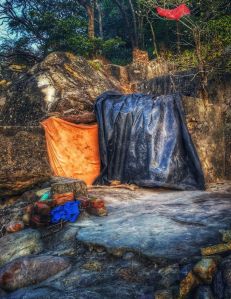
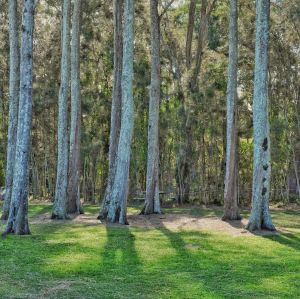
For the hermits a sacred site. Part of a grove we named The Sentinels. A place of experience of unity and oneness of creation

For me this an enormously comforting and reassuring concept. Of course, for me at least, it is also an extremely difficult one to wrap my head around. But here’s a small summary of what I think I’ve grasped so far.

Ishwara – the Divine – is all there is; everything. Also divine is the natural order of the Universe as governed by the laws of nature. These laws are neither good or bad – there is no duality. They are neutral.

You and I, as one more entity among who knows how many others, act as we do and are subject to the laws of nature, just like everything else. We can’t change or influence those laws; we can only live our lives as they unfold.

To quote from Desiderata: No doubt the Universe is unfolding as it should

And, well, then things just work out as they do. While we can’t change the laws of nature, or bend the universe to always suit our liking, it is also true to say that every action we take, every thought we think, every word we utter, even our very presence as a living being in our time and place, do indeed contribute to ‘how things work out’. Another way of saying this is to say, we do our bit, and the universe does its bit and what happens, well, happens.

For me, this is not at all as simple or as straightforward as it sounds. Naturally  we see ourselves as individual selves, as entities on our own. After all, to state the obvious, we live and operate in a material (dualistic) world. So automatically we see ourselves as individuals living in, but always separate from all the other individual entities, as well as being disconnected from the world itself.

It is part of human nature (for the most part) to long for connection; there is so often a drive within us pushing us to create family, enter relationships, feel we belong to a community or communities, and for many but not all, there is the almost instinctive urge to seek connection with the rest of nature.

Many forms, One reality

We often think of these longings as goals to achieve, as something outside of ourselves to attain, to reach for. Consequently, so very often we tend to focus our attention outwards, towards other people, or material things.

But, instead, all these inclinations, desires and longings are simply our Self (note the capital?) endeavoring to open itself to discovering (or rediscovering?) that which already exists: our oneness with, and our non-separation, and non-difference from, The All That Is.

Peace and Love from Paul the Hermit

FOOTNOTE

***Just a few thoughts about naming, or giving labels to the Universe and its laws.  Obviously it’s a personal choice for each of us what we choose to call that creation. Then, on the other hand, we don’t have to call it anything at all. For me personally it is very difficult, even near impossible to not name it. By naming the creation, I don’t think I am attributing the manifestation of the Universe to some distant entity living in some heavenly abode (as my teacher likes to say). Rather I am acknowledging the intelligence  and order, beauty, complexity of all that is and how it all works, as its own reality. At the same time, I am learning to understand that I as my true nature am not separate from the rest of creation, and I feel the need to have a name towards which I am able to focus my thanks and my reverence.

My Visit to the Beach, and a Poem Shared

Greetings friends

One of the key elements of the current temporary hermitage, the current safe-haven by the side of the road, is that it is literally two minutes walk from a very uncrowded and quiet coastal beach.

It is a place of golden sands (I know that’s a cliche but in this case I have the evidence!), gentle wave action, and the promise of a possible serenity of a kind I’ve not been close to for a long while.

While I don’t visit this little slice of Pacific coast every day, I get to walk and or sit there several days a week. And when I do, I find that it’s always uplifting and relaxing. A reminder too, of my oneness with all nature. All of us are actually nature, along with every other living thing on our planet (and of course elsewhere too).

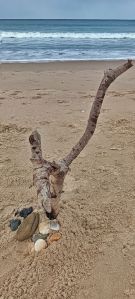
Today, for the second time I built a little ‘shrine’ on the sand.  Walking away from my little temporary temple, a poetic voice entered my mind and wrote itself a few lines. Too engrossed in the moment, I neglected to record it on my phone, so when I got back to the hermitage I wrote it as remembered.

And now, I would like to share it with you. I am grateful that I am actually able to share it, so thank you.

WE STAND ON SACRED GROUND

I planted the branch,
the branch of a fallen tree person.
On the beach,
in the sand of the beach.

And I built a shrine
around that branch.
A pop-up shrine.
Shells, stones, and a piece of coal.

A shrine to Varuna.
A shrine to Surya, to Saraswati.
A shrine to all the gods
of Earth, Sky, Water.
A shrine to the gods of all beings.

A shrine on the beach
is subject to tidal flow.
And soon, this simple shrine,
pop-up and temporary in nature,
will be engulfed.

Lord Varuna will make his claim.
What has emerged, must always return.

with love and in peace