No Internet Reception? Is It a coincidence?

My last post spoke of the need for spiritual seekers to have association with devotees, fellow travellers on a spiritual path. I extolled the virtues for hermits living more secluded lives with the little physical contact, such as me, of accessing the Internet to find stories of past and present spiritual seekers, as a means to satisfy that need for association.

Watching videos, reading books and articles online, exploring websites managed by individuals or groups, all present opportunities for association.

I pointed out how all these activities are blessing in that they help instill a sense of connection and belonging, how they confirm the reality that I am not alone. Encouraging and inspiring, I said it was – and it is.

However, I did neglect to point out that there are hazards, pitfalls, slippery slopes, triggers for depression, anger, sadness. For me, spending time ‘online’ should come with an ‘enter at your own risk’ warning.

This is especially the case when spending time on the video watching apps, where you can watch unlimited videos on an unlimited range of topics.

Call it temptation; call it the magnetism of old attachments and conditioning; call it what I like: the reality is that, after too much time watching videos online, I will often start to drift, just for a ‘quick look’, just a short spell of lookin but ‘just a bit’. Not forgetting the sad resolve to only look at ‘stuff that’s good for me’.

A sad resolve I said because so often what I ‘have a quick look’ at is news, movie clips; anything that tugs at my old ways and habits, anything that pushes old buttons and triggers my old depressive and decidedly non-peaceful, melancholic self.

It doesn’t happen that often, not anymore. But when it does, I have a sense of sinking back into the mire of worldliness as it’s called. I feel the falling into the aforementioned pit. Even stuff I have strong aversions to, such as certain political leaders, reach out to grab me when such moments arise.

Anyway, such a slide down the slippery slope has been threatening the last couple of days. So, tonight I decided: no videos or other web stuff. Time for a break; time to clear my mind and relax.

The only online thing I thought I’d do is post some photos on a photo sharing site I belong to. Watching videos and other web stuff, causes me to neglect important things, like sharing my photos, sitting quietly, reading; all the good things. Time to settle. Time to catch up.

So, all set up to begin sharing, all that was missing was an Internet connection. I tried rebooting devices; all the usual remedies. Still no connection. Twenty minutes later I finally got it: the Universe wasn’t going to allow me anywhere  near the Internet.

Interesting timing, I thought. I decide no Internet (sort of) but the Universe has other ideas: Absolutely no Internet.

Of course Internet dropping out is hardly a unique event. It’s not as if it’s even a rare or occasional occurance.
Still, the last few days, the connection has been excellent. Then, tonight, nothing. Could be a coincidence? But then I don’t believe in coincidences.

Whatever. Now I am happily writing a blog post to share with you, then I’m going to actually make some pictures – been neglecting that too. Then, after that I’m going to get back to a partly read but excellent book I’ve lost touch with. Time to reengage.

Meanwhile, I will choose to think that the Universe is unfolding exactly as it’s meant to.

No Internet? No problem.

Self Enquiry: Listen to Your Self

This last little while I’ve been going through some serious contemplation, some deep questioning, on how to be ‘more of a monk’. Things like how to pray more deeply, and often; how to have a more focused and concentrated devotional practice; how to be a nicer person. Things like that.

Actually, that’s not exactly right is it? These are questions, enquiries, that for a number of years (is all my life too big a stretch?) habe occupied me. I’ve consistently been making enquiries, addressing questions, to Self – as well as to God or the Divine.

Still, like all things in life, self-enquiry goes through more intense, then less intense phases or periods. Let’s just say that lately I’ve been immersed – sometimes to the point of distraction – in one of those more intense periods.

(note from internal editor: Do I have to remind you once again to get on with the story you are here to tell?)

Okay then; let me see. Oh yes, right. Last night I was looking forward to beginning a new book. I’d read the introduction and thought that it was going to be just my cup of tea as it were, that it was something I would enjoy and learn from.

Anyway, as I opened the book on my tablet, I was suddenly stopped by a sort of wordless warning. The sense I had was that this book would indeed be a little piece of the answers I’ve been seeking.

Not so much in the contents I felt, it was more about approaching the book with more openness, less skepticism, more generosity of spirit and mental attitude. And the idea seemed to also include taking these qualities with me later as I thought about what I had read (or was about to read I should say).

You see, being more open, less skeptical, and more generous, come under the umbrella of being nicer. Still given the subject I was about to read about, I was a bit surprised by this ‘warning’.

As it turned out, I finished the entire book, so enthralled was I by the contents. The only things that tested my resolve to ‘be nicer’ was a number of occasions when the author’s worldview and interpretation of events, stretched my patience.

But, I managed. I didn’t become inpatient or outraged or irritable . When threatened by such responses I simply reminded myself that I was reading about another person, and I didn’t have to have an opinion one way or the other about what they believed or how they lived. Not only do I not have to have an opinion, I’m not sure I really have the right to an opinion about someone else’s life at all.

Besides, haven’t I just got through describing how I am myself deeply engaged in a process of self-enquiry? And wouldn’t such a process involve exposing myself to ideas, worldviews, kinds of information, new to me or not in alignment with my own beliefs? Surely bursts of impatience, indignance, judgement, and the like, would close me off in my search for answers?

Anyway, as I said I was so enthralled by the book – my reading informed by a little more generosity, a little less judgement, a renewed attempt at openness – that I finished the book in that one sitting.

Mind you it was only one hundred and something pages long. Still, for me, it was pretty good going.

PS Speed reading wasn’t – isn’t, nor ever will be – a part of my ongoing self-enquiry into the depths of my monkhood. Perhaps I need to add something like ‘Transcend the ego’ to my list.

Friend Or Foe?

Your enemies will now question your capabilities. Is there anything more painful and shameful than that?

Bhagavad Gita 2:36

Thanks to inspiration from my partner hermit, I’ve once again begun reading Bhagavad Gita from the beginning. The quoted verse came up this morning as I continued through chapter 2.

Setting the scene, the Bhagavad Gita is a conversation between Krishna (God) and Arjuna, a famous warrior who’s leading the army of the ‘good guys’. The context is actually a metaphor for the battle that goes on constantly between what some call the Higher Self (represented by Krishna of course), and our lower selves, our ego, mind, and the rest of the worldly us (represented by the very worldly Arjuna).

Knowing that, sometimes a verse will jump out at me as being in some direct way related to me. This verse, this morning seemed spookily all knowing about my mood of just slightly earlier.

Before we move on, I should point out that Arjuna has just realised that if the battle goes ahead, he’s going to have to kill many relatives and friends, teachers, and others he respects. And he’s just decided he’s not going to do it and sits down depressed and dejected on his chariot.

Now while I personally applaud this decision (he even says it might be better if he went off into the forest and lived the life of a wandering monk rather than be in this battle), I have to remind myself that it’s not for real, it’s a metaphor for the battle between our two selves.

Krishna says to Arjuna that you’re going to look really bad if you don’t fight the fight to uphold the Truth as you know it. Lesson number one when studying the Gita: don’t sweat the context!

Anyway, to our current story.

I’d just finished my breakfast cup of tea, and I knew it was time to ‘get on with the day’ as the saying goes. Today, though, Tamas** was strong. Which left me feeling, I don’t really want to get on with the day.

Instead I felt I wanted to not get on with anything; I wanted to lie down and sleep, and not think about anything, or do anything else either!

This picture is called Lunchtime Sleeper but it’s how I felt after breakfast this morning!

Mind you, not in the ’empty your mind of random thoughts, relax the body, realise the Divine’ kind of mood. No, more like ‘lay down, block out everything, blank the mind, sleep.’ Blank as it blot out!

Then, the famous second thought kicks in: No, I said to myself. I will not allow Tamas to take control. So, I got up, brushed my teeth, washed my face, and got ready to begin my practice.

I guess you could say that Tamas finds it easy to take control when one’s mind is in enemy mode as I like to call it (somewhere else in the Gita, Krishna says the mind can be our friend or our enemy).

My mind in particular doesn’t usually need a lot of help to disparage me, put me down. Getting me to question my own capabilities is one of its favourite activities – sometimes.

And it’s exactly right, perhaps I should be questioning myself: If I allow Tamas (mind and ego etc) to have free rein, the pain and the shame is all I feel. Well, perhaps not all, and not always, but still, it’s not a good thing.

So, what’s going on now? I’ve been reading Bhagavad Gita, and now I’m making these notes. Tamas is on the run and my mind is being ever so friendly.

**Tamas is that aspect of our (human) nature that has us leaning towards lethargy, laziness, that ‘I can’t be bothered’ feeling, and excess sleep, and all the other slothful stuff. Blotting out, as I termed it earlier.

Let’s Talk

I feel like talking more … Sorry. Start again. It’s not what it seems and, well rather than get into it now, just read on a bit and all shall become clear.

Anyway, there’s an old joke that goes like this: One friend says to another friend: ‘How come you’re always talking to yourself?’ To which the second friend replies: ‘Well, you see, I always like to talk to the most intelligent person in the room, so I look around and usually I find that it’s me. So I end up talking to myself’.

Okay, maybe not so funny. Could be taken as bad manners or rude come to think of it. But that’s how jokes often are isn’t it?

Anyway, and here we get to the little bit of clarity I promised, you’re probably going to remind me that I have often said I would like to talk less, and be quiet more often.

That’s still true, but this is different. You see, lately I’ve been feeling the need to talk more about various aspects of my ‘inner life’. You know the sort of thing: confusions and worries; niggling issues bugging me; that kind of stuff.

And my community hear and experience quite enough of my inner life, with its contradictions, mood swings, and the rest; I have no intention of being more of a burdon than I probably already am.

So, I look around and ask who’s left? Me! Myself! I! Not exactly the most intelligent person in the room, so there the joke breaks down, but it does indeed look like I might end up talking to myself after all.

Well, it’s kind of a yes and no sort of thing. ‘Myself’ is the individual with this mind and body, making these words appear on the screen. It’s the ego self, the me that’s the being who walks, talks, breathes, and … Well you know what else.

But, and this is the brilliant bit, if I separate the words to read My Self, will it’s a whole other story. For a start, Self is not ‘mine’. Self is that part of me that is consciousness; and it’s not a different entity than ‘your’ consciousness, or anyone or anything else’s.

So, if I start talking to this Self that’s actually anyone and everyone, and not just me, who is it that I am in fact talking to?

Sounds to me like I’d be talking to you, and you, and everyone else; to the trees, the birds; everybody!

And yes, that’s exactly right. For me, there is only Self – consciousness – that is indeed anyone, anything, everyone, and everything in the Universe, both seen and unseen.

In other words, I’d be talking to God; the Divine; the Absolute Reality; the Thou Art That described by at least one of the world’s great spiritual traditions.

Which is to say, I want – need – to spend some more time talking to, and in conversation with, God.

Phew. I’m glad I figured that out.

You might remember the prayer I wrote a while ago to the Divine Mother? Seems like a good place to share it with you again.

Love and Peace from Paul the Hermit

A Little Bit of Self Knowledge Hard Won

You know, for all my prayers; for all my mental discipline – efforts at mental discipline – for all my meditations, chanting, and other practices, I still just talk way too much for my liking, and often it feels like it’s only talking for the sake of talking.

I still just open my mouth and let come out any old thing that keeps the noise going. Oh, it’s worse than that: sometimes when I talk it’s rambling and waffling that I cleverly (or not so cleverly) disguise as intelligent, rational, and based logically on knowledge that I either have or haven’t got. Either way, I somehow seem to think I’m offering words of well thought out wisdom.

Whereas, as I said, the noise I make is so often rambling, contradictory , ill-informed, thoughtless waffle.

Enough! Blimey, that’s enough. Talk about opening a post on a calm, relaxed, optimistic, and compassionate note.

Here’s the thing: I want to devote my entire life to devotion and prayer. And that requires at least some silence. Yet, instead, I merely talk about the joys of silence, about the joys of full-on devotion to the divine, and as well I occupy so much time and energy to just voicing random thoughts that come and go, go and come, without rhyme, without reason.

Okay, here’s the second thing: I long with my deepest longing to be silent – to not simply stop talking, though that would be an excellent beginning. No, I want to be quiet; I want my vocal chords to have a break and let my true voice speak through my life, through this blog, my photographs and in whatever way I am lead.

So, what to do? Well, here’s the third thing, thing number three: all I need to do in order to both stop talking so much and be silent is to just sit. Sit and do nothing. There is no thing that I can do that will magically turn me into an oasis of silence and peaceful calm.

Sometime in the dim distant path I read someone paraphrasing The fouth Noble Truth in two words, Just sit. Buddha did indeed know what he was talking about. And I do get the irony: when I talk, I need to say something that helps, not just make noise and try to avoid silence.

Just sit

What? It’s the Next Question

I’m rewriting this post after initially making it another two for one thing. One of those two questions had been: ‘What is prayer?’. As in what form can and does prayer take, my prayer that is.

Then I realised that all the thoughts, all the contemplations and reflections I came up with in answer, belonged more correctly in the How question which will be coming in due course.

Which means, that in this post we will be looking at just the one question, which also is only about my own personal prayer life.

What do I pray for?

As it happens, I have already spent a little time on this question in the Why do I pray? post back in November. I think it would be a good start to begin this post with a quote from that one:

  ‘So,’ you might ask, ‘you pray without any ulterior motive at all? You don’t pray to get things? You don’t pray for healing for others or yourself? You don’t pray for peace and happiness for the world or for yourself? None of these things?’
  These are good, valid questions. And the short answer is yes, of course I do. I do pray for healing for others and myself; I do pray for communal and personal peace. As for happiness, well who doesn’t pray in one way or another for a just a little happiness now and again?
  However, I do draw the line at praying for material things, like money and material objects to possess, none of those kind of things. I believe I don’t pray for such things. I think so anyway.

Now, I don’t know about you, but it seems to me that those two last little sentences are broadcasting a very clear message: Obviously there is some uncertainty in my thoughts about what I actually in fact do pray for.

Somewhere, sometime, recently I wrote to the effect of that there is nothing to pray for, and that there is nobody to do the praying. This, of course is not a notion we can really get to grips with while living in a material body in a material Universe.

It’s nore for those dwelling in some transcendental realm where everything that exists has ceased to exist, and all that remains is pure consciousness.

So, obviously while we continue our existence as embodied beings, living in a material universe, there is much to pray for and there are many of us who do pray. Speaking only for myself personally, I know I could pray more, better, and deeper. As I’ve mentioned many times, my aspiration is to make my entire life – physical, mental, spiritual, – a prayer.

Okay, that’s all very good and fine, but I still haven’t answered the question: What do I pray for?

Well, as I mention in the quoted passages above, I pray for healing and peace for other people, the world, and for myself. I pray for happiness, health, and freedom from suffering for all beings.

But it’s not that I’m directing my prayer to some being up there in some heavenly realm who sits arbitrarily dispensing favours or denying them, and who acts according to the quality and quantity of prayers sent their way.

No, it’s more about, as I talk about in Who do I pray to? the post before this one, directing my attention, thoughts, actions and everything else, to the symbols that represent for me the natural flow of the laws and order of the Universe. Why?

Seeking alignment, I think that’s the best answer. By praying I am seeking to align myself, to put myself in sync with those natural laws, with the flow of that natural order.

Referring to the quote above, the peace and healing I pray for are like affirmations of my desire for that alignment, and that the entirety of Self itself be in alignment. That Self I speak of is of course all that exists in the Universe.

It’s similar when talking about praying for material ‘things’ while remembering too, that healing and peace are also in fact ‘things’ of the material world. Perhaps the best way to put it is to say that it is not the ‘things’ themselves that I pray for. With the risk of sounding like i’m repeating myself, it is correct alignment with all material existence that I am praying for.

Actually, it is more than that now I think about it. My prayer – and my life – is actually about my seeking to properly and fully realise that (to quote the glorious Desiderata:

No doubt the universe is unfolding as it should

We suffer when we label that unfoldig or a person, a thing or event or whatever as good or bad, desirable or undesirable; when we think there is a them and there is a me or an us always separated; when we are compelled to gather possessions and yet still think we never have enough. These are the dualities of material nature.

My prayer is to realise, not just know in my mind, but realise in my heart, that there are no dualities. There is only … Ummm. Well, perhaps that’s it: There is. Only. Nothing else. Only. Is.

May all beings come to know their Isness.

New Series Coming Soon: An Introduction

Lord Krishna

Namaste and greetings friends

Not long ago I began studying an Indian scripture called The Uddhava Gita. It’s quite a lovely book actually: it’s poetic, actually it is a poem, or song, and beautifully written. The title means The song of Uddhava and is an account of a conversation between Krishna wearing his God of the Universe hat, and his cousin Uddhava.

The story takes place in their home town of Dwarka in the state of Gujarat (Krishna was also a regular family man with a huge extended family) which is about to explode in a destructive civil war. Soon Krishna is leaving to return to his heavenly abode, and at the opening of our story, he advises Uddhava that he too should leave town ASAP.

I should point out at this juncture that I do not see this Gita as a historical document. It’s a story created as a backdrop against which to place a long conversation in which Krishna, or God, passes some spiritual teaching to Uddhava.

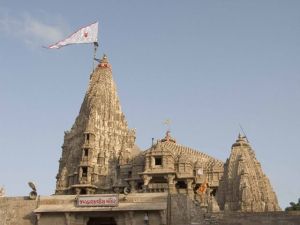
Dwarkadheesh Temple Dwarka India
By Scalebelow – Own work, CC BY-SA 3.0, https://commons.wikimedia.org/w/index.php?curid=5739970

Although the location of the story is a real place and exists today, we don’t learn anything beyond that this is the setting for this little chat.

The purpose was to present these teachings in an entertaining and accessible format. Like so many scriptures around the world, this one is a song, making it easier to learn and pass from one person to another over time in a society that was not yet universally literate.

So, why am I writing about this text? Well, in one section Uddhava is asking his cuz all sorts of questions, that have obviously been on his mind for a while. He knows Krishna is leaving he planet soon and he thinks that this might be his last chance to get some answers.

He asks questions like: What are reality and truth? And, What is a person’s strength. Then there are queries like: Who is a friend? What is home? Many are related to spiritual matters and practice, and all are concerning qualities and attributes a person should possess to live a good life, a honest life. A Dharmic life.

Actually, if I were to condense all of Uddhava’s questions into one big question, it would probably go something like this:

How can I change my lifestyle so I might live a righteous life, a good and honest life in which I can learn the truth and live my whole life according to that truth?

Now, here’s the thing: Uddhava asks a total of 36 questions, some singularly, some are multiple questions containing two or three queries. Krishna then proceeds to answer the questions, all of them in fairly quick succession.

I would like to share a few of those answers with you. I don’t get the sense that the questions are asked or answered in any particular order or pattern, so perhaps those I share will be an idiosyncratic selection, or it may be entirely random. Not that there is such a thing of course, so I guess you will just have to wait and discover for yourself the chosen questions.

Don’t worry! I have no intention of burdening you with the complete set of 36. In addition to saving you that fate, some of the questions and or answers didn’t resonate; others didn’t feel overly relevant to this blog.

I’d like to devote an individual post to each of the questions, bearing in mind some of them are multiples. I learned about all 36 questions and their answers in an hour long class. Needless to say that experience was more than slightly mind-blowing. One or two (or maybe three) at a time will be just fine for all concerned I think.

So, next post, I look forward to sharing with you the first of Uddhava questions along with Krishna’s answer. It will in fact be literally the first one asked; I thought discussing it at the start would sort of set the scene and the tone for us.
After that one there will be further posts. Again don’t worry, I’m planning a fairy short and occasional only series.

Reflections on a Word

Henry David Thoreau

Did you know that Thoreau, when he was staying at Waldon Pond would sometimes sit on the front steps of his cabin right after sunrise.

Often he would look up and discover that it was already  midday or even late afternoon; he’d spent those several hours in a reverie.

Being in a reverie is most often described as being a pleasant experience, just like a nice day-dream. It is also universally (at least in the context of my short Google searches) described as being ‘lost in thought’, as well as being a place of fantasy, a place in which fanciful and impractical ideas are born.

In other words, a reverie while being pleasant, does not seem to be looked upon as a useful, productive, or worthwhile experience.

I’ve been thinking about the word, reverie, and the state to which it refers for a couple of days now. In fact since I read the anecdote opening post in a truly wonderful and illuminating book called Thoreau’s Quest: Mysticism in the Life and Writings of Henry David Thoreau, by Paul and Anna Hourihan.

The outcome of this contemplation and the above-mentioned little bits of Googling, is that I don’t agree at all with the dictionaries when they tell us that reveries are almost useless and have little or no benefits.

Even the Hourihans dismiss the value of reveries when compared to the practice of formal meditation. Listen to what they say:

There is a difference between the two. Meditation means effort, concentration of the total mind. What Thoreau has experienced is reverie – passive, beautiful and enchanting, but not true meditation.

My reaction to this dismissal? Well, I say, what’s wrong with an experience that is passive (there might be a book in the idea that reveries might not be all that passive after all) beautiful and enchanting?

And on the other side? Why is it  seen as virtuous to be always making efforts and concentrating the total mind all the time? Speaking for me and I suspect several billion other people, I get tired, always trying, making effort, always concentrating and the rest.

I’m not saying at all that I’m not in favour of meditation. Indeed, I spend hours each day (in theory that is) in some kind of effortful, concentrated meditation. But, really, isn’t it nice now and again to just give up the effort, lose concentration, just for a bit? Just rest.

Of course when one’s mind wanders in reverie, fanciful ideas and thoughts will arise. Mind you it’s equally likely that some of those thoughts and ideas won’t be fanciful, but be helpful. And you know, I doubt there’s a meditator in the universe who would not report exactly the same thoughts and fancies come up despite all their meditatory efforts and concentration That’s just how our minds work.

The notion of being ‘lost in thought’ is interesting to look at too. I don’t think it’s quite the right way to refer to what happens in reveries. At least not completely.

Was Thoreau really lost in thought when he would suddenly realise that several hours had passed without him being aware?

Perhaps it’s more likely that at least a proportion of those hours were spent in a thought free state, just as in deep sleep when our mind is absent.And we all know how restful and satisfying deep, dreamless sleep can be. Maybe that’s why reveries are described as ‘pleasant’ experiences.

My teacher talks about how sometimes when we’re listening to a favourite piece of music, we can become ‘lost in the music’. We all know how that feels. He then asks us to consider, what is it exactly that ‘gets lost’?

Well, just as with deep sleep or when in a state of Samadhi or deep meditation, it is the mind that disappears – along with its self-idenifying ego sense. In other words, whoever we think we are goes missing or absent for a while.

When I’ve experienced that state when listening to music, I would describe it as losing track of time, or rather not being aware of time at all. Thoughts come and go but don’t often stay long, ‘just floating by like clouds’ as someone recently described it to me. And afterwards when I return to ‘normal’ I sometimes have a sense that for a time I and the music were one, no separation or judgements, non-different.

And so it is when ‘lost’ in a reverie: the ego disappears; thoughts come and go. What’s left is the space between thoughts – a bit like the silence that exists between notes in a musical composition.

Some say that it is this silence, this space when mind and ego are absent, is where the divine is to be found. It is said, by some, that it is in this space, this silence, one may experience God, or Absolute Reality.

So, no ego; no monkey mind jumping about; no ‘I’ to interfere with the state of silence, stillness, and peace. And quiet!

And if one removes the letter ‘I’ from the word reverie? We are left with revere. Perhaps those who tell us that the silence is God, those who say that the absence of thoughts, ego and so on, allows us to detect the Divine, are onto something. That silence, and the process by which it is realised, are to be revered.

Being ‘lost’ (the dictionary’s word not mine) in a reverie might just be the most useful and the most productive (not the world’s definition, but more in the sense of the actions that make for the betterment of Self) thing we can do when the mood, the moment, and the inclination strike.

Just Another Day at The Office

Who am I to even contemplate composing a commentary on the Bhagavad Gita (BG) after only seven or eight years of study, some formal with a teacher and some more casual alone?

Well, what I am is nowhere near qualified, nowhere near ready. Actually I don’t feel qualified in any way for such a thing. So much less so was I when I first sat down with my newly gifted BG in a tiny cafe called The Office in Rishikesh, literally hanging over the river Ganges.

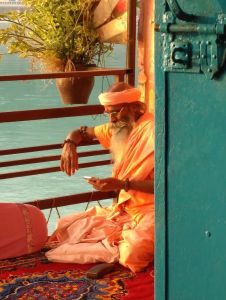
A Saddhu or Holy man and his phone at The Office

With the best fruit salad in the Universe, and fine chai to match, it was the ideal place for contemplation – that is when it wasn’t bursting at the seams and crazy.

But, as I sat there with my new BG I was one of only a couple of customers, so it was a conducive atmosphere for the aforementioned contemplation. Instead I think what happened as I thought about how to proceed to a proper study, was I allowed the sugar from the just ingested fruit salad go to my head.

You see, I decided, as I sipped a post-fruit salad chai, that the perfect study method would be to write a commentary on the whole thing starting with Chapter one, Verse one.

I no longer possess the diary in which this masterpiece was begun. Nor do I recall much, actually nothing, of what I wrote. It’s enough to say however that nothing I wrote could possibly have had any significance or depth or proper perspective.

So, as you might guess, I rambled and waffled for a couple of verses before I snapped out of my ego-driven state of arrogance and hubris. I realised I had absolutely no business taking on such a task. My lack of knowledge, wisdom, experience, all disqualified me from even thinking I had a right to try.

Now, even with the small amount of knowledge I have managed to acquire after all the study, I’m stunned at that arrogance and hubris – even if it was sugar induced. I mean, I’d never even read more than a few verses of the BG before. So, how could I even form a ‘first impression’ or ‘casual opinion’, much less a full blown commentary?

A couple of days ago I read a couple of verses that really resonated with me, as they have before. So, just like that fool sitting in The Office all those years ago, I confidently asserted that I was more than up to the job of making a commentary on those verses for this blog.

But, and here’s the really weird thing: I only just now realised, as I’ve been writing these notes, that the two verses which I will quote for you shortly, address precisely my behaviour on that post fruit salad, sugar shock induced ego trip.

I realised that it’s as if I have indeed written a commentary on those verses. And I have used a personal experience to illustrate the text. Absolutely unintentionally as it happens.

Regardless of what excuse I come up with the error in judgement in thinking I could write a full blown BG commentary all those years ago, the reality is that I failed to act with discrimination, or what I would call discernment.

In the high holy lands wrong thinking can still happen

Somehow I ignored (or totally forgot) the facts: I knew nothing! I’d lost the ability to discern what I could do and what I couldn’t do, what was a sensible action and what was a ridiculous one.

Stop! Memo to Self: Please stop picking on me!

Anyway, moving right along, here are the verses – free from commentary!

‘Thinking about sense objects brings an attachment towards them. Attachment leads to desire and desire leads to frustration, which in turn leads to delusion.
When you are deluded you lose your memory [the knowledge and experiences you could draw on to make proper decisions; sometime even to the extent of compromising your own values] and with the loss of memory the power of discrimination is destroyed; with the destruction of discrimination your self itself is lost’ .

Bhagavad Gita Chapter 2 Verses 62-63 (my version of the BG sometimes combines verses as it has here)

To Speak or Not to Speak & What Not to Speak About When You Do Speak

Have I mentioned lately that I talk far too much? No? Well then, it’s way past time to once again confess; it’s  time that I finally get it out into the open: the thing is you see, umm, I talk too much. There I’ve said it.

But wait, there is no need for concern: I have a prayer (stuck in my Bhagavad Gita, where else?) that I pray at least a couple of times a day. Well, rather than being a prayer, it’s a kind of affirmation or instruction to myself. Okay, it’s a prayer.


It’s a nice injunction, I think. I don’t recall where I borrowed it from, but I’m grateful that I came across it. It’s important to me; a vital instruction that I feel assists me in my aspiration to be a bit more thoughtful, and a bit less vocal.

Does it work?  Well with the risk of repeating myself, I will say yes. Maybe I’m a bit more thoughtful and perhaps a bit  less vocal. But, on the other hand, I wouldn’t say I was anywhere close to the ‘spending no time’ level.

Now that I’m thinking about it, illusion, fear, and wrong thinking are common themes in many people’s lives, and we might even say that they dominate our culture whether it’s the media, celebrity gossip, or any of the rest of the illusory and speculative talk that goes on all around us.

Tunnel to the Light

Anyway, fear is the biggie isn’t it? Fear of not having enough; fear of not being good enough; fear of what might happen or what might not. This list is endless. Fear of illness or ageing; fear of losing friends or fear of not having any! Fear of ‘missing out on the good life’ we imagine everyone else is living.

Then there is what’s called, the fear of the other, most often promoted and replicated by the mass media through their creation of illusions, fake news, exaggerated  or one-sided information (I hesitate to use the terms ‘facts and figures’ but you know what I mean). And then they sell us on ideas that we need to fear some other person, people, thing, time, impending catastrophe that never comes.

I don’t need to go on here: as I said, the list is endless. All that’s left to say about these fears and the illusions we are force-fed and made to believe are real, is that it all boils down to costing us a great deal of time spent and usually wasted, in wrong thinking of one kind or another.

It seems to me the media (news and social), advertising, and governments of all persuasions, are really quite happy for us all to be ‘getting the wrong end of the stick’. I think that’s the expression. Our societies are drowning in, for want of a better word, propaganda.

Buy this, do that, don’t do the other thing. Be afraid of (insert the latest scapegoat, political opponent, boogy man, the Apocalypse. Again it’s an endless list).

Then there are the fears we invent for ourselves, the illusions about ourselves that in our wrong thinking we come to believe are all real and true. One thing you can say about wrong thinking is that it makes for more and more wrong thinking. More illusions about who we are, what we do (or can’t do), what we are like, who likes (or doesn’t like) us. Here I once again risk repeating myself, but yes, it’s a long long list.

So, what can we do? Well, we could use a little reminder like the one we’re talking about here. It’s possible that it can help us correct a little of the wrong thinking that leads to fears and illusions.

Then there is what we might call discernment. Not so much deciding between one thing and another; more like coming to know what is real or illusion, a genuine, rational fear that I need to act on, or some inherited, manipulated, received  or otherwise irrational, baseless, or invented ‘fear’.

We won’t get rid of wrong thinking by trying to push it away. It’s about replacing the wrong thinking with some right thinking. We can try to recognise that wrong stuff as it comes up. We can make an effort to stop allowing ourselves to get away with our own misunderstandings, our own wild imaginations, wishful thinking, and confusions. As my teacher said just the other day, use your mind to control your mind.

One word we haven’t discussed from my little injunction is discussing. We discuss things when we talk or communicate  with others or when we talk to ourselves. Here we are at another issue for discernment: what shall we talk about?

Actually I was about to write that one excellent strategy for not spending time discussing illusions, fears, and wrong thinking is to simply stop talking altogether. That’s all there is to it: Don’t talk!

But obviously that’s a ridiculous notion right? Stop talking? Perhaps for a set time? Or perhaps as a kind of ‘time-out’ strategy? But as a principle for a whole life, it’s not going to appeal to the majority of us. Actually, that feels to me like a bit of wrong thinking creeping in: a life of no, or at least limited talking is very appealing to me. Just difficult.

Still that does seem to be what my treasured injunction suggests I do. Mind you, it’s very specific isn’t it? Spend no time, it says. Discussing what? Illusions, fear, and wrong thinking.

So, how do we manage to follow this suggestion ‘to the letter’ as they say?

Here’s another little prayer I say everyday. This one is from Thomas Merton.


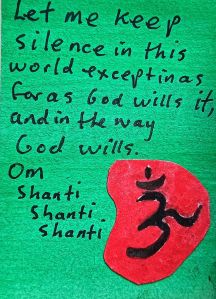
Keep silent ‘except in as far as God wills it’. For God I could say the good of all concerned; Truth; my heart; my goodwill; my love. It’s all God; it’s all the Divine.

I guess it gets back to something I said earlier about thinking before I speak. To this I would now add, feel before I speak: What’s right? What’s wrong? Does this help? Will this hurt someone else for myself.

About right and wrong: In the religious  tradition I was ‘raised in’ it was deemed that at the age of seven or eight a child is suddenly, without any preparation, able to discern right from wrong. Which means they are now responsible for the consequences of their thoughts, words, deeds. In other words, they are now capable of sinning and suffering  the consequences.

I can’t (obviously) speak for you or anyone else, but it’s been a very very long time since I was seven or eight, and I still find it tricky sometimes working out right from wrong. Of course while I know I am now responsible for my thoughts, words and deeds, I also know that we are all flawed; nobody’s perfect, so we’re going to make mistakes. 

So, all I can do – all any of us can do – is appeal to the innermost Self and use my intellect and my heart to try to discern as best I can, what is right and what is wrong.

Only in the innermost places where the real Self dwells can we know reality from illusion; it is only in our ‘heart of hearts’ as they say, combined with our rational thinking mind, what fears are real and what fear is illusion. And it is only then that heart and intellect can determine when our thinking is headed down the wrong (or the right) track.

It’s only then that we will know what and what not to spend our time discussing, either with others or internally within ourselves.  This all sounds like a long, convoluted, tricky process (told you I talk (write) too much!), but it needn’t be.

Like all things it takes practise, and once we begin to know that innermost Self, it will soon become a spontaneous way of living, when we begin to ‘just know’.

Your own inner divinity (which is the real you) wishes for you peace.

Om Shanti, Shanti, Shanti.