Me & My Senses

Today, once again, I would like to share with you some thoughts and insights on a quote I have written in the front of my Bhagavad Gita. Yes, I know, I do this quite frequently, but there really is a good reason.
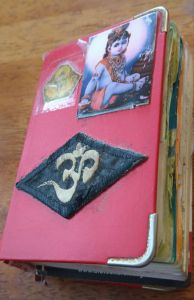
You see, for me, this particular Bhagavad Gita, this little book (and it is a little book: 10 x 7cm but still a little fat too!) is so much more than a collection of bits of paper with words printed on them inside a nice cover.

Well, it is a book, so of course it is that as well. But for me it is more a repository of wisdom. It is actually the first scripture or holy book of any kind that I have spent years studying. And over those years I have devoted who knows how much time, energy, heart and mind to it. As for how many times I’ve read it cover to cover, well I don’t keep count!

This Bhagavad Gita is truly a treasure trove that enriches me and my life every time I open it.
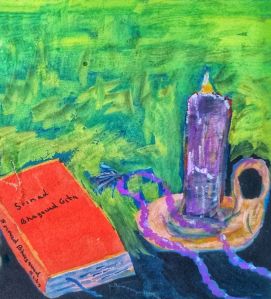
Anyway, enough of the praise and gratitude intro. Allow me to share the verse (in fact it’s a part of a verse) with you:

… restrain your senses and focus your entire mind on me.
               Bhagavad Gita 2:61

Let me try to explain why this verse – and this particular portion of the verse – is like a kind of motto or mission statement for my life. Well, to be honest, It’s one among a whole collection, but this one for me seems to especially significant.

It is through and only through, the senses that we are able to experience the world. In addition to the traditional five senses (sight, smell, hearing, taste, and touch) here we include the mind. This sixth sense includes all the activities of the mind.

When you think about it, the mind is really our major sense organ, in that it is in the mind that imput from our other senses comes together in such a way that allows us to perceive and experience the world around us as a coherent whole.

Then of course, the mind being a sense organ in its own right, does its share of providing us with imput in the form of thoughts and emotions. The problem arises when we let the mind have its way and we hand over control of our senses to our mind (and also we let our other senses free rein to control the mind) completely or at least in ways that  might not be in our best interests.

So, if we are to restrain our senses – all of them – what are we to do? Well, rather than getting into a long rave with a big list of what we should do, why don’t I simply talk about some of the ways in which I try to put into practice, the injunction to restrain the senses.
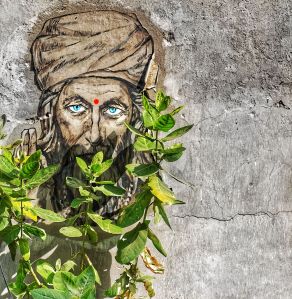
The Eyes of the Teacher

First, a disclaimer : I’m still in a human body. Meaning that I’ve been struggling with my senses for a long long time. And it means the struggle continues, just as it does with all of us. It’s the effort, though, that is the real key: to restrain the senses we might easily add retrain the senses including the mind.

For so much of my life I was careless about what I put into my body by way of my sense of taste. Food, I was not very controlled when it came to what, when and how I ate. I’ve been vegetarian for about 40 years and vegan for at least the last ten years. But until the last few years (and I still struggle now) that didn’t stop me from going for the tasty stuff – meaning the fatty and sugary things that can (and do) cause great harm, as they did to me.

Now, strictly vegan as I said, I never add sugar (okay one in coffee on very rare occasions), there’s no cooking with oils, and eating as little processed foods as is possible. Simple food too, simply cooked, with just a few spices. Surprisingly (to myself at least) I always have enough taste sensations to satisfy.

As to what I consume via the senses of sight and hearing, there is only so much that one can do unless one lives in a remote desert or mountain cave. Which, of course, some people do for this exact reason – to control and limit what they consume or are exposed to. Still, I don’t watch, listen to, or read news of any kind.

Like many people I watch videos on the Internet. While there is a massive amount of brilliant  content available, it is hard to sift through inappropriate suggested videos, impossible to avoid advertising, and even the news sneaks through quite often. For a while now I’ve been on the brink of deleting online video viewing platforms, but I’m not quite there yet. Soon.

Give up listening to Buddy Holly??? That’ll be the day!

As for music, I’ve gathered a large collection over the years. Lately however I’m finding that I’m not wanting to listen to much of the music I have.  Why? Well, I think as I’ve meditated more, studied, contemplated more, I’m slowly beginning to exert some discipline over my mind making me more sensitive to what my senses pick up.

It seems to me that more and more of the music and songs I’ve loved and listened to my whole life are about dark themes and subjects, about emotions made petty, and sometimes songs or tunes just feel plain and simply nasty.

I’m content with this outcome and curious to see where it leads. As with videos, TV or the news, so much of the music I listened to does’t speak of Truth, at least for me.

With a view to control visual and audio imput, I try to live in as quiet an environment as possible. As we all know, these days this is becoming more and more difficult, perhaps even for those who can retreat to the desert cave! And we have a saying in the hermitage about just this issue: Something’s gotta give! Meaning of course that the time is right for radical thinking and action to be taken in the search for silence.
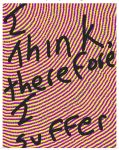
Which leads me to mind – my mind anyway. Like yours, my mind is a raging torrent of often repetitive thoughts going in all directions (or none) and very often without any kind of rhyme or reason.

But, through the above efforts at discipling the other senses, I do have some control, not much, but… . Through an increasing amount of time and effort spent on meditation and engaging mindfully in all my actions as much as I can, I think I am at least giving myself (my mind that is) some control over the other senses, my thoughts, and all that mental chaos.

Now, what does it mean, ‘focus your entire mind on me’? Well, this is a question that you will find asked and answered  given in numerous books, blogs, and in many other places. But, for me, and to sum it up in the one sentence, it’s about focusing all my senses (including mind) on what is of the good, what is right, what speaks of truth, love, and is for the betterment of all beings.

I mentioned that our quote is only a part of a verse. Here’s the whole thing:

In order to attain steady wisdom {knowledge of the true nature of Self and the world} restrain your senses and focus your entire mind on me.
               Bhagavad Gita 2:61

Self Enquiry is the means to acquire Self Knowledge which leads to real wisdom

It is this wisdom, or at least the efforts we make at acquiring it, that is the way to a happier, freer life. At least that’s my take on it all.
Peace
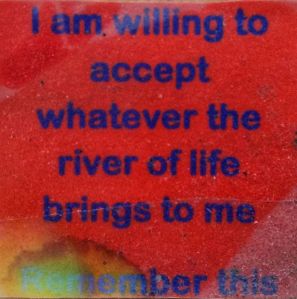

Accept the Flow of Life. It’s the Way to be Free

There is a sacred song by Krishna Das that I am especially fond of and find very uplifting. I’d like to share the lyrics of that song with you, as well as what it means to me. It’s called By Your Grace.

Closer than breath, you are the air
Sweeter than life itself, you are here
I am a wanderer, you are my peace
I am a prisoner, you are release

Jai Gurudev…

I am a pilgrim, your road so long
I am the singer, you are the song
Held in the open sky, so far above
I am the lover, you are the love

Jai Gurudev…

I follow your footsteps through the flame
All that I ever need is in your name
Carry your heart in mine, vast as space
All that I am today is by your grace.
By your Grace…
I live by your grace.

And if  you’d like to hear him as he sings the song (I guess you could call it a hymn?) then just go here.

Grace traditionally refers to a gift or blessing from God, or from the Divine, the Universe; whatever we call it. Generally  it seems to only have a positive or even happy connotation. It’s as if grace, like love, in Bette Midler‘s The Rose, is only for the lucky and the strong.

But I think it can be looked at another way. Or rather, in a similar way but with a twist.

Krishna Das is onto something when he sings:

All that I am today is by your grace

And

All that I ever need is by your grace

He’s not saying ‘Well that was by your grace, but that other thing wasn’t. He says everything .The good, the bad and the ugly, as they say.

There’s an old expression that I like: By your leave. It means with your permission, with your power and authority you can (do) grant this or that. In this sense Das’s song is a prayer to his guru for the granting of all that has made his life what it is today, as well as giving him all that he needs and will ever need regardless of the nature of the things granted or not.

Life can be a bumpy and bruising ride, always is really. Simple way to put it, go with the flow

To me the song is not so much, or rather not just, about a prayer in order to be granted something; it is a hymn of gratitude. It’s both really. Das is expressing his gratitude to his Guru in the broadest sense of the world: the divine or the universe.

The laws of nature determine how the universe operates, how nature works itself out, which it always does, though of course, it isn’t always to our liking.

But if we are able to look at with an objective outlook, with no notion of good and bad, right and wrong, desired or not desired, then it can be seen as an elegant order that simply works. The Universe has no agenda, it simply is.

This way of looking at grace as being the natural order of the universe requires our surrender. Surrender in the sense of acceptance of the fact the the Universe unfolds exactly as it is supposed to.

This surrender, this acceptance of that natural order is not about being resigned, or fatalistic. It is the way to rid ourselves of irrational and wishful attachments to outcomes. Outcomes and results, that when they don’t work in ‘our favour’ cause us suffering.

Peace and love

Sacred Places, Sacred States

Tirtha. There is much varied, detailed and fascinating information about this word on its Wikipedia entry. While I invite you to click the link and head over there to read what is truly a riveting story, for this post I wanted to focus on the word’s actual meaning, especially the metaphoric meanings it has acquired.

Tirtha is a Sanskrit word meaning ford, as in a place one fords or crosses a river, stream or other body of water. Over time, however places of religious pilgrimage began to be called Tirthas. This evolved because so many holy sites were on or near rivers or lakes, or were the water bodies themselves, or were located nearby.

Sacred sites, and places of pilgrimage often inspire in people a sense of leaving the ordinary material existence  of their day to day lives, and entering a kind of other world, the world of the spiritual or non-material. This experience, which we might call spiritual or religious , is something people remember as being very special, even transformational; for them it speaks of a connection, even briefly, with the divine in the form or in the presence of that place or site.

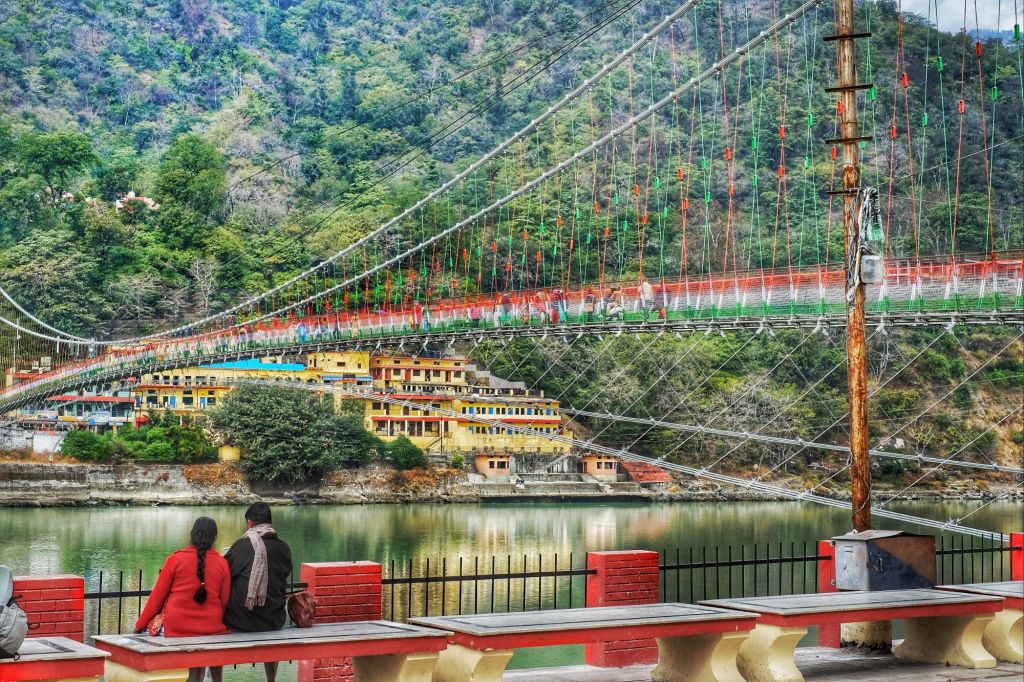
Perfect example of a Tirtha as a literal crossing place that is also an ancient sacred site. Mother Ganga at Rishikesh in India

And after many years – centuries and millennia very often – the energies from sometimes countless pilgrims and their prayers, devotion, love and mere presence, accumulate and begin to permeate the atmosphere in that place as well as the very ground and sacred objects there.

To me this notion is reminiscent of the concept of thin places  as described in Celtic Spirituality (though the concept by the same or other names exists for many cultures around the world. Sorry I’m not providing any links: there are so many!).

Some would say they are places where Heaven and Earth meet. Places where the boundary between the mundane world and that ‘somewhere else’ of the transcendent, is especially thin, and where crossing over, or connecting with that transcendent may be possible, or made easier than at other places.

Of course, as I’ve written in at least one previous post, I feel that we are always standing upon sacred ground; all things are sacred or holy. At the same time, I have, like so many others, experienced what seem to be very real connections to or mergings with something  transcendent, something ‘spiritual’ as we like to call it, at specific sites or location.

A few of these places of my own transcendent experiences  have been churches, temples, and other historically recognised  sacred places. However, I would say that most of my own experiences have been at unexpected places, places where the ‘transcendent’ has been for me alone at that moment.

The Campaspe River after the floods receded

One such place for me happens to be a river called the Campaspe. It was here that the ashes of two fellow hermit pilgrims of the feline persuasion found their rest.

As I stood on the muddy bank of that river, and made my offering, I sensed that feeling I describe above; that feeling of oneness with or connection to the river, to that place. As those two little creatures whom I loved (and love now) and who are made of the same stuff as me, were returning to some kind of essential or foundational state, we were there and connected with them as they continued on their journey.

I knew then for sure the sacredness of that place, the thinness of the boundaries there. While then I didn’t yet know the word, the Campaspe River had for me became a Tirtha.

DEDICATED TO:

Shanti and Lofi. Two beautiful beings and fellow hermits and pilgrims on the journey with us. With us in our hearts and now off carrying on with their own adventures and pilgrimages.

To Speak or Not to Speak & What Not to Speak About When You Do Speak

Have I mentioned lately that I talk far too much? No? Well then, it’s way past time to once again confess; it’s  time that I finally get it out into the open: the thing is you see, umm, I talk too much. There I’ve said it.

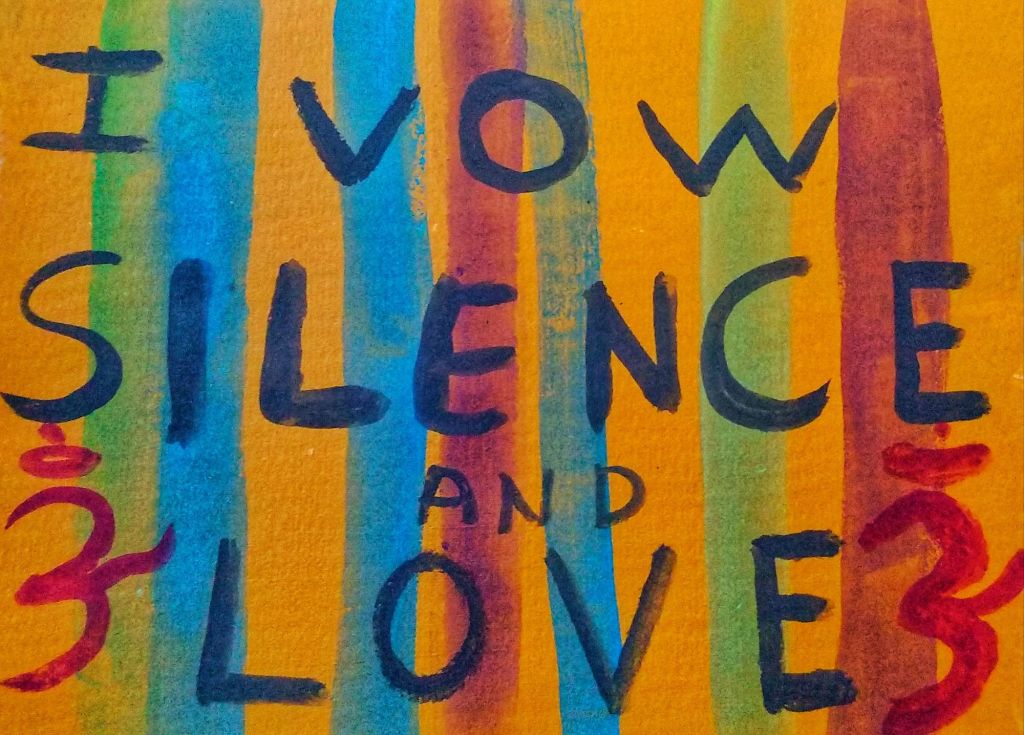
But wait, there is no need for concern: I have a prayer (stuck in my Bhagavad Gita, where else?) that I pray at least a couple of times a day. Well, rather than being a prayer, it’s a kind of affirmation or instruction to myself. Okay, it’s a prayer.


It’s a nice injunction, I think. I don’t recall where I borrowed it from, but I’m grateful that I came across it. It’s important to me; a vital instruction that I feel assists me in my aspiration to be a bit more thoughtful, and a bit less vocal.

Does it work?  Well with the risk of repeating myself, I will say yes. Maybe I’m a bit more thoughtful and perhaps a bit  less vocal. But, on the other hand, I wouldn’t say I was anywhere close to the ‘spending no time’ level.

Now that I’m thinking about it, illusion, fear, and wrong thinking are common themes in many people’s lives, and we might even say that they dominate our culture whether it’s the media, celebrity gossip, or any of the rest of the illusory and speculative talk that goes on all around us.

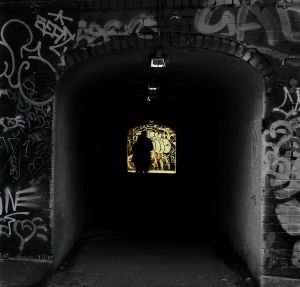
Tunnel to the Light

Anyway, fear is the biggie isn’t it? Fear of not having enough; fear of not being good enough; fear of what might happen or what might not. This list is endless. Fear of illness or ageing; fear of losing friends or fear of not having any! Fear of ‘missing out on the good life’ we imagine everyone else is living.

Then there is what’s called, the fear of the other, most often promoted and replicated by the mass media through their creation of illusions, fake news, exaggerated  or one-sided information (I hesitate to use the terms ‘facts and figures’ but you know what I mean). And then they sell us on ideas that we need to fear some other person, people, thing, time, impending catastrophe that never comes.

I don’t need to go on here: as I said, the list is endless. All that’s left to say about these fears and the illusions we are force-fed and made to believe are real, is that it all boils down to costing us a great deal of time spent and usually wasted, in wrong thinking of one kind or another.

It seems to me the media (news and social), advertising, and governments of all persuasions, are really quite happy for us all to be ‘getting the wrong end of the stick’. I think that’s the expression. Our societies are drowning in, for want of a better word, propaganda.

Buy this, do that, don’t do the other thing. Be afraid of (insert the latest scapegoat, political opponent, boogy man, the Apocalypse. Again it’s an endless list).

Then there are the fears we invent for ourselves, the illusions about ourselves that in our wrong thinking we come to believe are all real and true. One thing you can say about wrong thinking is that it makes for more and more wrong thinking. More illusions about who we are, what we do (or can’t do), what we are like, who likes (or doesn’t like) us. Here I once again risk repeating myself, but yes, it’s a long long list.

So, what can we do? Well, we could use a little reminder like the one we’re talking about here. It’s possible that it can help us correct a little of the wrong thinking that leads to fears and illusions.

Then there is what we might call discernment. Not so much deciding between one thing and another; more like coming to know what is real or illusion, a genuine, rational fear that I need to act on, or some inherited, manipulated, received  or otherwise irrational, baseless, or invented ‘fear’.

We won’t get rid of wrong thinking by trying to push it away. It’s about replacing the wrong thinking with some right thinking. We can try to recognise that wrong stuff as it comes up. We can make an effort to stop allowing ourselves to get away with our own misunderstandings, our own wild imaginations, wishful thinking, and confusions. As my teacher said just the other day, use your mind to control your mind.

One word we haven’t discussed from my little injunction is discussing. We discuss things when we talk or communicate  with others or when we talk to ourselves. Here we are at another issue for discernment: what shall we talk about?

Actually I was about to write that one excellent strategy for not spending time discussing illusions, fears, and wrong thinking is to simply stop talking altogether. That’s all there is to it: Don’t talk!

But obviously that’s a ridiculous notion right? Stop talking? Perhaps for a set time? Or perhaps as a kind of ‘time-out’ strategy? But as a principle for a whole life, it’s not going to appeal to the majority of us. Actually, that feels to me like a bit of wrong thinking creeping in: a life of no, or at least limited talking is very appealing to me. Just difficult.

Still that does seem to be what my treasured injunction suggests I do. Mind you, it’s very specific isn’t it? Spend no time, it says. Discussing what? Illusions, fear, and wrong thinking.

So, how do we manage to follow this suggestion ‘to the letter’ as they say?

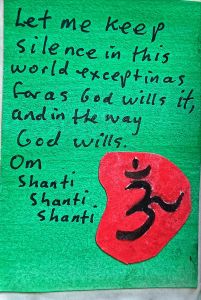
Here’s another little prayer I say everyday. This one is from Thomas Merton.


Keep silent ‘except in as far as God wills it’. For God I could say the good of all concerned; Truth; my heart; my goodwill; my love. It’s all God; it’s all the Divine.

I guess it gets back to something I said earlier about thinking before I speak. To this I would now add, feel before I speak: What’s right? What’s wrong? Does this help? Will this hurt someone else for myself.

About right and wrong: In the religious  tradition I was ‘raised in’ it was deemed that at the age of seven or eight a child is suddenly, without any preparation, able to discern right from wrong. Which means they are now responsible for the consequences of their thoughts, words, deeds. In other words, they are now capable of sinning and suffering  the consequences.

I can’t (obviously) speak for you or anyone else, but it’s been a very very long time since I was seven or eight, and I still find it tricky sometimes working out right from wrong. Of course while I know I am now responsible for my thoughts, words and deeds, I also know that we are all flawed; nobody’s perfect, so we’re going to make mistakes. 

So, all I can do – all any of us can do – is appeal to the innermost Self and use my intellect and my heart to try to discern as best I can, what is right and what is wrong.

Only in the innermost places where the real Self dwells can we know reality from illusion; it is only in our ‘heart of hearts’ as they say, combined with our rational thinking mind, what fears are real and what fear is illusion. And it is only then that heart and intellect can determine when our thinking is headed down the wrong (or the right) track.

It’s only then that we will know what and what not to spend our time discussing, either with others or internally within ourselves.  This all sounds like a long, convoluted, tricky process (told you I talk (write) too much!), but it needn’t be.

Like all things it takes practise, and once we begin to know that innermost Self, it will soon become a spontaneous way of living, when we begin to ‘just know’.

Your own inner divinity (which is the real you) wishes for you peace.

Om Shanti, Shanti, Shanti.

One, Without a Second, is All There Is

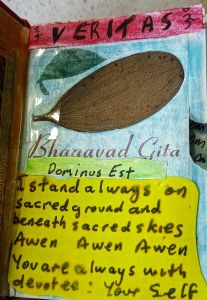
Right at the front of my Bhagavad Gita (the only book aside from the notebook I’m writing this in, that I personally own), I have recorded and inserted sayings and various words , that are important to me. Among those things is a statement I first heard many many years ago, that is common among the First Nations’ peoples of this country:

I [We] stand always on sacred ground and beneath sacred skies.


It is not an affirmation of ownership or possession. It is, instead, an affirmation of belonging to the land, to nature. It is a prayer of thanks, and it is a declaration of the knowledge of unity with the rest of the natural world, that is the hallmark and foundation for Indigenous cultures throughout the world and through time.

I’ve valued – treasured – this sentiment for a very long time – probably from even before I first heard it, which was so long ago as to be lost to memory. Perhaps I always knew it because I’ve somehow always thought this idea was a fundamental truth concerning my existence as a being living on this planet.

Well, now I have heard another statement that for me makes a perfect compliment for this one. The other day, during a lecture, my teacher mentioned that in his student days a fellow student said:

Wherever you are, you are walking through Ishwara

(Ishwara being her preferred name for the divine – for all that is.)

There is a feeling or sense of ‘belonging’, of awe and wonder when we attempt to immerse ourselves in what we term the natural world.

Once again I immediately felt the bell of Truth ringing clearly through this statement. Yes, I thought, everything is divine – including our own selves – so of course it follows that wherever we go, whatever we do, we are always in the divine.

You’ve probably read a number of times me quoting my teacher quoting his teacher:

It’s not that there is only one God, there is only God.
          Swami Dayananda Saraswati

Emphasis very much on only. Meaning of course, that it’s not that God is within us, or that we are within God; we are not surrounded by God; and it’s not that God ‘sits in our hearts’. The reality (for my teacher’s teacher) was that all that is, everywhere, everything, every thought, every word and deed, everything there is, is the divine.

Another way to describe the divine or God, that appeals to me is that Ishwara (also my own preferred name for the Divine) is in reality the natural order of the universe as dictated by the laws of nature. Those laws of nature, the rules that govern how the universe works, are also Ishwara, as are all that is manifest or in existence  as a consequence of the workings of those laws.

In other words, the Divine is the sum total of what some would call the entirety of creation.***

For the hermits a sacred site. Part of a grove we named The Sentinels. A place of experience of unity and oneness of creation

For me this an enormously comforting and reassuring concept. Of course, for me at least, it is also an extremely difficult one to wrap my head around. But here’s a small summary of what I think I’ve grasped so far.

Ishwara – the Divine – is all there is; everything. Also divine is the natural order of the Universe as governed by the laws of nature. These laws are neither good or bad – there is no duality. They are neutral.

You and I, as one more entity among who knows how many others, act as we do and are subject to the laws of nature, just like everything else. We can’t change or influence those laws; we can only live our lives as they unfold.

To quote from Desiderata: No doubt the Universe is unfolding as it should

And, well, then things just work out as they do. While we can’t change the laws of nature, or bend the universe to always suit our liking, it is also true to say that every action we take, every thought we think, every word we utter, even our very presence as a living being in our time and place, do indeed contribute to ‘how things work out’. Another way of saying this is to say, we do our bit, and the universe does its bit and what happens, well, happens.

For me, this is not at all as simple or as straightforward as it sounds. Naturally  we see ourselves as individual selves, as entities on our own. After all, to state the obvious, we live and operate in a material (dualistic) world. So automatically we see ourselves as individuals living in, but always separate from all the other individual entities, as well as being disconnected from the world itself.

It is part of human nature (for the most part) to long for connection; there is so often a drive within us pushing us to create family, enter relationships, feel we belong to a community or communities, and for many but not all, there is the almost instinctive urge to seek connection with the rest of nature.

Many forms, One reality

We often think of these longings as goals to achieve, as something outside of ourselves to attain, to reach for. Consequently, so very often we tend to focus our attention outwards, towards other people, or material things.

But, instead, all these inclinations, desires and longings are simply our Self (note the capital?) endeavoring to open itself to discovering (or rediscovering?) that which already exists: our oneness with, and our non-separation, and non-difference from, The All That Is.

Peace and Love from Paul the Hermit

FOOTNOTE

***Just a few thoughts about naming, or giving labels to the Universe and its laws.  Obviously it’s a personal choice for each of us what we choose to call that creation. Then, on the other hand, we don’t have to call it anything at all. For me personally it is very difficult, even near impossible to not name it. By naming the creation, I don’t think I am attributing the manifestation of the Universe to some distant entity living in some heavenly abode (as my teacher likes to say). Rather I am acknowledging the intelligence  and order, beauty, complexity of all that is and how it all works, as its own reality. At the same time, I am learning to understand that I as my true nature am not separate from the rest of creation, and I feel the need to have a name towards which I am able to focus my thanks and my reverence.

The Alchemy of Rain: A Poem & a Picture (or two)

THE ALCHEMY OF RAIN


Surya’s life-giving energies shine upon
scattered and drifting, yet converging, patches dotting the clear blue sky.
Silver linings, so they say,
granted to those scattered grey clouds.

Those clouds, those grey scattered and converging clouds,
bless.
Bless the domain of Varuna,
God of the skies
with the potential for change.
All forms change.

Clouds, silver-lined or no,
are Varuna,
for he is also God of the skies.
And now, with clouds’ convergence,
the expectancy ends:
the change begins.

The Sun, still present, yet his light blotted out
by those very clouds – joins Varuna
In the form of the cloud. Alchemy.

From the convergence of energy and matter
water droplets emerge;
Varuna has remanifested,
and falls to wet Earth below.

To cleanse the dust from all things
living and non-living.
From the feathers of the winged-ones;
From the fur of the four-legged;
To quench the thirst of the Tree People.
And to moisten the throats of us, the Two Legged.

Thank you my friends.

May your day be blessed by both Surya and Varuna, in the correct measure and balance that is for the benifit of all beings.

A Music Star, Some Songs, and the Human Condition

The first line of this post was going to read something like: I listen to a lot of music. Then just as I put fingers to keys, I thought, no I don’t. More true to say I don’t listen to anywhere as much music as I’d like.

But I do try, and I am blessed that I have quite a large and extremely diverse music collection. All digital these days (which in itself is a great blessing), but once, I had CDs, DVDs, cassettes, as well as quite a nice range of vinyl singles and LPs.

Thank you Wikipedia No glasses?

Anyway. Moving right along. Tonight, as I cooked dinner for the hermit pilgrims, I was listening to a self-titled album called Buddy Holly. I just discovered that it was his debut studio album recorded in 1958. My copy is most likely a rerelease,though unlike most of the rereleases, this one features the original track line up.

I found myself thinking about, fantasizing I could say, about what might have happened had tragedy not called a halt to Buddy’s songs and life. Who can say? Then I mentally shook myself: this kind of daydreaming and speculation is not what one might call being present in the here and now; such thinking is an outright denial of the truth of things as they are. But, remember, I’m still learning: not yet enlightened; just another sentimental human who can’t help himself or control his wayward mind.

A Studied Pose

Some would say that the album contains songs that are typical rock and roll pop songs. And yes, they would be absolutely correct. Why? Because, as you’ve probably worked out in your own life, living on this planet as a human being is a drama in itself ready made for song lyrics, movie scripts, and novel plots. It’s not a new idea!

As such the songs’ lyrics are about love and loss, hope and despair, longing, joy, sadness; you know, the normal everyday ups and downs, ins and outs of life. Not a lot you might think to interest the likes of me. But there is something, that I’m not sure I can name in Holly’s music and lyrics that strikes a chord (sorry pun not intended) for this hermit-pilgrim, aspiring to be a monk, rock and roll fan, who just loves music from wherever and whoever.

Sure, the songs being products of their times can be a little sexist (nothing compared to the twisted misogyny we sometimes hear today though): sometimes naive and simplistic. But, for me there seems to be an innocence, even a kind of purity to the lyrics. Have a look at the lyrics of Mailman Bring Me No More Blues:

Mailman, bring me no more blues
One little letter is all I can use

She wrote me only one sad line
Told me she’s no longer mine
Mr. Mailman, that’ll do for some time

Cried like never before
So hard, couldn’t cry no more
Shoo, shoo, Mailman, stay away from my door

Mailman, bring me no more blues
One blue letter is all I can use

By the way, those two lines in the second verse are about as sexist as any of the album’s lyrics get, not that I am suggesting we minimise in any way whatsover such a sentiment. It’s abhorrent to me.

Anyway, it is pretty clear what this song is all about: it is the pleas of our rejected hero to be left alone; he can’t handle any more bad news or heartbreak.

Actually as I’ve listened to this particular song a few times tonight, I’ve realised that it’s about attachment, about compulsions and aversions. It’s about how this guy believes his wellbeing depends on someone else, that without her he is doomed to suffer.

When we think like that, we are compelled to chase after those things in the world that we think will make us happy, and run away from the things that we think make us suffer. In this song it’s all the mailman’s fault.

Obviously we are all like that; it’s part of human nature isn’t it? You might ask, am I now preaching a dualistic , clinging to your desires type of approach to living. No, but at the same time, it’s a true story isn’t it? This song. None of us want suffering, pain, rejection, and all the rest of it. I guess instead I should be saying now: let go of worldly attachments, give up your notion that things of the world can make you happy.

Now, how about these partial lyrics from Everyday. One of Buddy’s biggest hits:

Everyday, it’s a gettin’ closer,
Goin’ faster than a roller coaster,
Love like yours will surely come my way, (hey, hey, hey)
Everyday, it’s a gettin’ faster,
Everyone says go ahead and ask her,
Love like yours will surely come my way, (hey, hey, hey)

Everyday seems a little longer,
Every way, love’s a little stronger,
Come what may, do you ever long for
True love from me?

And the music. Holly has been credited with being the originator of what became the standard set up for rock and roll bands: two guitars, bass, and drums. Mind you, according the album notes I read online, many of the songs on this album also feature many other instruments, classical and contemporary. I think it’s brilliant; something about it makes me think of alchemy

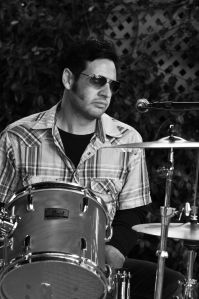
Wake me up for the drum solo

For me it’s that instrumentation, the tunes, the melodies, and sometimes great harmonies (not to mention the occasional lack of harmony) that promote or provoke a kind of mellow, reflective mood. Sometimes though it feels like the music itself goes further and actually creates or induces that mood.

I just love these songs. That’s the essence of what I’m saying. In a strange way, they serve to uplift, despite the sometimes apparant gloom and doom of many of them.

Anyway, let me leave you with a couple of verses from one more song, Valley of Tears, which was actually written and first recorded by Fats Domino.

While most of us have been at some time or another a frequent visitor to or even long term resident in that valley, in this song our hero wants to actually go there forever!

Of course, I don’t think it’s that simple. I think he wants so badly to be relieved of his suffering that the only place he can think of where he can truly belong is where everybody else is suffering like him.

I want you to take me
Where I belong
Where hearts have been broken
With a kiss and a song

The Closed Cafe at the End of Lonely Street

Spend the rest of my days, dear
Without any cares
Everyone understands me
In the Valley of Tears

I guess that’s why I love and respect Buddy Holly along with so many others: he’s telling us, reminding us, that happiness doesn’t come from outside, from out there in the world. And if it does, it’s fleeting, only temporary. He reminds us, or at least he speaks this truth to me, that the only place I can find permanent peace, love, happiness is within.

Peace and love from me to you

PS: A note of thanks

Most of the photos are mine, except for the ones depicting the record single and the LP cover. I am very grateful to Wikipedia for allowing such access to these things.

Also thank you to Wikipedia for the song lyrics. If you ask my personal opinion, I will tell you that Wikipedia is one of the greatest resources for knowledge (or rather informatioun with the potential to become knowledge), that has ever existed in the history of our species.

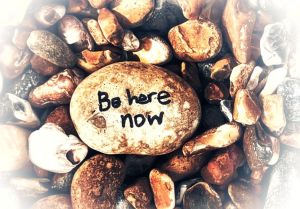
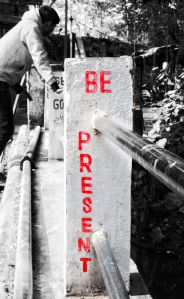
Be Here Now: There’s No There and Then

Earlier today I thought I might write a post to let you know what’s going on at the Hermitage at the moment. That’s it. One thought, no follow up.  One more idea that might or might not work out.

And then just now my partner hermit and I were talking about how we’re not feeling present where we are and how frustrating  that is.


Then I made a joke about how I’d had the thought about updating you on where we’re at right now and how useless that idea is because we aren’t actually here and it’s not actually now. We have already moved in our minds to our next temporary hermitage.

Let me explain.

You see, we move around a lot. Every few months, sometimes even more often. It’s just the way we are, pilgrims and nomads. Still hermits mind you, but the pilgrimage takes us wherever and whenever it wants.

Anyway, we are scheduled to move in about a month. It happens that our next safe haven is in a familiar town that we actually like quite a lot. So, naturally, we’ve been thinking and talking about all the great things about that place. But worse, all that forward thinking, fantasizing, speculating, has lessened our hold on the present, on the here and now.

Like I said, it’s as if we aren’t here anymore and that’s a pity. You’d think that someone who writes and thinks so much about presence would be a little more skilled at actually being present. At least sometimes. But, no. It often feels like the more I think about it, the less it happens. Being in the present, in the here and now I mean.

I know that my last post was about story and its central place in pretty much all our communication with each other and the world. With that in mind, there is a story I’d like to tell you now that I’ve heard a couple of times from a favourite teacher of mine.

It’s a story about presence, yes, but it’s also about having an attachment to some kind of anticipated and (in one’s own mind) fixed outcome. It’s really about how we can never really know anything at all about the future for absolute certain, and how that attachment to the outcome can easily obscure from us other possibilities, other outcomes that are available here and now.

Imagine you work in a city office and have just finished work for the day. You head out onto the street in a casual way because you know for sure the bus isn’t due for another 15 minutes and the stop is just across the road.

So, there you are, just about to cross the road, eyes on the ticket home (aka the busstop), and a car pulls up right in front of you. It’s a friend of yours you haven’t seen for a while (this part of the story is my little embellishment, added for extra clarity and detail you might say).

‘Hop in,’ your friend smiles and opens the passenger door to let you in. ‘I’ll drive you home. It’ll give us a chance to catch up.’

You are in a little world of your own after a long tiring day. You’re, already planning what to watch on TV, and thinking about dinner. So, after the hellos and the how are yous, you politely tell your friend that you’re okay, the bus is due in five minutes (time flies!) and you checked and you know it’s coming on time.

Your friend drives off with a shrug and a wave, and you get ready to cross the road .Just as you are about to step out onto the road the light changes leaving you stuck on the spot. Then you see the bus – your bus – pull into the stop. No worries, the light will change again in a few seconds. But it doesn’t. It’s a busy time of day and the traffic keeps on flowing.

Then, as you stand watching, the bus pulls away and your eyes follow it down the road, round the corner, and out of sight. Now, you also know that the next bus isn’t due for an hour and a half. And that is for sure going to ruin dinner and you won’t be watching much TV tonight either. An exhausting end to an exhausting day.

In your attachment to the idea of the bus arriving on time, and on your thinking about the evening ahead, you refused the other option that just by way of serendipity had presented itself.

Now, like all of us who miss opportunities because we’re busy thinking about the future (and of course it could just as easily be the past), you are asking yourself why was I so sure the bus was coming on time? How could I possibly know? Timetables can be wrong can’t they? You’re already regretting saying no to your friend. You were only being polite anyway.

While you sit annoyed and frustrated at the bus stop, you start to think a little differently. It might have been nice to catch up, after so long. Not only that [my friend’s] car would have been way more comfortable than a crowded bus. Not only that I would be almost home by now.

So, what about me? What will I miss because I’m not here while I’m still here? What won’t I see or experience because I’m attached to the next place? Well, unlike our bus timetable know-it-all, I don’t want to find out.

Time now to recentre. Time to practise what I preach. Time to return to where I already am, here and now. Mindfulness in even the smallest activity. When I remember that is; after all, it isn’t called practise for nothing: it’s a practice that never ends.

Time to remind myself that I can’t ever know for certain what’s going to happen from one moment to the next, much less at any moment between now and a planned event in a month. Nothing wrong with planning, with preparing. The trick is to not be so attached to that plan that you are compelled to either ignore the present or fixate on that possible future.

So then, it’s time to open my eyes, ears, mind and heart to what’s around me, where I am and what is happening. Same disclaimer as above mind you! It’s the effort we make that really matters after all.

The real bonus, though, of being as fully in the moment as you can be, is that being there (sorry I mean here) is the only place you can actually be, which means you are fully in the presence of all there is. There’s nothing else. Not in that (this?) moment anyway.

peace and love

Paul the Hermit

Wish for Truth and Honour with your signature

Maybe fifteen or so years ago, I reconnected with a good friend, after losing touch for a while (we’ve lost touch again). This friend used to send his poetry to friends on his email list, and after reconnecting, I was reading through some of those old emails.

I began to notice, as I read, that along with his name, he signed each email with a really lovely sentence which at that time I’d not heard before:

Vishwa dharma ki jai

This is Sanskrit and obviously I had to look it up. Not only did it read so nicely in Sanskrit, the English translation, was just as striking: it translates to: ‘victory to universal truth and honour’. When I read this translation, I was moved. What a beautiful way to sign off an email, or (age warning here) or a letter on paper.

(And, just rechecking online now, I see that there are songs, magazines, and organizations, that carry this expression as their name or slogan. Do a search for Vishwa dharma ki jai)

what about this as a signature?

Now, I don’t have a problem with ‘yours sincerely’ or ‘kind regards’ and so on, as ways of signing off a written communication. Indeed, I think those salutations (is that the right word?) can be meaningful and can carry heartfelt and sincere wishes from one person to another.

However, as with a lot of things we do ‘automatically’ and as a matter of course, these expressions seem to have lost much, if not all their true meanings. In fact, how often do we get emails with no such signing off, and with merely the sender’s name at the bottom?

Actually, now I think about it, I remember some emails that don’t even carry the sender’s name as a way of signing off. Now, that seems on the surface to be a rude omission, but in reality it’s not rude nor is it really an omission: people and the way they communicate are changing; I guess some of these so-called ‘niceties’ are just naturally going to be lost.

So, I thought after reading the Sanskrit salutation, hey,  I would really like to use this beautiful expression as my ‘signature’ for emails. What better salutation for a truth seeker (that’s me) to sign off with? And I’ve been using it ever since.

It might be that a wish for the victory of universal truth and honour sounds a bit old fashioned, a bit formal even. Not at all: how up to date, how necessary even, in our fast-paced, materialistic, and sometimes lonely and corrupt world, is it to seek truth and to act with honour? Honour isn’t the fuddy-duddy, formal term you might think. Look it up: it’s about honesty, truth, right behaviour, integrity, all that good and right stuff.

So, I’m going to continue using this great salutation whenever I can. And my message to you, dear reader?

When Two or Three …

It would be true to say that I’ve been on a spiritual journey all my life. Perhaps there have been other lives too, who can know? Who can work it out? And, anyway, I don’t think it matters at all. This life will do.

That’s an easy generalised statement to make I know. So, being more specific, let’s just say that for as long as I can remember I’ve been interested in and studied ‘spiritual stuff’; and in more recent years I’ve narrowed my focus, so to speak, and now I am on a deliberate and committed journey towards that time when I actually recognise, when I fully realise for myself that I am already one with God. Or the Divine, Dharma, Love, Absolute reality, Truth, Spirit. Many names and no names.

During this long journey, I’ve been blessed to have been exposed to so many sacred texts, scriptures, books, teachers, and so on, from so many different spiritual and religious traditions. And of course, the Christian New Testament ranks high among these treasure troves.

Like many of us, however, long before I actually read the text itself I had heard and was familiar with many of the stories and characters in the Gospels and so on. As well, over the years of childhood (and later too) I came to know several different Gospel verses. One of these in particular has long been a favourite (actually there are a lot of ‘favourites’ but …) and I couldn’t possible tally up all the times I’ve either thought about this verse or quoted it out loud.


For where two or three are gathered together in My name, I am there in the midst of them.”

             Gospel of Matthew 18:20


Now, this verse comes in the context of a chapter with some really powerful teachings from Jesus to his disciples, in which he is telling them how things should work when people gather to pray, to praise, celebrate the Divine. Essentially in this and other verses Jesus talks about the characteristics that should be present in a community of disciples.

And everyone else too

Things like harmonious relations between people. He stresses the importance of forgiveness when people think someone has wronged them. There is a great stress placed on the value of consensus when it comes to decision making or disputes between people.


Another biggie is the emphasis on how people should not behave in any way that would cause their fellow disciples to ‘stumble’ or fall. Meaning I think, be a good influence, not a negative one on others.

I have a confession to make: I knew none of this before I read the full chapter along with a few commentaries quite recently. Let me tell you what I thought for many many years the verse meant.

For me, it was simple. It just meant what it says: If I gather with one or more other people in the name of Truth, Dharma, God, the Divine, or whatever else we might choose to call the Absolute Reality that is everything, then we are reminded to recognise that Absolute Reality is present with us and in us.

Which means we have to act accordingly, just as Lord Jesus advises. That is, with love, with an intention to foster consensus and harmony; in ways that build us all up and bring nobody down.

While Jesus was addressing the needs of the newly formed Christian communities, I believe that this verse can refer to any gathering of people of goodwill. And communication between people that has as its intent love, devotion, positive living, peacemaking of any kind. Basically any meeting of people that is infused with good intentions and the desire to pursue right action in the world, or internally within each individual. And when you think of it like this, then it pretty much covers any coming together of people doesn’t it?

I especially like the use of the phrase I am in the verse. Of course, the ‘I AMis a name for God. Essentially there is no need for any other name because ‘God’ encompasses everything and there is no need to ‘label’ that I AM because that would limit what is actually Absolute Reality to some ‘created thing’, which is less real or perhaps absolutely unreal!

Notice I seem to be labelling the I AM as Absolute Reality. That’s the trouble with us limited beings: we have to use words to help us define or describe everything. So be it. Some people will call that Absolute Reality as God. Others will call it the Divine, Truth, Love, Dharma, and a million other names (or by no name as I said earlier).

This verse promising the presence of I AM may have been uttered by the human incarnation we know as Jesus, but for me, those words in truth came from Universal Consciousness, the I AM. Meaning, again for me,  Universal Consciousness or Absolute Reality, which really is all there is.

Peace and Love

Paul