What I want to talk about today, what I’d like to share, isn’t new. By that I mean the ideas are well known in the world – and they’ve even occured to me from time to time.
But, today, the thought seems new. Clearer and more obvious somehow. Perhaps when a little bit of knowledge finally ‘sinks in’, and is fully realised for what it is, then maybe that’s the beginnings of wisdom. Or an enlightenment. Perhaps we can say simply that a profound insight was had.
The thoughts I’m talking about concern prayer. More specifically the thoughts were prompted by my experience this morning chanting mantra – in this case, the Hare Krishna Maha Mantra, my mainstay you might call it; My main focus of devotion and meditation.
Hare Krishna Hare Krishna
Krishna Krishna Hare Hare
Hare Rama Hare Rama
Rama Rama Hare Hare
As so often happens, as I chanted today, I found myself thinking other thoughts, following mental stories invented as they went. I carried on chanting, but I was thinking other stuff at the same time.
I stopped the mental recitation of the mantra so I could focus on the emerging thoughts.
Yes, it’s true I was, chanting but it was merely at ‘lip level’ as I’ve heard it described. My intention may well have been to focus my full attention on the words of the mantra, on my means of devotion, and the repeating of God’s names. But clearly my mind had other plans as it wandered and skipped around on other paths.
I guess it’s a problem for anyone who prays in whatever form the prayer takes; it’s very easy to be distracted my experience tells me. I’ve read that people may have chanted a mantra for decades – twenty or more years – and feel that they still can’t ‘get it’, that while the intention is there and strong, they just can’t seem to fully immerse themselves in the mantra. Nothing of it reaches the heart. It’s a lonely feeling, I know.
They, like me quite often, will feel frustrated, empty, and as if their devotion is not devotion at all but simply a mouthing of supposedly holy words. Just an exercise, another spiritual practice to simply get through. Some, give up.
That’s why I stopped chanting this morning: I felt the insight coming on. That new revelation that’s hardly new at all.
Here it is then, the insight. If I become aware that my mind is straying and the mantra is being recited rote fashion, then so long as I gently bring my attention back to the words of the mantra, then in fact, all is well.
My teacher, Swami Tadatmananda has said when speaking about meditation, that the very act of bringing the mind, our attention back to the object of meditation when we notice it’s wanderings, is in itself an integral component of the meditation itself.
So, if I’m chanting and my mind begins to jump about, and I notice those mental antics and bring my focus back to the words of the mantra, then in truth, in the reality of the thing, I’ve actually not ceased my chanting at all. There hasn’t been any interruption.
As I said, it’s not a new idea; it’s not my own idea. But it feels new, it feels as if it’s an idea meant for me.
Intention, effort, resolve, persistence (or is it perseverance?) – and love. The only other necessity is that I continue chanting, both in that moment of supposed interruption and generally in my life.
In other words, if it feels like I’m only mouthing words that aren’t reaching my heart, don’t worry.
A few days ago we observed a day of silence here in the Hermitage. Our initial idea was to have a day of less talking, more quiet, which we hoped would help us reach a state of silence. We timed our little effort to coincide with a similar event being observed in an ashram in India whose foundation teacher we admire very much. A way for us to perhaps associate with others on a similar path out there (in there?) in the invisible community.
It’s not that we don’t experience periods of quiet (no talking) and even the aspired to silence, we do. Quite often they can be reasonably extended periods too, when meditating, chanting, studying, and so on.
But, it does have to be said, that we do spend a lot of time talking with its associated thinking – and unthinking too; with its listening – and not listening.
Of course, there are things we actually want or need to talk about; just that for us, sometimes we end up talking about stuff that’s not needed, as well we fall into what we call the adharmic trap of gossip, judgement, needless repetition, and the rest of the not so right speech.
Anyway, we wanted our day of quiet to be as complete as possible, so we agreed to not even discuss mundane and practical things unless it was absolutely essential. (Who gets to decide what’s ‘essential’ and not? Good question).
Around midday on the day in question I made a few notes on how my day was going so far. I had a vague notion I would make notes periodically through the day as a kind of ‘casual log. Needless to say, an approach of such vague casualness resulted in the notes made at midday being the only ones to actually come into existence.
Still, even though the notes were made relatively early in the day, I do think that they are a pretty good summary of my feelings on the day as a whole. So, let me share those brief reflections with you now:
Thus far (about 12) we are keeping silence (or at least not talking) – mostly. Practical things are sometimes tricky, sometimes not. It’s easy for example to point to a cup which translates to ‘Would you like a cup of tea?’. The reply which was ‘no thank you but I would like half a cup of soya drink’ took a bit more translational effort. Due of course to an almost complete lack of experience in speaking without umm, speaking.
Mind you,only three or four actual words spoken, along with a ton of hand gestures and facial expressions, did result in the transmitting and receiving of understanding.
PLUSES SO FAR
A sample of what it is like to be quiet, and actually being in quiet. And a happy anticipation (along with a sense of relief experienced in the present) of not having to talk about all the tired old things: the weather, the world, the ins and outs of teachings, teachers or writers, as well as ‘other people’, which often end up in judgements, criticisms, and plain simple gossip.
Alongside this overall positive vibe, there is a kind of nervousness. Where it comes from, I can’t say; probably an anxiety to do with not talking about the usual things. Though of course it’s only been a few hours.
While there has been little out loud talking, my mind has been running crazy, and I’ve had a strong compulsion to keep busy. Put these issues with the nervousness? To be expected really I think given my lack of experience with intentional quiet.
One step at a time.
Well, clearly that compulsion to keep busy didn’t extend to further note keeping, but, yes I have to say I did keep busy. Ironically some of that ‘busyness’ did in fact result in a few glimpses of silence.
I spent time working on an art piece in a prayerful manner, and in a quiet state; none of the all too usual chatter. Silence. I meditated for longer periods than usual, which allows for a deepening of a quiet mind (in theory that is). And when I chanted mantra, I think I may have been a little calmer and quieter of mind than usual.
Clearly the cultivation of silence – and even the seemingly straightforward task of simply not talking – is a practice that requires more practise, quite a lot of practise in my case.
We need to develop alternative communication strategies – hand signals, signs, gestures – to minimise speaking even more. Having said that if we’re to develop silence then even communicating about mundane stuff in other ways would get in the way. Too much talking!
Well, I occasionally make photos out there in the world
One very pleasing outcome is that I feel slightly less inclined to ‘talk about the outside world’ and other people. Less idle chatter. It’s a good start and it can only get better with some of the aforementioned practice.
Actually, thinking about it now, you’d think that a hermit who rarely goes out of the Hermitage except for a walk or occasional visits to a shop, who doesn’t watch the news or social media and the rest, wouldn’t have a lot to gossip or blah blah about.
That’s why, you see, I say that I really do need quite a lot more practice. Making silence is a long term project, an aspiration if you like, to find inner peace and make myself more able to radiate love to the world.
Opening my Bhagavad Gita this morning for my daily reading, I noticed that I was about to begin a new chapter. I always like when that happens, but this post isn’t about that; it’s inspired by a small scrap of paper glued on the facing page.
In years long gone, a less minimalist me would collect bits and pieces cut from newspapers, magazines or wherever (no Internet in those days). This particular strip of paper was cut from a newspaper (makes me shudder a bit to think how I would devour newspapers every day if I could. Shudder in horror) and has the title Today’s Text. It was a daily quote, usually a verse, from the Bible, and I’d often cut out those that appealed to me. As this one obviously did.
No longer collecting such bits and pieces, this one somehow survived the now ancient culling of excess material stuff, and has ended up in my Bhagavad Gita. Don’t ask me how or when.
Anyway, before I get off track, or too far down the track, here’s the quote we’re talking about
A man of knowledge uses words with restraint. Proverbs 17:37
I paused when I read this. As you probably are already guessing, I just had to write it down and added some notes of my own before getting on with my Bhagavad Gita reading.
What comes next is essentially what those full of first thought notes said, plus a little context setting to begin with.
In addition to the Bhagavad Gita, I am also reading, bit by bit, another sacred text. A couple of times (including today) I’ve been frustrated at having to plough through a page and a half (for example) of a description of a concept or idea that I’ve thought could have been said in no more than a couple of sentences.
Is he, the author, a person of knowledge? He most certainly is. He has wisdom too. He was a respected teacher and scholar. Some, many, say he was a saint.
So, perhaps it’s me demonstrating my own lack of knowledge here. Perhaps it is me, also lacking in wisdom, who is using words without restraint. Just because my opinion proposed using fewer words, does not mean by any means that they are better words.
Perhaps it’s me in error: passing judgement on an author I consider knowledgeable and wise, and who is certainly more than intimate with the topics he’s commenting on.
So, allow me to put another perhaps into this mix: Perhaps if such a person takes one and a half pages to describe an idea, then it might just mean that I am in need of more knowledge than I think I have. Surely I am missing something.
At the very least I am being prompted to reread the sections in question, that I was so hasty to dismiss as too wordy. Perhaps (what is it with this word today? Have to nominate it word of the day – perhaps) there is something for me to actually learn before letting my mind run away with critical thoughts based on quick and ill-informed judgements.
Just now, on rediscovering a quote I’d noted down months ago, I spontaneously decided to download again the book I took it from. This will be the third reading: seems to be one of those books that keep calling you back.
The book (The Abbot’s Shoes by Peter Robertson) tells the story of the author’s foray into monastic living in New Zealand way back in the early 1970s when he was twenty something.
One of many mini monastries we’ve been blessed to live in
I’d like to share the mentioned quote with you, because I think it really speaks to my own commitment to the contemplative, hermit life, which is for us a monastic life too – a hermitage is actually a mini monastery.
Sitting in his apartment one night, completely dissatisfied with life the universe and everything, the author contemplates the state of the world around him.
‘All the marching, all the writing, all the campaigning in the world isn’t going to change this insanity, brutality, and carnage.’
Actually this isn’t the quote I’d made a note of; it’s the preceding sentence which I saw again today and it seemed to just fill out the context for me. Anyway, after a few moments of quietness and thought, the author concludes:
‘I somehow intuited that the most powerful, significant , and influential action I could take to change the course of this kind of history, was to hide in a monastery.’
He goes on to reflect that by doing so – living simply, in a community devoted totally to contemplation and prayer – he could become a tiny part of ‘the turning of the tide’.
Years later, reading Thomas Merton‘s diaries, he discovered that Merton had felt the same way, concluding that those living simple, prayer filled, contemplative and quiet lives were ‘keeping the universe from crashing in pieces and falling apart.’
There is a strong sense among contemplatives, hermits, nuns, monks, that this is their function: keeping the whole thing going. Or as our author says, each playing a tiny part in the big picture. I would say, like I know Merton did many times (and acted upon his words), that action in the world is absolutely necessary; it’s just that it can’t do all the work alone.
In our hermitage we too speak often of these ideas, and think about them deeply and try to realise how they affect our lives as hermit monks.
So, hiding in a monastery? Or in a hermitage? It’s true it’s very much a hidden life in many ways. For me though, it’s not about being hidden, it’s more about just what Black Elk says, I’m trying to make my every step a prayer.
Speaking for myself, it’s not that I’m unwilling to pray for a specific individual, or for peace in such and such a country, or relief from poverty, and oppression for specific individuals or communities.
It’s more that: picking and choosing in that way risks leaving people and issues out inadvertently or through some unconscious bias.
I have chosen to live this life apart as much as possible from the world in order to minimise the anxiery being ‘out there’ causes me, to have the quiet, the time, the ‘head and heart’ space to simply pray. To make of my life a prayer
Let every step you take upon Mother Earth be as a prayer
My partner hermit is fond of reminding me of the well known aphorism that a stone dropped in a pond will make ripples that spread out and out. Just like the vibes – the vibrations – emanating from a prayerful life, from all the prayerful lives.
In my last post I reflected upon the meaning for me personally of a Bhagavad Gita verse that had particularly struck me as I carried on with my renewed inspiration to read the text from the beginning.
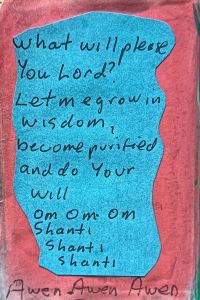
Today, I didn’t even get to the place where my reading left off yesterday. Before reading I like to pray some or all the prayers I have pasted in the front (and the back now). As I was deep into this practice, one prayer in particular stopped me, just as with that verse yesterday.
This one seemed to speak to me, asking ‘What do I mean to you?’ So, I made a mental note (always a risky proposition with me), and carried on with my prayers, determined to take time later to think about that prayer, and try to answer its question. So, here I am, later in the day, making these notes.
The prayer itself I am fairly sure comes from Thomas Merton, monk, mystic, and writer. Not completely sure, but I know that whoever composed it was one clearly inclined towards living the life of the mystic.
What will please you Lord? Let me grow in wisdom, become purified, and do your will.
For whoever composed this prayer, it is an expression of a genuine longing. I can say that for me it is a deep plea, expresses my own longing. Each time I recite it, in fact, I can say that, although this is the first time I’ve addressed the big what does it mean question, I do sense the longing and grasp the meanings of the various words and ideas in the prayer. Actually, now I think about it, I do say this prayer or parts thereof in one form or another very often.
What will please you Lord?
When I begin to pray these words, what I feel I am actually doing is asking the Universe, the Divine, Self, God – the I AM – how can I live my life so that it is attuned to the natural order and flow of the Universe.
I am asking, what do I need to do to let go of attachments to worldly things which arise from material desires? How do I find the grace to accept when things aren’t going completely my way?
In other words, I’m asking how can i live a good, truthful, happy life in harmony with all other beings and with the Universe.
Let me grow in wisdom
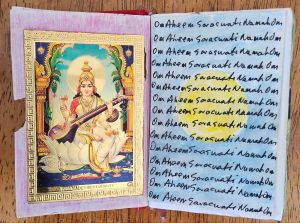
Another of my prayer pages. This one devoted to Maa Saraswati, goddess of, among other things, wisdom
A good place to start, a great first step. But, again I have to ask myself, what does growing in wisdom mean to me?
To me wisdom is not merely knowledge. Though, having said that wisdom needs to rest on a firm foundation of knowledge, otherwise what’s there to be ‘wise’ about?
I’m not talking about worldly knowledge here, though obviously it takes some degree of knowledge for any of us to live in the world. Also it’s relevant to the next part of our prayer; we’ll see that soon.
I’m referring instead to a special kind of knowledge that will (I pray) lead me somewhere closer to acquiring some degree of wisdom – one day.
Self-knowledge is what I’m getting at. And I go about my attempt to obtain self-knowledge in a couple of different ways. I study, sacred texts like the Bhagavad Gita, as well as the words of those wiser than me (which is rather a large selection of people I can tell you) both living and historical.
I meditate (not nearly enough!) as a way to enquire into my own ‘real’ or true nature: who am I? what am I? Just digging deep within to reach some realisation of the answers to those questions.
When I have answered those questions, I will understand that I have reached a true level of self-knowledge. I sense that, at least being on the path to that realisation, I would never be able to develop any level of wisdom.
Mind you, I do feel that all humans are born with some degree of wisdom potential ‘built in’ so to say. As for me, I don’t feel especially wise just yet.
Become purified
For me, becoming purified goes hand in hand with the cultivation of wisdom. In fact I would say that in the very efforts to become purified, it might be possible for me to develop some wisdom as a result of those efforts.
So, here we go again: What does it mean? To become purified? For me it means living a Dharmic life. By Dharmic I mean a life steered and driven by Truth, Right Living, Right Speech, Right Conduct , Right … The Buddha taught The Noble Eightfold Path. That is in my opinion the very best, topmost, pinnacle of self directed means to living a Dharmic or purified life.
The Eightfold Path is not a set of dogmas, rules, or anything like a list of commandments or instructions . The eight steps are merely signposts, a roadmap, pointers for me to follow in order to purify my life, live a Dharmic life. No behaviours are prescribed: it’s entirely my choice what forms my behaviour, actions, and the rest take.
Obviously the path to becoming purified is a life-long one, though some would say that many lifetimes are required. Personally, I can’t even hint that I might be anywhere near close; some days I feel further away than ever.
But, as I work towards ‘growing in wisdom, with the help of my becoming purified path, I pray that some day I might actually learn what I call proper discernment.
This discernment is the ability to act in the world and to react to the joys and sorrows that are inevitable, with compassion, love, and wisdom. To face those inevitabilities with calm and equanimity. Acting with proper discernment will mean that I am living in Truth.
… and do your will
As I reread the words I’ve just written, I realise that, by the time I reach the state described in that last paragraph, I will have succeeded in ‘doing your will. I will have aligned my self perfectly with the order of the Universe. I will know my place as a tiny fragment of that very order.
If I’m honest however, I have to say that I think it’s going to be a very very long time before such a state come to pass. So, what to do in the meantime?
Well, along with my attempts to live Dharmically, and to cultivate wisdom, I have committed myself to a life of devotion. Devotion, prayer, contemplation.
Devotion to what? To whom?
To the Universe, Divinity, God; all that is represented by all those names we humans have put on the Absolute Reality, that is all there is.
Everything. And everybody, is what I’m saying. There really is no separation except a kind of superficial one we allow ourselves to imagine by applying so many names and forms to the material objects, things and so on, that appear to us as separate one from another, whereas there is in fact only one, without a second.
That’s where the contemplation comes in. It’s a going within, inward to what we imagine is a kind of ‘space’ where all merges into one, the one that is all there is.
I think that’s what ‘pleases the Lord’. While I am indescribably, gravely, deficient at all the steps described above, one course I know to be right for me is to continue to engage with those steps, and to devote myself and my life to the Divine, to the Truth.
That’s what pleases me. I pray that it pleases the Lord.
A curious title for a post, I thought as the words popped into mind. And it’s one that could be hinting at, pointing towards, any number of ideas, topics, or whatever.
In this case, however, it is really quite straightforward: The title refers to a three-line quote I rediscovered when I was transferring notes from a full notebook to a new one the other day.
Actually, ‘three-line’ quote may not be quite correct. In fact, I have no idea if it is a longer quote consisting of three lines, or, three individual one-liners that I happen to have grouped together.
Whatever the case, I don’t know where I found this quote or these quotes. All I can say is that I was surprised to come across them as I performed the normally routine task of transferring notes.
Surprised, because each of these lines I think, hold a special message for me; a unique piece of advice. You could even call them guidance.
Each individual line and its message is wrapped around and driven by the verb to keep:
Keep your spirits up Please help keep the silence. God’s will be done and keep calm.
As a whole, this quote (these quotes) constitute a kind of ‘how to live in the world’ mini-guide. Each – and all – of the three lines point to an aspect of what we might call Right Living – guiding us to the means by which we may approach daily life with its ups and downs, its sorrows and joys, good and bad times, mistakes, hurts, confusion, that make up our lives as flawed human beings living the best we can in an imperfect world.
Keep your spirits up
What with all those ups and downs, sorrows, daily crises – in our own lives and in the world around us – how are we to keep our spirits up?
How do we free ourselves of the pain and suffering caused to us by all these travails?
How do we remain positive and optimistic in the face of what passes for a life ‘in the world’?
All good questions, and there are many many answers out there in that same crazy, mixed-up world that’s giving us all the trouble in the first place.
Speaking only for me, I have nowhere near reached the point where I can say that my spirits are consistently lifted, that I let nothing disturb me.
Why is that? The answer is simple: because I’m a human being. Or perhaps it’s better to say I inhabit a human body which is subject to one thing only: constant change.
I’m learning more and more that the only one I can address such questions to is me. If there are any answers to how to keep my spirits up, I’m realizing slowly that I won’t find them out there in the world or in the things of the world.
So, going within has to be at least my tentative response. It seems that there really is nothing else that will keep my spirits up for more than some fleeting often illusory moments here and there.
Please help keep the silence
What silence? Well may you ask: hardly what you’d call a quiet place to live, this world of ours.
Once again, for me, going within is a good start. Though I’m not the quietest person in the world, especially ‘within’. Too many thoughts, emotions coming and going, all the craziness of an overactive mind and heart.
But it’s a start.
I keep re-centring when I can. I focus on my breath; recite some favourite prayers; chant mantra (the names of God); I sometimes just sit. All these do help me, will help me, I know. They do, sometimes, every now and again, for little moments, create that little (vast?) space I call silence.
As to playing my part in keeping that broader, silence? Well I’ve mentioned before the invisible community – the heaps of people all over the world who are on the same or similar paths, practising their own unique ways of going within, of cultivating both inner and external quiet, or silence.
All of which tells me, I am not alone. And it says, my little contribution to silence – to being still and quiet – actually counts.
God’s will be done and keep calm
For me, ‘God’s will be done’ is simply another way of saying that the Universe (or life) is unfolding exactly as it does in the only way it can. It just is as it is. And me, being also that life, I play my part.
And that’s all: we play our part; we do our bit, and it all happens as it does.
Acceptance of this truth is also one of those aspiration things I keep near the top of my list. Surrender, I sometimes call it. Surrender, rather than being a ‘giving up’ as we sometimes use the word, is more about going with the flow of the river, or accepting and cooperating with the flow of the natural order of the Universe as we experience it in our lives.
That ‘keep calm’ bit reminds me of that meme that was everywhere a few years ago: ‘Keep calm and carry on’. It, in a real sense, is exactly what I’m trying to do.
Surrendering, or accepting that ‘the universe is unfolding as it should’ (to borrow once again from the astonishing Desiderata) seems to be the clearest most obvious way to that calm our quote speaks about: Calm acceptance, free from the resistance and struggle against the flow of the river of life that lies at the root of much of our suffering.
So, the Dharma of Keeping. One small (or perhaps not so small) set of clues about how to live right in the world – and with the world.
The river of life is calling me to the kitchen. Even hermit monks have dishes to put away. So, keeping calm, I carry on.
Hermitage on the Loch (courtesy: a member of our community
Scrawled in the margin of a page in my notebook are two words: Be nice. Nothing else on the page to suggest a context, source, or inspiration. But, here’s the interesting thing: Just below those two lonely words, and in brackets, I’ve written:
Do nice, Consume nice, Share Nice.
Most likely we’ll never know what prompted me to write that particular series of words. I mean, they’re not exactly new ideas are they? Still, discovering (or is it rediscovering) them today, I thought that, while not original, they do present us with a neat little package of behaviours, attitudes and actions; a perspective or way of looking at things that might just help us (or I should say me) along the road to spiritual growth, for being better, doing better; oops! You get the idea.
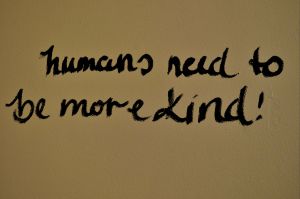
Be nice. All of us long to be nice to others, to family, friends, work colleagues, strangers, the world as a whole. Some of us would even feel better if we could only be nice to ourselves now and again.
Speak softly, go slowly in my interactions with others – loved ones or strangers, it doesn’t matter. While we all wish for others to be nice to us, we are all very aware that life doesn’t always work that way. But at the very least if we can be nice in every situation, then it’s better for everyone.
So, when slighted by another, spoken to with a loud or aggressive voice, or in some other way treated ‘not so nicely’, pause. Breathe. Then with confidence in yourself and what you have to say or do, be nice to that other.
Smile (when you can and it’s appropriate), be calm, assertive, but stay nice.
As to being nice to Self. Well, I’m trying to give up the negative self talk, and the self critical thoughts, as well as not so nice thoughts about other people or situations. Being nice to others is also an act of niceness to ourselves. We feel good when we’re nice to others (and bad when we’re not so nice to others).
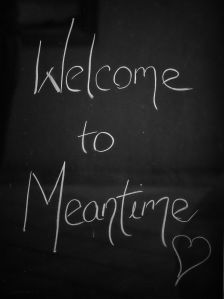
Meantime is so Yesterday. Make it Nicetime today!
Do nice
The verb do suggests doing; taking action. Do nice things for others – and for Self also. Sometimes it’s easy to do nice things for others, sometimes not so easy. Still, as with everything, it is the efforts we make that are the key: remember, nice makes nice.
Anyway, we’re all familiar with the brilliant (genius really) Random Acts of Kindness concept and movement. It’s a truly revolutionary idea that’s rightly spread far and wide and has become an integral aspcet of everyday life for many many people. Really any act of kindness, random or otherwise, is another way to describe doing nice.
And, once again, we shouldn’t forget about ourselves. Doing nice things for ourselves lifts our spirits, changes moods, enriches our lives overall. Don’t forget that doing nice things for others is just one more way we can do something nice for ourselves.
Consume nice. What am I putting into my body? What am I looking at, listening to, reading, buying – what am I consuming? How much of this consumption can I label as nice? How much of it is of benefit to myself or to any or all other beings, or to Earth herself?
And, the flip side of that question: Of all that I consume, how much is doing harm, again to myself, other beings, the planet itself?
Heaps, if you’re anything like me. I am engaged in constant struggle to change my habits of consumption. As I make these efforts, fight these battles with old old habits (I think I talked about this in a recent post?), I remind myself to be kind to myself when I fail to make forward steps – and just as or more often when I take a step (or two, or…)backwards.
Share nice. This one’s easy: reread all of the above. Well, okay, maybe there’s a little more to it than that. Actually, isn’t there an old aphorism that we’re all supposed to have heard in kindergarten? ‘Share nicely‘? I guess back then it was about sharing toys and other playthings with the other kids.
Now we are all grown ups, it means, well much the same really. If you have been blessed with material prosperity, be free with the way you share that good fortune. Be free and generous with how, and with whom, you share that wealth with.
Equally, no it’s not equally at all; it’s way more important and significant. Share your time; share your skills; share your knowledge; share your experience. The best thing of all to share – the nicest thing – is your love.
Love works well, not only with those close to us, those we call loved ones. Love can be shared in all our interactions with the world, whether it’s family, friends, work colleagues, or with strangers we encounter as we go about our day-to-day lives.
Share nicely of course isn’t only about what you share; it’s also about how we share. Share with a nice attitude. We’re right back where we started, be nice. Approach all with an attitude of love, generosity, and kindness.
So, how does all this nice stuff contribute to our spiritual growth?
The Greatest Hashtag of Them All
Well, I think as we’ve just seen, nice equals love. I feel that having nice – love – as the foundation of our being, doing, consuming and sharing, helps us move forward on the path to the realisation that happiness does not come from outside of ourselves – and certainly not from material things like money, possessions, and the like.
Nice can really only start with me – with you. From within my own Self, which in truth is non-different than your own Self.
There is a beautiful – truly beautiful – expression that has become an empty, flavourless, hollow, meaningless platitude. I’d like to rehabilitate that expression right now.
I want to say with my heart and my love, to all of you:
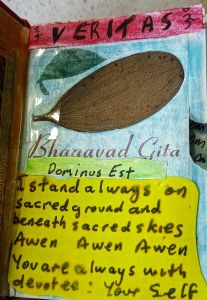
Right at the front of my Bhagavad Gita (the only book aside from the notebook I’m writing this in, that I personally own), I have recorded and inserted sayings and various words , that are important to me. Among those things is a statement I first heard many many years ago, that is common among the First Nations’ peoples of this country:
I [We] stand always on sacred ground and beneath sacred skies.
It is not an affirmation of ownership or possession. It is, instead, an affirmation of belonging to the land, to nature. It is a prayer of thanks, and it is a declaration of the knowledge of unity with the rest of the natural world, that is the hallmark and foundation for Indigenous cultures throughout the world and through time.
I’ve valued – treasured – this sentiment for a very long time – probably from even before I first heard it, which was so long ago as to be lost to memory. Perhaps I always knew it because I’ve somehow always thought this idea was a fundamental truth concerning my existence as a being living on this planet.
Well, now I have heard another statement that for me makes a perfect compliment for this one. The other day, during a lecture, my teacher mentioned that in his student days a fellow student said:
Wherever you are, you are walking through Ishwara
(Ishwara being her preferred name for the divine – for all that is.)
There is a feeling or sense of ‘belonging’, of awe and wonder when we attempt to immerse ourselves in what we term the natural world.
Once again I immediately felt the bell of Truth ringing clearly through this statement. Yes, I thought, everything is divine – including our own selves – so of course it follows that wherever we go, whatever we do, we are always in the divine.
You’ve probably read a number of times me quoting my teacher quoting his teacher:
Emphasis very much on only. Meaning of course, that it’s not that God is within us, or that we are within God; we are not surrounded by God; and it’s not that God ‘sits in our hearts’. The reality (for my teacher’s teacher) was that all that is, everywhere, everything, every thought, every word and deed, everything there is, is the divine.
Another way to describe the divine or God, that appeals to me is that Ishwara (also my own preferred name for the Divine) is in reality the natural order of the universe as dictated by the laws of nature. Those laws of nature, the rules that govern how the universe works, are also Ishwara, as are all that is manifest or in existence as a consequence of the workings of those laws.
In other words, the Divine is the sum total of what some would call the entirety of creation.***
For the hermits a sacred site. Part of a grove we named The Sentinels. A place of experience of unity and oneness of creation
For me this an enormously comforting and reassuring concept. Of course, for me at least, it is also an extremely difficult one to wrap my head around. But here’s a small summary of what I think I’ve grasped so far.
Ishwara – the Divine – is all there is; everything. Also divine is the natural order of the Universe as governed by the laws of nature. These laws are neither good or bad – there is no duality. They are neutral.
You and I, as one more entity among who knows how many others, act as we do and are subject to the laws of nature, just like everything else. We can’t change or influence those laws; we can only live our lives as they unfold.
To quote from Desiderata: No doubt the Universe is unfolding as it should
And, well, then things just work out as they do. While we can’t change the laws of nature, or bend the universe to always suit our liking, it is also true to say that every action we take, every thought we think, every word we utter, even our very presence as a living being in our time and place, do indeed contribute to ‘how things work out’. Another way of saying this is to say, we do our bit, and the universe does its bit and what happens, well, happens.
For me, this is not at all as simple or as straightforward as it sounds. Naturally we see ourselves as individual selves, as entities on our own. After all, to state the obvious, we live and operate in a material (dualistic) world. So automatically we see ourselves as individuals living in, but always separate from all the other individual entities, as well as being disconnected from the world itself.
It is part of human nature (for the most part) to long for connection; there is so often a drive within us pushing us to create family, enter relationships, feel we belong to a community or communities, and for many but not all, there is the almost instinctive urge to seek connection with the rest of nature.
Many forms, One reality
We often think of these longings as goals to achieve, as something outside of ourselves to attain, to reach for. Consequently, so very often we tend to focus our attention outwards, towards other people, or material things.
But, instead, all these inclinations, desires and longings are simply our Self (note the capital?) endeavoring to open itself to discovering (or rediscovering?) that which already exists: our oneness with, and our non-separation, and non-difference from, The All That Is.
Peace and Love from Paul the Hermit
FOOTNOTE
***Just a few thoughts about naming, or giving labels to the Universe and its laws. Obviously it’s a personal choice for each of us what we choose to call that creation. Then, on the other hand, we don’t have to call it anything at all. For me personally it is very difficult, even near impossible to not name it. By naming the creation, I don’t think I am attributing the manifestation of the Universe to some distant entity living in some heavenly abode (as my teacher likes to say). Rather I am acknowledging the intelligence and order, beauty, complexity of all that is and how it all works, as its own reality. At the same time, I am learning to understand that I as my true nature am not separate from the rest of creation, and I feel the need to have a name towards which I am able to focus my thanks and my reverence.
These last few days I’ve been researching and thinking about an idea for a blog post. But I’ve come to realise that I am grossly underqualified to write about the topic I had in mind. Let me put it another way: I am completely and utterly unqualified in any way whatsoever to go there. In fact, after all the research, I think I’m going to disqualify myself from ever going there in writing.
However, I’m a great believer in the idea that no quest for knowledge is ever a waste of time or effort; there is always something to be learned. During my research I came across a topic I believe I am qualified to discuss, as it forms an integral and vital part of my own personal spiritual practice.
Why I’ve decided to write this post, though, is because I made a discovery that lead to an insight that I know will lead to a great progress in that practice. It’s nothing new, not really, but it was one of those occasions we’ve all experienced of ‘I knew that, but now I really know it.’ For me, it was a realisation of something that till then had been a nice cosy theory and belief.
Bhakti Yoga is that practice. It is really a key foundation, a valuable component of my spiritual life.
Wikipedia opens its entry on Bhakti Yoga (see the link just above) with a description of the practice that mirrors what I think is the traditional understanding of Bhakti Yoga:
Bhakti Yoga (also called Bhakti Marga, literally the path of Bhakti) is a spiritual path or practice within Hinduism focused on loving devotion towards any personal deity.
In the same entry there is a description of the origins and meanings of the two words, Bhakti and Yoga:
The Sanskrit word Bhakti is derived from the root bhaj, which means “divide, share, partake, participate, to belong to”. The word also means ‘attachment, devotion to, fondness for, homage, faith or love, worship, piety to something as a spiritual, religious principle or means of salvation’.
The term Yoga literally means “union, yoke”, and in this context connotes a path or practice for ‘salvation, liberation’. yoga referred to here is the ‘joining together, union’ of one’s Atman (true self) with the concept of Supreme Brahman (true reality).
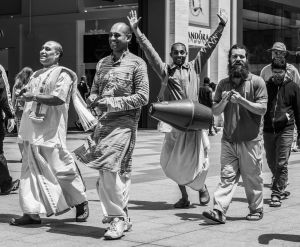
For some, dancing while chanting the names of their God, demonstrates their devotion and celebrates their union with each other and with God
In other words, those called to a religious or spiritual life, practise Bhakti Yoga whenever they pray or otherwise express devotion towards their personal conception of God, or the Divine. This particular definition seems to be saying that such a conception of the Divine, or God, is in the form of a personal deity who is a kind of representative of true reality, which the devotee is aspiring to join with.
Some Bhakta Yogis are full-time, full-on practitioners. People like contemplative nuns or monks, hermits who retire from the world into seclusion. Anyone basically whose entire life and activities are spent in devotion.
So, when I discovered all this, I became intrigued; I decided to go off on a tangent and explore the word Bhakti itself. Wikipedia has a separate entry for the word on its own:
Bhakti is a term common in Indian religions which means attachment, fondness for, devotion to, trust, homage, worship, piety, faith, or love. In Indian religions, it may refer to loving devotion for a personal God
…
is often a deeply emotional devotion based on a relationship between a devotee and the object of devotion.
…
In ancient texts the term simply means participation, devotion and love for any endeavor.
May refer to devotion to a personal god? While I thought this entry doesn’t contradict our first quote above, it does seem to broaden, and deepen, the meaning of Bhakti. Expand might be the better word.
In some traditions a simple life on the road is a way to commit full time to Bhakti or devotion.
It struck me that that object of devotion might be anything. Or even everything. You see? I told you it wasn’t a new idea. It’s just that it’s resonated deeply within me now. It appears that the object of Bhakti Yoga practice doesn’t necessarily have to be a ‘personal god’.
Many many people would say ‘I like animals’ or ‘I think we should save the world’. But, while that may imply a kind of love for or at least a fondness for, I think Bhakti is something more – actually several somethings more!
For example, some people have a particular attraction to and love for, the ocean, or it might be a river they view as, if not sacred in a religious sense, then as special to them in some deep, comforting, even therapeutic way. Others have similar relationships with and feelings for trees, or even a particular tree.
Animals as either individuals or as a species or group, can have the same appeal and call to other people. Then there are those who feel strongly in their hearts you could say, that Earth itself is a sacred object, or others have a knowing that the planet is a living entity and worthy of our devotion.
Bhakti begins with love and devotion, which is about caring for, affection towards, loyalty to, emotional engagement with the object of devotion. But even more than that, there is faith in that object of devotion; faith as in trust, confidence that the love is real, that the ‘relationship’ is sound and real.
Homage and worship too are key aspects of Bhakti. The deep inner feeling we have towards a thing, person, or other being, that is beyond what we normally call ‘love’. It’s about seeing and actually realizing ‘in our hearts’ our desire to be merged or united with that thing, person, or other being.
Actually, seeing that word other just now got me thinking. I had to go back and reread our definition of Yoga up there near the beginning. It says Yoga means ‘union, yoke’. It goes on to add: yoga refers to a ‘joining together, union’.
This passage seems to be suggesting that Yoga (in our case Bhakti Yoga) is both an already existing union, and a process of joining together to achieve union. One thing I would say here is that in my practice of Bhakti (and love as a general thing to strive for and be) it’s both.
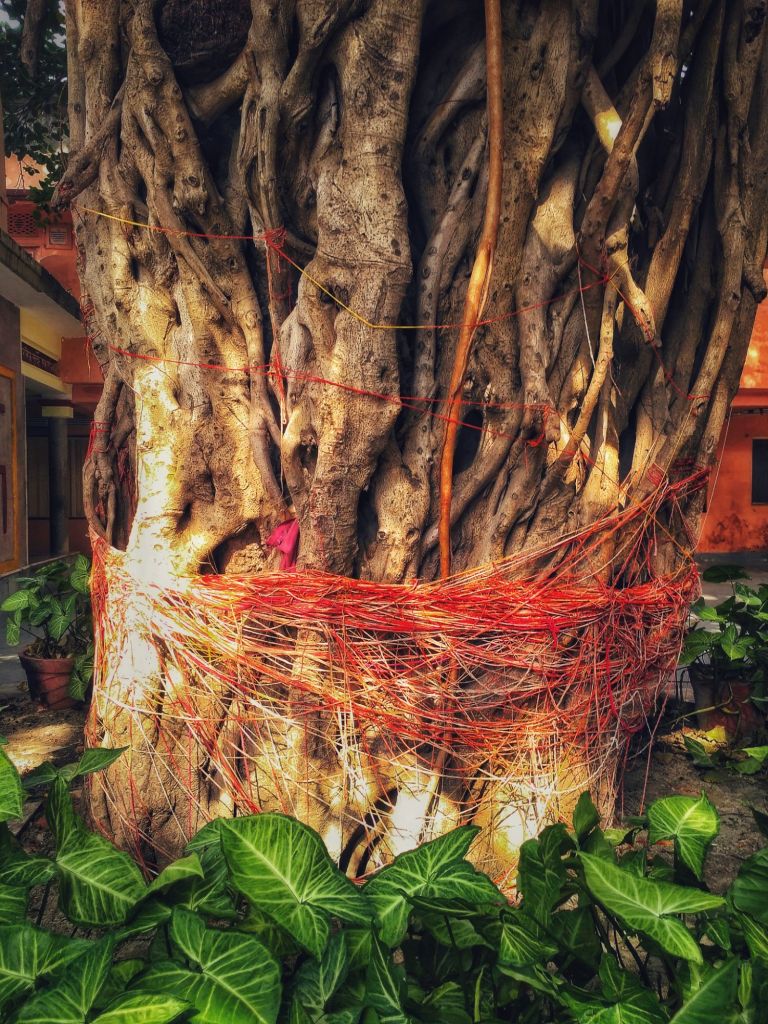
Trees are special beings for many people from a whole variiety of cultures all over the world
But, in the end, it seems to me that the process or practice, the path of Bhakti, serves to awaken us, to assist us to acknowledge, recognise, and realise in that really knowing way, our pre-existent true nature.
That true essential nature can be said to be the reality of our oneness with all things, living and non-living. And their oneness with us too of course. In fact, by putting it that way, I’m saying there is only one, or oneness. What’s that expression? One without a second.
May you be a Bhakta Yogi. Or, perhaps you already are one?
Love and peace from Paul the Hermit
Life has manifested itself as the multitudinous forms that comprise the universe. It is the one Universal Life, Power or Shakti (the laws of the universe or natural laws) that controls, guides and actuates all movements and activities in all beings, creatures and things.
One of the key elements of the current temporary hermitage, the current safe-haven by the side of the road, is that it is literally two minutes walk from a very uncrowded and quiet coastal beach.
It is a place of golden sands (I know that’s a cliche but in this case I have the evidence!), gentle wave action, and the promise of a possible serenity of a kind I’ve not been close to for a long while.
While I don’t visit this little slice of Pacific coast every day, I get to walk and or sit there several days a week. And when I do, I find that it’s always uplifting and relaxing. A reminder too, of my oneness with all nature. All of us are actually nature, along with every other living thing on our planet (and of course elsewhere too).
Today, for the second time I built a little ‘shrine’ on the sand. Walking away from my little temporary temple, a poetic voice entered my mind and wrote itself a few lines. Too engrossed in the moment, I neglected to record it on my phone, so when I got back to the hermitage I wrote it as remembered.
And now, I would like to share it with you. I am grateful that I am actually able to share it, so thank you.
WE STAND ON SACRED GROUND
I planted the branch, the branch of a fallen tree person. On the beach, in the sand of the beach.
And I built a shrine around that branch. A pop-up shrine. Shells, stones, and a piece of coal.
A shrine to Varuna. A shrine to Surya, to Saraswati. A shrine to all the gods of Earth, Sky, Water. A shrine to the gods of all beings.
A shrine on the beach is subject to tidal flow. And soon, this simple shrine, pop-up and temporary in nature, will be engulfed.
Lord Varuna will make his claim. What has emerged, must always return.




































 Notes from the Hermit's Cave