Cries of the Winged Ones

CRIES OF THE WINGED ONES

Just let go
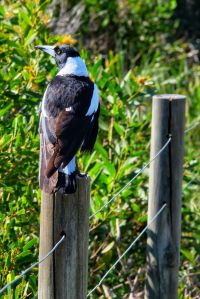
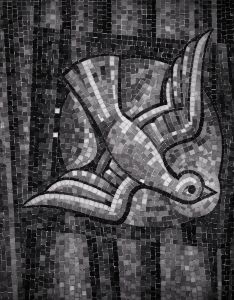
cries the winged messenger
perched in the fence-corner tree.
Let go. Just surrender.
Surrender to what?
The river of life,
its flow, its vibe

Lord here I am,
I cry in reply.
Two beings, one Self.

The winged messenger cries

because she longs for us to listen

The Word is the Word

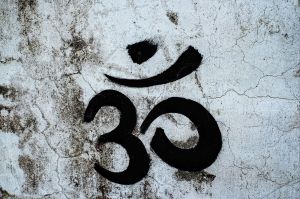
OM IS THE WORD
Om
In the beginning was the Word
Om
And the Word was with God
Om
And the Word was God
Om
And the Word is God
Om Om Om

Om
The object is the Word
Om
The subject is the Word
Om

Om
The observed is the Word
Om
The observer is th Word
Om

Om
The Word is the Word
Om
There is only the Word
Om
It is as it is – the Word
Om Om Om

Listen: It’s Already Silent

‘I must be back in the blog writing mode, I’m really hanging out for a new topic.’ I blurted out to my partner hermit just now.

Actually, it was desperate. What I actually said was ‘I’m really desperate‘ for a new topic. I quickly modified it to anxious then again to keen, in an attempt to keep the sound of attachment out of my voice. Finally, in these notes, it’s morphed into ‘hanging out’ which is obviously no better at all.

Her reply needs no disclaimer, no modification: ‘The answer comes from the silence,’ she said quietly.

I’ve actually had a relatively quiet – even silent – day: resting in recovery, laying on my bed, sometimes sleeping, sometimes simply following my breath.

Mind wandering, of course, that’s what minds do after all. But overall at least a semblance of silence seemed to be the order of the day.

Even then, after all that silence, quiet, rest and mostly a not overly busy mind, the best I can come up with is ‘I’m desperate’?

As in, I’m really hanging out; really anxious; really keen. As in, I”m not really listening – not at all silent. In fact, so full of desire, clinging and attachment for a new blog topic was I, that actually noticing one come out of the ‘silence’ would likely take a miracle.

All day – hours – I lie still. As I said, only sometimes sleeping, the rest of those several hours watching my breath, attempting just to be in silence and in the stillness.

So is it me? Am I missing something? An answer has come (here I am making notes for a new blog post), but what’s this ‘silence’ business from where answers apparently come all about?

Clearly, silence does not always seem to require an absolute, complete, and total absence of noise, voice, words, thoughts, if it is indeed the source of ‘answers’.

Maybe silence itself produced an apparent state of attachment to a new blog idea as a kind of ruse or trick to have my Self fool myself into seeing the foolishness of attachment as well as showing me how silence really works – in the real world.

Silence is not some sort of rarified mystical state that we have to enter through rigorous spiritual practices. It is actually a condition that emerges from everyday moments, ‘random’ thoughts, or comments made seemingly without thought or any apparent significance or meaning. Actually silence lives everywhere, is in everything and is all the time.

Listen and you’re there

It Is What It Is

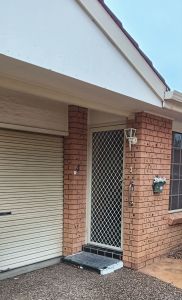
Right at the end of our last post, I mentioned – in an almost off-handed manner – that the hermitage has moved. Better to say the hermits were lead by the ever not so subtle universe to leave our refuge of a year for the safety and seclusion of another abode a few hundred metres away.

Why? Why did the hermits have to move? Well here’s the thing, the owner of that space that had graced us with its protection for that year decided to revive his on and off again campaign to sell the property. And with great success too: very soon there was a buyer very keen to move in ASAP

So, the search was on for a new abode to house the hermits. Cutting a long story short, and leaving out a multiplicity of praises, gratitude, and details, here we are.

Now you know why we moved into a new hermitage. Or do you? You have a few of the facts about how the process of us moving actually manifested in the material world, but as to proper answers to the why questions? You’ll agree that it’s all a bit vague, mundane, and that I haven’t given any answers to why at all.

That’s because I don’t know either; no idea at all.

It’s true, there were some unusual obstacles and pressures – but aren’t there always for everyone as they negotiate and try to manage their lives in the world?

And I could add that the timing could have been better – see above rhetorical question for my response to this one.

No. Like so much (actually everything really) that happens in the on-going, non-stop re creation of the physical world (constant flux, change,seeming chaos, conflicts, setbacks, advances, ups and downs) as it flows along in its own way at its own pace, I have to admit, its a mystery to be unravelled. Or not: there are some who would dare to label this constant re creation, God’s will.

So, we can ask why here? Why now? What’s the lesson to be learned from the move to the new hermitage.

Or we could just tell ourselves that that’s just the way the Cosmos does things. By any standards it’s been a no hitches, no hassles, change of address. But let’s not get distracted by dualities: It is what it is, as I like to say.

And there’s no good or bad, but thinking makes it so.

Not Talking About Time

If my life was ruled by ‘clock’ time (which generally speaking it is in spite of my many protests and despite my continuing meditation and other practices designed to assist in developing a sense of being fully present thereby enabling one to truly live in the here and now), I would be telling you now that there’s been a long gap between posts and that this has occurred because two and A half months ago I had a stroke and I didn’t leave the hospital untill less than a fortnight ago.

But there’s been no ‘gap’, the posts will carry on flowing along (or not) of their own accord; and while it is true that my brain and heart colluded in an action that has for now resulted in some damage to other bits of my body, the simple reality is that life has gone on doing what life does, and I AM still here, with perhaps a little more of a clue to the ‘how to live in the here and now’ as well as the whole ‘I AM THAT I AM and not the body’ mysteries.

Obviously, I’m not into swapping ‘You think your hospital stay was bad? Well let me tell you … .’ stories. Now I think about it, there are quite a few of the good, uplifting, kindness and compassion, decency and respect variety a couple of which I might write about if they decide they want to be shared.

But for now (when else is there?) I am here (where else is there?) trying to flow in the life I share with my partner hermit in our new (for us) hermitage just over the other side of the village Main Road.

Note To Self: Keep Chanting

What I want to talk about today, what I’d like to share, isn’t new. By that I mean the ideas are well known in the world – and they’ve even occured to me from time to time.

But, today, the thought seems new. Clearer and more obvious somehow. Perhaps when a little bit of knowledge finally ‘sinks in’, and is fully realised for what it is, then maybe that’s the beginnings of wisdom. Or an enlightenment. Perhaps we can say simply that a profound insight was had.

The thoughts I’m talking about concern prayer. More specifically the thoughts were prompted by my experience this morning chanting mantra – in this case, the Hare Krishna Maha Mantra, my mainstay you might call it; My main focus of devotion and meditation.

Hare Krishna Hare Krishna

Krishna Krishna Hare Hare

Hare Rama Hare Rama

Rama Rama Hare Hare

As so often happens, as I chanted today, I found myself thinking other thoughts, following mental stories invented as they went. I carried on chanting, but I was thinking other stuff at the same time.

I stopped the mental recitation of the mantra so I could focus on the emerging thoughts.

Yes, it’s true I was, chanting but it was merely at ‘lip level’ as I’ve heard it described. My intention may well have been to focus my full attention on the words of the mantra, on my means of devotion, and the repeating of God’s names. But clearly my mind had other plans as it wandered and skipped around on other paths.

I guess it’s a problem for anyone who prays in whatever form the prayer takes; it’s very easy to be distracted my experience tells me. I’ve read that people may have chanted a mantra for decades – twenty or more years – and feel that they still can’t ‘get it’, that while the intention is there and strong, they just can’t seem to fully immerse themselves in the mantra. Nothing of it reaches the heart. It’s a lonely feeling, I know.

They, like me quite often, will feel frustrated, empty, and as if their devotion is not devotion at all but simply a mouthing of supposedly holy words. Just an exercise, another spiritual practice to simply get through. Some, give up.

That’s why I stopped chanting this morning: I felt the insight coming on. That new revelation that’s hardly new at all.

Here it is then, the insight. If I become aware that my mind is straying and the mantra is being recited rote fashion, then so long as I gently bring my attention back to the words of the mantra, then in fact, all is well.

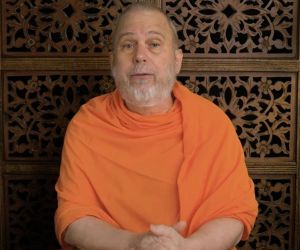
Swami Tadatmanda Resident teacher at Arsha Bodha Centre

My teacher, Swami Tadatmananda has said when speaking about meditation, that the very act of bringing the mind, our attention back to the object of meditation when we notice it’s wanderings, is in itself an integral component of the meditation itself.

So, if I’m chanting and my mind begins to jump about, and I notice those mental antics and bring my focus back to the words of the mantra, then in truth, in the reality of the thing, I’ve actually not ceased my chanting at all. There hasn’t been any interruption.

As I said, it’s not a new idea; it’s not my own idea. But it feels new, it feels as if it’s an idea meant for me.

Intention, effort, resolve, persistence (or is it perseverance?) – and love. The only other necessity is that I continue chanting, both in that moment of supposed interruption and generally in my life.

In other words, if it feels like I’m only mouthing words that aren’t reaching my heart, don’t worry.

Just keep chanting

Hare Krishna!

You’re Already There.

There are many blessings that come with the living of the hermit life. And I am especially blessed as I am not a ‘hermit alone’ – I share my life, the Hermitage, and my spiritual practice with another hermit. We are partner hermits.

One component of that spiritual practice is our times spent together reading a few verses from the Bhagavad Gita. We pursue our own personal studies, but sometimes one or the other of us will share an especially resonant verse, or an insight or thoughts.

This morning my partner hermit told me, in a casual almost by the way manner, that she’d just read a verse that spoke about not disturbing others, and not letting ourselves be disturbed by others.

At first, I had no memory at all of this verse; I just couldn’t place it. Which might sound a little worrisome, given I’ve been studying this text for seven or eight years.

So, it wasn’t till she gave me chapter and verse and I looked it up for myself, that it finally clicked into place. Of course I knew this verse, but it had slipped from conscious memory.

And that surprised me: this verse seems to me to be speaking to a key concept in the teaching of the text as a whole, as well as to my personal aspirations. Surely, I would think, it should be, what’s the expression? Top of mind?

He [sic] who disturbs no one, and who is never perturbed by anyone, who is unattached to happiness, impatience, fear, and anxiety is dear to Me.

               Bhagavad Gita 12:15

This verse is full of meaning for me. It’s like a one-stop how to lesson in avoiding the personal suffering that’s brought about through attachments. Mind you, once again I can’t help wondering after years of study, and with how much this verse resonates for me, why I had such a hard time remembering even seeing it before.

I suspect the power of the ego and the mind have a lot to do with it. Ego – along with its master, the mind – love attachments to the world, to anything really. I guess they are always doing their best to keep me attached to my compulsions and aversions.

Imagine though, not being disturbed by anything – or anyone – and me actually not doing anything that disturbs anyone or anything?

Not just people and other living entities in my immediate physical environment, but out there in the wider world – in the Universe even.

It’s about vibes isn’t it? What vibrations am I putting out into the world? Are they vibrations and waves of love, peace, compassion, detachment, equinimity? Or at they vibes of discord, dislike, anger and sorrow over the stuff I can’t control?

And just think what it would be like if I weren’t so attached to the idea that my happiness depends on getting pleasure or ‘results’ from worldly things, activities based on the senses? Imagine really understanding that the only true and real and lasting happiness and satisfaction can only come come from within my Self?

This doesn’t mean at all that I can’t be happy, or can’t have fun or enjoyment. It is merely saying that, if I can accept whatever comes to me in life without clinging to the things I want, or running away from the things or situations I don’t want, then there will be less suffering.

Ego is jumping in now and wants me to note that, while I may in fact be on the path to detachment and freedom, I’m not far along enough yet to escape its clutches. Anyway, moving right along.

Impatience, fear, and anxiety are tricky presences in the attachment arena. I’m even less far along the path to letting go of these stubborn attachments. But, again, at least I’m on the path.

And what is that path? Where’s it going? Well (paradox alert), on the path in this instance is another way of saying I’ve not realised fully that I am already at the path’s destination. I just think I have a long way to go.

Swami Ramdas (1884-1963) Courtesy Wikipedia

I think Swami Ramdas said: ‘When you set foot upon the path, you have reached the destination.’ I think!

That’s the ‘dear to me’ bit of the verse explained. The ‘me’ in this phrase represents the aspired to full realisation that I am free, liberation or enlightenment some call it. It’s a place, or state of mind in which I move through the world with peace, calm and equilibrium, where nothing disturbs me, and I disturb no one.

That state of liberation doesn’t mean I have given up, or will have to give up, all desires for things I want, nor will I have escaped the things I have aversions to. It simply means I will no longer be driven by those desires and aversions, I will no longer be attached.

It means, too, that I will no longer be concerned in an attached way, to who says or does what to whom, when, where, why or whatever. At that stage I will be in the world, but not of it.

Of course, I am a hermit; you would think it’s easy for me being secluded from the world (well it’s not total seclusion). If only that were true.

I still have the clingings, cravings, and aversions; I’m even attached to the clingings and the aversions.

The one desire, the one I permit myself to cling to, is the desire to free from all other attachments, the attachments that cause so much suffering.

As long at I have that desire guiding my life, then I will be satisfied, when I can be, knowing that one day I will fully realise that I’m already free, unattached, liberated and happy.

There’s a song I wish I could remember the name of, or at least who sings it, but there’s a line in the lyrics that, says something like ‘I don’t want to go searching for what I already have.’ That’s me!

A Case of Mixed Feelings & Questions of Identity

Yesterday, after getting back to the Hermitage from a walk around the block, I went to take off my shoes.

Actually, I thought, while I’ve got my shoes on I may as well spray the weeds out the front and out the back in the courtyards of the Hermitage.

Sounds like an innocent and innocuous thing to say and do doesn’t it? Well, in fact it is a far from innocuous euphemism which in reality has me saying: I’ll apply some poison through a spray bottle to the leaves and stems of plants somebody or other has classified weeds, in order to kill them slowly over a few days.

Needless to say, this activity always evokes mixed feelings in me. Like everything else in the material life, this issue has two sides concerning the rightness and wrongness of ‘spraying the weeds’.

On the one hand, I understand that we humans are merely one more species along with so many others. We have to do what we need to do in order to feed, clothe, and shelter ourselves.

Weeds, I know, interfere with humans’ ability to grow food for example. In this context weeds are those plants that threaten to overrun, damage, or reduce supplies of ‘acceptable’ food plant species. Thinking about it now, it strikes me that the decisions about is it a weed or is it not a weed, can be pretty subjective.

On the other hand I personally do not want – nor do I think it right – to kill other living things. Of course, and clearly obvious too, it’s a bit more nuanced than a simple choice between do I? or don’t I?

I eat plants of many varieties, and in many forms, and I understand very well that they are all living beings. And, add to that, how many insects, lizards, snails, small mammals, birds, and other animals are displaced, injured, or killed in the planting, growing, harvesting, packaging, transport, and sale of the fruits, vegetables, nuts and so on that I eat?

Like I said earlier, the human species, like all others, must do what it has to to survive. Obviously, again being human, we have minds capable of discernment and decision making that can help us minimise the harm we cause as we pursue survival.

For me, a major component of that harm minimization takes the form of not eating the flesh of animals, as well as my choice to not utilise items made from animals.

Even with this there is a problem: Who’s to say what life forms are acceptable as food, and which aren’t? Humans have invented the scary idea of the Food Chain. We simply decide who is higher and who is lower on that chain and eat accordingly.

Needless to say, humans have appointed themselves to be the highest species on that ‘food chain’. Meaning of course, anything else is lower and hence okay as food.

Anyway, I digress a bit. Getting away from food questions, to look specifically once again at the ‘weeds’ to be sprayed in the Hermitage garden.

I often ask myself what is it that makes one plant with big orange flowers acceptable as a garden plant? Of course it’s beautiful, ornamental, and a pleasure to have nearby, but what else?

But, what is it that makes another plant, with its delicacy and little flower that are equally beautiful and as pleasing to be around in my view, not acceptable as a garden plant? What makes this one a weed, while that first one we met in the previous paragraph not?

Well, it seems to me that the first answer has to do with necessity dictated by circumstances or conditions beyond one’s control.

As I’ve said, when it comes to growing food, it’s necessary to control plants that threaten that growth. Discernment comes in when we decide how to eliminate that threat with the least harm. One aspect of discernment is actually related to that subjectivity I mentioned before: one person’s weed, is another person’s delicious and nutritious food – and vice versa.

At the Hermitage we don’t grow our own food, so we don’t face that dilemma. Here, at the Hermitage, it is a condition of living here that we control the weeds. And the plants classed as weeds are well known to us due to this condition being a routine clause in most rental contracts.

Besides, it seems that another major factor that makes a plant a weed, is where it grows, how hard it is to keep in bounds and behave.

I guess it’s not only a requirement, that we control the weeds. It’s an issue for our discernment as we try to find ways to share this little patch of the world with the other life forms who also live in this space with us.

It is a wise discernment that tells us to follow the rules of the contract. And our discernment also shows us that, in this human built environment we live in, we can’t allow the space to be taken over by plants that would then provide a safe harbour for insects, rodents, and other creatures that might or would threaten our health and wellbeing and that of our neighbours.

In a pot rescued from a roadside pile of domestic discards, a variety of plants – weeds also rescued over a few months of ‘spraying the weeds’ as a kind of offering to and celebration of life – grow in a group.

It’s a pretty group, I think, of delicate, yet sturdy little lifeforms.

Are they still weeds? Now that I’ve placed them to grow in an ‘approved’ space? Now that they are confined by bounds within which I can control them?

Confined? Controlled? Perhaps for now, but not for long. It’s a comforting thought, realising they all have allies: the sun, the rain – and the wind.

At the same time, we consider all life forms, including humans, to be manifestations of the Divine. All life is one, as I assert so often. Speaking personally, I am sad that any lifeform that is harmed because of my actions and my material needs.

Discernment, compassion, love and mindful action. As we seek to coexist in peace with those beings we share our world and lives with, these things are all required. Empathy too: We are the weeds, the weeds are us.

And the inner editor is insisting I finish by reminding myself  that life, the universe, and all that happens, is unfolding exactly as it’s meant to; all we can do is play our part in that unfolding.

We All Get to Stay

Sharing our prayers this morning, the hermits each reciting a prayer to the other so each can pray, and talking about the oneness of life (prompted by one of the shared prayers), the dependence of one species upon another.

As we reflected on that idea – of interdependence – it occured to me that perhaps, there might be a problem in how we as humans, interpret its meaning. We can maybe call it a kind of paradox, but we’ll get to that in a bit.

Our dependence – as humans beings – on so many other species is actually a well known, and I hope increasingly accepted, reality. For food, for shelter, for water, air to breathe. Everything.

In any case, an aspect of this interdendcence idea that struck me as perhaps missing, that I’ve not really heard before (I haven’t researched this; just winging it thought and contemplation wise) is this; If, say, bees disappeared, or all trees were cut down, would humans survive? Definitely not.

On the other hand, let’s say that in an instant or even over time, all humans on Earth disappeared. What would happen to all the other living beings? All the bugs, the fishes, the animals of all kinds, trees, grasses – all the living beings?

It seems to me that all those other species, all those beings of all kinds, would not only survive, they would most likely thrive.

Actually, now I think about it, I remember during the COVID lockdowns, people in various places around the world were amazed at the return of birds to usually busy polluted cities, and how the air seemed fresher in some places when in ‘normal times’ it was getting hard to breathe. And beaches and rivers looked a bit cleaner than usual.

Fewer people commuting; fewer planes flying; less goods being transported on congested roads; less waste going into rivers and the oceans. Seems life on Earth was doing better when we (humans) were out of the picture, even for a short while.

Which is to say, humans may not be necessary for the survival of planet Earth and the other life that lives here. Putting it very simply: We go, they thrive; They go, we go too.

But, my thought train races along its newly discovered track here, what if I’m wrong? What if I’m looking at the whole issue on just a superficial level? What if all I am seeing is the gross material level of the whole question? What if I’m missing the real point of it all?

Well it seems to me that on that purely physical, surface level, my theory (borrowed as it may be perhaps) might be right, the irony true: we go, they thrive; they go, we all go; they stay, we all get to stay.

But who are ‘they‘? Who are ‘we‘? For me it’s clear that we are not all simply and only our physical bodies and our minds living here in the material world; that’s all temporary and comes and goes. No, there has to be more to it than that.

Which is what I end up coming back to so very often: there is only one. No separation; no you and me; them or us. Just one. Without a second. Only Consciousness.

I think the best thing to do, just to be on the safe side is to look after each other – regardless of the particular body we happen to be inhabiting at the moment.

That way, we all get to stay, and we’ll all thrive

All I Can Afford is a Loving Heart

Our post today is closely related to our last one. In fact, so close is the relationship, we can call them sibling posts, even twins.

Anyway to begin, I’d like to share one verse from a song I’ve loved and not loved for years. The song’s called You’re Just a Country Boy by Alison Krauss:

Never could afford a store bought ring
with a sparklin’ diamond stone.
All you can afford is a loving heart,
the only thing you own.

It’s easy to start disliking this song right from reading the title: ‘Just‘? As in only? As in ‘Is that all you are?’. And ‘country boy’? What’s wrong with people – of whatever age or gender – who come from rural areas?

But, there is some to love as well: The lyrics are clever (cleverer than I’d thought, as you will see soon); the singer has a lovely and skilled voice that I like a lot; and there is a generally relaxed, easy listening kind of vibe to the whole tune.

Still, there is more to dislike: The song is addressed to said country boy, perhaps as well meant advice from a friend who is trying to let the country boy down easy as they say. ‘Get real my friend,’ she seems to be saying. ‘You have nothing that anyone wants. You’re poor, you’re from the country, and no way will anyone ever want you.’

The lyrics are like an affirmation or confirmation of what we know already: the world turns on material objects and money, and you aren’t anyone or going anywhere if you don’t have that stuff.

But, then on the other hand, there is much more to love. And this verse kind of sums it up. For the first time today, rereading the lyrics as I ate my lunch, I finally got it: it’s IRONY!

‘What?’ the lyrics seem to say. ‘You mean to say that the only thing you own is a loving heart? What use is that for goodness sake? Nobody wants that. Everyone wants money, jewels, and other material things’.

Well, I think I’d actually gotten it already; it’s just (there’s that troublesome little word again) that today is the first time the word itself came to mind. How ironic to come to the realisation of the irony of this song after all this time?

I like the use of the word afford. Clearly our country boy is broke, has no money, little material worth, and being a ‘country boy’ he obviously has limited prospects.

The irony is, of course, obvious: if one has a loving heart (or an awakened heart as we reflected on in our last post), what else do they need to be able to afford?

Our friend has most likely earned his loving heart over and over again anyway as he’s lived his life with its inevitable trials, tribulations, joys and sorrows. Riches galore right there. Afford? Of what value are material riches when one already possesses the most valuable asset to which a human being can aspire – a loving heart?

Just thought I’d look up the lyrics to another song I also quote from quite often. It’s also about that ‘all I have’ idea. The song is Words by the Bee Gees. These two lines I like:

It’s only words and words are all I have
to take away your heart

Or, as I might reinterpret it: ‘I know these are only words, but they’re all I’ve got to try to speak to your heart from my heart’.

If I’m to dig deep, be honest, and all that, I would have to say that this idea has been a major guiding force in and for my life in one way or another – whether I’ve been conscious of it or not. As has been aspiring to a loving heart, though that aspiration has at times been bogged down in the mire of the mess of life.

Words are good and sacred, and I’ve always seemed to have a lot of them (it’s not the words that are at fault, it’s the one who uses or abuses them). Really, as I think about it now, all I want is to continue using them – words – to express what’s in this (aspirational) loving heart.

All I can afford is a loving heart.

PS Now I’ve actually truly and really seen the irony in the lyrics, maybe I don’t have to dislike this song quite so much