It Is What It Is

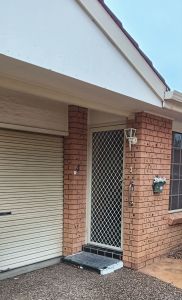
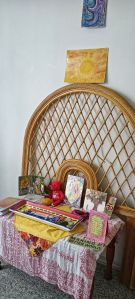
Right at the end of our last post, I mentioned – in an almost off-handed manner – that the hermitage has moved. Better to say the hermits were lead by the ever not so subtle universe to leave our refuge of a year for the safety and seclusion of another abode a few hundred metres away.

Why? Why did the hermits have to move? Well here’s the thing, the owner of that space that had graced us with its protection for that year decided to revive his on and off again campaign to sell the property. And with great success too: very soon there was a buyer very keen to move in ASAP

So, the search was on for a new abode to house the hermits. Cutting a long story short, and leaving out a multiplicity of praises, gratitude, and details, here we are.

Now you know why we moved into a new hermitage. Or do you? You have a few of the facts about how the process of us moving actually manifested in the material world, but as to proper answers to the why questions? You’ll agree that it’s all a bit vague, mundane, and that I haven’t given any answers to why at all.

That’s because I don’t know either; no idea at all.

It’s true, there were some unusual obstacles and pressures – but aren’t there always for everyone as they negotiate and try to manage their lives in the world?

And I could add that the timing could have been better – see above rhetorical question for my response to this one.

No. Like so much (actually everything really) that happens in the on-going, non-stop re creation of the physical world (constant flux, change,seeming chaos, conflicts, setbacks, advances, ups and downs) as it flows along in its own way at its own pace, I have to admit, its a mystery to be unravelled. Or not: there are some who would dare to label this constant re creation, God’s will.

So, we can ask why here? Why now? What’s the lesson to be learned from the move to the new hermitage.

Or we could just tell ourselves that that’s just the way the Cosmos does things. By any standards it’s been a no hitches, no hassles, change of address. But let’s not get distracted by dualities: It is what it is, as I like to say.

And there’s no good or bad, but thinking makes it so.

Not Talking About Time

If my life was ruled by ‘clock’ time (which generally speaking it is in spite of my many protests and despite my continuing meditation and other practices designed to assist in developing a sense of being fully present thereby enabling one to truly live in the here and now), I would be telling you now that there’s been a long gap between posts and that this has occurred because two and A half months ago I had a stroke and I didn’t leave the hospital untill less than a fortnight ago.

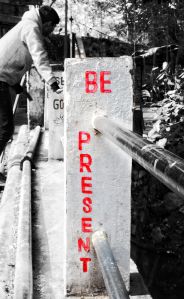
But there’s been no ‘gap’, the posts will carry on flowing along (or not) of their own accord; and while it is true that my brain and heart colluded in an action that has for now resulted in some damage to other bits of my body, the simple reality is that life has gone on doing what life does, and I AM still here, with perhaps a little more of a clue to the ‘how to live in the here and now’ as well as the whole ‘I AM THAT I AM and not the body’ mysteries.

Obviously, I’m not into swapping ‘You think your hospital stay was bad? Well let me tell you … .’ stories. Now I think about it, there are quite a few of the good, uplifting, kindness and compassion, decency and respect variety a couple of which I might write about if they decide they want to be shared.

But for now (when else is there?) I am here (where else is there?) trying to flow in the life I share with my partner hermit in our new (for us) hermitage just over the other side of the village Main Road.

You’re Already There.

There are many blessings that come with the living of the hermit life. And I am especially blessed as I am not a ‘hermit alone’ – I share my life, the Hermitage, and my spiritual practice with another hermit. We are partner hermits.

One component of that spiritual practice is our times spent together reading a few verses from the Bhagavad Gita. We pursue our own personal studies, but sometimes one or the other of us will share an especially resonant verse, or an insight or thoughts.

This morning my partner hermit told me, in a casual almost by the way manner, that she’d just read a verse that spoke about not disturbing others, and not letting ourselves be disturbed by others.

At first, I had no memory at all of this verse; I just couldn’t place it. Which might sound a little worrisome, given I’ve been studying this text for seven or eight years.

So, it wasn’t till she gave me chapter and verse and I looked it up for myself, that it finally clicked into place. Of course I knew this verse, but it had slipped from conscious memory.

And that surprised me: this verse seems to me to be speaking to a key concept in the teaching of the text as a whole, as well as to my personal aspirations. Surely, I would think, it should be, what’s the expression? Top of mind?

He [sic] who disturbs no one, and who is never perturbed by anyone, who is unattached to happiness, impatience, fear, and anxiety is dear to Me.

               Bhagavad Gita 12:15

This verse is full of meaning for me. It’s like a one-stop how to lesson in avoiding the personal suffering that’s brought about through attachments. Mind you, once again I can’t help wondering after years of study, and with how much this verse resonates for me, why I had such a hard time remembering even seeing it before.

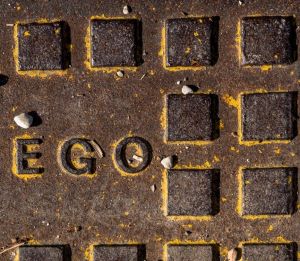
I suspect the power of the ego and the mind have a lot to do with it. Ego – along with its master, the mind – love attachments to the world, to anything really. I guess they are always doing their best to keep me attached to my compulsions and aversions.

Imagine though, not being disturbed by anything – or anyone – and me actually not doing anything that disturbs anyone or anything?

Not just people and other living entities in my immediate physical environment, but out there in the wider world – in the Universe even.

It’s about vibes isn’t it? What vibrations am I putting out into the world? Are they vibrations and waves of love, peace, compassion, detachment, equinimity? Or at they vibes of discord, dislike, anger and sorrow over the stuff I can’t control?

And just think what it would be like if I weren’t so attached to the idea that my happiness depends on getting pleasure or ‘results’ from worldly things, activities based on the senses? Imagine really understanding that the only true and real and lasting happiness and satisfaction can only come come from within my Self?

This doesn’t mean at all that I can’t be happy, or can’t have fun or enjoyment. It is merely saying that, if I can accept whatever comes to me in life without clinging to the things I want, or running away from the things or situations I don’t want, then there will be less suffering.

Ego is jumping in now and wants me to note that, while I may in fact be on the path to detachment and freedom, I’m not far along enough yet to escape its clutches. Anyway, moving right along.

Impatience, fear, and anxiety are tricky presences in the attachment arena. I’m even less far along the path to letting go of these stubborn attachments. But, again, at least I’m on the path.

And what is that path? Where’s it going? Well (paradox alert), on the path in this instance is another way of saying I’ve not realised fully that I am already at the path’s destination. I just think I have a long way to go.

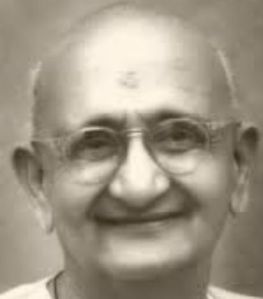
Swami Ramdas (1884-1963) Courtesy Wikipedia

I think Swami Ramdas said: ‘When you set foot upon the path, you have reached the destination.’ I think!

That’s the ‘dear to me’ bit of the verse explained. The ‘me’ in this phrase represents the aspired to full realisation that I am free, liberation or enlightenment some call it. It’s a place, or state of mind in which I move through the world with peace, calm and equilibrium, where nothing disturbs me, and I disturb no one.

That state of liberation doesn’t mean I have given up, or will have to give up, all desires for things I want, nor will I have escaped the things I have aversions to. It simply means I will no longer be driven by those desires and aversions, I will no longer be attached.

It means, too, that I will no longer be concerned in an attached way, to who says or does what to whom, when, where, why or whatever. At that stage I will be in the world, but not of it.

Of course, I am a hermit; you would think it’s easy for me being secluded from the world (well it’s not total seclusion). If only that were true.

I still have the clingings, cravings, and aversions; I’m even attached to the clingings and the aversions.

The one desire, the one I permit myself to cling to, is the desire to free from all other attachments, the attachments that cause so much suffering.

As long at I have that desire guiding my life, then I will be satisfied, when I can be, knowing that one day I will fully realise that I’m already free, unattached, liberated and happy.

There’s a song I wish I could remember the name of, or at least who sings it, but there’s a line in the lyrics that, says something like ‘I don’t want to go searching for what I already have.’ That’s me!

A Case of Mixed Feelings & Questions of Identity

Yesterday, after getting back to the Hermitage from a walk around the block, I went to take off my shoes.

Actually, I thought, while I’ve got my shoes on I may as well spray the weeds out the front and out the back in the courtyards of the Hermitage.

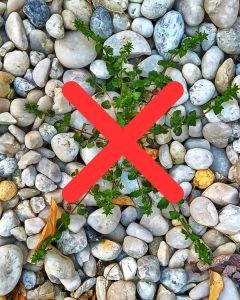
Sounds like an innocent and innocuous thing to say and do doesn’t it? Well, in fact it is a far from innocuous euphemism which in reality has me saying: I’ll apply some poison through a spray bottle to the leaves and stems of plants somebody or other has classified weeds, in order to kill them slowly over a few days.

Needless to say, this activity always evokes mixed feelings in me. Like everything else in the material life, this issue has two sides concerning the rightness and wrongness of ‘spraying the weeds’.

On the one hand, I understand that we humans are merely one more species along with so many others. We have to do what we need to do in order to feed, clothe, and shelter ourselves.

Weeds, I know, interfere with humans’ ability to grow food for example. In this context weeds are those plants that threaten to overrun, damage, or reduce supplies of ‘acceptable’ food plant species. Thinking about it now, it strikes me that the decisions about is it a weed or is it not a weed, can be pretty subjective.

On the other hand I personally do not want – nor do I think it right – to kill other living things. Of course, and clearly obvious too, it’s a bit more nuanced than a simple choice between do I? or don’t I?

I eat plants of many varieties, and in many forms, and I understand very well that they are all living beings. And, add to that, how many insects, lizards, snails, small mammals, birds, and other animals are displaced, injured, or killed in the planting, growing, harvesting, packaging, transport, and sale of the fruits, vegetables, nuts and so on that I eat?

Like I said earlier, the human species, like all others, must do what it has to to survive. Obviously, again being human, we have minds capable of discernment and decision making that can help us minimise the harm we cause as we pursue survival.

For me, a major component of that harm minimization takes the form of not eating the flesh of animals, as well as my choice to not utilise items made from animals.

Even with this there is a problem: Who’s to say what life forms are acceptable as food, and which aren’t? Humans have invented the scary idea of the Food Chain. We simply decide who is higher and who is lower on that chain and eat accordingly.

Needless to say, humans have appointed themselves to be the highest species on that ‘food chain’. Meaning of course, anything else is lower and hence okay as food.

Anyway, I digress a bit. Getting away from food questions, to look specifically once again at the ‘weeds’ to be sprayed in the Hermitage garden.

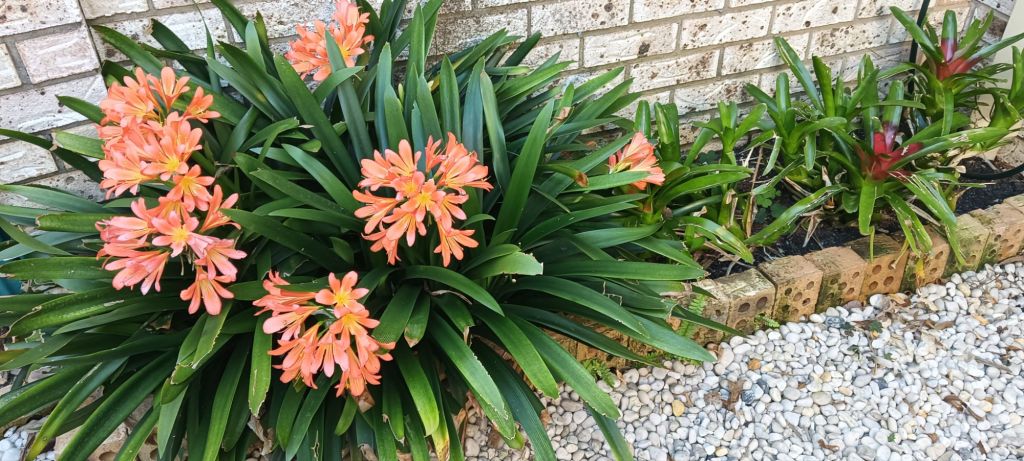
I often ask myself what is it that makes one plant with big orange flowers acceptable as a garden plant? Of course it’s beautiful, ornamental, and a pleasure to have nearby, but what else?

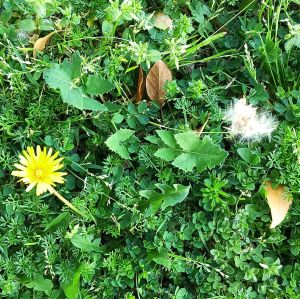
But, what is it that makes another plant, with its delicacy and little flower that are equally beautiful and as pleasing to be around in my view, not acceptable as a garden plant? What makes this one a weed, while that first one we met in the previous paragraph not?

Well, it seems to me that the first answer has to do with necessity dictated by circumstances or conditions beyond one’s control.

As I’ve said, when it comes to growing food, it’s necessary to control plants that threaten that growth. Discernment comes in when we decide how to eliminate that threat with the least harm. One aspect of discernment is actually related to that subjectivity I mentioned before: one person’s weed, is another person’s delicious and nutritious food – and vice versa.

At the Hermitage we don’t grow our own food, so we don’t face that dilemma. Here, at the Hermitage, it is a condition of living here that we control the weeds. And the plants classed as weeds are well known to us due to this condition being a routine clause in most rental contracts.

Besides, it seems that another major factor that makes a plant a weed, is where it grows, how hard it is to keep in bounds and behave.

I guess it’s not only a requirement, that we control the weeds. It’s an issue for our discernment as we try to find ways to share this little patch of the world with the other life forms who also live in this space with us.

It is a wise discernment that tells us to follow the rules of the contract. And our discernment also shows us that, in this human built environment we live in, we can’t allow the space to be taken over by plants that would then provide a safe harbour for insects, rodents, and other creatures that might or would threaten our health and wellbeing and that of our neighbours.

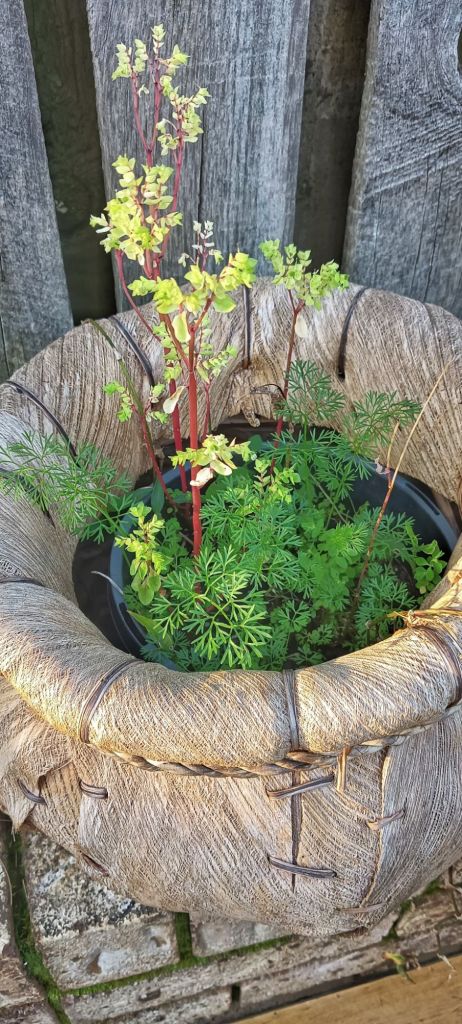
In a pot rescued from a roadside pile of domestic discards, a variety of plants – weeds also rescued over a few months of ‘spraying the weeds’ as a kind of offering to and celebration of life – grow in a group.

It’s a pretty group, I think, of delicate, yet sturdy little lifeforms.

Are they still weeds? Now that I’ve placed them to grow in an ‘approved’ space? Now that they are confined by bounds within which I can control them?

Confined? Controlled? Perhaps for now, but not for long. It’s a comforting thought, realising they all have allies: the sun, the rain – and the wind.

At the same time, we consider all life forms, including humans, to be manifestations of the Divine. All life is one, as I assert so often. Speaking personally, I am sad that any lifeform that is harmed because of my actions and my material needs.

Discernment, compassion, love and mindful action. As we seek to coexist in peace with those beings we share our world and lives with, these things are all required. Empathy too: We are the weeds, the weeds are us.

And the inner editor is insisting I finish by reminding myself  that life, the universe, and all that happens, is unfolding exactly as it’s meant to; all we can do is play our part in that unfolding.

We All Get to Stay

Sharing our prayers this morning, the hermits each reciting a prayer to the other so each can pray, and talking about the oneness of life (prompted by one of the shared prayers), the dependence of one species upon another.

As we reflected on that idea – of interdependence – it occured to me that perhaps, there might be a problem in how we as humans, interpret its meaning. We can maybe call it a kind of paradox, but we’ll get to that in a bit.

Our dependence – as humans beings – on so many other species is actually a well known, and I hope increasingly accepted, reality. For food, for shelter, for water, air to breathe. Everything.

In any case, an aspect of this interdendcence idea that struck me as perhaps missing, that I’ve not really heard before (I haven’t researched this; just winging it thought and contemplation wise) is this; If, say, bees disappeared, or all trees were cut down, would humans survive? Definitely not.

On the other hand, let’s say that in an instant or even over time, all humans on Earth disappeared. What would happen to all the other living beings? All the bugs, the fishes, the animals of all kinds, trees, grasses – all the living beings?

It seems to me that all those other species, all those beings of all kinds, would not only survive, they would most likely thrive.

Actually, now I think about it, I remember during the COVID lockdowns, people in various places around the world were amazed at the return of birds to usually busy polluted cities, and how the air seemed fresher in some places when in ‘normal times’ it was getting hard to breathe. And beaches and rivers looked a bit cleaner than usual.

Fewer people commuting; fewer planes flying; less goods being transported on congested roads; less waste going into rivers and the oceans. Seems life on Earth was doing better when we (humans) were out of the picture, even for a short while.

Which is to say, humans may not be necessary for the survival of planet Earth and the other life that lives here. Putting it very simply: We go, they thrive; They go, we go too.

But, my thought train races along its newly discovered track here, what if I’m wrong? What if I’m looking at the whole issue on just a superficial level? What if all I am seeing is the gross material level of the whole question? What if I’m missing the real point of it all?

Well it seems to me that on that purely physical, surface level, my theory (borrowed as it may be perhaps) might be right, the irony true: we go, they thrive; they go, we all go; they stay, we all get to stay.

But who are ‘they‘? Who are ‘we‘? For me it’s clear that we are not all simply and only our physical bodies and our minds living here in the material world; that’s all temporary and comes and goes. No, there has to be more to it than that.

Which is what I end up coming back to so very often: there is only one. No separation; no you and me; them or us. Just one. Without a second. Only Consciousness.

I think the best thing to do, just to be on the safe side is to look after each other – regardless of the particular body we happen to be inhabiting at the moment.

That way, we all get to stay, and we’ll all thrive

We are Many, Yet We are One

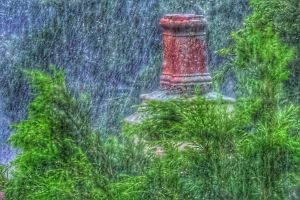
To ‘check the weather’ is to actively seek knowledge – news – of the world; it’s asking, what’s going on out there? Kind of an attachment, and in most cases, most of the time, I don’t seek out news of the world, but in certain circumstances it does sometimes seem necessary.

So, because it’s been raining heavily, and there have has been some minor flooding not too far from us, I checked the Bureau of Meteorology earlier this morning – I have an app on my phone.

Along with the air temperature, the measured and predicted rainfall, and other weather related details, there is list of ‘Current Severe Weather Warnings’.

There were three listed: big surf (we’re a couple of kilometres from the coast), big winds, and a third which leapt out and grabbed me, or putting it more accurately, it reached out and grabbed my heart.

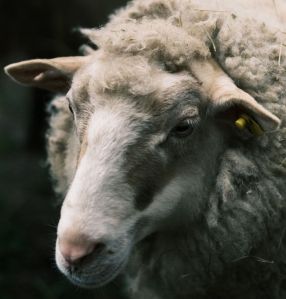
A ‘Sheep Graziers’ Warning’ it’s called. It’s purpose is to warn farmers, that due to cold temperatures, heavy rain, and high winds, there is a risk of ‘losses to lambs and sheep exposed to these conditions.’

In other words, lambs and sheep might die if left out in the weather.

That casual check of the weather has now exposed me to some of that information of the world, the news, that I usually avoid. And that news has impacted my heart, my soul.

The risk of ‘loss’ to those sheep – and lambs – is to me as devastating as it would be when any other being is at risk of suffering or death. And, obviously, I’m absolutely aware at the same level that many creatures of many and varied species – including my own – are at this moment exposed to the very same risks.

One of the thoughts that occur to me is this: The very reason for these warnings is so that farmers can take the appropriate action to protect and safeguard the creatures in their care.

Another thought: the sheep have no choice. Like the rest of us living beings they are subject to the conditions that play out in the material world. Of course we can add a little perspective to this: I am making these notes in a warm, dry and safe hermitage.

(Then, as I began to type up those notes just now, there was a very short but powerful thunder and lightning storm accompanied by very heavy hail. Once again I am warm, dry and safe.)

All beings are prisoners in a sense, to their material bodies, and, as I said, subject to suffering due to the material world. What we, as individual beings, or individual species, can do to reduce our suffering is going to always vary from individual to individual, from species to species.

I suppose what I’m getting at is that all of us – all beings – need help of one sort or another at some point, to release us or protect us from suffering.

I must admit that very often feel helpless when it comes to what I’m able to do to relieve the suffering of the world – my own, the suffering of those close to me, and that of all beings.

You know, I don’t not watch the news so I can avoid being upset or sad or angry which are often my reactions when seeing or reading news of the world. While I don’t enjoy those emotions when they come, it’s more the emotion they lead to that really bothers me: more and more feelings of helplessness.

And helplessness for me causes paralysis: whatever little I might otherwise be able to do, I cannot. For example, since checking that weather report I haven’t been able to settle to my prayers, my meditation, my chanting, and study; I am not, right now able to do any of the things I would normally do as my way of contributing to the welfare of other beings. Paralysis.

So, here I am making notes that will become a post to share with you. A story of checking the weather; of empathy with other beings; my feelings of inadequacy at not being able to relieve their suffering – as well as my own for that matter.

But, I will pray. I promise. Prayer is healing, prayer banishes helplessness.

Those sheep – as well as all other beings – and I are not separate; I am them and they are me. We are the One.

A Plea for Forgiveness

It was way back in the earlier days of this blog, sometime in 2022, that I wrote a post about our community’s liking for snacking on plain toast by choice. It’s our more or less regular late evening, before bed, bite to eat. Perhaps accompanied by black tea, as I described in that post.

As I also point out in that post, I do actually enjoy plain toast. It’s not that I no longer like jam or other yummy spreads; I like them too well truth be told, but sometimes, well, plain is good.

As the day winds down to become night, and we settle to our evening snack, I will sometimes make a joke about simple food, or monks with simple tastes, whatever. Anyway, a few nights ago I made a remark, a joke, that has had a profound impact on me.

‘I’ll just say a prayer for my two slices of dry toast.’

Of course I am just like so many other religious or spiritually inclined people, and say a prayer before I receive any and all food or drink. It’s a long time habit, and a blessing I like to perform. Just a thank you is all it is really.

This comment, this joke, as soon as it was out of my mouth, I realised, of course I will. Don’t I always?

It’s true that our community lives simply, as simply as we can. And that includes what we eat and drink. It’s also true that this is not some sort of ethical stance consciously taken; nor is it a kind of overlaid act of solidarity with those who have no choices due to poverty or other circumstances.

It’s purely and simple because we like simple. It really does suit our natures and temperaments and for us it is the obvious way to live.

It is no renunciation: we welcome simple. This obviously is not to say that we are unaware that our very natures and temperaments naturally steer us away from choices that are unethical or are out of sync with compassion (call it solidarity) for other beings.

The reason I’m ranting on about this off-hand comment thrown out as a so-called joke is, well just that: It was off-hand, and my misguided intention in making this ‘joke’ was insensitive and careless; it was lacking compassion for all the other living beings sharing life and consciousness with me.

And for that flippancy and carelessness, I ask forgiveness from the invisible community that is in fact all of us struggling to live in a material world.

My sense is that in saying ‘all of us’ I might instead say, all of us who are in truth One; We who are that one Self that seeks forgiveness.

Sun, Water, Sky, and Me

Varuna and Surya. the Hindu deities of sky and all Earth’s waters (Varuna), and our sun (Surya). These names resonate for me. I like how such great natural phenomena fundamental to our existence on this planet, can be ‘personalised’ in this way.

I find that having acquired symbolic or representational names for sky, water, and sun, has allowed me to somehow relate to the inherent giving and preserving of the energies that power all life that water, sky, and sun provide in a prayerful, thankful way. Kind of makes it personal.

Let me put aside for a moment the obvious scientific reality that tells us we can’t live long without water, can’t live at all without the gases in our atmosphere, and if the sun goes dark for whatever length of time it is, then all life ceases to exist.

How many times have I stood in awe watching a sunset?

Or watched as big waves rolled in with a surfer hoping for a ride?

How many times have I welcomed the sound of rain on a roof and the sight of it nourishing trees or other life

And how many times have I sat on or walked along a riverbank feeling uplifted and a little more grounded?

Many, many times is the short answer. Varuna and Surya are constant presences in our lives. And I am grateful for the life-giving and life-sustaining natures of their existence.

Sharing with you today, a little poetic expression of one of those times when sky, water, and sun, gave me just a little more than those fundamental material energies.

ONCE AGAIN VARUNA AND SURYA

Once again, Varuna and Surya
are coming to make rescue.
They arrive on – as in fact they are – the currents and eddies
of the river of life.
In this way, the natural order remains in motion.

Shared with love

from Paul the hermit

Flow river go, past the shady tree.
Flow river flow, flow to the sea.
Flow river flow, flow to the sea. 

Thanks to Roger McGuinn for one of the classic flowing on a river songs.

Contemplation: It’s a Gift of the Moment

Earlier today I took my camera out for a walk. Which is to say, I had an intention that the walk would be more than exercise for the body (very much needed as it is), but also an opportunity for my eyes and heart to open up a little to the tiny part of the world I was to pass through.

I also hoped that my mind would join in so that I would be able to actually recognise what I was seeing and feeling, allowing me to perhaps make images of what I saw and felt.

One final prayer: In doing its job, I hoped my mind would stay focused, and work behind the scenes very quietly.

A few minutes walk from the Hermitage is the shore of a fairly large lake, and when I reached that spot, I sat on a conveniently placed little wall, so I could, well, just sit for a bit.

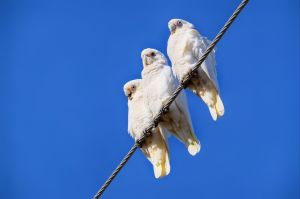
By chance, um. Sorry, let me rephrase that. By the brilliant synchronicity that results from the perfect working out of the natural laws of the Universe, right in front of me, nearer to the water’s edge, a dozen or more Corellas played and foraged. At least to my limited human eyes, that’s what they were doing.

Zoom in and share the fun!!

It’s mesmerizing watching them: tumbling with each other or on their own; picking up and wrestling with twigs and other small things. I was blessed too, to witness several of these creatures taking off, in flight, and landing.

You might have heard me say (or read when I wrote) that ‘I was just not there’. Well, not today; today I was definitely there. In a contemplative reverie in which I felt connected with what I was witnessing through my lens.

‘I had a small sense of being relaxed,’ I commented casually to my community when I arrived back at the Hermitage. And that’s what it felt like: I had relaxed for a time. I can’t say I was aware of the passage of time; it was more an eternal being in the moment if I was to try to label it now. It might have been thirty minutes or ten by the world’s measure; I have no idea really.

I’m only ever going to be a beginner when it comes to paying full attention, to contemplating and being completely immersed in the moment, and not forgetting trying to control the monkey mind. Practise will never make perfect in that department!

Anyway that’s why spiritual practices are called practices: they require the spiritual seeker to be committed to a life of ongoing and continual practise.

Of course encountering those birds at the lake today is definitely a practice I would be happy to practise anytime!

It’s a gift to witness birds in flight