It’s All There Is

This is my second attempt to start this post. In the first try I just couldn’t see or feel my voice, myself. Right away, as I began making notes, I launched into and quickly became bogged down, in a wordy, overly complex rational discussion.

It seemed more suited to some kind of academic essay (not that I am remotely qualified to write such essays) than a note from the heart of a hermit contemplating from deep within his cell.

So, here I am beginning again. This time I hope I’ll find a little more of me in what I write, perhaps discern something a little more authentically heartfelt.

This post emerged from my desire to share with you a little about a small item that helps me as I chant my mantra. My mind seems to switch into strong wandering mode when I try to settle into Japa or chanting mantra mode.

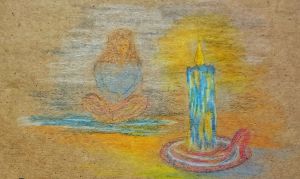
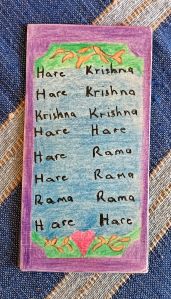
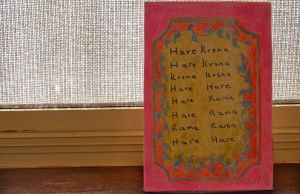
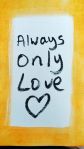
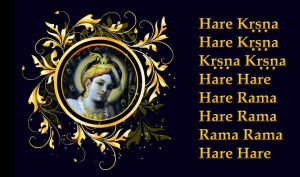
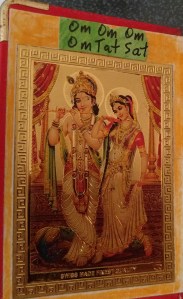
So, I have a small card, made from a cereal box and measuring about 15×7.5 centimetres, decorated with lovely colour pencil designs, with the mantra written in pen. Oh, it’s covered in plastic for protection and longevity, and was given to me as a gift.

Having it in hand or close by when chanting allows me to focus on the words if my mind wanders. I read them slowly, mindfully and I find it puts my chanting back on track – until the next wandering thoughts announce their presence!

Actually we have a couple of similar cards scattered around the Hermitage. One lives on the window ledge above the kitchen sink, and always acts as a timely reminder to make even the washing of dishes an opportunity for prayer.

The View from the Kitchen Sink

Having my card acts as more than a prompter to me to remember and focus; it acts as a kind of tool for contemplation: when looking at the mantra written there, I often sense the meaning of the words, the importance and place of them. I don’t call this mind wandering, this is contemplation and I welcome it.

While on this level, my card can be viewed as a mere ‘prompt’, there are some who would – and do – say that the card, and the very words written on it, are in fact, much more than being simply physical stuff.

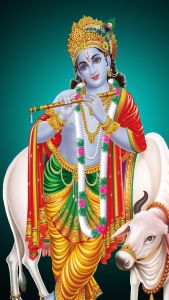
They would say that the card, and especially the words are literally, factually, and in truth the Divine (in this case in the form of Krishna). Just as some traditions maintain that ordinary bread is transformed through ritual, into the actual body and blood of their God who was once made human.

Not mine. I’ve had this as a file for ages, and love it. I think it was originally the size of a visiting card

For much of my life I dismissed such notions as mere fantasy, the products of literal interpretations accepted as dogma through blind faith. I’ve even in the past used the word nonsense to describe and dismiss such superstitions.

Nowadays though (and here comes the but, the however, the on the other hand) I’ve come to a slightly different view of the idea. Is my little card literally a piece of cereal box, decorated with nice coloured pencil work, with words written on it? Obviously it is. Of course it is a material thing existing in a material world.

Is the statue of a deity or saint in a church or temple a lump of stone, wood, metal, or other physical material? Again, it’s obviously a material thing with a material existence . Just as communion bread and wine are baked in a bakery, and brewed in a winery.

So, is my card, along with these other examples, merely a stand in, a symbol, a represention of the Divine?

No, I don’t think so.

Over recent times, my instinct, my heart, senses that, in truth, there is only God, only the Divine, only the Absolute Reality, what we can call existence, or being, itself. It seems to me that this Absolute Reality is everything, is everywhere; there can be nothing else.

One without a second, I’ve heard it described. It’s why, I think, we can look at a flower, a tree, the ocean, a person, or some other material object and be able to in awe remark ‘this is divine’. Or how when we hear birds singing in a nearby tree (or on a neighbour’s roof as I can now as I type this) we may have a sense that we have actually had an encounter with the Divine.

Lately I’ve become bored, uninterested, even irritated, with dogma (my own or that of others) and my constant striving for rational and logical answers. My heart tells me – it feels – that the Divine is all there is.

You, me, all that is visible, and all that is invisible, is all there is, one unity. No, not even a unity: that implies the union of one thing with another.

One without a second. Yes, that says it all for me. Those four words, now I think about it, really do encapsulate all there is.

Including my own heartfelt aspiration to fully realise this Truth in the heart and soul of Self.

Out Beyond Capricorn: Poetic Offering

Namaste and greetings

It’s been just over a week now since the new page on the blog went live. I have to say that it’s been very satisfying setting it up, then uploading some of my devotional poems.

Actually, it was while uploading one yesterday that I thought, I’ll feature this one in its own post. I did mention that I would like to continue this occasional practice.

There’s not too much to say about this particular poem really – best to leave it to speak for itself.  I’m only introducing it like this because I wanted to include a Wikipedia link that might help clarity a couple of the terms and some of the details mentioned in the poem.

The poem speaks about the concept of Viakuntha, which as you’ll see is the supreme heaven for some Indian traditions. The link leads to an interesting and short read, well worth the time I think.

The myth of Vaikuntha was a trigger for this poem, as was the meaning of the word itself. Is it a real place? Who knows. Fact and truth don’t always agree, and as for me, I don’t think about the question.

Myth has been the way we humans have always used to tell our story. To try to sort out the big questions: where are we from? Who are we? Where are we going? All the ‘big questions’ are addressed by mythologies from every culture – every family, country, you name it – on Earth.

In any case I think that my poem came about as a result of my own contemplation on the story, on those big questions, on Self really.

I hope you will visit my Poems of Devotion page. I’m still adding poems to the page, and of course, with grace, I will continue to write.

Now, please enjoy reading my poem, and I hope it’s a nice experience for you.

Love and Peace
Paul the hermit

OUT BEYOND CAPRICORN & DEEP WITHIN EACH HEART

Vaikuntha: Without anxiety.
Is there such a place? Free from worry?
Out there, they say, beyond Capricorn.
There’ll you’ll find the highest heaven,
the abode of God.

No need to look to the stars:
Vaikuntha is here. Vaikuntha is now.
Within and without you.

Vaikuntha is indeed beyond;
beyond the material world,
beyond the realm of bodies and minds;
beyond the illusions of places and spaces.
Atma – Universal Consciousness – you and me,
that’s Vaikuntha.
You and me, all there is. No anxiety

New Series Coming Soon: An Introduction

Lord Krishna

Namaste and greetings friends

Not long ago I began studying an Indian scripture called The Uddhava Gita. It’s quite a lovely book actually: it’s poetic, actually it is a poem, or song, and beautifully written. The title means The song of Uddhava and is an account of a conversation between Krishna wearing his God of the Universe hat, and his cousin Uddhava.

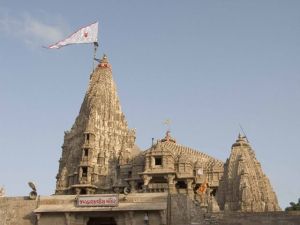
The story takes place in their home town of Dwarka in the state of Gujarat (Krishna was also a regular family man with a huge extended family) which is about to explode in a destructive civil war. Soon Krishna is leaving to return to his heavenly abode, and at the opening of our story, he advises Uddhava that he too should leave town ASAP.

I should point out at this juncture that I do not see this Gita as a historical document. It’s a story created as a backdrop against which to place a long conversation in which Krishna, or God, passes some spiritual teaching to Uddhava.

Dwarkadheesh Temple Dwarka India
By Scalebelow – Own work, CC BY-SA 3.0, https://commons.wikimedia.org/w/index.php?curid=5739970

Although the location of the story is a real place and exists today, we don’t learn anything beyond that this is the setting for this little chat.

The purpose was to present these teachings in an entertaining and accessible format. Like so many scriptures around the world, this one is a song, making it easier to learn and pass from one person to another over time in a society that was not yet universally literate.

So, why am I writing about this text? Well, in one section Uddhava is asking his cuz all sorts of questions, that have obviously been on his mind for a while. He knows Krishna is leaving he planet soon and he thinks that this might be his last chance to get some answers.

He asks questions like: What are reality and truth? And, What is a person’s strength. Then there are queries like: Who is a friend? What is home? Many are related to spiritual matters and practice, and all are concerning qualities and attributes a person should possess to live a good life, a honest life. A Dharmic life.

Actually, if I were to condense all of Uddhava’s questions into one big question, it would probably go something like this:

How can I change my lifestyle so I might live a righteous life, a good and honest life in which I can learn the truth and live my whole life according to that truth?

Now, here’s the thing: Uddhava asks a total of 36 questions, some singularly, some are multiple questions containing two or three queries. Krishna then proceeds to answer the questions, all of them in fairly quick succession.

I would like to share a few of those answers with you. I don’t get the sense that the questions are asked or answered in any particular order or pattern, so perhaps those I share will be an idiosyncratic selection, or it may be entirely random. Not that there is such a thing of course, so I guess you will just have to wait and discover for yourself the chosen questions.

Don’t worry! I have no intention of burdening you with the complete set of 36. In addition to saving you that fate, some of the questions and or answers didn’t resonate; others didn’t feel overly relevant to this blog.

I’d like to devote an individual post to each of the questions, bearing in mind some of them are multiples. I learned about all 36 questions and their answers in an hour long class. Needless to say that experience was more than slightly mind-blowing. One or two (or maybe three) at a time will be just fine for all concerned I think.

So, next post, I look forward to sharing with you the first of Uddhava questions along with Krishna’s answer. It will in fact be literally the first one asked; I thought discussing it at the start would sort of set the scene and the tone for us.
After that one there will be further posts. Again don’t worry, I’m planning a fairy short and occasional only series.

A Story of Words and a Journey of Discovery

Remember that old Bee Gees‘ song Words?  It’s about one person offering all they have to another. Well, the one doing the offering must have been a writer because, while the song’s a love story, it’s words that are the big thing on offer here:

It’s only words, and words are all I have
To take your heart away

Well, as this is a blog, words are the way it hopes to reach your heart. Actually, the posts also include photos and sometimes other art, but the main vehicle used here is words.

So, with that in mind I have a couple of words to offer you today. Well, one word and its opposite. Have a look at this sentence from Thomas Merton:

If Irish monks affirmed his Celtic spirit in their mastery of cataphatic contemplation of the wonders of divinity in nature, Buddhist monks evoked his Zen mind and drew him into the apophatic path of formless ’emptiness’…

A quote from the Introduction to When the trees say nothing: nature writings of Thomas Merton

As sentences go (though this is obviously only part of a sentence) this has to rank pretty close to the top for length and denseness.

Kataphatic. What a word! Of course I had to look it up; I’d never heard the word before (this post is a rewrite from notes written a while ago that I never got around to posting.), and even though the sentence seems to  suggest the meaning, I was still curious.

Looking at Wikipedia – where they spell it with a ‘C’ like Merton, as well as with a ‘K’- I learned that cataphatic is an adjective that describes an approach to theology that uses ‘positive terminology to describe or refer to the divine (God, Truth, Dharma, Spirit. You know what I mean: the divine).

Apophatic, as you probably figured out already, is when one uses ‘negative terminology to indicate what it is believed the divine is not’. A process of negation or we could say you get to what the divine is by a process of elimination.

Pretty simple concept really, but with a couple of big words to label it, and a lot of  words to define it. No, don’t worry, I won’t bore you with the meaning and origin of the words and all the rest. Mainly because I don’t know and I’m not especially interested anyway in all that technical stuff.

I simply resonated with the word, and the concept. Cataphatic made me think of Dick Van Dyke and Julie Andrews singing Supercalifragilisticexpialidocious in Mary Poppins. But let’s not go there: this is a serious blog after all. Except to say there’s more to that word than you might imagine.

Putting aside the aesthetic appeal of the word for a minute, let’s contemplate a while on cataphatic, and it’s opposite, apothatic.

To begin thinking about these two words, it’s necessary to acknowledge the existence of the divine. We can call it God, if we like. Or Dharma, Truth, Spirit, Love, Beauty.

As the quote suggests, a cataphatic approach, ideology, theology, or whatever we call it, ascribes names and forms to the divine, as well as describing where and in what the divine may reside.

Whereas apothatic, again as the quote suggests, does not ascribe names and forms to the divine. Instead it seeks to discover what or who god is or isn’t by a process of negation as described already. 

For a long time I labelled myself as a Humanist. I had decided that this physical body is all there is; the physical or material universe is all there is, and that there is no ‘god’ separate from us or who has special powers to affect our lives. No God at all in fact.

In the Grove of the Sentinals

But, all that while, I just knew that there was something else, something more than just the physical.  And over time, I came to the knowledge that there is indeed more than the simply phsical universe (including we humans).

I’ve thought about it a lot over the years and I came to the conclusion not that many years ago, that I had simply been afraid to name or define that something more. It would have meant admitting to myself that something more really did exist.

That is to say, I was scared of taking the cataphatic approach – and I’d never even heard the word.

Well brothers and sisters, I saw the light. The truth was revealed to me. And what is that truth? Well, to put it simply, I wasn’t scared anymore. Not of names and forms, and not of what I couldn’t see.

Now I could take both the Catophatic and the Apothatic approach: that the something else I had actually always known just was, really is, and can have a name and form, or not. The divine is not an omniscient being or any kind of being at all; As I’m very fond of saying, the divine (or truth, God, Dharma) simply is.  And it’s all there is.

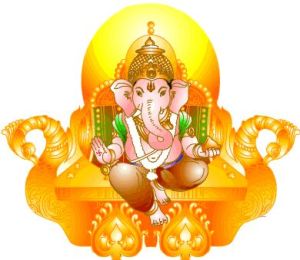
Some of you might know that I am really quite fond of the Indian deity, Ganesha . Do I believe that a man with the head of an elephant actually exists or ever existed?. Of course not. Do I actually think that he resides in the lovely painted icon that sits by my bed? Well, obviously not.

But do I believe that there is a spark or aspect or attribute in all life, in you and me, in nature, in (scary word time) creation, that we can tap into to help us overcome obstacles? Or that we can access when we begin new ventures of whatever kind, or when we need strength to face challenges? Yes, I do. Very definitely.

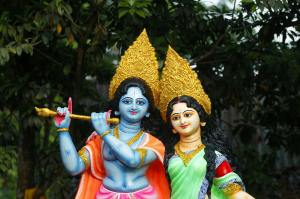
And do I believe in a blue boy called Krishna who lived in India 5000 years ago and spent his time playing in the fields with the village cows and his friends, entertaining them with his flute? Again, of course not. Does he live in the other beautiful icon by my bed? The answer is obvious: no.

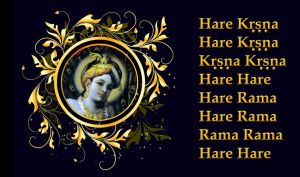
But do I chant the Hare Krishna mantra in an effort to come closer to the divine that is… well, that just is? Yes, again, very definitely.

Words. It’s all only words. Only words? Only??

In the beginning was the word, and the word was  with God and the word was God. (from the opening of the Gospel of John)

It’s all I have (for now).

Peace and Love from me to you

All I Had to Do Was Dream

Last night I had a dream. Of course there’s nothing unusual in that: I dream every night, every time I sleep (and sometimes when I’m supposed to be meditating as well). Actually I’m no different than probably every other living being in the Universe: I dream when I sleep.

No. The particular dream isn’t my point here (though we’ll be discussing it soon enough). What makes it worth noting is the fact that last evening, before going to bed, I watched a documentary on Carl Jung and The Red Book.

Jung compiled The Red Book at a time of personal crisis and distress. Using dream analysis, his own imagination, and intense self reflection, he used both paintings and text to express what he saw and understood from these practices. Hauntingly beautiful, other worldly pictures depicting dream images, archetypes, both personal and universal, helped him delve deeply into his unconscious mind and the collective unconscious.

I gave up trying to interpret dreams a long long time ago. Don’t ask me why: I probably couldn’t say. Most likely something to do with a kind of wariness about going too much into where the mind wants to take me, and my sense that the “dream” doesn’t stop when we wake up.

Still, watching this doco prompted a lot of discussion with my partner hermit, and a lot of thinking on my part. The mind is not our enemy, though sometimes I feel that it is. Well, it can be the enemy if we allow it, but equally we can allow the mind to be our friend. After all, what activity of any kind is possible in the world without mind?

So, with that in mind (get it? in mind?) I will share with you that above mentioned dream from last night.

In the dream I was in a small kitchen, making tea. I’d put on a kettle to boil. A very large, heavy kettle, probably three or four times the size of a normal one. I was in the process of looking for a mug or cup, and just as I picked one up that I liked the look of, a crowd of five or six people came bustling noisily into this very crowded space.

‘I’ve just put the kettle on,’ I called loudly over the din. As it happened I’d filled the kettle almost to overflowing, much more than I needed for myself alone.

‘There’s plenty of boiling water to go round.’

Then I busied myself looking for something (a tea bag perhaps?), and when I finally turned back to the kettle to make my tea, I saw it was gone. I was very unhappy with this disappearance: After all, I was the one who had filled the kettle and put it on to boil. Then without a thought or a, what’s the expression? without a by your leave, it’s all gone, nothing left for me. Not only no more water, but nothing to boil more with.

I looked everywhere, even outside the kitchen. Outside was a camp ground and apartment complex, where I (and presumably all the other people) was staying.

Anyway, that’s it. All I remember at least. So, the meaning? Was I merely processing trivial facts and events from my day in this strange fashion? Or was I in touch with the deepest part of my psyche and with the collective unconscious? Possibly a bit of both.

It’s not a big job to make a guess about the meaning. I had a plentiful supply of water (or whatever), and without thought, put the needs of others before my own. But then, I actively resented what had been ‘taken from me’, even though I had freely given it in the first place.

So, the message I take from this dream? Just as I’ve been studying lately, the fruits of my actions are not my responsibility. I have no say over what, if anything, will happen as a result of actions I take. All I am responsible for is the taking of the action itself, the manner in which I undertake it, and the attitude with which I approach the actions I take. That’s it. That’s all I can do. The rest is up to the laws of the universe. Call it Karma, or Natural Law.

Another idea just occured to me: When I take action (like boiling the kettle) and then serve others, I am serving Self, all life, everyone and everything. And obviously that includes me. I’m not suggesting I should have made sure ahead of time that I’d ‘reserved’ enough water for myself, but at the same time …

I might keep this dream analysis thing as practice to practise occasionally, when the inclination or inspiration is there. No more blocking memories of dreams, no more stubborn refusal to reflect on dreams. After all, I spend a lot of time contemplating and reflecting on what I do in my waking life, how is it any different just because it happens while I’m asleep?

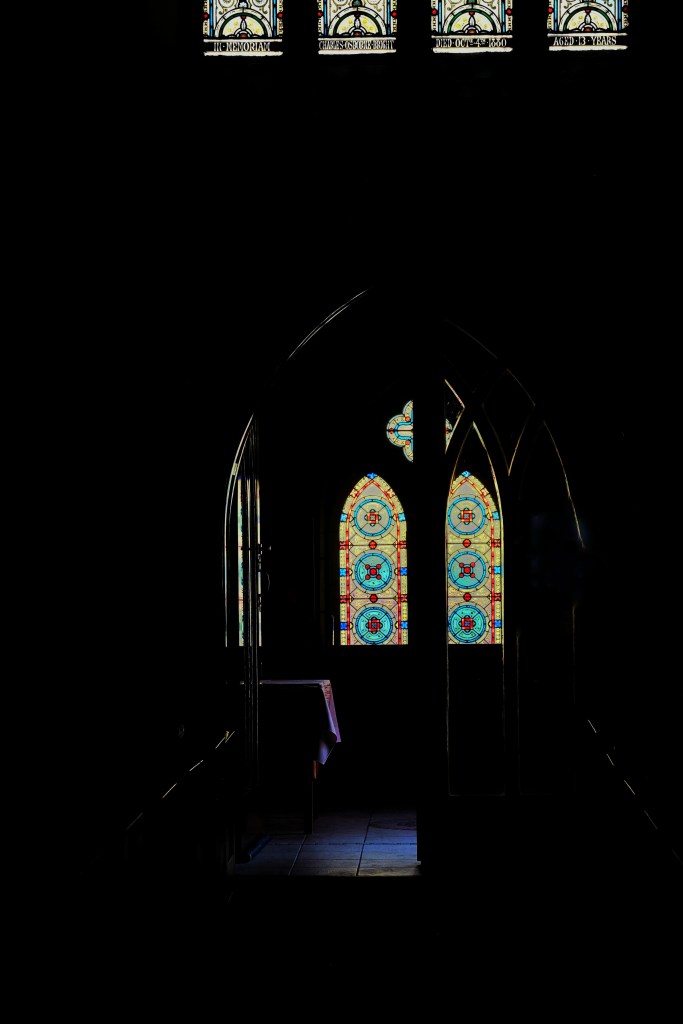
Sacred Glass in God’s House

At the entrance to the temple, the Way is illumined

Tell Me: What is God? Dominus Est

Welcome dear reader

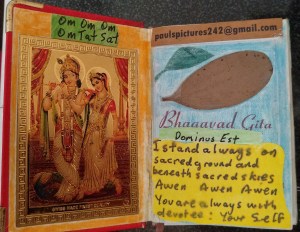
Have I shared with you my Bhagavad Gita? Well, I know I’ve mentioned a few times that it’s one of, if not the primary resource for study and guidance for me.

As you’ve probably guessed, this is a quick photo of the inside of the front cover. And, again as you’ve noticed, I like to stick things in my books, especially this little one. (Actually now I mention it, this is the only book in the traditional format as in made of paper, I own). It’s an old practice and for me adds multiple dimensions and depths to what is already a treasure.

Sometime I’d like to go through and describe to you all that I have added, but for today, do you see the little green section with the words Dominus Est printed?

In the religious tradition I was raised in, these two words have a specific meaning and use. However, it’s only recently that I’ve come to think of this little Latin phrase (well technically it’s a sentence, but …) in the sense of the literal meaning of the words themselves: God is.

That’s it. Or the Lord is, or the Master is. If we change the Dominus, we can use this tiny sentence to define our conception of the divine, the holy, in any way that seems right: Truth is, Beauty is, Art is. For me, God is, sits right. As do the others in this list. Same same.

So, God Is. What else could possibly be said that would add to this already very emphatic and simple statement? Nothing at all. It’s stand-alone, complete in itself.

Like asking who or what is God, we can answer: ‘I am this’ or ‘I am not that’. Or we can realise what for me is becoming the only answer:
I am.

Why? Well, if we were to add anything at all to these two words, such as God is Truth, or God is Love, or God Resides in …, or God is called … , then we are in fact stating only a little of the truth. Sure, God is truth and love, and goes by many names and is found in many forms, but once we say what something is, we are actually making more of a statement about what it is not.

In the beginning there was the word, and the word was with God, and the word was God.

Mind you, it’s perfectly natural, and for many of us helpful, even necessary, to ascribe to God a name and or form. We are ourselves material beings, living in a material universe; it’s logical that we would choose (or need) to see God in a word, a physical object, or attribute some other kind of materiality to our notions of the divine.

I must say that I am one of those who find it difficult to envisage an invisible, non-physical, and impersonal ‘God’. Of course, our little statement, God is, does indeed say just this doesn’t it? Isness is pretty non-corporeal, certainly not in the least physical. And isn’t even a ‘spirit’ or ‘entity’ of any kind; Isness just is. The moment we label something (including ourselves) we miss that isness, that essence.

You see my picture of Krishna and Radha? This form, or forms, is one of the several that I feel right in having as a kind of focus, or centre of my devotion to and love for the divine; for love, for truth, and for it all.

You might be saying, this guy does believe in a personal God. He just told us. The truth is I don’t believe or not believe that Krishna (or any of the myriad names and forms we’ve invented) is God. God simply is. And my heart tells me that this is enough.

There are a pair of theological ideas known as Cataphatic Theology, and Apophatic Theology. Cataphatic describes or approaches the divine by stating what God is, while Apothatic (you guessed it) describes God by speaking only of what God is not.

My guess is that pretty much everybody, from whatever tradition, would approach the divine (and not only the divine) in one or other of these ways. But for me it was such a relief to realise that there was no need to go there at all. I could stop with the definitions and the descriptions, the what is and what is not. I have the freedom to not have to believe or not beleive. None of it matters. Dominus Est. God is.

Am I there yet? Have I let go of dualities? Hardly. Maybe the odd glimpse, but it’s rare. And it always will be for as long as I live in a physical body. But to paraphrase something Swami Ramdas said:

I’ve set my feet upon the path, so I am already at the goal.

Peace and love from me to you

Believe It or Not

Welcome friend to another post. It’s good you are here.

Like so many other people I like documentaries on, well, all kinds of topics. I sort of go through phases and a while back I was on an historical/archaeological kick. And if it involved adventurous journeying, then so much the better.

Anyway, one I watched has stuck with me. In this show, an Indiana Jones type went in search of an ancient religious artifact. After a sombre pilgrimage across a stunning but arid landscape, a number of adventures and fascinating tours of interesting historic sites, he was forced to conclude that nobody could know for sure that this particular artifact actually existed.

This was especially the case given the fact that several hundred individual churches across a vast area claimed to possess said artifact, according to our intrepid guide. Then there was a doco I’d seen a few days prior that suggested this artifact was in fact hidden in Southern France.

Or perhaps it was destroyed in 800BC as some other ‘experts’ suggest. In any case, our fearless explorer came to the conclusion that, at the end of the day, whether the artifact still exists (or ever did exist) isn’t the point. He told us that what mattered was that people believed it existed, and that its power existed through that belief and was a force for good in people’s lives.

Actually I think even this misses the real point: I don’t think we are necessarily meant to have a belief one way or the other when it comes to the historical accuracy of myth. Myths tell us stories about truth, about our place in the Universe, and how to behave and live a good life. The facts or lack of them aren’t important.

Every culture throughout human history has had its myths: about creation, about their pasts, their gods, their futures, and how to conduct one’s life so that society can continue to function. Some will say that we in the so-called West are lacking our own myths and stories.

Well, I also believe that our myths are in many respects largely forgotten, or perhaps are only held by this group or that within our societies.

I think we all have our own myths, whether they are ones received from our society either consciously or unconsciously learned, or from our own personal life experience. Then of course there are the so called ‘modern mythmakers’: the media, politicians, and marketeers, all advertising their own ‘truths’. But that’s not what I’m talking about today.

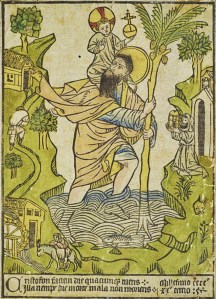
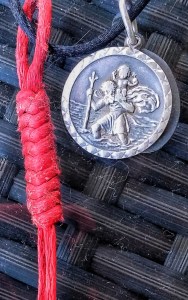
So, moving right along. Hands up if you’ve ever owned or been given a St Christopher medal? Ah, just as I thought. Huge numbers of people out there have at one time or another had a St Christopher around their neck, or hanging from their car’s rear vision mirror, or perhaps tucked securely in their bags. And really one doesn’t have to be ‘religious’ to admit to ownership of such an artifact.

He’s an interesting character this Christopher. He is a saint of the Roman Catholic Church and here we start already to get into the myths and legends around our friend Chris. It’s widely known that he was stripped of sainthood and declared to have never existed after the reforms of the late 60s in the Catholic Church. Myth number one.

He is still a saint, and all that happened was the church found itself with an overly crowded calender of saints’ days and decided that some could be cut off because they weren’t necessarily of ‘universal importance’, and besides, he may not have actually ever existed.

Poor old Christopher was thus unceremoniously dumped. No saint’s day, but he did keep his sainthood. As for the minor question of his existence, the church said that wasn’t their decision to make.

Not much is known about the possibly historical figure of Christopher. First up (myth number two) his name wasn’t Christopher: he was a seven foot five inch (may or may not be a myth) called Reprobus. He was a Canaanite who while working for the king suddenly decided to go off on a spiritual quest to find an even greater king.

Like all good heroes, Reprobus has all kinds of adventures, until one day he meets a wise old hermit who tells him that if he wants to serve the greatest king of all then he has to help people cross a treacherous river where many drowned trying to get across.

So, Reprobus started to carry people safely across the raging river. One day he lifted a small child onto his broad shoulders and carried him safely to the other side. Reprobus told the child that he’d never carried such a heavy weight before, and so they had both been in grave danger.

The child then told Reprobus that he had not only carried the weight of the world on his shoulders, but also the one who made the world. In other words our friend was informed that he was indeed serving the greatest King of all.

And that’s how good old Reprobus got the name Christopher: the name means Christ bearer. Later, Christopher is martyred for his faith and the rest, as they say, is history. Because of his splendid lifesaving deeds serving people crossing the river, our hero over time became the patron saint of travellers. And his fame spread beyond the confines of the Catholic Church and all sorts of people have looked to him for protection for themselves or loved ones when travelling.

I have a confession to make: I love and always have loved (venerated isn’t too strong a word) St Christopher.

Mind you, I’d always had some issues around the lack of evidence for his having ever existed. Not to mention the small detail of a miraculous appearance of the Christ as a child who was as heavy as the whole planet.

Anyway, while I was never quite convinced that St Christopher was a real historical figure anyway, I agree with what our friend the Indiana Jones look-a-like says: it doesn’t matter.

And for me there is still a truth at the heart of all this: Our pal St Christopher is me. He is you; he is each of us. We all have the strength to carry the soul of Self, the heart of ourselves, across the raging rivers, through the wild storms, and across the sometimes very rocky ground that make up each of our lives here on Earth.

Do I wear a St Christopher medal? I most certainly do. Belief or non-belief in his historical existence is beside the point for me. It’s the myth I resonate with, the symbolism.

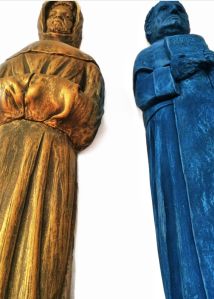
My medal shows a big, strong guy wading through knee high water carrying a small child on his shoulder. Both of them are me. Both of them are you.

Peace and Love
Paul