Taking it Slowly, Taking it Mindfully

A small irony revealed itself to me just now as I prayed my way through the prayers inserted in the front of my Bhagavad Gita.

I’d completed one prayer and turned the page to the next. Then, without a pause or thought, I quickly turned the page again. I stopped, thought better of it, and turned back to attend to the prayer I’d skipped over.

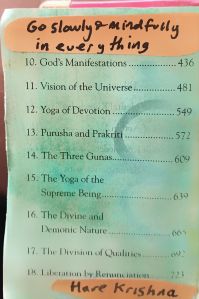
Now, here’s the irony: The prayer on the first side of that carelessly and mindlessly leafed past page read simply:

Go slowly and mindfully in everything.

Well, that’s not the ironey itself. But, given that this was the page I had simply passed over without a thought, with no pause, the words written there obviously were a lesson for me.

A message to contemplate, to actually stop and pause with, mull over, meditate on, and perhaps make resolutions over. Advice to me to stop, to slow down.

Couldn’t be clearer really.

There’s no telling why I skimmed past that page, that prayer, without a pause. Could be a simple case of absent-mindedness, or a rush to see what was on the next page; a grass is greener type of thing.

Why I was rushing through the pages isn’t the point. What is to the point is here I am, doing morning prayers, praying some, then skipping others. The other point is that in this instance, for some reason I stopped, went back, and prayed the skipped prayers.

So, moving to the resolution.

It’s extraordinary to me when that kind of thing happens. (It does happen quite a lot, but unfortunately I only notice it occasionally) We will have an intuition, or receive a message from ourself that helps to us get back on track when we mess up.

In any case, it’s obvious that I’ve found what I might call the prayer of the day, the mission statement, so to speak, informing whatever activities I undertake today.

Slow and mindful in everything I do, say, and think. For now, for the present, that will the guide on the path of today that I will follow. Keeping in mind the adage that practise makes perfect, for when I falter.

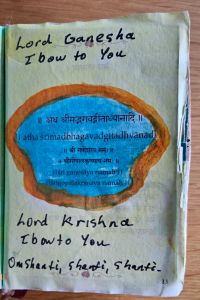
Oh, another irony wrapped up with this one. The prayer on the facing page was also skipped, and in itself sheds another light on the message from that first one. That second prayer actually puts forward one, important, way in which I can actually set about achieving  that first one:

In other words: place more focus on, pay more attention to, the Divine in whatever form, and by whatever name, I encounter it today.

Works both ways I think: Making the effort to go slowly, to be mindful, puts us in the present moment. And, the present moment is the only place we’re going to be able to become aware of the Divine.

Then, as we become aware of the presence of the Divine, we are right where we need to be, when we need to be there in order to actually slow down and be more mindful.

PS These notes were made a few hours ago. Since then, I have on the whole practised being slow and mindful. Not perfectly, mind you, but then as I say, practise makes perfect. Even now as I type this – very attentively – my mind wanders, so there is a way to go for me. The day is not over yet!

A Prayer to Share: for the Divine Mother

Namaste and Welcome

Today I would like to share with you a prayer (it’s a poem too, but …) I’ve written in praise of the Divine Mother. It’s actually the second prayer I’ve written to and for her. I shared that first one, called simply, A Prayer to the Divine Mother on the blog previously and you can find it here.

That post will also give you some background to my reverence for the Divine Mother – what she means to me; where my initial devotion comes from; my heart sense that this universal creative energy drives and sustains all creation; and finally how Divine Mother may be worshipped in many and varied (and even no) forms.

The prayer I share with you today – Jai Shree Maa –  emerged as I knelt chanting those exact word at the alter of a holy place dedicated to the Divine Mother as revered by many in her form as Our Lady of the Rosary.

It is a temple in that name I sometimes go pilgrimming to for quietness, meditation, and devotion.

Please accept my prayer. Thank you

JAI SHREE MAA

In this temple to the Divine Mother
upon my knees and praying.
Jai Shree Maa

I chant with sacred love in my heart,
sacred words upon my lips.
Jai Shree Maa

Divine Mother, with these words,
Jai Shree Maa
I invoke your holy presence;
I speak from my heart to yours.

With love and wishes for peace

Paul the Hermit

Lookin’ For Love in All the Right Places

It’s often advised by spiritual teachers and leaders, by Gurus, and other religious people, that a vital factor in the success of any spiritual endeavour or quest, is that the seeker or devotee is able to share the association of other, fellow devotees.

It is important, they say, that the seeker keep company with fellow travellers on the same or similar paths.

So, how does that work for a hermit? How does the seeker committed to living a secluded life, separated physically from others, find this association with those like himself pursuing a spirituality oriented life, a life of devotion, prayer, contemplation, and service?

Well, this hermit can’t speak for hermits generally; he can only tell you how it is from his personal perspective. So, how do I manage to obtain association with fellow travellers on my path to the Divine?

Firstly, I am blessed to share my hermitage and my life with my partner hermit, as I have done for virtually the whole of my adult life.

And my partner is very much a fellow traveller on the path of commitment to the hermit life, to a life of prayer, devotion, service, and contemplation.

This makes me think of something purportedly said by the Lord Jesus:

For where two or three are gathered in my name, there I am in the midst of them

Matt 18:20

In other words, when the two hermits are gathered in the name of the Divine, which is really all the time, then there is the Divine.

Of course, everything, all beings, all things, are the Divine. And, as if in confirmation of just that idea, something interesting happened. Out of curiosity, without any deeper thinking than that, I looked up Chapter 18 Verse 20 in my Bhagavad Gita. It was just for fun, but I ended up getting a nice surprise:

The knowledge by which the undivided supreme being is seen in all entities, though it is divided into numerous forms, is situated in the mode of goodness.

Bhagavad Gita 18:20

Supreme being, universal consciousness, the Christ, God, the Divine. Many names, one essence.

Even so, at times we feel alone, sometimes lonely.And isolated from others on the path of the Divine. So, what do I do to have this association with other devotees, with fellow travellers?

I make enquiries into the lives – both historical and contemporary – of others who have followed or are following a genuinely spiritual path and life. I watch online videos, I read books, as well as I subscribe to a few online newsletters which I discover by investigating websites I’m led to in some way. All these provide so much opportunity for association, for connection, and for learning.

Such explorations, are at the very least, informative: I can see – or read – for myself the evidence that I am not alone and never have been, in my commitment to the Divine and a spiritual life.

They are inspiring and encouraging: I’m not alone! I can do it! And often I get ideas, clues, on how I might deepen my practice, improve my service, love more.

I love the hermit life

In a sense such stories – in visual or in word form – ‘keep me company’. As I said a couple of times already (sorry!) I’m not alone. And I can smile, perhaps nod my head in agreement (or shake it in disagreement) with a comment or observation from one of my fellow devotees on the screen, or on the page. I guess in a way, it gives me a sense of belonging or connection.

Some might say that encountering people or experience via a video or book, is vicarious at best. But I wonder about that actually: Remember my fondness for the Ripple Effect? For my strong feeling for sending out good vibrations?

And, what did Jesus say about when two or three gather? He never mentioned that it was necessary for those two or three to be sharing the same physical space.

Life’s lonely; we all know that, and to encounter like-minded, or like-hearted people sharing a similar path to mine, is more than a prayer answered. It’s a life affirming, love affirming, blessing.

Sendin’ Out Good Vibrations

It always surprises me how quickly, how easily – how smoothly – a perfectly okay conversation or train of thought will, just like that, morph into a full-on gossipy rant.

You know the thing: pointing the finger at what someone else is doing wrong; or precisely and with great clarity of analysis detailing how another person (or sometimes myself) has erred, how they’ve slipped up, made mistakes they could have or in ‘my opinion’ should have avoided.

How easy it seems to happen that I will suddenly find myself very eagerly ranting about the sawdust in the eye of another, while breezily ignoring the huge plank in my own eye. The errors in someone else’s way are so often clear to me, while my own not so terrific ways are completely ignored.

And the weird thing is, how it sneaks up on you. I mean on me. As I said at the start, one minute I’m having a pleasant and reasonable conversation, the next minute I’m ranting about him, or her, or them, or who or whatever.

Such an error in my own ways, occured this morning as I fell into what felt like a perfectly rational pointing the finger session, full of criticisms and judgements about someone I actually quite admire.

That is until one of the hermits with just one comment, brought the whole thing to a sudden and definite stop:

‘We should be sitting here sending out good vibes. That’s our job.’

A perfectly timed cause for a pause for thought. And absolutely correct – as hermits, as monks committed to the welfare of all beings, it’s more than our job; our lives are dedicated supposedly to love, prayer, service, contemplation on the Divine in all things and how we can best serve that Divine.

Human nature is a tricky topic to think about though. So much of what we do in the world is driven by our desires for more things, for status, for happiness, or pleasure. Eating, sleeping, mating, and defending, I have heard it called by way of summary.

Hermits behind walls are still flawed human beings

I’ve supposedly withdrawn from all that, left it behind ‘in the world’. I live a secluded, quiet, and contemplative life precisely in order to counter those very attributes of human nature.

I suppose all this says is, I am still a human being with all the flaws, all the desires – and aversions – that come with being that kind of, well, being.

Yes, all true. Maybe. But, isn’t it possible that I might use just a bit more discipline? Could I be perhaps a little more clear in my focus?

Perhaps I could ‘sit here’ and send out good vibes. At the very least I could pay a bit more attention to those times when I’m about to slide – or have already slid – into my ‘putting out  bad vibes’ mode.

We can’t really ever know what’s going on in the lives of other people, or in their minds and hearts. In any case, it is rarely, if ever, our business to even want to know or make guesses or assumptions about others’ lives.

As a hermit monk, as a pilgrim on the spiritual path I aspire to walk, my only business is the making of ripples (I know it’s a cliché but it works for me, just as so many do), the distribution of waves, or vibrations of replenishment, of love, and kindness, of good things, out beyond myself.

Good vibes to all living beings who I am pledged to serve, to the Divine that is in, and in fact is, all beings, including me, you and all there is.

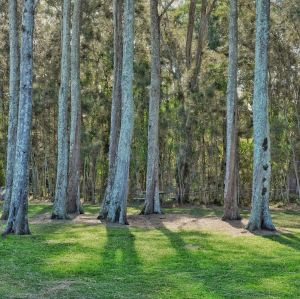
As Promised: A Prayer of Praise and Gratitude to Trees

Greetings friends

This post is from several months ago. I was reminded of it as I read a book that’s partly about humankind’s relationship with trees.

Seems like a good good moment to share this prayer with you all once again

At one point in my last post on Bhakti (if you missed it you can find it here) I mentioned that I hoped to soon publish a recently written prayer titled A Prayer of Praise and Gratitude to Trees.

Even as I typed those words in that previous post, I thought: ‘soon’? Why the delay? What’s wrong with now? So, without any further delay, here is our next post and in it I’m very glad to be sharing that prayer with you.

As my comment in that previous post explained, this prayer (and others too) is one more little step in my ongoing effort to cultivate a mood or feeling, and a practice, of Bhakti or loving devotion to the Divine.

If you’ve read that last post you will recall that I stressed my deeply held and heartfelt conviction that the Divine is everything. As I may have actually said: there is only the Divine; one, whole, partless and indivisible. Now, to knowingly repeat myself: The Divine is one without a second; that’s all there is.

This prayer to trees is an attempt to acknowledge that oneness of which each and every tree – just like you and me and all other beings – is a manifestation, each with its own unique name and form.

This prayer, though composed by this particular name and form, is in fact just one more expression of that oneness we all share. As such it is as equally yours as it is mine. As I said earlier, I am glad we are sharing this now.

A Prayer of Praise & Gratitude to Trees

Dear Aranyani

With this prayer we greet you. We offer you our praise, and our gratitude.

When we come into your presence, you remind us that in meeting and greeting you, we are in fact meeting and greeting God.

We bless you and we thank you for the shelter that you steadfastly provide to so many living beings. In so doing you support, protect, and nurture the continuance of life for all of us.

Your every exhalation is for so many other living beings the breath of life, of Prana – the life force itself.

You remind us as we witness your strength, your resilience, and your calm flowing with the winds of change that we too share that strength, resilience and the potential for calm flowing with those winds of change that are also constantly buffeting us.

Om Aranyani Namah

PS Who is Aranyani? She is a Hndu deity of the forests and all that dwell within the forests. Basically she is the Goddess of Trees and here is simply the name and form representing all trees.

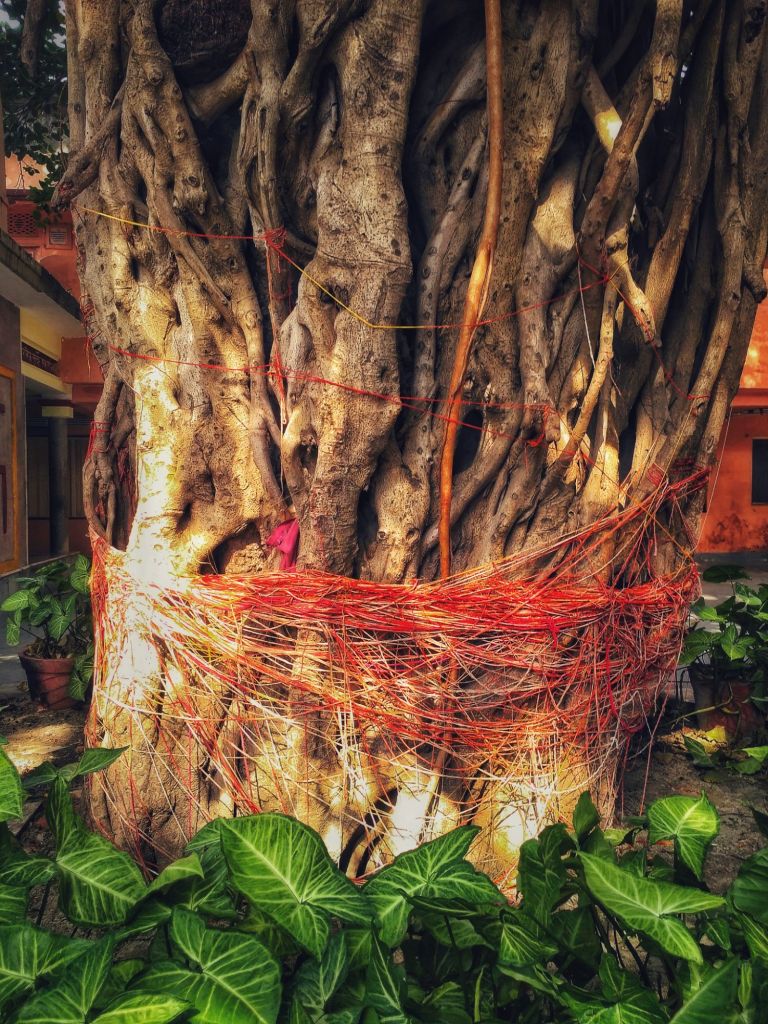
Sacred Strings, Sacred Tree

Self Enquiry: Listen to Your Self

This last little while I’ve been going through some serious contemplation, some deep questioning, on how to be ‘more of a monk’. Things like how to pray more deeply, and often; how to have a more focused and concentrated devotional practice; how to be a nicer person. Things like that.

Actually, that’s not exactly right is it? These are questions, enquiries, that for a number of years (is all my life too big a stretch?) habe occupied me. I’ve consistently been making enquiries, addressing questions, to Self – as well as to God or the Divine.

Still, like all things in life, self-enquiry goes through more intense, then less intense phases or periods. Let’s just say that lately I’ve been immersed – sometimes to the point of distraction – in one of those more intense periods.

(note from internal editor: Do I have to remind you once again to get on with the story you are here to tell?)

Okay then; let me see. Oh yes, right. Last night I was looking forward to beginning a new book. I’d read the introduction and thought that it was going to be just my cup of tea as it were, that it was something I would enjoy and learn from.

Anyway, as I opened the book on my tablet, I was suddenly stopped by a sort of wordless warning. The sense I had was that this book would indeed be a little piece of the answers I’ve been seeking.

Not so much in the contents I felt, it was more about approaching the book with more openness, less skepticism, more generosity of spirit and mental attitude. And the idea seemed to also include taking these qualities with me later as I thought about what I had read (or was about to read I should say).

You see, being more open, less skeptical, and more generous, come under the umbrella of being nicer. Still given the subject I was about to read about, I was a bit surprised by this ‘warning’.

As it turned out, I finished the entire book, so enthralled was I by the contents. The only things that tested my resolve to ‘be nicer’ was a number of occasions when the author’s worldview and interpretation of events, stretched my patience.

But, I managed. I didn’t become inpatient or outraged or irritable . When threatened by such responses I simply reminded myself that I was reading about another person, and I didn’t have to have an opinion one way or the other about what they believed or how they lived. Not only do I not have to have an opinion, I’m not sure I really have the right to an opinion about someone else’s life at all.

Besides, haven’t I just got through describing how I am myself deeply engaged in a process of self-enquiry? And wouldn’t such a process involve exposing myself to ideas, worldviews, kinds of information, new to me or not in alignment with my own beliefs? Surely bursts of impatience, indignance, judgement, and the like, would close me off in my search for answers?

Anyway, as I said I was so enthralled by the book – my reading informed by a little more generosity, a little less judgement, a renewed attempt at openness – that I finished the book in that one sitting.

Mind you it was only one hundred and something pages long. Still, for me, it was pretty good going.

PS Speed reading wasn’t – isn’t, nor ever will be – a part of my ongoing self-enquiry into the depths of my monkhood. Perhaps I need to add something like ‘Transcend the ego’ to my list.

Sun, Water, Sky, and Me

Varuna and Surya. the Hindu deities of sky and all Earth’s waters (Varuna), and our sun (Surya). These names resonate for me. I like how such great natural phenomena fundamental to our existence on this planet, can be ‘personalised’ in this way.

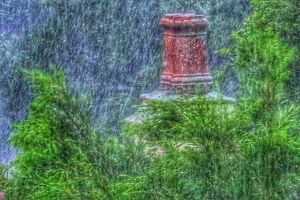
I find that having acquired symbolic or representational names for sky, water, and sun, has allowed me to somehow relate to the inherent giving and preserving of the energies that power all life that water, sky, and sun provide in a prayerful, thankful way. Kind of makes it personal.

Let me put aside for a moment the obvious scientific reality that tells us we can’t live long without water, can’t live at all without the gases in our atmosphere, and if the sun goes dark for whatever length of time it is, then all life ceases to exist.

How many times have I stood in awe watching a sunset?

Or watched as big waves rolled in with a surfer hoping for a ride?

How many times have I welcomed the sound of rain on a roof and the sight of it nourishing trees or other life

And how many times have I sat on or walked along a riverbank feeling uplifted and a little more grounded?

Many, many times is the short answer. Varuna and Surya are constant presences in our lives. And I am grateful for the life-giving and life-sustaining natures of their existence.

Sharing with you today, a little poetic expression of one of those times when sky, water, and sun, gave me just a little more than those fundamental material energies.

ONCE AGAIN VARUNA AND SURYA

Once again, Varuna and Surya
are coming to make rescue.
They arrive on – as in fact they are – the currents and eddies
of the river of life.
In this way, the natural order remains in motion.

Shared with love

from Paul the hermit

Flow river go, past the shady tree.
Flow river flow, flow to the sea.
Flow river flow, flow to the sea. 

Thanks to Roger McGuinn for one of the classic flowing on a river songs.

A Little Bit of Self Knowledge Hard Won

You know, for all my prayers; for all my mental discipline – efforts at mental discipline – for all my meditations, chanting, and other practices, I still just talk way too much for my liking, and often it feels like it’s only talking for the sake of talking.

I still just open my mouth and let come out any old thing that keeps the noise going. Oh, it’s worse than that: sometimes when I talk it’s rambling and waffling that I cleverly (or not so cleverly) disguise as intelligent, rational, and based logically on knowledge that I either have or haven’t got. Either way, I somehow seem to think I’m offering words of well thought out wisdom.

Whereas, as I said, the noise I make is so often rambling, contradictory , ill-informed, thoughtless waffle.

Enough! Blimey, that’s enough. Talk about opening a post on a calm, relaxed, optimistic, and compassionate note.

Here’s the thing: I want to devote my entire life to devotion and prayer. And that requires at least some silence. Yet, instead, I merely talk about the joys of silence, about the joys of full-on devotion to the divine, and as well I occupy so much time and energy to just voicing random thoughts that come and go, go and come, without rhyme, without reason.

Okay, here’s the second thing: I long with my deepest longing to be silent – to not simply stop talking, though that would be an excellent beginning. No, I want to be quiet; I want my vocal chords to have a break and let my true voice speak through my life, through this blog, my photographs and in whatever way I am lead.

So, what to do? Well, here’s the third thing, thing number three: all I need to do in order to both stop talking so much and be silent is to just sit. Sit and do nothing. There is no thing that I can do that will magically turn me into an oasis of silence and peaceful calm.

Sometime in the dim distant path I read someone paraphrasing The fouth Noble Truth in two words, Just sit. Buddha did indeed know what he was talking about. And I do get the irony: when I talk, I need to say something that helps, not just make noise and try to avoid silence.

Just sit

The Q&A in the Scripture: Part 2

Namaste

And welcome to Part 2 of The Q&A in the Scripture series in which we are looking at the answers given by Krishna to a list of questions asked by his cousin Uddhava in a scripture called the Uddhava Gita.

Remember the scene? Uddhava has asked Krishna a pile of questions about how to live a good life, how to live in the world with discernment.

These questions have become urgent because the cousins are about to leave their hometown which is on the brink of war. Both will be going their separate ways and both know they won’t be seeing each other for a while – perhaps never again.

Anyway, moving right along: In our last installment, we had Uddhava asking the first of his questions; this one happens to have two parts:

What is quietude and what is self-control?

We discovered that quietude is not the state in which one finds peace, silence, our true selves, or the Divine, but is itself that consciousness, that pervades and permeates all that is, silence, peace. In other words, quietude is  the Divine itself.

In the present post, we move to the second of Uddhava’s two-part question: what is self-control? Krishna’s answer is excellently short and sweet:

Dama  (self-control) is restraint of the senses.

Krishna in his response, makes it clear that restraining the (one’s own) senses includes mind as a kind of sixth sense in addition to the five physical senses. In the context you could almost say that it’s his mind that Uddhava is in most need of restraining. Maybe that’s the message for all of us?

Well, we are all well aware of the ways in which we have tried to control our senses; Uddhava knows too. But look at the situation these two cousins find themselves in:

It’s fine for Krishna: he’s returning home to Heaven, or wherever. But, Uddhava, who is also about to leave, is facing more uncertain prospects. He’s experiencing great turmoil, and fear over his and his familiy’s safety as the threat of war closes in. Most likely he’s also grieving over having to go into exile from his ancestral home.

Of course he’d be fearful for the future: where will he go? What will he do? How will he protect and provide for his family? Like I said, an onslaught of mental and emotional anguish.

Still, it does seem that Uddhava is maintaining quite a steady presence of mind. He’s thinking about the future; he is clear about the sort of stuff he needs to find out from his cousin (remember Krishna is God) in order to put and keep his life on the right track despite the challenges facing him now and in the future.

Then there’s the fact that this self-control thing is only one question on a list of 36. Clearly Uddhava is looking for a lot of advice.

Restrain the senses – all six of them – Krishna says. But how? What does it mean, ‘restrain the senses’? I think I alluded to the notion that we all have some ideas, some clues, about how we as individuals might restrain them, but let’s personalise this: What does it mean for me to restrain my senses?

Actually, now I’ve made that suggestion, I feel overwhelmed: Where would I start? Surely I need to do a whole series of posts, just on this one topic alone?

Oh wait, I can start right there. Exaggeration, hyperbole, over-dramatising, catastrophizing, all perfect examples of emotional reactions leaping from an unrestrained senses central: my mind.

Let’s put aside that mental stuff for a little while, and just say that all those emotional responses could do with a bit more restraining training. Just looking at the physical senses to begin with, I can easily say that they also, at least some of them sometimes, need various degrees of working on.

First, my sense of taste: it goes into overdrive sometimes, and then I eat too much. Not so much as in the past, but the restraint has a way to go still.

My sense of sight is pretty good, well restrained for the most part. But there are times when I lapse into old habits and spend too much time looking at a screen and scrolling in a mindless kind of way. Getting there though!

As for my sense of hearing: You might remember a post from a while ago when I talked about letting go of much of my music collection, some of which I’ve listened to my whole life.  I’m doing this because so much of what used to be ‘my favourite’ songs or artists, no longer serve my spiritual growth, nor does much of it reflect the view of life and the world that I’m trying to cultivate.

Well, I’ve made a good start, but occasionally I slip and find myself humming old tunes, or listening to an album that I really ‘should have’ deleted already. Restrained? Sort of, and I’m still encouraged.

Enough! Let’s get straight to the biggie: my mind. If I’m honest, I have to say that my mind, while not exactly in full agreement with my efforts at restraint, is starting to get into sync with me and my aspirations for a more controlled mind.

But still, those previously mentioned emotional reactions like exaggeration, over-dramatising and the rest, are still there. Falling into line, it’s true, still … .

Then there is the (more than) occasional first port of call reactions to pieces of news of various kinds: I’m prone to ask, just as I imagine Uddhava might have: Why don’t ‘they’ control themselves? Why can’t he or she or such and such country or politician show a little restraint?

Yes, I know, we’re all guilty of this one to some degree or other.

My quickness to anger is not quite, but almost, might soon be, won’t be long before it is, a thing of the past.

Then, there’s my tendency to ruminate: rehash endlessly real and imagined events and other stuff from the past – as well as the always imagined possibilities (as well as the impossibilities) for the future.

Again, I know I’m not alone in this emotional roller coaster ride, and I do know that I am nowhere near as much of a ruminator as I was; I have made great strides, significant inroads, and I am encouraged that the end of rumination is getting closer!

And now, here is the one thing I tend to think of one of my biggest, most tiresome and tedious, most annoying conditioned emotional responses: I talk too much. Not as much as I used to, but still too much for my comfort, and for the peace of mind of those around me. More restraint is called for.

Restraint has played its part in reducing my talking. But in a sense the major ally has been the ongoing quest I’m engaged in to discover my true nature, as consciousness, which is really my oneness with all that is.

And here our second question and answer leads us right back to the first: quietude.

I wrote in that post:

Quietude, calmness, peace of mind, are not where  you will find God, consciousness, or whatever we call it.  Quietude and the rest are God. They are consciousness.

Or putting it the other way round: cultivate silence, calm, peace of mind, and your senses will no longer need to be restrained. Your whole Self, including body and mind, will then be resting in Quietude, in your true nature.

That’s why I think these two questions are asked and answered together: Each leads to the other: by restraining our senses we are more easily able to achieve a state of calm, quiet, some level of peace of mind – in other words, Quietude.

On a Pilgrim’s Way

Today I went on a pilgrimage.Not that I don’t undertake all kinds of little pilgrimages all the time. And even more, it’s not as if my whole life – just like yours and everyone else’s – isn’t one ongoing and continuing pilgrimage.

All true; but this one, today, was embarked upon in what might be called, a classic manner: on foot, to a place of sacred significance, and in a spirit of contemplation of the nature of the journey as well on that which is being pilgrimed too. (I am positive there is no such word!)

In this case, today’s pilgrimage, that place was a church about two and a half kilometres from the  hermitage. It’s a place I have visited several time, but today was the first time I set out as a pilgrim and walked in the way and spirit of the pilgrim.

Our Lady of the Rosary is a Catholic church dedicated to the Mother of Jesus in her role as patron of the Holy Rosary, a Catholic way of prayer that has evolved over time and is a key part of the lives of many Catholic people.

Just to the right, just inside the door there is a plain brick wall in which there is a small niche. The niche holds an almost life-size statue of Mary. She stands, hands folded over her chest on which sits the Dove of Peace.

You can see from the photo that the church itself is a lovely, quiet, serene place full of good vibes and nice peaceful energies. The object, however, of my pilgrimage was not the church in itself, but stood just inside the side door accessed through an equally peaceful, fountain centred garden.

I have come to offer her – this form or manifestation of the Divine Mother – the prayer I wrote to her which I hope you saw when I posted it on this blog recently.

I had decided that my pilgrimage vow would be fulfilled once I had knelt at her feet and offered her the words of my heart in prayer.

My reverence for the Divine Mother is well known, and especially in her form as Mary the Mother of Jesus. Or Our Lady as we called her as good little Catholic children way back in the long ago. And I know I have said often that the entirety of the material and non-material cosmos is a manifestation of the Divine.

So, why then a special trip on foot, that I’m labeling a pilgrimage to a specific site, so I can kneel at the feet of a statue that I know perfectly well is made of stone or plaster and is simply a symbol of one aspect of the Divine?

Actually, the question has answered itself. The pilgrimage and my associated actions worded in that question tell us the why.

It is about acknowledging at a heart level and in my own way, that that symbol, that form, is actually representing a particular aspect of the Divine that I revere.

Besides, I’m not the first person who’s knelt at that spot, at Mary’s feet. I don’t know the age of the church, nor do I know the history of that particular statue, but I think we can say for certain that many hundreds, if not thousands of other people have been there where I was and spoken words from their hearts.

Being honest and true now, what I can say is that, as I said to my partner hermit: ‘I feel like i’ve been on a pilgrimage’.

And I do. I’ve walked – praying and chanting – to a sacred place where I have prayed at the feet of the Divine in the form of a likeness of Mary. I feel blessed that I actually got to offer the prayer I wrote to the Divine Mother.

Somehow I feel a link was established. A heart (mine) opened ever so slightly. I acknowledged the Divine, and I sense that I might just be – ever so slightly again! – topped up with a bit of the Grace that is in reality our true state.

Mary in the Garden (enhanced by a fellow Hermit Pilgrim. 
Thank you)

So, this is the story of my pilgrimage. I was absolutely exhausted when I arrived back at the hermitage. Most likely that was due to the heat, the traffic, and the noise encountered on the way I trod.

But, now I’ve shared this little tale with you, I’m not tired. Anyway, the Way is not always easy, and we are all very well aware of that aren’t we?

Namaste friends. The Divine in me salutes the Divine in you.

It’s a walk to take,

a pilgrimage to make.

Sometime soon.

Said by me long ago, I don’t know when or where. It was one of those ‘You’re a poet and don’t know it’ moments.

Peace!