
A Day of Silence Observed

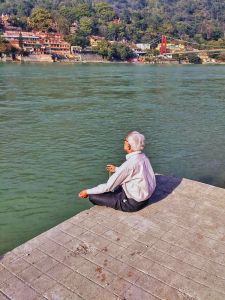
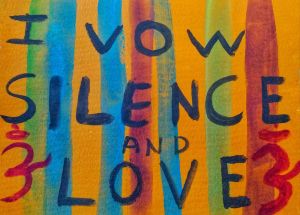
A few days ago we observed a day of silence here in the Hermitage. Our initial idea was to have a day of less talking, more quiet, which we hoped would help us reach a state of silence. We timed our little effort to coincide with a similar event being observed in an ashram in India whose foundation teacher we admire very much. A way for us to perhaps associate with others on a similar path out there (in there?) in the invisible community.

It’s not that we don’t experience periods of quiet (no talking) and even the aspired to silence, we do. Quite often they can be reasonably extended periods too, when meditating, chanting, studying, and so on.

But, it does have to be said, that we do spend a lot of time talking with its associated thinking – and unthinking too; with its listening – and not listening.

Of course, there are things we actually want or need to talk about; just that for us, sometimes we end up talking about stuff that’s not needed, as well we fall into what we call the adharmic trap of gossip, judgement, needless repetition, and the rest of the not so right speech.

Anyway, we wanted our day of quiet to be as complete as possible, so we agreed to not even discuss mundane and practical things unless it was absolutely essential. (Who gets to decide what’s ‘essential’ and not? Good question).

Around midday on the day in question I made a few notes on how my day was going so far. I had a vague notion I would make notes periodically through the day as a kind of ‘casual log. Needless to say, an approach of such vague casualness resulted in the notes made at midday being the only ones to actually come into existence.

Still, even though the notes were made relatively early in the day, I do think that they are a pretty good summary of my feelings on the day as a whole. So, let me share those brief reflections with you now:

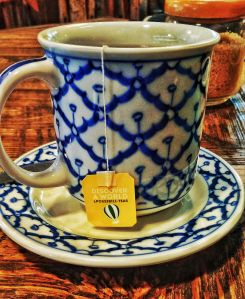
Thus far (about 12) we are keeping silence (or at least not talking) – mostly. Practical things are sometimes tricky, sometimes not. It’s easy for example to point to a cup which translates to ‘Would you like a cup of tea?’. The reply which was ‘no thank you but I would like half a cup of soya drink’ took a bit more translational effort. Due of course to an almost complete lack of experience in speaking without umm, speaking.

Mind you,only three or four actual words spoken, along with a ton of hand gestures and facial expressions, did result in the transmitting and receiving  of understanding.

PLUSES SO FAR  

A sample of what it is like to be quiet, and actually being in quiet. And a happy anticipation (along with a sense of relief experienced in the present) of not having to talk about all the tired old things: the weather, the world, the ins and outs of teachings, teachers or writers, as well as ‘other people’, which often end up in judgements, criticisms, and plain simple gossip.

Alongside this overall positive vibe, there is a kind of nervousness. Where it comes from, I can’t say; probably an anxiety to do with not talking about the usual things. Though of course it’s only been a few hours.

While there has been little out loud talking, my mind has been running crazy, and I’ve had a strong compulsion to keep busy. Put these issues with the nervousness? To be expected really I think given my lack of experience with intentional quiet.

One step at a time.


Well, clearly that compulsion to keep busy didn’t extend to further note keeping, but, yes I have to say I did keep busy. Ironically some of that ‘busyness’ did in fact result in a few glimpses of silence.

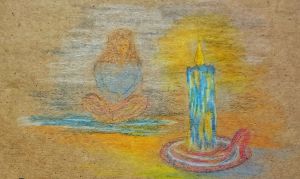
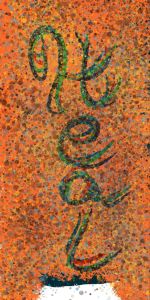
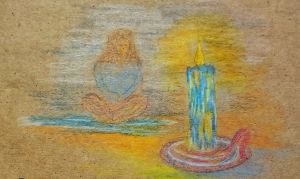
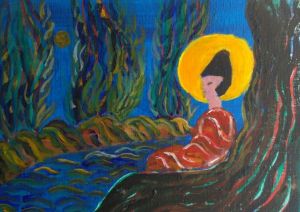
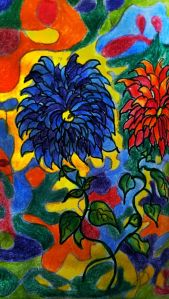
I spent time working on an art piece in a prayerful manner, and in a quiet state; none of the all too usual chatter. Silence. I meditated for longer periods than usual, which allows for a deepening of a quiet mind (in theory that is). And when I chanted mantra, I think I may have been a little calmer and quieter of mind than usual.

Clearly the cultivation of silence – and even the seemingly straightforward task of simply not talking – is a practice that requires more practise, quite a lot of practise in my case.

We need to develop alternative communication strategies – hand signals, signs, gestures – to minimise speaking even more. Having said that if we’re to develop silence then even communicating about mundane stuff in other ways would get in the way. Too much talking!

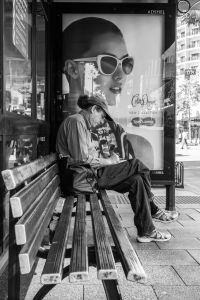
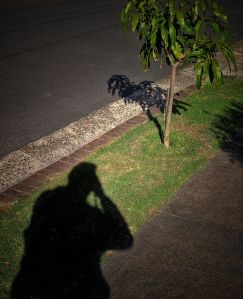
Well, I occasionally make photos out there in the world

One very pleasing outcome is that I feel slightly less inclined to ‘talk about the outside world’ and other people. Less idle chatter. It’s a good start and it can only get better with some of the aforementioned practice.

Actually, thinking about it now, you’d think that a hermit who rarely goes out of the Hermitage except for a walk or occasional visits to a shop, who doesn’t watch the news or social media and the rest, wouldn’t have a lot to gossip or blah blah about.

That’s why, you see, I say that I really do need quite a lot more practice. Making silence is a long term project, an aspiration if you like, to find inner peace and make myself more able to radiate love to the world.

Love and Peace

Paul the Hermit

Breathing Free & Easy Through My Life: I Wish

There’s this funny little thing I do; it’s an odd little habit. On the face of it, at first glance, it’s not really anything to bother about. Just another little quirk that could easily be dismissed to add to my long list of such quirks.

Don’t laugh. I’ve had this habit for I have no idea how long, and I’ve been wanting for ages now to stop and think about it: why I do it? Can I stop it? You know the thing. Well, I’ve taken steps to try to change it, but still, I think it’s time to look at it properly.

You see, I am prone to holding my breath. Just to illustrate: as I held my pen poised about to write that last sentence: I held my breath. What directly prompted this renewed resolve to finaly get down to facing the facts, is that just a little earlier I’d made a cup of tea, and when I went to put it down on the table? Yes, I held my breath.

I’m likely to hold my breath (for a short moment) at any old time: Bend down to pick up a dropped pen? Hold the breath. Raise a forkful of food to my mouth? Hold my breath. Do one or any of my regular physical exercises? I have to really watch myself, otherwise I’d not breathe at all doing them.

All the time, and at any time, as I said. Why? Well, that’s the question isn’t it? I can kind of understand it as a pause, a way to summon up focus and physical energy before doing a task requiring much physical (or mental?) effort.

But that’s just a guess really. As you probably could imagine, I’ve never discussed breath holding issues with anyone else. Well, present company excepted.

Anyway, my guess doesn’t really tally with the lightweight activities, like my pen poising before a new sentence, or my breath suspending before taking a bite of food. Something else is at play here.

So, what is air? What is it good for exactly? Well, umm, it’s a gaseous combination of a whole heap of ‘stuff’, the key one for us here is oxygen. And, more or less obviously we mammals and other beings too, need oxygen to breathe – to keep breathing. In other words it’s the ideal means of staying alive.

I guess that’s why some traditions call air, not only an element, but a sacred element. Life giving, life sustaining – some call it the Life Force, or Prana. Of course these two terms encompass other elements and concepts, but air is pretty much a fundamental component of the whole eqaution.

Next question: If I know it to be the life force, that which keeps me alive, why would I choose to suspend breathing? No, after pausing here (and holding my breath briefly), I’ve concluded that I very much doubt that I’m trying through this little habit to curtail the flow of the Life Force, or Prana through my body.

So, specifically, what does air do in the body? Well, it fills the lungs, which then somehow get the oxygen into the bloodstream (the heart’s job?), which in turn carries that oxygen to the brain, other organs, and to the muscles. I hope you will forgive my over-reliance on such complex technical jargon.

Once again, I can’t see how holding my breath as I poise my pen, is intended to deprive my arm muscles – and my brain – of the fuel needed to help the pen do its work of putting words on paper.

Anxiety? Well, finally we might be getting somewhere at last. When we get a fright, or fear something, or watch scary stuff in a movie, we will often ‘hold our breath in suspense’.

Maybe that’s where the breath holding habit began for me. Not watching movies, but perhaps when confronted with anxiety making situations. Of course picking up a pen is hardly a cause for anxiety, though eating might be?

Well, maybe those ‘little things’ are where the habit became a habit, but now I’m starting to think this breath holding might be a habit without a cause.

At least no consistent cause or causes. Anyway, there’s no point to  dredging the past to try to find out the why of the thing. What’s important  and the only thing we can impact on is now; best to pay attention to here and now;

So, I suppose the conclusion is simple: Sometimes a quirky little habit is just that, a quirky little habit.

PS A habit to be done away with mind you. Time for some little reconditioning of myself. I’d prefer not to hold my breath while writing notes, while eating, or while doing my exercises – or when doing anything else for that matter. The brain, the digestion, the muscles – this entire being – needs oxygen, and it’s my job to make sure that it flows freely and easily to everywhere it’s needed.

A Prayer Is a Prayer, Is a Prayer, Is a …

‘I’ll carry on with my Gita then,’ I said to my partner hermit after we’d been discussing something for a while.

‘I’m enjoying reading my prayers this morning. So I’ll read a few more then read a few verses’ (of the Bhagavad Gita).

‘Reading’ my prayers? Is that what I’m doing? Surely a prayer – prayers – are for praying? Anyway, not simply for ‘reading’.

Of course in this particular instance, the forms the prayers are taking – on the most superficial, worldly, material level –  are as words written by human hand (mine) on paper pages in a little book.

But, right now, the big question, the existential question really, is have I been merely reading those prayers? Or have I been praying those prayers?

Then there’s another, equally existential, concern that arises: How to know the difference. Reading? Or praying?

I feel like saying that the first thought that comes to mind – the first answer to reach the tip of my pen on this page – is this: Actually, the answer has come in the form of a rhetorical question:

If a prayer is prayed, how would it ever even occur to me query if  it is in fact a prayer, and not just words on a page to be read?

Yes, first thought best thought here I think. When a prayer is prayed, even if its form is words written on a page, there is a movement beyond those words on the page. In fact, there is a transcendence of all that is of the material world that takes place.

A prayer is what it’s always been: a prayer. The forms prayers take are, I think, literally endless, uncountable, and can never be submitted to categorisation by us humans.

Prayer is for praying, that’s the lesson for me. Just pray.

Self Enquiry: Listen to Your Self

This last little while I’ve been going through some serious contemplation, some deep questioning, on how to be ‘more of a monk’. Things like how to pray more deeply, and often; how to have a more focused and concentrated devotional practice; how to be a nicer person. Things like that.

Actually, that’s not exactly right is it? These are questions, enquiries, that for a number of years (is all my life too big a stretch?) habe occupied me. I’ve consistently been making enquiries, addressing questions, to Self – as well as to God or the Divine.

Still, like all things in life, self-enquiry goes through more intense, then less intense phases or periods. Let’s just say that lately I’ve been immersed – sometimes to the point of distraction – in one of those more intense periods.

(note from internal editor: Do I have to remind you once again to get on with the story you are here to tell?)

Okay then; let me see. Oh yes, right. Last night I was looking forward to beginning a new book. I’d read the introduction and thought that it was going to be just my cup of tea as it were, that it was something I would enjoy and learn from.

Anyway, as I opened the book on my tablet, I was suddenly stopped by a sort of wordless warning. The sense I had was that this book would indeed be a little piece of the answers I’ve been seeking.

Not so much in the contents I felt, it was more about approaching the book with more openness, less skepticism, more generosity of spirit and mental attitude. And the idea seemed to also include taking these qualities with me later as I thought about what I had read (or was about to read I should say).

You see, being more open, less skeptical, and more generous, come under the umbrella of being nicer. Still given the subject I was about to read about, I was a bit surprised by this ‘warning’.

As it turned out, I finished the entire book, so enthralled was I by the contents. The only things that tested my resolve to ‘be nicer’ was a number of occasions when the author’s worldview and interpretation of events, stretched my patience.

But, I managed. I didn’t become inpatient or outraged or irritable . When threatened by such responses I simply reminded myself that I was reading about another person, and I didn’t have to have an opinion one way or the other about what they believed or how they lived. Not only do I not have to have an opinion, I’m not sure I really have the right to an opinion about someone else’s life at all.

Besides, haven’t I just got through describing how I am myself deeply engaged in a process of self-enquiry? And wouldn’t such a process involve exposing myself to ideas, worldviews, kinds of information, new to me or not in alignment with my own beliefs? Surely bursts of impatience, indignance, judgement, and the like, would close me off in my search for answers?

Anyway, as I said I was so enthralled by the book – my reading informed by a little more generosity, a little less judgement, a renewed attempt at openness – that I finished the book in that one sitting.

Mind you it was only one hundred and something pages long. Still, for me, it was pretty good going.

PS Speed reading wasn’t – isn’t, nor ever will be – a part of my ongoing self-enquiry into the depths of my monkhood. Perhaps I need to add something like ‘Transcend the ego’ to my list.

Slowly & Mindfully: A Reminder

Among the physical exercises I try to perform on a daily basis, are a couple for strengthening the hips. One of these begins with me standing upright, feet together, eyes level, looking ahead.

Then I swing one leg at a time for ten repetitions in a kind of arc like motion out to side, keeping it level with the side of my body, bringing the leg back to the rest position with feet together. It’s a pendulum motion.

Anyway I’d been merrily going along doing these exercises more or less every day for ages, months really, until one day my partner hermit was watching me, and said:

‘You’re supposed to be doing it slowly and mindfully’. Or words to that effect.

You see I had been quite happy swinging each leg out in turn at a fast pace, kind of like an aerobic sort of thing. Just to get it done if I’m honest. Wrong! Supposed to be slowly and mindfully.

Lift one leg slowly in an arc like motion out to the side of the body. Pay attention to the movement as it’s happening; no need to push the leg out, just lift it to a comfortable position. Just let the arm trail loosely and of its own accord, along with the leg. Then, again slowly and paying attention to the process of the movement, bring the leg back.

And I do have to say there’s been an amazing difference. I can actually feel the muscles working during the exercise, and can sense the minute incremental motion as the leg swings slowly. It’s a way better exercise than it was, and now I wouldn’t do it any other way.

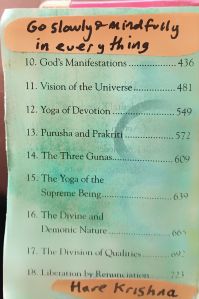
I was reminded of this incident this morning as I came across a short admonition, a little reminder to myself I have stuck on a Table of Contents page in my Bhagavad Gita.

Go slowly and mindfully in everything

What’s interesting is that, despite seeing and reading this so-called reminder more or less every day, and despite proofs of the benefits of actually listening to the reminder, such as what I’ve just described with the exercise , the reminder seems to mostly go right over my head, in one ear and out the other as they say.

Today, for some mysterious reason, it actually got my attention. At the same time, again who knows why, it triggered a truly relevant and appropriate memory to act as a kind of metaphor to illustrate the point to me.

I suppose it’s stating the obvious, but I can say that doing that (or any) exercise slowly and mindfully – in a watchful and observant manner – acts as an exercise in presence. Otherwise I’d not be sensing or feeling the muscles and the movement, or the peace of no random thoughts.

Did I mention that, having corrected my modus operandi with that particular exercise , I’m feeling the benefits? It definitely feels like things with legs and hips are loosening up, getting stronger. I’m actually walking further now without my legs aching on me.

More than that, I actually find myself wanting to do the exercise as opposed to ‘wanting to get it done’. Why is this? Well, I think it’s because I’m yearning to rediscover that feeling of presence; it’s a bit like a meditation, and in the same way clears the mind of random thoughts – at least for the short duration of the exercise. Having said that, even a short duration clarity plays its part in reconditioning a stubborn mind.

So, mental clarity, good exercise for the body, for the heart, even the soul?I think it’s the perfect metaphor for how I aspire to be living my life.

Slowly and mindfully.

Note to Self: Have a Little Faith Will Ya?

As a hermit, I am a pilgrim, dependent on a pure faith that I am exactly where God would have me be. I am here, and it is now.

I forget in which of his books I read this, but it’s a prayer written by Thomas Merton shortly after he’d finally moved into his hermitage full time. The ‘I am here, and it is now’ I added, though of course it’s also borrowed.

It’s a prayer, an affirmation, I recite at least once a day. And, like Merton, I aspire to that ‘pure faith’. Faith is a strange thing: it may grow and develop and then it does indeed support me in my intentions and living, not to mention the comfort it provides..

But, all of a sudden it can just flow away, leaving me adrift, bereft, and not sure of anything.

I am a pilgrim, it’s true. But as Bhajan (a bhajan is a sacred song, a hymn) singer Krishna Das sings:

I am a pilgrim/the road’s so long.

And sometimes it seems a lot longer than this particular pilgrim would like. Still, as they say, how long’s a piece of string? And it’s rougher than I’d like as well. but again how rough is rough? Layers of meaning in that word longer.

Yes, I am a  hermit, and my mind’s not the same, as Jackson VanHorn sings. Same as what? Whose mind is mine different from? Is my mind somehow not that same as it once was? True though: my mind is hardly ever the same.Here’s the whole chorus as it spoke to me:

Yes I am a hermit
My mind is not the same
Yes I am a hermit and ecstacy’s
my game.

For this hermit, ecstacy is not a stage experienced all that often. Mind you, there are fleeting moments, but like the pilgrim road, there are long distances to be trod between one of those moments and the next.

And as for Tim Moore claiming he’s

‘… sittin’ peacefully on Hermit Rock’?

Well, yes the rock – the hermitage – has much potential for peacefulness; a peace expereienced quite often actually. It’s a sacred space

But, as in any way of living, any way of being, peace comes and peace goes. And when it goes, it can seem like it never existed, and that ‘sittin’ peacefully’ is, and always will be a fantasy never to be realised or made real.

It’s about equinimity 

That’s something else I heard today. Well, there’s not a lot of equinimity in this hermit pilgrim today. Seems, then, that there needs to be some shifting of perspective; some peace needs to be restored

My Lord Ishvara

Deep withn the still centre of my being

May I find peace.

Silently withing the quiet of the grove

May I share peace.

Gently and powerfully in the wider circle of humankind

May I radiate peace.

Om Tat Sat
Om Shanti Shanti Shanti

Afterword:

A few hours have passed since I made these notes; I have regained a little balance, but still thought it was important to publish this post.

Thank you for your patience

Love and peace

Paul the hermit

A Few Thoughts on the Big Question: Why a Monk’s Life?

Just now, on rediscovering a quote I’d noted down months ago, I spontaneously decided to download again the book I took it from. This will be the third reading: seems to be one of those books that keep calling you back.
The book (The Abbot’s Shoes by Peter Robertson) tells the story of the author’s foray into monastic living in New Zealand way back in the early 1970s when he was twenty something.

One of many mini monastries we’ve been blessed to live in

I’d like to share the mentioned quote with you, because I think it really speaks to my own commitment to the contemplative, hermit life, which is for us a monastic life too – a hermitage is actually a mini monastery.

Sitting in his apartment one night, completely dissatisfied with life the universe and everything, the author contemplates the state of the world around him.

‘All the marching, all the writing, all the campaigning in the world isn’t going to change this insanity, brutality, and carnage.’

Actually this isn’t the quote I’d made a note of; it’s the preceding  sentence which I saw again today and it seemed to just fill out the context for me. Anyway, after a few moments of quietness and thought, the author concludes:

‘I somehow intuited that the most powerful, significant , and influential  action I could take to change the course of this kind of history, was to hide in a monastery.’

He goes on to reflect that by doing so – living simply, in a community devoted totally to contemplation and prayer – he could become a tiny part of ‘the turning of the tide’.

Years later, reading Thomas Merton‘s diaries, he discovered that Merton had felt the same way, concluding that those living simple, prayer filled, contemplative and quiet lives were ‘keeping the universe from crashing in pieces and falling apart.’

There is a strong sense among contemplatives, hermits, nuns, monks, that this is their function: keeping the whole thing going. Or as our author says, each playing a tiny part in the big picture. I would say, like I know Merton did many times (and acted upon his words), that action in the world is absolutely necessary; it’s just that it can’t do all the work alone.

In our hermitage we too speak often of these ideas, and think about them deeply and try to realise how they affect our lives as hermit monks.

So, hiding in a monastery? Or in a hermitage? It’s true it’s very much a hidden life in many ways. For me though, it’s not about  being hidden, it’s more about just what Black Elk says, I’m trying to make my every step a prayer.

Speaking for myself, it’s not that I’m unwilling to pray for a specific individual, or for peace in such and such a country, or relief from poverty, and oppression for specific individuals or communities.

It’s more that: picking and choosing in that way risks leaving people and issues out inadvertently or through some unconscious bias.

I have chosen to live this life apart as much as possible from the world in order to minimise the anxiery being ‘out there’ causes me, to have the quiet, the time, the ‘head and heart’ space to simply pray. To make of my life a prayer

Let every step you take upon Mother Earth be as a prayer

Black Elk (Ogala Lakota Holy Man)

My partner hermit is fond of reminding me of the well known aphorism that a stone dropped in a pond will make ripples that spread out and out. Just like the vibes – the vibrations – emanating from a prayerful life, from all the prayerful lives.

A Story of a Door

The walk from the Hermitage to the coffee shop at the Village Green takes around five minutes or so. This morning, noticing a pause in the rain, we thought we might take the opportunity to get some fresh air and a walk, at the end of which there would be coffee. So, we stepped bravely forward, with the faith that the gods of the rain were indeed taking a break.

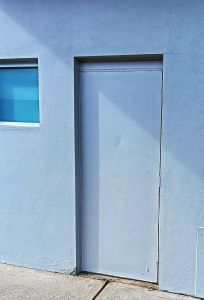
‘Look over there, ‘ said my partner hermit as we passed through the centre of the village. ‘There’s a door that can only be opened from the inside.’

‘I’ve never noticed that before,’ I replied, looking across the street to a wall into which was set a door with no visible handles or lock. The only things that suggested that it was in fact a door were the hinges on one side, as well as its size and shape.

Now don’t ask me how many times I’d passed that spot. Most likely dozens of times, on both sides of the road. Still, now that I had been shown it, I was intrigued. Mentally I was captured: I thought, what a wonderful thing: the one or ones on the other side of the door have complete control over who or what is allowed to enter.

With such a door, one that only opens from your side, you could easily choose to rarely – or even never – open it. Ah, peace at last went my thoughts.

But, right away, those thoughts were dismissed, sent packing: too simplistic, too extreme, to heavy a response. Though, you know, I do feel strongly that such a response to the world – shutting it all out completely – is perfectly understandable, completely reasonable, and oftentimes even an absolute necessity .

Still, I had that feeling towards my reactive thoughts of ‘too extreme’ (inner editor’s note: he has no idea what he’s saying does he? If you ask me, right this minute he will be thinking his initial reaction was spot on and he’d love to have a door like that. Anyway, we’ll let him have it his way).

Some further, more careful thought is required here I think. For a start, here’s a question: If I were to keep the door shut all the time, how would I ever be able to allow my own light, my own love, my own Self, out into the world?

Maybe there’s a way to keep the door open sometimes, then at other times choose to keep it closed to bar access to unwanted intruders in the form of people, thoughts, events, emotions and so on.

After all, it is my door (in this little fantasy at least), the door to the inside, where resides the ‘real’ me, the Self within, beyond and above, the physical form that I so tenaciously cling to as as being the real me. Talk about attachment!

Perhaps slightly exagerated, but this is close to how I see my actual door working as distinct from the story I’m telling in this post.

Where was I? Oh yes. With that door that opens only from the inside, I might come – eventually – to realise that there is nothing to disturb me – unless I open the door and let whoever or whatever that is unwanted, through the door.

I am my own gatekeeper, and without my consent my gate (door) cannot be opened and entered.

And, getting back to the choices I am able to make to sometimes open the door to allow some light and love to flow out from me, out the door and into the world. The more I’m able to discern when, and for how long, to open the door as a way to control what comes in, to what can reach me, the more resources of said love and light I shall be able to build up.

Which, in turn, will lead to more and more opportunities I’ll have to open the door in order to share some of that good.

I can envisage a state reached where my door could quite possibly be left to stand ajar all the time.

You see, the more love and light pouring out, the less that disturbs me can get in. Love and light is transforming, isn’t it?

Yes. Now I’ve noticed – recognised – the door that can only be opened from the inside: It’s me! Now, where did I leave my door keys?

Out Beyond Capricorn: Poetic Offering

Namaste and greetings

It’s been just over a week now since the new page on the blog went live. I have to say that it’s been very satisfying setting it up, then uploading some of my devotional poems.

Actually, it was while uploading one yesterday that I thought, I’ll feature this one in its own post. I did mention that I would like to continue this occasional practice.

There’s not too much to say about this particular poem really – best to leave it to speak for itself.  I’m only introducing it like this because I wanted to include a Wikipedia link that might help clarity a couple of the terms and some of the details mentioned in the poem.

The poem speaks about the concept of Viakuntha, which as you’ll see is the supreme heaven for some Indian traditions. The link leads to an interesting and short read, well worth the time I think.

The myth of Vaikuntha was a trigger for this poem, as was the meaning of the word itself. Is it a real place? Who knows. Fact and truth don’t always agree, and as for me, I don’t think about the question.

Myth has been the way we humans have always used to tell our story. To try to sort out the big questions: where are we from? Who are we? Where are we going? All the ‘big questions’ are addressed by mythologies from every culture – every family, country, you name it – on Earth.

In any case I think that my poem came about as a result of my own contemplation on the story, on those big questions, on Self really.

I hope you will visit my Poems of Devotion page. I’m still adding poems to the page, and of course, with grace, I will continue to write.

Now, please enjoy reading my poem, and I hope it’s a nice experience for you.

Love and Peace
Paul the hermit

OUT BEYOND CAPRICORN & DEEP WITHIN EACH HEART

Vaikuntha: Without anxiety.
Is there such a place? Free from worry?
Out there, they say, beyond Capricorn.
There’ll you’ll find the highest heaven,
the abode of God.

No need to look to the stars:
Vaikuntha is here. Vaikuntha is now.
Within and without you.

Vaikuntha is indeed beyond;
beyond the material world,
beyond the realm of bodies and minds;
beyond the illusions of places and spaces.
Atma – Universal Consciousness – you and me,
that’s Vaikuntha.
You and me, all there is. No anxiety

Realisation of Reality; It started With a Joke

‘I like looking at you,’ says the hermit.

‘You must be sick in the head,’ replies, as quick as  you like, his partner hermit of 40 odd years. (Obviously an old and oft shared joke).

‘Of course I’m sick in the head,’ bursts out of the hermit in response. ‘It’s like saying the sun comes up every morning. It’s a given, a simple fact of life.’

Problem is, it’s not true is it? the sun I mean; it doessn’t come up does it? Doesn’t go down either for that matter. I mean it looks like it rises up every morning, and it looks  like it goes down every night. But it doesn’t. In reality it’s us here on planet Earth who are doing the turning.

At ‘sunrise’, our home planet in its continual revolving has us looking at a stationary star (our Sun, Sol, Surya) that is, rather than going up, just sits there as we revolve downwards leaving it behind, Same story at night with the sunset, just the other way round.

Our experience when looking at this scene is that the sun is going down behind the hills. But in reality it’s the hills and river and the viewer going up as Earth rovolves. Hard to get one’s head around.

To explain what we see, what we experience – or rather what our ancestors saw and sought to explain – the simplest, most obvious thing to do is tell it like we see it. Sounds obvious enough, but as we’ve just seen, the story we inherited and which was only recently (in historical terms that is) shown to be incorrect, of the rising and the setting of the sun was based on an illusion,

As to the hermit and his story – the long-held believed to be true story – well, if we’ve been able to establish that stories we tell ourselves are often based on illusions, then perhaps the hermit can look for another story concerning the state of his head health, that is based a little more on facts, not so much on illusion.

Or to put it in other words: It’s quite possible that if the truth of the matter is that the sun never goes up and never  goes down, then just maybe the hermit is not actually sick in the head.

Except perhaps when it comes to old jokes shared between beloved partner hermits.