Breathing Free & Easy Through My Life: I Wish

There’s this funny little thing I do; it’s an odd little habit. On the face of it, at first glance, it’s not really anything to bother about. Just another little quirk that could easily be dismissed to add to my long list of such quirks.


Don’t laugh. I’ve had this habit for I have no idea how long, and I’ve been wanting for ages now to stop and think about it: why I do it? Can I stop it? You know the thing. Well, I’ve taken steps to try to change it, but still, I think it’s time to look at it properly.

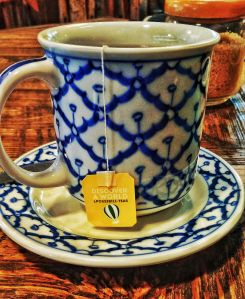
You see, I am prone to holding my breath. Just to illustrate: as I held my pen poised about to write that last sentence: I held my breath. What directly prompted this renewed resolve to finaly get down to facing the facts, is that just a little earlier I’d made a cup of tea, and when I went to put it down on the table? Yes, I held my breath.

I’m likely to hold my breath (for a short moment) at any old time: Bend down to pick up a dropped pen? Hold the breath. Raise a forkful of food to my mouth? Hold my breath. Do one or any of my regular physical exercises? I have to really watch myself, otherwise I’d not breathe at all doing them.

All the time, and at any time, as I said. Why? Well, that’s the question isn’t it? I can kind of understand it as a pause, a way to summon up focus and physical energy before doing a task requiring much physical (or mental?) effort.

But that’s just a guess really. As you probably could imagine, I’ve never discussed breath holding issues with anyone else. Well, present company excepted.

Anyway, my guess doesn’t really tally with the lightweight activities, like my pen poising before a new sentence, or my breath suspending before taking a bite of food. Something else is at play here.

So, what is air? What is it good for exactly? Well, umm, it’s a gaseous combination of a whole heap of ‘stuff’, the key one for us here is oxygen. And, more or less obviously we mammals and other beings too, need oxygen to breathe – to keep breathing. In other words it’s the ideal means of staying alive.

I guess that’s why some traditions call air, not only an element, but a sacred element. Life giving, life sustaining – some call it the Life Force, or Prana. Of course these two terms encompass other elements and concepts, but air is pretty much a fundamental component of the whole eqaution.

Next question: If I know it to be the life force, that which keeps me alive, why would I choose to suspend breathing? No, after pausing here (and holding my breath briefly), I’ve concluded that I very much doubt that I’m trying through this little habit to curtail the flow of the Life Force, or Prana through my body.

So, specifically, what does air do in the body? Well, it fills the lungs, which then somehow get the oxygen into the bloodstream (the heart’s job?), which in turn carries that oxygen to the brain, other organs, and to the muscles. I hope you will forgive my over-reliance on such complex technical jargon.

Once again, I can’t see how holding my breath as I poise my pen, is intended to deprive my arm muscles – and my brain – of the fuel needed to help the pen do its work of putting words on paper.

Anxiety? Well, finally we might be getting somewhere at last. When we get a fright, or fear something, or watch scary stuff in a movie, we will often ‘hold our breath in suspense’.

Maybe that’s where the breath holding habit began for me. Not watching movies, but perhaps when confronted with anxiety making situations. Of course picking up a pen is hardly a cause for anxiety, though eating might be?

Well, maybe those ‘little things’ are where the habit became a habit, but now I’m starting to think this breath holding might be a habit without a cause.

At least no consistent cause or causes. Anyway, there’s no point to  dredging the past to try to find out the why of the thing. What’s important  and the only thing we can impact on is now; best to pay attention to here and now;

So, I suppose the conclusion is simple: Sometimes a quirky little habit is just that, a quirky little habit.

PS A habit to be done away with mind you. Time for some little reconditioning of myself. I’d prefer not to hold my breath while writing notes, while eating, or while doing my exercises – or when doing anything else for that matter. The brain, the digestion, the muscles – this entire being – needs oxygen, and it’s my job to make sure that it flows freely and easily to everywhere it’s needed.

Self Enquiry: Listen to Your Self

This last little while I’ve been going through some serious contemplation, some deep questioning, on how to be ‘more of a monk’. Things like how to pray more deeply, and often; how to have a more focused and concentrated devotional practice; how to be a nicer person. Things like that.

Actually, that’s not exactly right is it? These are questions, enquiries, that for a number of years (is all my life too big a stretch?) habe occupied me. I’ve consistently been making enquiries, addressing questions, to Self – as well as to God or the Divine.

Still, like all things in life, self-enquiry goes through more intense, then less intense phases or periods. Let’s just say that lately I’ve been immersed – sometimes to the point of distraction – in one of those more intense periods.

(note from internal editor: Do I have to remind you once again to get on with the story you are here to tell?)

Okay then; let me see. Oh yes, right. Last night I was looking forward to beginning a new book. I’d read the introduction and thought that it was going to be just my cup of tea as it were, that it was something I would enjoy and learn from.

Anyway, as I opened the book on my tablet, I was suddenly stopped by a sort of wordless warning. The sense I had was that this book would indeed be a little piece of the answers I’ve been seeking.

Not so much in the contents I felt, it was more about approaching the book with more openness, less skepticism, more generosity of spirit and mental attitude. And the idea seemed to also include taking these qualities with me later as I thought about what I had read (or was about to read I should say).

You see, being more open, less skeptical, and more generous, come under the umbrella of being nicer. Still given the subject I was about to read about, I was a bit surprised by this ‘warning’.

As it turned out, I finished the entire book, so enthralled was I by the contents. The only things that tested my resolve to ‘be nicer’ was a number of occasions when the author’s worldview and interpretation of events, stretched my patience.

But, I managed. I didn’t become inpatient or outraged or irritable . When threatened by such responses I simply reminded myself that I was reading about another person, and I didn’t have to have an opinion one way or the other about what they believed or how they lived. Not only do I not have to have an opinion, I’m not sure I really have the right to an opinion about someone else’s life at all.

Besides, haven’t I just got through describing how I am myself deeply engaged in a process of self-enquiry? And wouldn’t such a process involve exposing myself to ideas, worldviews, kinds of information, new to me or not in alignment with my own beliefs? Surely bursts of impatience, indignance, judgement, and the like, would close me off in my search for answers?

Anyway, as I said I was so enthralled by the book – my reading informed by a little more generosity, a little less judgement, a renewed attempt at openness – that I finished the book in that one sitting.

Mind you it was only one hundred and something pages long. Still, for me, it was pretty good going.

PS Speed reading wasn’t – isn’t, nor ever will be – a part of my ongoing self-enquiry into the depths of my monkhood. Perhaps I need to add something like ‘Transcend the ego’ to my list.

Foster Your True Self: It’s A Big Deal

Today I finished watching  a beautiful and extremely fascinating documentary.  It was about life in a Trappist monastery as well as a fascinating history of that movement. I was struck by something one of the monks said.

He was referring to what he and his fellow monks are actually doing with their lives in the monastery. He said their lifestyle was helping them to:

‘foster who we truly are before God.’

Hearing this, I had to pause the video, make notes, and do some thinking. What had actually struck me, my first thought on pausing, was that this is exactly what I’m doing as a hermit monk dwelling in our Hermitage. Exactly what I’m doing. Well, at least it’s what I’m aspiring to.

There are two aspects or primary intentions that inform the life I try to live as a hermit and monk that are in fact integral one to the other; they merge actually to become one primary focus of my life.

I practice an ever evolving and I hope intensifying devotion to the divine, with the upliftment of the world and all beings as its central theme.

The other, integral focus, is an equally ever evolving and intensifying quest for self-knowledge, for the answer to the question, who am I?

In other words, I am attempting to foster who I truly am before God. Foster as in ‘encourage the development of …’ (as one definition puts it).

In this case, the development is the growth of the knowledge of my true nature – who I am above and beyond this physical (and mental) creature running around madly trying to figure things out.

In my life there is much effort devoted to the cultivation – a synonym for foster – of that knowledge: meditation, prayer, contemplation, study, just sitting, being still. Did I mention the aspirational nature of all this? It’s an ongoing project to say the least.

Speaking of aspirational: Two more synonyms for foster that I like are nurture and support. Both are even more in that aspirational category; at least it feels like that sometimes. Actually, maybe there’s a more accurate way for me to be putting this.

After all, as I think about it now, even I would agree that my whole lifestyle, my entire way of being in the world supports and nurtures me.

Except for me, myself, and I, that is: Lest the inner grammarian sends me mad in a search for antonyms for foster, let me just say that I am overly skilled in the self-critical and self-destructive departments. My ability to put myself down and to tear myself apart is legendary.

Anyway, with overwhelming nurture and support coming from my partner hermit all the time reinforcing my sense of Self, all I have to do is work on ridding myself of these self-destrucitive and self-critical tendencies.

So, the conditions for the banishment of self-loathing are there; all that’s missing is discipline on my own part in seeing the Divine in myself as I profess to be trying to see it in everyone else.

I need to be rid of the forgetfulness  that blinds me to the Truth that is actually very plain to see.

Speaking of the Divine, the ‘before God’ is the vital element for me. God is all there is, so it is always before God that I act, whether in a positive or in a not so great manner.

The best prescription is for me to remember. To remember that God is everywhere and everything (did I say that already?). To remember that me, myself, and I, are also included in that everything and everywhere.

I think that once I do remember these truths even for the odd moment now and again, then the real fostering of who I truly am will have begun.

The Hermits Visit a Coffee Shop

Namaste and Greetings

Welcome to another poetic sharing post. There have been a few lately haven’t there? I had thought that once I had the new page Poems of Devotion up and running that I would only feature one every now and again in its own post.

However the one I feel inclined to share with you today is slightly different. Well, not really: it’s still a devotional piece, but for some reason feels a little other than that.

This hermit’s choice: the number 1 coffee shops in the Hermitage neighbourhood

For a start, it’s set in a café and features the thoughts of a hermit monk (me), and is about what’s going on in that space at that moment. As well as what’s in his mind and heart. Oh yes, almost forgot: the action takes place on Election Day.

So, what is it that makes me feel this poem is ‘still devotional but slightly other’? Well, aside from the setting, timing, and so on I just described, I sense that, in its words, in its composition, the hermit has sought to record (through the poem) that moment in the café as the reaching out to all those fellow beings sharing the space, to recognise, and to celebrate the divine in them all.

May that intention shine through to you too, dear reader

THE HERMITS HAVE COFFEE ON ELECTION DAY

I feel like I’m sitting
in a Hopper painting.
Just off the village green
at a coffee shop, in the Toukley Mall.

There are people; aren’t there always?
Coming and going.
This one catching gossip; that one seeking connection;
One or two heads down, backs bent
over newspapers assimilating myriad tales of woe.
It’s election day.

Of little interest to the hermits,
out of the hermitage for coffee.
A treat that comes at a cost.

Voices – of people and of headlines –
speak, some even shout,
of worldly things. To us not real.

Leaves me hollow.
That’s the vibe,
the feeling inside
– And that’s not real either.

I Want to Sing Praises: A Poetic Offering

Occasionally, on this blog, I have had the good fortune to be able to share with you a poem I have written.

I say occasionally because, at best, I am an occasional poet – or rather than take on that label, it’s better to say that sometimes words in some kind of poetic form emerge.

From time to time said poetic emergences could be called devotional. Devotional in the sense that my words seek to express praise, recognition, gratitude or similar sentiments, ideas, thoughts, and so on, directed towards those things I regard as sacred.

That might be ‘God’ in the direct sense that we all would understand right away, or it might be the divine as manifested through objects, people, or other beings in the material or non-material world.

Actually, come to think of it now as I make these notes, I realise that according to that not so short definition, most if not all my poetry has been devotional for quite some time now. Yes. I think that’s right.

Anyway, to get this post moving along a bit. A few days ago, I mentioned to my community, ‘I’ like to write devotional poetry.’

‘You do already,’ was the unanimous response. To which I replied, ‘I suppose so, but I want to sing praises.’

Hare Krishna Hare Krishna Krishna Hare Hare
Hare Rama Hare Rama Rama Rama Hare Hare

And that, my friends, became the title of a poetic effort from me expressing just that exact prayer.

Now I share with you those words that were given me as I ‘just sat’ in our temple.

                                 I WANT TO SING PRAISES

Devotional poetry.
That’s what I want to compose.
Actually, is there a calling to such composition?
Yes, for I do hear the call; it resonates deeply.
But, my ego-mind, it’s not listening.
Anyway, composing poetry devotional
is of the heart;
It leaves the mind behind.
Looks like one more ‘make the mind your friend’
moment.
Praise be all that is.

Who? Just One of Many Questions

In November last year I published a post on this blog that sought to answer the question, Why do I pray?
In that post I said that this question is one of the big ‘Who am I’, Self-Enquiry questions.

I also claimed in that post that it was (is) a core aspiration of mine that I make prayer a ‘whole of life activity’. To quote me from that post:

You see, I want to pray, and make my whole life a prayer. A prayer of praise and devotion; a prayer of gratitude and loving; and a prayer of service to all beings .

Anyway, moving along to today’s post.

That question, why do I pray, is one I ask myself quite often. It’s not a one time enquiry you can tick off and move on from. The contemplation of why pray is an ongoing and evolving thing.

A couple of days ago, as I once again reflected on this particular question, it occured to me that perhaps it wasn’t the only one I needed to be asking myself if I am to think about my prayer life in any depth. Actually, the same could be said for pretty much anything one is trying to find answers to.

Indeed, many writers – particularly story tellers and journalists – will be aware of the series of questions often used to get to the truth of something:

Who? What? When? Where? Why? and How?

Commonly refered to as the ‘The Five W Questions’ (although there is that H in the mix leading to some calling them the WH Questions), these questions asked correctly and thoughtfully, will help to ensure a comprehensive and complete answer to any enquiry.

The next thought popping in suggested that it might be a great idea to apply the W Questions (including the H) to me and my prayer life.

At first I thought it seemed like a neat challenge, a kind of intellectual exercise that would be interesting. Then, though, after thinking about it some more, I realised that contrary to being just some mental challenge, asking myself these questions in relation to my prayer life, might actually be essential.

Especially if I am to some day reach fulfillment of my aspiration to make of my whole life a prayer. It’s the only way, I reasoned, that I would be able to get complete picture of the state of my prayer life.

Of course I have to wonder if it is indeed possible to ever get a ‘complete picture’ of a phenomenon such as an individual’s prayer life. Still, let’s just plunge in, see where it goes, what happens, how it works.

Who

There are actually two ‘who’ questions that I’d like to try to answer, both essential to our enquiry:

Who is it that’s praying? And Who do I pray to?

The answer to the first question is obvious: it’s me doing the praying. But, which me exactly? Not the me who is the true Self, the Absolute Reality. The reason why will become clear as we go along.

No, the me doing the praying is what we might call the body mind complex, the me that lives in the material world as a material being. The impulse to pray, what to pray, who to pray to and all the rest arises in the mind.

Mind you, I along with so many others I’m sure, like to say that I pray with and from my heart, my spiritual heart. But then I do also know that emotions originate as thoughts in the mind. Of course that does not lessen the significance of such emotions and the prayers, love, or devotion that follows.

Now, who do I pray to? I know it’s going to sound a bit odd, flippant and even silly, but as I think about it, I realise that I do in fact pray to everyone and to everything.

Which is to say, my prayers are directed to that invisible ‘something’ that pervades and permeates – and actually is  – everything that exists. You could say that I pray to existence itself. There is nothing or nobody else.

Of course it’s not exactly an easy thing to get a handle on praying to ‘everything and everybody’. I mean, where does one direct their attention? Who or what does one address or speak to? The answer is a lot more straightforward than you might think at first.

Because my prayers are to that amorphous ‘everything and everybody’ it’s quite easy to select one or more resonating and meaningful somethings or somebodys as the objects of my prayer.

There are many spiritual or religious traditions in the world, all with their preferred names and forms of the Divine (or Existence as I named it earlier). Each of these manifestations of the Divine has its own characteristics, their own place in the Universe. They each play their own roles in the cosmic order.

As such there are more or less an infinite number of choices for me to have as foci for my prayer life. I will try to share with you a few of my personal pantheon.

Om: The Essence of Brahman, Absolute Reality

The Existence I’ve mentioned a couple of times is named by some Brahman, the Ultimate Reality, the everything and everybody that I was talking about.

So, I might sometimes pray to Brahman. Mainly it’s an aspirational prayer as I seek to realise fully my already existent oneness with the Ultimate Reality.

Then there is Ishvara, which is probably closer to what most would recognise as God – a personal supreme being, Or, in some traditions Ishvara simply refers to the one or more deities that an individual chooses as objects of her or his devotion.

Centre of Attention on the Hermitage temple alter

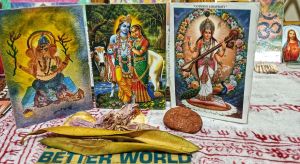
Also included in my personal pantheon, are the Divine Mother, Kirishna, Ganesha, Lord Jesus, The Buddha, Sarasvati, as well as other teachers and saints from many traditions who pop in and out of my prayers, seemingly at random.

My prayers are of praise and/or gratitude to the teacher, deity or saint who seems to me at that moment to be most linked to my current circumstances and thoughts.

All of this I call prayer. To God. Or Brahman or Ishvara. Or very often, simply My Lord,

Divine Mother

The Q&A in the Scripture Part 1

Welcome to the first in a short – and occasional – series centred on a text containing a kind of Q & A session between Krishna (God) and Uddhava (his cousin).

Thirty six questions in all, with which Uddhava asks Krishna how he can live a good and honest life, dedicated to doing right and living the truth.

If you haven’t already, it would be really helpful if you read the Introduction post here, before going much further; just so you have a better handle on the context, the background etc. It will just help to set the scene a little more.

Now that’s been said, let’s get on and into it. The very first question Uddhava puts to Krishna is actually two questions in one.

What is quietude and self-control

Good questions, the both of them, given the circumstances Uddhava finds himself in. His hometown (it’s Krishna’s too) is about to descend into a nasty civil war and is most likely a chaotic, noisy, overwhelming and frightening environment to be stuck in.

Uddhava, like the rest of us just wants a peaceful life, and as to the second question, well he’s bound to be asking himself the same question we’d ask: Why can’t these people just control themselves before it’s too late? Not to mention the onslaught of emotional and mental anguish he’d be suffering himself.

Anyway, Uddhava is about to leave town following his cousin’s advice, and would like to find out how he can go on to live a good, righteous and honest life, while he’s in exile from his home.

Krishna chooses (sensibly I’d say: they’re both big questions) to answer one question at a time and he begins by explaining what is quietude:

Quietude is fixing the mind on me.

Krishna is not saying here: ‘Look, once I’m gone [I think I’ve mentioned that he’s leaving too, going back to Heaven or wherever he lives on a permanent basis] try to remember your dear old cuz in the odd quiet moment now and again will you?’

What I think he is actually saying is: ‘If you fix your mind on me, then that’s quietude’. We could call it silence as well. He’s not saying ‘I am in the silence’, nor is he saying ‘Through silence (or quietude) you will come closer to me’. No, what he says is ‘Quietude is what I am’.

So, what about those of us not in a first names relationship with Krishna? Well, think of Krishna as being a name and form of Universal Consciousness. Yes, the same Universal Consciousness  that is all created and non-created things; the sun, Earth herself, trees, the oceans, all living and non-living beings in the Universe, in all universes if there are more than one.

There are a whole list of synonyms for quietude: equanimity, calmness, peace of mind, rest, serenity, dispassion. Just to name a few.

These further definitions are really quite helpful. What I mean to say is that we rarely if ever associate that calmness, equanimity, peace, and the rest, with actually being the Universal Consciousness, that is also all of us and everything else that is. Again, think of Consciousness as the Divine, God, or by any other name and form, you attribute to the natural order and flow of the Universe.

Forgive the repetition : Quietude, calmness, peace of mind, are not where you will find God or consciousness, or whatever. They are all consciousness.

The beach is also dog friendly

Have I mentioned that the current hermitage is a cottage on the side of a large sand dune, on the other side of which is a stunning stretch of Pacific Coast beach. Sitting on the top of the dune and looking out over the beach and ocean it is easy to think of all that’s seen as divine.

It is most definitely a peace of mind, calm and quiet inducing experience to sit there. Certainly it is quietude itself with the only sounds being the song of the universe in the form of the waves and wind.

A question I asked myself, and I now pose to you: If what we’ve been calling Universal Consciousness is actually all that is, then why not a state of mind like quietude, calmness, balance, and the rest? Like everything else perhaps these states are simply elements of that consciousness or Absolute Reality, or oneness, or what some call God, the Divine, or … ?

In any case, I have a feeling that’s what Krishna was getting at with his answer, and what Uddhava somehow intuited with his question.

Thank you for joining me on this little pilgrimage. in the next post in this series (it could appear anytime, so stay tuned!) we will discuss Krishna’s answer to Uddhava’s second question: What is self-control?

Peace

Un hommage à tous les ailés

Silence Is!

Everyday I affirm, I pray with longing and with hope, these words:

Let me keep silence in this world

Some days, like today for instance, the prayer feels empty, devoid of any hope, or faith on my part, that I will at some point really be able to attain at least a degree of silence.

Yes, I know, prayer is not some kind of magic formula by which one utters the words of the prayer as in some kind of incantation, then in due course that which has been prayed for appears or comes to pass as if by magic.

Prayer, rather, is affirmation in which the one praying places full attention on the words prayed and their meanings. And more importantly on the notion that the Universe is in perfect balance all of the time, and that things – all things  – are manifesting how and where and when and why, and in precisely the manner that they’re supposed to.

Prayer is more a kind of wake-up call, a reminder notification to Self that everything is exactly as it is, and is meant to be that way.

Fine theory. Yet it’s a theory I sometimes know to be much more than a theory.

Other times, this being one of those times, I have a hard time, or I should say my mind can’t accept that silence does indeed exist. My mind is simply not able to grasp that silence is already within me, ready and able to give me peace.

Closed Cafe at the End of Lonely Street: Silence comes in many and varied forms

It is obvious to all of us I think, that silence is not simply the mere absence of words, of speech. Not talking is simply one aspect of silence; it’s like silence is a thing, an entity or state of being that doesn’t only imply an absence but suggests an adding on of a new state of being.

When I pray Let me keep silence, it is true that I am seeking the silence of the mind, the inner silence that can bring calm and quiet to the heart and whole of Self too. But, to be truly upfront as they say, it is the silence or quiet that emerges from time spent not speaking that I long for.

Long for? I use that word quite often and it’s occured to me that, while to long for something is to have a desire for that thing, a longing is actually more than a simple desire. It’s a very strong desire, a kind of desperate wanting or wishing for that thing. You might even call it a compulsion.

Now I think about it, what is the desire or drive that keeps me doing exactly the opposite? Why do i feel the need to be talking (thinking too, but here I’m thinking about talking too much) all the time? It is clearly also a compulsion. That’s the only conclusion I can come to.

So then, why the compulsion to talk all the time?

Well, to once again be frank, upfront, I don’t really care about the reasons for or causes of, this compulsion. Probably stems from deep-seated anxiety, long-standing low self-esteem, old habits, fear. The list of explanations could go on and on, but what would be the point of that?

The real point, for me, is that compulsive talking is no mere bad or inconvenient habit. Personally it can actually cause physical symptoms of the ‘feeling sick’ variety, as well as guilt, shame, even sadness and regret.

And even far worse still is that this compulsion causes at the very least for those around me annoyance and frustration. Incessant talking distracts them from their own thoughts and activities, disturbs their own desire for silence. It’s all very obvious to me.

So, while I am compelled to talk all the time and too much, at the same time I have a strong aversion to that very act of talking too much (and all the time). The talking too much causes suffering to myself and others, while my inability to change also causes suffering. A kind of no-win situation arises, has risen, is always present.

Okay then, what is the solution? Or, more to the point,is there a solution? Well, I didn’t start making these notes with the hope that I would somehow come up with a solution to this dilemma . But, having said that, I’ve been thinking while writing that I do seem hugely attached to the idea that I talk too much, and too often. 

As well, I also seem desperately  attached to the desire to stop talking so much and so often.

While doing all this (possibly excessive) thinking, I was reminded that the Buddha didn’t say that the cause of suffering is desire; what he said was (allow me to paraphrase): the cause of suffering is attachment to  desires.)

You know, another thing I write and think of a lot, is the idea that things work out exactly as they’re meant to. Of course not so easy to actually believe all the time, especially when things aren’t going according our personal wants, desires, and wishes. But it’s another of the prayers if you like, the affirmations which speak of the truth of the balance of the workings of the Universe.

In a way then, despite the lack of intention, I may have nevertheless stumbled upon at the very least a hint of a solution to my dilemma.

We ourselves are merely one more manifestation or result of those workings of the Universe, of that natural order, of those laws of nature that keep it all (including us) in motion.

So, I’m back where I started when I described what I believe prayer to be: an affirmation and a statement of faith in the reality that the Universe is unfolding exactly as it should.

Perhaps if I spent more time (not to forget more heart, more mind, more love) in reminding myself of that reality, and less in toying with my compulsions and aversions and with all my efforts to shift and maneuver the natural order of things to my liking, then I might find that equilibrium , that – what’s the word? – equipoise – in which I may actually realise the balance that I know already and always exists. Maybe then I can finally attain silence.

Deep with the still centre of my being,
may I find peace.

Silently within the silence of the grove,
may I share peace.

Gently & powerfully within the greater circle of humankind,
may I radiate peace.

Just a quick final note: my idea that the universe is working out exactly as it’s supposed to is not mine and it’s not new. I’ve quoted the beautiful poem/prayer Desiderata (the word is from Latin for things desired) before, but there’s a line from it that I’ve borrowed heaps of times:

No doubt the Universe is unfolding as it should


Thank you for allowing me the privilege of sharing all of this, which is really one long prayer, with you.

One, Without a Second, is All There Is

Right at the front of my Bhagavad Gita (the only book aside from the notebook I’m writing this in, that I personally own), I have recorded and inserted sayings and various words , that are important to me. Among those things is a statement I first heard many many years ago, that is common among the First Nations’ peoples of this country:

I [We] stand always on sacred ground and beneath sacred skies.


It is not an affirmation of ownership or possession. It is, instead, an affirmation of belonging to the land, to nature. It is a prayer of thanks, and it is a declaration of the knowledge of unity with the rest of the natural world, that is the hallmark and foundation for Indigenous cultures throughout the world and through time.

I’ve valued – treasured – this sentiment for a very long time – probably from even before I first heard it, which was so long ago as to be lost to memory. Perhaps I always knew it because I’ve somehow always thought this idea was a fundamental truth concerning my existence as a being living on this planet.

Well, now I have heard another statement that for me makes a perfect compliment for this one. The other day, during a lecture, my teacher mentioned that in his student days a fellow student said:

Wherever you are, you are walking through Ishwara

(Ishwara being her preferred name for the divine – for all that is.)

There is a feeling or sense of ‘belonging’, of awe and wonder when we attempt to immerse ourselves in what we term the natural world.

Once again I immediately felt the bell of Truth ringing clearly through this statement. Yes, I thought, everything is divine – including our own selves – so of course it follows that wherever we go, whatever we do, we are always in the divine.

You’ve probably read a number of times me quoting my teacher quoting his teacher:

It’s not that there is only one God, there is only God.
          Swami Dayananda Saraswati

Emphasis very much on only. Meaning of course, that it’s not that God is within us, or that we are within God; we are not surrounded by God; and it’s not that God ‘sits in our hearts’. The reality (for my teacher’s teacher) was that all that is, everywhere, everything, every thought, every word and deed, everything there is, is the divine.

Another way to describe the divine or God, that appeals to me is that Ishwara (also my own preferred name for the Divine) is in reality the natural order of the universe as dictated by the laws of nature. Those laws of nature, the rules that govern how the universe works, are also Ishwara, as are all that is manifest or in existence  as a consequence of the workings of those laws.

In other words, the Divine is the sum total of what some would call the entirety of creation.***

For the hermits a sacred site. Part of a grove we named The Sentinels. A place of experience of unity and oneness of creation

For me this an enormously comforting and reassuring concept. Of course, for me at least, it is also an extremely difficult one to wrap my head around. But here’s a small summary of what I think I’ve grasped so far.

Ishwara – the Divine – is all there is; everything. Also divine is the natural order of the Universe as governed by the laws of nature. These laws are neither good or bad – there is no duality. They are neutral.

You and I, as one more entity among who knows how many others, act as we do and are subject to the laws of nature, just like everything else. We can’t change or influence those laws; we can only live our lives as they unfold.

To quote from Desiderata: No doubt the Universe is unfolding as it should

And, well, then things just work out as they do. While we can’t change the laws of nature, or bend the universe to always suit our liking, it is also true to say that every action we take, every thought we think, every word we utter, even our very presence as a living being in our time and place, do indeed contribute to ‘how things work out’. Another way of saying this is to say, we do our bit, and the universe does its bit and what happens, well, happens.

For me, this is not at all as simple or as straightforward as it sounds. Naturally  we see ourselves as individual selves, as entities on our own. After all, to state the obvious, we live and operate in a material (dualistic) world. So automatically we see ourselves as individuals living in, but always separate from all the other individual entities, as well as being disconnected from the world itself.

It is part of human nature (for the most part) to long for connection; there is so often a drive within us pushing us to create family, enter relationships, feel we belong to a community or communities, and for many but not all, there is the almost instinctive urge to seek connection with the rest of nature.

Many forms, One reality

We often think of these longings as goals to achieve, as something outside of ourselves to attain, to reach for. Consequently, so very often we tend to focus our attention outwards, towards other people, or material things.

But, instead, all these inclinations, desires and longings are simply our Self (note the capital?) endeavoring to open itself to discovering (or rediscovering?) that which already exists: our oneness with, and our non-separation, and non-difference from, The All That Is.

Peace and Love from Paul the Hermit

FOOTNOTE

***Just a few thoughts about naming, or giving labels to the Universe and its laws.  Obviously it’s a personal choice for each of us what we choose to call that creation. Then, on the other hand, we don’t have to call it anything at all. For me personally it is very difficult, even near impossible to not name it. By naming the creation, I don’t think I am attributing the manifestation of the Universe to some distant entity living in some heavenly abode (as my teacher likes to say). Rather I am acknowledging the intelligence  and order, beauty, complexity of all that is and how it all works, as its own reality. At the same time, I am learning to understand that I as my true nature am not separate from the rest of creation, and I feel the need to have a name towards which I am able to focus my thanks and my reverence.

You Can’t Always Get What You Want

‘I wish I could write a blog post.’

So said I to my partner hermit yesterday. You see, for a few days I’d felt the coming on of a blog post: no topic, no clue as to ideas, and no hint of anything, only that it was on its way. Hence the exasperated outburst.

What’s wrong with wishing for something we want? Absolutely nothing. Sort of. Contrary to popular rumours, erroneous teachings, misunderstandings, mistranslations, or just a simple lack of information, Buddha’s Second Noble Truth does not say ‘The cause of suffering is wishes’ or we can say desires.

What he actually taught was that the cause of suffering is clinging. Clinging, being attached to a desire so strongly that failing to fulfil that desire causes us to suffer through annoyance, frustration, sadness and all those other things that impact on our mental or emotional wellbeing.

My teacher uses the word  compulsion. Compulsion to chase after what you want, compulsion to run away from what you don’t want.

Using me as an example: yesterday I wanted so badly to write, and was so frustrated that I couldn’t write just then, that I caused myself suffering. Because I couldn’t have what I wanted immediately, I made myself miserable.

Just as an aside (or perhaps not?), I realise that this little annoyance hardly means anything in the larger context of living and suffering that all of us experience simply by being alive.

But in a way, that’s my point. How many of the things we desperately want or that we desperately don’t want are the ‘little things’? Aren’t they so often the very things that, on a daily basis, cause us the most annoyance, frustration, anger, and even sorrow?

In any case, I had made myself annoyed with myself, frustrated too. However as soon as it was suggested that I needed to just down and type something – anything – if only to get the words flowing, I felt much better. I had the answer!

So, here I am, albeit a day late, and not typing as it happens, but scribbling in my notebook. Actually I don’t know why I don’t type it all up first thing, cutting out the middle step.  I mean, it really does flow better on the screen (via my fingers on the keyboard of course), and it’s also, as an added incentive, a whole lot easier to read than my scratchings.

I suppose I could say that not all old habits that have not quite died just yet, are necessarily ‘bad’ ideas. I happen to like my notebook.

Now, here’s the thing, the paradox if you like. I had felt a post coming on, and because I wished so badly for it to emerge and it wouldn’t, I suffered. And then, I sat to write something (anything as was suggested) and voila: the desperately, compulsively, longed for post obedeintly appears.

Cause and effect? I mean to say, which came first? Did I at some deeper subconscious level already have an idea to write a blog post about how clinging and compulsions and attachments to the things we want – and aversions and compulsions to get away from things we don’t want – cause us suffering?

Did that existing but deeply buried idea then manifest itself as a real world situation to give me the ‘material’ to write from?

Or, perhaps more simply, I got annoyed because I couldn’t write, so I made myself write (took a day to get to it though; remember me saying?), and well, what you see is what you get when one sits to write – words on a page.

Who can say? There are theories that propose effects can and do often precede causes. It’s a tough one to get my head around, and somehow I don’t think there’s any point in trying to.

We know instinctively that everything that exists in the Universe is constantly changing, evolving, devolving, mutating, never still. And we also know that we can affect what happens in our lives and in the world around us through our own actions. Some might disagree with me on that last one; it’s only my opinion.

The tricky bit is that oftentimes we forget that those changes as well as the lack of fulfilment or otherwise of our desires (wishes also), and even the results of our own actions aren’t always to our liking. Well, it’s not that we don’t know it in our minds and through personal experience, but when it comes down to it, we all usually as part of our normal conditioning, suffer when outcomes aren’t to our liking. It’s like we know it but we haven’t realised the truth of it yet.

Sounds like a trivial or flippant, even silly and pointless, thing to say, but it’s demanding to be said anyway: things (as in life and the rest) always work out how they work out.

But if you think about it, it’s true whether we like it or not. Actually, in a sense this is one of the very important, even pivotal points, of my ongoing studies, meditations, and contemplations. To realise fully that I, along with every other living thing, has a place within, no, not just a place within but is actually an indivisible part of, if I may be forgiven a cliché, the grand scheme of things. Not only that, but we in our essential true natures as Consciousness remain untouched and genuinely okay whatever transpires here in the material world.

I do what I do; you do what you do; and regardless of whether we like the outcomes or not, things work out as they do. Sorry to be repeating myself. Just seemed the right thing to say again.

And here’s another tricky bit: it’s not about resigning ourselves to ‘fate’ or ‘destiny; or whatever we might call not having control over our own lives.

Just by way of exploring that last point, and finishing this post, I would like to leave you with a quote. Yes, I know, we are all bombarded by quotes from famous (and not so famous) people, aphorisms of all sorts, and affirmations that claim they will improve our lives.

I truly believe this flood (mixing my metaphors here) of good words, written with good intentions, has numbed us to their actual value and usefulness to us in assisting us to live good lives.

So, here is one such, that I think puts it in a nutshell, in a very simple, straightforward way, an important Truth. It’s called the Serenity Prayer, and rereading it just now, I see clearly that serenity would indeed be the outcome if we are able to take this invocation to heart, and begin to live by it.

God grant me the serenity to accept the things I cannot change,

Courage to change the things I can,

and the wisdom to know the difference

Peace and Love from Paul the Hermit

PS: This version is only one among many. In fact, the Wikipedia entry linked above is a fascinating (though apparently quite flawed) exploration of this prayer and its origins.