Taking it Slowly, Taking it Mindfully

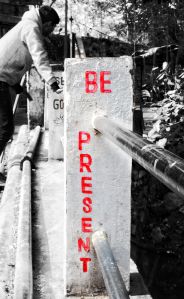
A small irony revealed itself to me just now as I prayed my way through the prayers inserted in the front of my Bhagavad Gita.

I’d completed one prayer and turned the page to the next. Then, without a pause or thought, I quickly turned the page again. I stopped, thought better of it, and turned back to attend to the prayer I’d skipped over.

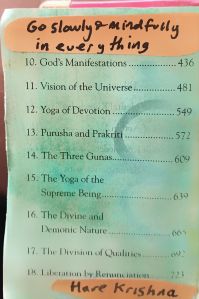
Now, here’s the irony: The prayer on the first side of that carelessly and mindlessly leafed past page read simply:

Go slowly and mindfully in everything.

Well, that’s not the ironey itself. But, given that this was the page I had simply passed over without a thought, with no pause, the words written there obviously were a lesson for me.

A message to contemplate, to actually stop and pause with, mull over, meditate on, and perhaps make resolutions over. Advice to me to stop, to slow down.

Couldn’t be clearer really.

There’s no telling why I skimmed past that page, that prayer, without a pause. Could be a simple case of absent-mindedness, or a rush to see what was on the next page; a grass is greener type of thing.

Why I was rushing through the pages isn’t the point. What is to the point is here I am, doing morning prayers, praying some, then skipping others. The other point is that in this instance, for some reason I stopped, went back, and prayed the skipped prayers.

So, moving to the resolution.

It’s extraordinary to me when that kind of thing happens. (It does happen quite a lot, but unfortunately I only notice it occasionally) We will have an intuition, or receive a message from ourself that helps to us get back on track when we mess up.

In any case, it’s obvious that I’ve found what I might call the prayer of the day, the mission statement, so to speak, informing whatever activities I undertake today.

Slow and mindful in everything I do, say, and think. For now, for the present, that will the guide on the path of today that I will follow. Keeping in mind the adage that practise makes perfect, for when I falter.

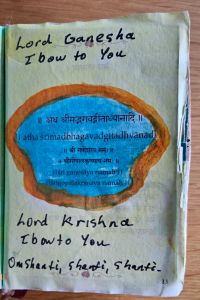
Oh, another irony wrapped up with this one. The prayer on the facing page was also skipped, and in itself sheds another light on the message from that first one. That second prayer actually puts forward one, important, way in which I can actually set about achieving  that first one:

In other words: place more focus on, pay more attention to, the Divine in whatever form, and by whatever name, I encounter it today.

Works both ways I think: Making the effort to go slowly, to be mindful, puts us in the present moment. And, the present moment is the only place we’re going to be able to become aware of the Divine.

Then, as we become aware of the presence of the Divine, we are right where we need to be, when we need to be there in order to actually slow down and be more mindful.

PS These notes were made a few hours ago. Since then, I have on the whole practised being slow and mindful. Not perfectly, mind you, but then as I say, practise makes perfect. Even now as I type this – very attentively – my mind wanders, so there is a way to go for me. The day is not over yet!

A Few Thoughts on the Big Question: Why a Monk’s Life?

Just now, on rediscovering a quote I’d noted down months ago, I spontaneously decided to download again the book I took it from. This will be the third reading: seems to be one of those books that keep calling you back.

The book (The Abbot’s Shoes by Peter Robertson) tells the story of the author’s foray into monastic living in New Zealand way back in the early 1970s when he was twenty something.

One of many mini monastries we’ve been blessed to live in

I’d like to share the mentioned quote with you, because I think it really speaks to my own commitment to the contemplative, hermit life, which is for us a monastic life too – a hermitage is actually a mini monastery.

Sitting in his apartment one night, completely dissatisfied with life the universe and everything, the author contemplates the state of the world around him.

‘All the marching, all the writing, all the campaigning in the world isn’t going to change this insanity, brutality, and carnage.’

Actually this isn’t the quote I’d made a note of; it’s the preceding  sentence which I saw again today and it seemed to just fill out the context for me. Anyway, after a few moments of quietness and thought, the author concludes:

‘I somehow intuited that the most powerful, significant , and influential  action I could take to change the course of this kind of history, was to hide in a monastery.’

He goes on to reflect that by doing so – living simply, in a community devoted totally to contemplation and prayer – he could become a tiny part of ‘the turning of the tide’.

Years later, reading Thomas Merton‘s diaries, he discovered that Merton had felt the same way, concluding that those living simple, prayer filled, contemplative and quiet lives were ‘keeping the universe from crashing in pieces and falling apart.’

There is a strong sense among contemplatives, hermits, nuns, monks, that this is their function: keeping the whole thing going. Or as our author says, each playing a tiny part in the big picture. I would say, like I know Merton did many times (and acted upon his words), that action in the world is absolutely necessary; it’s just that it can’t do all the work alone.

In our hermitage we too speak often of these ideas, and think about them deeply and try to realise how they affect our lives as hermit monks.

So, hiding in a monastery? Or in a hermitage? It’s true it’s very much a hidden life in many ways. For me though, it’s not about  being hidden, it’s more about just what Black Elk says, I’m trying to make my every step a prayer.

Speaking for myself, it’s not that I’m unwilling to pray for a specific individual, or for peace in such and such a country, or relief from poverty, and oppression for specific individuals or communities.

It’s more that: picking and choosing in that way risks leaving people and issues out inadvertently or through some unconscious bias.

I have chosen to live this life apart as much as possible from the world in order to minimise the anxiery being ‘out there’ causes me, to have the quiet, the time, the ‘head and heart’ space to simply pray. To make of my life a prayer

Let every step you take upon Mother Earth be as a prayer

Black Elk (Ogala Lakota Holy Man)

My partner hermit is fond of reminding me of the well known aphorism that a stone dropped in a pond will make ripples that spread out and out. Just like the vibes – the vibrations – emanating from a prayerful life, from all the prayerful lives.

Realisation of Reality; It started With a Joke

‘I like looking at you,’ says the hermit.

‘You must be sick in the head,’ replies, as quick as  you like, his partner hermit of 40 odd years. (Obviously an old and oft shared joke).

‘Of course I’m sick in the head,’ bursts out of the hermit in response. ‘It’s like saying the sun comes up every morning. It’s a given, a simple fact of life.’

Problem is, it’s not true is it? the sun I mean; it doessn’t come up does it? Doesn’t go down either for that matter. I mean it looks like it rises up every morning, and it looks  like it goes down every night. But it doesn’t. In reality it’s us here on planet Earth who are doing the turning.

At ‘sunrise’, our home planet in its continual revolving has us looking at a stationary star (our Sun, Sol, Surya) that is, rather than going up, just sits there as we revolve downwards leaving it behind, Same story at night with the sunset, just the other way round.

Our experience when looking at this scene is that the sun is going down behind the hills. But in reality it’s the hills and river and the viewer going up as Earth rovolves. Hard to get one’s head around.

To explain what we see, what we experience – or rather what our ancestors saw and sought to explain – the simplest, most obvious thing to do is tell it like we see it. Sounds obvious enough, but as we’ve just seen, the story we inherited and which was only recently (in historical terms that is) shown to be incorrect, of the rising and the setting of the sun was based on an illusion,

As to the hermit and his story – the long-held believed to be true story – well, if we’ve been able to establish that stories we tell ourselves are often based on illusions, then perhaps the hermit can look for another story concerning the state of his head health, that is based a little more on facts, not so much on illusion.

Or to put it in other words: It’s quite possible that if the truth of the matter is that the sun never goes up and never  goes down, then just maybe the hermit is not actually sick in the head.

Except perhaps when it comes to old jokes shared between beloved partner hermits.

A Plea for Forgiveness

It was way back in the earlier days of this blog, sometime in 2022, that I wrote a post about our community’s liking for snacking on plain toast by choice. It’s our more or less regular late evening, before bed, bite to eat. Perhaps accompanied by black tea, as I described in that post.

As I also point out in that post, I do actually enjoy plain toast. It’s not that I no longer like jam or other yummy spreads; I like them too well truth be told, but sometimes, well, plain is good.

As the day winds down to become night, and we settle to our evening snack, I will sometimes make a joke about simple food, or monks with simple tastes, whatever. Anyway, a few nights ago I made a remark, a joke, that has had a profound impact on me.

‘I’ll just say a prayer for my two slices of dry toast.’

Of course I am just like so many other religious or spiritually inclined people, and say a prayer before I receive any and all food or drink. It’s a long time habit, and a blessing I like to perform. Just a thank you is all it is really.

This comment, this joke, as soon as it was out of my mouth, I realised, of course I will. Don’t I always?

It’s true that our community lives simply, as simply as we can. And that includes what we eat and drink. It’s also true that this is not some sort of ethical stance consciously taken; nor is it a kind of overlaid act of solidarity with those who have no choices due to poverty or other circumstances.

It’s purely and simple because we like simple. It really does suit our natures and temperaments and for us it is the obvious way to live.

It is no renunciation: we welcome simple. This obviously is not to say that we are unaware that our very natures and temperaments naturally steer us away from choices that are unethical or are out of sync with compassion (call it solidarity) for other beings.

The reason I’m ranting on about this off-hand comment thrown out as a so-called joke is, well just that: It was off-hand, and my misguided intention in making this ‘joke’ was insensitive and careless; it was lacking compassion for all the other living beings sharing life and consciousness with me.

And for that flippancy and carelessness, I ask forgiveness from the invisible community that is in fact all of us struggling to live in a material world.

My sense is that in saying ‘all of us’ I might instead say, all of us who are in truth One; We who are that one Self that seeks forgiveness.

And in Conclusion: According to the Text Message

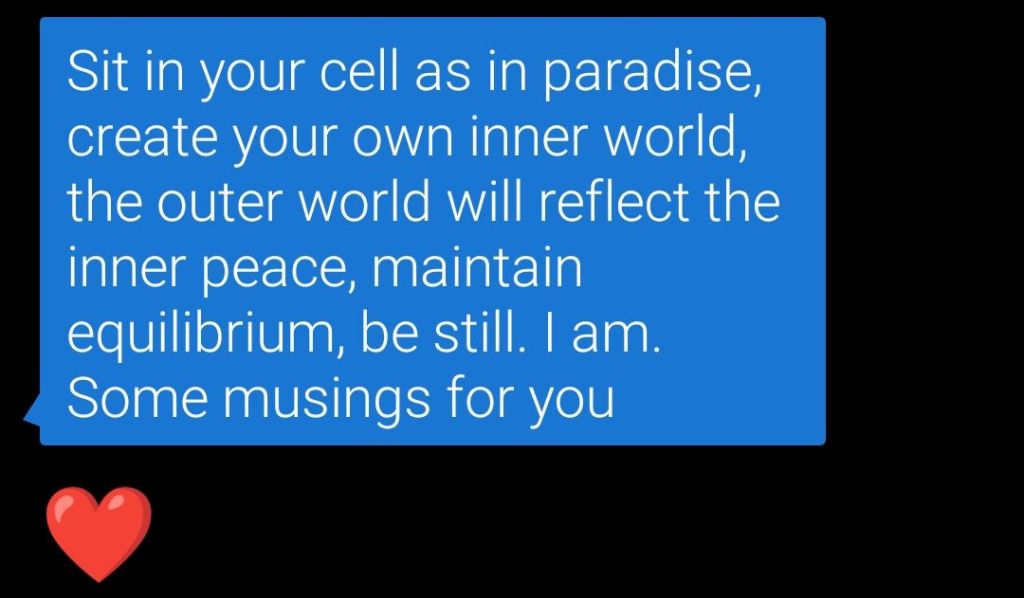
Welcome to the continuation and conclusion of the topic we were discussing in our last post. We are spending some time reflecting on a text message I received some days ago.

A multi layered text and one full of treasures on leading a purposeful and satisfying spiritual or inner life. If you missed it, please feel free to visit that post here.

In that previous post I included an image of the text in question, and we ended up looking rather deeply and prayerfully at the first sentence in the text:

Go sit in your cell and your cell with teach you everything.

In today’s post I hope to share with you my contemplation and rigorous reflections on the remainder of the text message.

So, let’s carry on with the next little bit of that text message.

Create your own inner world

This little gem speaks directly to the notion that it is your body and mind themselves that are the primary places in which you dwell; they are your cell that you carry around with you (or perhaps it is they that carry you around) always and everywhere.

And in that cell, where you dwell, you are the creator of the world. It needn’t be a fantasy world, as we might think of an inner world we create for ourselves. It need not be made up of wishful thinking, dreams, or endless thinking about the past, future, fears, regrets and all the other stuff we are prone to.

Rather it can be a place where you content yourself with the constant efforts to remain in the present; it can be a place in which your disciplined and focused mind and heart remain on those self enquiry questions which will ultimately lead you to the full realisation of who you really are, what is your true nature.

There’s a paradox here it occurs to me as I type: while everything that exists in the universe is simply a manifestation of Absolute Reality, (and that includes you and me obviously) the only way to actually discover or realise this knowledge is by delving deeply in our own hearts and minds – and sitting in our cells. We won’t find it ‘out there’.

The outer world will reflect the inner peace

So, with all this inner – self – enquiry cause the big shift? Will you see and experience only bliss and happiness? Will the ills of your body suddenly vanish never to return?
Well, yes. And no.

No because as living entities we are able to do our bit in making our lives what they can be; we can do our part in keeping a healthy body and mind; we can play our part in making the world a better place for all living beings.

Ultimately, though, it is the natural order, the natural laws of the universe that controls, directs, and manifests how all of the material world – including us obviously – operates and works itself out.

Yes, because the committed and rigorous discipline necessary to sit in our cells and enquire into our true natures, will over time and step by step help us to change the way we look at all the troubles and events of the world and our own minds and bodies. Our perspective will undergo a big shift (not quite the one mentioned earlier; this one’s for real).

You see, there are three sources from which our suffering come from: other people, nature, and our own bodies and minds. Self-Enquiry will lead us to realise that our true nature is in fact the totality of all there is, the Absolute Reality.

After this realisation of the truth of our natures, the sources of suffering (other people, nature, and our own body and mind) are still going to be there, going about their business as usual. It’s just that we won’t be as affected by them like we were before; we won’t suffer as we once did.

Maintain Equilibrium

Having read this far you might well be thinking that, yes indeed, the realisation of our true natures, the evolving knowledge that we are not simply the mind and body, and that we are in fact the Absolute Reality, just might lead to a life of balance, of equilibrium. Of calm in the face of crises and problems, peace in the wake of strife.

Well, umm yes, that’s all entirely true. But as for me, I can say I’m nowhere near that state yet. And I suspect nor are most people, and most of us will be trying for a few more lifetimes (if there are any more that is) before we make it.
Mind you, equilibrium does seem to come in little bursts, like a kind of reconditioning process. Sometimes I realise that I am indeed acting more calmly, with more equanimity to situations that might once have thrown me completely off balance.

I’ll admit, though it’s an issue that frustrates me (you see? That proves I’m still identifying with and attached to, the idea that I am a body and mind only). I ask myself, how come with all the spiritual practice, the meditation, and all the sitting in my cell, I can still suffer with annoyance and irritation or collapse with existential angst, rant at injustice … You know what I’m talking about.

All I can do, all any of us can do, is persevere with the enquiry into self; Who is it exactly that’s losing it right now?
Of course it’s ‘me’, but is it really? It is the mind and its emotions and the ego. But it isn’t me, and it’s not you.

Be Still

One of the beauties of this wonderful text message, is that the individual injunctions have built – are building – one upon the other in a nicely logical and understandable way.

Now, the advice to be still: Of course we can take it at face value and take it to mean we are to literally sit with our bodies very still in the one place, in the one spot. Not moving.

Well, it seems the Desert Fathers and Mothers  had a saying or a word of advice to fit every situation. I came across a quote from Abba Ammonas, that sits as a kind of caveat, or perhaps a sort of reality check when thinking of sitting still:

A person may remain for a hundred years in his [sic] cell without learning to live in the cell.

Meaning obviously, that thinking we are still doesn’t mean we actually are still. Well, yes it does actually. But it’s only a part of the picture that we name stillness.

For example, right this moment I am making these notes, I’m looking up references online, listening to Bob Marley on my headphones, and every few minutes I’m taking a sip of tea.

Yet I feel quite still. I sense real focus on every one of these particular tasks as I’m performing them. I am feeling pretty calm and even a tad relaxed. Believe it, for me these are big achievements. Actually this very much speaks to a concept called Action in Inaction, and Inaction in Action. If you’re interested, there’s a fascination article here.

In other words, I think I am actually being still. My thoughts are focused as I said. I’m even in the moment well enough to pause everything else to listen to something from Bob in my ear that speaks to me.

I don’t think anyone can tell you how to be still. Not only is it going to be different from every one of us, being still will always vary and fluctuate in quality and degree. You might say it’s one of those ‘it depends’ kind of things.

I am

Ask yourself: Who am I? Usually the answer comes back: I am … followed by a name, designation, label, an identity of some kind.

Nothing wrong with this. In fact it is natural: it’s how members of our species place ourselves – and everyone else – in the order of things; we need to know our position and that of others in order to negotiate our way through and in the world.

So, what happens when I ask myself that big who am I question? Well, I could answer: I am Paul, I am a hermit, I am a writer, I am servant of God, I am tall, I am a friend, I am a …

Stop! These are all things I do or roles I take on and fill by choice or otherwise. They’re not me, though they are ways for me to describe the ‘me’ that exists and acts in the material world.

It seems according to Ramana‘s teachings on Self-Enquiry that the only way we can discover who or what we are is to list instead what we are not.

Neti Neti it’s called: not this, not this. But most of us feel very strongly that we do in fact exist. In other words we are – or referring to myself – I am.

If I’m not to confuse myself with the misidentification , the temporary labels, and other limiting beliefs as I try to answer my own Who am I? question, then the best I can do is metaphorically shrug my shoulders and answer, ‘Well, I am’.

Which means I think we’ve reached the point where we may finally realise that there is actually no answer to our enquiry; we simply are.

There is nothing to ask; nothing to answer. Only pure being, as in existing: the Absolute Reality. There’s nobody to do the asking.

And in the example of this text message the expression I am, speaks as a kind of signature of the text sender. No names, no labels or self-identifiers or anything else. I aim.

Some musings for you

Last, but most definitely not least is this, a final PS if we can call it that. A reminder that I am to contemplate on all the above, that I am to reflect on the words of the text.

And I’m very happy that I’ve spent this time sharing that contemplation, those reflections, with you.

I am. You are. We are
(actually there is only I am, but you know what I mean

When You Say It All in a Text Message

It wouldn’t be quite correct to say that I never get calls or texts on my phone. What would be correct is to say is that the vast majority are to do with what I might call The Bureaucracy: Reminders of Doctor and dentist appointments, notices from various government bodies, library notices; all that kind of thing.

And there is another emerging category that’s actually a lot more welcome: while my partner hermit and I have always phoned each other, lately we’ve been texting more and more as an extra way to communicate with each other.

Sometimes these texts are about the mundane things we all have to do in the world, but then there’s another dimension in which texting allows us to keep in touch with each other’s feelings, thoughts, doings, and simply as a means of keeping the connection open and strong.

The other day, for example, such a text arrived unannounced in my phone. Like some I get from The Bureaucracy, this one was essentially a little series of reminders. But rather than being about the things of the outside world, these ones, in this text, spoke directly and deeply to the enrichment of the inner life – my inner life.

Powerful messages, all of them, that really go to the heart of one’s (my) efforts to live a life more centred on my spiritual quest and my commitment to living more in sync with Absolute Reality.

On first reading of this text (and on each rereading, of which there have been many), I really felt strongly that I needed to contemplate deeply and prayerfully on the pieces of this whole. And, as well, to share my reflections with you.

Sit in your cell as in Paradise

This little – yet tremendous – injunction references an answer to a question posed to Abba Moses, one of the early Desert Fathers:

Go sit in your cell and your cell will teach you everything.

Essentially Moses’ advice is, remain within the confines of your dwelling place – whatever and wherever form that place takes. This can be a literal geographical location, or even your own body as it moves in the world. We all have a body, we all dwell there.

Sitting in one’s cell is not a simple or passive activity. It is in fact hard work as we wrestle with the mad monkey mind, and attempt to grow spiritually.

So, what about the ‘as in Paradise’ bit? Well, to me this feels very much like thinking of one’s cell as the place to be. What I mean to say is that it’s the only you can possibly be in right now, in the present of the here and now.
It’s not about judgements of is it good or bad, pleasant or unpleasant, painful or not. Just acceptance of where youu’re at right now. Doesn’t mean you’re stuck there and by no means suggests you resign yourself to your circumstances. It simply means you see it like it is, at this moment.

And it’s about understanding that, while you are in that place, it’s where you know you need to be. Your cell – your dwelling place – has within it everything you need to live, grow, learn, and prosper in the spiritual life.

Whatever the ‘place’ you are in is like, we can try to cocoon ourselves, make a space within the space, even if it is just being aware of our bodies sitting in the space. Cocoon myself is an expression I’ve been using lately to describe the act of isolating myself in any way I can from my surroundings. This can apply on the macro scale or the micro as we seek to centre ourselves and find quiet and a peaceful place.
It’s not as if in this cocoon (or whatever it might be)  that  all will be bliss and light all of a sudden. No, I think the suggestion here is we try to develop an attitude of non-attachment towards the things of the world that trouble us, those things that cause us suffering, precisely because we are attached to them.

That is the purpose of sitting in your cell. That is the everything that your cell will teach you.

You know my friends, I’m a bit weary tonight, and with your permission I will continue with this sharing of my contemplation, my reflections, in my next post.

Thank you for staying with me.

Peace and love

Paul the Hermit

The Time is Always Right for Niceness

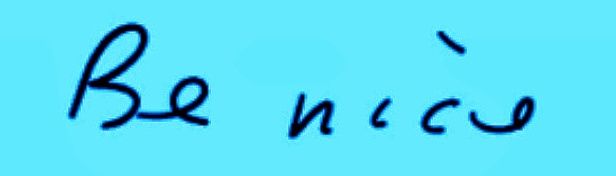
Scrawled in the margin of a page in my notebook are two words: Be nice. Nothing else on the page to suggest a context, source, or inspiration. But, here’s the interesting thing: Just below those two lonely words, and in brackets, I’ve written:

Do nice, Consume nice, Share Nice.

Most likely we’ll never know what prompted me to write that particular series of words. I mean, they’re not exactly new ideas are they? Still, discovering (or is it rediscovering) them today, I thought that, while not original, they do present us with a neat little package of behaviours, attitudes and actions; a perspective or way of looking at things that might just help us (or I should say me) along the road to spiritual growth, for being better, doing better; oops! You get the idea.

Be nice. All of us long to be nice to others, to family, friends, work colleagues, strangers, the world as a whole. Some of us would even feel better if we could only be nice to ourselves now and again.

Speak softly, go slowly in my interactions with others – loved ones or strangers, it doesn’t matter. While we all wish for others to be nice to us, we are all very aware that life doesn’t always work that way. But at the very least if we can be nice in every situation, then it’s better for everyone.

So, when slighted by another, spoken to with a loud or aggressive voice, or in some other way treated ‘not so nicely’, pause. Breathe. Then with confidence in yourself and what you have to say or do, be nice to that other.

Smile (when you can and it’s appropriate), be calm, assertive, but stay nice.

As to being nice to Self. Well, I’m trying to give up the negative self talk, and the self critical thoughts, as well as not so nice thoughts about other people or situations. Being nice to others is also an act of niceness to ourselves. We feel good when we’re nice to others (and bad when we’re not so nice to others).

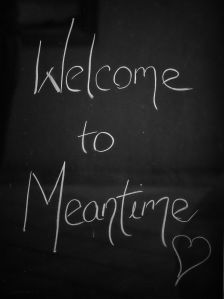
Meantime is so Yesterday. Make it Nicetime today!

Do nice

The verb do suggests doing; taking action. Do nice things for others – and for Self also. Sometimes it’s easy to do nice things for others, sometimes not so easy. Still, as with everything, it is the efforts we make that are the key: remember, nice makes nice.

Anyway, we’re all familiar with the brilliant (genius really) Random Acts of Kindness concept and movement. It’s a truly revolutionary idea that’s rightly spread far and wide and has become an integral aspcet of everyday life for many many people. Really any act of kindness, random or otherwise, is another way to describe doing nice.

And, once again, we shouldn’t forget about ourselves. Doing nice things for ourselves lifts our spirits, changes moods, enriches our lives overall. Don’t forget that doing nice things for others is just one more way we can do something nice for ourselves.

Consume nice. What am I putting into my body? What am I looking at, listening to, reading, buying – what am I consuming? How much of this consumption can I label as nice? How much of it is of benefit to myself or to any or all other beings, or to Earth herself?

And, the flip side of that question: Of all that I consume, how much is doing harm, again to myself, other beings, the planet itself?

Heaps, if you’re anything like me. I am engaged in constant struggle to change my habits of consumption. As I make these efforts, fight these battles with old old habits (I think I talked about this in a recent post?), I remind myself to be kind to myself when I fail to make forward steps – and just as or more often when I take a step (or two, or…)backwards.

Share nice. This one’s easy: reread all of the above. Well, okay, maybe there’s a little more to it than that. Actually, isn’t there an old aphorism that we’re all supposed to have heard in kindergarten? ‘Share nicely‘? I guess back then it was about sharing toys and other playthings with the other kids.

Now we are all grown ups, it means, well much the same really. If you have been blessed with material prosperity, be free with the way you share that good fortune.  Be free and generous with how, and with whom, you share that wealth with.

Equally, no it’s not equally at all; it’s way more important and significant. Share your time; share your skills; share your knowledge; share your experience. The best thing of all to share – the nicest thing – is your love.

Love works well, not only with those close to us, those we call loved ones. Love can be shared in all our interactions with the world, whether it’s family, friends, work colleagues, or with strangers we encounter as we go about our day-to-day lives.

Share nicely of course isn’t only about what you share; it’s also about how we share. Share with a nice attitude. We’re right back where we started, be nice. Approach all with an attitude of love, generosity, and kindness.

So, how does all this nice stuff contribute to our spiritual growth?

The Greatest Hashtag of Them All

Well, I think as we’ve just seen, nice equals love. I feel that having nice – love – as the foundation of our being, doing, consuming and sharing, helps us move forward on the path to the realisation that happiness does not come from outside of ourselves – and certainly not from material things like money, possessions, and the like.

Nice can really only start with me – with you. From within my own Self, which in truth is non-different than your own Self.

There is a beautiful – truly beautiful – expression that has become an empty, flavourless, hollow, meaningless platitude. I’d like to rehabilitate that expression right now.

I want to say with my heart and my love, to all of you:

Have a nice day

and

To Speak or Not to Speak & What Not to Speak About When You Do Speak

Have I mentioned lately that I talk far too much? No? Well then, it’s way past time to once again confess; it’s  time that I finally get it out into the open: the thing is you see, umm, I talk too much. There I’ve said it.

But wait, there is no need for concern: I have a prayer (stuck in my Bhagavad Gita, where else?) that I pray at least a couple of times a day. Well, rather than being a prayer, it’s a kind of affirmation or instruction to myself. Okay, it’s a prayer.


It’s a nice injunction, I think. I don’t recall where I borrowed it from, but I’m grateful that I came across it. It’s important to me; a vital instruction that I feel assists me in my aspiration to be a bit more thoughtful, and a bit less vocal.

Does it work?  Well with the risk of repeating myself, I will say yes. Maybe I’m a bit more thoughtful and perhaps a bit  less vocal. But, on the other hand, I wouldn’t say I was anywhere close to the ‘spending no time’ level.

Now that I’m thinking about it, illusion, fear, and wrong thinking are common themes in many people’s lives, and we might even say that they dominate our culture whether it’s the media, celebrity gossip, or any of the rest of the illusory and speculative talk that goes on all around us.

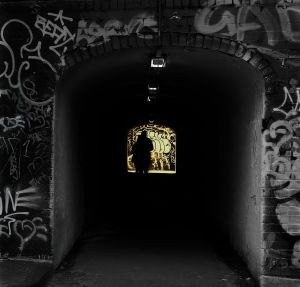
Tunnel to the Light

Anyway, fear is the biggie isn’t it? Fear of not having enough; fear of not being good enough; fear of what might happen or what might not. This list is endless. Fear of illness or ageing; fear of losing friends or fear of not having any! Fear of ‘missing out on the good life’ we imagine everyone else is living.

Then there is what’s called, the fear of the other, most often promoted and replicated by the mass media through their creation of illusions, fake news, exaggerated  or one-sided information (I hesitate to use the terms ‘facts and figures’ but you know what I mean). And then they sell us on ideas that we need to fear some other person, people, thing, time, impending catastrophe that never comes.

I don’t need to go on here: as I said, the list is endless. All that’s left to say about these fears and the illusions we are force-fed and made to believe are real, is that it all boils down to costing us a great deal of time spent and usually wasted, in wrong thinking of one kind or another.

It seems to me the media (news and social), advertising, and governments of all persuasions, are really quite happy for us all to be ‘getting the wrong end of the stick’. I think that’s the expression. Our societies are drowning in, for want of a better word, propaganda.

Buy this, do that, don’t do the other thing. Be afraid of (insert the latest scapegoat, political opponent, boogy man, the Apocalypse. Again it’s an endless list).

Then there are the fears we invent for ourselves, the illusions about ourselves that in our wrong thinking we come to believe are all real and true. One thing you can say about wrong thinking is that it makes for more and more wrong thinking. More illusions about who we are, what we do (or can’t do), what we are like, who likes (or doesn’t like) us. Here I once again risk repeating myself, but yes, it’s a long long list.

So, what can we do? Well, we could use a little reminder like the one we’re talking about here. It’s possible that it can help us correct a little of the wrong thinking that leads to fears and illusions.

Then there is what we might call discernment. Not so much deciding between one thing and another; more like coming to know what is real or illusion, a genuine, rational fear that I need to act on, or some inherited, manipulated, received  or otherwise irrational, baseless, or invented ‘fear’.

We won’t get rid of wrong thinking by trying to push it away. It’s about replacing the wrong thinking with some right thinking. We can try to recognise that wrong stuff as it comes up. We can make an effort to stop allowing ourselves to get away with our own misunderstandings, our own wild imaginations, wishful thinking, and confusions. As my teacher said just the other day, use your mind to control your mind.

One word we haven’t discussed from my little injunction is discussing. We discuss things when we talk or communicate  with others or when we talk to ourselves. Here we are at another issue for discernment: what shall we talk about?

Actually I was about to write that one excellent strategy for not spending time discussing illusions, fears, and wrong thinking is to simply stop talking altogether. That’s all there is to it: Don’t talk!

But obviously that’s a ridiculous notion right? Stop talking? Perhaps for a set time? Or perhaps as a kind of ‘time-out’ strategy? But as a principle for a whole life, it’s not going to appeal to the majority of us. Actually, that feels to me like a bit of wrong thinking creeping in: a life of no, or at least limited talking is very appealing to me. Just difficult.

Still that does seem to be what my treasured injunction suggests I do. Mind you, it’s very specific isn’t it? Spend no time, it says. Discussing what? Illusions, fear, and wrong thinking.

So, how do we manage to follow this suggestion ‘to the letter’ as they say?

Here’s another little prayer I say everyday. This one is from Thomas Merton.


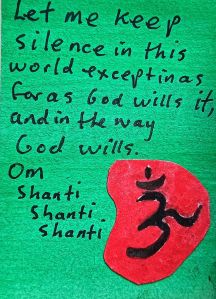
Keep silent ‘except in as far as God wills it’. For God I could say the good of all concerned; Truth; my heart; my goodwill; my love. It’s all God; it’s all the Divine.

I guess it gets back to something I said earlier about thinking before I speak. To this I would now add, feel before I speak: What’s right? What’s wrong? Does this help? Will this hurt someone else for myself.

About right and wrong: In the religious  tradition I was ‘raised in’ it was deemed that at the age of seven or eight a child is suddenly, without any preparation, able to discern right from wrong. Which means they are now responsible for the consequences of their thoughts, words, deeds. In other words, they are now capable of sinning and suffering  the consequences.

I can’t (obviously) speak for you or anyone else, but it’s been a very very long time since I was seven or eight, and I still find it tricky sometimes working out right from wrong. Of course while I know I am now responsible for my thoughts, words and deeds, I also know that we are all flawed; nobody’s perfect, so we’re going to make mistakes. 

So, all I can do – all any of us can do – is appeal to the innermost Self and use my intellect and my heart to try to discern as best I can, what is right and what is wrong.

Only in the innermost places where the real Self dwells can we know reality from illusion; it is only in our ‘heart of hearts’ as they say, combined with our rational thinking mind, what fears are real and what fear is illusion. And it is only then that heart and intellect can determine when our thinking is headed down the wrong (or the right) track.

It’s only then that we will know what and what not to spend our time discussing, either with others or internally within ourselves.  This all sounds like a long, convoluted, tricky process (told you I talk (write) too much!), but it needn’t be.

Like all things it takes practise, and once we begin to know that innermost Self, it will soon become a spontaneous way of living, when we begin to ‘just know’.

Your own inner divinity (which is the real you) wishes for you peace.

Om Shanti, Shanti, Shanti.

One, Without a Second, is All There Is

Right at the front of my Bhagavad Gita (the only book aside from the notebook I’m writing this in, that I personally own), I have recorded and inserted sayings and various words , that are important to me. Among those things is a statement I first heard many many years ago, that is common among the First Nations’ peoples of this country:

I [We] stand always on sacred ground and beneath sacred skies.


It is not an affirmation of ownership or possession. It is, instead, an affirmation of belonging to the land, to nature. It is a prayer of thanks, and it is a declaration of the knowledge of unity with the rest of the natural world, that is the hallmark and foundation for Indigenous cultures throughout the world and through time.

I’ve valued – treasured – this sentiment for a very long time – probably from even before I first heard it, which was so long ago as to be lost to memory. Perhaps I always knew it because I’ve somehow always thought this idea was a fundamental truth concerning my existence as a being living on this planet.

Well, now I have heard another statement that for me makes a perfect compliment for this one. The other day, during a lecture, my teacher mentioned that in his student days a fellow student said:

Wherever you are, you are walking through Ishwara

(Ishwara being her preferred name for the divine – for all that is.)

There is a feeling or sense of ‘belonging’, of awe and wonder when we attempt to immerse ourselves in what we term the natural world.

Once again I immediately felt the bell of Truth ringing clearly through this statement. Yes, I thought, everything is divine – including our own selves – so of course it follows that wherever we go, whatever we do, we are always in the divine.

You’ve probably read a number of times me quoting my teacher quoting his teacher:

It’s not that there is only one God, there is only God.
          Swami Dayananda Saraswati

Emphasis very much on only. Meaning of course, that it’s not that God is within us, or that we are within God; we are not surrounded by God; and it’s not that God ‘sits in our hearts’. The reality (for my teacher’s teacher) was that all that is, everywhere, everything, every thought, every word and deed, everything there is, is the divine.

Another way to describe the divine or God, that appeals to me is that Ishwara (also my own preferred name for the Divine) is in reality the natural order of the universe as dictated by the laws of nature. Those laws of nature, the rules that govern how the universe works, are also Ishwara, as are all that is manifest or in existence  as a consequence of the workings of those laws.

In other words, the Divine is the sum total of what some would call the entirety of creation.***

For the hermits a sacred site. Part of a grove we named The Sentinels. A place of experience of unity and oneness of creation

For me this an enormously comforting and reassuring concept. Of course, for me at least, it is also an extremely difficult one to wrap my head around. But here’s a small summary of what I think I’ve grasped so far.

Ishwara – the Divine – is all there is; everything. Also divine is the natural order of the Universe as governed by the laws of nature. These laws are neither good or bad – there is no duality. They are neutral.

You and I, as one more entity among who knows how many others, act as we do and are subject to the laws of nature, just like everything else. We can’t change or influence those laws; we can only live our lives as they unfold.

To quote from Desiderata: No doubt the Universe is unfolding as it should

And, well, then things just work out as they do. While we can’t change the laws of nature, or bend the universe to always suit our liking, it is also true to say that every action we take, every thought we think, every word we utter, even our very presence as a living being in our time and place, do indeed contribute to ‘how things work out’. Another way of saying this is to say, we do our bit, and the universe does its bit and what happens, well, happens.

For me, this is not at all as simple or as straightforward as it sounds. Naturally  we see ourselves as individual selves, as entities on our own. After all, to state the obvious, we live and operate in a material (dualistic) world. So automatically we see ourselves as individuals living in, but always separate from all the other individual entities, as well as being disconnected from the world itself.

It is part of human nature (for the most part) to long for connection; there is so often a drive within us pushing us to create family, enter relationships, feel we belong to a community or communities, and for many but not all, there is the almost instinctive urge to seek connection with the rest of nature.

Many forms, One reality

We often think of these longings as goals to achieve, as something outside of ourselves to attain, to reach for. Consequently, so very often we tend to focus our attention outwards, towards other people, or material things.

But, instead, all these inclinations, desires and longings are simply our Self (note the capital?) endeavoring to open itself to discovering (or rediscovering?) that which already exists: our oneness with, and our non-separation, and non-difference from, The All That Is.

Peace and Love from Paul the Hermit

FOOTNOTE

***Just a few thoughts about naming, or giving labels to the Universe and its laws.  Obviously it’s a personal choice for each of us what we choose to call that creation. Then, on the other hand, we don’t have to call it anything at all. For me personally it is very difficult, even near impossible to not name it. By naming the creation, I don’t think I am attributing the manifestation of the Universe to some distant entity living in some heavenly abode (as my teacher likes to say). Rather I am acknowledging the intelligence  and order, beauty, complexity of all that is and how it all works, as its own reality. At the same time, I am learning to understand that I as my true nature am not separate from the rest of creation, and I feel the need to have a name towards which I am able to focus my thanks and my reverence.

When Love is a Yoga and Lovers are Yogis

There was light at the end of the research tunnel

These last few days I’ve been researching and thinking about an idea for a blog post. But I’ve come to realise that I am grossly underqualified to write about the topic I had in mind. Let me put it another way: I am completely and utterly unqualified in any way whatsoever to go there. In fact, after all the research, I think I’m going to disqualify myself from ever going there in writing.

However, I’m a great believer in the idea that no quest for knowledge is ever a waste of time or effort; there is always something to be learned. During my research I came across a topic I believe I am qualified to discuss, as it forms an integral and vital part of my own personal spiritual practice.

Why I’ve decided to write this post, though, is because I made a discovery that lead to an insight that I know will lead to a great progress in that practice. It’s nothing new, not really, but it was one of those occasions we’ve all experienced of ‘I knew that, but now I really know it.’ For me, it was a realisation of something that till then had been a nice cosy theory and belief.

Bhakti Yoga is that practice. It is really a key foundation, a valuable component of my spiritual life.

Wikipedia opens its entry on Bhakti Yoga (see the link just above) with a description of the practice that mirrors what I think is the traditional understanding of Bhakti Yoga:

Bhakti Yoga (also called Bhakti Marga, literally the path of Bhakti) is a spiritual path or practice within Hinduism focused on loving devotion towards any personal deity.

In the same entry there is a description of the origins and meanings of the two words, Bhakti and Yoga:

The Sanskrit word Bhakti is derived from the root bhaj, which means “divide, share, partake, participate, to belong to”. The word also means ‘attachment, devotion to, fondness for, homage, faith or love, worship, piety to something as a spiritual, religious principle or means of salvation’.

The term Yoga literally means “union, yoke”, and in this context connotes a path or practice for ‘salvation, liberation’. yoga referred to here is the ‘joining together, union’ of one’s Atman (true self) with the concept of Supreme Brahman (true reality).

For some, dancing while chanting the names of their God, demonstrates their devotion and celebrates their union with each other and with God

In other words, those called to a religious or spiritual life, practise Bhakti Yoga whenever they pray or otherwise express devotion towards their personal conception of God, or the Divine. This particular definition seems to be saying that such a conception of the Divine, or God, is in the form of a personal deity who is a kind of representative of true reality, which the devotee is aspiring to join with.

Some Bhakta Yogis are full-time, full-on practitioners. People like contemplative nuns or monks, hermits who retire from the world into seclusion. Anyone basically whose entire life and activities are spent in devotion.

So, when I discovered all this, I became intrigued; I decided to go off on a tangent and explore the word Bhakti itself. Wikipedia has a separate entry for the word on its own:

Bhakti is a term common in Indian religions which means attachment, fondness for, devotion to, trust, homage, worship, piety, faith, or love. In Indian religions, it may refer to loving devotion for a personal God

is often a deeply emotional devotion based on a relationship between a devotee and the object of devotion.

In ancient texts the term simply means participation, devotion and love for any endeavor.

May refer to devotion to a personal god? While I thought this entry doesn’t contradict our first quote above, it does seem to broaden, and deepen, the meaning of Bhakti. Expand might be the better word.

In some traditions a simple life on the road is a way to commit full time to Bhakti or devotion.

It struck me that that object of devotion might be anything. Or even everything. You see? I told you it wasn’t a new idea. It’s just that it’s resonated deeply within me now. It appears that the object of Bhakti Yoga practice doesn’t necessarily have to be a ‘personal god’.

Many many people would say ‘I like animals’ or ‘I think we should save the world’. But, while that may imply a kind of love for or at least a fondness for, I think Bhakti is something more – actually several somethings more!

For example, some people have a particular attraction to and love for, the ocean, or it might be a river they view as, if not sacred in a religious sense, then as special to them in some deep, comforting, even therapeutic way. Others have similar relationships with and feelings for trees, or even a particular tree.

Animals as either individuals or as a species or group, can have the same appeal and call to other people. Then there are those who feel strongly in their hearts you could say, that Earth itself is a sacred object, or others have a knowing that the planet is a living entity and worthy of our devotion.

Bhakti begins with love and devotion, which is about caring for, affection towards, loyalty to, emotional engagement with the object of devotion. But even more than that, there is faith in that object of devotion; faith as in trust, confidence that the love is real, that the ‘relationship’ is sound and real.

Homage and worship too are key aspects of Bhakti. The deep inner feeling we have towards a thing, person, or other being, that is beyond what we normally call ‘love’. It’s about seeing and actually realizing ‘in our hearts’ our desire to be merged or united with that thing, person, or other being.

Actually, seeing that word other just now got me thinking. I had to go back and reread our definition of Yoga up there near the beginning. It says Yoga means ‘union, yoke’. It goes on to add: yoga refers to a ‘joining together, union’.

This passage seems to be suggesting that Yoga (in our case Bhakti Yoga) is both an already existing union, and a process of joining together to achieve union. One thing I would say here is that in my practice of Bhakti (and love as a general thing to strive for and be) it’s both.

Trees are special beings for many people from a whole variiety of cultures all over the world

But, in the end, it seems to me that the process or practice, the path of Bhakti, serves to awaken us, to assist us to acknowledge, recognise, and realise in that really knowing way, our pre-existent true nature.

That true essential nature can be said to be the reality of our oneness with all things, living and non-living. And their oneness with us too of course. In fact, by putting it that way, I’m saying there is only one, or oneness. What’s that expression? One without a second.

May you be a Bhakta Yogi. Or, perhaps you already are one?

Love and peace from Paul the Hermit

Life has manifested itself as the multitudinous forms that comprise the universe. It is the one Universal Life, Power or Shakti (the laws of the universe or natural laws) that controls, guides and actuates all movements and activities in all beings, creatures and things.

                — Swami Ramdas