The Word is the Word

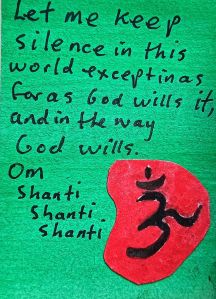
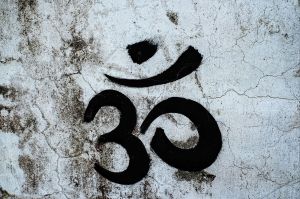
OM IS THE WORD
Om
In the beginning was the Word
Om
And the Word was with God
Om
And the Word was God
Om
And the Word is God
Om Om Om

Om
The object is the Word
Om
The subject is the Word
Om

Om
The observed is the Word
Om
The observer is th Word
Om

Om
The Word is the Word
Om
There is only the Word
Om
It is as it is – the Word
Om Om Om

We All Get to Stay

Sharing our prayers this morning, the hermits each reciting a prayer to the other so each can pray, and talking about the oneness of life (prompted by one of the shared prayers), the dependence of one species upon another.

As we reflected on that idea – of interdependence – it occured to me that perhaps, there might be a problem in how we as humans, interpret its meaning. We can maybe call it a kind of paradox, but we’ll get to that in a bit.

Our dependence – as humans beings – on so many other species is actually a well known, and I hope increasingly accepted, reality. For food, for shelter, for water, air to breathe. Everything.

In any case, an aspect of this interdendcence idea that struck me as perhaps missing, that I’ve not really heard before (I haven’t researched this; just winging it thought and contemplation wise) is this; If, say, bees disappeared, or all trees were cut down, would humans survive? Definitely not.

On the other hand, let’s say that in an instant or even over time, all humans on Earth disappeared. What would happen to all the other living beings? All the bugs, the fishes, the animals of all kinds, trees, grasses – all the living beings?

It seems to me that all those other species, all those beings of all kinds, would not only survive, they would most likely thrive.

Actually, now I think about it, I remember during the COVID lockdowns, people in various places around the world were amazed at the return of birds to usually busy polluted cities, and how the air seemed fresher in some places when in ‘normal times’ it was getting hard to breathe. And beaches and rivers looked a bit cleaner than usual.

Fewer people commuting; fewer planes flying; less goods being transported on congested roads; less waste going into rivers and the oceans. Seems life on Earth was doing better when we (humans) were out of the picture, even for a short while.

Which is to say, humans may not be necessary for the survival of planet Earth and the other life that lives here. Putting it very simply: We go, they thrive; They go, we go too.

But, my thought train races along its newly discovered track here, what if I’m wrong? What if I’m looking at the whole issue on just a superficial level? What if all I am seeing is the gross material level of the whole question? What if I’m missing the real point of it all?

Well it seems to me that on that purely physical, surface level, my theory (borrowed as it may be perhaps) might be right, the irony true: we go, they thrive; they go, we all go; they stay, we all get to stay.

But who are ‘they‘? Who are ‘we‘? For me it’s clear that we are not all simply and only our physical bodies and our minds living here in the material world; that’s all temporary and comes and goes. No, there has to be more to it than that.

Which is what I end up coming back to so very often: there is only one. No separation; no you and me; them or us. Just one. Without a second. Only Consciousness.

I think the best thing to do, just to be on the safe side is to look after each other – regardless of the particular body we happen to be inhabiting at the moment.

That way, we all get to stay, and we’ll all thrive

How Shall I Live?

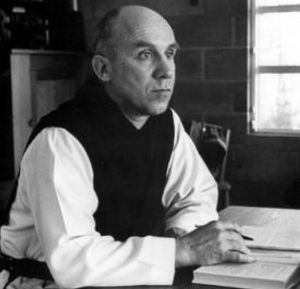
Thomas Merton in his hermitage (Courtesy Wikipedia)

The great study of the monk is to have an awakened heart

      Thomas Merton


There would be some – including me – who would say that all human beings, and not just monks, need to learn to awaken their hearts, to cultivate attitudes and a life of love, compassion, empathy, and kindness.

Who would disagree with such a suggestion?

Well, I’ve already said that I am one of the ‘some’ who would welcome such an evolution in human consciousness. But, at the same time, I don’t want to make pronouncements, form judgements, hold opinions, on what anybody should do, or be like. Only me. I am only responsible for my own behaviours, attitudes, ideas, thoughts, speech, and the rest of how to live my life. I just can’t – as in I’m not entitled – to tell anyone else what to do, what to think, what to say and so on.

Actually I’d even speculate that Merton is in fact talking about just the one monk: himself; he’s not preaching a prescription for the behaviour  of others.

I’ve read so much Merton that it’s impossible now for me to remember exactly where I read this statement of his, but I do know that when I first saw it and made a note, the concept resonated deeply for me as a great aspiration for my own life as a monk, and as a trying to be decent human being.

In other words, this monk – me, myself, and I – has a task to carry on with: to cultivate an awakened heart. And being a ‘great study’ it’s bound to be at least a lifetime’s project.

It’s an effort though, awakening one’s heart. It’s even a bit of a mystery at times what the phrase actually means in real terms.

Love, obviously, tops the list for any aspirant on the awakened heart path. And, yes, I do feel, express, and act out love – so deeply sometimes to the point of being overwhelmed or ‘flooded’; sometimes speechless (that’s the good bit), sometimes full of words.

But then there are times (oftentimes is the word) when that love is clouded or shrouded completely by angers and irritations, by regrets of what should be or shouldn’t be, could be or cant’t be, what isn’t.

The great study of the monk is to have an awakened heart
          Thomas Merton

All attachments to what is not as I think it should be. All barriers to love. All ways and means of keeping the heart asleep – or at best semi-awake, and still sleepy: slow to respond, slow to act, and with ongoing blockages to seeing how things actually are.

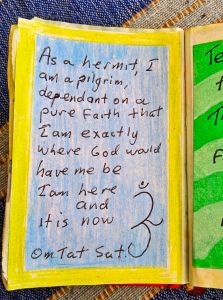
The quest to acquire an awakened heart and the outpourings of love, kindness, gentleness, generosity, that such a state would allow, is probably at the root, the foundation, of my life as a hermit monk, of my life as a pilgrim journeying through and to Self.

Living quietly and simply; developing a contemplative way of being in the world while definitely being not of the world; cultivating silence, peace and calm; all are activities and attitudes directed at cultivating an awakened heart.

All that generosity, patience, love, kindness, empathy, and all the rest are definitely all characteristics of an awakened heart. Here’s my dilemma  (only one among many that riddle my crazy monkey mind): they are also precisely the elements that need to be practised in order for one to acquire an awakened heart. What’s the expression? Catch 22?

Of course, it just occurs to me now, everything that is, is exactly as it’s meant to be, happening just as it ‘should’. So, in other words, all these words of reflection are simply a commentary on what has been and gone already, that which is in the past, and is no longer existing.

All that matters – all that exists – now is that at this moment, in its ongoingness, I am as loving, as kind, as patient, and as generous (not to forget compassionate, empathetic) as I’m able. To others obviously, as well as to myself.

All that wonderful list of characteristics of an awakened heart all exist right now within me. Perhaps I need to wake up my mind a bit more so I might see that reality. Then I might actually realise that I already have an awakened heart and that I simply got forgetful somewhere along the way.

with love
Paul the Hermit

In the Dream The Word Was Written

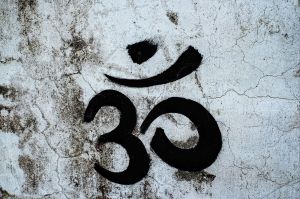
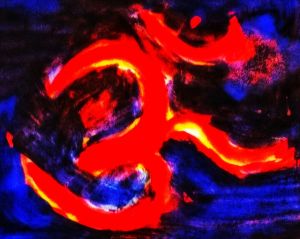
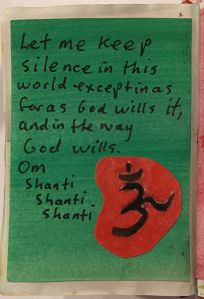
I dreamed I was drawing an OM symbol. Nothing else, no memory of a dream setting or situation, no other dream characters; only the view – as from my own eyes – of my hand making that sacred mark.

It is quiet during morning prayers today. At one point, after completing one prayer, I turned the page, and began praying the prayer there. Attentively and prayerfully, which is a really nice thing for me to notice because oftentimes I can be a lip level prayer sayer.

As I prayed, I was drawn to the part of that page labelled ‘blank space’. It was at that moment the memory of that dream began to arise.

Instinctively, without thought, I reached for my pen – this pen I now use to make these notes – and inscribed (as that dream memory seemed to demand) the sacred OM in that formerly blank space.

This all transpired as the memory unfolded; really only a matter of a just a few seconds of clock time. But, of course, what meaning is there to ‘clock time’?

In the beginning was the Word, and the Word was with God. And the Word was God. And the Word is God. No beginning. No end.

Om Om Om

PS Thank you John for allowing me to use your words. I know I have paraphrased and modified them a little with my own words, but somehow I don’t think you’d mind.

Moment of Catharsis?

One morning recently I was reciting my prayers when I began to notice the welling of tears in the corners of my eyes. Soon the wellings became a slow stream down each cheek. And, before long, I was more or less sobbing. For a little while.

Where did the tears come from? Why was I crying? Well, to be honest, it’s a mystery.

No mystery, you might be thinking: Sounds like your tears were brought on for some reason by reading the prayers.

I’m not so sure. I used the words ‘reciting my prayers’ deliberately: Not only was I not paying attention to, or even seeing the words on the paper, I was not engaged in the least in the words themselves and their meaning.

Rather than ‘praying’ I was reciting from memory, rote fashion, as if chanting my times tables in primary school. Merely mouthing the words; my mind was blank, as in not there, distant, off doing what my mind does, without awareness from me, when I’m trying to pay attention.

So, was this some sort of moment of catharsis? Possibly, or so it seems to me.

Sometimes – often spontaneously, other times with some forewarning – there is a release: a shedding of tears, as in my story above; a heavy inner or outer sigh of relief; sometimes simply a sense of something let go, something gone, or at least on the way to being gone.

When such moments of catharsis take place, often what causes them, the catalyst, appears obvious. On the other hand – as in my recent sobbing session – that catalyst is a mystery, unrelated in any obvious way to anything happening at that moment, or at least to anything taking place on the surface of that moment.

Equally the cause for the tears, sighs, relief, and so on – the object of any potential catharsis – may also be a mystery. I had no idea at the time, nor do I know now, what caused my tears.

The prayer being recited at the time was about silence. But, as I’ve already mentioned, no way was I actually praying, what with my total lack of attention, obliviousness to the words, my mental blankness. My unconsciousness come to think of it. Nothing to suggest a catalyst or catharsis.

In any case, when such miraculous happenings occur, one thing I try (I hope) to remind myself to not do: Do not ask why. Let catharsis – or whatever process is underway – be as it is.

And to put aside my habitual tendency to analyse and categorise; resist the temptation to want to know and label everything that happens to me. Let the catharsis – if that’s what it is – carry on as it does and not dismiss it as: ‘Oh that’s just me getting emotional.’ Or ‘I must be a bit overtired today.’

To – wildly and freely – paraphrase a few words from an iconic movie character:

Catharsis is as catharsis does.

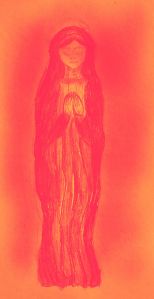
A Prayer to Share: for the Divine Mother

Namaste and Welcome

Today I would like to share with you a prayer (it’s a poem too, but …) I’ve written in praise of the Divine Mother. It’s actually the second prayer I’ve written to and for her. I shared that first one, called simply, A Prayer to the Divine Mother on the blog previously and you can find it here.

That post will also give you some background to my reverence for the Divine Mother – what she means to me; where my initial devotion comes from; my heart sense that this universal creative energy drives and sustains all creation; and finally how Divine Mother may be worshipped in many and varied (and even no) forms.

The prayer I share with you today – Jai Shree Maa –  emerged as I knelt chanting those exact word at the alter of a holy place dedicated to the Divine Mother as revered by many in her form as Our Lady of the Rosary.

It is a temple in that name I sometimes go pilgrimming to for quietness, meditation, and devotion.

Please accept my prayer. Thank you

JAI SHREE MAA

In this temple to the Divine Mother
upon my knees and praying.
Jai Shree Maa

I chant with sacred love in my heart,
sacred words upon my lips.
Jai Shree Maa

Divine Mother, with these words,
Jai Shree Maa
I invoke your holy presence;
I speak from my heart to yours.

With love and wishes for peace

Paul the Hermit

Lookin’ For Love in All the Right Places

It’s often advised by spiritual teachers and leaders, by Gurus, and other religious people, that a vital factor in the success of any spiritual endeavour or quest, is that the seeker or devotee is able to share the association of other, fellow devotees.

It is important, they say, that the seeker keep company with fellow travellers on the same or similar paths.

So, how does that work for a hermit? How does the seeker committed to living a secluded life, separated physically from others, find this association with those like himself pursuing a spirituality oriented life, a life of devotion, prayer, contemplation, and service?

Well, this hermit can’t speak for hermits generally; he can only tell you how it is from his personal perspective. So, how do I manage to obtain association with fellow travellers on my path to the Divine?

Firstly, I am blessed to share my hermitage and my life with my partner hermit, as I have done for virtually the whole of my adult life.

And my partner is very much a fellow traveller on the path of commitment to the hermit life, to a life of prayer, devotion, service, and contemplation.

This makes me think of something purportedly said by the Lord Jesus:

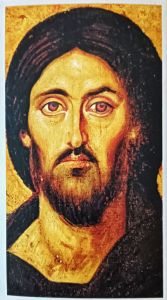
For where two or three are gathered in my name, there I am in the midst of them

Matt 18:20

In other words, when the two hermits are gathered in the name of the Divine, which is really all the time, then there is the Divine.

Of course, everything, all beings, all things, are the Divine. And, as if in confirmation of just that idea, something interesting happened. Out of curiosity, without any deeper thinking than that, I looked up Chapter 18 Verse 20 in my Bhagavad Gita. It was just for fun, but I ended up getting a nice surprise:

The knowledge by which the undivided supreme being is seen in all entities, though it is divided into numerous forms, is situated in the mode of goodness.

Bhagavad Gita 18:20

Supreme being, universal consciousness, the Christ, God, the Divine. Many names, one essence.

Even so, at times we feel alone, sometimes lonely.And isolated from others on the path of the Divine. So, what do I do to have this association with other devotees, with fellow travellers?

I make enquiries into the lives – both historical and contemporary – of others who have followed or are following a genuinely spiritual path and life. I watch online videos, I read books, as well as I subscribe to a few online newsletters which I discover by investigating websites I’m led to in some way. All these provide so much opportunity for association, for connection, and for learning.

Such explorations, are at the very least, informative: I can see – or read – for myself the evidence that I am not alone and never have been, in my commitment to the Divine and a spiritual life.

They are inspiring and encouraging: I’m not alone! I can do it! And often I get ideas, clues, on how I might deepen my practice, improve my service, love more.

I love the hermit life

In a sense such stories – in visual or in word form – ‘keep me company’. As I said a couple of times already (sorry!) I’m not alone. And I can smile, perhaps nod my head in agreement (or shake it in disagreement) with a comment or observation from one of my fellow devotees on the screen, or on the page. I guess in a way, it gives me a sense of belonging or connection.

Some might say that encountering people or experience via a video or book, is vicarious at best. But I wonder about that actually: Remember my fondness for the Ripple Effect? For my strong feeling for sending out good vibrations?

And, what did Jesus say about when two or three gather? He never mentioned that it was necessary for those two or three to be sharing the same physical space.

Life’s lonely; we all know that, and to encounter like-minded, or like-hearted people sharing a similar path to mine, is more than a prayer answered. It’s a life affirming, love affirming, blessing.

You Can’t Try to Go With the Flow

Every writer, every painter, every person who makes things – and that includes all of us human beings – will sometimes get the feeling that they are never going to have another idea, or the inspiration, the creative spark or energy, to create anything ever again. Not ever again.

Certainly  that – what could we call it: crisis of confidence? Moment of fear? A feeling of inadequacy? The seeming loss of the desire to create? We could probably keep going with this, but let’s not.

Where was I? Yes. Certainly that, whatever we call it, comes over me really quite often when it comes to the writing of this blog. It’s become a standing joke in the hermitage: Whenever I’m asked if I have another post coming on, my most usual response goes something like:

‘No, and I don’t think I’ll ever write another post. The ideas are all gone. It’ over.

(As I reached for this notebook just now, I was asked that question and ironically I was able to answer with confidence and certainty, ‘Yes I do’.)

As I said, it’s a standing joke because, well, something always reveals itself to me, eventually. An idea, an inspiration, an insight is presented. Something I sense is worthy of sharing, always comes to me.

Having said that, there are times when I really do have that horrible sense that it’s finished, that I will never ever again receive an idea for another blog post.

But, here’s the great thing: Having become a standing joke, this perceived loss of ideas, insights, inspiration, the joke serves its purpose: It makes me smile, it treats the whole thing with some humour.

In other words, I’m not allowed to just get away with feeling sorry for myself. It cheers me up. It props me up a little, and gets a little part of my mind opening up to something new or fresh to write about.

There have been times during the journey of this blog when I have strayed from my intention for this blog. As it says beneath the blog title on the top of the page, this blog is meant to be:

musings on one hermit’s life and world

In the past, I’ve sometimes solved this ‘no ideas’ problem by writing about a topic from something I’ve read, teachings I’ve studied, or some other things not directly about me or my personal experience.

Lately (for some time now) I’ve resisted this ‘easy way out’, and tried more attentively to stick to the intention stated in my sub-heading – write about me and my experience.

Okay, it’s in fact not trying that’s the point, both with me writing this blog, and also with every other aspect of how I try (sorry, not try) to live my life.

Wu Wei it’s called, the path of least resistance. Certainly wracking my brain to come up with post ideas, and straying from intentions just so I can have a post, sets up much resistance on many levels.

You can’t ‘force’ musings, can you? If you muse you muse, if you don’t muse you don’t muse. It’s about letting it flow, or if it’s not flowing, let it be.

And here’s the interesting thing: it – the flow of ideas, insights, musings, whatever – flows at its own pace anyway regardless of my interference, angst, worry, or my forcing things to go this way or that.

My lesson for today – for my life too I pray:

Go with the flow

Sendin’ Out Good Vibrations

It always surprises me how quickly, how easily – how smoothly – a perfectly okay conversation or train of thought will, just like that, morph into a full-on gossipy rant.

You know the thing: pointing the finger at what someone else is doing wrong; or precisely and with great clarity of analysis detailing how another person (or sometimes myself) has erred, how they’ve slipped up, made mistakes they could have or in ‘my opinion’ should have avoided.

How easy it seems to happen that I will suddenly find myself very eagerly ranting about the sawdust in the eye of another, while breezily ignoring the huge plank in my own eye. The errors in someone else’s way are so often clear to me, while my own not so terrific ways are completely ignored.

And the weird thing is, how it sneaks up on you. I mean on me. As I said at the start, one minute I’m having a pleasant and reasonable conversation, the next minute I’m ranting about him, or her, or them, or who or whatever.

Such an error in my own ways, occured this morning as I fell into what felt like a perfectly rational pointing the finger session, full of criticisms and judgements about someone I actually quite admire.

That is until one of the hermits with just one comment, brought the whole thing to a sudden and definite stop:

‘We should be sitting here sending out good vibes. That’s our job.’

A perfectly timed cause for a pause for thought. And absolutely correct – as hermits, as monks committed to the welfare of all beings, it’s more than our job; our lives are dedicated supposedly to love, prayer, service, contemplation on the Divine in all things and how we can best serve that Divine.

Human nature is a tricky topic to think about though. So much of what we do in the world is driven by our desires for more things, for status, for happiness, or pleasure. Eating, sleeping, mating, and defending, I have heard it called by way of summary.

Hermits behind walls are still flawed human beings

I’ve supposedly withdrawn from all that, left it behind ‘in the world’. I live a secluded, quiet, and contemplative life precisely in order to counter those very attributes of human nature.

I suppose all this says is, I am still a human being with all the flaws, all the desires – and aversions – that come with being that kind of, well, being.

Yes, all true. Maybe. But, isn’t it possible that I might use just a bit more discipline? Could I be perhaps a little more clear in my focus?

Perhaps I could ‘sit here’ and send out good vibes. At the very least I could pay a bit more attention to those times when I’m about to slide – or have already slid – into my ‘putting out  bad vibes’ mode.

We can’t really ever know what’s going on in the lives of other people, or in their minds and hearts. In any case, it is rarely, if ever, our business to even want to know or make guesses or assumptions about others’ lives.

As a hermit monk, as a pilgrim on the spiritual path I aspire to walk, my only business is the making of ripples (I know it’s a cliché but it works for me, just as so many do), the distribution of waves, or vibrations of replenishment, of love, and kindness, of good things, out beyond myself.

Good vibes to all living beings who I am pledged to serve, to the Divine that is in, and in fact is, all beings, including me, you and all there is.

You’re the Voice, Try and Understand It

One of the things I like about one of our local coffee shops is that they play a nice wide selection of music. Mostly popular songs from pretty much every decade back to the ’60s. I think they have one of those looping playlists you hear sometimes in shops and cafés.

It must be quite a long list because you don’t necessarily hear the same songs repeated at every visit. Which is a nice thing too.

Anyway, yesterday the chorus of a song I heard played got stuck in my head. The song, You’re the Voice, was a hit around the world in 1986 when it was released by Australian singer John Farnham.

It’s essentially a protest song reminding us that we all have a voice, and encouraging us to use our voices to stand up against corruption and war. One of the co-writers Chris Thompson missed out on going to an anti-nuclear protest because he slept late. He felt so badly about sleeping in that he wrote the lyrics reminding us about taking personal responsibility and making our voices heard.

Okay, back to the chorus getting stuck in my head.

You’re the voice, try and understand it
Make a noise and make it clear Oh woah.
We’re not gonna sit in silence
We’re not gonna live in fear Oh woah

You see? It’s very catchy, and an excellent piece of advice too. And, for a hermit monk, it’s actually advice I could and do aspire to live by. Just not quite in the sense the song intends perhaps.

This morning, when my partner hermit suggested we just sit in silence for a while, I spontaneously started singing the chorus, though a slightly modified version:

We’re just gonna sit in silence
We’re not gonna live with fear.

Then, as I sat in said silence, I got to thinking about the words of the chorus.  Nobody wants to live in fear, yet it is an aspect of the human condition and something so many people live with constantly all over the world. All through human history as well.

The message of the song reminds us all that we have a voice which we can use to help create a state of affairs in which we don’t have to live in quite so much fear, fear that’s coming at us from so many sources.

For me, this is a vital, fundamental, and absolutely essential principle. Without those who do stand up, those who do use their voices to try to right wrongs, then, well I can’t think of what that might mean.

Yet, for me, I’ve chosen silence. Not only chosen I must admit: temperament, my own nature, health, all are factors that have made silence the best course for me to take. Silence as in seclusion from the world, minimizing outside imput, and reducing as much as possible the attachment to the world and its things and fears.

And this way of living ironically allows me to use my voice in my own ways to address the Truth as I see it; to help effect change and contribute to the healing so sorely needed.

Being ‘out there’ and engaged with worldly things and activities and interacting with people constantly causes me so much anxiety that it threatens my health and ability to act in the world.

There is also the personal choice aspect, common to so many who live a contemplative life. Silence – when I can actually achieve such a state – gives me the energy and clarity to write; it gives me the mental, emotional and spiritual ‘space’ and energy to pray, to contemplate, and to foster the ‘good vibrations’ I feel are also necessary to turn the world towards peace, healing, and truth, as well as to assist in maintaining the wellbeing of all life.

The world, and all of life, needs both those who can’t or won’t be silent (I’m definitely not suggesting the world needs more noise). We all need people who can and do raise their voices against war, poverty, corruption, and all the ills that plague us.

And it needs those who are able to ‘just sit in silence’. The work to be done is the same; the outcomes perused are the same; and in essence the means themselves aren’t all that different either. Silence as mentioned can include the use of our voices in ‘quiet’ ways, in ways that don’t have to relate so directly the affairs of the world.

It really is a symbiosis: Those of us living secluded and contemplative lives with our prayers, our witness, our creative endeavours, support those active and vocal ones out there trying to heal the world.

And at the same time those out there in the world support the secluded and contemplative ones. Their efforts and hard work, and simply knowing they are there, are encouraging and nurturing for the secluded and contemplative ones.

We are One after all.
Yet our voices are all unique, each and every one.
That’s what I understand to be true.